



Abstract
Capturing the effectiveness of organizational citizenship behaviour (OCB), authors have adopted the 2-dimension approach of individualism/collectivism to predict OCB in their studies on the OCB-individualism/collectivism relationship. However, given that employees undertake OCB toward different recipients in the workplace, a more refined approach of individualism/collectivism is required to predict OCB. To meet such a demand, the current study aimed to propose the 4-dimension approach of individualism/collectivism beyond the traditional 2-dimension approach of individualism/collectivism. The current study collected the data through an online survey and analysed the data using regression. The analysis revealed that vertical individualism is related to OCB toward the organization and the supervisor but not towards coworkers, while horizontal individualism is not related to OCB toward any of those recipients. Also, the current study found that horizontal collectivism is related to OCB toward the organization, the supervisor, coworkers, but vertical collectivism is not related to OCB toward any of those recipients. To predict the different effects of each dimension of individualism/collectivism on OCB, the current study proposed the theory-based nomological network for individualism/collectivisms-OCB relationship by incorporating cultural values with other theories including identity orientation, motives for OCB and the multifoci approach of OCB.
Keywords
Introduction
Traditionally, employees were believed to contribute to the organization through task performance (Borman & Motowidlo, 1993), which refers to the behaviours relevant to the core job requirement in the job description (Williams & Anderson, 1991). However, as the complexity and job interdependence increase, the organization acknowledges the significance of job performance beyond the job description (Shin et al., 2017). Such job performance includes volunteering for extra work and helping coworkers or the supervisor. In recognition of such behaviours, Organ (1988) proposed the term, organizational citizenship behaviour (OCB). OCB is defined as employees’ discretionary behaviours that are beneficial to the organization though they are not recognized or rewarded (Organ, 1988). In recognition of its effectiveness in task performance, OCB has been regarded as a factor that maintains and enhances the social and psychological context in the organization (Borman & Motowidlo, 1993).
Capturing the effectiveness of OCB, researchers have made efforts to elucidate its characteristics and antecedents. Regarding the antecedents of OCB, past studies have demonstrated the significance of individual-level factors such as motivation (Bolino, 1999) or cultural values (Farh et al., 2007). Given that cultural values result in different outcomes at the individual level (Kim et al., 2017), individualism/collectivism has been adopted as a cultural predictor of OCB. Individualism/collectivism has been regarded as the most useful and strongest cultural dimension to explain social behaviours (Voyer & Kastanakis, 2017), and a meta-analysis found that individualism/collectivism accounts for 88% of cultural values reported in the cross-cultural literature (Taras et al., 2010). Reflecting the strong predictive power of individualism/collectivism, few researchers have adopted individualism/collectivism as a cultural predictor for OCB in their study (Farh et al., 2007). However, when two dimensions are conceptualized as the opposite constructs, with individualism at the one end and collectivism, at the other end, on a single scale, only simple predictions may show that collectivism has a positive effect on OCB but individualism have a null or negative effect on OCB (Moorman & Blakely, 1995). Also, Liu and Fellows (2011) reported inconclusive results regarding the collectivism-OCB relationship in their multiple studies despite the prevalent prediction of a positive relationship between collectivism and OCB. Moreover, different characteristics of individualism may predict different behavioural outcomes: individualists high on the value of independence may not engage in OCB, but those with a strong ambition for power may express OCB to make a good impression on their supervisor. Furthermore, the previous literature suggested that (a) employees direct OCB differentially at different recipients (Williams & Anderson, 1991) and (b) different identities and motives predict OCB toward different recipients (Rioux & Penner, 2001). To make more nuanced predictions regarding individualism/collectivism-OCB relationships, adoption of a more refined approach of individualism/collectivism beyond the traditional 2-dimension approach is required.
Therefore, the purpose of the current study was to propose a more refined approach of individualism/collectivism to predict OCB. To achieve this goal, first, we adopted four cultural dimensions suggested by Triandis (1995): horizontal individualism (HI), vertical individualism (VI), horizontal collectivism (HC) and vertical collectivism (VC). Focusing on the difference in hierarchy and status, Triandis (1995) introduced vertical orientation, which emphasizes hierarchy and inequality in status; and horizontal orientation which values equality in status to the 2-dimension of individualism/collectivism. This approach is also in line with the suggestion by Gargalianou et al. (2017) that individualism/collectivism could be enriched by considering individuals’ acceptance of equality. Although vertical and horizontal dimensions have not received adequate attention from both researchers and practitioners (Xie et al., 2006), the current study demonstrated that the incorporation of verticality/horizontality into individualism/collectivism could yield more nuanced predictions on OCB. Secondly, to investigate the effect of the 4-dimension of individualism/collectivism, we tapped into multiple theories on the relationship of OCB with identity orientation and motives for OCB. Since cultural values shape the self-construal and motivation for behaviours (Triandis, 1989), such theoretical perspectives regarding identity and motivation have the potential to provide the nomological net for the individualism/collectivism-OCB relationships. Third, reflecting that employees differentiate the foci (or target) of OCB, we adopted three types of OCB: OCB toward the organization (OCBO), OCB toward the supervisor (OCBS) and OCB toward individuals (OCBI). Especially, being an individual with the power, a supervisor is a unique recipient of OCB compared to the organization, which is an entity with power, and coworker, an individual with equal status. With the 4-dimension approach of individualism/collectivism and multifoci approach of OCB, we sought to clarify the relationship between individualism/collectivism and the target of OCB. Especially, we demonstrated the differential effect of each dimension of individualism/collectivism on OCBS, which has rarely been studied in the past literature. To fulfil this purpose, we conducted a survey-based field study, measuring cultural values at the individual level. Then, we analysed the data using regression analysis.
The current study makes the following contributions. First, in response to the growing concern over OCB, we proposed that the 4-dimension approach of individualism/collectivism can make more nuanced predictions for OCB in our proposed nomological net. More specifically, by incorporating four dimensions of individualism/collectivism with the research stream regarding OCB, identity orientation, and motives for OCB, we enhanced the theory-based nomological net to predict how each dimension of individualism/collectivism has a different effect on OCB. Secondly, with the adoption of multifoci approach of OCB, the current study incorporates multifoci approach of OCB with the cultural approach in management literature. In the next section, OCB and the multi-foci approach of OCB are introduced.
Theoretical Background
Multifoci Approach Toward Organizational Citizenship Behaviour
Since the introduction of the concept of OCB, researchers have identified nearly 30 dimensions of OCB (Podsakoff et al., 2000). With various dimensions of OCB overlapping one another, researchers have become more interested in how to clarify the nomological net of OCB (Lavelle et al., 2007). One of the promising approaches is to differentiate OCB according to the intended recipient (Lavelle et al., 2007), given that employees can direct OCB at certain recipients with the intention to benefit them (Brief & Motowidlo, 1986). To specify the foci of OCB, Williams and Anderson (1991) divided OCB into
OCBO, which is directed at the organization. OCBI, which is directed at individuals (i.e., coworkers and the supervisor).
Adopting the scale developed by Williams and Anderson (1991), Turnley et al. (2003) confirmed the difference between OCBO and OCBI by demonstrating that fulfillment of the psychological contract with the organization is more strongly associated with OCBO than OCBI. Meanwhile, on the assumption that it is not easy for employees to differentiate the organization and an agent of the organization (i.e., the supervisor), OCB toward supervisor (OCBS) was not studied separately from OCBO (Aryee et al., 2002). However, as empirical findings suggest that employees differentiate the exchange relationship with the organization and the supervisor (Wayne et al., 1997), OCBS was proposed to capture OCB directed to the supervisor (Tekleab & Chiaburu, 2011). Malatesta and Byrne (1997) also established the difference between OCBO and OCBS by demonstrating the association of the interactional relationship with the supervisor with OCBS, not with OCBO. Also, Malatesta and Byrne (1997) modified Williams and Anderson (1991)’s OCBI scale by specifying the supervisor as the beneficiary of OCB for each item of the scale, by arguing that employees could direct OCB specifically at their supervisor. It means they differentiated between OCBI and OCBS. The foci- or recipient-based approach of OCB has a potential to benefit the current study because each OCB with different foci is expected to be influenced by the different dimensions of individualism/collectivism, considering those dimensions are related with different identity and motives for behaviours.
In the following sections, we introduce the theoretical discussions regarding the relations among identity, motives for behaviours and OCB. As cultural values shape identity orientations and motives for behaviours (Triandis, 1989), it can be seen that these values affect the practice of OCB in the organization. Therefore, the nomological net for the effect of cultural values on the OCB can be provided by the advances made in the literature regarding OCB, motives for OCB and identity orientation.
Motivation Approach Toward Organizational Citizenship Behaviour
Since OCB contributes to organizational success (Podsakoff et al., 2009), research efforts have been made to identify the antecedents of OCB (Kim et al., 2013). Although a body of research assumes that OCB is an individuals’ response to the perception of the organization (Rioux & Penner, 2001), personal differences have been found to contribute to the enactment of OCB (Borman et al., 2001) and also motives have emerged as an individual-level antecedent of OCB (Penner et al., 1997). Rioux and Penner (2001), in their study identified three motives for OCB, including prosocial values, organizational concern and impression management. When individuals have prosocial value motives, they value interpersonal relationships with others and embody their goals and values (Grant & Mayer, 2009). In consequence, their sense of self becomes intertwined with the self of others and thereby motivates them to enhance others’ well-being (Kim et al., 2013). Engaging in helping behaviours toward others is a common behaviour when employees have other-oriented motives and identities (Rioux & Penner, 2001). Therefore, prosocial values motivation tends to drive altruism (i.e., OCBI) (Kim et al., 2013). Meanwhile, employees with strong impression management motives are driven to create a favourable impression of themselves on others. They undertake OCB with the belief that OCB will contribute to their reputation, which possibly brings them personal reward and recognition (Halbesleben et al., 2010). Therefore, it has been suggested that impression management is related to OCB (Bolino, 1999). Lastly, when employees have strong organizational concern motives, they identify with their organization and internalize its norm and goals (Kim et al., 2013). Therefore, they are motivated to undertake OCB to promote the well-being of the organization, instead of specific members (Rioux & Penner, 2001).
Identity Approach Toward Organizational Citizenship Behaviour
The three motives for OCB are aligned with three self-concepts, which have been identified as predictors of OCB (Kim et al., 2013). Studies on identity orientation showed that individuals tended to have personal, relational and collective identity orientation (Brewer & Gardner, 1996), which corresponded to the motive of prosocial values, organizational concern and impression management, respectively. Employees with personal identity orientation view themselves as individuals, and their behaviours are primarily motivated by self-interest (Klotz & Bolino, 2013). In contrast, when employees have relational orientation, they define themselves as members of social relationships and are motivated by concern for others, such as for coworkers (Klotz & Bolino, 2013). Meanwhile, when employees have collective identity orientation, they construe themselves as a member of the organization and are primarily motivated by the concern for the effectiveness of the organization (Johnson et al., 2006). Furthermore, Johnson et al. (2006) suggested that different identity orientations have relations with a different type of OCB: employees with the personal identity are interested in self-serving OCB, those with the relational orientation are motivated to undertake coworker-oriented OCB, and those with collective orientation focus on OCB targeted at the organization (Johnson et al., 2006). As such, identity orientations parallel OCB motives in terms of the relationship with OCB.
Four Cultural Dimensions
The discussions of the relationship among constructs, including identity orientations, motives and OCB, are expected to imply the relationship between cultural orientations and the types of OCB because cultural orientations are associated with self-construal and motives for behaviours. Since the cultural dimensions, including individualism/collectivism, were proposed by Hofstede (1980), individualism/collectivism has been regarded as the most useful and strongest cultural dimension to explain social behaviours (Voyer & Kastanakis, 2017). In an effort to enhance the predictability of individualism/collectivism, Triandis (1995) introduced the dimensions of horizontality, which focus on equality and verticality, which emphasizes hierarchy, to individualism/collectivism. Horizontality/verticality is similar to the concept of power distance (Hofstede, 1980), and is conceptually associated with personal values such as power, achievement and conformity (Schwartz & Bilsky, 1990). Horizontality/verticality was captured from the observation that individualism and collectivism are expressed differently in individualistic countries and collectivistic countries, respectively (Shavitt et al., 2006).
In vertical individualistic cultures, individuals tend to focus on improving their personal status and standing out, differentiating themselves from others through competition, achievement and power (Shavitt et al., 2006). In contrast, individuals in horizontal individualistic cultures construe themselves as equals to others in status and focus on expressing their uniqueness and establishing the ability to be successfully self-reliant instead of standing out (Triandis & Singelis, 1998). In cultures high on VC, individuals comply with authorities and are concerned with improving the solidarity and status of their in-groups (Shavitt et al., 2006). In cultures high on HC, individuals focus on sociality and interdependence with others, valuing cooperation rather than status (Erez & Earley, 1987).
Mapping Cultural Values on Identity Orientation and Motives for Organizational Citizenship Behaviour
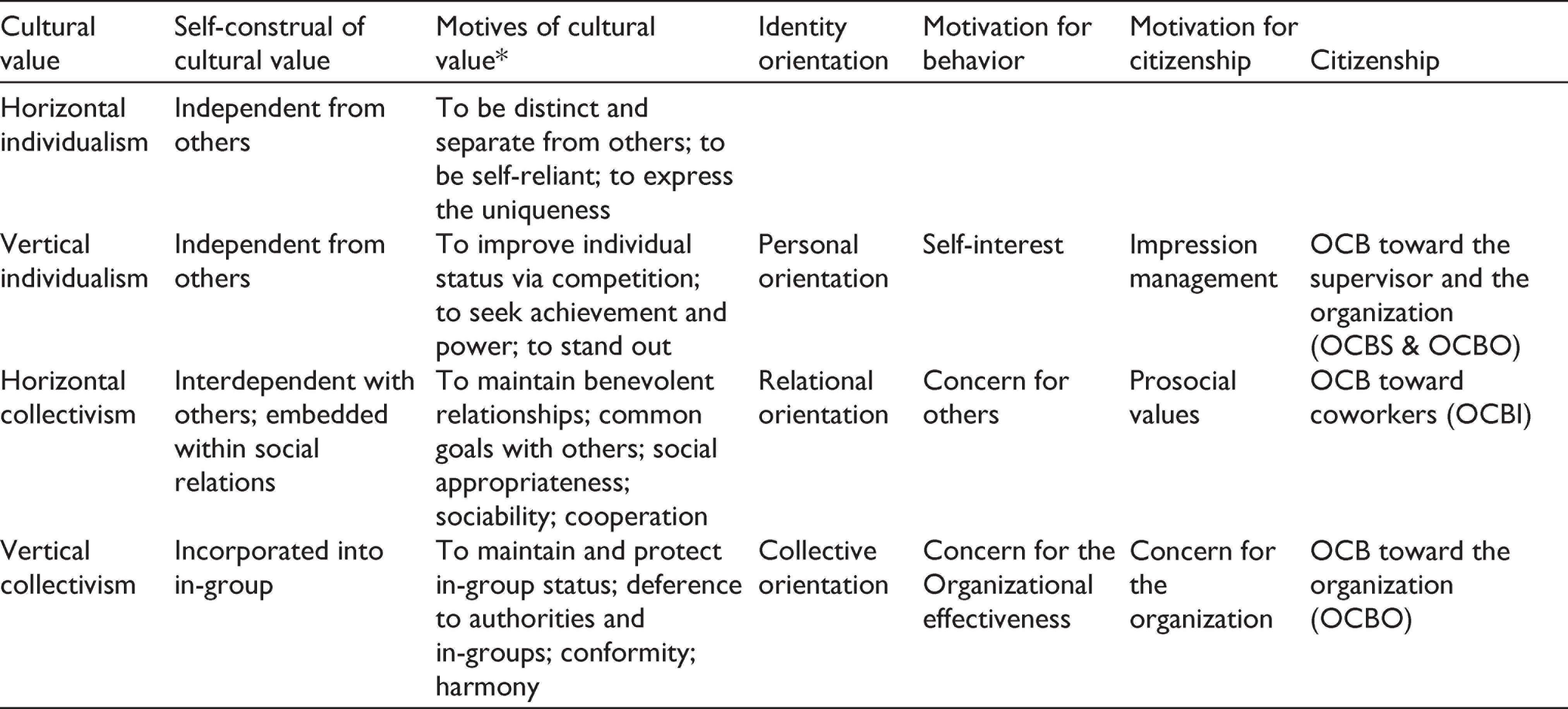
Now, we will map four cultural dimensions on the relations among identity orientations, motives for OCB and three types of OCB. Since each cultural dimension has a different identity orientation and motive for OCB as we discussed above, each of them is expected to have a different relationship with three types of OCB, including OCB toward individuals (i.e., coworkers) (OCBI), the supervisor (OCBS) and the organization (OCBO).
Horizontal Individualism
Although horizontal individualists see themselves as independent, they value equality and uniqueness but do not seek higher status (Triandis & Singelis, 1998). Therefore, HI may overlap personal identity but does not overlap any of the three motives for OCB (i.e., prosocial value, organizational concern and impression management). Regarding impression management, HI is less likely to drive individuals to have the competitive motive for OCB because the motive for career enhancement is less conspicuous to horizontal individualists (Chan & Snape, 2013). In line with this reasoning, Chan and Snape (2013) argued that there was no rationale for the relationship between HI and OCB. Thus, it logically follows that HI is not likely to have significant relationships with any of the three types of OCB. Therefore, a hypothesis regarding the relationship between HI and three types of OCB, including OCBO, OCBS and OCBI is not formulated by us in current study.
Vertical Individualism
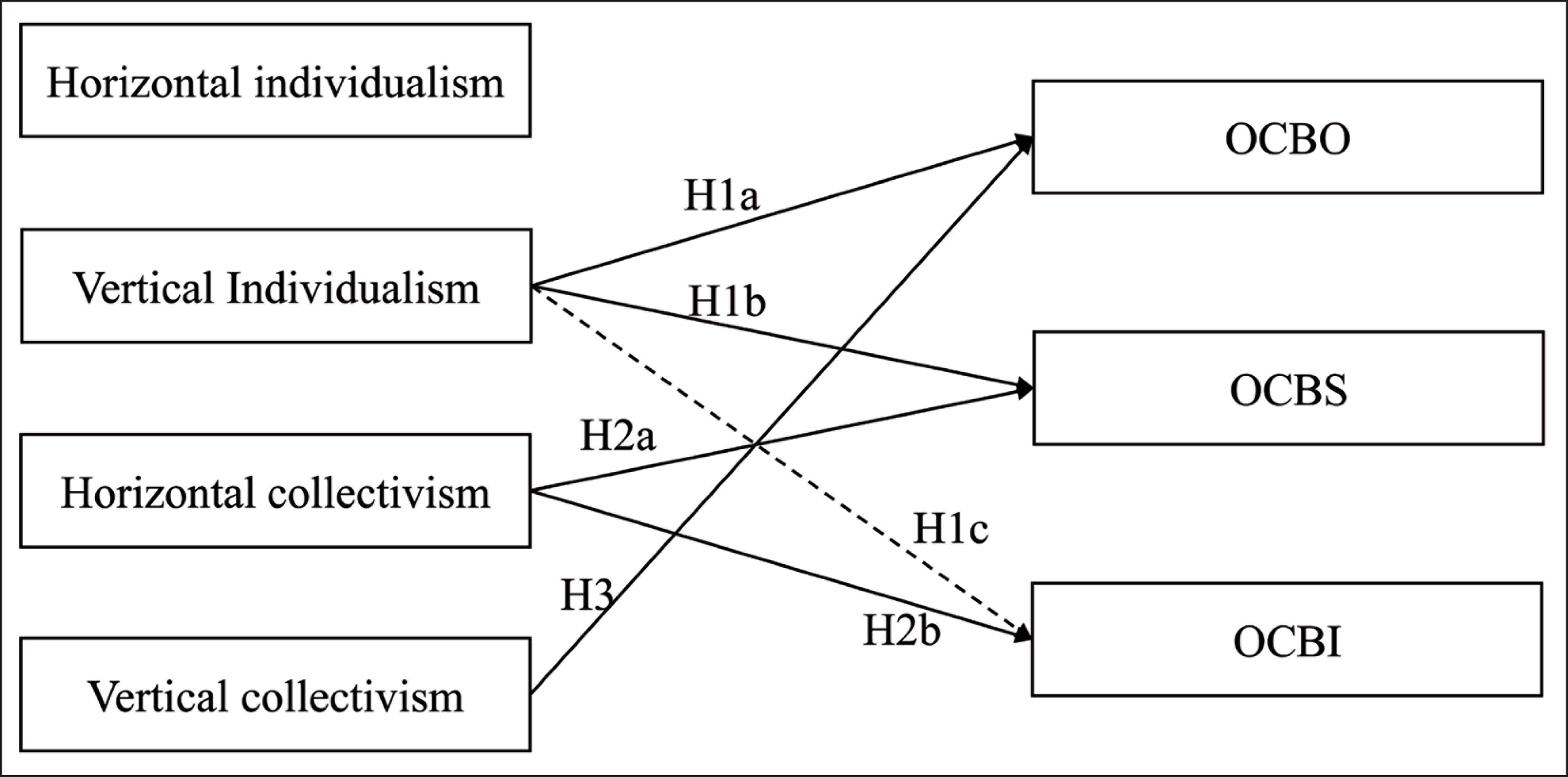
As an individualist, vertical individualists construe themselves as independent from others and are motivated primarily by self-interest (Markus & Kitayama, 1991). In addition, they tend to be individualistic careerists and pursue individual achievement and status via competition (Chan & Snape, 2013). Therefore, VI overlaps both personal orientation and impression management motives, which may enhance OCB. Additionally, VI may drive employees to engage in OCB because OCB may serve self-interest by enhancing the possibility of promotion when it is exposed to the supervisor or important others (Eastman, 1994). In other words, employees with high VI may engage in OCB out of calculative motivation (Bolino, 1999). Therefore, it follows that vertical individualists are expected to engage in OCB toward objects with power such as the organization (OCBO) and the supervisor (OCBS), but not coworkers, because the organization and the supervisor possess the power to bring them the reward such as the raise or promotion. However, regarding the relation of VI and OCBI, one competing argument is also still feasible in that vertical individualists may undertake any form of OCB, including even OCBI, as long as OCBI contributes to self-interest when it is witnessed by the supervisor. Thus,
VI has positive relationships with a) OCBO and b) OCBS. VI has positive relationships with OCBI.
Horizontal Collectivism
As collectivists, horizontal collectivistic employees tend to view themselves as interdependent with others and embed within social relations (Markus & Kitayama, 1991). Also, their behaviours are motived by sociality and cooperation (Singelis et al., 1995). Therefore, HC overlaps both relational orientation and the motive of prosocial value and, therefore, is expected to enhance OCB toward individuals, including coworkers and supervisors. Employees with HC support a collective of people rather than an organization as a demonstration of solidarity with their coworkers (Chan & Snape, 2013). Thus, it can be concluded that horizontal individualistic employees are expected to engage in OCBS and OCBI, but not OCBO
HC has positive relationships with a) OCBS and b) OCBI.
Vertical Collectivism
Vertical collectivists view themselves as incorporated into in-group and submit to the authority of the group (Markus & Kitayama, 1991). They are motivated to enhance the solidarity and status of their in-group (Triandis, 1995). Therefore, VC overlaps both collective orientation and motive of concern for the organizational effectiveness and, therefore, is expected to enhance OCB toward the organization rather than coworkers. Chan and Snape (2013) also argued that vertical collectivistic employees are likely to enhance OCB toward the organization because they subordinate their interest to that of the organization. Therefore, it can be reasonably inferred that VC is related to OCBO, not to OCBS and OCBI.
VC has positive relationships with OCBO.
Reflecting the discussion above, Table 1 summarizes the relationships among the four dimensions of individualism/collectivism, identity orientations, OCB motives and OCB.
Integration of Cultural Values, Motives for OCB, Identity Orientation and Prediction for the Type of OCB
Methodology
Participants and Procedure
We recruited 334 adults from the US, using Amazon Mechanical Turk (MTurk) for an online survey. Through the data screening process, such as attention check and examining employment status and missing data, we finally identified 156 valid samples for the current study. Of the participants, 41.82% were females, 58.18% were Caucasians, 33% were 30–35 years olds and the education level varied from high school to graduate school.
Measurement
For the measurement of four dimensions of individualism/collectivism, we used Triandis and Gelfand (1998)’s 16-item scale, in which four sets with four items assess their corresponding cultural values, including HI, VI, HC and VC. Regarding the measurement of OCBO and OCBI, we used a 16-item scale developed by Lee and Allen (2002), which is composed of eight items to measure OCBO and other eight items to measure OCBI. To measure OCBS, we used a 6-item scale which was modified from Williams and Anderson’s (1991) OCBI scale by Moeller (2016). To measure all the variables, we used a 7-point Likert scale, which was anchored at (1) strongly disagree and at (7) strongly agree. For the measurement of each OCB dimension, participants were asked to think of their behaviours in their workplace for the last 30 days and then to rate the extent to which they agreed with each statement regarding their OCB in the workplace. For the measurement of four dimensions of individualism/collectivism, participants were asked to rate to what extent they agree with the statement regarding each cultural value.
Result
Descriptive Statistics
Table 2 shows the means, standard deviations, intercorrelations and scale reliabilities. Coefficient alphas are shown on the diagonal in Table 2. We conducted a regression analysis to test our hypotheses using SPSS version 22.0. Prior to the regression test, we examined the internal consistency and dropped one item in the VI dimension and the other item in the VC dimension for further analysis because both of them had low item-to-total correlation score (score lower than 0.4) (Mohr & Spekman, 1994). In addition, since we used a cross-sectional survey design, Harman’s single-factor test (Harman, 1967) was employed to examine the common method bias. It was found that 28.09% of the total variance was explained by a common factor, which is lower than the threshold of 50%.
Means, Standard Deviations, Reliabilities and Intercorrelationsa
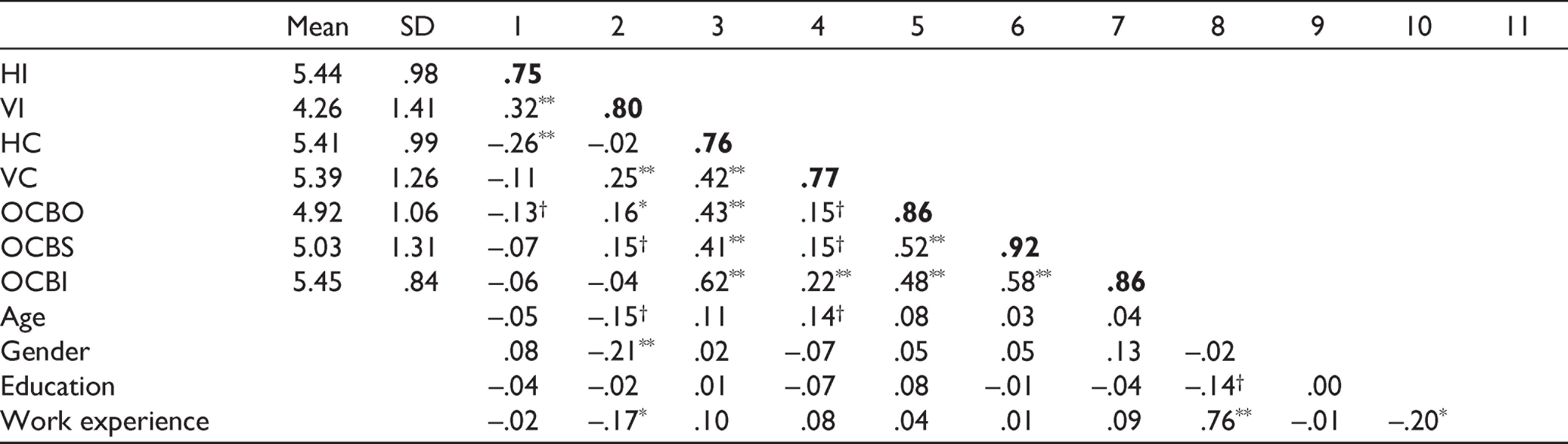
a N=156. Coefficient alphas are on the diagonal.
† p <.10; * p <.05; ** p <.01
HI: Horizontal individualism OCBO: Organizational citizenship behavior toward organization
VI: Vertical individualism OCBS: Organizational citizenship behavior toward supervisor
HC: Horizontal collectivism OCBI: Organizational citizenship behavior toward individuals
VC: Vertical collectivism
Tests of Hypotheses
During the regression analysis, we controlled for age, gender, education level and work experience. First, we tested the relationships between the 4-dimension of individualism/collectivism and OCBO. The result revealed that VI was positively related with OCBO (β = 0.27, p < 0.01), supporting H1a. Also, as we predicted, HI was not related to OCBO (β = −0.12, n.s.). However, VC was found not to be related to OCBO (β = −0.12, n.s.), rejecting H3. Also, contrary to our predictions, HC was found to be positively related to OCBO (β = 0.45, p < 0.01). Next, we tested the relationship between the 4-dimension of individualism/collectivism and OCBO. As predicted, VI (β = 0.22, p < 0.05) and HC were positively related with OCBS (β = 0.43, p < 0.01), supporting H1b and H2a. Also, as expected, HI (β = −0.05, n.s.) and VC (β = −0.09, n.s.) were not significantly related to OCBS. Finally, we tested the relationships between the 4-dimension of individualism/collectivism and OCBI. The result revealed that VI was not related to OCBI (β = 0.11, n.s.), this finding contradicted H1c, which was suggested as a competing hypothesis to the null relation between VI and OCBI. Meanwhile, HC was found to be positively related with OCBI (β = 0.66, p < 0.01), supporting H2b hypothesis.
Regression Results for the Relation Between 4-Dimension of Individualism/Collectivism and OCB
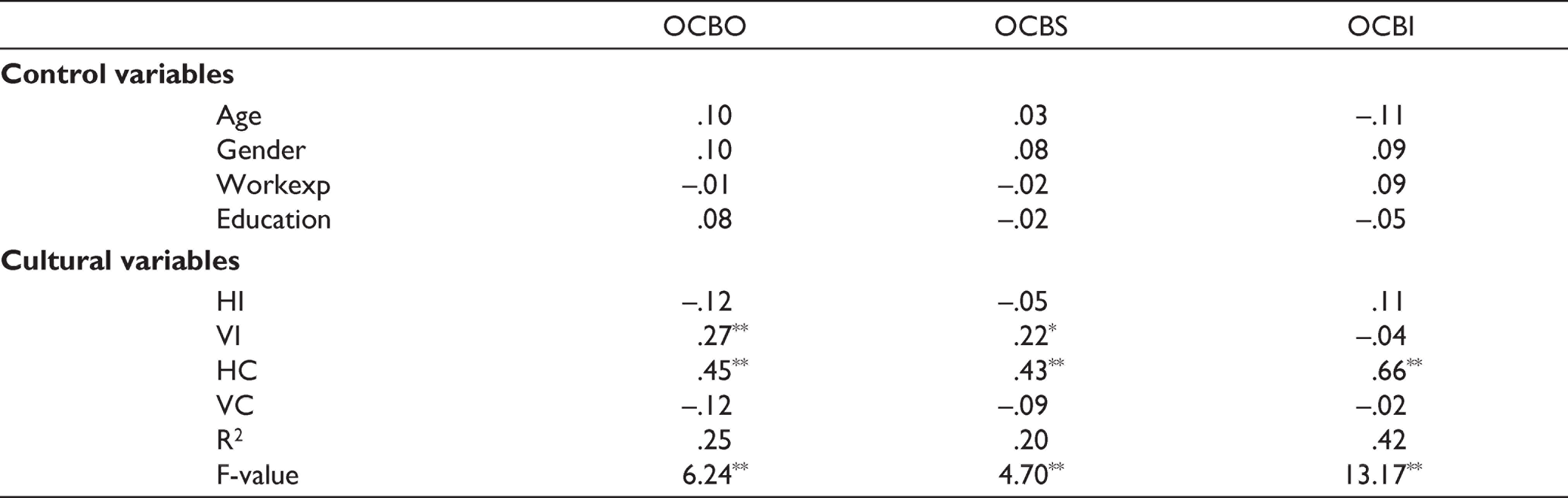
† p <.10; * p <.05; ** p <.01
HI: Horizontal individualism OCBO: Organizational citizenship behavior toward organization
VI: Vertical individualism OCBS: Organizational citizenship behavior toward supervisor
HC: Horizontal collectivism OCBI: Organizational citizenship behavior toward individuals
VC: Vertical collectivism Workexp: work experience in year
Summary of Predictions and Results
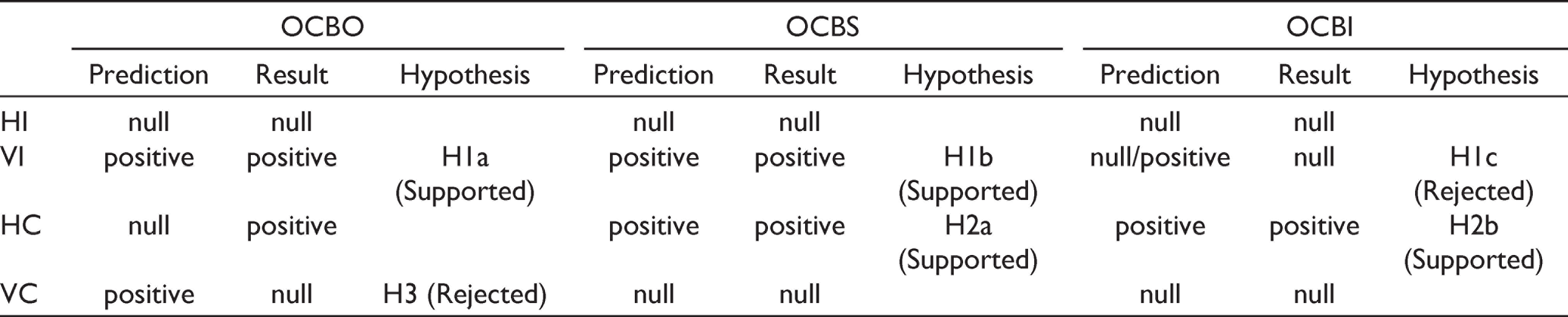
HI: Horizontal individualism OCBO: Organizational citizenship behavior toward organization
VI: Vertical individualism OCBS: Organizational citizenship behavior toward supervisor
HC: Horizontal collectivism OCBI: Organizational citizenship behavior toward individuals
VC: Vertical collectivism
Discussion
Cultural researchers have usually treated individualism/collectivism as contradictive constructs rather than complementary constructs (Chen, 2018). However, opposing such a conventional and simple approach of individualism/collectivism, we embarked on our study to propose a more refined approach of individualism/collectivism to make nuanced predictions for OCB. We proposed a nomological net for the relations between OCB and the 4-dimension of individualism/collectivism by incorporating the 4-dimension approach of individualism/collectivism with the current research development in identity orientation and motives for OCB.
Regarding the first contribution, contrary to the conventional prediction, the incorporation of the 4-dimension approach of individualism/collectivism with the proposed nomological net for individualism/collectivism-OCB relationship demonstrated that even certain type of individualists (i.e., vertical individualists) engage in OCB while the other type of individualists (i.e., horizontal individualists) showed reluctance to express OCB. Meanwhile, a certain type of collectivists (i.e., horizontal collectivists) still actively undertook OCB, but the other type of collectivists were not willing to perform OCB. Regarding the second contribution, with the incorporation of multifoci approach of OCB, the 4-dimension approach of individualism/collectivism, and the proposed nomological net, the current study demonstrated each dimension of individualism/collectivism was associated with different foci (or recipients) of OCB. Being assumed to be associated with personal orientation and the motive of impression management, VI was found to be related with OCB directed toward recipients with power (i.e., organization and supervisor) but not without power (i.e., coworkers). Specifically, it may imply that VI is likely to drive employees to engage in OCB as a means of impression management toward the organization or supervisor that has more potential to reward them. That is, employees high on VI might consider that supervisor has the power to allocate the resources (Rank et al., 2009) and evaluate employees performing OCB more favourably in overall job performance and promotability (Podsakoff et al., 2009). In contrast, VI was not related to OCB toward coworkers as a means of impression management. This finding suggested that employees with high VI cared less about coworkers because coworkers had only similar status or power, which had less potential to bring them the raise or promotion in the workplace. Meanwhile, assumed to be associated with relational orientation and the prosocial value, HC was revealed to be associated with OCB toward individuals (i.e., coworkers and supervisor). It suggests that employees high on HC appear to be driven by relational motives to enact OCBI and OCBS. Especially, a supervisor was the most interesting foci of OCB in the current study. The supervisor is different from the organization due to individuality but different from coworkers due to his/her relevance to the stronger power and authority. OCB for this unique recipient was found to be related to VI, which is motivated by impression management, and HC, which is mainly motivated by prosocial values. For HI, though we did not hypothesize any relationship between it and three types of OCB, we investigated its effect on OCB as an exploratory test. In line with the prediction based on the identity and motives for OCB, HI was not found related with any type of OCB in the current study. These contrasting effects of two different types of individualism on OCB showcased that separation of two types of individualism could predict more accurately which type of individualists would engage in any type of OCB.
However, two findings contradicted our predictions. One finding stated that HC was significantly related to OCBO. According to the theoretical prediction, employees with HC were supposed to have relational orientation, social values and more concern for others rather than the organization as an entity. Thus, they were expected to show OCB toward coworkers, not the organization, contrary to the result. Meanwhile, another result suggested that VC is not likely to drive employees to engage in any type of OCB under investigation. This result contradicted our hypothesis that employees with high VC were likely to undertake OCBO because people with collective identity orientation, which is close to VC, are more concerned about the effectiveness of the organization (Johnson et al., 2006). The unexpected relationships between two types of collectivism and OCBO appear to pose questions, which require explanations. Regarding the unexpected positive relationship between HC and OCBO, one possible explanation may be that the samples in the current study view an organization as a collective of people, not just an entity. As for the non-significant relationship between VC and OCBO, the irrelevance of the items in the VC scale might cause low predictive power toward the OCBO. Farh et al. (2007) suggested that when items in a scale for a predictor are irrelevant to the working context, the predictor may lose its predictive power toward the work-related outcome. To solve the contradictory findings, we suggest further studies to search for the potential moderators or develop a scale relevant for VC to the working context.
Practical Implication
With the trend of internationalization, both the organization and supervisor are highly likely to manage the culturally diversified workforce with different cultural values. Such a culturally diversified workforce poses a challenge in terms of workforce management. With the findings regarding the significant effect of cultural values on OCB, the current study provided the organization and the supervisor with managerial implications. One of the conspicuous findings is the significant effect of VI on OCBO. Therefore, for the organization to promote the vertical individualistic employees to engage in OCB, it needs to recognize the employees’ OCBO and enact a policy to reward the OCBO properly. Also, the supervisor needs to use the leadership for vertical individualistic employees to activate personal identity and use their impression management motives to enhance their OCB performance. The other conspicuous finding is that HC had pervasive effects on three types of OCB. Therefore, the organization can start and maintain the training programme that activates socialization and cooperation to instill collectivism in employees (Rhee et al., 2017). Also, when managing employees with high HC, the supervisor should try to activate the relational identity and use prosocial motivation to promote OCB. Also, considering that cultural values are stable and shaped in the early stage of life, the organization needs to pay attention to hiring policy as well as training policy. Since the cultural orientation of vertical and HI/HC is measurable and observable in people (Xie et al., 2006), the organization can design an interview to select job candidates with high HC (Rhee et al., 2017).
Limitation and Future Research
The current study is not free from limitations. First, although Harman’s single-factor analysis indicated that results are unlikely biased by the research method, common method variance might be an issue because the data were collected from a single source (i.e., employees). To enhance the validity of the current findings, future researchers may obtain the data from multiple sources such as supervisors and coworkers as well as employees. Also, as another limitation of the current study is that we did not measure the identity orientation and motives for OCB though we incorporated four dimensions of individualism/collectivism into the research stream regarding identity orientation and motives for OCB. Therefore, future researchers are encouraged to investigate the relationship between cultural dimensions and identity orientations. Finally, aside from individual cultural values, organizational and team culture have been considered as a crucial factor that influences employee performance. Despite several limitations, this study offers potential avenues for future research. A recent study revealed the moderating role of team cultures, such as team collectivism and individualism, on the OCB-performance association (Lai et al., 2013). It is a promising avenue for future researchers to investigate the interaction between employees’ personal values and team or organizational cultural values. For example, though VI was found to be positively related to OCBS in the current study, it remains undefined whether the individual culture of the team strengthens or weakens the association between VI and OCBS. This research question is worthy of careful study because team-based collaboration has become a central element of workplace performance.
Conclusion
Capturing the effectiveness of organizational citizenship behaviour (OCB), authors adopted the 2-dimension approach of individualism/collectivism to predict OCB in their studies on the OCB-individualism/collectivism relationship. However, given that employees undertake OCB toward different recipients in the workplace, a more refined approach of individualism/collectivism is required to predict OCB. To meet such a demand, the current study aimed to propose the 4-dimension approach of individualism/collectivism beyond the traditional 2-dimension approach of individualism/collectivism. The current study collected the data through an online survey and analysed the data using regression. The analysis found revealed that VI is related to OCB toward the organization and the supervisor but not coworkers, while HI is not related to OCB toward any of those recipients. Also, the current study found HC is related to OCB toward the organization, the supervisor, coworkers, and VC is not related to OCB toward any of those recipients. To predict the different effects of each dimension of individualism/collectivism on OCB, the current study proposed the theory-based nomological network for individualism/collectivisms-OCB relationship by incorporating cultural values with other theories including identity orientation, motives for OCB and multifoci approach of OCB.
Our approach demonstrated that vertical individualists engage in OCB horizontal individualists are still reluctant to express OCB. Meanwhile, horizontal collectivists still actively undertake OCB while vertical collectivists do not. Also, the current approach demonstrated that each dimension of individualism/collectivism was associated with different foci (or recipients) of OCB. VI was found to be related with OCB directed toward recipients with power (i.e., organization and supervisor) but not without power (i.e., coworkers). In contrast, VC was not related to OCB toward coworkers as a means of impression management. Meanwhile, HC was revealed to be associated with OCB toward individuals (i.e., coworkers and supervisors). OCB for this unique recipient was observed to be associated with VI, which is motivated by impression management, and HC, which is mainly motivated by prosocial values. For HI, it was not related to any type of OCB in the current study. These contrasting effects of two different types of individualism on OCB clearly showcased that separation of two types of individualism can predict more accurately which type of individualists will engage in what type of OCB.
Footnotes
Declaration of Conflicting Interests
The authors declared no potential conflicts of interest with respect to the research, authorship and/or publication of this article.
Funding
The authors received no financial support for the research, authorship and/or publication of this article.