



Abstract
Studies in the area of psychological empowerment have been on the rise since early 1990s. Given the large amount of information available, the researchers aim to consolidate findings, in order to arrive at a deeper understanding of the concept and its relation to job satisfaction of employees in organizations. The researchers have identified 50 studies, set in varied cultural and organizational settings. The data from these studies form the basis of the analysis in this paper. A meta-analysis of the findings of the chosen studies was conducted. This is followed by a systematic review of literature, to identify a few probable intervening variables that modify the relationship. The findings of the analysis suggest that the direct relation between psychological empowerment and job satisfaction is positive, strong and statistically significant. The study supports the validity of one of the earliest models explaining the relation. The paper establishes that the direct relation between psychological empowerment and job satisfaction is strong, positive and significant. The variations in the strength of the relationship is due to the presence of certain intervening variables like culture, age, educational qualification and experience.
Keywords
Introduction
Job satisfaction has been identified as a key determinant of the health of an organization with regards to the human resources. Studies in the area have established the importance of job satisfaction by measuring its relation with key constructs like tenure, job performance and commitment.
In recent years, psychological empowerment has begun to gain importance with the understanding that it can prove to be a source of competitive advantage in contemporary organizations. According to Kimolo (2013), psychological empowerment has been known to strongly influence employee motivation, job satisfaction and job performance. It has been established through research that psychological empowerment is a key contributor to an organization’s success. Psychological empowerment has also been shown to impact the tenure of employees by improving the levels of satisfaction and creating better work environments (Carless, 2004; Fuller et al., 1999; Patah et al., 2009). Empowered employees believe they are more efficient and effective at their jobs and have been rated as more effective, by peers and superiors (Quinn & Spreitzer, 1997). Psychological empowerment has also been found to encourage innovative behaviour and better project performance among employees (Malik et al., 2021).
The concept of psychological empowerment has been studied extensively and its impact on the level of job satisfaction has been explored in a variety of contexts. Given the large body of literature available in the area, the researchers sought to consolidating the finding of studies that have analysed the relation between psychological empowerment and job satisfaction, qualitatively and quantitatively. The article presents a meta-analysis of the results of the correlation analysis. Since these studies have been conducted in different contexts, the result would provide a more precise estimate of the relationship between the constructs than that which can be derived from any single study. This would provide a base for future studies into the constructs and also highlight the importance of psychological empowerment in the creation and retention of a satisfied workforce.
Review of Literature
Research in the field of job satisfaction has been gaining priority as organizations begin to understand that sustainable competitive advantage can only be built through its people. The focus into people practices and understanding what make people more efficient and effective is the need of any organization in any sector and any country. Although these researches are based on theories that were proposed years ago, they just go on to prove how significant and relevant they remain, even today.
Psychological Empowerment
The last 20 years have seen the emergence of the field of psychological empowerment, although the terminology may have undergone changes from researcher to researcher. Thomas and Velthouse (1990) defined it as a state of intrinsic motivation of the employee. Conger and Kanungo (1988) explained psychological empowerment as a process of increasing the employee’s feeling of self-efficacy. Spreitzer (1995) is credited with expertise in the domain and she identified psychological empowerment as a reflection of one’s personal sense of control at the workplace. According to her, this sense of control manifests into four dimensions of person–work relation, namely meaning, competence, self-determination and impact.
Meaning—According to Thomas and Velthouse (1990), meaning is the value that an employee associates with a work goal or purpose. This dimension requires that the work goal must not conflict with the personal values and beliefs of the employee in order for the employee to feel empowered in the work role.
Competence—Spreitzer (1995) explains competence as the extent to which the employee believes that they have the capability and skill to perform the job well. This is very similar to the self-efficacy concept described by Bandura. The confidence that one can perform at the job would enable the employee to perform better and feel even more empowered.
Self-determination—Spreitzer (1995) defines self-determination as the degree of freedom that the individuals believe they have while making decisions regarding their work. The level of control that the employee perceives makes the employee much more responsible about the task at hand. Self-determination is the perceived level of autonomy in work processes and level of autonomy is directly dependent on the employee perception regarding the level of control.
Impact—Impact is the level of influence that the employee perceives they have on the strategic and overall progress of the organization. However, impact is not the same as locus of control; as impact is influenced by the work context while internal locus of control is a personality characteristic that is exhibited across scenarios (Wolfe & Robertshaw, 1982). If the employee perceives that their work influences the overall progress of the organization, they are more likely to feel like they are in a position of power or control.
Researchers have also attempted to link the construct of psychological empowerment to other human resource constructs that are at play in the organizational context. Ugboro and Obeng (2000) studied organizations that had adopted total quality management. The study attempted to find the relationship between top management leadership, employee empowerment, job satisfaction and customer satisfaction. It was found that there existed a statistically significant relationship between these factors.
Bharadwaja and Tripathi (2021) also explored the construct in the Indian work context. They used structured questionnaires to collect data from 431 middle-level executives from 12 Indian organizations and found that psychological empowerment had a strong positive impact on positive work attitudes. Similarly, Suifan et al. (2020) found that psychological empowerment can help in reducing employee turnover.
Job Satisfaction
Job satisfaction has now become one of the primary indicators of employee behaviour in the organization. The level of satisfaction indicates the chances of employee displaying behaviour that would be beneficial to the organization. Lorenz and Dickson (2009) established the relation between employee job satisfaction and employee creativity, innovativeness, absenteeism and intention to leave the organization. Locke (1976) provided one of the most widely accepted definitions of job satisfaction. He defined job satisfaction as ‘an enjoyable or optimistic emotional state resulting from the assessment of one’s job or job experiences’. As is clear from the above definition, levels of satisfaction are employee perceptions. There are numerous variables that the employee perceives and experiences at the workplace and these perceptions and evaluations of the variables could then be summed in order to give the satisfaction levels of the employees. These variables that contribute to the final level of satisfaction that one experiences could vary from person to person, gender to gender and also be dependent on the life stage that one may be at. The variables as such do not vary but their relative importance has been known to vary.
A lot of studies have defined job satisfaction in different ways but the basic idea remains that it is a dimension that reflects the physical and emotional state of the employee. Herzberg (1966) suggests that the level of meaning that the job holds is a major determinant of the level of satisfaction that one would experience. According to Locke (1976), the lack of meaning and a feeling of fulfilment can be linked to dissatisfaction and apathy. Ashforth (1989, 1990) suggests that the presence of opportunities can impact the level of satisfaction that an employee experience.
Relationship Between Psychological Empowerment and Job Satisfaction
Job satisfaction was one of the earliest predicted outcomes of empowerment of employees (Spreitzer, 2007). Varma and Malhotra (2020) in their study of accountants found that the meaning, self-determination and impact significantly impacted the level of job satisfaction. Thomas and Tymon (1993) in their study established that one of the biggest and most important outcomes of psychological empowerment was job satisfaction. This was one of the first studies to represent the relation (Figure 1). Prior studies restricted to the model of the dimensions of psychological empowerment.

Hypothesis
The relation between the two constructs can be assumed basis the Range Affect Theory (Locke, 1976). This theory suggests that the level of job satisfaction is a result of the difference between what the employee wants from their job and what they perceive they receive. The researchers assume that there would always be a strong positive correlation between the variables. Herzberg (1966) has also established that a primary requirement for a satisfied employee is that they must find their work personally meaningful. Studies have also established how the level of perceived control can help employees feel positively about their work (Cordery et al., 1991).
The model suggested by Thomas and Tymon (1993) explained in the previous section and the literature reviewed provide the basis for the assumption of this study.
Methodology
The study is a secondary research which bases its findings on data that has already been presented by other researchers and scholars. The main steps involved were the identification of the studies to be included, based on the criteria for inclusion, tabulation of the data, analysis and interpretation of the result. A systematic review of literature was also done to understand the probable intervening variables that could impact the relation between the variable of psychological empowerment and job satisfaction.
Criteria for Inclusion
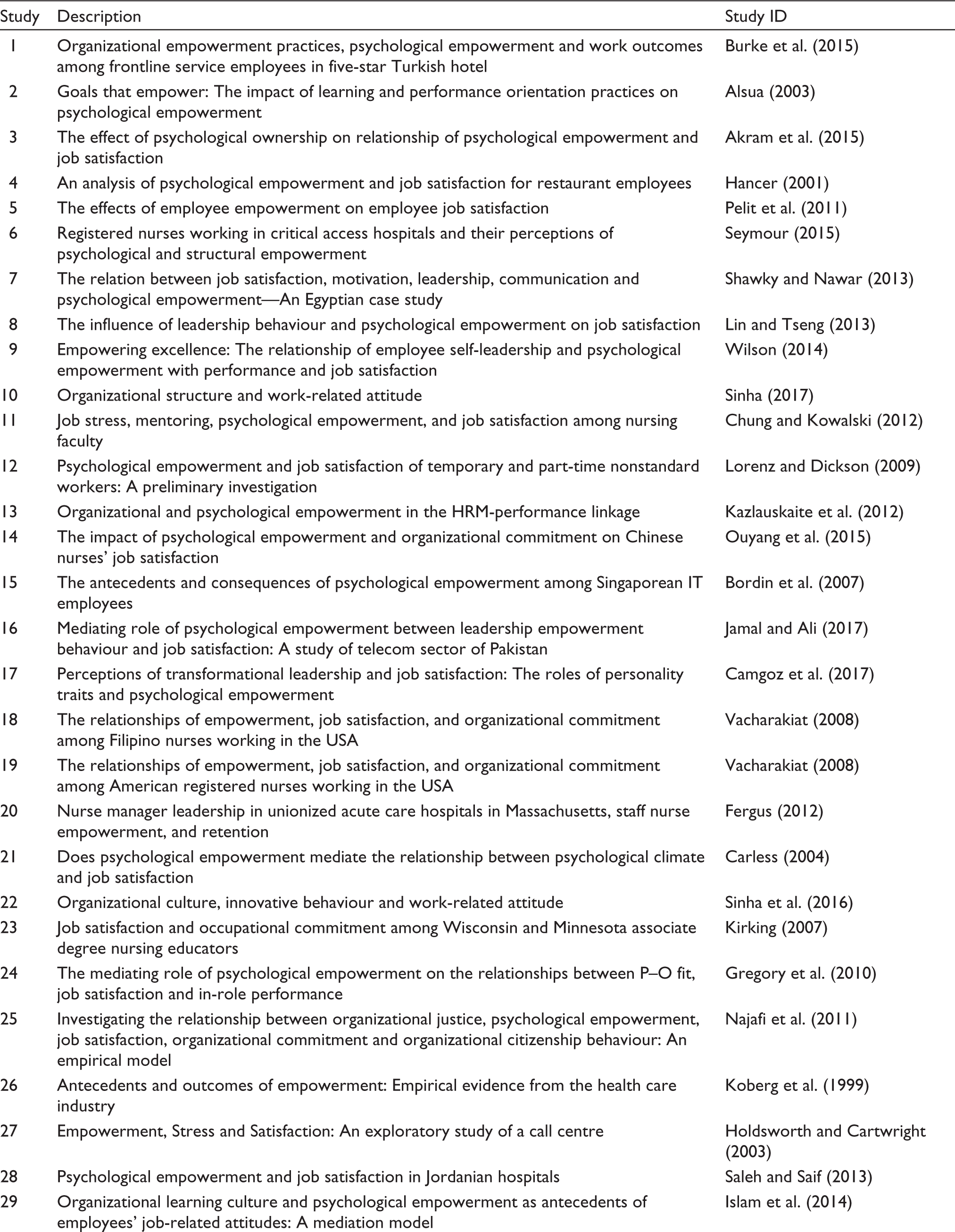
In order to be included in the study, the research had to be published in a reputed journal or by reputed universities. Articles published over the last 20 years were included in the analysis. The initial search result consisted of over 5,000 articles. However, the studies that were finally considered measured the direct relation between the variables of psychological empowerment and job satisfaction. Those that measured relations between the dimensions of psychological empowerment and job satisfaction only, were not included in the meta-analysis. The third criterion was that the articles were using the term empowerment as defined by Spreitzer (1995). Even if the terminology was slightly different but the description and measurement tool were the same, the study findings were included. Due to the presence of a large number of tools for measuring job satisfaction, no criterion was set regarding the same. However, only studies that measured job satisfaction alone, not as part of life satisfaction or any other construct, were included. All the studies that were considered were sourced from ProQuest database. Some articles were directly sourced from the authors. The final list of studies is mentioned in the ‘References’ section at the end of the article and a table of the studies and their respective IDs are mentioned in Annexure 1 (Table A.1).
Analysis
The research involved a review of literature in the domains of psychological empowerment and job satisfaction. The included studies were then tabulated along with their correlation coefficients and sample sizes. The next step involved was the conversion of the r values to Fisher’s Zr values, which adjusts for bias and returns an unbiased effect size (ES).
Conversion of the r values to Fishers Zr. This was done using the formula

The ES is then multiplied by the inverse of the variance (v) to give an inverse variance weighted unbiased ES which can then be used for calculation in the meta-analysis.
Calculation of the weights (w) to be assigned to each study was done by calculating the inverse variance

The final analysis was done using the Wilson Macros in SPSS.
Data analysis on SPSS done using the sample size, Zr and w. The results of the meta-analysis are presented in Figure 2.

The Q value suggests that as is expected, there was heterogeneity in the studies and so the Random Effects Model value has been considered. The Zr value of 0.6432 is equal to an r value of 0.57. Thus, the analysis suggests that there is a statistically significant positive correlation between psychological empowerment and job satisfaction and the r value is 0.57, P < .05 and standard error value of 0.0305.
The forest plot for the meta-analysis is shown in Figure 3. The values of the correlation coefficients of the studies that were included in the analysis range from 0.25 to 0.88. However, majority of the studies have reported correlation values between 0.4 and 0.7, implying a strong correlation.
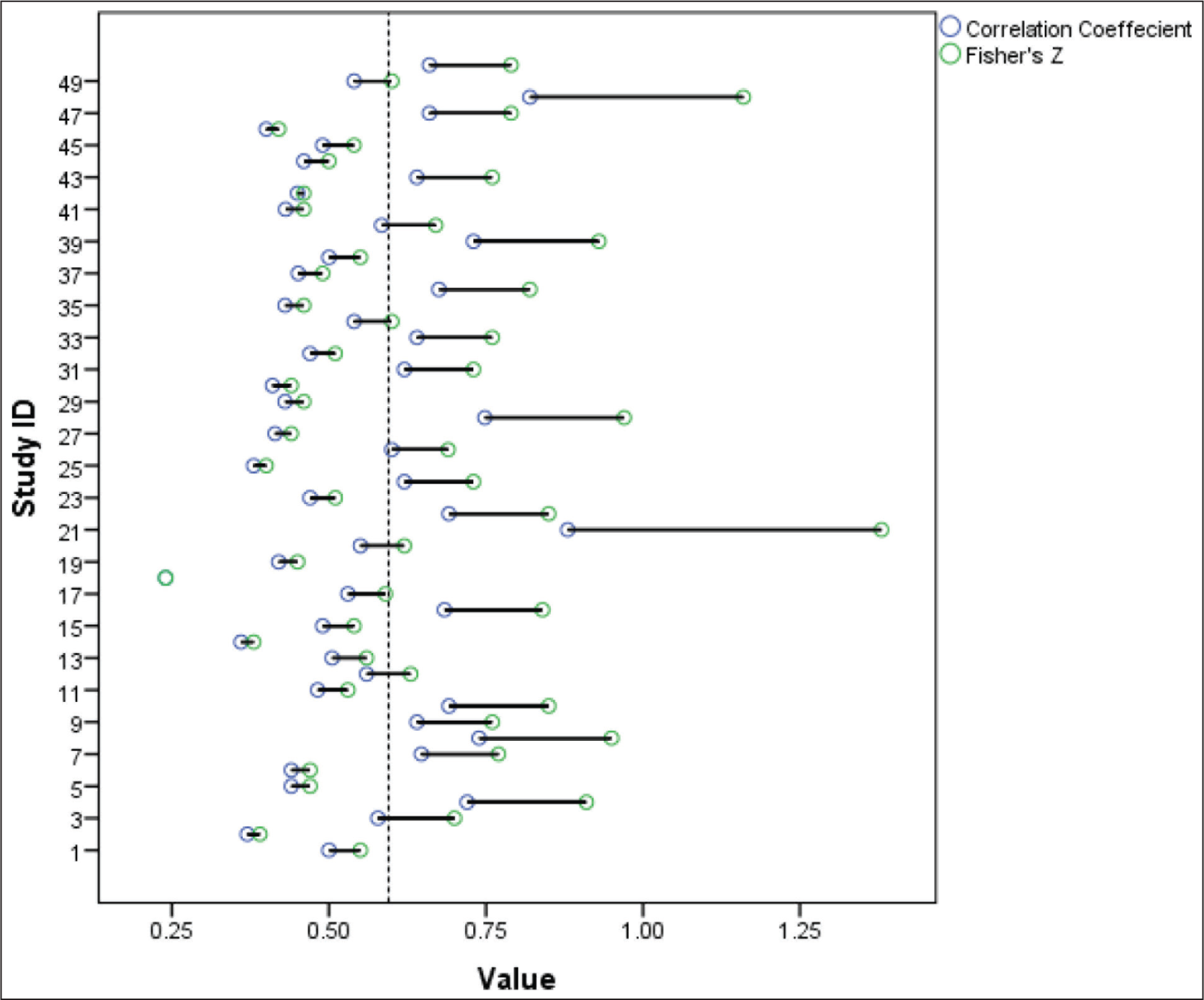
The analysis reveals that there is a strong positive correlation between the constructs of psychological empowerment and job satisfaction. Thus, the hypothesis was accepted.
Discussion
The results of the analysis led us to accept the hypothesis regarding the relationship between psychological empowerment and job satisfaction. The correlation values of 0.57 imply a strong positive correlation between the constructs and is consistent with the works of Thomas and Tymon (1993), who proposed the relationship in their theoretical model. Our study establishes that the model is currently relevant and that in today’s workplace, the construct of psychological empowerment can explain as much as 32% of the variance in job satisfaction levels of the employees.
Given the growing importance of job satisfaction as an indicator of the expected behaviour of the employees, the related constructs that can impact job satisfaction need to be clearly identified and evaluated for their relation with job satisfaction (Lorenz & Dickson, 2009). As the number of women entering the workforce increases, the focus shifts to understanding the softer aspects of employment and how they would impact employee behaviour in the organization (Clark, 1997). Psychological empowerment is one such key factor and the current study establishes its importance in understanding and predicting the levels of job satisfaction of employees. The current study used meta-analysis to consolidate the findings of researchers in different settings and establishes that the theoretical model is still valid.
The second objective of the study was to identify certain variables that could intervene and thereby strengthen or weaken this relationship. These intervening variables were identified purely through a systematic review of literature and no statistical analysis was done to establish their relevance.
The cultural setting of the organization has been studied as a possible intervening variable. Studies have analysed the correlation between psychological empowerment and job satisfaction in different ethnic or cultural groups and it was found that the collectivist or individualistic dimension of the ethnic group moderated the relation between psychological empowerment and job satisfaction (Hui et al., 2004). Studies also showed that as the collectivist nature increased the impact of psychological empowerment, specifically the dimensions of self-determination and impact on job satisfaction also increased (Fock et al., 2011). The dimension of power distance was also shown to moderate the relation. The power distance has been revealed to influence the level of psychological empowerment through the provision of discretionary power. In high power distance cultures, the provision of discretionary power has been shown to confuse the employee and create a sense of incompetence and this reduces the feeling of empowerment and job satisfaction. Thus, the relative importance of psychological empowerment varies from culture to culture, thereby influencing the level of impact it would have on the job satisfaction levels of the employees.
Another important set of variables that was shown to intervene was the demographic variables. An analysis of demographic variables suggested that age, educational qualifications and experience could influence the level of perceived psychological empowerment and job satisfaction (Spence et al., 2016). This was mainly due to the relative importance and expectation of empowerment changing. As employees grew more experienced, their expectations were found to reduce and the relative importance of psychological empowerment seemed to reduce (Ouyanga et al., 2015). In the case of educational qualifications, the relationship was reverse. Studies suggest that the more qualified one was, the more they expected to have the freedom of deciding what to do and how. In fact, the level of perceived psychological empowerment was actually found to mediate the relation between over qualification and job satisfaction (Erdogan & Bauer, 2009; Khan & Morrow, 1991). Maan et al. (2020) also found that the impact of psychological empowerment on job satisfaction was moderated by level of proactiveness that the employee displayed. Al-Ababneh et al. (2017) studied the relationship in the context of Hotels in Jordan and found that psychological empowerment had a stronger impact on job satisfaction when combined with structural empowerment.
The level of job satisfaction is a result of an analysis done by the employee regarding their job. A number of factors are considered in that analysis and psychological empowerment is only one such factor. The purpose of this study was to consolidate the literature on this relation and provide a base for further research to be conducted.
Future studies must understand that the workforce in today’s organization is different from the traditional setting. Would the theoretically established relationships still hold well in the current work environments, which consist of employees of varying backgrounds and an increasing number of women who have different expectations from their job as compared to their male counterparts?
Conclusion
Organizations are constantly evolving with time. This creates a need to understand the changing needs and demands of the corporate employees. For any organization, the key challenge is the attraction and retention of the right talent. Retention of the right talent implies creation of a mutually beneficial relation between the employee and organization. While the traditional benefits of compensation and benefits still hold importance, the current talent pool expects and demands much more. The current study conducted meta-analysis on the relationship between psychological empowerment and job satisfaction. The study is based on the theoretical model proposed by Thomas and Tymon (1993). The findings of the meta-analysis supports the model and suggest that there is a strong positive correlation between the level of psychological empowerment perceived and the level of satisfaction experienced at the job. This implies that the more empowered the employee feels, the more the chances of them being satisfied with their job and lesser the possibility of them leaving.
However, the relation is modified by the presence of a large number of variables. These intervening variables include culture, age, experience and educational qualification. This identification was possible through a systematic review of literature and further research into the variables would be required to understand the extent to which they influence the relation. In addition, there is a need to identify and evaluate other variables to understand any further mediating or moderating impact they might have on this relation.
Footnotes
Declaration of Conflicting Interests
The authors declared no potential conflicts of interest with respect to the research, authorship and/or publication of this article.
Funding
The authors received no financial support for the research, authorship and/or publication of this article.
Appendix
Studies Included in the Analysis

| Study | Description | Study ID |
| 1 | Organizational empowerment practices, psychological empowerment and work outcomes among frontline service employees in five-star Turkish hotel | Burke et al. (2015) |
| 2 | Goals that empower: The impact of learning and performance orientation practices on psychological empowerment | Alsua (2003) |
| 3 | The effect of psychological ownership on relationship of psychological empowerment and job satisfaction | Akram et al. (2015) |
| 4 | An analysis of psychological empowerment and job satisfaction for restaurant employees | Hancer (2001) |
| 5 | The effects of employee empowerment on employee job satisfaction | Pelit et al. (2011) |
| 6 | Registered nurses working in critical access hospitals and their perceptions of psychological and structural empowerment | Seymour (2015) |
| 7 | The relation between job satisfaction, motivation, leadership, communication and psychological empowerment—An Egyptian case study | Shawky and Nawar (2013) |
| 8 | The influence of leadership behaviour and psychological empowerment on job satisfaction | Lin and Tseng (2013) |
| 9 | Empowering excellence: The relationship of employee self-leadership and psychological empowerment with performance and job satisfaction | Wilson (2014) |
| 10 | Organizational structure and work-related attitude | Sinha (2017) |
| 11 | Job stress, mentoring, psychological empowerment, and job satisfaction among nursing faculty | Chung and Kowalski (2012) |
| 12 | Psychological empowerment and job satisfaction of temporary and part-time nonstandard workers: A preliminary investigation | Lorenz and Dickson (2009) |
| 13 | Organizational and psychological empowerment in the HRM-performance linkage | Kazlauskaite et al. (2012) |
| 14 | The impact of psychological empowerment and organizational commitment on Chinese nurses’ job satisfaction | Ouyang et al. (2015) |
| 15 | The antecedents and consequences of psychological empowerment among Singaporean IT employees | Bordin et al. (2007) |
| 16 | Mediating role of psychological empowerment between leadership empowerment behaviour and job satisfaction: A study of telecom sector of Pakistan | Jamal and Ali (2017) |
| 17 | Perceptions of transformational leadership and job satisfaction: The roles of personality traits and psychological empowerment | Camgoz et al. (2017) |
| 18 | The relationships of empowerment, job satisfaction, and organizational commitment among Filipino nurses working in the USA | Vacharakiat (2008) |
| 19 | The relationships of empowerment, job satisfaction, and organizational commitment among American registered nurses working in the USA | Vacharakiat (2008) |
| 20 | Nurse manager leadership in unionized acute care hospitals in Massachusetts, staff nurse empowerment, and retention | Fergus (2012) |
| 21 | Does psychological empowerment mediate the relationship between psychological climate and job satisfaction | Carless (2004) |
| 22 | Organizational culture, innovative behaviour and work-related attitude | Sinha et al. (2016) |
| 23 | Job satisfaction and occupational commitment among Wisconsin and Minnesota associate degree nursing educators | Kirking (2007) |
| 24 | The mediating role of psychological empowerment on the relationships between P–O fit, job satisfaction and in-role performance | Gregory et al. (2010) |
| 25 | Investigating the relationship between organizational justice, psychological empowerment, job satisfaction, organizational commitment and organizational citizenship behaviour: An empirical model | Najafi et al. (2011) |
| 26 | Antecedents and outcomes of empowerment: Empirical evidence from the health care industry | Koberg et al. (1999) |
| 27 | Empowerment, Stress and Satisfaction: An exploratory study of a call centre | Holdsworth and Cartwright (2003) |
| 28 | Psychological empowerment and job satisfaction in Jordanian hospitals | Saleh and Saif (2013) |
| 29 | Organizational learning culture and psychological empowerment as antecedents of employees’ job-related attitudes: A mediation model | Islam et al. (2014) |
| 30 | Mediating effect of job satisfaction in the relationship between psychological empowerment and job performance | Olcer and Florescu (2015) |
| 31 | The impact of frontline employee empowerment on service quality in the Jordanian restaurant industry | Odeh (2008) |
| 32 | The relationship of empowerment and selected personality characteristics to nursing job satisfaction | Manojlovich and Laschinger (2002) |
| 33 | A multi-level exploration of empowerment mediators | Ritter et al. (2014) |
| 34 | Taking empowerment to the next level: A multiple-level model of empowerment, performance and satisfaction | Seibert et al. (2004) |
| 35 | Perceived overqualification and its outcomes: The moderating role of empowerment | Bauer (2009) |
| 36 | The impact of psychological empowerment and job satisfaction on organizational commitment amongst employees in a multi-national organization | Theron (2010) |
| 37 | The effects of psychological empowerment on job satisfaction and job performance of tourist guides | Tetik (2016) |
| 38 | Psychological empowerment, job satisfaction and performance among Filipino service workers | Hechanova et al. (2006) |
| 39 | Psychological empowerment and job satisfaction of employees in a petrochemical industry | Hlalele (2005) |
| 40 | Employee empowerment and job satisfaction: An empirical study in IT industry | Rana and Singh (2016) |
| 41 | An examination of the mediating role of job satisfaction on the relationship between psychological empowerment and innovative behaviour | Cingoz and Kaplan (2015) |
| 42 | The moderating effect of collectivistic orientation in psychological empowerment and job satisfaction relationship | Focka et al. (2011) |
| 43 | The influence of psychological empowerment on overall job satisfaction of front office receptionists | Patah et al. (2009) |
| 44 | The impact of political skills on job outcomes: Moderating role of psychological empowerment | Khan and Akhtar (2018) |
| 45 | Investigating the effects of employee empowerment on job satisfaction and performance: A case study of front office employees in Egyptian hotels. (3 star) | Ibrahim et al. (2016) |
| 46 | Investigating the effects of employee empowerment on job satisfaction and performance: A case study of front office employees in Egyptian hotels. (5 star) | Ibrahim et al. (2016) |
| 47 | The relationship between psychological empowerment and creative performance of employees: Mediating effect of job satisfaction in international non-governmental organizations | Ayoub et al. (2018) |
| 48 | Empowerment effects and employee job satisfaction | Abraiz et al. (2018) |
| 49 | Linking empowering leadership to job satisfaction, work effort and creativity: The role of self-leadership and psychological empowerment (Study 1) | Amundsen and Martinsen (2015) |
| 50 | Linking empowering leadership to job satisfaction, work effort and creativity: The role of self-leadership and psychological empowerment (Study 2) | Amundsen and Martinsen (2015) |