



Abstract
The current unique business scenario has brought in the increased overlap between work and nonwork boundaries. This situation has prompted psychologists and social scientists to focus on how the work and nonwork boundaries (WNWB) is constructed and sustained. The purpose of the study is to examine the relationship between how Boundary strengths at home (BSH) and work (BSW) influence performance among academicians using structural equation modeling (SEM).The sample for the study was selected from among full-time university educators from Jordan. Data was collected from 161 full-time faculty from Jordan using the convenience sampling method. Then, using R, SEM was performed on the collected data to test the tenability of the formulated hypotheses. Results suggest that boundary strength at work and home, and overall work-nonwork boundary had a significant positive relationship with the work performance of faculty. The findings are significant and are an addition to the literature on boundary studies.
Keywords
Introduction
Working life the world over is in flux due to multiple reasons. Some of them include rapid volatility, uncertainty, and the current global pandemic. This state of affairs has prompted psychologists and social scientists to evince a keen interest in how the work and non-work boundaries (WNWB) are constructed and sustained. There exist different and unique boundary management styles. These styles are techniques engaged by employees to separate work, family, and non-work roles (Kossek & Lautsch, 2012). Cardinal to boundary management is the awareness that boundaries are constructed individually and collectively (Mellner et al., 2014). Furthermore, research evidence shows that boundary management is characterized by permeability, flexibility, and unique preferences (Bulger et al., 2007; Matthews, 2014; Matthews et al., 2010; Sulphey & Faisal, 2020; Winkel & Clayton, 2010). According to Ashforth et al. (2000), a boundary is ‘the physical, temporal, emotional, cognitive, and/or relational limits that define entities as separate from one another.’ Individuals construct psychological and behavioural boundaries to facilitate the seamless organization of their work and life spheres (Clark, 2000; Gardner et al., 2021; Kossek et al., 2012). These boundaries can be presented on a continuum based on employee preferences. The preference could be for either a strong or a permeable boundary between work and non-work. Many individuals strive to separate work and family life by instituting two distinct segments. Others are amiable in integrating the two domains (work and personal life). Thus, the permeability of the boundary between work and private life is based on the strength or weakness of the boundaries between the two domains (Mellner et al., 2014). Clark (2000) opined that the fringe between the two domains is the space where the individual indulges in balancing the conflicting demands and expectations and involve in boundary work/management (Gardner et al., 2021; Hattrup et al., 2005).
Boundary management is a set of strategies that individuals use to deal with the demands and expectations in home and work domains (Kossek & Lautsch, 2012; Kossek et al., 1999). The strategy could be either integration or segmentation (Matthews et al., 2010). Those who prefer a high level of overlap between the two domains are integrators, and those individuals who prefer to maintain a distinction between work and family are known as segmenters. The term separator is also used interchangeably for segmenters (Mellner et al., 2014). Some social scientists have proposed other typologies—the alternator (Kossek & Lautsch, 2012; Kreiner, 2006). Alternators use multiple behavioural strategies to oscillate between integration and segmentation (Kreiner, 2006). Whether an individual is an integrator, segmentation, or an alternator is based primarily on multiple aspects. Some of them include role centrality, personality, gender, and family demands like the presence of parents and young children in the household, and the like (Kossek & Lautsch, 2012; Kossek et al., 1999).
Multiple psychosocial factors provide goal clarity and frames of reference for assignments at work and actual performance. The psychosocial factors are the external boundaries at the workplace in the otherwise boundaryless area. These external boundaries could facilitate the separation of work and personal life, aiding in boundary control (Piszczek & Berg, 2014). For boundary management and control, individual capability and self-regulation capacity are definite and vital aspects. Towards this, an individual needs to have the capacity to organize the work efficiently, assess the completion of a work assignment, their capability to perform tasks independently, set limits at the workplace, and master the art of saying no (Mellner et al., 2014). All these skills denote an individual’s ability to set the boundary and efficient control. Further, an individual’s capacity to self-regulate denotes his competence to preserve the boundary in his work context. This calls for qualities like flexibility and permeability for the boundaries between work and private life. Based on these discussions and a fair review of the literature (Allen et al., 2021; Ashforth et al., 2000; Gardner et al., 2021; Kossek et al., 2011; Rudolph et al., 2021), it could be considered that WNWB and work performance are related.
There are marked differences between WNWB and work-life balance (WLB). Extant literature shows that WNWB precedes WLB and could predict it (Chen et al., 2009; Kossek, 2016; Ming et al., 2021). WLB, according to Izak et al. (2022), is the favourable outcome of increased autonomy and flexibility associated with the boundary management fit of employees. WNWB explains how people draw lines between their personal and professional lives to create WLB. For instance, Nippert-Eng (1996a) and Kreiner et al. (2009) identified WNWB management as an individual-level effort to control and manage boundaries, which can predict an individual’s work-life balance (WLB) and well-being. Higher levels of WNWB or a well-defined boundary, according to Ming et al. (2021), could defend people from work–life conflicts. Chen et al. (2009) found that individuals having flexible WNWB management could have higher and better work–life balance. Thus, effective managers of WNWB can take care of their needs and resources, reduce burnout, and mood disorders, prevent conflicts in work and personal life, and enhance mental and physical health (Demerouti et al., 2001; Kossek, 2016). In general, they have better WLB.
Several WNWB management factors help achieve WLB. They include organizational support, working environment, autonomy, employee attitude, and the like. Carlson and Perrewé (1999) and Rothbard et al. (2005) identified organizational support to help reduce work and non-work conflict and consequent boundary management. Studies by Kreiner (2006), Lapierre and Allen (2006), and Thompson et al. (1999) found that a conducive workplace environment helps individuals care for their family members and those surrounding them, reducing work-family conflict. Better WLB would be made possible by autonomy to manage WNWB since it would make the workplace more rewarding and less hostile (Clark, 2000). Finally, effective WNWB management fosters a positive work environment that enhances performance (Michel et al., 2011).
However, only scant literature exists about boundary management in general and WNWB in particular. Moreover, prior studies have not yet established the performance benefits of integrating work and non-work responsibilities. Proper boundary management could help maintain a harmonious work-life balance (Ming et al., 2021). Furthermore, a fair review failed to identify literature about WNWB outside the western world. In addition, no study has attempted to identify the relationship between WNWB and work performance. Therefore, the present study intends to fill this gap in the literature. Thus, the study aims to determine the relationship between WNWB and performance. The research questions addressed in the study include—what is the relationship between BSH and BSH and WNWB, and how do they impact WP? Further, what is the impact of CP and TP on WP?
Literature Review
The separation of work and non-work as distinct domains with a boundary was first proposed by Lewin (1951) and reinforced by Kanter (1977). After that, multiple linkage models were proposed by social scientists and management experts. Some include segmentation–integration, spillover, compensation, resource drain, and the like (Edwards & Rothbard, 2000; Voydanoff, 2002).
Theoretical Underpinnings
Boundary theory has evolved from cognitive sociology and is used extensively in organizational behaviour (OB) and human resource management (HRM). The theory evolved from multiple pieces of research conducted about the employees’ cognitive organization of roles. The theory was later influenced by the seminal work of Zerubavel (1993, 1996), who suggested that individuals engage in heuristics to organize mental and physical constructs. According to this theory, individuals habitually lump constructs together into a single mental category or split them into separate categories. According to Zerubavel (1993, 1996), individuals often create ‘mental islands’ with meanings derived from discrete masses of reality adapted from society. These ‘islands’ are derived from the subconscious cognitive construction of the individual, or in other sense, the inconsistent yet complementary cognitive process of lumping and splitting (Zerubavel, 1996). The theory further postulates that individuals idiosyncratically construct, consistently maintain, and transition such boundaries to simplify their environment (Ashforth et al., 2000; Nippert-Eng, 1996b). These boundaries could be thick (also known as strong) or thin (also referred to as weak), which can be placed along a continuum. When a boundary is permeable, it is referred to as thin. Those boundaries that are closed to the individuals’ influence or segmented are termed thick (Ashforth et al., 2000; Kreiner, 2006).
The evidence suggests that boundary theory literature has grown slowly (Piszczek & Berg, 2014). Most studies focused on individual-level outcomes and sporadically on organization-level outcomes. Though some studies identified the requirement of environmental and institutional forces in boundary management, the implications on the performance of individuals and organizations have not been explained (Ashforth et al., 2000; Clark, 2000; Piszczek & Berg, 2014). Further, boundary management preferences are based on individual desires to manage them (Gardner et al., 2021).
Hypothesis Development
Nippert-Eng (1996a) first applied boundary management to the work−family interface. The study proposed segmentation and integration of work and home cognitive categorizations into a single theoretical continuum. However, there are wide variations and overlaps in the degree of mental classifications of work and family domains. According to Nippert-Eng (1996a), while negotiating the concept of boundary, individuals tend to be more active when involved in mental lumping and splitting of roles, which is often subconscious. This has become the fundamental underpinning of individual-level boundary management research. Thus, mental classification is not merely a heuristic mechanism but is often a conscious, strategic, and purposive choice where individuals actively manage conflicting roles by intelligently adjusting and navigating the different boundaries between the various roles.
The boundary strength discussed in the present article is associated closely with the segmentation–integration model. Although various characteristics of the segmentation–integration continuum are discussed in the literature, permeability seems to be the common factor shared in all the conceptualizations. Based on this model, multiple studies have been done highlighting its relation with variables like permeability (Ashforth et al., 2000; Bulger et al., 2007; Olson-Buchanan & Boswell, 2006), flexibility (Bulger et al., 2007); role contrast (Ashforth et al., 2000) and role referencing (Olson-Buchanan & Boswell, 2006). The model postulates that work and non-work are separated from or intertwined with one another in a continuum.
Relationship between Boundary Strength at Home and Work Performance
According to Hecht and Allen (2009), boundary strength has two dimensions: integrating work into home and home into work. Evidence suggests that the boundaries are bi-dimensional (Bulger et al., 2007; Hecht & Allen, 2009; Olson-Buchanan & Boswell, 2006; Wepfer et al., 2018). Hecht and Allen (2009) found that work permeates non-work lives rather than the other way (non-work lives permeating work). Further, those who are highly involved with work are inclined to have weak home boundaries. Likewise, those individuals who are highly involved in their personal lives are likely to have stronger home boundaries. Recently a few studies have emerged examining the effect of boundary management while working from home due to COVID-19 (Allen et al., 2021; Andrade & Fernandes, 2021; Irawanto et al., 2021). For example, Allen et al. (2021) found that if there is dedicated office space at home, there are higher levels of WNWB. Based on this, H1 is formulated as under:
Relationship between Boundary Strength at Work and Work Performance
It is challenging for individuals to adapt to the highly volatile and uncertain workplace demands in the current business world. Gardner et al. (2021) found that individuals with less structured work environments in their organizations are likely to perceive higher work boundary control. In addition, Thompson and Prottas (2006) observed job autonomy to be positively associated with life control. Further, fewer household members also had a relationship with WNWB. Thus, it is most likely that individuals could have better control over home boundaries than at work. This is because work boundaries are influenced by various organizational factors, with a minimal role in individual characteristics. Therefore, organizational factors can influence boundary management, and those who can elicit higher levels of organizational support could bring in a better WNWB management fit (Carlson & Perrewé, 1999; Rothbard et al., 2005). Furthermore, healthy working life helps individuals to effectively balance their families and work domains (Rashmi & Kataria, 2021; Russell & Bowman, 2000).
A good working environment that fits with an individual’s WNWB management would result in overall job satisfaction, excellent organizational commitment levels, and improved mental health (Kreiner, 2006). According to Cable and Edwards (2004), proper WNWB management indicates an individual’s positive attitudes and behaviour in the workplace, which could result in well-being. A strong WNWB fit might also support a positive work ethic and enhance job performance (Michel et al., 2011). A recent study by Ming et al. (2021) identified that the boundary management level could predict an individual’s workplace well-being and consequent performance. Thus the next hypothesis is formulated as under:
Relationship between Work-nonwork Boundary Strength and Work Performance
Despite current border erosion and a heightened sensation of liquidity, there is a threshold or boundary that divides them in some way (Izak et al., 2022). In a recent study, Gardner et al. (2021) examined how individuals manage boundaries across various roles. They found that a few job characteristics had relationships with cross-role interruptions. Hattrup et al. (2005) observed that the variables like conscientiousness and locus of control could positively connect with the perceptions of boundary control. Similarly, individual characteristics influence home boundary strength more than work boundary strength (Hecht & Allen, 2009). Gardner et al. (2021) suggest that boundary strength is strongly associated with the work situation. Therefore, effective WNWB management could foster a conducive work environment that enhances organizational performance (Michel et al., 2011). However, not many studies have examined the relationship between boundary strength and work performance. Thus, based on a fair literature review and identification of the gaps, the present study intends to examine this aspect, and hence it is hypothesized that:
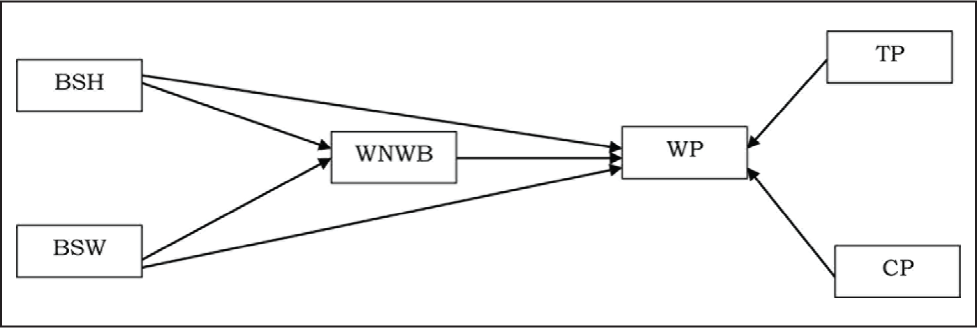
Further, based on the objective of the study and reviewed literature, the following measurement model is constructed to be empirically tested (Figure 1).
Methodology
Data Collection Tools
Data for the study was collected using validated and generalized structured questionnaires. In addition, other demographic details were also collected. The details of the scales used to collect the data for the study are now presented.
In addition, demographic details of the respondents such as age, gender, experience, and qualifications. The study used Google docs to collect data.
Data Collection
Data for the study were collected online from 161 respondents from among gainfully employed business faculty members from different universities/colleges in Jordan. A few heads of the departments were identified from across the country, and the questionnaire link was posted to them, requesting them to help collect the required data from among their subordinates. The questionnaire also added a personal appeal, requesting their responses to the link. Confidentiality was assured to all the respondents for their responses. Since all the items were made compulsory, there were no missing data, and all the received responses could be used for analysis.
The demographics of the collected data show that there is enough diversity among the respondents. There were 126 males and 35 females. The respondents’ experience ranged from less than a year to 45 years, with the average years of experience being 16.42 years. While 77 respondents were Master’s degree holders, 84 were doctorates. Based on this diversity of the respondents, data representativeness is assumed.
Given that this study’s data were gathered using self-reporting, common method bias (CMB) could affect the findings (Podsakoff & Organ, 1986; Podsakoff et al., 2003). Therefore, the study used a rigorous statistical methodology to confirm the study’s validity and reliability to lower the risk. A few actions were taken to check the survey directed at CMB. First, the scales used for the study were carefully identified from the body of existing literature. Next, the responses were anonymous, as no identifying questions were elicited. Third, items in the questionnaire were shuffled so that the respondents could not segregate them based on the variables used. Finally, Harman’s single test was performed to determine whether one single factor accounts for most of the variance in the data, as Podsakoff and Organ (1986) proposed. The examination outcome revealed seven factors with an eigenvalue of more than one, accounting for 66.991% of the total variance. The first factor accounted for 19.002% of the variance, the second-factor was 12.913%, and the third-factor 11.419%. Since no single factor accounted for a high level of variance, CMB is not an issue in this study (Teo & Noyes, 2008).
Data Analysis
The collected data were analyzed using structural equation modelling (SEM) using Python (Wold et al., 1984). SEM can be considered to be an extension of FA and multiple regressions. SEM is an effective tool to test theories that involve multiple equations and their relationships and interdependence of the study variables (Hair et al., 2010). There are multiple SEM statistical packages, and the most popular among them include Mplus, EQS, AMOS, LISREL, a few packages in R programming, and Semopy. Each has its advantages and limitations. More importantly, most of them are not open-source. On the other hand, Semopy, written in Python, is a versatile, free, and open-source package. In addition, it has other advantages like having user-friendly syntax, simultaneous assessment of multiple statistics and fit indices, estimation of model parameters employing multiple objective functions, and possession of a vast number of settings to fit a researcher’s requirements (Igolkina & Meshcheryakov, 2020), which is why the current study used this package. Furthermore, Python is now increasingly used in data analytics and data visualization.
Reliability and Validity
The ‘fit’ of the data is one of the basic and crucial steps required for SEM (Yuan, 2005). To assess the data fit, reliability and validity were assessed. The details of reliability and validity are presented in the forthcoming sections. Reliability and validity of the questionnaires used for research are essential to have research rigour.
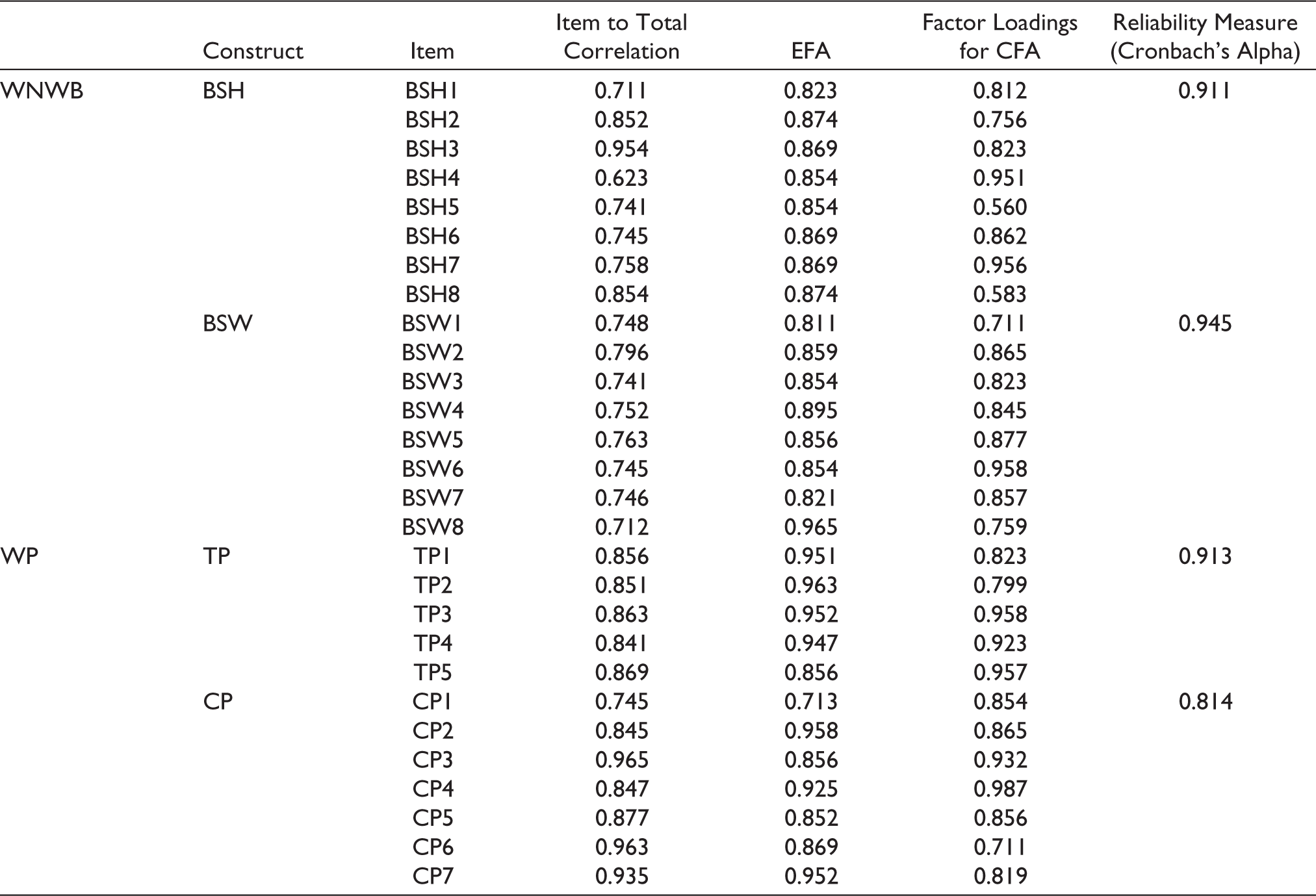
According to Cronbach (1951), reliability refers to the construct’s accuracy in repeatedly measuring the same phenomenon without any variations. Reliability can be determined with Cronbach’s α, a popular measure to assess scale reliability (Johnson & O’Leary-Kelly, 2003). The acceptable minimum alpha score is greater than 0.70. Table 1 presents the alpha values of the constructs used for the study. It can be observed that for all the constructs, the α values are over the stipulated value of 0.70 (George, 2011; Hinton, 2014; Nunnally, 1994), thereby confirming the reliability of the scales.
Table 1 presents the item-to-total correlation and factor loadings (exploratory and confirmatory). All the r values in the correlation analysis were above 0.711, which denotes high statistical significance. All the standardized factor loadings coefficients (for both exploratory and confirmatory factor analysis) were greater than the stipulated 0.50 (Kline & Santor, 1999)
Factor Loadings.
The robustness of any measurement model is assessed based on convergent and discriminant validities (Hair et al., 2010). According to Hair et al. (2016), Convergent validity is the ‘degree of association between items of a latent factor and other items within the factor.’ According to Fornell and Larcker (1981), any average variance extracted (AVE) value over 0.50 is a pointer toward good convergent validity. It can be observed from Table 2 that all the AVE values of all the constructs exceed the stipulated 0.50. This indicates robust convergent validity for all the constructs (Fornell & Larcker, 1981; Hair et al., 2016). Furthermore, the composite reliability (CR) ranged between 0.932 and 0.953 (Table 2), which is well above the minimum required value of 0.60 (Bagozzi et al., 1991). These results signify good convergent validity.
Convergent Validity Standardized Regression Weights (Default model).


Discriminant validity indicates that a construct in a model shares more variance with its measures than the other constructs (Hulland, 1999). It can be observed from Table 3 that no construct has an r value over 0.70 (Anderson & Gerbing, 1988). Further, it can be observed that all the r values are lesser than the square roots of AVEs (presented in the diagonal), thus meeting the stipulation of Fornell and Larcker (1981).
Discriminant Validity.

Results
After validating the measurement model using CFA, SEM was used to test the hypothesized relationship between the variables. The results are presented in Figure 2 and Table 5.

Structural Equation Modelling
SEM was chosen for the present study as it provides complete and concurrent testing of all possible relationships (Tabachnick & Fidell, 2001). Further, it assesses the model (both measurement and structural) for predictive validity (Becker et al., 2013). Therefore, a theoretical measurement model was proposed, which was grounded in a detailed literature review. The results of the SEM analysis are presented in the following sections.
The χ2/df (Chi-square probability) value was 12.35 (p < 0.01). This demonstrates the ‘overall fit and the discrepancy between the sample and the fitted covariance matrix’ (Bentler, 1990). The p-value needs to be > 0.05 if the model is to have a fit, which is perfectly met here. Kenny et al. (2015) opine that χ2 is an old measure of fit due to its lack of universal acceptance as a good or bad fitting model. According to Kenny et al. (2015), certain other fit indices, including TLI and RMSEA, are preferred. Table 4 presents the model fit results. It can be observed that all the fit indices meet the preferred standards, denoting perfect fit. The RMSEA is 0.031, which is well within the limit (0.07) prescribed by Steiger (2007). The CFI of 0.976 is as per the rule of thumb (> 0.90) set by Bentler (1990). The prescribed limit for NFI is > 0.80 (Hooper et al., 2008). In the present study, the NFI is 0.991, which is acceptable. Similar is the case of RMSR (0.025) and TLI (0.975). Both are well within acceptable limits. Nunnally (1994) prescribed a limit of 0.70 for Cronbach alpha. For the present study, the alpha ranged from 0.719 to 0.881. This shows the reliability of the instruments used for the study.
Fit Index.

Measurement Model and Structural Model Results
Since no misfit existed for the proposed model, as evidenced by the constructs modification indices, there was no need to include any coefficients, error variables, or new paths between the constructs. The hypotheses formulated for the study (presented in the earlier section) and the theoretical model proposed based on an exhaustive literature review were tested for tenability against the research model (Geladi & Kowalski, 1986). The main aim of the model was to assess the relationship between WNLB and WP. The output arrived at based on SEM is presented in Figure 2 and Table 5.
Structural Equation Modelling Results.

The path coefficients of the latent variables were assessed by comparing the β values. According to Aibinu and Al-Lawati (2010), a high β value signifies a strong effect of predictor variables on dependent variables. Therefore, the significance of β is examined through the t-values.
The paths identified for the measurement model were examined for significance. For having significance at the 5% level, the t-value needs to be greater than 1.96. It was found that all the paths have significant levels. From Table 5, it can be observed that all the hypotheses formulated for the study are supported. Furthermore, the positive relationships of all the hypotheses are accepted at a confidence level of 0.01. Thus the hypothesis (H1) that ‘Boundary strength at home has a positive relationship with work performance’ is accepted at 0.01 level (path coefficient of 0.729, t-value of 3.21, and regression of 0.520). Likewise, hypothesis (H2) that ‘Boundary strength at work has a positive relationship with work performance’ is also accepted at 0.01 level (path coefficient of 0.829, t-value of 4.59, and regression of 0.810). Similarly, H3 that ‘Work-nonwork boundary strength has a positive relationship with work performance’ is also accepted.
The acceptance of all the hypotheses implies the strong effect of the paths in the model. Robust t-values present the strengths of the respective relationships (Hair et al., 2011). The regression weights are presented in Figure 2, which are also significant.
Discussion
The study examined the relationship between BSH, BSW, and WP. The study conducted among faculty members of Jordan found support for all the predicted associations between the variables, including boundary management outcomes, highlighting its immense theoretical and practical implications. The identification of the relationships between the variables, and the model developed in the study is a contribution to the literature, which is in line with a few earlier studies (Alanzi et al., 2022; AlKahtani & Sulphey, 2022; Ghali-Zinoubi et al., 2021). First, the results demonstrate the connection between BSH and BSW and WP, adding to the existing literature on boundary research. Recently, an increased overlap has been observed between work and non-work boundaries. This overlap is facilitated due to the widespread proliferation of modern technologies, which has facilitated flexible work arrangements like telecommuting and working from home (Allen et al., 2021). Furthermore, boundary studies received even greater focus with the COVID-19 pandemic ravaging the globe in its monstrous proportions and compelling organizations to make employees work from home (Paustian-Underdahl et al., 2016; Rudolph et al., 2021).
The findings of the study are in unison with Kanter (2006) and Gardner et al. (2021), accepting the finding of Hecht and Allen (2009) that ‘the myth of separate worlds must be buried.’ It is also suggested by Hecht and Allen (2009) that organizations need to recognize employee desire to participate in both work and non-work institutions, as both are indispensable and essential for an individual. However, as a matter of abundant caution, individuals need to be encouraged to dedicate focused attention to both work and non-work roles separately, which would make them avoid conflicts of having to do both simultaneously.
Research evidence suggests that individual boundary management styles influence multiple other aspects and work outcomes. Some of them include the health of the individual, work-to-family and family-to-work conflict (Matthews et al., 2010), turnover intention (Kossek et al., 2011), and mental and physical well-being (Wepfer et al., 2018). Thus, the association between boundary management styles and their outcomes has been a matter of theory and empirical examination; scant insight exists into its relationship with work performance. Further, there is minimal theoretical direction about the inhibitors and facilitators of boundary management (Gardner et al., 2021). Though apparently, boundary strength at home (BSE) and boundary strength at work (BSW) could constrain performance, the findings do not support this. The observed positive relationships have multiple theoretical implications within the work–family literature. However, further examinations are required to understand the various aspects of the work environment that could facilitate boundary management. For example, further empirical examinations could be conducted to examine whether support from family, colleagues, and supervisors could influence boundary management.
Implications
The study has broad theoretical and practical implications. The study has extended the findings of earlier research works of Chen et al. (2009), Kossek (2016), and Kossek et al. (2011), to name a few. The observed relationship between work performance and boundary management (boundary strength at home and work) has numerous theoretical implications and can trigger further research. In addition, the study has contributed to the scarce but growing literature about boundary management and its relationship with performance. Another contribution is that the current study has succeeded in replicating the boundary management styles that Kossek et al. (2011) proposed in a non-western backdrop. Since WNWB management allows proper and efficient time management, there would be better WLB. This suggests that an adequate focus on boundary management would bring in the required WLB. Thus managements need to pool their efforts and initiate interventions to help their members have a strong boundary management fit, which would help derive good WLB.
Furthermore, the study proposes addressing combinations of features rather than concepts like WLB in isolation, as this could be a better intervention design for the managers and could be more instinctual to organizational members. Gardner et al. (2021, p. 23) also expressed this view, who suggested that ‘work-life policies that are “one size fits all” would not be effective for everyone and will not necessarily reduce work-life conflict, stress, or turnover.’ Further, boundary management interventions that fail to consider the organizational environment could be unrealistic and of no use. As the study suggests that WNWB management is connected to performance, managers must work with organizational members individually to develop appropriate boundary management strategies based on individual job requirements and preferences. This could have a more significant impact on the WLB of employees.
The study also has profound implications for educational administrators. The findings can be used to have an effective functioning of educational institutions by having a band of educators who meet job demands through good boundary management. They can also identify and implement policies that could help educators derive effective boundary management, which would help make their organizations effective. In addition, administrators could also identify ways to harmoniously combine instructional, mentoring, and boundary roles, which could help enhance faculty motivation. Further, earlier studies have also identified that enhancing managerial and organizational knowledge on enhancing boundary management would facilitate greater organizational effectiveness among the workforce (Kossek & Lautsch, 2012).
Limitations and Suggestions for Further Research
The study has a few limitations that need to be noted. First, the study was undertaken with a modest sample of faculty members of Jordan. Whether this result could be generalized for other vocations and locations need to be identified. Second, though the study identified the relationship between the variables, causal inferences are not identified. A longitudinal examination would help identify this aspect. Third, there is a possibility that the personality factors of the employees could influence the relationship between the variables (Gardner et al., 2021). This aspect was not examined in the present study. Next, future research could identify the relationship between personality factors on boundary management and vice versa. Theory building about the background and contextual factors that could influence boundary management could facilitate a methodical approach in selecting the personality factors for future research. Finally, this study was conducted among the faculty of Jordan. The current study did not examine work characteristics, diversity, and job patterns. Further research could explore this aspect and examine the impact of cultural, industrial (manufacturing or service), and individual differences in boundary management. It is honestly and earnestly expected that social scientists and scholars undertake future research to extend the present study’s findings.
Conclusion
This study has shed light on the relationships between boundary strengths and work performance. In addition to examining the relationship between WNWB and work performance, the study also examined the relationship between boundary strengths at home and work with task performance. A significant positive relationship was observed between all the variables examined and work performance. The boundary management processes are expected to remain a topic of empirical examination for years.
Footnotes
Declaration of Conflicting Interests
The authors declared no potential conflicts of interest with respect to the research, authorship, and/or publication of this article.
Funding
The authors received no financial support for the research, authorship, and/or publication of this article.