



Abstract
The advent of social media as a marketing tool has transformed how businesses connect and share information about their brands with their consumers. Amplified consumer engagement has created novel relationships between consumers and companies. People’s reliance on seeking information from other online users and reviews has increased, and this is where social media influencers play an important role in shaping consumers’ opinions. Augmented reality will revolutionize the influencer marketing environment due to its ability to engage consumers. This research involved an online survey with questions established on a 7-point Likert scale. Later, exploratory factor analysis was used to summarize data better to understand associations between dependent and independent variables. Later principal component analysis was espoused for the extraction process. Varimax rotation congregated 39 items into various factors. The Kaiser-Meyer-Olkin (KMO) test was administered to justify the adequacy of the sample.. The findings suggest that augmented reality moderates user engagement and is the future of influencer marketing.
Keywords
Introduction
The application of web and mobile-based technologies for creating and sharing information across the globe by people to interact and participate collaboratively is called social media (SM; Pan et al., 2019). The advent of SM as a prominent tool for marketing has transformed how companies connect and communicate information about their brands with their consumers. Today’s consumers are well-informed and use SM to connect with companies, enhancing consumer engagement (Parsons & Lepkowska-White, 2018) and creating novel associations between consumers and businesses (Upadhyay et al., 2022). Most well-known SM platforms now include live streaming, augmented reality, online shopping and other features, as more and more people rely on SM daily. People’s reliance on seeking information from different online users and reviews has increased. This is where social media influencers (SMI) significantly shape consumers’ opinions (Upadhyay et al., 2022).
SMIs are not necessarily celebrities; the public perceives them as ordinary people turned into SM superstars (Masuda et al., 2022). SMIs are known to authenticate the relationship between the company and its consumers by bridging the trust gap and creating authentic associations among their followers (Lou & Yuan, 2019). The influencers leverage their followers in structuring relationships built on trust, assurance and penchant. Influencers have proven to connect with audiences creatively (Dimitrieska & Efremova, 2021). The objective of influencer marketing (IM) for firms is to convey their message legitimately through these people, who already have high trust among their followers (Cooley & Parks-Yancy, 2019). Consumers across brands connected to SMIs are more inclined to accept or believe SMI’s opinions about the brand (Lou & Yuan, 2019). IM has become one of the essential strategies used by brands looking forward to increasing brand awareness and reaching potential consumers. A report by AspireIQ revealed that in 2020, around 69.8% of marketers scheduled to boost their budget for IM activities (AspireIQ, 2020).
IM is an efficient strategy if businesses are looking for brand imaging and marketing; it also considerably impacts the brand value of businesses (Upadhyay et al., 2022). SM applications like Instagram provide several ways to implement IM as a marketing strategy (Lee et al., 2022). IM puts the brand in front of a whole new audience by curing ‘ad fatigue’ and delivering authenticity. The influencer indus-try is expected to grow continuously, with people spending more time online. The influencer industry is predicted to become 15 billion dollars by 2022 (Statista, 2021).
SM users have witnessed a considerable spike, with 520 million new users entering SM in 2021 (Data Reportal, 2021). Instagram has played a vital part in the twenty-first century, with prominent users called ‘influencers’. Influencers have emerged as an essential demographic for Instagram, and the service has expanded its platform to include shopping and other marketing features to help these influential users succeed (Lee et al., 2022).
Augmented reality (AR), an interactive interface reproduced digitally inside a real-world setting, is one of the few upcoming trends the digital world will experience (Rauschnabel et al., 2022). AR has given a new meaning to the digital world during the pandemic, and it will persist in enriching users’ experience and providing more IM prospects (Tsai et al., 2020). Every business seeks to leverage AR to advertise its products to consumers and improve their purchasing journey. Snapchat’s Shoppable AR capabilities allow them to add a ‘Shop Now’ button for the AR experience (Groove Jones, 2020). Brands such as Sephora, L’Oréal, Nike and Adidas have executed AR to enhance the realistic experience of their products and assist the consumer in decision-making. Different researchers have studied the effect of SMI on followers’ behavioural intentions and purchase intentions (Chatzigeorgiou, 2017; Masuda et al., 2022; Reinikainen et al., 2020). However, relatively few studies investigate the impact of IM and AR on the user engagement (UE) led e-word-of-mouth (eWOM). Previous literature in this field has not covered the impact of AR adoption in influencers’ content on UE; this study identifies this as a gap and addresses it through RQ1. How would the adoption of AR by SMI affect UE? The answer for RQ1 was found in the Stimulus Organism and Response (SOR) model. SOR framework is a series of procedures that commence after contact with external cues (stimuli), which bring changes in the user’s internal state (organism), which further leads to behavioural retorts (Response; Lee et al., 2011). AR adoption in their content can help influencers provide an interactive experience for their audience, letting users superimpose visual elements, sound and other stimuli on their real-world environment and pique their curiosity (Rauschnabel et al., 2022). AR provides an immersive experience that holds on to the consumers for a longer time on SM platforms, providing an opportunity for deeper connections between brands, their influencers and their followers (Yim et al., 2017).
Marketers have realized the importance of integrating their marketing communications into influencers’ narratives over time to increase followers’ engagement (Masuda et al., 2022). This indicates that IM can be considered a multidimensional marketing association between influencer and consumer, influencer and brand and brand and consumer relations. Influencers use their pre-existing relationship and trust with their followers to convey the brand’s message to their followers. It is thus essential to develop relational trust, which is the foundation of any influencer–follower association (Brooks & Piskorski, 2018).
Brand trust indicates the willingness of the consumer to depend on the faith that the brand will constantly execute (Hafez, 2021). Brands can utilize influencers to create brand trust as they have a closer connection with their followers, thereby increasing brand trust their companies. One study found that 92% of SM users trust influencers more than traditional marketing channels, demonstrating the importance of trust in influencer marketing. Previous studies have focused more on the transactional results of IM, like followers’ perceptions, attitudes and behavioural intents (Lou & Yuan, 2019). Still, the research on developing and leveraging trust between influencer and follower relationships is limited. This led to a lack of clarity on establishing a connection between UE and trust, which marketers can capitalize on. The current study will address this gap as GAP 2 and answered by RQ2 ‘Are engaged users expected to be in a more trusting relationship with the influencer?’ The answer for RQ2 was answered using social exchange theory (SET; Homans, 1961). SET was employed in social interaction to describe how people communicate based on the exchange of costs and benefits, providing the status of guide or support to the speaker by the listener. It shows how influencers can have a social impact on their followers on social media. It also implies that the exchange of interpersonal influence is influenced by source characteristics and the message’s perceived aim.
Expertise, attractiveness and credibility are the characteristics of SMI, and their followers perceive their eWOM as authentic and trustworthy. A multidimensional pattern of communication is offered by SM, which facilitates UE in brand-linked eWOM (Zhao et al., 2020). Evolved from traditional word-of-mouth (WOM), eWOM has become one of the most critical touch points in influencing and impacting consumer attitudes and purchase behaviours, inspiring consumers to be web-stimulated decision-makers (Ismagilova et al., 2020). eWOM of SM users does not cover liking, commenting, or sharing a post but also the intent to follow brands and inform others regarding the post (Messiaen, 2017). eWOM of consumers creates extra buzz in this way. A fundamental principle in eWOM research is that it is more impactful than other communications; it is an interlinked market space, and trust is critical (Filieri et al., 2021). As eWOM has become a prominent information source for digital consumers, understanding how eWOM will influence consumers is pivotal for marketers to understand (Filieri et al., 2021). Previous literature has not covered the relationship between eWOM and SM posts by influencers. Thus, this study intends to analyse the impact of AR on influencer endorsement for UE, leading to trust and resulting in eWOM intentions.
Literature Review and Hypotheses Development
Stimulus–Organism–Response Model
The SOR model has been widely used to examine the interface between factors like system features, user experience and the results of immersive technology on the consumer. This model employs three steps to explain how people react to environmental stimuli. In this model, stimuli (S) in the environmental impact an individual’s internal states (O), and then these internal states cause responses (R) in the consumer’s approach (Kim & Lennon, 2013). The present study is based on the SOR framework to explain the adoption of AR by influencers for enhancing consumer engagement leading to trust and eWOM. Marketers must understand how AR-induced influencer content will compel consumers to spend more time on SM with the brand.
Social Exchange Theory
SET states that social behaviour is the product of an exchange process which says that a trusting relationship promotes the continuity of exchange between parties. To evaluate the SMI-follower relationship, SET is appropriate for this study because it consists of an interpersonal relationship: influencers are seen as ordinary people, a person with whom a customer can connect and with whom a customer can build a direct connection based on the content being produced and the influencer’s personality. The present study via SET will explain how SMI can impact SM users.
Research Model and Hypothesis
Social Media Influencer Marketing Value and User Engagement
Lou and Yuan developed the social media influencer value (SMIV) model in 2019 to investigate and explain the dynamics that make influencer marketing effective. The SMIV model recognizes and emphasizes consumer trust in influencer-branded content, an essential factor (Yuan & Lou, 2020). Additionally, it broadens the idea of Source Credibility (which includes four variables: Expertise, Trust-worthiness, Attractiveness and Similarity) and Advertising Value (which provides for Informative value and Enter-tainment value), and it develops an integrated model to comprehend the concept of influencer marketing better (Lou & Yuan, 2019). The relationship between source credibility and branded trust was studied, showing that source credibility indirectly influenced purchase intention (Reinikainen et al., 2020). The idea of source credibility’s relationship with purchase intention was examined using the criteria of expertise and trustworthiness of the influencer (Lim et al., 2017). Influencers provide regular SM updates in their knowledge field, which they communicate to their followers, which is informative and entertaining (Lim et al., 2017). Based on Lou and Yuan’s (2019) research on peer endorsers, this study uses a four-dimensional source credibility model, encompassing trustworthiness, expertise, resemblance and attractiveness.
UE is a user experience characteristic defined by the intensity of an individual’s cognitive, temporal, emotive and behavioural investing while engaging with a digital system (O’Brien & Cairns, 2016). The User Engagement Scale (UES) is one method for measuring UE utilized in various digital applications. Human–computer interaction (HCI) researchers are progressively interested in interpreting, planning and assessing UE with a wide range of computer-mediated health, education, gaming, social and news media and search applications (O’Brien & Cairns, 2016). Under HCI, users exhibit emotional responses to the system (e.g., annoyance), content (e.g., shock, interest), or other users in the interface area. The connection between users’ skills and the complexity of the work dictates the amount of mental power required by users and whether this causes boredom, engagement or dissatisfaction (O’Brien et al., 2018). UE has been incorporated into studies using a variety of digital applications, such as an archival webcast system (O’Brien & Toms, 2010), the social networking application Facebook and a simulated travel agency website, and its reliability and validity in these settings have been studied. Influencers have obtained micro-celebrity status on Instagram, and they win their followers by engaging them by giving them a sense of belief, authenticity and trust (Cotter, 2019). Thus, we can hypothesise that:
Augmented Reality Adoption by SMI and User Engagement
In the current era of technological advancements, marketers have begun to use AR to create immersive brand encounters, interactive advertising (Yim et al., 2017) and new ways for consumers to interact with the brand. AR projects digital information on top of people’s real-time views of products, people or environments (Scholz & Smith, 2016). Snapchat has blended in-app viewing options with ‘Lenses’, an in-app AR feature that layers visuals and designs over real-world items when seen through a smartphone’s camera. AR permits superior consumer satisfaction, resulting in more meaningful UE (Jessen et al., 2020). Research has shown that AR traits influence certain activities, such as behavioural intentions (Baytar et al., 2020). The SOR model is well adapted to understand how AR traits affect behavioural purposes. When consumers interact with inanimate items, they participate in a kind of interaction (Brodie et al., 2013). These activities in AR experiences might involve observing how a product is entrenched in an engaging 3D environment, altering the colour of a sofa (IKEA catalogue), or imagining petting a cheetah (National Geographic). All AR initiatives can drive user-brand interaction; marketers may boost this engagement by allowing users to engage in more immersive activities (Rauschnabel et al., 2022). Users feel more involved with AR as the AR experience is new and more engaging. Creative action for the users results in greater anticipated satisfaction by using AR (Dahl & Moreau, 2007). Hence, we hypothesise that
User Engagement and Brand Trust
With the swift expansion of SM, the idea of SM engagement has become a prominent focus among researchers and practitioners (Brodie et al., 2013). UE in online interactions is a primary interest for technology developers, mentors, corporations and marketing firms. However, UE continues to be a confusing notion with cognitive, emotional and behavioural attributes influenced by various technological and human interconnected elements (Antelmi et al., 2018). Brand trust refers to the ‘willingness of the average consumer to rely on the ability of the brand to perform its stated function’. When consumers feel vulnerable in uncertain circumstances, trust becomes more critical (Panda, 2013) and decreases uncertainty because they realize they can rely on a trustworthy brand (Hafez, 2021). Interactions occur between members of an online community, which play a significant part in developing users’ confidence in society and its representatives (Vohra & Bhardwaj, 2019). Therefore, we hypothesise that:
Brand Trust and e-Word-of-Mouth Intention
Trust is an extract of various disciplines like marketing, economics, psychology, sociology and economics (Matute et al., 2016). It results from reliability and integrity (Handi et al., 2018), enhancing the exchange between seller and buyer. It is one of the esteemed basics to boost the relationship and direct it towards eWOM (Filieri et al., 2021). eWOM refers to any positive and negative product and brand-related opinions and information made and shared via the internet by potential, current and past consumers (Rahaman et al., 2022). To evaluate the trustworthiness of the data transmitted, consumers implicitly examine the speaker’s motivations (e.g., material interest, compassion) and competence, encapsulating the complex conceptualization of trust. In brand trust, a product’s quality and dependability represent its ability (Mal et al., 2018). Consumers can also infer the reviewer’s ability based on information about the reviewer, such as reviewer reputation systems (Cheung & To, 2017). According to existing research, consumers choose eWOM for various reasons, including risk minimization. The findings suggest that sharing expertise and experience can help build trust in online groups (Rahaman et al., 2022). However, trust may also influence eWOM. Previous research indicates that the personal characteristics of the endorser can increase brand trust (Lassoued & Hobbs, 2015). The details of the proposed conceptual model has been depicted in Figure 1. Additionally, eWOM helps in communication and developing a community around a brand, which can increase brand trust (Hajli et al., 2017). Therefore, we can hypothesise that:

Methodology
Data and Sample
The present study is primarily focused on consumer electronics products. A descriptive research design has been employed for conducting this study. Two reputed universities, the NMIMS University, Bangalore Campus, and the Christ University, Bangalore, were selected for the study. The Christ University Bangalore is one of the leading private universities with more than 20,000 students across UG and PG programmes. And NMIMS University, Bangalore campus, is one of the top business schools in India, with more than 2000 students across UG and PG courses. As the present study focuses on Gen Z as the sample frame, the two selected universities were considered appropriate for the study. Student lists and email ids from selected private universities in India were collected from university offices.
The researcher developed a structured online questionnaire in English using Google Forms. The questionnaire had a link to watch the Samsung Galaxy Note 20 AR filter on Instagram. This filter has an exclusive touch of AR technology for those who want to feel their Samsung Galaxy Note series. A questionnaire was mailed to the respondents, and it was answered only by those who are using Instagram as an SM platform after watching the link. Only respondents from India answered the questionnaire, as India ranks number one in the world for Instagram usage (Statista, 2021). The researchers have used a few contemplations to identify the most suitable respondents. First, the respondents’ age was restricted between 18 and 24 as this group constitutes a significant number of online populations and validates the definition of Gen Z (born between 1995 and 2003; Iorgulescu, 2016). As per the urban market report, there is 65% internet diffusion in urban India compared to 20% in rural India, as reported by the Internet and Mobile Marketing Association of India (IAMAI; Agarwal, 2018). Therefore, responses were collected only from private universities in urban India. The questionnaire was sent to students aged between 18 and 24, irrespective of gender. Lastly, a qualifying question was included in the survey. This question expected respondents to answer the questionnaire only if they were following influencers on SM platforms and had bought at least one electronic product via the influencer’s content supported by the marketer. These multiple filter questions and criteria ensured that the researcher would receive replies from India’s most appropriate online consumer cohort. A total of 586 responses were received, of which 32 were unsuitable for analysis due to missing data. Therefore, an analysis of the data was performed with 554 responses.
Measures
Questions were established on a 7-point Likert scale ranging from 7 (strongly agree) to 1 (strongly disagree). The questionnaire consists of questions intended to quantify SMIV, AR, UE, trust and WOM intention. SMIV was adapted and modified by Lou and Yuan (2019). The number of items adopted for SMIV was 25. The items to measure AR were adapted from the vividness and interactivity scale from Yim et al. (2017). The total number of items adapted for AR was 10. UE scale with 18 items was adapted from O’Brien and Toms (2010). Trust was measured by using three items from Wu and Lin (2017). eWOM intentions with three items were adopted from Kim et al. (2001) and Chiu et al. (2019). Face validity was also established by taking the opinions of experts in the field of marketing from the academic and corporate sectors. Four experts from academics and four from corporate were approached for their expert opinions. Experts confirmed the appropriateness of the items for the examination. However, based on their suggestions, one item from the AR scale and eight items from the UE scale were not considered for the study. These items had less significance in the Indian context. Finally, 50 items were considered for the study.
Data Analysis and Findings
Descriptive Statistics
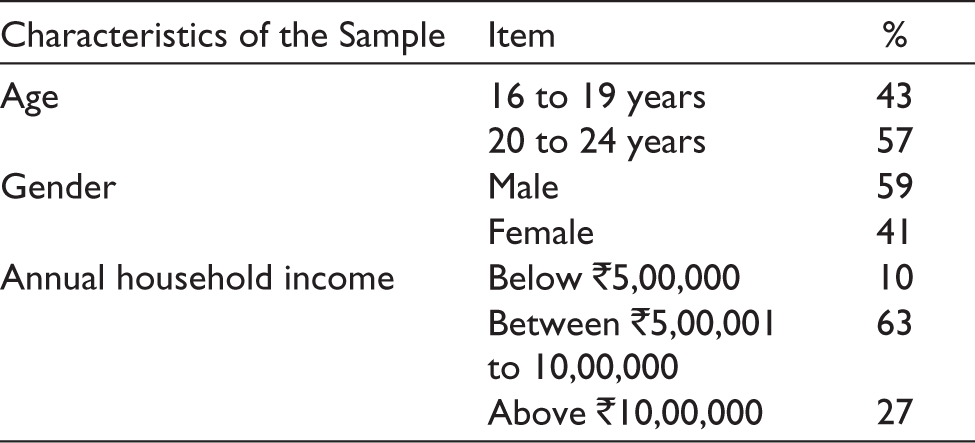
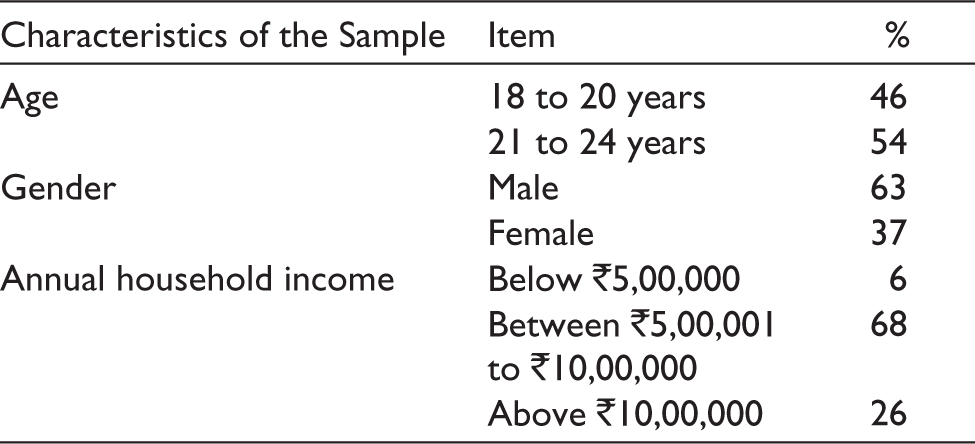
In this study, 554 valid responses were collected within a period of 6 to 7 months. Out of the total sample, 265 samples were considered for exploratory factor analysis (EFA), and 289 samples were used for confirmatory factor analysis (CFA). The demographic profile of the respondents for EFA is mentioned in Table 1, and for CFA, it is mentioned in Table 2.
Demographic Characteristics of the Respondents of This Study for EFA.
Demographic Characteristics of the Respondents of This Study for the CFA.
Exploratory Factor Analysis
EFA was engaged to summarise data to better understand associations between dependent and independent variables. Later, principal component analysis (PCA) was later espoused for the extraction process. The items with factor loadings less than 0.5 were not considered for the study. A total of 11 items were removed from the analysis. Finally, varimax rotation congregated 39 items into 10 factors. The KMO test was administered to justify the adequacy of the sample. KMO value was 0.822 for the current study. EFA of 39 items discovered a 10-factor structure which reported 10.853, 9.643, 8.555, 7.684, 6.800, 5.976, 5.971, 5.652, 5.551 and 5.063% variance, respectively, and 71.749% of the total variance. Factor loadings are highlighted in Table 3. As Nunnally (1978) suggested, reliability alpha (Cronbach’s alpha) for all the variables was in the range of 0.700 to 0.920, above 0.7.
Factor Loadings Involving Rotated Component Matrix.

Confirmatory Factor Analysis (CFA)
The Goodness of Fit Indices
Hair et al. (2008) suggested that a measurement model was established using CFA. As guided by Hooper et al. (2008), the goodness-of-fit (GFI) of the projected measurement model was evaluated based on the following indices, normed-fit index (NFI), χ2 test value, comparative fit index (CFI), root mean square error of approximation (RMSEA), incremental-fit index (IFI) and adjusted GFI. The measurement model of dependent and independent variables analysed using the CFA depicted a satisfactory model fit with χ2/df = 1.74, CFI = 0.920, IFI = 0.921, TLI = 0.910, GFI = 0.836 and RMSEA = 0.051.
Reliability and Validity Tests
The reliability and validity of the model were established by conducting interitem and composite reliability and convergent validity. Composite reliabilities surpassed the recommended value of 0.6 (Bagozzi & Yi, 1988). The interitem reliability encountered the recommended range (between 0.70 and 0.91; Nunnally, 1994). Fornell and Larcker’s (1981) methodology was espoused (Hair et al., 2008) to establish construct, discriminant and convergent validity. The convergent validity was observed using the average variance extracted (AVE) value. As the AVE values were more than 0.5, it was confirmed that the validity of the constructs was accepted. Discriminant validity was established by comparing the constructs’ AVE values with the correlation estimates’ square. It was found that the AVE values of all the constructs were higher than squared inner construct correlation estimates (between 0.071 and 0.701). Face validity was also established by taking the opinions of experts in the field of marketing from academic as well as corporate sectors. Experts confirmed the appropriateness of the items for the examination.
Regression Analysis
Multiple regression analysis was adopted to establish the association between dependent and independent variables. Durbin-Watson statistics, a measure of auto-correlation, were in the acceptable range of 1.5 to 2.5, indicating that residues are not correlated, an assumption of multiple regression. The findings of the regression analysis are indicated in Table 4.
Results of Regression Analysis.
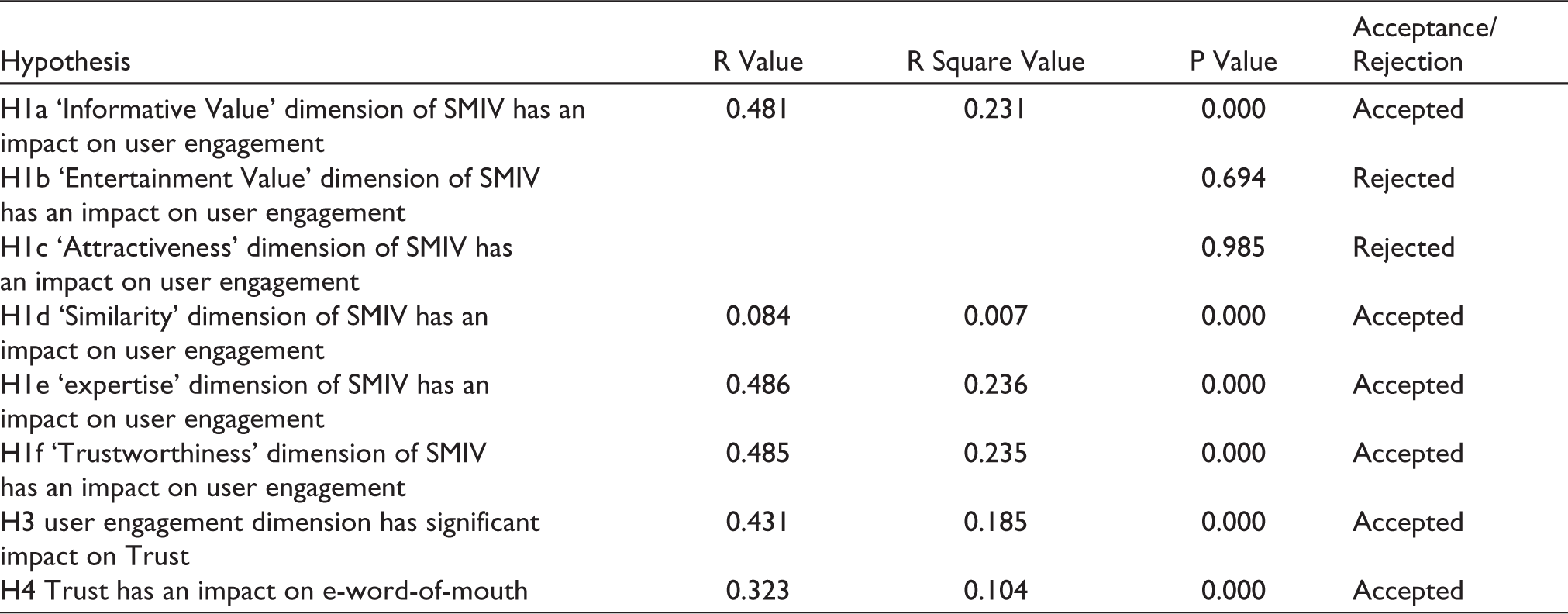
The regression analysis led to the acceptance of some hypotheses. However, the relationship between the entertainment value, attractiveness and expertise dimensions of SMIV was not established with UE. The relationship between the informative and trustworthiness dimensions of SMIV was established with UE. Also, the relationship between UE and trust and WOM.
Moderation Effect of Augmented Reality on the Relationship Between SMIV and User Engagement
Subsequently, the authors administered hierarchical regression analysis to examine the moderating relationship between AR as the moderating variable, SMIV dimensions as independent variables and UE as the dependent variable. The authors adopted this method for testing the moderation effects because it has been suggested in the literature that this method is most suitable if the data is not categorical (Chen & Huang, 2017). It was established by Holm-beck (2002) that moderation could be established if the interaction variable, which is created by the interaction between the independent variable and moderating variable, had a substantial effect on the dependent variable. The association between some of the dimensions of SMIV and UE was moderated partially by AR, and some had complete moderation. The relationship between the expertise and trustworthiness dimensions and the informative value dimensions of SMIV was partially moderated by AR. AR fully moderated the entertainment value and attractiveness dimension of SMIV as the R-squared value in both cases increased from model 1 to model 2, which indicates a moderating effect (Aiken et al., 1991). However, there was no moderation by AR between the similarity dimensions of SMIV and UE (as depicted in Table 5).
Moderation Effect of Augmented Reality on the Relationship Between SMIV and User Engagement.

Discussion and Conclusion
SM-induced influencer marketing is catching the attention of most companies and is growing at a fast pace. Due to its entertainment capability, AR is already very popular on SM and has tremendous potential in the e-commerce realm. Although technology is still at the entry stage in influencer marketing, marketers have embraced it with open arms, which unfolds huge potential for influencers to utilize the technology to the fullest. The present study is one of the few studies conducted so far aiming to observe the moderating effect of AR-induced SMI posts on engaging the user and the trust it builds with the consumer in choosing an electronic product, leading to eWOM intention among Gen Z. The results indicated that the regression analysis led to the acceptance of almost all the hypotheses except the relationship between the entertainment and attractiveness dimensions of SMIV with UE. This underlines that Gen Z may not always look forward to entertainment in SMI’s posts and the attractiveness of the influencer. Still, content that is often informative and reflects the expertise of the SMI, who has more trustworthiness, engages the user on SM. Gen Z consumers give more weightage to SMI’s point of view, expertise, information and the extent to which they can relate to the influencer compared to the attractive SMI when opting for an electronic product. Gen Z looks forward to a personal relationship with influencers; therefore, influencers who care for their followers and reflect expertise in the subject matter are likely to have long-term followers. As per the present study, attractiveness did not hold much importance compared to information, similarity, expertise and trustworthiness, significantly influencing SMI posts on Instagram. Trustworthiness in online platforms indicates users’ trust have in SMI without personal information. However, SM platforms make them feel connected to the user (Martensen et al., 2018), thus making them trustworthy. This indicates that SMIs with more personal content is perceived as trustworthy by Gen Z, especially when they can comment on the influencers’ post, which strengthens the feeling of similarity between Gen Z and the influencer. Similarity led to stronger trust and has been explored in several studies (Tolstikova et al., 2021). This is because a high level of similarity opens Gen Z to more increased interpersonal bonding with influencers. SMI try to be ordinary and be like themselves, leading to trust among their followers. The expertise dimension of SMIV has an impact on UE as influencers make a living via writing content and making videos. They know exactly what their target audience wants to see and in what format they want to view it. They spend years creating unique content for many online platforms, and when they cooperate with a business, that content also reflects on them. Both parties benefit from more great content and outcomes when brands collaborate with influencers, allowing them creative power.
The relationship between entertainment value and attractiveness dimensions of SMIV was not established with UE, which means that it is not always true for the consumer to spread information about the content or discuss the same even after having a pleasant experience. Gen Z is a generation with unrestricted internet access and is immersed in SM; they do not consider it only a source of entertainment, unlike millennials. If they are following any influencer, it is not only for entertainment; they prefer that they feature more relatable content in their posts. Attractiveness refers to the aesthetically pleasing appearance of the influencer, which can be a catalyst for engaging the user, but the kind of product determines it. The present study did not establish a relationship between attractiveness and UE. Electronic brands must remember to collaborate with an influencer to whom Gen Z is willing to pay more attention.
The present study’s findings indicate that the relationship between UE and trust was established when we spoke about Gen Z. They do not believe in mass marketing instead, this generation is falling more for micro-influencer marketing. They expect brands to prove their worth through transparent communication. Although Gen Z refuses all other kinds of marketing, they are on board with influencer marketing. As supported by SET, most Gen Z’s make the purchase based on the suggestion from an influencer due to their ability to engage the user. Working with influencers is a great way to win new consumers’ trust and turn them into loyal consumers and brand advocates. After witnessing the effects of COVID-19, most Gen Z expected brands to help them in their daily lives. Businesses now bear more responsibility than ever before, and influencers are the ideal resource for assisting, supporting and delivering on client needs due to their trust in their followers. The same trust SMIs have gained during the period leads to the eWOM intention, as when an influencer endorses a product or service on their channels, it can appear as if it came from a trusted friend. Identifying individuals influencing your target audience is one of the most effective strategies to drive WOM. Today, SM has altered the way consumers and brands engage and bond. Influencer marketing can be thought of as a new type of e-WOM marketing. It has been noticed that a significant portion of Gen Z consumers frequently reach out to other consumers before making a purchase decision, especially when the purchase is one of higher significance or value, which is in the sink with SET. As per a 2019 report by Edelman, 63% of Gen Z consumers trust what influencers say about brands much more than what brands say about themselves in their marketing strategies. Personal recommendations and positive WOM are more crucial than ever for brands to strengthen trust with consumers at this moment of volatility, uncertainty and concern. User-generated content and good product evaluations are essential success elements in the current consumer climate, with many of us spending more time on SM.
The relationship between all dimensions of SMIV and UE was moderated partially by AR except for the similarity dimension, which did not have any moderation by AR. The finding of this study iterates the fact that Gen Z considers AR just as a medium for enhancing the creative possibilities of influencers but does not associate it with their personalities. The moderating role of AR in SMIV falls in the sink with the SOR model. It shows that, although the technology is new, it can keep consumers engaged and unveils a whole new playground for brands to create engagement for consumers via content. Drawing from the SOR model and the empirical study, the study states that AR technology is quite new but is already having an impact on IM, helping influencers engage their audiences by creating interactive experiences. Besides quickly transitioning consumers to the buying cart, having AR in the influencer’s post embedded in SM platforms increases shareability. Brands will still win if users don’t click the ‘buy now’ button but instead share a picture, likes, comments and shares (eWOM) of the influencer’s post with their SM networks. As supported by SOR, AR stimulates users to spread eWOM more often by creating an engaging environment that encourages them to do so.
Theoretical Contribution
The present study has a theoretical contribution from the following perspectives. At first, this study adds to the understanding of the effect of SMI’s sponsored content or posts on consumers’ decision-making processes in the Indian market via reactance theory. There is only limited research on the impact of IM on various facets of the consumer decision-making process. This research empi-rically establishes the importance of SMIV in electronic products. IM is becoming very important, and this study highlights the role that IM performs based on trust and WOM intention, which is an essential contribution to understanding the present situation of IM. Further, this study adds to the moderating influence that AR has on SMIV and UE with the SOR model by focusing on SMI’s alliance with the technology, which has a pivotal role in emerging, presenting and testing a new cohort of graphical user interfaces to support eWOM intention. For SMI, the most critical aspect of this model is that it endorses the realization of how different stimuli affect consumer response. This study also unveils the impact of trust on SM platforms while utilizing IM via social exchange theory, as it consists of an interpersonal relationship: influencers are considered a person to whom the consumer can relate and with whom a consumer can build a direct relationship based on the content being produced and the influencer’s personality. However, as the present study proposed moderating role for AR from the vantage point of influencer marketing, the results are an incremental addition to the theory of involvement.
Practical Implication
IM has gained rapid growth and has become a billion-dollar business. As per a study by Forbes, there will be a steep rise in the number of marketers embracing IM. IM market is still in its initial stages, and big brands have identified its importance and started allocating budgets for famous influencers on SM. SMIs create content and have millions of followers, and consumers would want to watch real people who are more relatable because brands are glad to sponsor them to create content with their product or mention the brand in their captions. AR is the future of IM, as many brands are incorporating technology to create a more modern and successful brand among consumers, fuelling a new kind of influencer: AR influencers. The present study adds to the practical implications by underlying the importance of SMIV with UE for electronic products, as influencers must assist their followers with reliable and updated information about the product, which surges UE and strengthens the user’s trust in SMI. As the study’s finding indicates that AR has a moderating effect on SMIV, it may help marketers achieve better UE by incorporating AR in IM and creating a more realistic experience for the consumer, as consumers are more likely to connect with the brand over SM if it produces engaging content (Coursaris, 2016).
Limitations and Future Scope
It is essential to mention that SI influencers are understudied, and the researcher’s incorporation of AR is still untouched. This is arguably one of the few pieces of research focused on examining the effect of AR and SMIV on UE from the point of view of consumer electronics. This study has a few limitations, as the data collection is done only from Gen Z, which does not represent a very populated country like India. The impact of AR on SMI is supposed to be different for different product categories. Therefore, further studies can focus on different categories of products that are emerging in e-commerce, like fashion, furniture. Future studies can also examine the effect of AR on IM on other essential constructs like brand equity and brand recall. Culture impacts the effectiveness of SMI, so future researchers can do a cross-cultural study comparing the effects of AR on SMI in developed and developing countries.
Footnotes
Declaration of Conflicting Interests
The authors declared no potential conflicts of interest with respect to the research, authorship, and/or publication of this article.
Funding
The authors received no financial support for the research, authorship, and/or publication of this article.