



Abstract
This study aimed to examine the influence of performance expectancy (PE), effort expectancy (EE), social influence (SI), facilitating condition (FC), hedonic motivation (HM), perceived trust (PT) and lifestyle compatibility (LC) on the intention to adopt M-payment (IMP) as well as the mediating effect of IMP on the adoption of M-payment (AMP). This study adopted a cross-sectional design and collected quantitative data through an online survey from 309 respondents in China. The results revealed the significant positive influence of PE, EE, FC, HM, PT and LC on the IMP. The IMP was found to positively and significantly mediate the relationships of all predictors (except SI) and the actual usage of M-payment. Artificial neural network results validated the high prediction accuracy of the data fitness and highlighted the importance of PE, EE and LC on the IMP among Chinese users.
Introduction
Over the last decade, mobile payment (M-payment) has become increasingly crucial and offers incontestable financial technology services due to their growing prevalence via smartphones and other mobile devices. Slade et al. (2015) defined M-payment as a method of financial transactions that combine payment services with mobile devices and applications, allowing customers to initiate, approve and execute transactions using a mobile network or wireless network technology. M-payment tools can be used whenever and wherever, as required, such as for online shopping, shopping at a mall, purchasing metro tickets, seeing the doctor (Liu et al., 2021), utility bills, air tickets, food delivery services, booking taxi, donations and even investment (Huang et al., 2020).
In several ways, sustainable financial development is similar to financial inclusion since it is built on involving wide sectors of the community in any business. In the sector of digital-payment system, financial inclusion aims to facilitate the growth of underprivileged populations, SMEs and the entire economy by encouraging access to digital financial services, and it is portrayed significantly as a facilitator of Sustainable Development by the United Nations (Luo et al., 2022). Hence, it can be said that sustainable finance through M-payment involves social financing, as well as supporting larger aspects of a country’s industrial sector for the long term, having longstanding steady turnover, and stability in the overall financial system. Unfortunately, in reality, users of M-payment are only presumed as frequent users (Luo et al., 2022).
Moreover, M-payment technologies are critical to attaining sustainable financial development goals because they provide a platform for social and economic development by supporting innovative approaches to access a wide commercial platform that effectively addresses social challenges faced by underprivileged community (Kikulwe et al., 2014). M-payments boost socioeconomic development by acting as a social safety net in times of crisis (Pal et al., 2020). Lutfi et al. (2021) argued that establishing an advanced e-payment system is essential for sustaining the effectiveness and performance of the national financial system by leveraging its benefits to all communities that can contribute to gross domestic product (GDP) growth.
Financial inclusion is aided by digital financial technologies, which provide a mechanism to alleviate issues of financial downturns in developing nations (Luo et al., 2022). Even in developed economies, sustainable finance through FinTech nowadays is key policy priorities for most governments and regulators, as evidenced by numerous of European Commission initiatives (Arner et al., 2020). Jordan’s interest in establishing infrastructure for financial inclusion through digital-banking has recently expanded, particularly in the sphere of mobile payment (Lutfi et al., 2021). Kikulwe et al. (2014) revealed that, in East Africa, the adoption of mobile money has broadened economic activities, enhanced human capital and created labour market, which has generated employment opportunities and added values to the sustainable development goals. Although M-payment has already become the most popular and preferred means of payment for purchasing goods and services in China (Liu et al., 2021), government and regulatory initiatives to mass implementation of this technology as a crucial component for achieving sustainable financial development are still inadequate. Till date, M-payment in China are controlled by only two major service providers, namely Alipay (by Alibaba) and WeChat Pay (by Tencent) and these platforms have become mainstay financial transaction systems in China’s everyday personal life and business operations (Huang et al., 2020). It indicates that, while other countries have already taken initiatives to mass-adopt M-payments and have developed rules and regulations to support this, China is only sustaining general-level usages at online shopping and small level transactions via two privately owned providers. Hence, it is time for China to take some major initiatives in M-payment to ensure financial and social sustainability across a vast population, which may create long-term financial stability through the retention of existing customer and gaining new customers.
Because of the unprecedented speed of technological development, including BigData, artificial intelligence, enhanced connectivity and storage technologies (i.e., block-chain and cloud services) (Arner et al., 2020), the most recent waves of M-payment technology development pose new regulatory challenges. Despite the fact that improved facilities and faster transaction times have made M-payment an inevitable transaction method, the rapid changes in the policies and securities are considered as hindering factors among consumers. The 47th statistics report based on the development of the Internet in China (China Internet Network Information Center, 2021) illustrated that by December 2020, the total number of M-payment users in China recorded 853 million, which is 86.5% of the country’s total mobile Internet users. These statistics do not really confirm the continual usage of M-payment among Chinese users since a vast population is still concerned about the security and rapid changes in technologies. According to Pénicaud and Katakam (2013), the quantity of active users and continual rise in customers should be measured to comprehend the mass adoption of services that determine the sustainability of the specified services (i.e., M-payment). Although numerous studies on the intention to adopt M-payment in China have been conducted (Chen et al., 2020; Huang et al., 2020; Yu et al., 2018), there is a scarcity in research relating sustainable financial development that can be gained through the mass adoption of M-payment and continuous new adoption.
In earlier literature, how M-payment services can promote sustainable financial development is unclear. To address this gap, this study intended to investigate the broad level adoption of M-payment among the working Chinese population as this segment covers a large variety of demographic characteristics. Since working people should always deal with a variety of financial transactions on a regular basis, rapid adoption of M-payment among this segment undoubtedly reflects mass adoption. Furthermore, working people represent a broad range of economic sectors, which is critical for the widespread adoption of M-payment and GDP growth. Thus, the findings of this study will provide a solid understanding of the factors that should guide providers in promoting M-payment mass adoption, as well as recommend appropriate strategies to marketers, practitioners and government policymakers for making M-payment available to all levels of users.
This study developed a robust and comprehensive framework that potentially offer clearer explanation of the UTAUT2 model along with two additional constructs and provides a more precise analysis of M-payment’s mass-adoption to gain sustainable financial development. Additionally, this study employed a comparatively new analytical methodology combining a structural equation model (SEM) and artificial neural network (ANN) model. In dual-stage analysis, partial least squares structural equation modelling (PLS-SEM) is initially used to determine the important exogenous factors, which are subsequently used as the input neurons for ANN analysis to thoroughly appreciate the non-linearity among the endogenous and exogenous factors (Leong et al., 2015). ANN is a resilient and flexible model; unlike other linear methods, it is not necessary to fulfil multivariate assumptions (i.e., normality, homoscedasticity, linearity and multicollinearity). Therefore, ANN is believed to produce a more accurate and comprehensive model than other linear models (Sharma et al., 2018).
Literature Review
Theoretical Foundation
Earlier studies mainly concentrated on three major categories of determinants, namely technological factors, personal factors and environmental factors, which were mostly derived from the unified theory of acceptance and use of technology (UTAUT) and technology acceptance model (TAM) (Gupta & Arora, 2020; Hussain et al., 2019; Liébana-Cabanillas et al., 2021; Tang et al., 2014). UTAUT2 has been shown to be highly capable of amplifying behavioural intention and usage behaviour of M-payment (Gupta & Arora, 2020). Despite the enormous popularity of UTAUT, Venkatesh et al. (2012) introduced three additional components, namely ‘price value’, ‘hedonic motivation’ and ‘habit’, resulting in the creation of the UTAUT2 model. The UTAUT2 model has been considered in numerous prior studies that focused on the intention to adopt M-payment (IMP) (Koenig-Lewis et al., 2015; Oliveira et al., 2016; Slade et al., 2015; Tang et al, 2014), but the findings have remained inconclusive due to the variations in the respondent selection and country circumstances (Hussain et al., 2019). Considering these facts, this study employed UTAUT2 model to explain the IMP among users in China, particularly among working people in the main cities. The majority of prior studies (Hussain et al., 2019; Oliveira et al., 2016; Slade et al., 2015; Tang et al., 2014) did not identify price value as a major predictor of the IMP when upgraded scenarios in mobile banking, M-payment. Based on the findings and considerations of prior studies, price value was also excluded from this study.
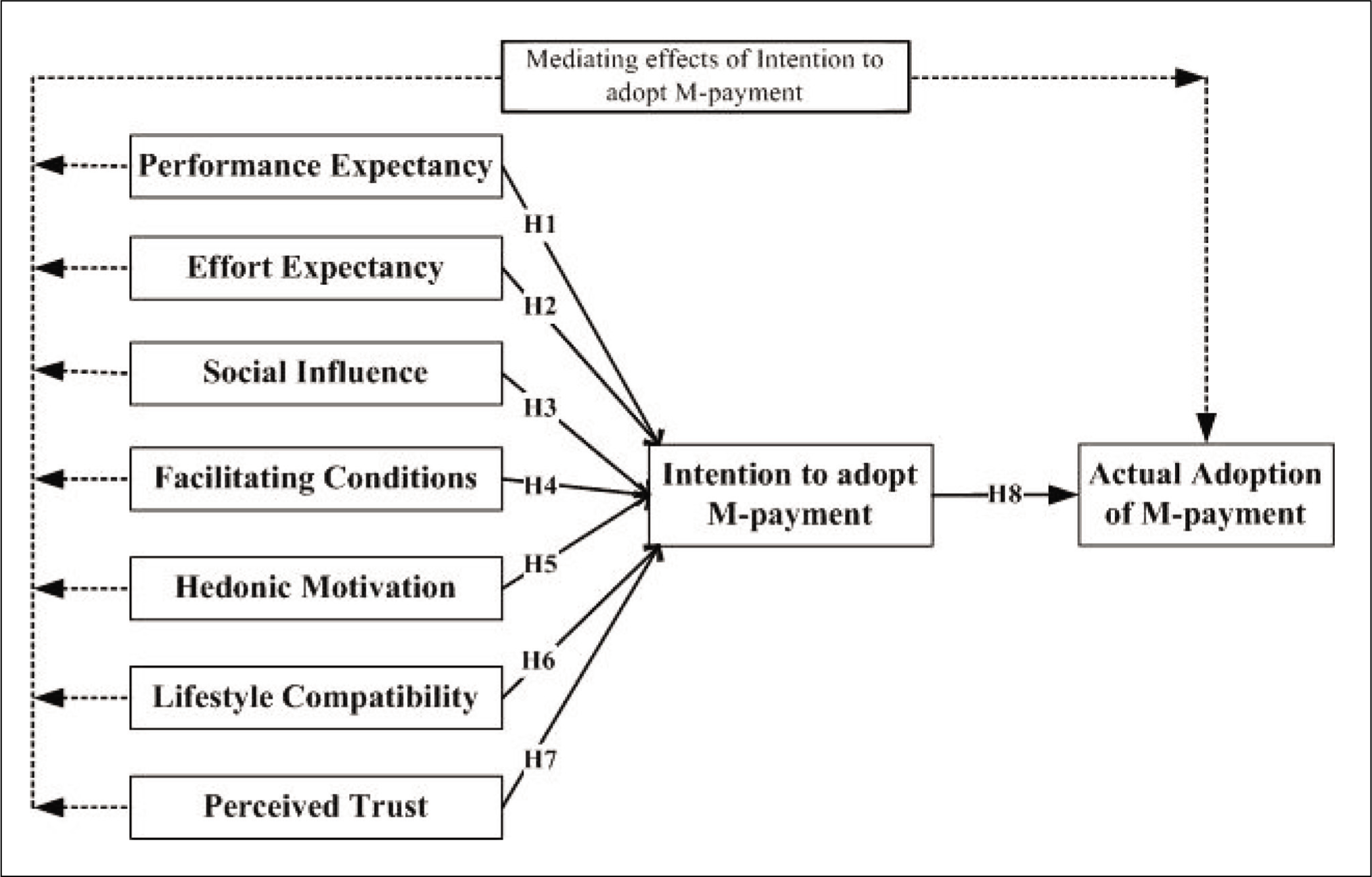
Additionally, studies have suggested to expand the UTAUT2 model by determining the characteristics in relation to regions with new technologies (Sobti, 2019). A few studies (Liébana-Cabanillas et al., 2021; Yang et al., 2021) expanded UTAUT and UTAUT2 by including perceived trust as a factor that influences M-payment adoption. According to other studies (Kim et al., 2019; Yang et al., 2021), lifestyle compatibility was identified as one of the crucial indicators of the intention to use contactless payment technologies. Thus, this study responded to the recommendations of prior studies by examining the influence of two additional factors, namely perceived trust and lifestyle compatibility, along with the original elements of UTAUT2 model (Figure 1), in order to investigate the adoption of M-payment (AMP) in China.
Research Framework.
Hypothesis Development
Performance Expectancy
Performance expectancy (PE) is described as the extent to which adopting a technology can benefit customers in the accomplishment of specific tasks (Venkatesh et al., 2012). PE has been noted as a strong motivator for non-users in their IMP services (Slade et al., 2015). In the context of M-payment, PE has been measured as the degree to which users perceive that M-payment can improve the efficiency of their transaction performance. Moreover, it represents customers’ perceptions of enhanced performance as a result of using M-payment services, such as convenience in payment, quick response and service efficacy (Penney et al., 2021). Oliveira et al. (2016) demonstrated the significant positive influence of PE on the IMP based on respondents in Portugal. Considering the different categories of population (people from the bottom of the pyramid), Hussain et al. (2019) demonstrated the substantial positive effect of PE on the inclination to adopt M-payment among customers in Bangladesh. All the evidence from earlier studies led to the formulation of the following hypothesis:
H1: PE positively influences the IMP.
Effort Expectancy
Effort expectancy (EE) denotes the extent of simplicity and unsophisticated features of technology in relation to the adaptability of customers (Venkatesh et al., 2012). Customers would be enthusiastic to obtain the desired results when they believe that new technologies are simpler to use and require minimal effort (Zhou et al., 2010). As for M-payment, EE refers to how simple it is to sign up for the related services, the simplicity of the payment method and the minimum number of steps necessary to complete the transactions. Furthermore, the EE can be enhanced through the easily available M-payment platforms and effortless access of the application on all mobile devices (Penney et al., 2021). EE has been identified as an important component of IMP among different customers in numerous studies (Abrahão et al., 2016; Teo et al., 2015; Ting et al., 2016). In contrast, Tang et al. (2014) focused on the young individuals in Malaysia and demonstrated the positive influence of EE on their IMP. Hence, EE has been considered as a predominantly relevant construct based on demographic, environmental and economic circumstances. Therefore, in order to investigate the influence of EE, this study tested the following hypothesis:
H2: EE positively influences the IMP.
Social Influence
When it comes to determining whether to utilize a new technology, certain customers place high importance on the opinions and recommendations of their close relatives and friends (Venkatesh et al., 2012). Social influence (SI) denotes the influence of the external circumstances on the users’ behaviour, such as close relatives’ experiences and opinions, superiors’ viewpoints and friends’ comments (Baptista & Oliveira, 2015). SI has also been measured by the amount of societal pressure put on customers to adopt a new technology (Chaouali & Yahia, 2016). Studies on M-payment have revealed SI as a major determinant of behavioural intention (Abrahão et al., 2016; Hussain et al., 2019; Koenig-Lewis et al., 2015). Oliveira et al. (2016) validated the importance of SI, confirming that the IMP was heavily impacted by the suggestions and opinions of prominent and renowned individuals in society. In another study with Ghanaian mobile-money users, it is found that the greater the SI, the more likely customers embrace the technology (Penney et al., 2021). Based on the findings of prior studies, this study proposed the following hypothesis:
H3: SI positively influences the IMP.
Facilitating Condition
Facilitating condition (FC) refers to customers’ perceptions towards the availability of resources and assistance to accomplish an activity using a new technology (Venkatesh et al., 2012). FC assesses how strongly individuals consider about the technical, financial and associated infrastructure resources needed to support a new technology. Hussain et al. (2019) recommended that as FC was originally developed and evaluated for organization-level technology adoption, it has not been thoroughly studied within the context of single users’ adoption behaviour of M-payment. Based on M-payment users in Taiwan, Lin et al. (2020) demonstrated a positive intention to adopt the M-payment system when users were provided with higher resource adequacy, higher service support and lower financial cost. In another study, Gupta and Arora (2020) and Penney et al. (2021) demonstrated a significant positive influence of FC on the behavioural inclination to M-payment. However, among Portugal users, Oliveira et al. (2016) identified FC as an insignificant indicator of IMP and AMP. Based on the majority of the previous studies’ findings, the following hypothesis was formulated:
H4: FC positively influences the IMP.
Hedonic Motivation
Hedonic motivation (HM) refers to the pleasure or enjoyment that comes from adopting new technologies (Brown & Venkatesh, 2005). Venkatesh et al. (2012) revealed the crucial role of HM in determining the degree of the intention to adopt new technologies. In information system research, the concepts of perceived pleasure and satisfaction are considered to have influence on customer acceptance and usage of technology innovations (Thong et al., 2006). For instance, Hussain et al. (2019) described HM as a pleasurable experience when users are satisfied with M-payment services to send a portion of their incomes to family members and pay for their family’s essentials despite living in different locations. HM emerges as a compelling element in adoption of mobile banking. Similarly, HM was considered as a substantial predictor of M-payment acceptance in numerous prior studies that involved different demographic samples, such as bottom of pyramid segment (Hussain et al., 2019), and Indian users (Gupta & Arora, 2020). All these findings of earlier studies led to the formulation of the following hypothesis:
H5: HM positively influences the IMP.
Lifestyle Compatibility
In societies, customers adopt services and consider the lifestyle standards and values that those services possess (Armstrong et al., 2014). Technologies are regarded to be consistent with customers’ beliefs, experiences and preferences in lowering the risk of adopting new products and services (Lin, 2011). Customers may consider new payment technology to be more suitable if they recognize the benefits of adopting the technology for certain activities that match their lifestyle (Oliveira et al., 2016) and the natural alignment of lifestyle decisions (Chawla & Joshi, 2019). Prior studies on M-payment evaluated the compatibility of the service with users’ lifestyle and proved that compatibility as a major factor that influences users’ intention to adopt the service (Hussain et al., 2019; Schierz et al., 2010). Oliveira et al. (2016) found that customers were more likely to adopt M-payment technologies if the services were found to be suitable for their lifestyle and environment. Based on these findings of prior studies on M-payment systems, this study proposed the following hypothesis:
H6: Lifestyle compatibility (LC) positively influences the IMP.
Perceived Trust
Perceived trust (PT) is about the willingness, confidence and feeling of being secured to depend on a system that do not disappoint and can consistently meet user expectations (Koksal, 2016). PT is essential in anticipating one’s acquisition purpose by reducing the visible risks, doubts, uncertainties and fears during the transaction (Kim et al., 2017). Concerns about the security of M-payment can be solved by establishing trust-building mechanisms, such as certifying bodies that cascade authentication (Koenig-Lewis et al., 2015). Customers’ PT and assurance in the mobile-money service imply that the service should be free of hackers and fraudulence to improve customers’ intention to adopt the system (Penney et al., 2021). Customers’ trust is important to encourage the adoption of contactless-payment and to shape more favourable perceptions towards the technology (Alalwan et al., 2017). Yu et al. (2018) identified PT as a compelling determinant that affected the ongoing intention to use M-payment among Chinese. In another study, Penney et al. (2021) confirmed the positive influence of trust in the service on the users’ IMP. With that, this study proposed the following hypothesis:
H7: PT positively influences the IMP.
Behavioural Intention and Actual Use (AMP)
UTAUT is built on the concept that the intention to adopt or use influences the actual adoption (Venkatesh et al., 2012). Customers who are more receptive to new technologies undoubtedly become adopters (Oliveira et al., 2016). Customers with stronger intention to adopt new technologies are more likely to be end-users (Leong et al., 2013). Behavioural intention appears frequently in contemporary studies and plays a crucial role in the acceptance and practical application of new technologies (Moorthy et al., 2020). Penney et al. (2021) revealed that the ultimate usage of mobile money is largely dependent on customers’ intention to adopt the system. In another recent study on the AMP, Gupta and Arora (2020) revealed that behavioural intention positively and significantly predicted the actual use of M-payment. All the above arguments supported the following hypothesis:
H8: The IMP positively influences the AMP.
Methodology
Sample and Data Collection
Focusing on working people (working adults) in China, this study adopted a cross-sectional design to examine the IMP and the actual usage of M-payment. Convenience sampling technique was employed to select the respondents. This sampling technique is generally economical, and the respondents can be addressed from any part of the accessible population. An online survey was conducted by posting the survey form at wjx site (http://www.wjx.cn/) from May 2021 to June 2021. A total of 309 respondents were successfully gathered at the end of the data collection.
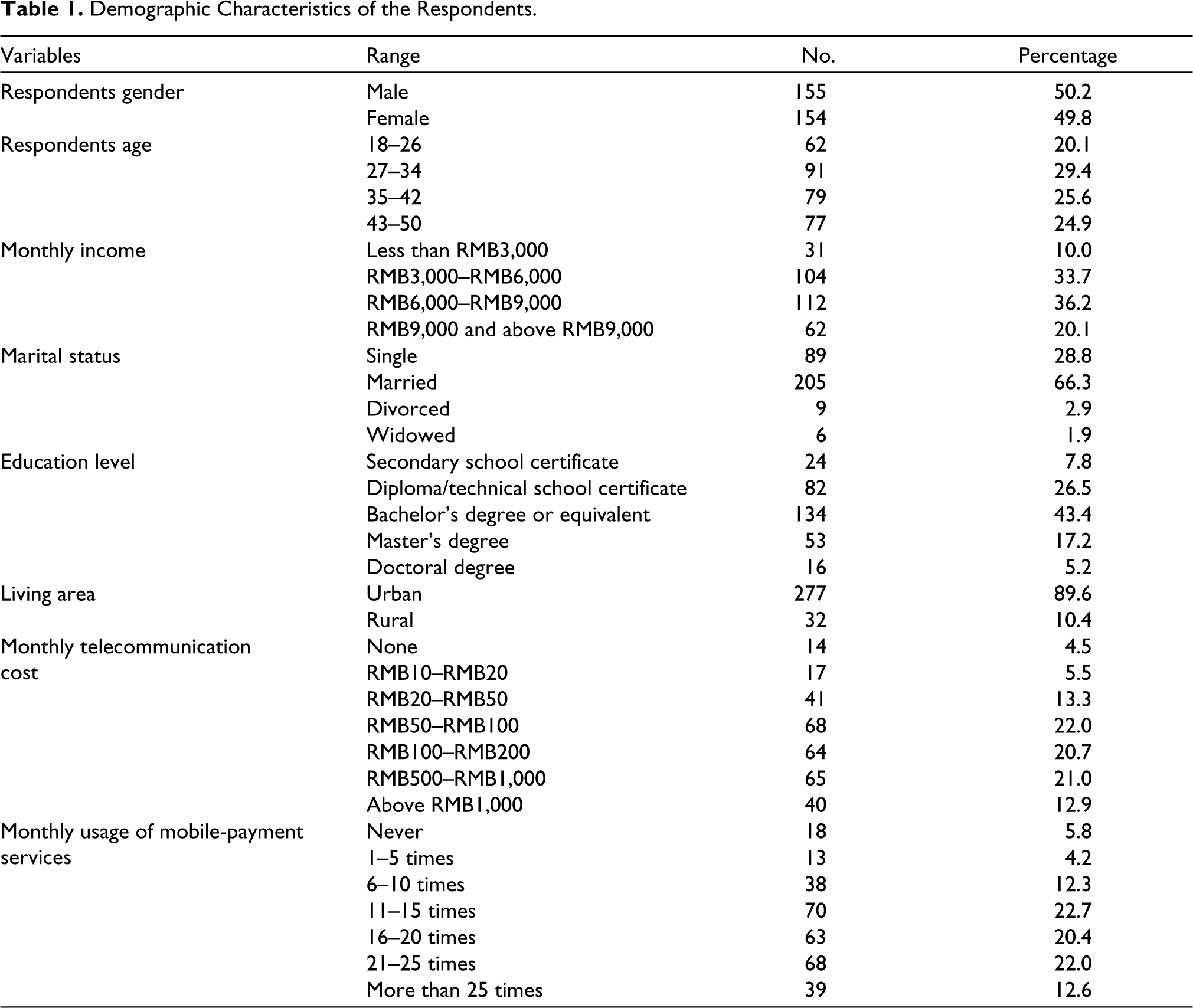
All respondents participated in the survey on voluntary basis. They were assured that all information would be kept anonymous. Table 1 presents the demographic profile of the respondents in terms of gender, age, monthly income, marital status, education level, living area, monthly telecommunication cost and monthly usage frequency of M-payment.
Demographic Characteristics of the Respondents.
Measures of Constructs
For this study, all the scale items, which were already validated, were adopted from earlier studies. This study adopted five items of PE from Chong et al. (2010) and Lwoga and Lwoga (2017), while five items of EE for M-payment were retrieved from Karjaluoto et al. (2019) and Chawla and Joshi (2019). Next, five items of SI were adopted from Lwoga and Lwoga (2017) and Pandey and Chawla (2019), whereas five items of FC were adapted from Pandey and Chawla (2019). In addition, five items of HM were taken from Voss et al. (2003). Meanwhile, this study adopted five items from Lwoga and Lwoga (2017) and Chawla and Joshi (2019) to assess LC. This study adopted five items from Chong et al. (2010) and Chawla and Joshi (2019) to evaluate PT. Last but not least, this study adopted five items from Chong et al. (2010) and Karjaluoto et al. (2020) to evaluate IMP.
Common Method Variance
As recommended by Podsakoff et al. (2003), the common method variance (CMV) test for this study revealed that the highest component contributed for 29.454% of total variance, which was lower than the 50% threshold. Moreover, as recommended by Kock (2015), this study conducted full collinearity test (Table 2) for all components. All variables were projected on the common variable, and the variance inflation factor (VIF) values were found to be less than 3.3, indicating that single-source data were not skewed.
Full Collinearity Test.

Method of Data Analysis
The study employed dual-staged analytical methods, including PLS-SEM and ANN. In the first stage, PLS-SEM was employed to evaluate the reliability and validity of the measurement model, as well as the significance of the effects of predictors on the IMP. In the second stage, ANN was used to determine the importance of these predictors of M-payment adoption. The outcomes of these two methods were compared to observe any variations in the variables for the prediction of M-payment adoption.
Data Analysis
Reliability and Validity
As presented in Table 3, this study evaluated the reliability and validity of the constructs. Overall, all constructs in this study recorded Cronbach’s alpha (CA) of higher than 0.70, confirming that the reliability of these constructs. Composite reliability (CR), with threshold value of more than 0.7 (Hair et al., 2011), was used in this study to determine internal consistency. The results revealed that all constructs recorded CR of more than 0.70. In other words, these constructs were highly reliable. Furthermore, Fornell and Larcker (1981) recommended that convergent validity should be evaluated using AVE, with threshold value of more than 0.50. Based on the obtained results, the recorded AVE values ranged from 0.644 to 0.756, which are higher than the recommended threshold value of 0.50.
Reliability and Validity.
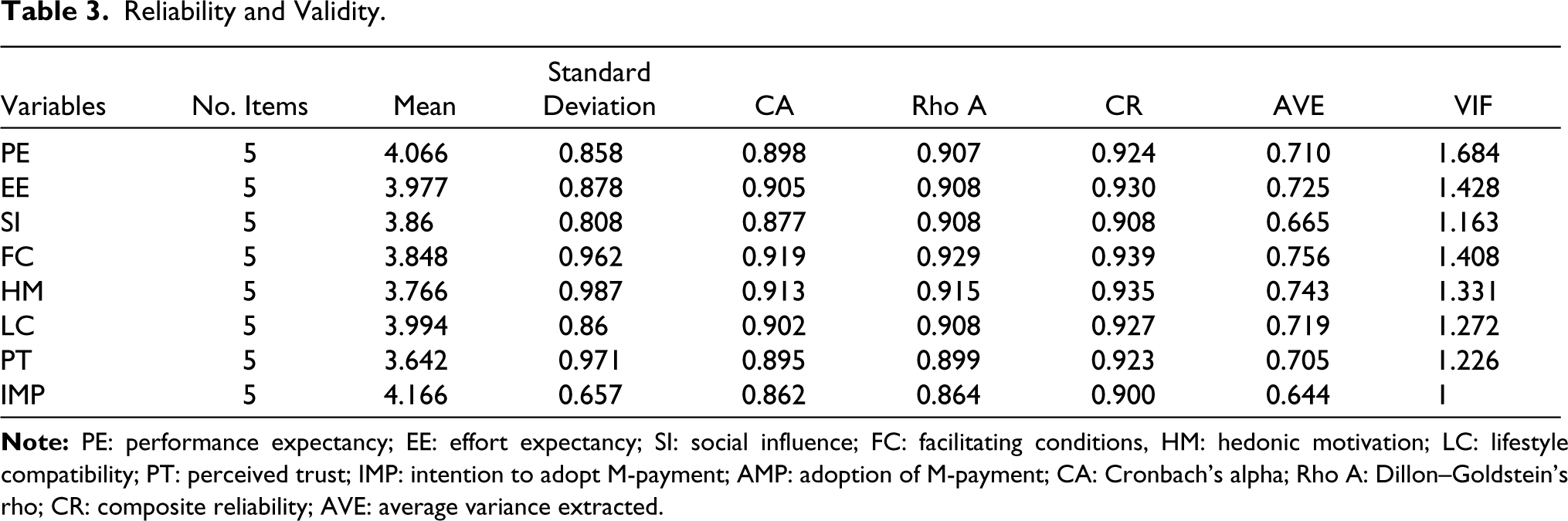
This study considered three techniques to obtain a more comprehensive understanding of discriminant validity: Fornell-Larcker criterion, heterotrait–monotrait ratio (HTMT) and cross-loadings (Supplementary Tables 1 and 2). The discriminant validity of constructs, with threshold value of equal to or less than 0.9, represents the standard for Fornell-Larcker criterion and HTMT (Hair et al., 2019). All constructs in this study achieved the threshold value for both Fornell-Larcker criterion (the highest value was 0.869) and HTMT (the highest value was 0.661). These results confirmed that there was no lack in discriminant validity. This study also compared the outer loadings of constructs. Earlier studies suggested that all loadings must exceed the value of 0.60 (Chin et al., 1997; Hair et al., 2011). Based on the results, all loadings ranged from 0.747 to 0.892, and all positive values were higher than the specified threshold value.
Path Analysis
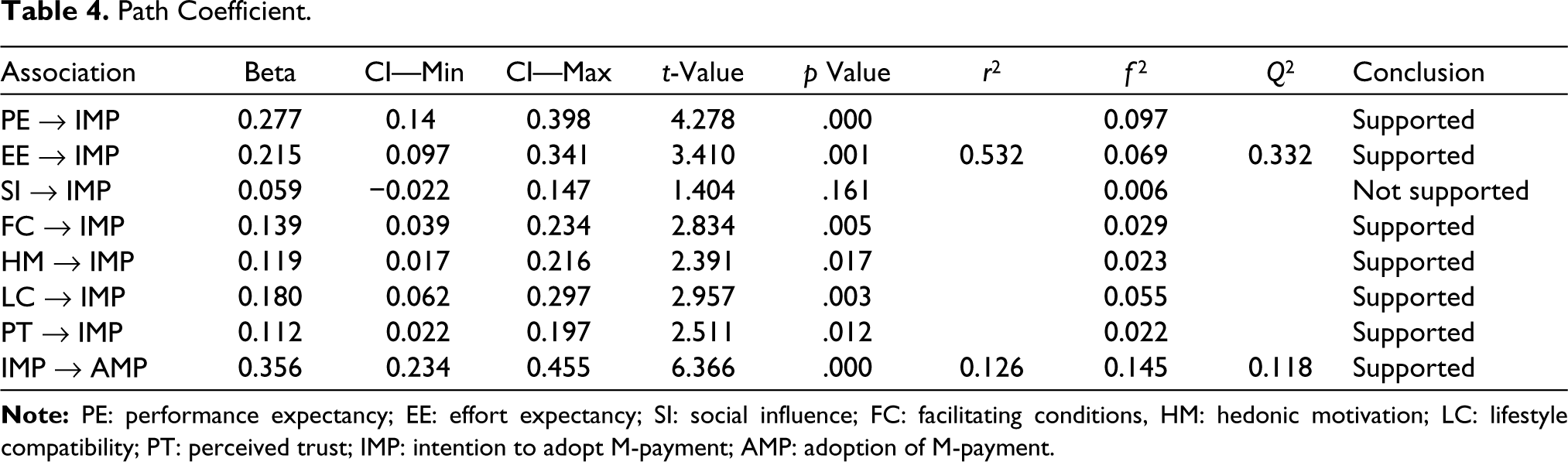
Referring to Table 4, the path coefficient analysis demonstrated that the path of PE to IMP recorded positive coefficient (β) value of 0.277 and p value of .000 (lower than the threshold value of 0.05 for statistical significance). Hence, the influence of PE on IMP was significantly positive and H1 was supported. Likewise, the path of EE to IMP recorded positive β-value (0.215) and significant p value of .001. With that, the influence of EE on IMP was positive and significant supporting, H2. However, the study observed different results in the path analysis of SI to IMP, which revealed positive β-value (0.059) and p value (.161). The result indicated a statistical insignificance. Thus, H3 was not supported. For the remaining four associations that involved (1) FC to IMP (β = 0.139; p value = .005), (2) HM to IMP (β = 0.119; p value = .017), (3) LC to IMP (β = 0.180; p value = .003) and (4) PT to IMP (β = 0.112; p value = .012), all paths recorded statistically significant positive β-values. Thus, the study obtained adequate evidence to support H4, H5, H6 and H7.
For a more comprehensive analysis, f2 measures the effect size and f2 ≥ 0.02, f2 ≥ 0.15 and f2 ≥ 0.35 represent small, medium and large effect sizes, respectively (Cohen, 2013). Based on the study’s results, all f2 values (except for SI) indicated small effect size. This study also employed Q2 test to measure the predictive relevance of endogenous variables (Stone, 1974). Q2 of greater than 0.00 (zero) is considered to have predictive relevance (Hair et al., 2011). The recorded values of Q2 (0.332 and 0.118) in this study exceeded the threshold, suggesting large predictive relevance of all constructs. Besides that, the coefficient of determination (r2) represents the degree of explained variance and refers to the percentage of variations in dependent variables that a linear model can explain. Significant, moderate or weak endogenous latent variables have r2 values of 0.75, 0.50 or 0.25, respectively (Hair et al., 2019). In this study, the recorded value of r2 (0.532) indicated that these predictors can explain a significant proportion (53.2%) of variations in AMP, suggesting moderate explanatory power.
Meanwhile, the path of IMP to AMP recorded positive β-value of 0.356 and significant p value (.000), which demonstrated the positive and significant of IMP on AMP among these Chinese users. In other words, H8 was supported. Moreover, the f2 value of 0.145 for the path of IMP to AMP indicated moderate effect size. As a final point of analysis, the recorded Q2 value of 0.118 (>0.00) indicated strong predictive relevance of IWP to AWP.
Mediating Effect
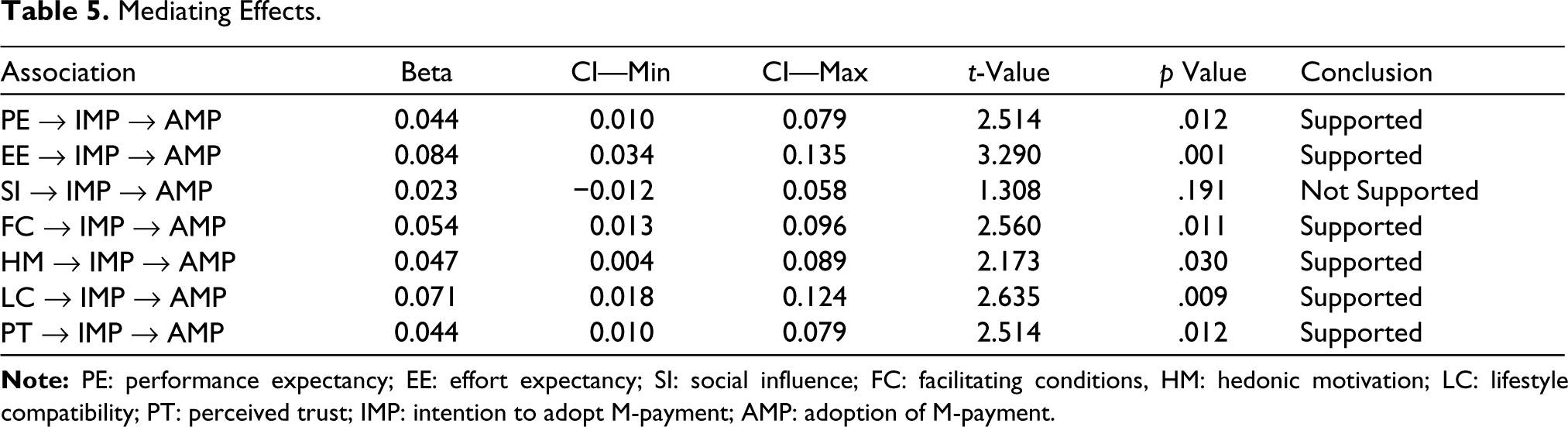
In PLS-SEM, the assessment of correlations in PLS-SEM should focus direct and indirect effects as well as total effects (the consolidation of direct and indirect effects) in a structural model (Hair et al., 2019). Table 5 presents the results on the mediating effect of IMP. The analysis revealed that IMP fully mediated the associations of PE, EE, FC, HM, LC and PT with AMP in this study, except for the association between SI and AMP. Path coefficient of 0.044 and p value of .012 indicated statistically significant and positive mediating effect of IMP on the relationship between PE and AMP. Similarly, the recorded path coefficients and p values were found below the recommended threshold value, which confirmed the statistically significant mediating effect of IMP on the relationships of EE, FC, HM, LC and PT with AMP.
Multi-group Analysis
The measurement invariance of composite models (MICOM) portrayed the results of the compositional invariance assessment. The permutation’s p values for all constructs (except for AMP) are larger than .05, indicating that compositional invariance was established. This study, therefore, compares standardized path coefficients across the location (urban vs. rural respondents). Findings (as presented in Supplementary Table 3) revealed that there were no significant differences in each of the associations between urban and rural respondents.
Artificial Neural Network Analysis
For this study, the ANN analysis focused on prediction accuracy, which was calculated using training data and testing data. The relative accuracy of the prediction was characterized by the root mean square of error (RMSE) values for both training and testing dataset. As presented in Supplementary Table 4, the values of RMSE ranged from 0.36 to 0.44 for the training dataset and 0.32 to 0.55 for the testing dataset. These results indicated small and close values with high precision and robust predictive power of the study’s model (Liébana-Cabanillas et al., 2021).
Path Coefficient.
Sensitivity analysis in neural networks allows the evaluation of input variables in terms of the importance of their effect on the output variable, as well as the identification of factors that can be excluded without compromising the network quality and key factors that should not be ignored (Mrzygłód et al., 2020). The resultant mean of importance presented in Supplementary Table 5 for this study’s dataset indicated PE as the most important factor, followed by LC and EE. HM and PT exhibited the same degree of importance, and SI was revealed to be the least important factor that influence the IMP among Chinese users.
Mediating Effects.
Discussion
This study identified factors that significantly influence the IMP among Chinese users. Based on the findings, the study acquired adequate evidence to support seven hypotheses. However, one hypothesis was rejected. This study first demonstrated the significant positive influence of PE on IMP, which was found to be analogous to the findings of Abrahão et al. (2016), Hussain et al. (2019) and Liébana-Cabanillas et al. (2021). This is because, Chinese users perceive M-payment as an assured, faster and safer transection process compared to traditional payment methods (e.g., cash, check and debit–credit cards) at any time and in any location. Thus, customers perceive M-payment to be a convenient method of transaction, paving the way for broader adoption and ensuring rapid growth in turnover towards achieving sustainable financial development goals. This also confirms the ability of M-payment to foster hassle-free large-amount commercial transactions at all levels business activities that can open opportunities for several financial agency growth.
Similarly, this study revealed a significant positive influence of EE on IMP, which was found to be consistent with the findings of Teo et al. (2015), Abrahão et al. (2016) and Gupta and Arora (2020). The most probable explanation is that M-payment in China ensured a user-friendly platform that is easier to master. Another potential explanation is that working people in China are typically more techno-savvy, and they can quickly adapt to new technologies easily. This attribute of simple dexterity in the system may stimulate stress-free transection methods for big amount of payments at all level of business sectors. As a consequence, unsophisticated transaction steps of M-payment should be a revolutionary financial technology among China’s broad industrial sectors in order to achieve sustainable financial development.
Based on the obtained statistical results, this study empirically established the significant positive influence of FC on IMP. This result is found to be parallel with the findings of earlier studies in usage of M-payment (Lin et al., 2020; Teo et al., 2015; Yang et al., 2021). The plausible reason for such result might be that Chinese providers have established a well infrastructure such as mobile and internet network, platform-independent application software and secure banking connectivity for facilitating seamless transections. It also signifies that the mass level of M-payment adoption would aid the related technology vendors (such as internet provider, software developer, local financial agents, call centre and service centre agents) to grow with more business opportunities to add value in the financial sustainability.
Meanwhile, this study’s result revealed an insignificant influence of SI on IMP, which was found to be in line with the findings of Gupta and Arora (2020) and Chen (2019). However, this particular finding was found to contradict the findings of most prior studies on M-payment (e.g., Hussain et al., 2019; Liébana-Cabanillas et al., 2021; Oliveira et al., 2016). There might be multiple causes for such a result. To begin with, since M-payment has become a well-known technology in China, the opinions of others may have little influence on consumers. Second, in terms of financial transactions, Chinese people like to make their own decisions independently. Furthermore, people are cautious to advocate any financial-related topic because they fear that if a transaction-error occurs, it would cast a negative image on their personality.
Besides that, this study demonstrated the significant positive influence of HM on IMP, which also contradicted the findings of most prior studies on M-payment. Koenig-Lewis et al. (2015), Oliveira et al. (2016), Hussain et al. (2019) and Liébana-Cabanillas et al. (2021) concluded that HM, has no considerable influence on users’ continuation to use M-payment due to its sensitive characteristics. The likely reason for such a contrasting result is that Chinese M-payment users enjoy employing M-payment due to its compelling user interface, add-ons and other real-time functionalities. Unlike users in other countries, Chinese M-payment users find it enjoyable and exciting since providers offer reward points and bonuses, discounts and cashbacks and a variety of payment choices such as pay-later, emergency-credit, gift vouchers for friends and so on.
Likewise, this study demonstrated a significant positive influence of LC on IMP. This finding was found to be consistent with the findings of earlier studies on various contactless payments (Hussain et al., 2019; Oliveira et al., 2016; Yang et al., 2021). This conclusion arose since Chinese working people tend to be highly busy in their everyday lives and seek financial services that can match their hectic lifestyle. Another reason is that the highly technological trend in China has made people’s lives such dependent on technology that people at all levels are so accustomed to fast-changing technologies like M-payment. This demonstrates a broad spectrum of M-payment flow that incorporates all aspects of people’s daily lives, from buying grocery to paying large business invoices, providing financial inclusion.
Adding to that, users’ perceptions of trust significantly influenced the IMP of users in this study. Prior studies on contactless payments revealed similar findings (e.g., Liébana-Cabanillas et al., 2021; Penney et al., 2021; Yu et al., 2018). Due to the mature level of M-payment in China, it is considered feasible that there is a high level of dependency on M-payment among users as they heavily rely on this. Chinese customers choose M-payment because they believe providers are trustworthy and ensuring high level of security. Furthermore, Chinese M-payment users are so familiar with scamming and hacking tricks that they are confident in identifying and avoiding any unexpected phishing occurrences. This strong trust among users confirms that people will continue to using M-payment and contribute value to government service taxes and other value-added taxes with their large volume of transactions.
Theoretical Implications
This study developed an advanced framework that expanded a well-practised theoretical model, UTAUT2. Based on the study’s findings, the proposed model demonstrated a high level of explanatory power of predicting users’ IMP. This study expanded the UTUAT2 model with two impelling factors, namely perceived trust and lifestyle compatibility, which have remained underexplored in literature on the use of M-payment in China. One of the most notable theoretical contributions of this study was that the findings on the influence of SI and hedonic motivation on the IMP contradicted the findings of previous studies on M-payment acceptance among users in other countries. This provided the opportunity to test the model in different countries and cultures. Another significant theoretical contribution of this study involved the use of a two-step analytic approach (SEM-ANN), which has been particularly rare in literature on M-payment adoption in China, particularly studies that employed the UTAUT2 model. ANN emphasized the influence of the most significant independent variables (i.e., PE, LC and EE) and validated the high prediction accuracy of the data fitness. This allowed a more precise determination of the importance of each construct.
Practical Implications
Mass adoption and success of M-payment are crucial for service providers and innovators (Hussain et al., 2019). This study primarily focused on identifying and validating a number of factors that increase users’ IMP and AMP. Promotional efforts that highlight the benefits of M-payment, such as faster and easier shopping, higher productivity, enhanced transaction performance and secure transactions anywhere and at any time, may gain the attention of users. The perception of insecurity may be a deterrent to the AMP. Therefore, this study emphasized the necessity of focusing and enhancing resources to create the safest possible infrastructure and environment for M-payment services. Enterprises may take advantage of effort expectancy by reducing users’ effort and maintaining the security and accuracy of M-payment systems through the use of sophisticated algorithms to facilitate the transaction processes (Gupta & Arora, 2020). Machine learning can be deployed to fix the repetitions or duplications of certain types of M-payment transactions involving the same recipient and amount (Gupta & Arora, 2020). As SI was found to have no significant influence on Chinese M-payment users in this study, businesses should explore other methods to make their services more appealing to these users, such as introducing impelling add-ons and features that would entice users to use their services and spread positive word-of-mouth. Furthermore, M-payment providers must properly communicate rational benefits and all guidelines to use the system and services to the users. For effective marketing of M-payment, the service providers should establish a communication strategy that emphasises primary advantages that users can easily comprehend. M-payment service providers should also properly consider factors related to the living standards and lifestyles of target user segments when they design and promote these services. Marketers may assist the M-payment architect to build a system that can alleviate negative views and doubts about the technology based on this study’s findings and thorough assessment of the local environment of target users. Therefore, all the highlighted components in this study were deemed critical in increasing the IMP and actual use of M-payment among Chinese users. Properly examined elements as well as continual improvements and innovations can result in a higher number of M-payment users. Finally, the study’s findings can facilitate the government and key policymakers to improve relevant policies to promote mass AMP and achieve sustainable financial development goals.
Conclusion
From customers to retailers, M-payment has gained traction as a viable alternative to cheques, cash and debit–credit cards. Studies have not thoroughly examined all determinants that can influence the IMP and actual use of M-payment. Focusing on the gaps in the M-payment context in China for mass adoption, this study aimed to develop a new model that combines constructs from other studies, with the inclusion of perceived trust and lifestyle compatibility. The comparisons of this study’s findings and findings of prior studies revealed certain similarities and differences, confirming the significant positive influence of PE, EE, HM, PT and LC on the IMP and AMP. Based on the obtained ANN results in this study, PE, EE and LC were identified as the most significant predictors of Chinese users’ AMP, while SI was deemed irrelevant. Finally, this study concluded that there is no alternative to understanding the key constructs for designing, refining and implementing M-payment services, functionalities and applications, which may help to achieve higher customer satisfaction and add values to achieve sustainable financial development goals through the mass AMP.
As for the study limitations, this study’s findings on the inclusion of two additional variables (i.e., perceived trust and lifestyle compatibility) may offer a better fit, but this study did not explore innovativeness, risk, brand image and other potential factors, which may offer more comprehensive and in-depth findings on the AMP. This has introduced more opportunities for researchers to undertake future research on the expansion of the UTAUT2 model. Second, this study adopted a cross-sectional design, which restricted the controllability of unobserved heterogeneity and prevented a solid foundation for establishing causality. Future longitudinal studies that acquire data over a long period of time may empower variable arrangements and measures more efficiently. Finally, the convenience sampling has restricted the controllability of getting responses from a specific demographic segment. It is recommended for future researchers to explore more demographic characteristics and a cross-country viewpoint on diverse cultural, environmental, economic and technical settings.
Supplemental Material
Supplemental material for this article is available online.
Footnotes
Declaration of Conflicting Interests
The authors declared no potential conflicts of interest with respect to the research, authorship and/or publication of this article.
Ethics Approval and Consent to Participate
This study has been performed in accordance with the Declaration of Helsinki. Written informed consent for participation was obtained from respondents who participated in the survey. For the respondents who participated the survey online (using Google Form), they were asked to read the ethical statement posted on the top of the form (There is no compensation for responding nor is there any known risk. In order to ensure that all information will remain confidential, please do not include your name. Participation is strictly voluntary and you may refuse to participate at any time.) and proceed only if they agree. No data were collected from anyone under 18 years old.
Funding
The authors received no financial support for the research, authorship and/or publication of this article.
References
Supplementary Material
Please find the following supplemental material available below.
For Open Access articles published under a Creative Commons License, all supplemental material carries the same license as the article it is associated with.
For non-Open Access articles published, all supplemental material carries a non-exclusive license, and permission requests for re-use of supplemental material or any part of supplemental material shall be sent directly to the copyright owner as specified in the copyright notice associated with the article.
