



Abstract
This article investigates the transformation of tacit knowledge on enterprise development in family business, specifically on generational change. Different generations exhibit different characteristics that will influence organization outcome and strategy management, this motivates the current work to form a conceptual framework, which determines the factors that trigger generation change in family enterprises. First, the case study of plastic family firm examines the firm’s historical profiles that were attained from Malaysia’s companies house (SSM) to assess the organization capabilities towards enterprise development. Second, this article examines the influence of strategy management during generational change upon innovation capacity. In this case study of plastic family firm in Malaysia, this firm focuses on the firms’ ability to keep and advance their tacit knowledge, which prompted them to pick up new technology and skills to achieve innovativeness in their products and services. As the business is inherited by the later generation with a good education background, they tend to form new knowledge.
Introduction
Family firms are described as ‘businesses with dominant family control and a vision to maintain family control across generations’ (Zellweger, 2017). In these firms, the businesses are influenced by the family members via three overlapping systems, namely, the business system, the ownership system, and the family system (Gersick et al., 1999). While a family business is referred to a ‘total system’ that is based on several sub-systems (Wang, 2010), each sub-system has its own unique features. To reach a common enterprise culture, this requires a high cohesion, operational flexibility, and mutual trust among family members (Zellweger & Sieger, 2012). Due to the increasing pressure of global competition, the West and the Asian countries including Malaysian companies began focusing on the relationship between production and marketing to develop new services and innovative products more effectively (Fang et al., 2018). Just like other developing nations, Malaysia also focuses on the stability of family firms due to their important role in economy growth (Ratnawati, 2020). Therefore, it is essential to explore how these family firms in Malaysia foster innovation by implementing joint venture outsourcing, OEM, R&D, and new markets exploration to sustain their business and trigger economic growth during generational change (Lee & Gomez, 2014; Xavier & Gomez, 2018).
During the last decade, we have witnessed an increased attention garnered in formalizing these technical-economic networks that are previously seen as spontaneous. To do so, enterprises are urged to determine factors that are linked to commitment, leadership, skills, effective processes, expertise, and customer involvement. In the knowledge-based economy, it is stimulated by innovation, speed, and flexibility, whereas its progress is largely influenced by the government’s roles. Rather than focusing on business cycles, the government’s policy chooses to emphasize on innovation adoption. By institutionalizing innovation processes, policy-makers aim to generate same outcomes on macro level, similar to how firms undergo knowledge transformation from tacit to codified one on micro level. Nevertheless, owing to the fact that tacit knowledge is formed from human senses and experiences, it is challenging to describe, imitate, codify, and replicate this knowledge. For instance, in order for a top manager to lead a business, rather than learning the leadership skills from books, they need to gain the necessary knowledge and abilities through personal experiences.
Following innovation adoption, the family business begins to codify their existing tacit knowledge in order to ensure that competences are evolved effectively (Lee & Gomez, 2014). While relying greatly on trust to transmit knowledge among family members (Yu & Liu, 2013), it is also important to note that the transformation of tacit to explicit knowledge has to be performed in a dynamic manner (Seles et al., 2018). Ideally, the successors should utilize the inherited tacit knowledge to train employees and the family members (Quaye & Mensah, 2019). Furthermore, these forms of tacit are important in promoting design thinking, innovation, and developing better products (Naqshbandi & Tabche, 2018). However, there is no guarantee that the next generations will promote the process actively. Therefore, this article will discuss the importance of fostering tacit knowledge innovation in the family business in adjusting to the competitive and dynamic business environment.
To enhance their ability to thrive in the market, the next generations tend to evolve by sharpening their skills, leveraging on human capital management, and advancing their technology. To improve upon the products that were introduced by the previous generation, the successors utilize innovative approach to develop better products designs and form recognizable brands to compete on the global scale. Drawing these assumptions, this article assesses first- and second-generation family firms, specifically on their development styles and business activities. Previous researchers agreed that the second or third generations have no contribution towards the family firms (Gersick et al., 1999; Wang, 2010). However, since the next generations tend to be more educated, they can help devising strategies to improve enterprise growth. Despite the claim that leadership transitions have positive impact on family businesses, limited evidence is available to support this statement.
Besides, as first-generation founders are ageing, it is challenging for the following generations to learn the founders’ extensive tacit knowledge, as well as to match the possessed knowledge with the knowledge required for the business development. Locally, no research has been performed on progressing tacit knowledge by fostering second-generation entrepreneurs to form appropriate strategies based on their limited knowledge. To better understand the knowledge innovation and generational change evolution in a prominent local family business, the present study discovers how the newer generation family firms introduce value in their industry for the sake of the firms’ survival in the ever-growing market.
Literature Review, Hypotheses Development, and Conceptual Framework
Both growth evolution and firm’s achievement are examined through various determining factors such as innovation capabilities and generational change (Lee, 2020; Yadegaridehkordi et al., 2018). In general, the most prominent aspect in an economy based on knowledge is on the notion that knowledge exchange is an easy process that occurs during generational change in a family enterprise. This exchange increases their innovative capabilities that contribute towards enterprise development. As innovative capabilities are seen as a vital component in enterprise growth, social capital’s role is also recognized. According to a well-known quote, family business is typically made up of a three-generation model where the first generation works very diligently to achieve their dreams and live comfortably and the second generation grows the foundation inherited by their parents. Unfortunately, the third generation faces struggles in building the legacy (Tang & Hussin, 2020). Since generational change increases the complexity of a family firm (Bika et al., 2019), restructuring in family roles is required in three evolution stages: entrepreneurship shown by the first generation, family partnership formed in the second generation, and the growth of business dynasty in the third generation (Gersick et al., 1999; Lansberg, 1999). In both family business and generational change concepts, evolution serves for knowledge transfer.
Tacit Knowledge Innovation and Generational Change
The method of knowledge transformation from tacit knowledge (knowledge that can only be gained through first-hand experience) to codified knowledge (knowledge that cannot become immediately available in the market, digitalized information) is seen as an important aspect in discussing the topic of family enterprises and generational change (Iqbal et al., 2023; Lee, 2021). The transformation of the founders’ tacit knowledge into codified knowledge is regarded as an asset that the subsequent generation in family enterprise can utilize to enhance their competitive power and ultimately, this will contribute to enterprise growth. Thus, it is not surprising that the majority of the literature in this area emphasizes on enterprises’ efforts towards commercializing their tacit knowledge. Moreover, prior works have claimed that difficulties in knowledge transformation have negative impact on enterprise development (Kucharska & Erickson, 2023; Lee, 2019).
Seeing from the enterprise’s angle, codifying knowledge should be regarded as investments to utilize parts of the existing social capital, that is, tacit knowledge. The production of social capital, particularly tacit knowledge, is influenced by the organization of the enterprise. It is widely known that family enterprises that produce knowledge typically have a more horizontal organization compared to traditional hierarchical industrial enterprises.
Although extensive works have been carried out to investigate the family enterprises development, there are limited knowledge available in enhancing organization capabilities (Mendes et al., 2023). Previously, numerous works have been reported in proving the influence of the profile and organization changes on values, objectives, 3Ms (Kessler & Zipper-Weber, 2023; Lee & Xavier, 2022), and innovation capacity (e.g., Lee, 2020; Naqshbandi & Tabche, 2018; Yadegaridehkordi et al., 2018). In a study by Prajogo and Ahmed (2006), strategy that is applied in family enterprises can be categorized into three key streams. The first stream investigates the role of human aspects in generational change which assumes that people and organizational context are the keys in achieving innovation and successfully gaining beneficial organizational outcome, for instance organization capabilities, quality management, and resource utilization. The second stream emphasizes on technological aspects in performing innovative efforts, such as research and development (R&D) (e.g., Agostino et al., 2023; Martínez-Alonso et al., 2023). The last stream explains that generally, in achieving organization outcome, family enterprises are realizing the importance of global opportunities and thus taking advantages of networking, financial aid, and partnership (Fang et al., 2018).
Since generational change characteristic will influence organization outcome (Alvino et al., 2023), this necessitates the formulation of hypotheses and conceptual framework that will be useful in determining the factors that influence generation change in family enterprises. Hence, the following hypothesis is proposed:
Family Objective and EnterpriseDevelopment
Habbershon and Williams (1999) highlighted that Resource Based View serves as a chance for researchers to examine the uniqueness of family firms. Numerous studies agreed that the key component that uphold the strategy of family-owned business is the family objectives (Ginesti, 2023). Since the values and objectives of a family-owned business are not replicable, these components serve as a competitive advantage. Nevertheless, following a generational change, the character of a family-owned business might be challenged because as the enterprise develops under a new management, its objectives, strategy, structure, values, and culture might change. Hence, it is proposed that:
3Ms (Management, Marketing, and Manufacturing) and Enterprise Development
Chandler and Hikino (1997) reported that the enhancement in manufacturing process of capital-intensive industries in United States such as chemicals, transportation, and petroleum-refining industries is owing to the advancement in technological innovation during the industrial evolution. Plus, the complex production and distribution activities resulting in an organizational revolution. The management structures are mainly monopolized by salaried low, middle, and top managers based on their specialized roles. Soon, the owners lose their position at the top of the firm as they are displaced. In line with the family enterprise’s growth, more resources in the form of financial are needed and the change from personal, family capitalism to financial capitalism happened (Lee & Xavier, 2022). Nevertheless, ultimately, considering the intricacies of the new enterprises, it is up to the managers to shoulder the responsibility of making the decisions on strategy planning and resource allocation. In accordance with the managerial corporation’s advancement, this transforms the global industrial enterprise and promotes a revolution in competitive advantage and family-owned enterprise (Zellweger & Sieger, 2012). Moreover, it catalyzes the emergence of some first movers to gain a sustained leadership in national and international markets (Jayantilal et al., 2019). Therefore, it is posited that:
Innovation Capacity and Enterprise Development
Innovativeness of an enterprise has been defined as its capacity come up with novel ideas regarding processes, products, or organization successfully (Ndubisi et al., 2020). The significance of innovation capacity on strategy implementation in strategic change has been regarded as a vital topic in the literature (Ellonen et al., 2009). It has been observed that in ensuring the high degree of innovation capacity, this is influenced by cooperation, commitment, leadership, expertise, and networking. These factors and strategies contribute greatly towards enterprise development. Compared to non-family firms that assess business operations based on short-term returns (Salimi et al., 2023), family-based firms have the tendency to aim for long-term orientation (Manelli et al., 2023). Rather than indulging in their wealth, family firms’ managers aim to pass their business to their successors for the sake of business survival (Chang et al., 2010; Kim et al., 2008).
Thus, to achieve organization outcome towards enterprise development in the long term, a unique strategy implementation must be adopted. To safeguard the continuation of their business and lineage, family members are encouraged to manage capital in an effective way (Martínez-Alonso et al., 2023). In a multi-generation firm, it is expected to perform long-term expenditure, for instance to promote R&D, organization capabilities, and partnership (Agostino et al., 2023; Martínez-Alonso et al., 2023). This requires patient financial capital which refers to capital that is invested without the threat of liquidation for long periods (Habbershon & Williams, 1999). Since strategy investment needs a certain level of flexibility, it is assumed that family involvement could be positively linked to strategy implementation. Thus, it is hypothesized that:
Enterprise Development and Generational Change
In this literature, there are three stages of enterprise evolution, namely partnerships, single owner/family business, and managerial control. Most of the time, the process of transitioning from Stage 1 to Stage 2 is rather rapid where it typically occurs within a few years following the moment when a company is established. On contrary, the changeover from Stage 2 to the next stage is typically involving generational change (Colli & Larsson, 2013). According to Chandler, if managerial hierarchies become more embedded into an enterprise, professional control structures are separated from ownership. Consequently, changes in business ownership and control patterns will pose a great impact on a company (Lee & Xavier, 2022).
Although this has been addressed previously in the literature, limited attempts were made to study the implication of these changes in the long run. In his analysis in The Visible Hand, it has been demonstrated that the modern industry is not mainly influenced by capital and company management. Instead, industry growth is stimulated by its capacity to undergo technological advancement for mass production and distribution. To achieve this, managers must evaluate the organizational structure to improve or propose novel mechanisms to enhance innovation and raise market share of its products (Chandler & Hikino, 1997). Based on this discussion, it is hypothesized that:
Conceptual Framework
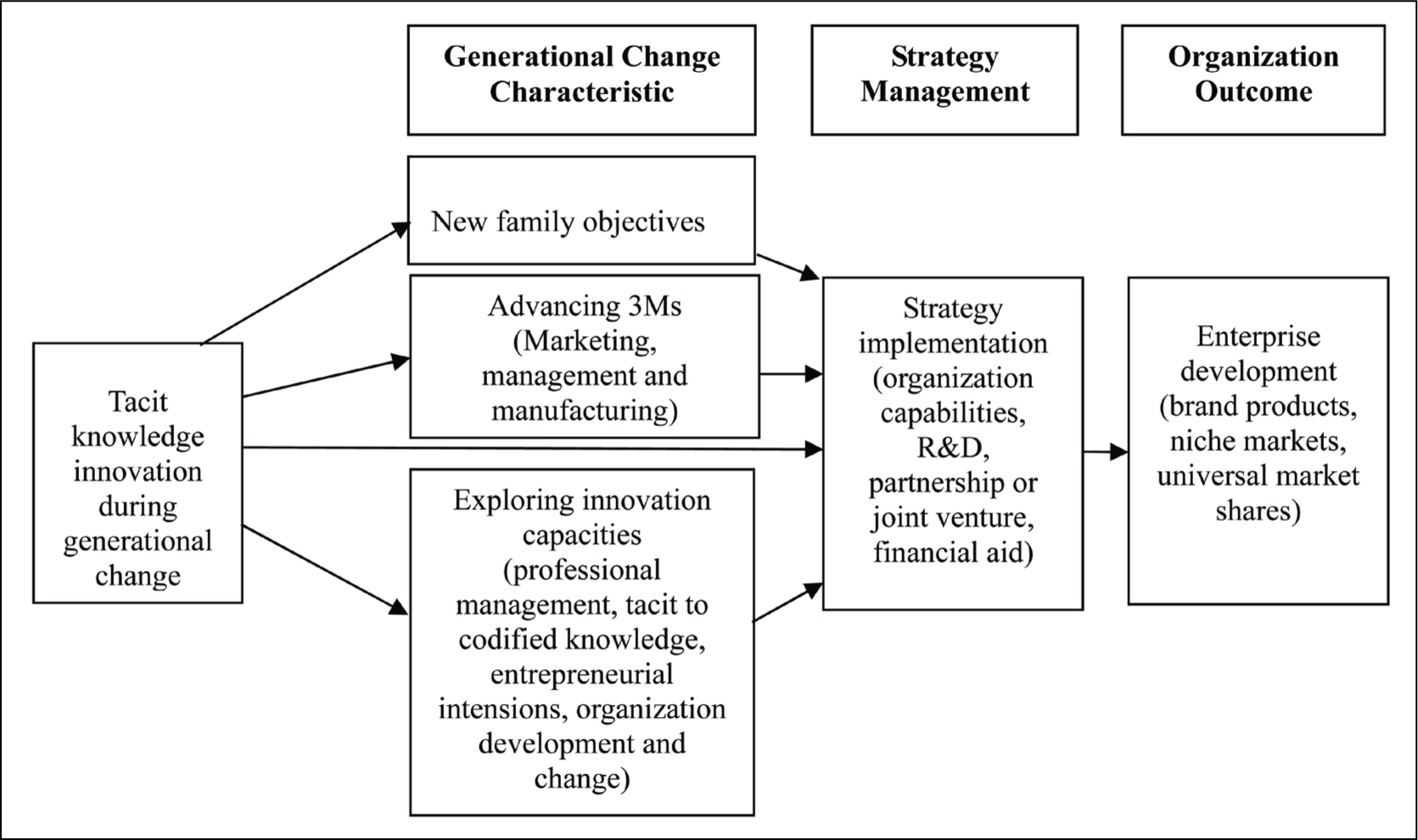
In formulating a conceptual framework for this study, relevant theories or disciplines have been considered as suggested by the previous researchers (Cope & Watts, 2000). When discussing previous studies, it is important to implement strategy towards enterprise development, this involves the generational change in three areas namely organization characteristics (objectives), organization structure (3Ms) and innovation capacity (professional management, tacit to codified knowledge, entrepreneurial intensions, and organizational change and development). Based on the published reports, it is observed that family history and profile (Colli & Larsson, 2013), organization structure in 3Ms (Lee & Xavier, 2022) and innovation capacity in a family firm (Lee, 2020; Naqshbandi & Tabche, 2018; Yadegaridehkordi et al., 2018) during a generational change (Fernández & Nieto, 2005; Gomez-Mejia et al., 2002) have impacts on the founder and the successors’ strategic goals which resulting in organizational outcome (Kelly et al., 2000; Morck & Yeung, 2003). Figure 1 shows how the ideas from other literature are incorporated to find the link between family enterprise, strategy management, and enterprise development by implementing suitable strategy towards organization outcome.
Proposed Conceptual Framework of Tacit Knowledge Innovation, Generational Change, and Enterprise Development in Family Enterprise.
Case Study Approach in Methodology
Background of Case Study
Kemajuan Plastics is a medium-scale family enterprise in Malaysia that pioneers in plastic carrier tape. Before Syarikat Perniagaan Kemajuan (SPK) becomes a well-known and reputable plastics business in Kepong Baru, this enterprise was founded by Mr Chia Kiu in 1973. Taking advantage of a booming industrial revolution during year of 1965–1970 in metal fabrication parts and accessories, he saw this as an opportunity to start a business in plastic industry. As an innovative man with great skills and knowledge in his field, Mr Chia generated his income by utilizing available materials, tools, and resources to make cupboard, container, and other products.
Despite only using basic machinery and tools in his works, this did not stop the elder Chia to make progress in his plastics-making business after took over the business from his previous regular Korean customer, making engineering plastic products, carrier tape, and semiconductor components when the opportunity arose during the booming of electronic industry in Malaysia. Over time, he was able to build a large business in creating plastic-based products based on his previous experience in metal fabrication and started purchasing injection moulding machine from the Korean customer. From metal fabrication (Hang San metal fabrication works) in Jinjang west, he moved forward to plastic carrier tapes production that cater solely to semiconductor industry in 1973 to the present day. Based on this enterprise’s outstanding growth, this reflects the company’s ability to adapt successfully with the ever-changing market and environment.
During the 1960s and 1970s, the steel industry was relatively undeveloped and the government paid little attention to the steel industry. The trade in steel was handled by Chinese SMEs, which operated in a market that was primarily made up of small Chinese manufacturers, fabricators, and traders. The larger and more lucrative foreign market was dominated by British steel manufacturers and British trading houses. By the mid-1970’s, the company began plastics injection moulding operations in Malaysia, a progress that has a huge impact in shaping the company’s current image: a respectable figure in the engineering plastics industry. After the elder Chia fully took over all the share owned by Korean customer include plastic machines, tools, and equipment, he formed a partnership with his good friend, elder Chin Wai Kuan. Then, he continued to collect the fund and startup capital to establish SPK, replacing metal fabrication activities with plastic injection carrier tape moulding. Cut from the same cloth as previous business activities, Mr Chia and Mr Chin have the necessary business acumen and realized the significance of modern machinery in production. Under their management, for the first time, the company attained an up-to-date injection moulding machine that was imported from the USA. As the production by the company becomes more in demand, more machines were needed. After operations were shifted to Kepong Baru industrial estate and keep away from housing estate during the year of 1980, numerous modern infrastructures were utilized by the company and by the 1990s, the company started exporting products to the USA and Asia Pacific region. Since the company was able to meet the strict international standards by manufacturing high-quality plastics, understandably the excellent image of this company grew.
Findings of Tacit Knowledge Innovation, Generational Change, and Enterprise Development in SPK
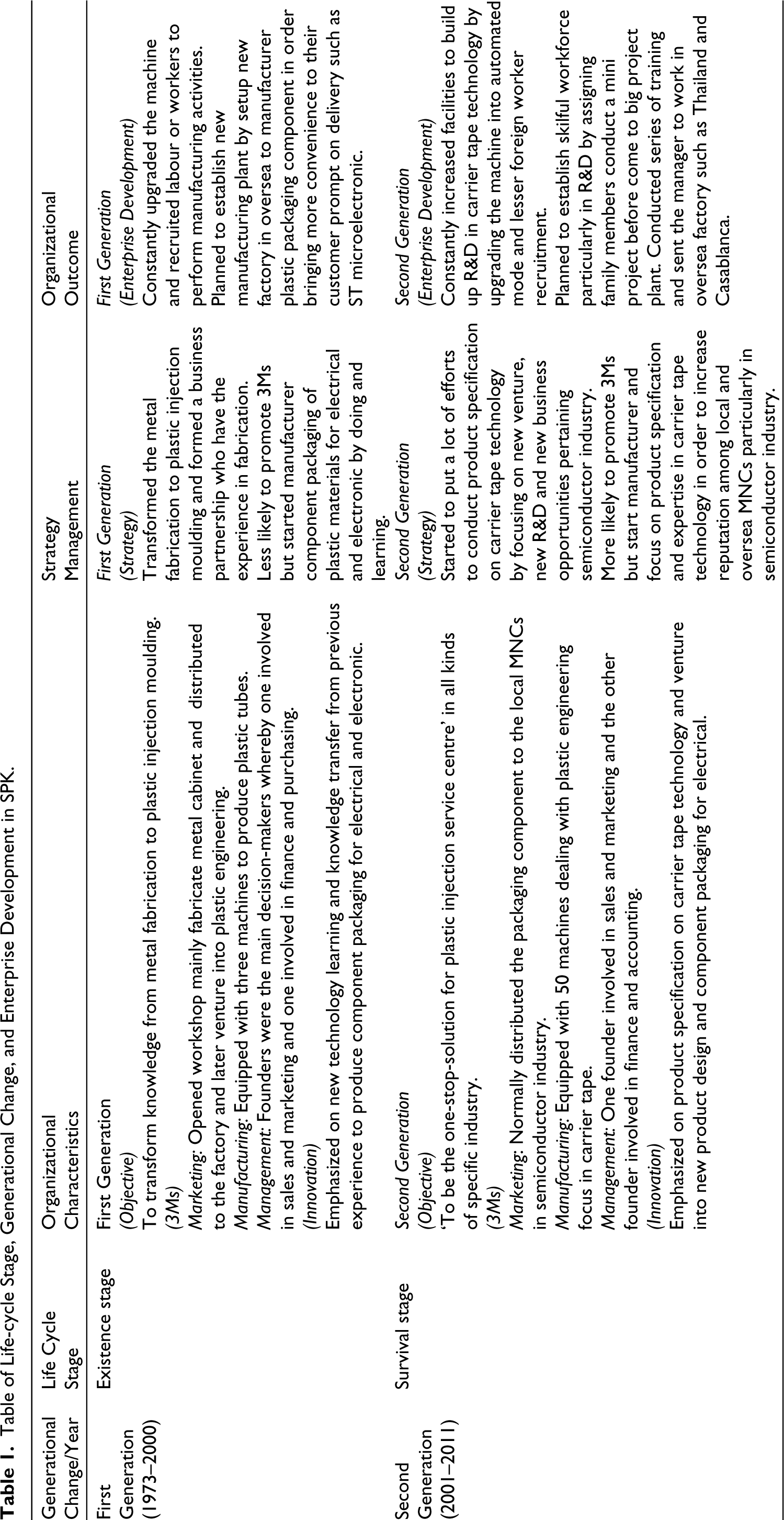
Referring to Table 1, existence-survival stage is the life cycle stage across 2 generations started from 1973 to 2011. In between, SPK faced great challenge during global financial crisis. However, they manage to overcome the problem since the company itself is focusing on product specification rather than all plastic related products. From generation to generation, second generation always focuses on sophisticated customization project in order to build more confidence from the customer and this is the only way to look at. SPK always in the survival stage to compete with others in lower price and shorter delivery time.
Table of Life-cycle Stage, Generational Change, and Enterprise Development in SPK.
Analysing the Life Cycle Stage During Generational Change in SPK
Existence Stage During First Generation—From Workshop to Semiconductor Industry Plastics
The plastic making attractiveness had become well-spread through the word-of-mouth specifically in Japan MNCs. New customers from other local MNCs were quite satisfied with the products sold by Kemajuan. Compared with those produced by other manufacturers, the products from Kemajuan were made with higher accuracy in measurement since they acquired knowledge in metal fabrication and always strive for high precision engineering. As local MNCs cluster in electronic sector started to visit workshop for one-stop service centre, product demands increased drastically and Kemajuan products were periodically improved in order to keep pace with technological advancement in semiconductor industry.
Survival Stage during second generation—From semiconductor industry to Original Design Manufacturer (ODM) for MNCs in Semiconductor
Discussion of Tacit Knowledge Innovation and Generational Change in SPK
‘Malaysia’s electronics industry has certainly come a long way over the last 30 years. From a handful of companies with less than 600 workers in 1970, the industry has today attained world-class capabilities and is the largest contributor to the country’s manufacturing output, employment and exports. There are currently more than 900 companies employing 360,048 workers. The value of exports in 2003 was RM183.2 billion (US$48.2 billion)’.
Source: Malaysia Department of Statistic for Electronic Industry (Monthly Manufacturing Statistic1997–2003)
SPK’s strength lies in the leadership of Mr Chia Kiu and Chin Wai Kuan, first-generation CEOs and Mr J. S. Chia and J. B. Chia, second-generation CEOs. With its vision, Kemajuan was assured to lead its industry:
‘In Kemajuan, we are producing and aimed at new markets in the US, UK, Northern Africa and Australia, which are expected to increase our revenue by 10% to 20%. It is difficult to say whether this year will be better than last year, as the business environment will depend much on whether the ringgit grows any stronger and the price of oil’. (J. S. Chia, second-generation CEO of SPK.) ‘In this industry, we hope the banker, Bank Negara Malaysia and government authority will discuss the issues included trade-line facilities, higher/additional collaterals, failing which credit limits would be reduced; and refection of applications for the expansion of existing facilities and/or hire purchase for new machineries. The rejection of the latter had prevented plastic manufacturer like us from investing new machines to achieve better efficiencies to meet quality requirements of customers’. (J. B. Chia, second-generation Purchasing Director of SPK.)
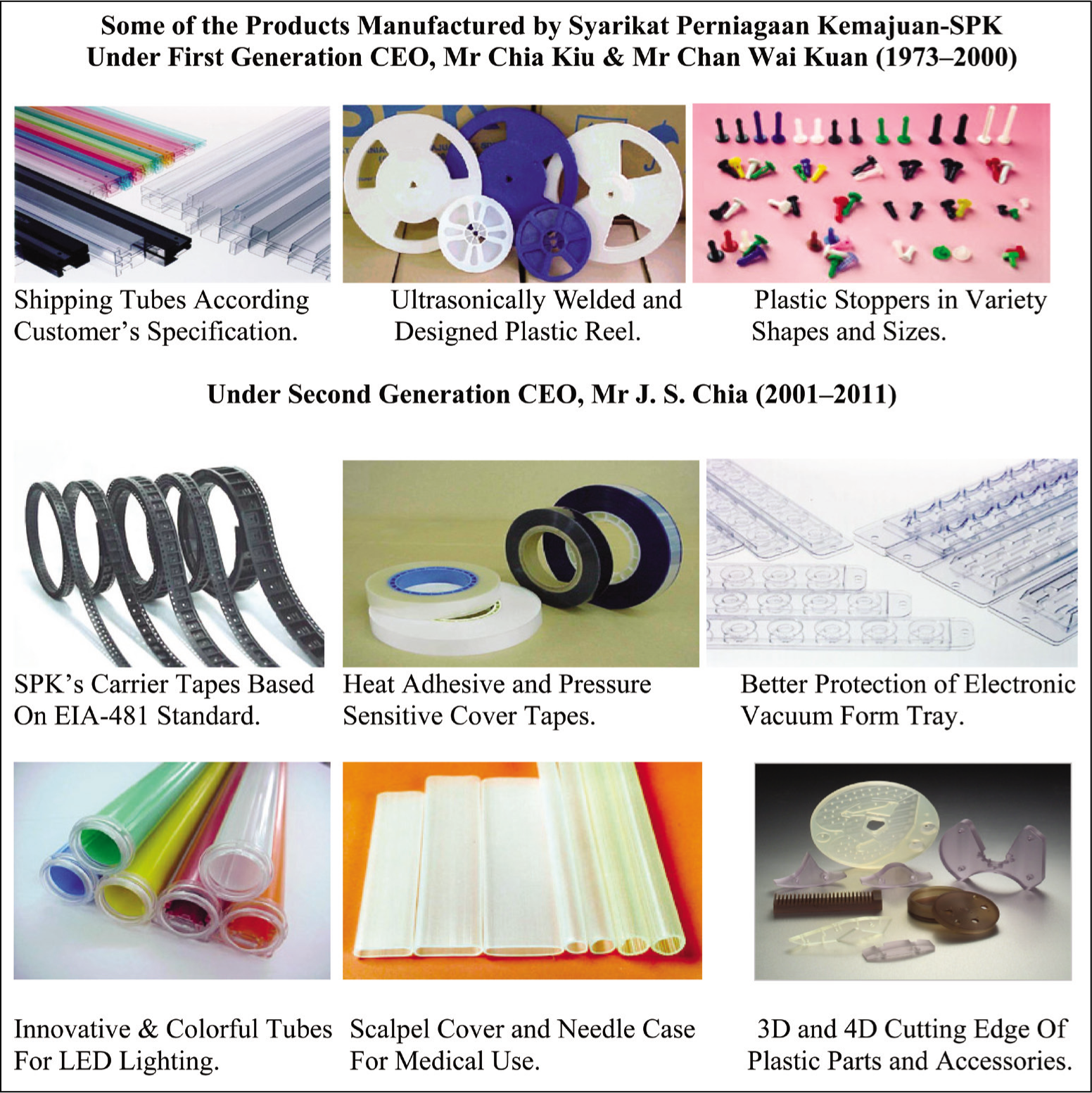
Referring to Figure 2, it is clearly shown that SPK is really focusing on technology changes from one generation to another. For example, shipping tubes, plastic reel, and plastic stoppers were normally welded and manufactured according customer specification during between 1973 and 1990. In the beginning, the first generation only focuses on plastic packaging in semiconductor industry. As time goes by, the second-generation CEO is getting more adventurous to venture into other industry, namely medical, automobile, lighting accessories, heat adhesive cover tapes, and innovative colourful tubes. Together, the second-generation CEO and his dedicated siblings learn the current technology of plastic injection moulding and conduct R&D in carrier tape technology in order to upgrade the product value which aligns with technology changes.
Tacit Knowledge Innovation in New Product Development in SPK.
Discussion of Organization Changes During Generational Change in SPK
Since 1973, SPK has strived to make improvement. The main problems faced by the group in 1997–1998 and 2009–2010 were Asian financial crisis and US financial crisis. In 1998, Malaysia had faced a reduction in GDP growth because of the Asian financial crisis. Consumer sentiment was also adversely affected since SPK has the customer based in Thailand mostly involved in semiconductor industry. In contrast, the present crisis was directly killing SPK slowly with the weakness in the United States financial industry, leading to a global financial crisis and worldwide trade recession by the end 2008.
Consequently, major economies in the world are experiencing the most severe economic contraction since the 1930s. This is because SPK’s majority business is dealing with US and Japanese customer in semiconductor industry and they actually suffer capital flight since the second quarter of 2008. In the US and the West, financial institutions dropped their transnational business and fixated on their domestic market. Thus, SPK’s majority export products to US and the West have been declined tremendously since funds flowing into Malaysia market was greatly reduced. In light of the situation, J. S. Chia with his siblings upgraded the production capabilities and current carrier tape research laboratory to compete with their competitors in Malaysia, Thailand, and China since family Chia noticed that most Thai and China suppliers lacked of skills.
He and his siblings quickly restructured the organization structure by focusing more into their signature products of carrier tape by implementing 3Ms practice. They also recruited new talented project manager, upgraded to the latest technology, and made plans for more distribution channel aim to MNC in semiconductor industry. Slowly, Chia family was able to implement international standards in procurements and assembler-suppler relations to maintain quality and price internationally competitive. Under second-generation leadership, J. S. Chia with his dedicated staffs continued proactively by approaching local suppliers to fulfil the requirements of local content and offer support, if needed, to local firms to cater local and international MNCs. Their efforts came into fruition as they managed to save SPK from declining and they continued getting more orders that required customization from their customers.
From Small Workshop to One of the Most Established ODM Plastic Firms in Malaysia
From 2001 until 2006, the Malaysia plastics packaging sub-sector was reported as the main market segment for the plastic industry which exhibited a sturdy growth, particularly over 20% growth in the export sectors. Considering that Kemajuan was expecting a moderate growth of 5% in 2001–2004, this company’s outlook was promising. The company growth was contributed by the encouraging advancement in the domestic sub-sectors’ performance, including the automotive, construction, and packaging sub-sectors. Seeing as AFTA and the accession of China to WTO were expected to be fully implemented, this posed challenges for Kemajuan.
This is because Kemajuan forecasted that they would face a marginal decline due to huge competition from low-cost producing countries, such as China. As a result, founder of Kemajuan with his son, J. S. Chia did not choose China as their main choice of oversea sales office and factory. With the implementation of AFTA, this lead Chia family venturing into semiconductor industry targeted to ASEAN MNCs market. In light of the enlarged ASEAN market and bigger access to China’s domestic market, Kemajuan had more business prospects to discover, mainly for products with potentials niches and market segments developments.
Hence, to thrive in these competitive markets and market segments, there was a need for Kemajuan to improve their capabilities and produce products with better qualities. According to the WTO Agreement on Technical Barriers to Trade, it is required to notify new standards and regulations on products 6 months prior their implementation. This procedure thus permits impacted parties to gain explanation and offer insights before a regulation is put into effect. Moreover, this allocated time period allows manufacturers to make the required changes on a certain product safely before it is marketed. This assesses the industry’s capability to work with great efficiency while adapting to the strict requirements of the current market. To cope with the NEP policy, one of the strategies that has been implemented by Kemajuan is recruiting Mr Sazali as their export consultant manager to monitor the overall export activities. Since he used to work in Malaysia custom for several years, his experience and expertise in export activities are vital in ensuring that Kemajuan’s trade is in accordance with Malaysia’s standards and regulations before exporting the products to other countries, as well as making sure that their plastic parts and accessories are in compliance with the standards from MNCs in Malaysia.
In order to address some of the issues that are experienced by local SMEs in fulfilling the requirements and designing capabilities, SMEs could cooperate with SMIDEC in upgrading their in-house design capabilities. However, first-generation CEO argued that they seldom seek financial aid from government authorities due to the technical and design secrecy in this industry. By creating brand recognition and building good reputation, Kemajuan is able to offer trustworthy and reliable services and products to both local and international MNCs, particularly in semiconductor industry. Business networking of these two markets provides support to the government authorities.
Implications
This article has signification implications, particularly for new generation in family business and small business owner. The analysis undertaken from an organization change and evolution standpoint demonstrates that since plastics family firms such as SPK had to follow strict regulations and contract terms, it is complicated to combine various technologies to form new products. In discussing the family organization, the family members had the power to control its development. In terms of knowledge acquisition, the first and second generations had practical experience during their childhood, but for the second generation, acquiring knowledge from the current trend in plastic technology is essential. The findings emphasize the need for business owners and manager to advance the tacit knowledge innovation as by effectively developing it, this would ensure the sustainability of the enterprise. Finally, note that long-lasting OEM firm has the tendency to devise a renewal plan by highlighting its tacit knowledge innovation during generational change, and demonstrating its capacity to stay competitive in market.
Conclusion
In previous literature, it has been stated that the events that occur during the generational change in the family enterprises will pose changes in the structure of the organization, particularly 3Ms (Colli & Larsson, 2013; Lee & Xavier, 2022). Typically, professional managers will gain the appropriate training in a business school setting. In this article, family enterprises keep evolving during generational change by utilizing the skills of management science to maintain a competitive edge. During second and third generation in the family enterprises, they are more likely to localize, centralize, decentralize, and customize to encourage flow of innovative idea towards quality resource utilization and more professionalize. The founders in the first generation usually act as venture entrepreneur, depending on their accumulated knowledge transfer or experience. They refuse to join venture with other people due to the higher content of technical secrecy unless those are the founder’s trusted partner. The next generations usually are more internationalize thus oversea branches or organization change and development can be seen during the second generation.
In terms of management, usually first generations they have a preference for privacy and are less likely to employ professional managers, outsourcing, and offer training to their management team compared with the next generation. In terms of marketing, founders usually lack of marketing capabilities to conduct an efficient marketing and promotion plan. Word-of-mouth and relational marketing are the common marketing strategies during the first generation. Since marketing channel becomes more globalized and customer requirement keep changing, mostly successful family enterprises in this study are combining management, marketing, and manufacturing perspective to conduct R&D on new product development.
Limitations and Future Studies
First, it is possible that interviewer bias was shown by the respondents to safeguard the trade secrets. Second, since it is proven that family firms have dual impact on role of sociocultural characteristics and the development process, the family firms’ rise and fall should be highlighted in future studies. Third, in further research, perceptions of employees and stakeholders on tacit and explicit knowledge regarding challenging technology environment should be considered. Last, seeing as this research only considered single case study in the west Malaysia, future works should consider entrepreneurial family firms in the east Malaysia.
Footnotes
Declaration of Conflicting Interests
The author declared no potential conflicts of interest with respect to the research, authorship and/or publication of this article.
Funding
The author received no financial support for the research, authorship and/or publication of this article.
Appendix
It is a widely known fact that the economy in this country is largely contributed by the success of family businesses. The present work seeks to enhance our understanding on enterprise developments that occur as a result of innovation capacity following generational change in a family business. In addition, this study aims to offer suggestions to catalyze the enterprise development of family businesses. Since you and the members of your organization have the first-hand experience on this topic, your insights will be useful in achieving the objectives of this study. Any information that will be provided by your party will be treated with strict confidentiality. For the ease of analysis, if permitted, the interview process will be recorded and transcribed. At the end of this research, the tapes will be destroyed and any personal or company details will not be disclosed in the transcripts. In the published reports based on this work, the name of your firm will not be identified, unless permitted by your party. Although the interview process will be carried out in an informal manner, a general interview method will be adopted during the process.
(Company Stamp) Please state which generations of your family enterprise? 1st, 2nd, 3rd or more.