




Abstract
Workplace spirituality has received widespread acceptance among scholars and practitioners due to its value-laden approach in all organizations. Despite substantial efforts to unite the literature, scholarly knowledge on workplace spirituality appears scattered and incoherent. The study aims to undertake a scoping review of the existing literature on workplace spirituality to track the evolution of the concept and point out the research gaps for future studies. The sample papers for review are assembled from the SCOPUS database using a two-step manual screening procedure. This article examines 135 conceptual, review and empirical works associated with more than 50 journals published between 2000 and 2023. The main finding is that the concept of workplace spirituality is complex, with conflicting dimensions, and lacks a clear definition. Workplace spirituality is a multifaceted construct comprising individual, organizational, psychological and social variables. The assessment provides an in-depth understanding of the current state of workplace spirituality. In addition, we offer potential research gaps which will serve as a beacon of light for future workplace spirituality research.
Introduction
The global business environment affirms that organizations need to nurture and retain a highly competent workforce to generate competitive advantage and enhance sustainability. In recent workplace trends, employee spirituality is considered a distinctive feature of the organization’s development. Spirituality in the workplace has apprehended the interest of academics over the past two decades and has gained traction in organizational and behavioural studies during the COVID era. Workplace spirituality means being appreciative of others, enjoying job roles and caring about organizational ideals (Petchsawang & Duchon, 2012). Owing to the dwindling influence of families, neighbourhoods and communities, employees require workplace spirituality for personal growth (Jurkiewicz & Giacalone, 2004), and it promotes a culture of trust, creativity, mutual love and affection (Prabhu & Modem, 2023). Workplace spirituality fosters mindfulness, which leads to innovative thinking and creativity, and can encourage individuals to experience attentiveness in a deeper way, boosting their innate capability to generate more significant and persuasive thoughts (Afsar & Badir, 2017). Workplace spirituality does not belong to a radical concept. Earlier, there has been an excessive amount of focus on theology in the spiritual context. In the modern era, it is entirely built upon the foundations of individual beliefs along with individual ideologies (Ullah et al., 2020). More generally, workplace spirituality encourages a worker to look into the true meaning and purpose of existence (Garg et al., 2019). Workplace spirituality satisfies profound behavioural requirements, including comprehensive personality growth with care, confidence and optimism (Aboobaker et al., 2022). Workplace spirituality is also noteworthy, like other administrative and operational elements for every business (Al-Mahdy et al., 2022; Garg, 2017). Workplace spirituality refers to employees and their organizations embracing employment as a means of enlightenment or a platform to develop and serve constructively to their community (Fry, 2003; Jena & Pradhan, 2018). It is imperative to handle spirituality in the workplace carefully because, with proper management, it may be used as a tool by employees to govern their behaviour at work and increases job happiness (Eliyana & Sridadi, 2020). Workplace spirituality involves a set of organizational principles and cultural norms that represent inner life, transparency, caring, connection, dignity, humbleness, empathy and transcendent within the organization (Jurkiewicz & Giacalone, 2004; Saeed et al., 2022).
The literature on workplace spirituality includes articles reaching back to 1995. Interestingly, workplace spirituality is a complex idea and a hard-to-measure construct precisely because of the ambiguity inherent in the name itself. This is bolstered by the fact that there is no common agreement on the definitions, theoretical underpinnings and essential dimensions of workplace spirituality (Hudson, 2014), which is exacerbated by the existence of several measurement methods of the construct (Garg et al., 2019; Rego & Pina e Cunha, 2008; Rego et al., 2007). There is a lack of clarity on what actually workplace spirituality is, how it works, what causes it and how it is related to other variables. The existing studies that have explored workplace spirituality are fragmentary in nature and lack a rigorous conceptual framework. Therefore, a review of workplace spirituality outcomes, moderators, mediators and relationships with other potential variables is required. In light of the dynamic nature and constantly emerging ideologies of workplace spirituality, it is necessary to investigate its trajectory and expansion. There has not been a comprehensive review of the field’s current state of growth. Although Mhatre and Mehta (2023) tried to bridge the gap through a systematic literature review, but their sample size was limited to 72 articles. Consequently, this work seeks to unravel the unifying threads of the existing workplace spirituality literature to ascertain potential research gaps that can aid in future knowledge of the subject.
Method
Study Design
A scoping review was chosen because it is an appropriate method for discovering knowledge gaps and investigating unidentified themes in the literature (Peters et al., 2015). It involves five steps comprising identifying study/research objectives, pinpointing the relevant literature, study selection, charting the data and summarizing and reporting (Arksey & O’Malley, 2005).
Database and Search Strategy
This scoping review has considered the scientific database SCOPUS rather than the Web of Science and Google Scholar because it is the largest scientific database containing consistent repositories and other aspects like authors, countries, important journals, citations per document and average publication per year. SCOPUS chooses articles for its index based on impartial and uniform criteria and covers a broader range of documents than the Web of Science (Dinh et al., 2023). In comparison to Google Scholar, SCOPUS offers more sophisticated exportation possibilities for bibliographic information (Hallinger & Nguyen, 2020). The search process was completed using the keywords: ‘workplace’ and ‘spirituality’.
Inclusion Criteria
This scoping review included both qualitative and quantitative articles published in journals. The inclusion criteria are based on the search field: business, management and accounting, social science; document type: articles and review papers; publication stage: final; source type: journal; language: English.
Search Outcomes
The initial identification of articles using the search strategy resulted in 1,164 documents. After applying the inclusion norms (Figure 1), the number of articles was reduced to 417 documents, out of which 298 documents contain only workplace spirituality. We opted to concentrate on articles which are solely about spirituality. As a result, articles related to categories, such as religious diversity and religion, were excluded from the study. So, 78 research articles were eliminated because they did not fulfil the requirements. The study included conceptual, review and empirical literature on workplace spirituality. Afterwards, the complete texts of 220 publications which only consider workplace spirituality were read. The titles as well as the abstracts of the articles were considered to determine their appropriateness and 135 documents were ultimately selected for the study. This article did not use any statistical approach for getting the results. Overall, the study reviews papers on workplace spirituality, different dimensions, as well as interrelationships between workplace spirituality and employee, job and organizational domains.
Methodological Procedure.

Results and Discussions
Workplace Spirituality: Definition and Conceptualization
Authors have endeavoured to define workplace spirituality through multiple perspectives. However, the unifying theme of all the definitions is related to meaningful work, inner life, values or experience, the wisdom of self-transcendence, belongingness among co-workers and mutually shared ideals among individuals and organizations. According to Neck and Milliman (1994), workplace spirituality is the employee’s appeal to comprehend the meaning or purpose of his work life. Workplace spirituality is people’s inner values, beliefs and feelings that impact their conduct in the work environment (Mitroff & Denton, 1999). Using an existential view of spirituality, Ashmos and Duchon (2000) conducted the first empirical research on spirituality in the workplace that explained it as the realization that employees have an inner motive that is nurtured and nourished by meaning, and purposeful work within the organization. Giacalone and Jurkiewicz (2003) described workplace spirituality as ‘a basis of organizational norms that foster employees’ perception of transcendence through their effort, encouraging their sense of belongingness to other employees which will generate feelings of completion and joy’. Jurkiewicz and Giacalone (2004) defined workplace spirituality as a value articulated in organizational culture and involves employee familiarity with meaningful work, integration into the group dynamic, sentiments of affinity with the organization and ultimately self-transcendence. Workplace spirituality is a person’s sense of vitality, joy, harmony between value and meaningful work, association with others, something larger than himself and transcendence (Kinjerski & Skrypnek, 2004; Petchsawang & McLean, 2017). Spirituality at work is about seeking meaning and purpose, being connected and transcending (Garg, 2017). Although workplace spirituality has been well-defined through a number of concepts, scholars are yet to settle on a consensus definition. Workplace spirituality is the sense of employees with meaningful work, connection with others and matching between organizational and individual values (Shrestha & Jena, 2021).
Workplace Spirituality Dimensions
Meaningful Work
Meaningful work was originally proposed by Hackman (1980) in their job characteristics model which proposes that employee involvement is high in a job that provides opportunities to utilize a variety of skills, enhance their potential and benefit society. Meaningful work is a noteworthy dimension of workplace spirituality because it encompasses the exploration of a profound sense of purpose in work, and expressing the demands of their inner life through meaningful labour (Ashmos & Duchon, 2000). Authors have expressed meaningfulness through synonymous terms like karma capital, contribution to the community, enjoyment at work and swadharma. Karma signifies action or activity (Gita Chapter 2, verse 50) and is defined as the full psychological motivation behind every action (Harvey, 2001). In swadharma, ‘swa’ means own and ‘dharma’ means legitimate action.
Sense of Community
Sense of community entails deeper relationships and connectedness with colleagues at the workplace (Ashmos & Duchon, 2000). The employees’ interactions with others make them interdependent and an integral part of the workplace community (Mitroff & Denton, 1999). A positive feeling of togetherness at the workplace can help the employees to connect their inner selves with others, leading to pleasant emotions (Jurkiewicz & Giacalone, 2004). Extant researchers have articulated a sense of community by means of words like compassion, other’s orientation, lokasangraha, and sociability. In the organizational context, the term lokasangraha denotes ‘lok’ means an organization and ‘sangraha’ means interconnectedness among employees. Sociability means interdependence between people and their communities. Compassion is the profound consciousness and sympathy for everyone (Twigg & Parayitam, 2006) to alleviate their sufferings through mutual caring and sharing.
Alignment of Organizational Values
Alignment of organizational values assesses the employee’s connection with the organizational goals, mission and vision. This entails linking personal values and beliefs with the larger organizational purpose (Milliman et al., 2003). Alignment with values is plausible when the employee visualizes that the organizational members espouse positive values, practice ethical behaviour, and prioritize employee well-being (Ashmos & Duchon, 2000). Employees align with the organizational value and consider workplaces as ‘great places to work for’ when the goal of the organization is not only to generate greater revenue and profitability but also to make significant contributions to the development of the employees, communities and society.
Expression of Inner Life
Expression for inner life is the opportunity that enables employees to examine their lives through the lens of spiritual development and self-actualization (Khari & Sinha, 2020). Therefore, the consciousness of one’s spiritual self is a prerequisite to the inner self-dimension of workplace spirituality (Ashmos & Duchon, 2000; Fry et al., 2005). The dimension encompasses discovering a unique self-identity and having clarity on the goals of life, the sources of motivation and the ways to be adopted for achieving success (Duchon & Plowman, 2005). The workplace that facilitates the accomplishment of the employees’ spiritual demands along with their materialistic needs also empowers them to nurture themselves positively and experience high levels of self-esteem and self-worth.
Mindfulness
Mindfulness is the intellectual capability of paying attention to the present moment (Hayes & Shenk, 2004). It helps in minimizing the negative effects of work overload, stress and fatigue on mental health (Leary, 2007). Mindfulness is a self-driven behaviour that comprises the ability to pay attention and be aware of both internal and external circumstances taking place at the moment (Brown & Ryan, 2003). Employees who practice mindfulness can improve their focus levels in stressful situations, allowing them to be more productive and effective. Mindfulness is a contemplative practice that improves consciousness, focus and creativity. Greater awareness and concentration are achieved through mindfulness leading to decreased stress level along with energized body, mind and behaviour.
Transcendence
The word transcendence signifies the mental strength, thoughts and concentration level of the employees and their connection with a higher power. The notion of transcendence in management resembles Abraham Maslow’s concept of self-transcendence, which is described as the ultimate level of human desire. The term transcendence refers to a positive state of energy or vibrancy that enables employees to achieve ecstasy and euphoria while being engaged in their work roles (Kinjerski & Skrypnek, 2008). Transcendence can spike pleasant emotions of joy and vitality that sustain the motivation to work even after attaining self-fulfilment (Wong, 2016). Transcendence does not relate to god because it is above religion but deals with spirituality (Kinjerski & Skrypnek, 2006).
Authenticity
An individual whose words and behaviour reflect their values is authentic. Authenticity means accepting one’s experience, feelings, desires, requirements, opinions and beliefs (Avolio & Gardner, 2005). Authenticity is a concept employed in both psychology and philosophy. It refers to the conformity of an employee’s actions and behaviours with their fundamental and assumed cultural beliefs and values (Pandey et al., 2016). The concept also examines the level of genuineness that is perceived by the organizational members about the employee’s interactions and behaviour. A member is often recognized as authentic if he/she is truthful to himself and others (Garg, 2017).
Gratitude/Kritagayata
Gratitude is a good emotion characterized by thankfulness for a person, object or occurrence (Emmons & McCullough, 2003). Practising gratitude increases life satisfaction and has a positive effect (Cunha et al., 2019). In the Indian context, the phrase kritagayata denotes the feeling of appreciation for the divine. Attaining spiritual ideals indicates the zenith or sophisticated and prolonged form of gratitude. Spirituality is based on a sense of gratitude for all forms of existence. Shrimad Bhagwad Gita discourses that one should be grateful for whatever they have. Indians value almost everything accomplished for humanity. The noble habit of gratitude leads to serenity and growth in spirituality (Saxena et al., 2020). The dimensions of workplace spirituality are represented in Table 1.
Dimensions of Workplace Spirituality Proposed in Studies.

Workplace Spirituality Scales
The relevant scales adopted by different researchers to measure workplace spirituality are presented in Table 2. Milliman et al.’s (2003) scale is adopted by the highest number of research articles trailed by the Ashmos and Duchon (2000) scale; and a combination of both the Ashmos and Duchon (2000) scale and Milliman et al. (2003) scale. The Milliman et al. (2003) scale of workplace spirituality involves three dimensions with 21 items: meaningful work (six items), sense of community (seven items) and alignment with organizational values (eight items). The workplace spirituality scale developed by Ashmos and Duchon (2000) comprises 21 items and three dimensions, namely a sense of inner life (five items), meaningful work (seven items) and a sense of community (nine items). Rego and Pina e Cunha’s (2008) scale on workplace spirituality includes 17 items and five dimensions: alignment with organizational values (five items), sense of community (five items), contribution to community (three items), enjoyment at work (two items) and opportunities for the inner life (two items). The 12-item Milliman et al. (2018) scale consists of three dimensions, that is, work full of meaning, sense of togetherness and connection to organizational values. The Spirituality Scale developed by Petchsawang and Duchon (2009) comprises four dimensions namely mindfulness (six items), compassion (four items), meaningful work (six items) and transcendence (five items). Duchon and Plowman (2005) developed a scale for measuring workplace spirituality consisting of three dimensions with 21 items: inner life (five items), meaningful work (seven items) and sense of community (nine items). Gatling et al. (2016), Haldorai et al. (2020), Sharma and Kumra (2020), Shrestha and Jena (2021), Srivastava and Gupta (2022) measured workforce spirituality using a scale that combines Ashmos and Duchon’s (2000) scale and Milliman et al.’s (2003) scale. Similarly, Garg (2020) and Saxena et al. (2020) adopted a scale comprising items from Pandey et al.’s (2009) and Garg’s (2017) scale to assess workplace spirituality. Likewise, Campbell and Hwa (2014) used both Rego and Pina e Cunha’s (2008) scale and Milliman et al.’s (2003) scale to gauge workplace spirituality. All scale items were evaluated on a 5- or 7-point Likert scale having a range from strongly disagree to strongly agree.
Scales for Measuring Workplace Spirituality.

Theories in Workplace Spirituality
The primary theories that have set the foundation of the concept of workplace spirituality are depicted in Table 3. The widely used theories to define workplace spirituality are social exchange theory, self-determination theory, spiritual leadership theory, social cognitive theory, person–organization fit theory and job demand resources theory.
Important Theories Supporting Workplace Spirituality.

Social Exchange Theory
In 1958, George Homans introduced the concept of social exchange theory. The theory proposes that a type of reciprocal duty emerges between parties in a situation of mutual dependence, such that the activities of one party evoke a matching action or reaction from the other party. When employees enjoy and find meaning in their job, they tend to demonstrate company loyalty and other pro-business attitudes and behaviours. In contrast, workers who experience negativity are more prone to demonstrate unfavourable attitudes and behaviours, such as cynicism, carelessness and counter-productivity, as well as the desire to leave their current employment (Ahmad & Omar, 2014; Haldorai et al., 2020; Zhang, 2020). In a spiritual organization employees always think their organization is taking care of both their personal and professional life. So they are more motivated to work in the organization.
Self-determination Theory
Psychologists Edward Deci and Richard Ryan in 1985 proposed self-determination theory. The theory suggests people have an underlying need for relatedness, autonomy and competence. The autonomy need and the alignment with organizational values’ dimension both have a similar understanding of how the process of alignment between an individual and his or her works (Srivastava & Gupta, 2022). The urge for autonomy drives an employee’s activities to be congruent with personality cohesiveness (Gatling et al., 2016). Employees show self-determination to meet the demand for meaningful work. The need for competence is a proper explanation for employees seeking meaning in their work as it helps fulfil their intellectual potential and creativity. The relatedness need of self-determination theory is associated with the sense of community (belongingness) dimension of workplace spirituality.
Spiritual Leadership Theory
The theory was proposed by Fry (2003). Spiritual leadership theory is focused on the values, attitudes, characters and behaviours that can motivate self and others to attain a sense of spirituality (Duchon & Plowman, 2005). A spiritual leader is one with innovative knowledge and skills along with empathy, spiritual wisdom and maturity (Mohammed & Elashram, 2022). The leaders may indulge in workshops, activities and spiritual practices that can enhance the latent qualities of integrity, honesty, humanity and trustworthiness among the employees. The actions, decisions and words of a spiritual leader are based on careful thoughts, authenticity and affection that create a climate of spirituality in the workplace. Spiritual leadership is an inner feeling of leaders which enables them to connect with others and serve for a common goal instead of thinking about self-interest (Fry, 2003).
Social Cognitive Theory
Albert Bandura in 1986 developed social cognitive theory. This theory is a human agency paradigm in which persons actively involved in self-reflection, self-regulation and self-organization. The theory encompasses the triadic reciprocity of personal, environmental and behavioural factors. Thus, social cognitive theory incorporates moral and psychological considerations and provides a standard in which human elements like ethical ideas and affective self-reactions, ethical activity and environmental factors can interact with each other (Bandura, 1986). Employees are more motivated and empowered when they believe that their organization is fostering an atmosphere that supports and encourages workplace spirituality through its values and ambience of the community (Otaye-Ebede et al., 2020).
Person–organization Fit Theory
The theory recommends that an individual is more likely to gain positive outcomes at the workplace provided that his/her needs, values and beliefs are aligned with the organization. As per the demands–supply perspective of the person–organization fit theory, ‘fit occurs when an organization meets the needs of its members’. Employees who engage in workplace spirituality live integrated lifestyles within the organizations and are more in line with their mission and core values. Their perception that their principles, identities, demands and talents match those of the organization and its values, beliefs, resources and requirements help to increase their person–organization fit (Palframan & Lancaster, 2019). However, if they have a lower level of workplace spirituality, their personal ideals conflict with organizational values and they feel alienated and cut off from the workplace.
Job Demand Resources Theory
The theory emphasizes on job demands and job resources. Job demands are the elements of the job that require continuous physical, emotional or cognitive effort (Bakker & Demerouti, 2007, 2017). Job resources are those parts of a job that assist workers to achieve their professional goals, lessen the burdens of their work and help to develop their potential (Demerouti et al., 2001). High job demands lead to negative physiological and psychological outcomes, whereas high job resources lead to more motivation, productivity and work engagement.
Antecedents of Workplace Spirituality
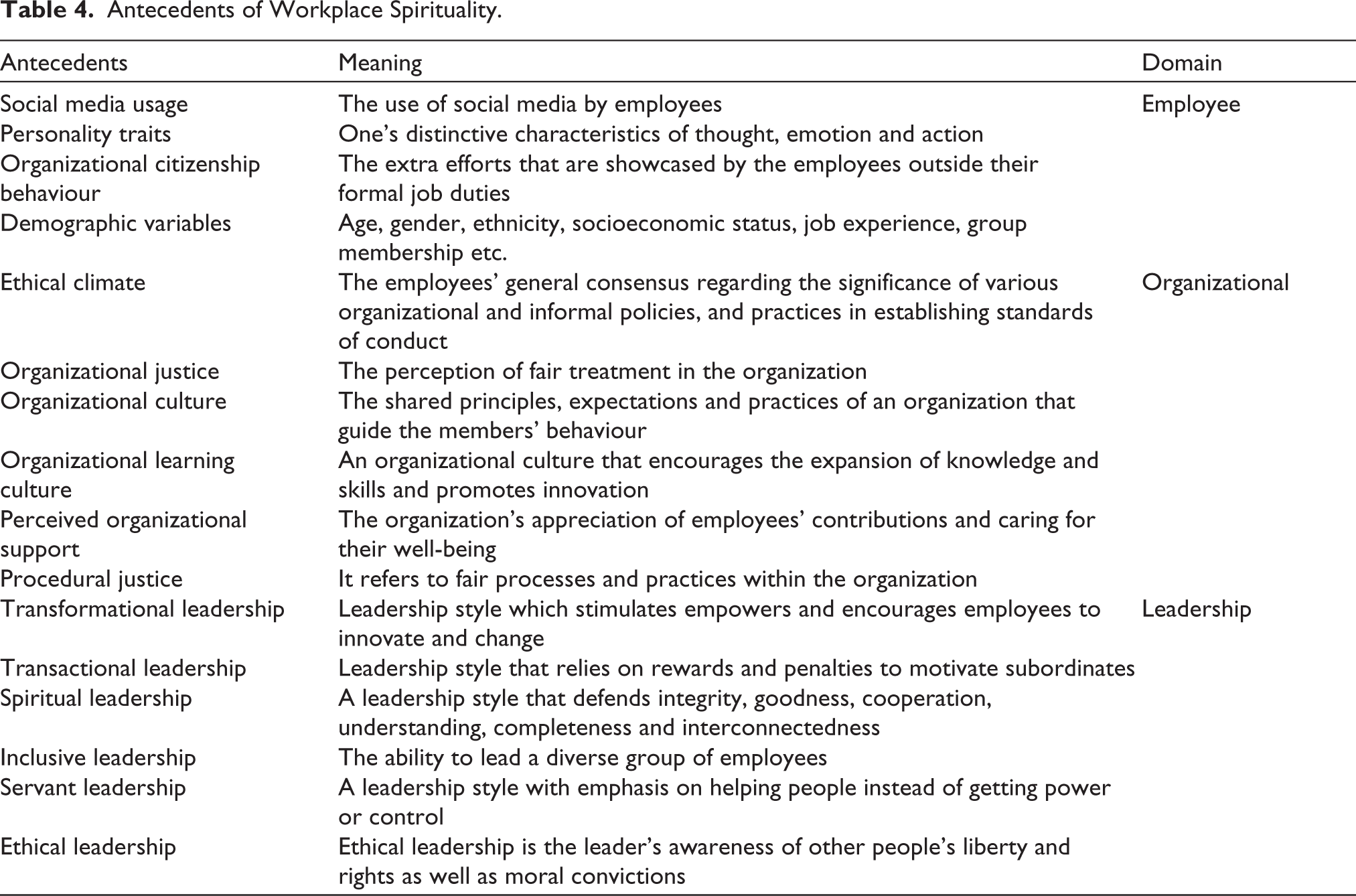
The list of the antecedents of workplace spirituality identified in the scoping review is presented in Table 4. The antecedents are grouped under three domains, that is, employee, organizational and leadership. The antecedents in the employee domain are those variables that are related to the employees, such as work-related attitudes, situational variables, responsibilities, demographic variables and physical characteristics. The organizational domain includes variables derived from organizational conditions, the internal environment and the surrounding external environment. The variables associated with the behaviour of the supervisors, leaders, and leadership style are placed in the leadership domain. Zhou and Mou (2022) emphasized that socialistic, cognitive and hedonic use of social media increases workplace spirituality by enhancing the rational energy of employees. The personality traits of employees like extraversion, and conscientiousness positively influence workplace spirituality whereas traits like neuroticism, agreeableness and openness have a negative influence on workplace spirituality (Tutar & Oruç, 2020). Indartono and Wulandari (2014) found a strong correlation between workplace spirituality and commitment among males than in females. In hotel industries, workplace spirituality acts as a mediator between organizational characteristics like justice and ethical climate and deviant behaviour (Haldorai et al., 2020). Similarly, the two dimensions of workplace spirituality, that is, meaningful work and sense of community mediate the relationship between perceived organizational support and career satisfaction (Bhaskar & Mishra, 2019). An ethical organizational environment combined with ethical leadership espouses the sentiments of care, mutual trust, benevolence, fairness and equality, which are precursors to spirituality in the workplace (Haldorai et al., 2020; Ozdemir et al., 2022; Srivastava & Madan, 2023). Sorakraikitikul and Siengthai (2014) studied that the organizational learning culture fosters a meaningful work environment and significantly influences knowledge transfer in organizations. The effectiveness and style of a leader can play a vital role in facilitating the culture of workplace spirituality. Servant leaders possessing diplomacy and strong political skills are pivotal in fostering workplace spirituality and infusing innovation among their followers (Williams et al., 2017). Similarly, transformational leaders often motivate employees to be energetic, productive and have high spiritual values (Porter et al., 2023). Essentially, spiritual leadership, enriched with the values of sacrifice, inspiration, courage and connectedness between employees, acts as a dominant impetus for workplace spirituality (Mohammed & Elashram, 2022; Zou et al., 2023).
Antecedents of Workplace Spirituality.
Outcomes of Workplace Spirituality
Workplace spirituality can produce a variety of outcomes for employees, jobs as well as organizations that are displayed in Table 5. Spirituality in the workplace benefits both employees and organizations (Milliman et al., 2018). Employees who experience high spirituality perceive their careers to be more satisfying, while employees with low spirituality tend to have challenges at work (Afsar & Rehman, 2015). A strong feeling of workplace spirituality encourages employees to showcase organizational citizenship behaviours and go out of their way to reap benefits for both employers and employees. Organizations with high workplace spirituality comprise employees with high level of helpfulness and commitment (Adi & Fithriana, 2020; Utami et al., 2021). Workplace spirituality has a positive effect on psychological well-being (Mahipalan, 2019), subjective happiness (Mahipalan & Sheena, 2019) and is strongly correlated with employees’ intentions to remain with the company for the long term (Aboobaker et al., 2019; Milliman et al., 2018), and thus it promotes employees’ intention to stay (Febriani et al., 2023). Workplace spirituality can help in reducing the incidence of unpleasant behaviour or incivility (Lata & Chaudhary, 2021) and experience of incivility (Lata & Chaudhary, 2022) in the workplace by encouraging a more respectful culture. The employee’s opinions of the ethical climate at work can influence their pro-social drive and moral judgement (Otaye-Ebede et al., 2020). Employers should foster a spiritual culture in the workplace to reduce deviance and increase productivity through increased employee satisfaction (Ahmad & Omar, 2014; Eliyana & Sridadi, 2020). Workplace spirituality has the potential to make workplaces more cheerful and optimistic, which can help reduce employee cynicism (Shrestha & Jena, 2021); unethical pro-behaviour (Zhang, 2020), toxicity (Garg et al., 2023) and boost employee morale. Spiritually enriched employees find value and importance in their work, which in turn improves their ability to analyse problems and come up with novel solutions and ideas (Bantha & Nayak, 2023; Garg & Saini, 2023). Workplace spirituality extends employees’ organizational citizenship behaviour towards the environment and has a strong connectedness with nature (Rezapouraghdam et al., 2018). Employees get a greater sense of job satisfaction when they realize the significance and purpose of the work (Altaf & Awan, 2011; Hassan et al., 2016). In a spiritually charged organization, employees are more likely to bring their whole selves to work, use their full ability and behave in a loyal and committed manner towards the achievement of organizational goals (Jena & Pradhan, 2018; Tayebiniya & Khorasgani, 2018). Workplace spirituality helps in reducing employee stress (Jalan & Garg, 2022; Garg et al., 2022) and increase commitment and organizational citizenship behaviour (Mahipalan, 2023; Baskar & Indradevi, 2023). Employee ambidexterity is fostered by workplace spirituality through the idea of leadership trustworthiness (Alam et al., 2023). The structure of workplace spirituality is represented in Figure 2.
Outcomes of workplace spirituality.

Structure of Workplace Spirituality.

Research Settings
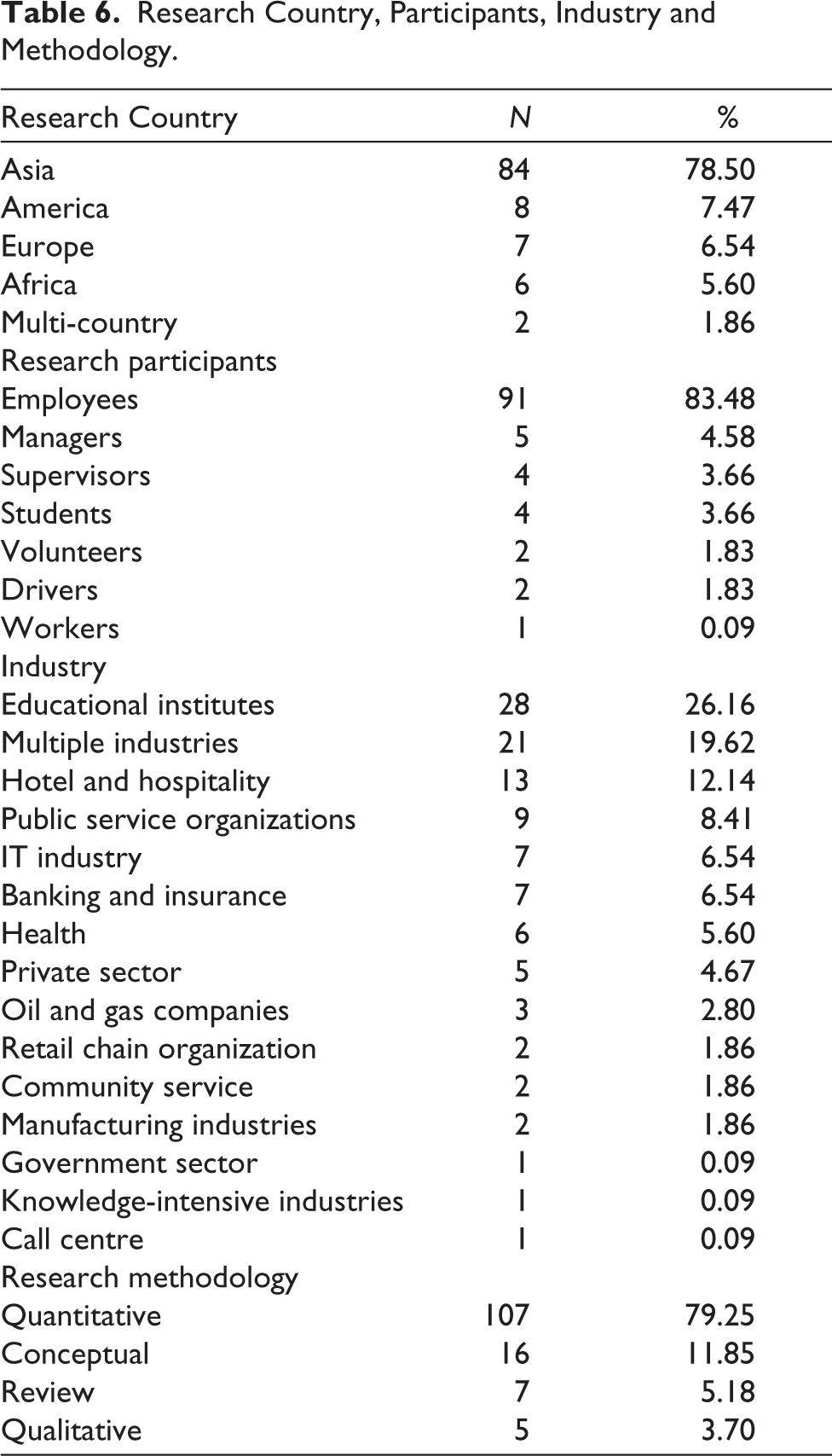
The selected sample documents of the study have a strong presence in global regions except for Australia. The highest number of studies has been conducted in Asian countries than in any other continent, including America, Europe and Africa. Countries with significant literary representation include India, China, Malaysia, Indonesia, Pakistan, Italy, the United States of America and Nigeria. Thus, researchers may consider less-developed countries, especially African countries for the research setting. Also, novel research from Oceania countries may provide new direction to existing research. The majority of the research in the sample is quantitative in nature and employs factor analysis, regression analysis and structural equation modelling. The qualitative research and literature reviews make up a smaller proportion of the publications. A total of 107 papers are quantitative, five papers are qualitative, 16 papers are conceptual and seven are review papers. Participants in this study sample typically include employees, managers, supervisors and students. The health and hospitality sector, academic institutions, government and private sectors are the research settings in most papers in the sample. The research settings in workplace spirituality research are represented in Table 6.
Research Country, Participants, Industry and Methodology.
Research Gaps and Future Directions
Extant works on workplace spirituality have discretely mentioned about the small sample size of the study and have shown concern for the generalizability of the results.The potential research gaps are mentioned in Table 7. Further, the authors also revealed that collecting self-administered data from a single source often leads to common method bias (Lata & Chaudhary, 2021; Mahipalan et al., 2019; Saadatyar et al., 2019; Saxena et al., 2020; Shrestha & Jena, 2021; Soliman et al., 2021; Zhou & Mou, 2022). Common method bias causes an excessive dominance of particular factors, which is detrimental to the validity of the research. Consequently, future studies can be conducted on large samples and broaden the scope of the study by including a variety of respondents and contexts.
Research Gaps.

The sample papers taken up for the review are mostly cross-sectional research that restricts the assessment of continuous and long-term changes in workplace spirituality (Jayakumar & Vinodkumar, 2023; Lata & Chaudhary, 2021; Na’imah et al., 2023; Sharma & Kumra, 2020; Srivastava & Gupta, 2022). Subsequent investigations on workplace spirituality should focus on longitudinal and time-lagged research methods that assess the patterns of employee behaviours and organizational outcomes owing to workplace spirituality.
The study context is one of the gaps identified in the review sample and was limited to a specific country, universities, geography, hospitality, service industry, organization, industry, public sector, banking, knowledge workers, non-profit teachers etc. Scholars have not adequately explored workplace spirituality in the context of schools. Universities hosted the majority of the studies (Hassan et al., 2022) and their results could not be generalized to schools owing to their contextual and structural differences (Williams et al., 2017). The investigation regarding the effect of spiritual principles of teachers on pedagogical improvements and student learning outcomes may be pursued by future researchers (Pawar, 2009).
The sample papers present fewer emphasis on the role of leaders and leadership styles in enhancing workplace spirituality. Future research can revisit the effect of spiritual leadership style, servant leadership, transformational leadership and reward leadership on workplace spirituality (Mohammed & Elashram, 2022), ethical climate, commitment and turnover (Otaye-Ebede et al., 2020). Studies may also pursue the mediating effect of leadership styles between workplace spirituality and job outcomes (Soliman et al., 2021). There is also room for quantitative and qualitative studies on spiritual leadership (Sapta et al., 2021). Subsequent research endeavours may assess the buffering impact of spiritual leadership in the interplay of workplace spirituality and occupational stress. Similarly, work–family conflict, workplace bullying and ostracism can advance the literature on ethical leadership and workplace spirituality (Srivastava & Madan, 2023). Interestingly, there is a limited number of papers on the interplay between instructional leadership and workplace spirituality (Bhutto et al., 2023). Research on this area can expand knowledge on workplace spirituality.
In the current review, the papers mostly focus on workplace spirituality and neglect individual spirituality. Individual spiritual values and beliefs which relates to ethical and religious convictions, may illustrate the variety of mediating/moderating effects and results for workplace spirituality (Lata & Chaudhary, 2022). The works selected for review were mostly conducted in the pre-COVID era. COVID-19 had massive impacts on individuals and organizations and triggered changes in policies, procedures, attitudes and perceptions. So, novel studies that explore the COVID-evolved organizations can provide a new direction for workplace spirituality. Future research could look at workplace spirituality in remote organizations (work from home).
Personality dimensions play a substantial role in determining the effectiveness of techniques and interventions for enhancing workplace spirituality. Advanced studies can assess the mediating role of personality characteristics and psychological state indicators like self-efficacy, optimism, and hope in workplace spirituality (Aboobaker et al., 2020; Srivastava & Gupta, 2022). Similarly, individual factors (perception, personality, attitude and motivation) and organizational factors (culture and climate, human resource policies, leadership, job satisfaction, organizational commitment and organizational citizenship behaviour) need extensive examination in the context of workplace spirituality (Petchsawang & McLean, 2017).
The influence of cultural factors has been least investigated in the field of workplace spirituality. Empirical analysis of cross-cultural impacts between work and spirituality (Petchsawang & Duchon, 2012); cross-cultural dimensions between workplace spirituality and employee innovative behaviour (Afsar & Badir, 2017) may provide novel insights. Cross-cultural samples can help in better understanding of workplace spirituality (Farmanesh et al., 2021). Thus, there is an impending need for exploring the cultural dynamics of workplace spirituality (Indartono & Wulandari, 2014; Petchsawang & McLean, 2017; Vallabh & Vallabh, 2016). Future research needs to be conducted across borders to determine whether cultural differences influence variations in workplace spirituality (Sorakraikitikul & Siengthai, 2014). Additional focus should be on the impact of workplace spirituality on employees’ gender, inner lives, ideologies and innovative and sustainable behaviour. There are opportunities to empirically address the obstacles in implementing spirituality in the workplace due to workforce diversity and globalization.
Numerous authors have suggested to examine the positive and negative implications of workplace spirituality. Studies may focus on the examination of the linkage of positive employee outcomes like organizational citizenship behaviour, work attitudes, commitment and innovative work behaviour with workplace spirituality. Additionally, future investigations may consider the influence of negative employee behaviours like workplace incivility, turnover intention, emotional labour, religiosity tendency, work stress, anti-productivity behaviours and absenteeism on workplace spirituality (Lata & Chaudhary, 2021; Srivastava & Gupta, 2022; Tutar & Oruç, 2020). Prospective scholars could look into specific constructive deviant behaviours related to workplace spirituality, such as pro-social behaviour, organizational citizenship behaviour, whistleblowing behaviour and data selling (Garg et al., 2022). Furthermore, there is limited research on workplace spirituality and safety performance (Liu et al., 2023). Empirical research on the direct relationship between workplace spirituality and team or organizational level safety performance, as well as on the indirect relationship through safety work climate, may reveal novel insights.
The majority of the works prescribe empirical and quantitative results in the field. The concept of workplace spirituality is complex and subjective and needs to be explored through the lens of qualitative methods such as interviews, case studies, content analysis and mixed methods (Al-Mahdy et al., 2022; Gatling et al., 2016; Hafeez et al., 2022; Rahman et al., 2015; Sorakraikitikul & Siengthai, 2014). The domain of workplace spirituality may also be evaluated through control experiments, multi-group analysis and causal analysis to ascertain potential mediators and moderators (Beehner & Blackwell, 2016; Garg, 2017; Nwanzu & Babalola, 2021; Yunan et al., 2018). The dimensions were incorporated to build workplace spirituality scales, which is problematic for the generalizability of the findings. The majority of the scales belong to Western norms. We propose developing additional context-specific and integrated scales to measure workplace spirituality.
The sample papers fail to address the importance of spiritual values like finding meaning, self-awareness, envisioning, altruistic love and authenticity, which may serve as avenues for future research (Ramnarain & Parumasur, 2015). Authors assert that studies should explore the mediating/moderating effect of demographic variables (age, marital status, gender, education levels and experience) in the linkage between workplace spirituality, employee and organizational outcomes (Aboobaker et al., 2019a; Mohammed & Elashram, 2022; Zhang, 2020). Furthermore, the findings of the current review indicate a research gap between workplace spirituality and spiritual intelligence; subsequent investigations might look into the association between spiritual intelligence and personal, group-level and institutional spirituality.
Implications of the Study
The objective of this scoping review is to evaluate the broad spectrum of existing literature for revealing the theoretical underpinnings and empirical outcomes in the domain of workplace spirituality. The assortment of definitions of workplace spirituality proposed by extant authors deciphers the explicit and implicit meaning of the term through varied perspectives that can enable future researchers to create an operational definition for the concept. The article also states the specific theories that can be utilized by experts in the field to build the theoretical foundations to support the association of workplace spirituality with the employee, job and organizational outcomes. The research classifies the numerous antecedents and outcomes of workplace spirituality, which can be beneficial in understanding the current state of workplace spirituality research and future explorations to develop frameworks and models for examining workplace spirituality. The work also discloses the gaps in the available literature that will provide a springboard for progressive scholars to embark on research that bridges these gaps. There is a lack of widespread agreement and little comprehension about workplace spirituality in the literature, making it difficult for executives and staff members to practice spirituality within the workplace. It is vital to approach with caution when implementing and integrating spirituality at work, as imposing spiritual practices and beliefs on the workforce would be ineffective and perhaps disastrous for certain individuals. The conceptualization of workplace spirituality illustrates the comprehensive list of variables that can be adapted by human resource professionals to measure the phenomenon and implement within their organization.
Limitations
There are some limitations to this scoping review. First, the limitation of articles to ‘English’ language and study disciplines to ‘business management and accounting’ may have excluded potential papers for the review that was published in other languages and study areas. Second, this review comprised publications from the SCOPUS database only and may have left out relevant papers indexed in other databases. Third, this review was conducted by manually reading the papers and may by chance overlook relevant articles. Few of the publications are included in the scoping review, even if they did not directly relate to the theme because they contained relevant concepts and metrics.
Conclusion
The rise of workplace spirituality continues to project both challenges and opportunities for organizations. The discipline has achieved considerable advancements, resulting in a flourishing research area. However, due to several conceptualizations and structures, it is missing conceptual clarity. Using a scoping review of the published literature from 2000 to 2023, this research endeavour aims to bring together the studies on the topic in order to provide a comprehensive grasp of the concept. The study reviews 104 articles that were taken from SCOPUS in an effort to synthesize the available research. Additionally, the current research provides a more thorough understanding of spirituality inside organizations in the context of employee, organizational and job domains. Our study also highlighted several key theories, antecedents and outcomes of workplace spirituality that can be beneficial for future explorations.
Footnotes
Declaration of Conflicting Interests
The authors declared no potential conflicts of interest with respect to the research, authorship and/or publication of this article.
Funding
The authors received no financial support for the research, authorship and/or publication of this article.