



Abstract
The derivatives market is an important asset class and has been found to positively contribute to economic development. It has sparked interest from researchers, policymakers and financial agencies. This article aims to present a literature review that explains the motive of individual investors to trade in equity derivatives. Studies from 1997 to 2023 were extracted from SCOPUS, Emerald and Web of Science using the keywords, and articles were later refined with their motive, research methodology, source of data, journal, year of publication, country-wise articles published and publication source to explore the opportunities for further research. VOS viewer has been used to visualize the author keyword and link among various keywords. This study reviews 51 articles, which were found relevant and have been segregated theme-wise. The motives of investors are categorized as ‘Hedging vs. speculation’, ‘Return vs. risk’ and ‘Gambling’. The findings of the study show that most of the studies are conducted in the USA using discount house data and most of the articles were published in the Journal of Banking and Finance. The findings of the study will be useful to the researchers, practitioners, stock exchanges and regulators by providing the current landscape of the body in this domain.
Introduction
Motive is a reason for doing something. The decision to invest is driven by the motive of risk and return reward (Aravind, 2021). Different investors have different motives for trading in financial assets: Some trade with a motive to speculate and some to hedge to reduce price efficiency (Goldstein et al., 2014). Traditionally, investors’ main motive to invest in financial markets has been to make some financial savings for retirement. Individual investors were motivated to invest in the stock market for the long term rather than for short-term speculation activities as well as they did not have the opportunity to speculate on falling prices. However, today there are various innovative financial products available for investors to invest and trade in the financial market, which has drastically reduced the way institutional and individual investors trade (Meyer et al., 2014). Modern financial markets have allowed investing in various markets such as the stock market, equity derivatives, fixed income market, foreign exchange market, commodity market and exchange-traded funds, which allows an investor to trade and create their portfolios (Mayo, 2009). Investor interested in equity market trading has two ways of entering the market:
Trading directly in stocks in the cash market or, Using equity derivatives by trading in options, futures and warrants.
Derivatives are financial instruments that derive their value from the underlying asset (Hull, 2008), where the underlying asset can be stocks, interest rates, commodities or currency value. Initially, the derivatives were used by the firms to hedge relative risk (Bezzina & Grima, 2012). The use of financial derivatives has increased tremendously over the last few decades, not only by corporates and financial institution participants but also by the individual investors who are part of its growth. The volatility in emerging countries has grown high, which has led to an increase in demand for derivatives products for the purpose of hedging and speculation in emerging markets (Lee, 2020).
The main purpose of this article is to present a literature review that explains the motive of individual investors to trade in equity derivatives. To develop an understanding of what are the motives of an investor to trade in the equity derivatives market, we used the existing literature on these areas and segregated the motives by aggregating the research articles according to their finding results. A growing literature to understand the reasons for investors’ participation in the derivatives market suggests that the behaviour of individual investors is irrational (Bauer et al., 2009). There are various motives of investors to trade and invest in equity derivatives which have been explained by researchers: leverage need (Abreu & Mendes, 2020), higher expectation of return (Bailey et al., 2008; Bernard et al., 2011; Grinblatt & Keloharju, 2009; Hoffmann et al., 2015; Seru et al., 2010), speculation (Lakonishok et al., 2007) and hedging (Goldstein et al., 2014). Few pieces of literature emphasize other reasons for aggressive trading activity in derivatives markets such as gambling (Bauer et al., 2009), fun (Cox et al., 2020), event or news announcement time (Chen & Tang, 2009; Choy & Wei, 2012; Li et al., 2021; Meyer et al., 2014). However, derivatives look more attractive to investors for leveraging benefits, where investors’ overall return on the invested amount is higher than the stock market.
This literature review process has used inclusion criteria using keywords (Paul & Criado, 2020). First, the research articles were searched to explore the motives of individual investors to invest in equity derivatives, which helped us to decide the key motives. Second, we segregated the motives and chose the ones that were more appropriate for the researchers and arranged them systematically motive-wise. The relevant data was obtained from SCOPUS, Emerald, EBSCO and Web of Science to maintain the quality of the literature review. The topic is important for stock brokers, policymakers and researchers as it helps as a reference point. The article also recommends the literature gap for future reference.
The remainder of the article is organized as follows: the second section: Motivation for Study. The third section: Methodology of the Study. The fourth section: Classification of Literature Reviewed. The fifth section: Literature Framework and Review. The sixth section: Conclusion and Scope for Further Study.
Motivation for Study
Previous studies focused on individual investors’ participation in the derivatives market are from developing economies, and it is important to understand the reasons for participation in emerging economies. Lee (2020) pointed out that the trading volume of emerging economies like Chinese and Indian exchange-traded derivatives markets has seen an increasing trend, the Asian market share in the global exchange-traded derivatives market is steadily growing, which has increased from 33% in 2014 to 42% in 2019, and the Latin America and Africa also increased from 9% to 11% during the same period. In contrast, the market shares of North America and Europe decreased during the same period. The derivatives market is an important asset class and has been found to contribute to economic development positively and has sparked interest from researchers, policymakers and financial agencies (Vo et al., 2019). As mentioned by Vo et al. (2019), this market has seen development and expansion in terms of significant use of derivatives instruments in recent years in India. The derivatives market has emerged as a most important financial innovation (Acharya et al., 2009; Bezzina & Grima, 2012; Cochran, 2007; Zhang, 2021), and it has changed the style investors use to trade in the equity market. As Calvet et al. (2004) claimed, innovative financial products allow individual investors to hold a diversified portfolio. Derivatives have given the opportunity to take leverage advantage, lower transaction costs and help hedge risk (Stout, 2011). The derivatives market provides a distinct investment opportunity be it—speculation, arbitrage and hedging. In the past, researchers have explored various reasons for participation and motives of investors to trade in equity derivatives such as the benefit of leverage, speculation, hedging, risk preference, gambling, transaction cost or news or event trading. Even insider trading takes place during merger and amalgamation announcements where prices are manipulated (Shah et al., 2023). This study studies the motives of investors in the derivatives market. A systematic review has been undertaken to understand the various motives. The following research questions are the focus of the study.
Question 1: Is the derivatives market only for corporates to hedge risk or retail investors can also use it?
Question 2: Do investors use derivatives for speculation or hedging?
Methodology of the Study
For this study, secondary data was systematically collected after reviewing the relevant literature published in renowned journals and international investor survey reports. After setting up an objective to find answers to the research questions, the data were collected from SCOPUS, EBSCO, Emerald and Web of Science to explore and find existing literature related to the motives of individual investors in equity derivatives. Relevant articles have been found using keywords such as Investor’s motive, purpose of investment, equity derivatives and participation. A maximum number of relevant literature was found in journals such as Journal of Banking & Finance, The Review of Financial Studies, The Journal of Financial and Quantitative Analysis, and so on. After finding the relevant studies, the literature was segregated according to different motives based on their findings. The study relied on logical reasoning to reach its conclusions and findings.

Classification of Literature Reviewed
Year-wise Classification
The distribution of the research article has been done year-wise, shown in Figure 1 which helps in understanding that the research articles concerning the motives of investors in equity derivatives have been growing since year 1997, but more attention was given after the year 2008. This could be because derivatives were introduced around the year 2000 in many developing countries and gradually gained popularity.
Classification of Studies Year-wise.

Country-wise Classification
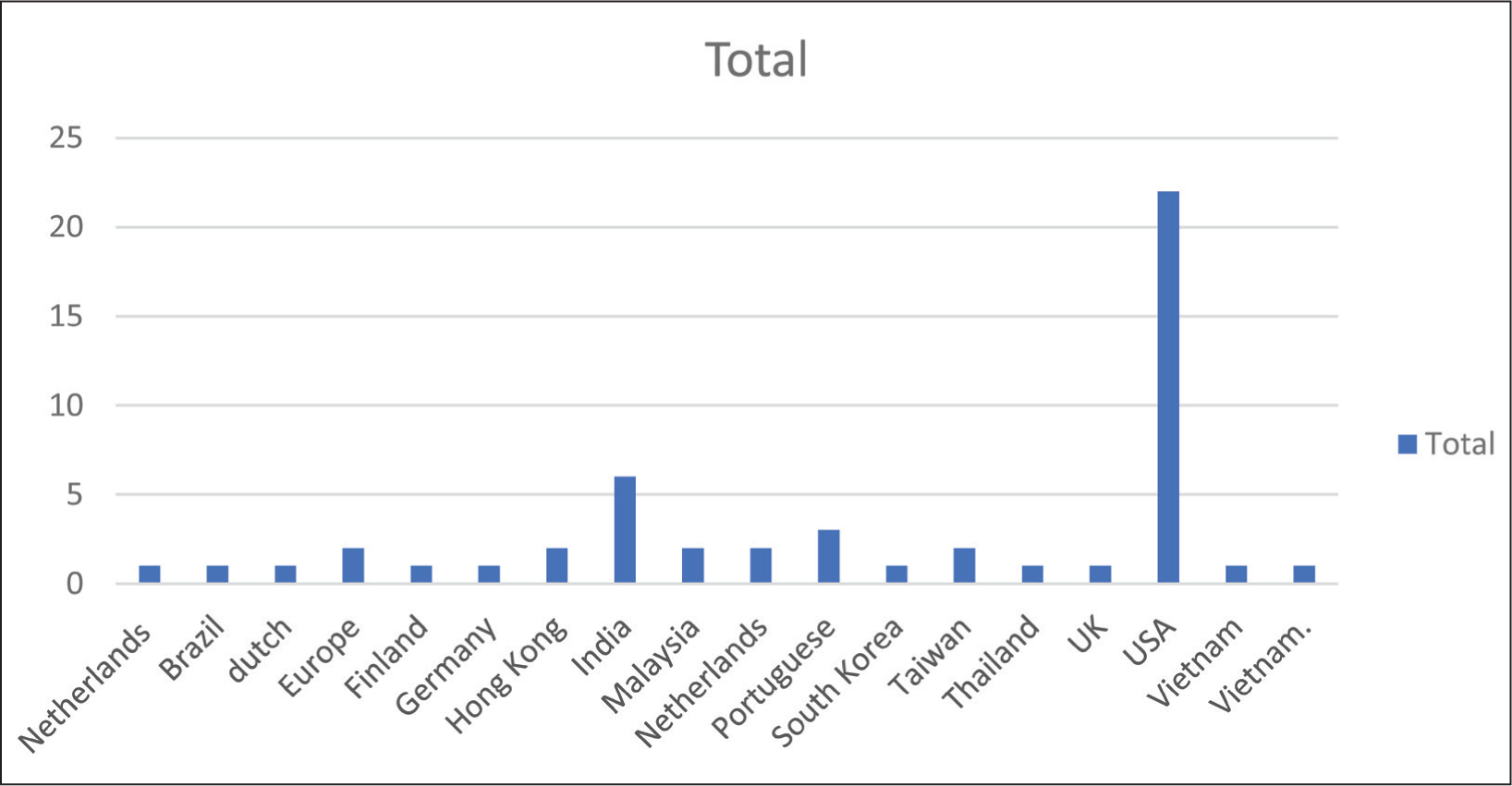
The relevant literature selected for this article is country-wise classification, as shown in Figure 2. To explore the motives, the current study has reviewed 51 studies, and most of the studies considered are from the USA and European countries. One reason for this may be the higher participation in the derivatives market in the USA and Europe compared to other countries. India has also seen a focus on financial markets.
Classification of Studies (Country-wise).
Source Wise
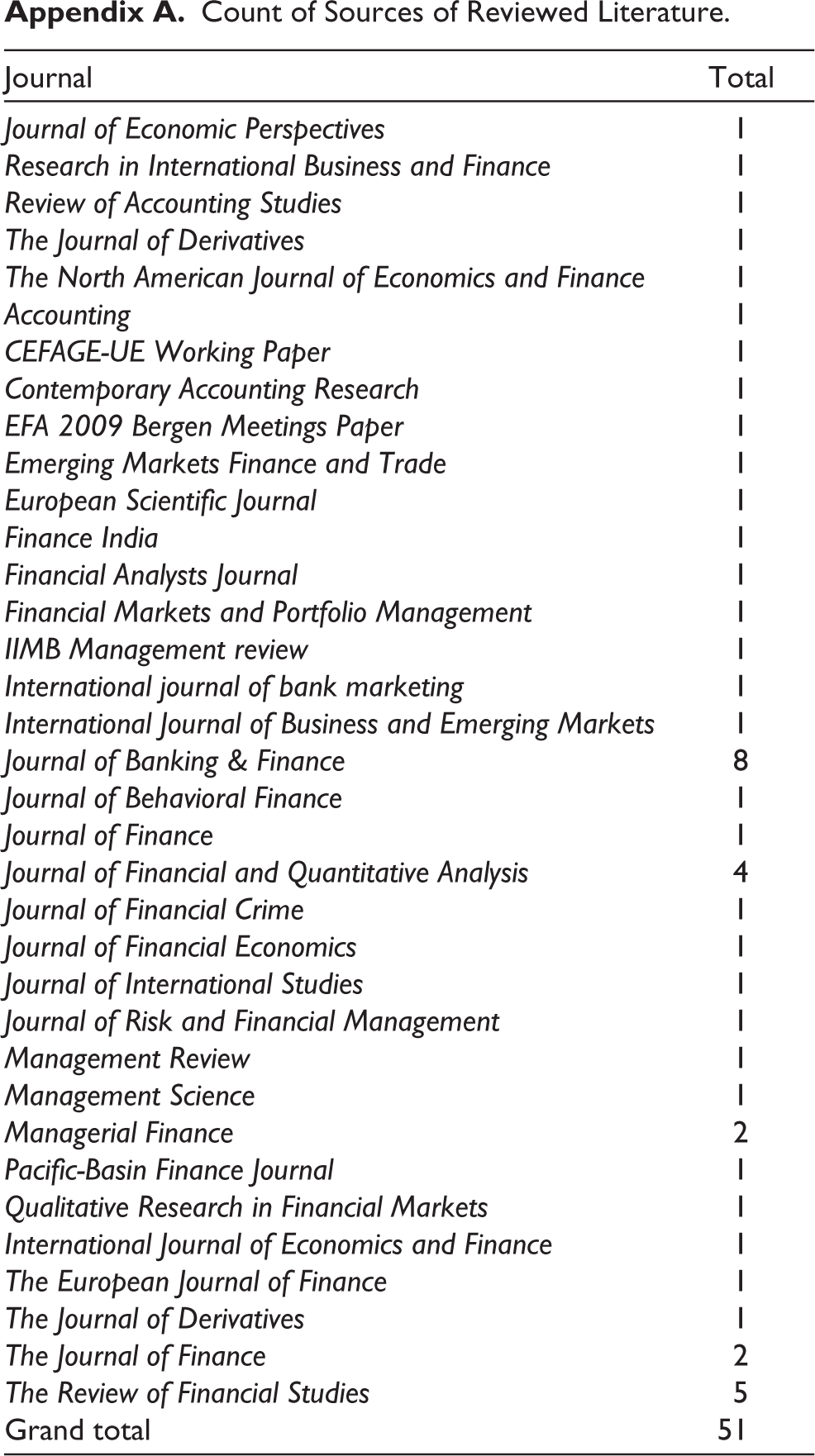
The study has collected the research articles from different sources, which are presented in Appendix A. The research articles have been extracted from various journals, which are from SCOPUS, Emerald and Web of Science, have been rated by ABDC and a few working articles as they helped to collect more relevant information. As shown in Appendix A, the highest numbers of articles are taken from the Journal of Banking & Finance, The Review of Financial Studies, Journal of Financial and Quantitative Analysis, and more.
Keyword Analysis
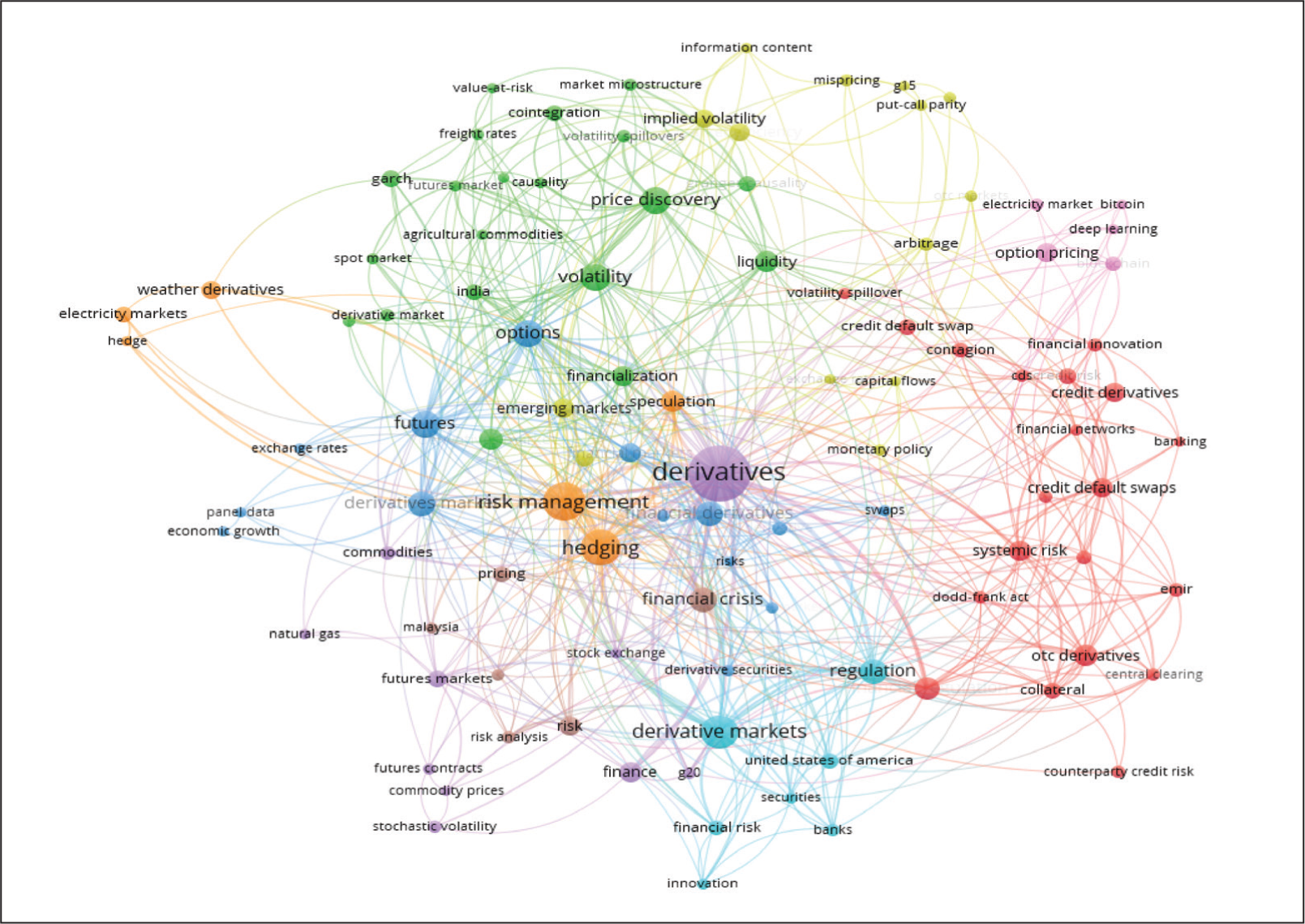
The VOSviewer software has been used to create the network map of author keywords as shown in Figure 3. Terms and links are displayed on the map, with the link indicating the relationship between the two objects. Each link possesses strength, and the higher the strength, the stronger the relationship. The most occurring keywords found are derivatives and derivatives market. The term ‘derivatives market’ shows a strong link with ‘Hedging’, ‘risk management’, ‘options’, ‘liquidity’, ‘volatility’, ‘emerging markets’ and ‘speculation’, and importantly, it links with ‘economic growth’. It shows a clear understanding that there is a strong link between hedging and speculation in emerging economies. The country names, which are reflected, are the USA, India and Malaysia.
Keyword Performance.
Focus Area-based
This part of the study classifies the literature based on their motives to trade in equity derivatives. Three main motives to invest or trade in equity derivatives have been identified: (a) speculation versus hedging; (b) high return and risk; and (c) gambling.
The next section of the article will present the literature review of these motives in detail.
Literature Framework and Review
Direct content analysis, which is a deductive approach, has been used for the data of 51 quality articles, which were extracted from SCOPUS, Emerald and Web of Science. Later the study has been classified into three motives to invest—speculation versus hedging, high return versus risk and gambling. The researchers read the complete data set, which was then further divided into significantly smaller portions through the process of abstraction, to conduct content analysis. To improve conceptual limits and the study’s framework, codes were evaluated. The previously mentioned research themes were chosen by coding based on author keywords. Each data set tries to find the research answer. For the literature review, a categorization matrix was created and coded for the specified categories. The articles’ contents were analysed and condensed in Figure 4. A thorough examination of a few chosen research articles is provided in the analysis section to address the research questions. This section will be divided into subsections as follows:
Motives to invest Research methodologies used
Motives of Investors.

Motives to Invest
In the last four decades, the derivatives market has emerged as a most important financial innovation (Acharya et al., 2009; Bezzina & Grima, 2012; Cochran, 2007; Zhang, 2021). As Calvet et al. (2004) claimed, innovative financial products allow individual investors to hold a diversified portfolio, whereas Stout (2011) suggested that there are various benefits for individual investors to invest in derivatives products; an investor can hedge their risk using a derivatives contract.
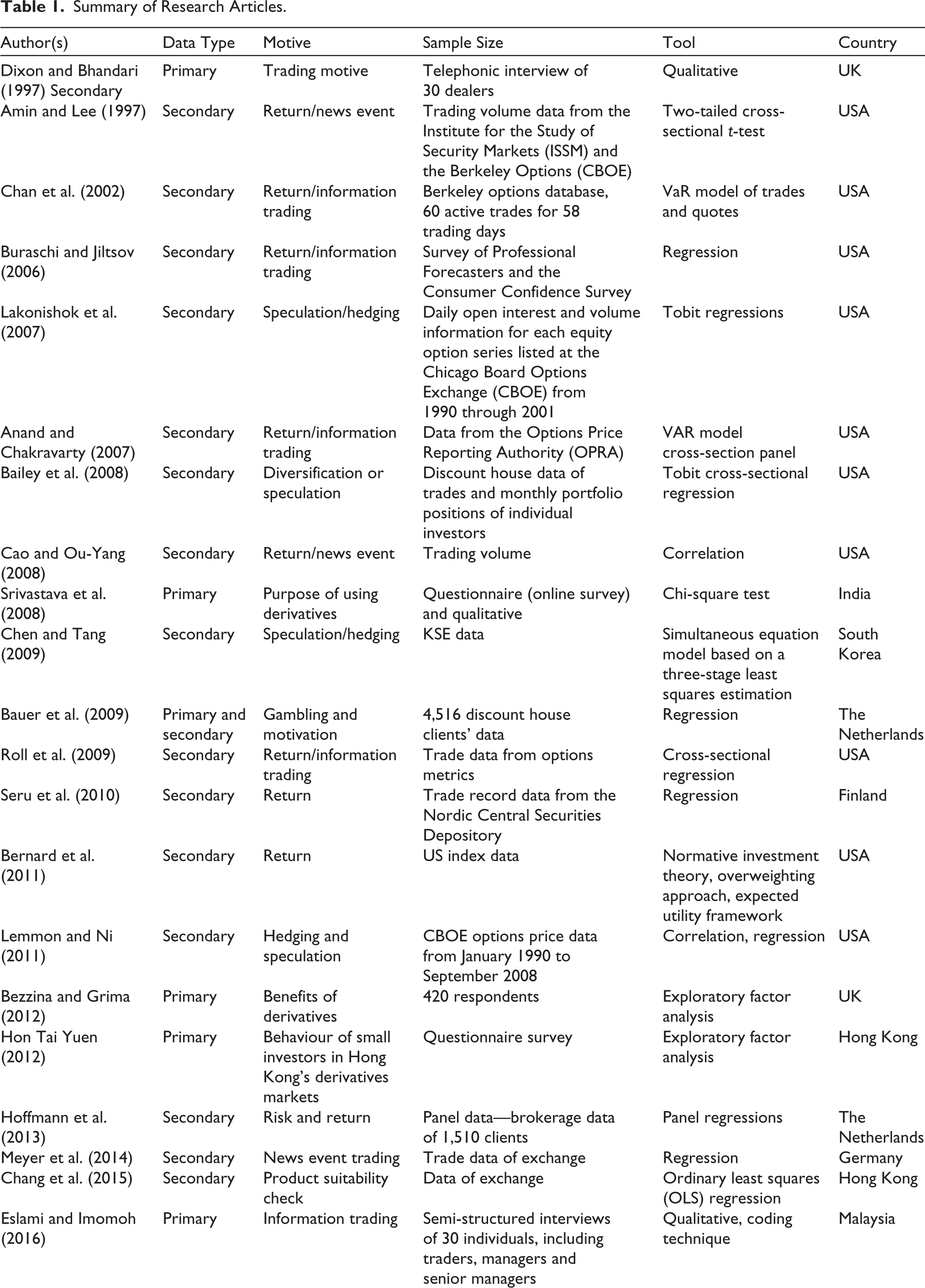
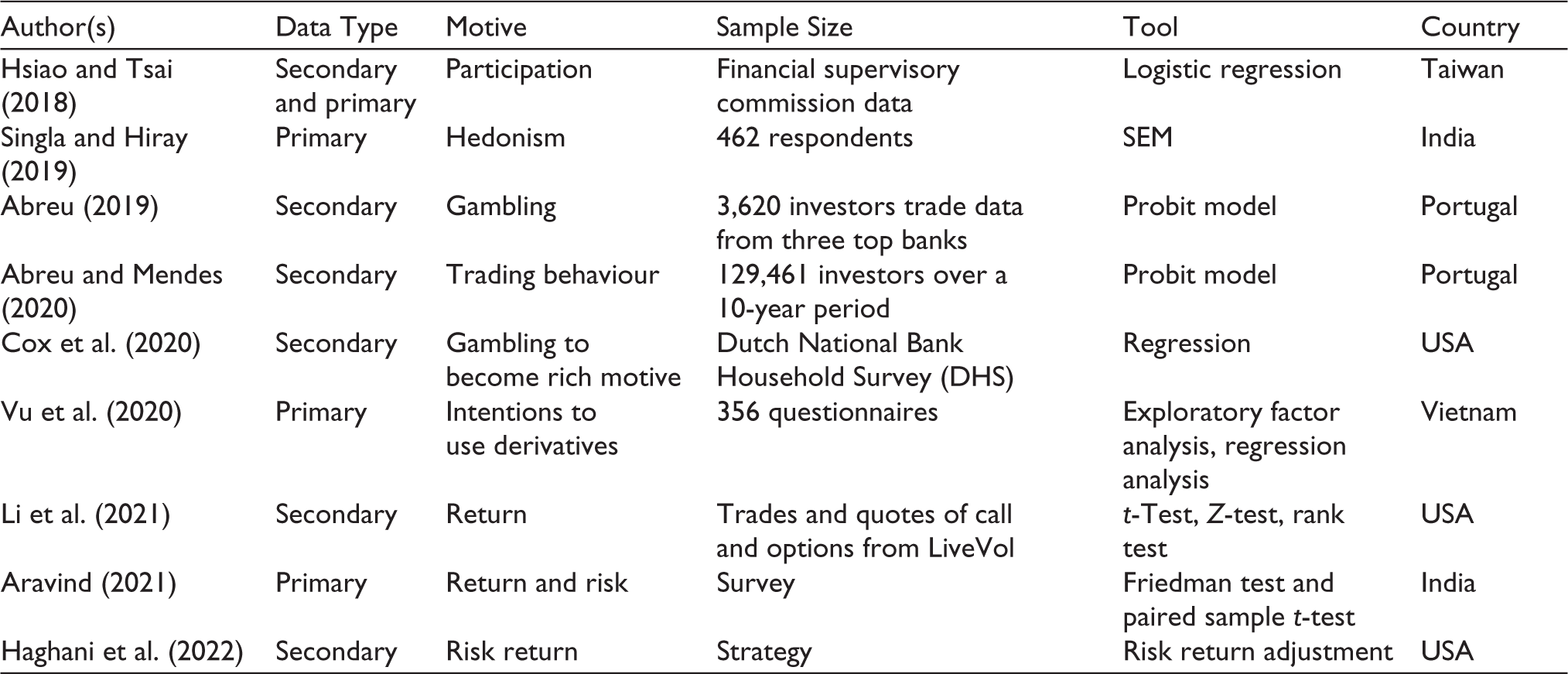
The main reason the options have gained popularity is due to lower transaction costs for taking a position in options than the cost for purchasing the same number of underlying stocks directly. Roll et al. (2009) pointed out that the options market seizes information faster than the stock market, and due to lower transaction costs, the investors prefer to use options to use information which makes trading in stock derivatives more active (Bezzina & Grima, 2012) as given in Table 1. Reddy (2021) has found that factors like company image, stock recommendations and movement of stock indices play an important role in investors’ decisions. Hsiao and Tsai (2018) associated the use of derivatives with social welfare because derivatives can be used for hedging and diversification needs. Jaramillo-Restrepo et al. (2020) used secondary data worked on Indonesian stocks’ hedged and non-hedged scenarios and found that put options can be used to mitigate investment risk and volatility risk.
Summary of Research Articles.
The factors that impact the small investors’ participation in the derivatives market are personal background, reference group, return performance, risk tolerance and cognitive style (Hon Tai Yuen, 2012).
In the past, researchers have explored various reasons for participation and motives of investors to trade in equity derivatives such as the benefit of leverage, speculation, hedging, risk preference, gambling, transaction cost or news or event trading. This part of the literature review explains and organizes the literature as per the motive of individual investors preferred by past studies.
Hedging Versus Speculation
In today’s financial market, different types of traders have different motives for entering the market, some enter for speculation and some for hedging as explained by Goldstein et al. (2014). Hedging is a way to reduce and eliminate various types of financial risks in financial assets such as stocks, commodities and currencies. Whereas, in speculation, a speculator tries to predict the future price movement to make a profit and is ready to take higher risks.
From the respondents, Srivastava et al. (2008) found that the most important objective of using derivatives securities is for risk adjustment and profit making. Koonce et al. (2008) found that investors use derivatives both for speculation and hedging, whereas the investors regret the use of speculation over hedging and feel more satisfied when they use derivatives as a hedging tool over speculation. Lantara (2010) found that in Indonesia, derivatives are used more as a hedging tool against financial risks rather than to speculate.
Goldstein et al. (2014) stated that there are different types of traders in today’s financial markets with different trading objectives. The difference in trading objectives suggests that different traders have different motives to trade in a given underlying asset; some trade to speculate and others for hedging purposes. Investors trading with speculation are mainly dependent on the profitability of speculative positions (Bailey et al., 2008) and are speculating based on superior information or hedging their investment to reduce price efficiency. Lemmon and Ni (2011) documented that unsophisticated investors use stock options to speculate and trade on future price movement, while sophisticated investors’ motive is to hedge risk by using index options. Hedging-motivated traders account for just a small portion of stock options trading, as documented by Lakonishok et al. (2007) and Bauer et al. (2009).
Using an online survey of 420 users of derivatives, Bezzina and Grima (2012) found that few investors know the importance and benefits of using financial derivatives and that the derivatives can be used to hedge unwanted risk. Investors were aware of the risks and complexity associated with trading in derivatives, but few investors found less expertise in dealing with derivatives in complex situations. Stulz (2004) answered the question, of whether we should fear derivatives. The answer is ‘No’. Derivatives help the firm and investors to hedge risk and take risk effectively. The risks associated with derivatives positions should be analysed properly. Derivatives trading can be risky for inexperienced investors and firms.
Meyer et al. (2014) investigated the retail investors’ motive to trade in the derivatives market, whether it is profitability, event or news trading, or transaction costs. The study found that the investors who were attracted to news trading traded more around news events and made losses in a very short period. Because of high transaction costs, the retail investors avoided participating in futures and options. The research of Meyer et al. (2014) suggests the same findings as Bauer et al. (2009).
Li et al. (2021) have focused on understanding why mini-options were introduced by exchanges for small retail investors to trade. He found that many investors were using mini options to trade but the overall return was generated more by using standard contracts over mini. They also documented that small investors using mini options contracts reacted more during attention-grabbing events, earning announcements and trade heavily compared to normal times. Therefore, their trading performance was less profitable than the standard option contracts.
Choy and Wei (2012) investigated the motive of retail investors in options trading. The study focuses on understanding if opinion dispersion or differences of opinion is the main driver for options trading. The results show that the smallest retail investors are speculative in options more around earnings announcements and they trade heavily. Investors prefer options trading more for speculation relative to hedging (Jongadsayakul, 2019; Lakonishok et al., 2007). In contrast, Chen and Tang (2009) found that investors trade in futures and options with the motive of speculating on future price movements to make a profit during political election periods. Few investors use derivatives for hedging and choose to trade options compared to futures contracts.
The direction of the price movement and the information about the stock are used to take a position in options after understanding the volatility (Black, 1975). Investors have information about a particular stock and prefer to trade options to speculate and trade medium size options (Anand & Chakravarty, 2007; Chern et al., 2008). Chan et al. (2002) suggested that investors with information about an event choose to trade actively in options to take leverage benefit compared to stocks. Yang et al. (2016) reported that investors were more pessimistic as the number of catastrophes rose in Taiwan, which affected their trading activity and motivated them to use derivatives to hedge their risk. Yuan and Rieger (2021) used expected utility benefits and found that diversification is the main motive to trade in options and structured products. Investors use stock-based options or index options to diversify their investment risk.
High Return and Risk
The main factor that impacts the financial decision of an investor is the perception of risk and return (McInish & Srivastava, 1984). Zhang (2021) investors preferred to invest in financial derivatives, especially in options, which have more benefits but with high-risks. Hoffmann et al. (2015) tested the perception of risk and return of investors using panel regressions and found that investors with a motive to earn high returns trade more and trade larger quantities per transaction and they prefer to trade in derivatives to achieve higher expected returns. Bernard et al. (2011) showed that retail investors prefer more complex contracts to get the maximum possible return.
Bailey et al. (2008) identified that sophisticated investors with trading experience take more risk and prefer to trade derivatives, while larger portfolio investors take less risk. Lemmon and Ni (2011) explained that experienced investors with records of past market return demand more for stock options positions compared to index options. Li et al. (2021) used discount house data to analyse the trader’s behaviour in the derivatives and found that a small portion of investors only make a profit and the rest due to their ‘doubling strategy’ make losses in derivatives.
The reason for the growing popularity of derivatives was explained by Black (1975), which was the benefit of financial leverage, which encourages traders to trade in the derivatives market rather than the stock market and more liquidity reduces the transaction cost and increases the return on the invested amount (Acharya et al., 2009; Black 1975; Chern et al., 2008). In contrast, Meyer et al. (2014), Bauer et al. (2009) and Li et al. (2021) revealed that high transaction cost reduces the overall return and is the main cause of the negative performance of options.
Guiso et al. (2008) have explained that trading decision is associated with risk involved in investment. If an Individual investor finds that an asset is risky and does not earn a risk premium, they avoid investing in risky assets such as options.
Shah et al. (2023) have found that investors preferred to use options to trade more during mergers and amalgamation announcements. Li et al. (2021) have found that Mini option investors which are small individual investors trade less during normal working hours and they respond less to news and thus trade less. Hon Tai Yuen (2012) surveyed around 524 small investors and found that one third of investors had an average return of less than 10% and another one third of them had an average return of 10%–30%, and their risk tolerance was medium to high.
Gambling
Past literature suggests that few investors trade in the derivatives market as an opportunity to gamble. Barber et al. (2009) documented that the turnover of the stock market in Taiwan was reduced drastically after the government introduced a government-sponsored lottery. The excessive trading before the introduction of government-sponsored lottery indicates that gambling is the motive of the individual investor to trade.
Bauer et al. (2009) revealed that most of the investors make losses on their option trading more than from equity trading, due to poor market timing from overreaction. The most important motives to trade in options are gambling and entertainment.
Cox et al. (2020) revealed that investors who have symptoms of compulsive gambling trade stocks more frequently and invest in the derivatives market. Their motives to trade in the financial market are fun or to become rich. The frequency of trading and demographics also impacts investors’ motive to trade. Bailey et al. (2008) revealed that investors with gambling as a preference mostly use aggressive strategies to trade using options and short positions, and they mostly choose speculative stocks which are high-risk and may give high returns for their portfolios.
Research Methodologies Used
Most of the articles have pointed towards the various motives and reasons to participate in the derivatives market in different countries and across various types of investors. After reviewing the research methodologies, it has been found that most of the research has been conducted to understand the reason for the participation of investors who have used secondary data from the discount house or analysed volume and price behaviour and few have found reasons for participation using qualitative and quantitative.
Conclusion and Scope for Further Study
The analysis confirms that the derivatives market helps investors to take benefits of higher returns and adjust risk and the same time it leads them to make losses too. Derivatives are more often used for news trading, event trading and quarter result trading. This article has reviewed 51 articles to understand the motives of individual investors trading in equity derivatives. It combines the knowledge available in this area. After conducting a detailed analysis to understand the factors that motivate investors to trade in equity derivatives and the methodologies used by the past studies, it has been found that there is a dearth of research to find motives of investors to invest in derivatives using primary research. The majority of studies have taken discount house data or price data for the analysis to understand the reasons for participation.
Most of the studies are conducted in the USA, and very less studies have been conducted in India. The stock exchange of India, that is the National Stock Exchange has been ranked the world’s largest derivatives exchange for the third year in terms of the number of contracts traded. Still, the numbers of articles published in India to understand the motives or reasons of investors participation were very few. This gives the researchers a very big opportunity to explore the motive of investors to trade in derivatives. More in-depth studies about individual investors will help policymakers, brokers and traders also.
Footnotes
Declaration of Conflicting Interests
The authors declared no potential conflicts of interest with respect to the research, authorship and/or publication of this article.
Funding
The authors received no financial support for the research, authorship and/or publication of this article.
Appendix
Count of Sources of Reviewed Literature.
| Journal | Total |
| Journal of Economic Perspectives | 1 |
| Research in International Business and Finance | 1 |
| Review of Accounting Studies | 1 |
| The Journal of Derivatives | 1 |
| The North American Journal of Economics and Finance | 1 |
| Accounting | 1 |
| CEFAGE-UE Working Paper | 1 |
| Contemporary Accounting Research | 1 |
| EFA 2009 Bergen Meetings Paper | 1 |
| Emerging Markets Finance and Trade | 1 |
| European Scientific Journal | 1 |
| Finance India | 1 |
| Financial Analysts Journal | 1 |
| Financial Markets and Portfolio Management | 1 |
| IIMB Management review | 1 |
| International journal of bank marketing | 1 |
| International Journal of Business and Emerging Markets | 1 |
| Journal of Banking & Finance | 8 |
| Journal of Behavioral Finance | 1 |
| Journal of Finance | 1 |
| Journal of Financial and Quantitative Analysis | 4 |
| Journal of Financial Crime | 1 |
| Journal of Financial Economics | 1 |
| Journal of International Studies | 1 |
| Journal of Risk and Financial Management | 1 |
| Management Review | 1 |
| Management Science | 1 |
| Managerial Finance | 2 |
| Pacific-Basin Finance Journal | 1 |
| Qualitative Research in Financial Markets | 1 |
| International Journal of Economics and Finance | 1 |
| The European Journal of Finance | 1 |
| The Journal of Derivatives | 1 |
| The Journal of Finance | 2 |
| The Review of Financial Studies | 5 |
| Grand total | 51 |