



Abstract
The article offers a comprehensive view of the field of ‘digital advertising’, tracing its evolution from the occurrence of the first banner ad in 1994. The objective of the study is to trace systematically how the digital advertising industry has transitioned from being the traditional one-way communication model to its current ‘intelligent’ state. This study offers profound insights into the dynamic and continually evolving domain of digital advertising. More specifically, it traces the evolutionary stages, major themes, influential articles and citation networks from 1993 to 2023. The articles have been thoroughly examined in three phases, each covering a period of 10 years from 1993 to 2023. The first two decades saw significant growth in the subject domain of ‘digital advertising’; however, the maximum number of articles contributing to the subject from 2013 to 2023 focused mainly on ad-personalization using ICT tools and incorporating artificial intelligence (AI). The key findings indicate that the third decade witnessed a remarkable rise in the number of articles pertaining to AI-driven ad personalization, thus portraying further focus by the researchers on how best to leverage technology in driving advertising effectiveness. AI became one such pivotal innovation, changing the very concept of digital advertising with its capability, to automatically target precisely and develop personalized promotions to engage consumers. The work is unique for the contribution it can make to already existing works regarding digital advertising by coming to one synthesized view of its evolution and its function in its totality regarding AI. The article sets a common platform for future research efforts and innovations within this domain, therefore offering valuable insights both for industry practitioners and future scholars.
Keywords
Introduction
In the contemporary digital landscape, marketers leverage a plethora of technological advancements at their disposal. They attempt to engage consumers effectively by employing a diverse range of advertising methodologies across multiple portable devices, such as smartphones and tablets. However, their approach extends beyond the mere bombardment of advertisements. Instead, marketers utilize consumer data to tailor advertisements, ensuring ad relevance, particularly concerning products or services aligning with consumer interests and potential purchasing intentions. As the Internet emerged and became publicly accessible, marking the Early Information Age, marketing strategies transitioned to prioritize consumer engagement. Termed Web 1.0, this expansion of the internet facilitated the creation of a content-delivery network, empowering numerous marketers to establish their websites and blogs for one-way dissemination of information. Then, a shift occurred towards Marketing 2.0, which focused on meeting consumer needs rather than just promoting products. Online ads began to offer solutions during this time. The evolution continued with the rise of Web 2.0, emphasizing social interactions. This led to Marketing 3.0, where marketing strategies revolved around providing value. It was during this phase that the importance of digital word-of-mouth became evident, as highlighted by Professor Philip Kotler (Kotler et al., 2010).
The current web development wave, Web 3.0, is based on utilising the strength of the Internet via several information and communication technologies (ICTs) and having regular two-way interaction with consumers. Access to massive databases related to customers’ tastes and preferences, collected from numerous touchpoints, helps marketers make decisions and put more effort towards getting a distinct position in consumers’ minds. Web 3.0 helped marketing take its next leap, and the fourth wave of marketing evolution came into play. Marketing 4.0, a book written by Professor Philip Kotler, the father of modern marketing, published in 2017, focuses on harnessing the power of converging technologies (Kotler et al., 2017). Technology convergence may lead to the convergence of traditional and digital marketing activity. Advertising techniques have progressed from single-channel to omnichannel approaches, using artificial intelligence (AI) and natural language processing to understand consumer behaviour in real time. Advancements in technology primarily drive the intriguing growth of marketing.
Overview of the Field of Digital Advertising and the Emergence of AI
AI is a system’s potential to accurately read and understand data patterns and utilize these patterns to achieve set goals and tasks (Kaplan & Haenlein, 2019). The debut of the first banner ad on the Internet in the mid-1990s marked the emergence of digital advertising, which has been a subject of academic research for the past three decades. According to research, digital advertising has evolved in three distinct phases. Initially, it was commonly referred to as interactive advertising for significant consumer interaction instead of usual one-way advertising. However, with the introduction of social media platforms like Facebook (2004) and YouTube (2005), Internet advertising enjoyed substantial development in the first decade of the new century. Then arrived programmatic advertising (PA), which uses software, data and algorithms to automate and interactively buy and sell advertisements. As described by Oliver Busch, ‘Programmatic Advertising involves the automated serving of digital advertisements in real-time based on individual advertisement impression opportunities’. It is built on AI-powered infrastructure, making it a feasible solution for efficient digital ad placement, increasing ad usefulness, increasing media revenue and pleasing customers.
With the support of AI tools, programmatic creative has progressed from a conservative distribution platform for pre-made digital advertising to the real-time creation of customized advertisements based on user information and context. The availability of Internet services at cheaper rates led to a significant increase in data consumption and the proliferation of digital media platforms, creating vast possibilities for consumer interconnectivity worldwide. The widespread presence of the Internet and easy access to digital media platforms resulted in a substantial database of consumer online behaviour, giving rise to the third wave of advertising known as intelligent advertising.
As defined by researchers, ‘Intelligent advertising involves consumer-centred, data-driven, and algorithm-mediated brand communication’ (Li, 2019). AI-powered publishing of advertisements includes gathering consumer insights from digital touchpoints, automating the creation of ads (programmatic creative), real-time planning and buying of media through real-time bidding (RTB) and evaluating the impact on consumers. RTB, which mimics stock exchange dynamics, enables the automatic buying and selling of ads using computer algorithms. It leverages per-impression context and precise targeting based on user profiles, significantly enhancing ad effectiveness.
Overall, the evolution of marketing and advertising has been shaped by technological advancements and the ability to leverage data and AI-powered tools to gain insights, personalize content and improve targeting for better consumer engagement. However, the research done by Han et al. (2021) reveals a discrepancy between businesses’ interest in AI’s potential and applied guidelines about how they can adopt it’. Haenlein and Kaplan (2019) suggest that ‘Research in AI is growing fast, but there is still a massive gap in exploring how AI techniques are being used at present and what should be the future adoption of these techniques in marketing’. Even though various research works emphasize the importance of the use of AI in different domains of marketing, limited researchers have attempted to compile those scholarly works. With more studies on utilizing AI in advertising, it is vital to synthesize the relevant literature and comprehensively investigate this topic.
Researchers gave opinions about the research on the use of AI in marketing (Talwar et al., 2020; Vlačić et al., 2021), but very few studies have used bibliometric analysis to explore the field of usage of AI in digital advertising. Bibliometric analysis is critical in determining the relevance and influence of research on the application of AI in digital advertising by finding trends in research topics, methodology and frequency of publication throughout the field of study. By assessing citation networks and co-citation patterns, bibliometric analysis may visualize the discipline’s knowledge base. This enables researchers to comprehend the connectivity of diverse concepts and ideas’ evolution across time, offering an in-depth overview of the research field. Bibliometric indicators such as citation counts, h-index and journal impact factors can be used to assess the impact of research publications in the field. This helps identify influential studies and researchers and understand the dissemination and reception of research findings within the academic community. Bibliometric analysis can reveal collaboration patterns among researchers and institutions working in the field of AI in digital advertising. Understanding collaboration networks may promote interdisciplinary research and facilitate knowledge exchange and innovation. Insights from bibliometric analysis can inform policy decisions and resource allocation by funding agencies, academic institutions and industry stakeholders. This can help prioritize research areas, allocate funding effectively and support evidence-based decision-making processes.
Research Questions
In order to accommodate the gaps identified in the literature review stage, the authors of the current research formulated the following research questions (RQ), the answers to which can be a result of this bibliometric study.
RQ1. What is the trend of publications in the field of digital advertising?
RQ2. What are the key concepts/themes studied and the intellectual structure of digital advertising’s knowledge base?
RQ3. What could be the future research paths that researchers may explore in the field of AI-enabled digital advertising?
Research Objectives
In order to answer the above research questions, the authors conducted a comprehensive analysis of the evolution and current state of digital advertising, with a specific focus on the integration of AI in this field. The present research aims to fulfil the following objectives:
Analyse the trend of publications in digital advertising by providing insights into the growth and development of this domain over time. Identify and examine the key concepts/themes studied in digital advertising. Forecast potential research paths in AI-enabled digital advertising, thereby providing a roadmap for future researchers interested in the subject domain.
Research Methodology
Scope and Definition
The initial phase of the review focused on determining the specific domain for conducting a bibliometric review. While recognizing the significant potential of AI in boosting the forthcoming advancement of the advertising sector, an extensive examination of the available literature on digital advertising highlighted the need for a comprehensive study that thoroughly explores the use of AI for pushing digital ads. AI is a cutting-edge technology that can analyse large amounts of customer data and derive insightful information. Advertisers employ AI tools to interact with their target audience, as they have a distinctive capacity to learn and grow independently (Ford et al., 2023). As a result, AI integration in advertising is a beneficial tool that helps marketers make sense of both structured and unstructured consumer data, develop and distribute ads specifically catered to consumers’ interests and preferences, and get important insights (Mogaji et al., 2021).
Review Method
The study uses the bibliometric method to analyse the changes in the literature of digital advertising and the application of AI in this field. A popular and rigorous process of bibliometric analysis makes use of quantitative techniques and software tools to evaluate literature, study over and analyse a lot of scientific data, pinpoint important topics for future research and detect emerging themes. By applying this methodology, we can explore the intricacies of the advancements made in a particular field while acquiring insights into new research directions. As suggested by Donthu et al. (2021), bibliometric analysis comprises mainly the steps shown in 0 below.
The study utilizes the PRISMA protocol (see Figure 2) to identify pertinent studies related to AI-enabled advertising (Page et al., 2021). This technique, which is well-known in marketing literature, guarantees consistency and transparency, allowing for the replication of the study when the research corpus grows substantially in the future (Paul et al., 2021).
Identification
During the first stage of this study, keywords were chosen after a careful analysis of pertinent reviews, papers and journal articles about advertising on the Internet were examined. Two seasoned marketing professors with expertise in advertising research actively participated in the process to improve the keyword selection. Subsequently, the chosen keywords were applied in searches conducted on both the Web of Science (WoS) and the Scopus databases, utilizing ‘title, abstract, author keywords, and Keywords Plus’ and the ‘title-abstract-keywords’ search rule, respectively. The objective was to identify articles that specifically focused on using different forms of digital advertising and integrating AI tools to make more effective digital ad campaigns and target them over different digital media tools for personalized advertising. To accomplish this, the search query involved a combination of keywords related to AI and the various possible forms of personalized digital advertising. The Boolean operators were used to confirm the presence of any keyword combinations. The initial query keyword used to extract articles for this review comprised of following keywords: ‘(‘Digital Advertising’ OR ‘Online Advertising’ OR ‘Interactive Advertising’ OR ‘Internet Advertising’ OR ‘Social Media Advertising’ OR ‘Email Advertising’ OR ‘E-mail Advertising’ OR ‘Mobile Advertising’ OR ‘S.M.S Advertising’ OR ‘SMS Advertising’ OR ‘Search Engine Advertising’ OR ‘Pay-Per-Click Advertising’ OR ‘Pay Per Click Advertising’ OR ‘Electronic Advertising’ OR ‘E-Advertising’ OR ‘e Advertising’ OR ‘Blogs Advertising’ OR ‘Twitter Advertising’ OR ‘Facebook Advertising’ OR ‘LinkedIn Advertising’ OR ‘Instagram Advertising’ OR ‘Social Media Analytics’ OR ‘Digital Advertising Analytics’ OR ‘Display Advertising’ OR ‘Video Advertising’ OR ‘YouTube Advertising’ OR ‘Artificial Intelligence Based Advertising’ OR ‘Artificial Intelligence enabled Advertising’ OR ‘AI-based Advertising’ OR ‘AI-enabled Advertising’ OR ‘Intelligent Advertising’ OR ‘AI Induced Advertising’ OR ‘Artificial Intelligence Induced Advertising’)’. By utilizing the vast coverage of the WoS and Scopus databases, a comprehensive range of articles was covered, while cross-checking over Google Scholar further ensured the inclusion of pertinent articles and minimized the risk of overlooking any relevant material. In this initial stage, 8,267 documents from Scopus and 2,779 from WoS databases were identified for further analysis.
Screening
The selection norms were established to evaluate the appropriate articles from both databases. From Scopus’ database, only the English language journal articles, which were at the final stage of publication, available in the public domain and focused on ‘digital advertising and the use of AI for advertising’, were considered for further research. Conference proceedings, texts and book chapters were not included in this analysis since they did not go through a thorough review procedure or are considered continuing research. The articles published within the 30-year timeframe, that is, those published from 1994 to 2023, were considered for this study. The initiation point chosen is 1994, marking the advent of online display advertising. This significant milestone traces back to the emergence of the first reported example—a banner ad—on the website HotWired (currently known as wired.com) during that particular year. It was purchased by telecom giant AT&T and used to promote its ‘You Will’ campaign (LaFrance, 2017). The search query for Scopus was further refined by limiting it as: ‘(LIMIT-TO (SUBJAREA, ‘BUSI’)) AND (LIMIT-TO (DOCTYPE, ‘ar’)) AND (LIMIT-TO (PUBSTAGE, ‘final’)) AND (LIMIT-TO (SRCTYPE, ‘j’)) AND (LIMIT-TO (LANGUAGE, ‘English’)).’ This resulted in a total of 4,024 relevant documents that were considered for further analysis. For the search done through the WoS database, the same search string was used initially, and the search results were further refined by limiting it to ‘Languages: English; Document Types: Article; Web of Science Categories: Business or Management or Communication; Research Areas: Business Economics or Communication; Web of Science Index: Social Sciences Citation Index (SSCI).’ The extraction timeframe from the WoS database defaults to the last 20 years, thereby restricting it to the period from 2004 to 2023 only. The above search resulted in 2,555 such articles. The search results were refined based on the preset eligibility criteria, which were decided based on the source of articles, stage of publication and subject domain. Only full-text articles published in the subject domain of business or management or communication from the WoS database (n = 994) were extracted, and those from the Scopus database (n = 1605) were limited to the business, management and accounting subject areas. The initial step involved extracting data from the WoS and Scopus databases in BibTeX (.bib) and comma-separated variables (.csv) formats. Subsequently, these files were converted into a standard data frame and merged into one single bibliometrix file through the Biblioshiny platform. The transformation was carried out by executing the R-commands: ‘web_data<-convert2df(‘WOS.txt’)’ for the WoS dataset and ‘scopus_data<-convert2df(‘scopus.bib’,dbsource=‘scopus’,format=‘bibtex’) for the Scopus dataset. The next step comprised merging the two datasets into a unified file and removing all the duplicate values in the title column, using the code: ‘combined<-mergeDbSources(web_data,scopus_data, remove.duplicated = T).’ The utilization of these R-commands led to the creation of a unique spreadsheet comprising bibliometric data of 1,938 distinct articles, removing 645 duplicated documents. For further analysis, the Biblioshiny package was used. The merged Excel file was imported and run over the platform to get the insights. A few still-in-press publications, as well as the conference proceedings, were deemed ineligible for further investigation.
Eligibility
The documents required additional manual verification and refining before they were eligible to be included in the subsequent bibliometric study. Throughout this phase, we thoroughly evaluated the article’s title, abstract, keywords and primary text to ensure their relevance to the investigation’s objectives. During this phase, the researchers determined 65 papers to be ineligible for further research.
Inclusion
During the review process, precise screening criteria were applied to ensure that only publications directly related to digital advertising were considered. Articles that did not fit the parameters were frequently rejected. This extensive screening method revealed a total of 1,873 documents that were deemed to be appropriate for future research.
Data Analysis Technique
To analyse the data, we utilized bibliometrix, an open-source, freely available and widely used bibliometric analysis and reporting software tool (Aria & Cuccurullo, 2017). It was built in the R programming language to be flexible and integrate with other statistical and graphical tools, making it easier for non-coders to use the software effectively. Biblioshiny is a web-based software included in the bibliometrix package that enables non-coders to use bibliometrix more quickly and efficiently, as well as simplifying the visualization of bibliometric data utilizing Scopus and WoS databases (Benatiya Andaloussi, 2024; Thottoli et al., 2023; Tigre et al., 2023).
Findings
The following analysis examines 1,873 unique research articles published between 1994 and 2023 from 478 sources, with 3,565 authors, 279 of the articles being single-authored documents. The data set deals with an average of 2.7 co-authors per document, having 4,700 author keywords and 37,396 references. The documents taken into consideration hold an average of 27.75 citations per document.
Publication Trends
The bibliometric analysis of the resultant dataset reveals publication trends and provides descriptive statistics on the most frequent publication sources, publications and sources/countries. R’s Biblioshiny package is employed to conduct these studies and offer a comprehensive view of the field, highlighting recent advancements.
Year-wise Publication Trend
The landscape of digital advertising research has undergone a rapid and transformative evolution spanning the last three decades (see Figure 2. A Flowchart Illustrating the Process of Searching and Selecting Relevant Literature for Bibliometric Analysis Following the PRISMA Protocol).


This evolution can be primarily attributed to the widespread adoption of the Internet and personal computers. The extensive focus on the study of digital advertising represents a significant paradigm shift in the advertising sector. This change is distinguished by a substantial divergence from traditional methodologies, giving way to a more technologically-centred landscape. The increased focus of research on digital advertising is inextricably connected to the industry’s dynamic changes. Notably, the incorporation of cutting-edge technology, particularly AI and other ICT tools, has been a driving force in this transition. Rapid advances in AI and ICT tools have played a significant role in modifying the fundamental approaches to advertising. This progression not only reflects the changing dynamics of advertising strategies but also highlights the importance of thoroughly exploring and comprehending the profound consequences of integrating these cutting-edge technologies. As the advertising industry continues to negotiate this technologically driven landscape, the necessity for extensive research in this subject domain intensifies.
Digital advertising has advanced leaps and bounds over the last three decades, as has the field of study. As a subject, this can be investigated in three phases, each spanning 10 years.
The First Decade
The subject at hand was very new in the first 10 years, with only 53 relevant articles published between 1994 and 2003. This was in response to limited internet connection and the fact that computers were primarily employed for company-related tasks. These studies mostly address interactivity as a measure of advertising efficacy (Liu & Shrum, 2002), attitudes towards internet advertising (Schlosser et al., 1999), the introduction of mobile advertising (Barwise & Strong, 2002) and ad-personalization (Kim et al., 2001).
The Second Decade
The discipline of digital advertising research experienced substantial growth over the next ten years, with 400 articles published between 2004 and 2013. This clearly indicates that digital advertising research flourished as the internet became more accessible and computer systems became more affordable and readily available. This expansion was further accelerated by the rising popularity of several social media platforms, which created new opportunities for advertisers to reach their target consumers. The articles covered a varied range of themes, such as measuring consumers’ attitudes towards internet advertising (Tsang et al., 2004), ad-effectiveness, online engagement (Calder et al., 2009), social media advertising (de Vries et al., 2012), ad-avoidance (Cho & Cheon, 2004) and online privacy (Chen et al., 2004; Debatin et al., 2009; Dolnicar & Jordaan, 2007; Rapp et al., 2009).
The Third Decade
Today, digital advertising is one of the most important and dynamic areas of marketing research. Researchers are constantly exploring new ways to use technology to target and measure advertising campaigns. Hence, the research domain saw a massive growth in the number of publications, with a total of 1,420 unique journal articles published in reputed journals during the latter phase of 2014–2023. The surge in research interest in digital advertising can be attributed to the transition of the ad industry from traditional to technology-driven techniques, as well as the rapid progress in applications of AI and related technologies. Most of these articles dealt with relevant topics, such as ‘social media analytics’ (Roy et al., 2017); ‘programmatic advertising’ (Chen et al., 2019; Ciuchita et al., 2023; Diwanji et al., 2022; Guitart et al., 2020; Li et al., 2018; Malthouse et al., 2019; Samuel et al., 2021); ‘real-time bidding of ad-space’ (Yuan et al., 2013); ‘ad-campaign optimization’ (Luzon et al., 2022); ‘advertisement creativity’ (Lee & Hong, 2016); ‘ad-evaluation and performance measurement’ (Yun et al., 2020); ‘use of AI for advertising’ ‘(Campbell et al., 2022a,b; Coffin, 2022; Esch et al., 2021; Hayes et al., 2021; Qin & Jiang, 2019; Shumanov et al., 2022; Wu & Wen, 2021)’; and the ‘related privacy concerns’ (Goldfarb & Tucker, 2012; Irani et al., 2019; Rafieian & Yoganarasimhan, 2021; Schmeiser, 2018; Tucker, 2014; Xie & Karan, 2019).’
Country-wise Publications
Table 1 represents each country’s contribution in terms of unique research articles in the field of digital advertising. Notably, the United States emerges as the leading contributor, with 598 articles or 31.93% of the total share. China is close behind, having contributed 154 research articles. The United States’ dominance in the literature of digital advertising reflects its preference for a data-centric strategy in marketing and advertising, implying a need for further investigation in many worldwide contexts.
Top Contributing Countries in Digital Advertising Research.


According to the data, India ranks third among nations in this category. However, its contribution is relatively minor, accounting for only 4.16% of all relevant papers. In the last 30 years, only 78 scholarly papers have been published from different sources. The contribution from ‘core sources’ stands only with seven such articles, suggesting a significant research gap in the Indian subcontinent, which requires additional and more rigorous examination of the field.
Journal-wise Performance
As shown in Table 2 the top 10 journals published 443 relevant articles, which represent 23.65%, that is, even less than 1/4th of all the relevant articles published between 1994 and 2023. The top journals, namely The Journal of Advertising Research and The International Journal of Internet Marketing and Advertising, have the highest number of publications, with 67 and 59 articles, respectively, showing their strong encouragement to the field of research in digital advertising. Furthermore, the data reveal a concentration of impactful research within top-tier journals, as delineated by the ABDC ranking, where A* category journals account for 92 publications, A category for 199, B category for 120 and C category journals for 59. This pattern underscores the propensity of influential research to gravitate towards journals of higher standing.
Top 10 Most Contributing Journals in Digital Advertising Research.

Keyword Analysis
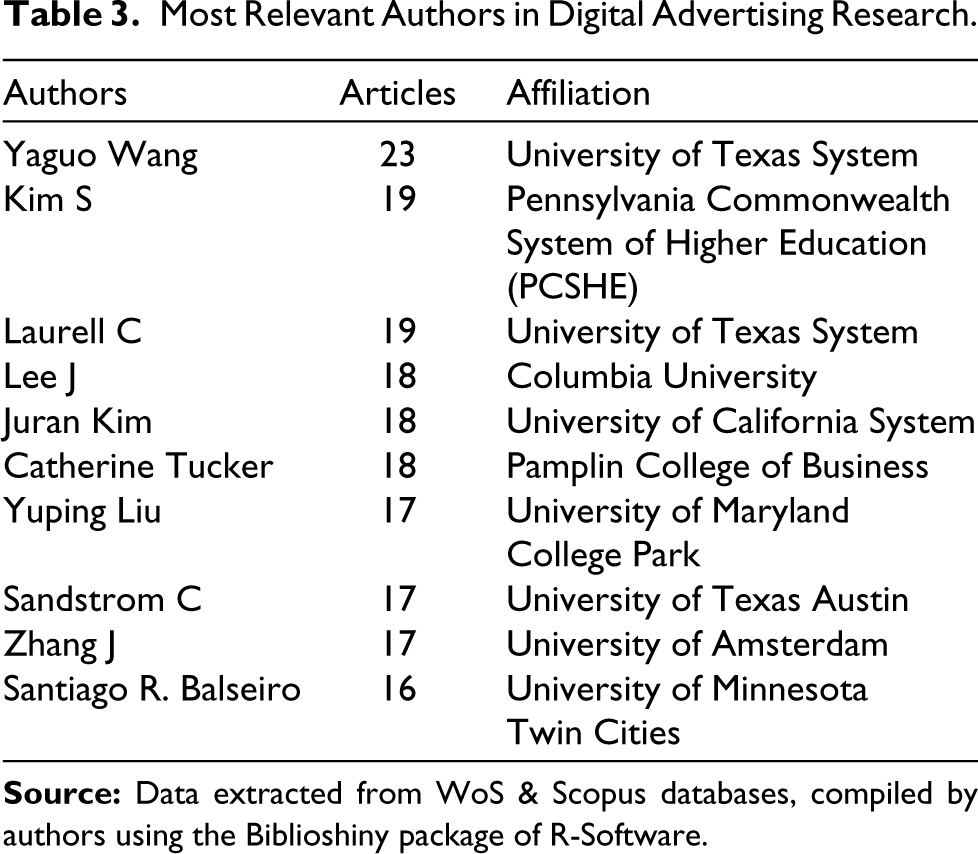
Keyword frequency analysis has been used to identify significant focus areas, validate the significance of articles in the research corpus and detect prevalent phrases concerning digital advertising. Figure 4 depicts a word cloud-based summary of keyword analysis. Online advertising, social media, social media analytics, mobile advertising and internet advertising are dominating authors’ keywords used extensively in the digital advertising literature. This confirms their correspondence with the concept and search string used for this study, verifying keyword selection. Other popular keywords are sentiment analysis, purchase intention, internet marketing, privacy and advertising effectiveness. The analysis further focused on identifying the key authors and their respective affiliations, and the relevant information is presented in Table 3.
Most Relevant Authors in Digital Advertising Research.
Most Cited Articles
The most cited articles are presented in Table 4, with the corresponding total number of citations and the average citations per year for each article, highlighting their significant impact on the field of digital advertising research. The most cited articles are de Vries et al. (2012), Liu and Shrum (2002) and Varian (2007). De Vries et al. (2012) scrutinized 355 posts representing 11 global brands spanning 6 distinct product categories. The outcomes reveal that elevating the placement of a brand post to the forefront of the brand fan page amplifies its popularity. Liu and Shrum (2002) studied advertising effectiveness and concluded that ‘the efficacy of advertising can be influenced by the presence of interactivity, which exhibits both advantages and disadvantages, and the impact of interactivity on advertising effectiveness is contingent upon individual and situational factors’. The study undertaken by Xiang et al. (2017) employs text analytics to compare TripAdvisor, Expedia and Yelp for information quality in online hotel reviews in Manhattan. Several other studies were carried out to find out the effects of online engagement on advertising effectiveness (Calder et al., 2009). The most influential article, according to the number of times it has been cited on average, talks about social media analytics (Stieglitz et al., 2018). It concludes that there are various challenges in social media analytics, especially in finding subjects, collecting data and preparing data because dealing with a large amount of raw data is a big challenge. Other articles mentioned above measure consumers’ attitudes towards mobile advertising (Tsang et al., 2004) and interactive advertising (Ko et al., 2005).
Most Cited Articles in Digital Advertising Research.

Discussions
The findings have been divided into four key themes around digital advertising encompassing efficiency, contextual influence, ad-personalization and the transformative role of AI. It explores the dynamics of online advertising efficacy, contextual factors shaping ad processing, the rise of ad-personalization strategies and the recent technological advancements in AI that revolutionize digital advertising practices.
Efficiency of Digital Advertising
The efficiency of digital advertising has been a subject frequently identified in earlier reviews. While there is widespread agreement that online advertising creates beneficial results, new research highlights the difficulties involved. Product category, consumer demographics and ad-type diversity all influence variation in efficacy in both online and offline domains. Ha (2008) asserted that online advertising was clearly superior to traditional/print media, although recent research contradicts this assertion. According to Steele et al. (2013), visual attention is a significant component influencing the efficacy of Internet advertising. Interestingly, offline advertising frequently outperforms online advertising in controlled laboratory studies, highlighting the varied dynamics of various platforms. This synthesis seeks to give a thorough and balanced viewpoint, considering the complexities involved.
Role of Context in Digital Advertising
The effectiveness of a digital advertisement on the Internet is inextricably connected to its context. According to Stipp (2018), ‘context affects ad processing primarily through attention transfer or a priming/halo effect’. A large volume of research has been conducted on context effects, with ad-context congruence emerging as a common emphasis. Earlier research suggests that ‘congruent ads outperformed incongruent ones’ (Yaveroglu & Donthu, 2008; Yoo, 2009). However, recent research reveals ‘complex congruence effects dependent on ad-arousal (Belanche et al., 2017), position (Li & Lo, 2015) and goal relevance (van ’t Riet et al., 2016; Zanjani et al., 2011)’. Furthermore, congruence interacts with creative factors such as ad complexity (Yeun Chun et al., 2014). Other contextual features have been studied in addition to congruence, such as contextual arousal (Duff & Faber, 2011), ad clutter (Yaveroglu & Donthu, 2008) and contextual valence (Yoo & Eastin, 2017). Consumer location, which is critical in mobile advertising, is a recent addition to contextual features (Grewal et al., 2016). According to research on location effects, mobile ads related to the consumer’s present location and purpose result in more purchases, even when they are near a competitor’s location with a substantial discount (Fong et al., 2015). Zubcsek et al. (2017) demonstrate ‘the significance of place by showing that customers in the exact location respond similarly to adverts, revealing underlying homogeneity’. Goh et al. (2015) make similar observations about customer search behaviour after receiving mobile ads.
Ad-Personalization
Ad-personalization has recently gained popularity as advertisers increasingly use microtargeting tactics. Personalization tactics might be based on ‘consumers’ past actions (e.g., retargeted advertisements), present behaviours (e.g., contextual ads), or knowledge about consumer identification (e.g., personalized emails) and location (e.g., mobile ads) (Pearson, 2019). This personalized strategy improves advertising efficacy by ‘increasing personal relevance’, decreasing ‘scepticism towards advertisements’ and encouraging more ‘attentive processing’ (Baek & Morimoto, 2012; Maslowska et al., 2016; Sahni et al., 2018). Ads that are accurately behaviourally targeted may influence subsequent consumer behaviour by changing self-perceptions (Summers et al., 2016). According to a study, a personalized strategy can enhance advertisers’ earnings while ensuring consumer welfare (Yao & Mela, 2011). However, when customers approach a purchasing choice, the influence of personalization declines, with knowledge having a greater impact. The efficacy of personalization is also dependent on other aspects of ad execution, such as visibility (Goldfarb & Tucker, 2011) and content quality (Bruce et al., 2017). Specific forms of personalization, such as ‘behavioural targeting and geotargeting, raise notable privacy concerns (Kim & Huh, 2017; Limpf & Voorveld, 2015), as consumers may be unaware of being tracked. Social cues, such as a human-like recommendation agent, can intensify these concerns (Puzakova et al., 2013)’. Some articles examine the ethical and legal aspects of behavioural targeting, helping advertisers in dealing with concerns such as customer permission and data protection (Matwyshyn, 2011; Nill & Aalberts, 2014).
AI for Digital Advertising
In recent years, technological breakthroughs, notably in AI, have transformed many aspects of marketing. AI evolves as a dynamic force in digital advertising, enabling new ways to communicate with target audiences. AI-powered advertising tools have become increasingly popular in recent years, with the goal of improving the customer experience. What was once thought to be an advantage reserved for larger organizations is now available to smaller enterprises as well. Smaller firms can generate insights for data analysis and forecasting by leveraging publicly available algorithms and well-established AI approaches. As digital advertising grows, AI will move beyond gathering and analysing information, with the potential to completely revolutionize digital advertising tactics. Notably, one out of every five Google searches is carried out through voice, necessitating that advertisers understand its value. This raises a fundamental question: How could AI be utilized to increase the effectiveness of digital advertising?
Implications
Theory
The adoption of AI-based systems in digital advertising differs significantly from the adoption of previous technologies, as highlighted. Unlike prior technologies that required manual intervention, AI-based systems are primarily automated, creating novel challenges (Terzopoulos & Satratzemi, 2020). This distinction in functionality needs a rethinking of existing theories since traditional frameworks may not adequately reflect the complexities of AI in the digital advertising market (Davenport et al., 2020). Future research in AI applications for digital advertising should be based on an intersection of management and computer science theories (Ismagiloiva et al., 2020). Prospective studies can take the following approaches to build an intellectual foundation suitable for AI in digital advertising:
Assessing the suitability of existing theories for AI in digital advertising research. Investigating the necessity for the creation of new ideas relevant to the digital advertising industry. Investigating characteristics of AI in digital advertising research that extend beyond technology, management of businesses and consumer behaviour. Developing a comprehensive, integrated framework or model that describes the current AI system deployment landscape in digital advertising.
Context
To capitalize on the benefits of AI, various types of AI-based systems have been found to be helpful in digital advertising. Examples include collaborative robots (cobots) that help with packing, drones that help with delivery and service robots that help with assistance (Huang & Rust, 2021). Prospective researchers in digital advertising can delve into the diverse array of AI-based arrangements available for advertising purposes. Studies may investigate those elements that impact organizations’ policymaking processes when picking various AI-based systems for their digital advertising activities, focusing on the following areas:
Examining the contrasts and similarities between several AI-based systems used in digital advertising. Investigating how contextual factors can influence the implementation of AI arrangements in digital advertising. Identifying organizational aspects that play a vital role in the implementation of AI systems for digital advertising. Discerning characteristics that differentiate organizations within the identical industry and across different trades, affecting the acceptance of such systems.
Content
Given that the use of AI in digital advertising is still in its infancy, concerning acceptance in various sectors, the potential applications are boundless (Dwivedi et al., 2021). Researchers could explore how AI is impacting the digital advertising arena in diverse situations. Future studies may address the following inquiries:
Examining the influence of organizational capabilities on determining whether to incorporate AI in digital advertising activities. Understanding the reasons behind advertisers’ incorporating AI tools into their digital advertising practices. Identifying responsible practices that firms should follow when adopting AI systems in their digital advertising activities to protect consumers’ data and privacy, that is, ensuring ethical use of AI for increased ad-effectiveness.
Method
While the attraction of adopting new technologies, including AI, is evident (Huang & Rust, 2021), various factors impact the adoption of these technologies. Future research might discover the domain related to the methodology of assessing AI system adoption in digital advertising, considering the following aspects:
Identify methods or models to scale the accurate adoption of AI systems in digital advertising. Analyse the impacts of AI on digital advertising strategies and compare companies that have and have not used these technologies. Investigate the need for diverse methods for various applications of AI in digital advertising research and explore ways to combine these approaches to study the research domain comprehensively.
Conclusion
In conclusion, the study on the evolution of digital advertising and the integration of AI has provided useful insights into the dynamic and ever-changing world of marketing and advertising. The study thoroughly examined the evolution of advertising from traditional one-way communication to intelligent, personalized ad distribution. The study emphasized the considerable growth in the subject domain of digital advertising over the last three decades, with a special emphasis on the current surge in papers exploring the use of AI in advertising.
Findings from the research highlight the importance of AI in defining the future of digital advertising. AI-enabled advertising is at the forefront of innovations in the area, allowing marketers to comprehend consumer demands more effectively, personalize content and improve targeting for increased engagement. The study offered insights into AI’s revolutionary impact on advertising strategies, highlighting the need to integrate data and AI-powered solutions to enhance consumer experiences and boost marketing success.
The study used bibliometric analysis to identify major trends, themes and research avenues in digital advertising. The review of publishing trends over three decades demonstrated the growth of digital advertising research, with a significant increase in studies focusing on ad personalization using AI methods. The study also looked at country-specific contributions, journal performance and the most cited articles on the subject, giving a full picture of the research landscape.
The research implications include theoretical, contextual, content and methodological elements (TCCM) of AI in digital advertising. The use of AI-based systems generates new difficulties as well as possibilities for marketers, necessitating a rethinking of existing ideas and the creation of integrated frameworks to guide future research. The study emphasizes the necessity to investigate the various applications of AI in advertising, taking into account organizational capacities, ethical considerations and adoption strategies.
Limitations
The authors made significant efforts to examine the research domain, yet this study may have certain limitations. To begin, despite our efforts to conduct a thorough keyword search, some material linked to AI in advertising might be overlooked due to a lack of certain keywords. Second, the scope of our literature search was limited to research publications that had been published and were publicly available in the WoS and Scopus databases. We realize that articles that are still in print or that have been published in conference proceedings were not included in our study. We urge that future researchers in the field of AI in advertising broaden their collection of keywords. Third, it is critical to emphasize that our analysis includes research published up to December 2023. Given the ongoing evolution of the subject matter, it is possible that some relevant material on AI in advertising was overlooked. Researchers should continue to monitor current advancements in the field beyond the timeframe specified.
Footnotes
Authors’ Contribution
Abhishek Kumar carried out the conceptualization, data curation, formal analysis, investigation, resource management and software utilization along with original draft writing and editing.
Mrinalini Pandey contributed with her continuous supervision in conceptualization, data curation, formal analysis, investigation, methodology, project administration, resource management, software usage, validation, visualization and reviewing/editing the draft.
Pankaj K. P. Shreyaskar extended his contribution by resource management, validation, visualization and participation in the original draft writing and review/editing processes.
Declaration of Conflicting Interests
The authors declared no potential conflicts of interest with respect to the research, authorship and/or publication of this article.
Funding
The authors received no financial support for the research, authorship and/or publication of this article.