



Abstract
The present research seeks to outline a common ground between the notions of urban aesthetics and inclusive planning by taking Siliguri Town station and its adjacent market as the cases. This article attempts to redirect the study of urban geography of Siliguri city away from macro-level analysis of space, which sometimes generates crude generalized discussions about the spatial development of urban landscapes, on the side of a more vigorous contemplation and critical consideration on the scope of micro-level planning alternatives for the city. Toward this objective, the research methodology is grounded on the analysis of historical databases, intensive field observation, and qualitative interviews. Through ten in-depth semi-structured interviews with key stakeholders including local body representatives, railway officials, planners, investors, as well as civil society organizations in Siliguri City, this study seeks to emphasize the factors that stakeholders in the city consider to be essential for the micro-scale development of Siliguri Town station neighborhood and its long-term effects on a number of actors. Findings from the interviews indicate that Siliguri Town station and its neighboring markets, such as Mahabirsthan and Hawkers’ Corner, are continuously growing as the places of urban contestation and struggle. To critically address these contestations, the research argues for the resurgence of Siliguri Town station neighborhood as the key urban territorial form for collaboration among central, state, and local government authorities as well as private players. The principal outcomes of this research, therefore, are expected to provide some micro-level planning alternatives, which can pave the path for an inclusive and planned production of urban space around Siliguri Town railway station, representing the heart of Siliguri city.
Introduction
India is a country with more than 170 years of railway history and railway stations along with their neighborhoods have been evolved into places with complex socio-spatial organizations. Over the last few years in India, a fair amount of attention has been paid to the redevelopment of railway stations (like Habibganj, Gandhinagar Capital and others) and their immediate surroundings, as key territorial forms of urban redevelopment through public–private partnership (PPP) measures. The Smart City Mission, for instance, has governed the attention of urban affairs in the country toward the requirement and advantages of accompanying a comprehensive approach of formulating urban development strategies as well as preparing purposeful and timely projects, which can help Indian cities to grow as global centers of capital formation. Railway stations and their surrounding areas are proposed to be redeveloped on Smart City lines to enhance passenger convenience, smoothen accessibility to stations and, above all, enable optimum use of Railway’s land (Garg & Chaudhry, 2017). In the year 2023, the Ministry of Railways launched “Amrit Bharat Station Scheme,” under which “Priority will be given to those works which improve the ease of movement of passenger, their convenience and integration of station with surrounding areas” in 1275 selected stations from different parts of the country (MoR, 2023).
Traversing a great deal of these contemporary endeavors, this research seeks to outline a common ground between the notions of urban aesthetics and inclusive planning. It takes theoretical support from the works of Mattila (2002) and Deusen Jr. (2002), in order to be cognizant of different notions of equity planning as well as different dimensions concerning the process of production of urban public space. Toward this theoretical stance, this research examines the Siliguri Town railway station, one of the oldest railway stations of the entire North-Eastern India and the production of urban space around it from historical lenses in order to understand the relationship between actors that led to the formation of the contemporary face of the neighborhood. Subsequently, through ten in-depth semi-structured interviews with local stakeholders, the study endeavors to associate the theoretical notion of “Aesthetic Justice” (Mattila, 2002) with the institutionalized framework of decision-making for potential redevelopment of Siliguri Town railway station and its surrounding market. Moreover, engagement with the theory of “Aesthetic Justice” advances a means through which the study of micro-level urban planning moves away from the notion of space as a concrete “object,” toward a wider and more critical understanding of the “processes” that conceptualize urban space more from a relational perspective.
Context
Theoretical Background
The renewal of urban neighborhoods is particularly a useful notion through which the concepts of “absolute” and “relational” space can be explored. In the modernist tradition of urban planning, for instance, urban space has been comprehended as the absolute unit of physical design and planning, where accommodating aesthetically pleasing architecture has the most important role to play in shaping the cities and their neighborhoods (Taylor, 1998). This approach has been highly criticized by a group of urban theorists due to its inefficiency to consider the underlying social processes that substratum the physical design (Buser, 2012; Deusen Jr., 2002). Despite the fact that modernist planners have endeavored to achieve a number of social goals by means of physical or architectural planning solely, these endeavors have been proven to be fallacious in practice (Mattila, 2002). In contrast, many contemporary urban redevelopment endeavors well-reflect a relational understanding of space where urban neighborhoods are considered as complex units of overlapping networks (Buser, 2012).
As is widely known, urban development and planning are complex subjects that can be approached from a variety of theoretical standpoints. However, knowing this fact does not make it easier to utilize planning theories in the formulation of actual urban planning policies (Mattila, 2002). In order to partially fill this theory-practice gap in urban planning, in 2002 Mattila came out with the notion of “Aesthetic Justice,” which previously was proposed by philosopher Beardsley in 1973. However, moving beyond the definition of “Aesthetic Justice” by Beardsley (1973, p.53), that is “…a fairer distribution of aesthetic welfare,” Mattila (2002) tried to find out a common thread between two diverse notions of urban planning. The first notion considers good urban planning as a way to give out goods, services, and/or welfare in society in as equitable manner as possible, and hence, considers the adoption of social justice as the key objective of urban planning. The second notion underlines the contribution of urban planning as a medium to produce or reproduce aesthetically pleasing environments for the daily activities of urbanites. In the words of Mattila (2002, p.132):
“…the aesthetics of urban form as one of the many issues that should be considered from the viewpoint of social and moral theories…. the possibilities to experience aesthetically good urban forms produce a specific kind of welfare for the users of urban space, which is why we should consider how this welfare is distributed in urban environments.”
Since the prime objective of this study is to put forward the idea of (re)production of public space in and around a railway station, the notions of “struggle, exclusion, representation and justice” as four axes of public space are worth mentioning (Deusen Jr., 2002, p.150). Public space, in most of its conceptualizations, is a space of conflict where a continuous struggle takes place on the rights to its accessibility, use, and reproduction. Then public space in many instances is a site of limit and exclusion, where a certain degree of access and activities is allowed or tolerated (Deusen Jr., 2002). Next to this, the public space is a space of representation of various complex networks between urban history, politics, and population features. And finally, the characteristics of public space govern social justice regimes of any society, by governing the spectrum of rights, distribution of resources as well as social relations (Deusen Jr., 2002). All these dimensions of public spaces appear from the perception of designers who design them, as well as people who use them to produce a certain degree of social capital.
It is, therefore, widely acknowledged that the production, access, use, and reproduction of aesthetically pleasing urban public spaces are not merely associated with the distribution of aesthetic welfare in society, but rather they are associated with a collective cum inclusive framework of decision-making in planning endeavors (Buser, 2012; Deusen Jr., 2002; Healey, 1997; Mattila, 2002). Thus, it can be conveniently argued that the knowledge of urban designers or planners cannot be superficially accepted as superior to the knowledge of local stakeholders.
Neighborhood-Level Planning and Urban Sustainability
Neighborhoods are the localities in which people live, work, and socialize, thus producing a deep sense of belonging and togetherness (Barton et al., 2021, p.1). Although it is very difficult to recognize a scholarly agreement on the definition of “urban neighborhoods,” they are largely conceptualized as building blocks of urban places with distinctive urban identities, marked by specific physical, historical, functional, and behavioral characteristics (Barton et al., 2021, p.1; Bianca, 2000). There has been a substantial number of scholarly attempts which argued that planning at neighborhood scale is of immense significance for promoting urban sustainability, as the overall status of a city is largely shaped by the characteristics of its neighborhoods (Adewumi et al., 2021; Stanislav & Chin, 2019). Since each neighborhood of a city stands for a specific identity and distinctiveness, at policy level they must be considered as individual (but not isolated) units for planning and management measures (Banerjee, 2023b).
Over the past few decades, there has been a discernible rise in global initiatives advocating for sustainable development, with numerous cities actively embracing these principles. However, in reality, many of these attempts remain concentrated at pan-city scales with little or no benefits for urban neighborhoods. “Currently we have networks of resilient cities, smart cities, sustainable cities, livable cities, 15 minute cities, slow cities, 85cm cities, healthy cities, child-friendly and age-friendly cities… and the list goes on” (Adewumi et al., 2021, p.11). In India also, the Smart City Mission, to a large extent, involved pan-city initiatives, comprising the application of selected smart measures to improve prevailing citywide infrastructural systems and transit networks (Shenvi & Slangen, 2018). While each of these notions of urban sustainability is relevant at their own levels of conception, in shaping urban neighborhoods there must be a site-specific bottom-up approach to physical and functional planning that in turn will ensure maximum local participation in the decision-making process. Furthermore, contemporary research also suggests that an urban neighborhood is a spatial scale at which socio-economic footprints can be better assessed and citizens’ participation can be smoother and more meaningfully implemented (Moroke et al., 2019). Therefore, micro-scale planning at neighborhood level is crucial for attaining the broad goals of urban sustainability where efficacious cooperation between institutionalized decision-makers and other stakeholders is essential for formulating and implementing effective policies.
Railway Station Areas as Urban Neighborhoods
Railway stations are the extensive infrastructures that accommodate a multitude of activities and provide a fair variety of services to a wide range of users (Lunardon et al., 2023). In view of the physical and functional imprints of train stations on overall urban landscapes, previous studies have termed railway stations as “volcan of life,” “palace of modern industry,” “cathedral of humanity,” as well as “detector of urbanity” (Dethier, 1981, p.6; Lunardon et al., 2023). Considering the importance of a railway stations on the overall urban dynamics, Bertolini (1996, 1999; Bertolini & Spit, 1998) have recognized two different, but diverging roles of a station as an urban entity—station as a node in transit network and a place in the city. The idea of “place” function of railway stations is built in line with the notion of territorial impact of train stations on their surrounding pieces of land, often termed as station neighborhoods. Despite ongoing efforts, complexities persist in conceptualizing railway station neighborhoods as effective spatial units for planning and development purposes (Banerjee, 2022). The questions that what are the identifying characteristics or criteria used to recognize a station neighborhood? and how is the boundary defined between the station district and the rest of the city? require serious attentions. Bertolini and Spit (1998, p.12) have identified four place-based approaches to theoretically conceptualize station neighborhoods including walkable radius, functional-historical elements, topographic continuity, and development perimeter. However, from a policy and planning perspective, the area encompassed within a walkable distance (ranging from 500 meters to 1000 meters) from transit stations is primarily regarded as station neighborhoods (Joshi et al., 2017; Mohammad et al., 2013; Thomas & Bertolini, 2020).
Aims and Organization
The present research attempts to redirect the study of urban geography of Siliguri city away from macro-level analysis of space, which sometimes generate crude generalized discussions about the spatial development of urban landscapes, on the side of a more vigorous contemplation and critical consideration on the scope of micro-level planning alternatives for the city. This attempt is grounded on the reflections of postmodern tendencies in urban planning where planners moved away from large scale city-level planning to an appreciation of the city as a mosaic of fragmented (but not isolated) spaces, produced by multiple forces (Degen, 2008, p.26). This study is principally aimed at understanding the factors that lead to the evolution of one of the oldest railway stations in north-eastern India and the production of urban space around it. Toward such objective, this article seeks to examine the potential for redevelopment of Siliguri Town railway station and its adjacent Mahabirsthan market and Hawkers’ Corner by studying the perceptions of institutionalized stakeholders (i.e. municipal councillors, planners, business union representatives, railway officials, and private investors). Insights gathered from the responses of such stakeholders thus will enable one to directly track the perception of individuals having hands-on experiences in decision-making.
The rest of the article is organized into three main sections where in the next section the article gives a brief description of Siliguri city, Siliguri Town station, and the adjacent market. Subsequently, an account of the adopted methodology is given. Next the results of the interviews are discussed and analyzed with respect to the findings of relevant literature in order to better frame the content of the interviews with respect to the existing sphere of knowledge. Finally, this article concludes with a synoptic discussion on the corroboration between the theoretical stance and empirical findings of the research.
Materials and Methods
The Case Study: Siliguri Town Railway Station and Its Surrounding Market
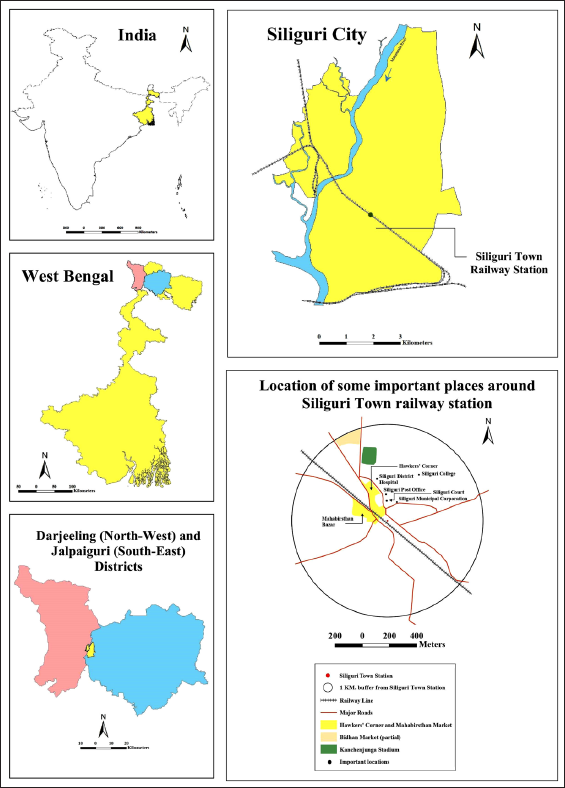
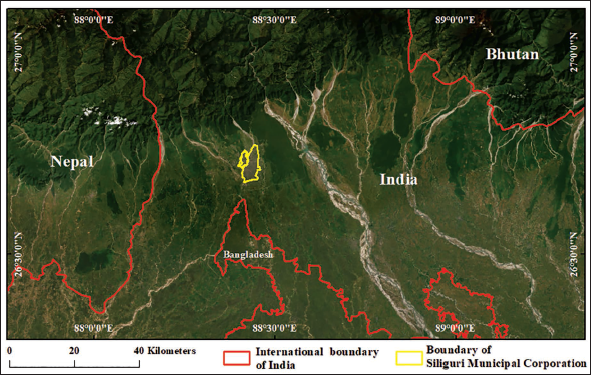
Situated along the topographic transition between plains and mountains as well as the geographic intersection between eastern and north-eastern India (Figure 1 and 2), the city of Siliguri covered a long journey in a very short time span, from a swampy malarious village in the 1910s to an enormous “metropolis-in-making” in the 2010s (Ghosh, 2018; O’Malley, 1907, p.40). The apparent reasons for the growth of the city can be explained by the factor of its location and the consequent development of transport infrastructure. There are enough historical shreds of evidence to prove that the present commercial giant of northern Bengal, Siliguri City, was cradled around a prestigious railway station, currently known as Siliguri Town station (Chattopadhyay, 2017; Dash, 1947; Gangopadhyay, 2019). The railway station, built with rigor and care, was not only a physical landmark in the nineteenth century Siliguri but also was the sole demographic and functional nuclei of the town. In the words of Ashok Gangopadhyay (2019, p.110):
“…In 1881 Siliguri was a village with a 200/300 population. Majority of them were Bengali railwaymen, with a small number of Bihari coolie and Marwari businessmen. The tiny Siliguri was confined around the railway station. For decades until then, there was nothing other than the railway station in Siliguri that could attract the eyes of a visitor…. In the nineteenth century, Siliguri was the sole rail-centric tiny settlement of the region….”
Location Map of the Study Area.
Geomorphic and Geo-political Significance of Siliguri.
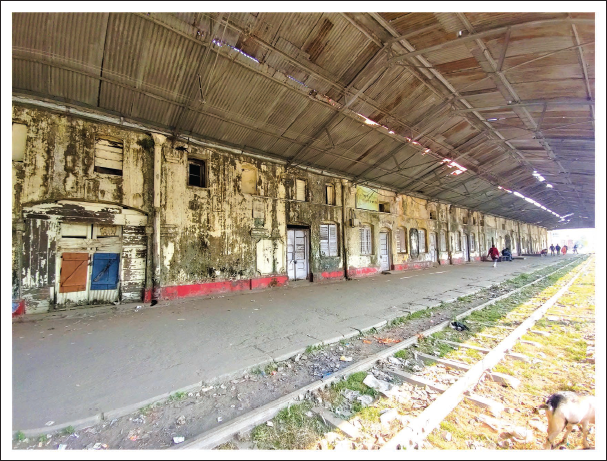
However, with time the Siliguri Town station (previously known as Siliguri station) has entirely lost its importance and presently is known for its obsolete nature and slummy neighborhoods, thus, serving as one of the most “topophobic” places in the city (Figure 3 and 4). Contrariwise, the tiny market of the 1880s around that station has grown into a thriving market on railway tracks, locally known as Mahabirsthan Bazar and Hawkers’ Corner on two different sides of the railway tracks, respectively. Thus, the history of evolution of the Town station neighborhood has been the testimony of several legal, economic, social, and environmental struggles—struggles that depicted a wide range of evident socio-economic disparities of the urban development process.
Siliguri Town Railway Station.
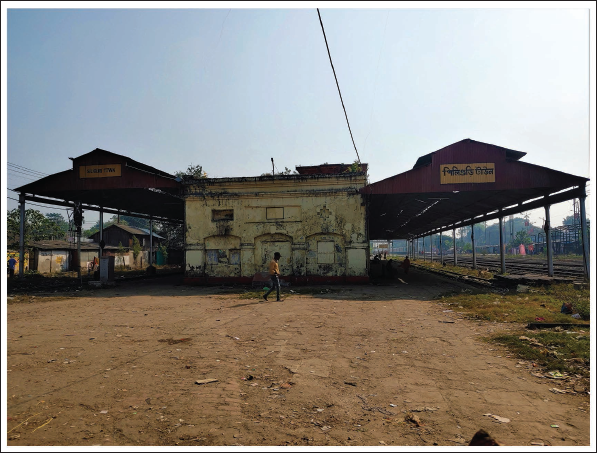
Dilapidated Condition of Colonial Architecture of Siliguri Town Station Building.
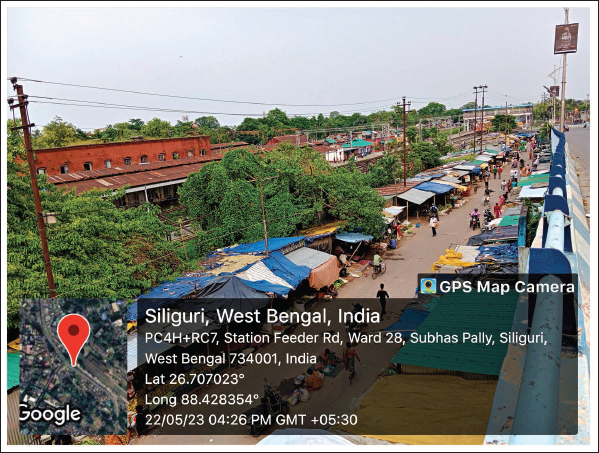
The choice of consideration of Siliguri Town station and its surrounding market as the case is principally grounded on the factor of its location at the heart of Siliguri City. Important institutions like Siliguri Court, District Hospital, office of Siliguri Municipal Corporation, as well as Bidhan Market, Kanchenjunga Stadium and many other important locations of the city, are situated within a 1-km radius from the station (Figure 1). Nevertheless, the contemporary urban landscape in and around the station has been a symbol of several environmental, social and aesthetic issues, depicting the decades of negligence and decay, but simultaneously stands for the substantial potential to serve the identity of Siliguri City as well as the economic and social needs of its residents. This research argues that the organic growth of Siliguri City disregarded the significance of Town station or even failed to see it at all, wasted the heritage potential of the station, neglected its locational advantage in the city and thus inflicted grave injustice to the landscape around it. Furthermore, Mahabirsthan market and Hawkers’ Corner have been at the nucleus of Siliguri’s urban life for decades, and despite the proliferation of neoliberal retail chains in the city and online shopping platforms, these markets still continue to provide affordable products, food and employment opportunities for a visible size of population across the city and its surrounding region. However, with time these markets have emerged as the “contested spaces” at the “urban margin” of Siliguri with a lot of physical, social, economic, and legal disgrace attached to them (Figure 5). Therefore, these markets are marginal, seeing that they inhabit an edgy space in the city that is centrally located but is marginalized and/or neglected, encircled by neoliberal retail chains and threatened by dispossession.
Mahabirsthan Market.
Data Sources and Methodology
The findings of this study are principally grounded on primary data, collected from intensive field observations as well as 10 in-person semi-structured interviews conducted with key local stakeholders from different fields of interest (Table 1). Conducting intensive field observation and rigorously taking field notes as well as drawing on semi-structured methodical interviews is expected to bring about “personally historicized, temporally formatted” responses to the queries concerning the collective’s opinion on a certain course of action (Katz, 2001, p. 445; Ley, 2023). The field observation, along with the interviews, was conducted in the months of March and April 2023. Moreover, the study participants were sampled through a purposive cum snowballing method, where the chief objective was to ensure the participation of local stakeholders from a variety of fields. However, while identifying stakeholder groups theoretical insights were taken from a number of scholarly evidence (Carmona et al., 2002; Fiore et al., 2021; Prové et al., 2016; Schiller et al., 2013). Fiore et al. (2021, pp. 352–353), for instance, have identified three major categories of stakeholders including “Government; Civil Society; and Market,” whereas Schiller et al. (2013, p. 6) have categorized stakeholders into seven major groups comprising “Public; Policy makers and government; Research community; Practitioners and professionals; Health and social service providers; Civil society organization; and Private business.” Given the willingness to participate and the specific requirements of this study, stakeholders from three distinct groups (government, private body and civil society organization) were interviewed for the current research. Responses of the interviewees were not voice-recorded, rather hand-written notes were taken by the researcher during interviews. Participants were asked to answer a number of descriptive questions regarding the potential for redevelopment of Siliguri Town station and its neighboring market as well as the possible implications of that redevelopment on the overall urban dynamics of Siliguri City. Moreover, they were asked to discuss their respective roles in the proposed set of actions. Finally, interviewees were asked whether they had any suggestions for the planners and government authorities concerning the redevelopment of the town station neighborhood.
List of Stakeholders/ Interviewees.

Since the prime methodological stance of this research is grounded on qualitative modes of enquiry, the findings of this research have largely relied on subtle judgements that ask for an attestation to the researchers’ “positionality” and “reflexivity.” Positionality, which popularly refers to “the position that the researcher[s] has chosen to adopt within a given research study” (Savin-Baden & Major, 2013, p.71), shapes the ways the researchers “view themselves and are viewed by others: as an insider or outsider” (Ozano & Khatri, 2018, p. 191). In the present research, the authors’ positionality as the researcher is informed by a number of key factors that have molded their position and proposition to the research subject. At the outset, the authors’ academic involvement in research concerning rail-based transit-oriented development (TOD) and associated station-area redevelopment ventures, both in India and abroad, over the past five years has played a significant part in endowing their interest and advocacy stance toward the regeneration of railway station territories. Through this academic attachment, the authors have obtained a subtle understanding of the importance of railway stations as pivotal points of convergence of urban redevelopment and community engagement, which in turn has encouraged them to raise a fundamental question in front of the stakeholders that “why do railway stations and their surrounding territories matter as buildings in urban landscape?” Moreover, it is essential to acknowledge that the researcher (first author) who conducted the field survey shares the same regional background as the respondents under consideration. This shared regional affiliation has primarily facilitated the task of developing rapport with the stakeholders and ingress to insider perspectives—by that means, augmenting the authenticity and depth of the data collection process.
Furthermore, with respect to reflexivity that is “a set of continuous, collaborative, and multifaceted practices through which researchers self-consciously critique, appraise, and evaluate how their subjectivity and context influence the research processes” (Olmos-Vega et al., 2023, p.241), it is important to through light on two principal types of reflexivity, such as personal and interpersonal reflexivity. Central to the “personal reflexivity” (Olmos-Vega et al., 2023) is the first author’s keen personal affiliation with the city of Siliguri—a connection cultivated over a continuous period of nearly five years characterized by scholarly engagement and perceptive observation, particularly through the lens of his doctoral research. Drawing on this intimate academic connection with the city of Siliguri, the researcher’s lens of observation has been sharped toward the variegated urban challenges permeating the landscape of Siliguri, resulting in a diligent recognition of the existing problems and dormant potentials intrinsic to the Siliguri Town station complex. Also, the researcher did spend a substantial amount of time walking through the streets around Siliguri Town station, gathering important insights into the nature of production of urban space in that neighborhood. This experience, in turn, assisted the task of figuring out the construction of questions that were to be asked at the time of interviewing key stakeholders. The next crucial consideration concerning the “personal reflexivity” is associated with the confusion between nonparticipant observation and “obscurely gazing at ‘others’ in the street” (Verloo, 2020, p.52). The researcher, thus, made a comprehensive plan to take field notes in a manner that is sensitive to stereotyping and reification of both people and space. Next to this, with reference to “interpersonal reflexivity” (Olmos-Vega et al., 2023) which principally mattered in semi-structured interviews with stakeholders, it is important to mention that the researcher essentially relied on snowballing method while obtaining information about the potential interviewees, which means that the lion’s share of the respondents was contacted through the initial participants. This pre-existing familiarity helped facilitate trust and cooperation, as respondents felt more comfortable engaging with the research process. Since a number of politicians were also contacted, the researcher had to conciliate any prior differences in opinion and/or ideologies with the politicians to uncover their unbiased responses regarding the study subject.
At the analysis phase, the handwritten interview notes were scrutinized with care and rigor, in order to find out some common themes that stakeholders from various fields consider to be crucial for the redevelopment of the town station and its surrounding market. The thematic discussions are drawn on an interpretive stratagem that is used in the analysis of interview materials in lieu of objectively assigning codes to the responses (Ley, 2023). Subsequently, the views of the stakeholders were compared with each other, to find out the spheres of complementary as well as contradictory interests concerning the planning endeavor. Finally, the advice of the stakeholders for fruitful implementation of the proposed redevelopment initiative was analyzed thematically in order to find out the broad subjects of concern that may facilitate or di-facilitate such endeavors.
Results and Discussion
Results
Interviewees were first asked a number of questions about their perceptions of the present state of Siliguri Town station and its neighborhood as well as the redevelopment potential of the same. Table 2 provides a synoptic view of the stakeholders’ perception concerning the existing image of Siliguri Town station, its neighboring market, and their redevelopment potentials.
Summary of Stakeholders’ Perception.
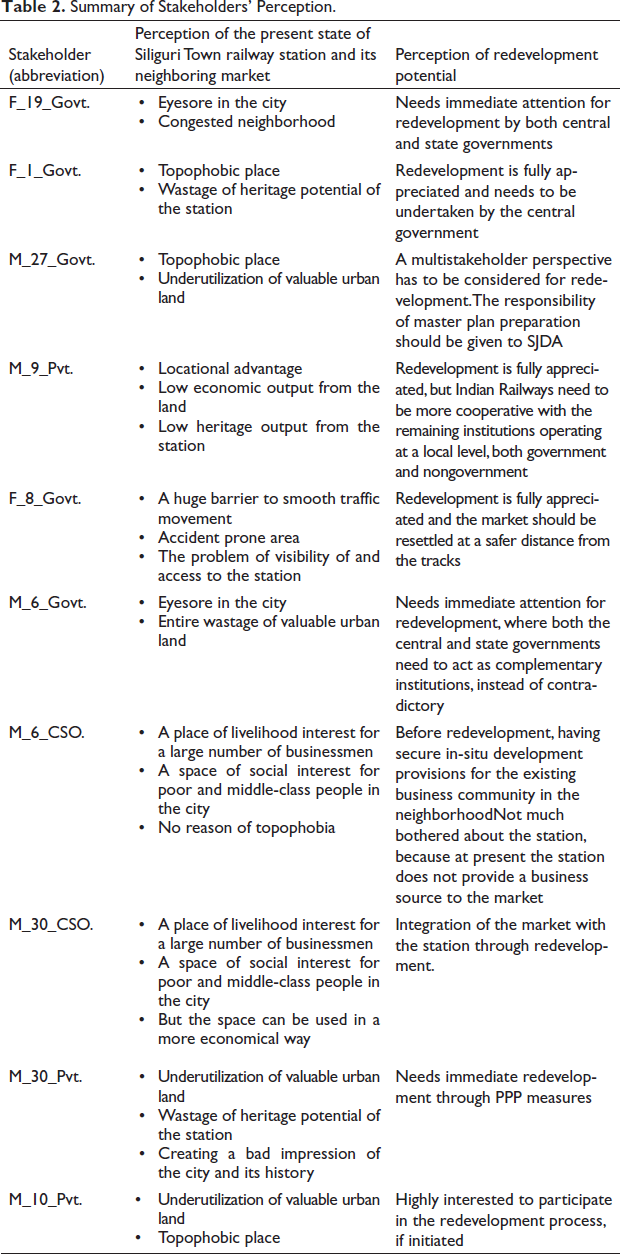
Throughout the history of urban development, the processes of growth and decline have invariably coexisted, shaping the ebb and flow of cities. Siliguri Town station and its neighboring Mahabirsthan market and Hawkers’ Corner are no exceptions. From the 1880s, until the 1950s, Siliguri Town station was the most important transit hub of Siliguri City. But the later emergence of Siliguri Junction and New Jalpaiguri Junction stations had entirely driven the attention away from the Siliguri Town station and led to its obsolescence. Similarly, the oldest commercial nuclei of Siliguri City (i.e., Mahabirsthan market) had also lost its importance due to the proliferation of other post-independence markets in the city like Bidhan Market and City Centre market complex. Thus, the most important outlook that has shaped the contemporary perception of institutional stakeholders about Siliguri Town station and its surrounding market is the filthy nature of the station and congested condition of its neighboring market. As evident from the words of a planning professional, “…Today, Mahavirsthan and Hawkers’ Corner are among the most congested neighbourhoods of Siliguri, with unorganised shops, some of which are recklessly close to the railway tracks [Figure 6], narrow lanes bustling with commercial activities and inducing traffic congestion, unavailability of open spaces, and of course, outmoded urban infrastructures…. Somehow we have started believing that this is the fate of the city and its citizens…. There is an immediate need to initiate the reconfiguration of the plots of the neighbourhood through redevelopment by imposing regulations to arrange space for new lanes, and for the betterment of existing ones, in order to promote walkability and pedestrianisation…”
A municipal councilor (people’s representative) further added “…Siliguri Town station has a heritage value attached to it, which has been completely unseen in the last few decades by all the apex authorities…consequently, the station has lost its historical identity and become a subject to many informal and immoral uses…this is not only affecting the picture of the neighbourhood but also the image of the entire city, which asks for an immediate attention to redevelop the station and its neighbourhood…. Apart from the actual, on-the-ground tangible restructuring outcomes, the re-emergence of Siliguri Town railway station as an aesthetically appealing point of convergence for several urban activities will carry a strong symbolic meaning for the citizens of Siliguri: it will further solidify the image of Siliguri as a ‘Railway Town’…it will provide an identity to the city…”
The Adjacent Market of Siliguri Town Station That Is Dangerously Close to the Railway Tracks.

The capacity of institutional stakeholders as stimulators and/or regulators is essential in participatory endeavors, especially where both regulation and balancing are imperative, such as in urban redevelopment projects. However, poor institutional collaboration has always been one of the major obstacles to the concept and application of participatory decision-making in urban redevelopment programs, more prominently in developing countries (Erfani & Roe, 2020). This thing has been evident from the outcomes of the interviews in the present study along the lines of contradictory opinions of different stakeholder groups, representing different institutional interests. In other words, it was evident from the interviews that high probability of mistrust between different institutional stakeholders’ groups is potent enough to negatively shape the sustainability objective of the whole participatory planning initiative to enhance the aesthetic quality, social value, and economic appeal of Siliguri town station and its adjacent market. This was revealed to the researcher in a number of ways. For instance, a business union representative from the neighborhood commended, “…This [Mahabirsthan and Hawkers’ Corner] is the oldest market in Siliguri city, thriving here since the very inception of the railway station [Siliguri Town] in this place. Thus you can well-analyse the age of these shops, here in this market…. Now if anyone will randomly come and say that they want to redevelop the market by removing the local shops, just because the local shops do not look good in the eyes of the developers…why are we supposed to let them do that…this is the matter of life and livelihood of thousands of people…. Additionally, there is no reason of fear [Topophobia] in this neighbourhood at all…. This is a thriving market, a bright light space…why would someone feel fear in this locality?…these words are just said to defame this locality.”
This is a critical ground due to which government institutions may fail to succeed in mobilizing all the shop units to redevelop the neighborhood through participatory measures; the pre-redevelopment shape of the station and the market is not being seen as a shared problem. The comment below, of a railway group stakeholder, demonstrates that circumspection as a consequence of differing ideas of urban redevelopment has been a major roadblock to the path of establishing a pragmatic discourse between local stakeholders and institutional groups: “…major portion of the market around Town station is flourishing on Railways’ land, which is yielding no economic value for the Railways…this land otherwise could have been used in a much economical way that could generate better economic virtue for both the Railways as well as local shops…but if the Railways will even think of redeveloping that market, opposition will come from all the available spheres, including the local shops of the market…they always think that redevelopment means dispossession…acquiring the consent of occupants for such an endeavour is the lengthiest process, and the most challenging one as well….”
The stakeholders representing local business unions have always perceived the fear of dispossession of local business firms from the market as well as changing nature of the market economy when the subject of redevelopment is stimulated. As confirmed by another stakeholder from a local business union, “…both the markets of Mahabirsthan and Hawkers’ Corner are used by the poor and middle-class people in the city… I really doubt that any person who has the economic support to shop from City Centre or any other elite urban commercial conclave in the city come here in this neighbourhood to purchase products…At this moment, if this market will be redeveloped into a mega-commercial structure with a lot of restrictions on who can access this place…then a huge affordability crisis among the citizens of Siliguri is bound to appear…”
A major theme which was evident from the responses of the lion’s share of the interviewees is a lack of physical and functional integration between Siliguri Town station and its neighboring market. Despite the fact that the town station is the very reason for the existence of both of these markets under discussion, at present, none of these markets are functionally attached to the town station. As indicated by an urban planner (government stakeholder), “…the organic growth of Mahabirsthan market and Hawkers’ corner had somehow left Siliguri Town station behind and led to the present state of invisibility of the Station…the ‘congestion’ status associated with these markets and their very existence in an unsafe proximity to the railway tracks, I believe, are two major reasons of declining significance of Siliguri Town station…. Hence, if we full-heartedly desire to redevelop the neighbourhood, we need to bring that old functional integration back between the station and the market, in one way or another….”
Even though the train station neighborhoods are not always entirely (re)developed into high-quality pedestrian-friendly urban environments, simply co-locating new activity and employment centers and aesthetic urban attractions in and around railway stations is considered to be a good planning practice in present times (Banerjee & Saha, 2022; Lierop et al., 2017; Peters & Novy, 2012). Many contemporary international as well as Indian evidence shows that countries have national or regional scale planning legislations, precisely considering the pivotal role that railway stations play in reconfiguring urban places toward sustainability and resilience through land use-transit integration, hence actively promoting such co-locations (Banerjee, 2022; Banerjee & Saha, 2023; Knowles et al., 2020). Therefore, parallel redevelopment of Siliguri town station and its adjacent market with an emphasis to achieve a better integration between the station and the market needs to look after the subjects of physical and functional assimilation between these two. Thus, successfully co-locating a redeveloped heritage building with some recreational facilities, a mixed-use activity center and convenient public-transit services may generate substantial virtue for not only the public-private investors but also for a wide range of users with different needs. This endeavor may or ultimately may not produce a more sustainable neighborhood for Siliguri City and promote “Aesthetic Justice” in such production, but it certainly can offer a convincing possibility for land valorization and social capital generation through comprehensive redevelopment and infrastructure amelioration of a centrally located neighborhood.
Discussion
In order to corroborate the findings of the interviews with the researchers’ own observation of the study area as well as literature review, this section seeks to find out some possible pathways through which the objective of inclusive planning and “Aesthetic Justice” can possibly be satisfied. The arguments here are based on the results and analysis of primary data, gathered through interviews and observations, in correspondence to a number of critical subjects that became apparent from the desk research.
The interview results unveil that different stakeholders representing different institutions had diverse visions to problematize the built environment of Siliguri Town station and its neighborhood which in turn has reflected their own individual interests and institutional objectives. This institutional unconformity among different stakeholder groups is a long-standing area of scholarly debate concerning rail-based TOD planning and associated station-area redevelopment ventures (Tan et al., 2014). In the context of United States, for instance, Mathur and Gatdula (2023, p.3) have argued “…A lack of coordination and collaboration among various stakeholders such as local governments, transit agencies, and developers, is the most noted organizational/ institutional barrier [in TOD practice]…. This lack of coordination may be due to the competition between local governments for new development and funding, a lack of a regional land use-transportation planning agency, unclear terms of interactions, and a lack of a project leader…”
Along these lines, each stakeholder has portrayed a “partial picture of truth” of the prevailing conditions where a selective approach to the problems and solutions is foregrounded by the stakeholders (Erfani & Roe, 2020). The benefits suggested are, therefore, predominantly one-dimensional. This, however, can be seen as an opportunity for communication and collective decision-making within aesthetic facet of urban planning through sharing aesthetic visions—sharing in this context does not principally mean that the visions of dominant institutions and planners will be imposed upon common public, but that different institutional groups taking part in aesthetic planning will learn equally from each-others approach to the problem. This kind of communication will also promote the production and fair distribution of aesthetic welfare in urban society (Healey, 1997; Mattila, 2002).
The key perceptions of different institutional stakeholders and their assigned roles as participants in the decision-making process primarily determine the nature and characteristics of redevelopment initiatives for aesthetic betterment of urban neighborhoods. However, in many instances, urban neighborhoods are evaluated typically on the basis of their economic appeal and property values. Local people may attach many other values and meanings to different neighborhoods that defy their calculation in mathematical terms and assessments of worth from a financial perspective solely. This thing has become evident from the responses of the interviewees where the existing shape of Siliguri Town station and its surrounding market has been problematized chiefly in financial terms (Table 2). However, from the perspective of local shops, their duration of stay in the market, a feeling of kinship with their neighbors (business community), and/or dependence on other business firms in the market due to ancillary effects are associated with some positive meanings to the place, which are difficult to be calculated on financial terms (Erfani & Roe, 2020). Transitioning to a new physical setup does not necessarily perpetuate these social values, which may give rise to a sense of loss, dissatisfaction, detachment, and erosion of social ties (Erfani & Roe, 2020; Li, 2012). Such an approach to physical or architectural planning does not recognize the potential advantages of public participation in aesthetic decisions, rather it simply serves the improvements of urban utilities and economic concerns. The idea here is that if the neighborhood transformation initiatives through redevelopment are going to outweigh the “exchange value” of marketplaces over their “use value,” then the important role of such traditional marketplaces as public meeting places and places of production of ordinary daily urban life, particularly for marginalized people, is going to be threatened (González, 2019).
Dissatisfaction with the existing functional cum aesthetic qualities of a place has always been a major driver of aesthetic planning and (re)production of urban space along the lines of aesthetic welfare. As soon as a person gains the perception that his/her sense of a place, either private and/or public, evinces that the quality of the place has ceased to meet his/her aesthetic requirements, the person senses a place dissatisfaction (Stedman, 2003). Such a situation is potent enough to stimulate a rejuvenation initiative for an urban neighborhood. This, as the findings of the interviews as well as observation indicate, can be a point of departure over which the endeavor of aesthetic and functional redevelopment of Siliguri Town station, Mahabirsthan market, and Hawkers’ Corner can be grounded. The responses from stakeholders clearly indicate that despite possessing significant heritage value and economic potential, town station and the neighboring market are generating limited social and economic benefits for a wide range of people, including local shop owners and tourists. In such circumstances, redevelopment proposals are more likely to be accepted by the current users of the space. What is most needed in this regard is a wholehearted effort to merge individual institutional interests in a manner that facilitates the achievement of the ultimate objective—to enhance the image of Siliguri City on regional, provincial, and national scales. In other words, the neighborhood-level plan for Siliguri Town railway station can be formulated in such a way that will facilitate the integration of neighborhood redevelopment initiative with the comprehensive development plan for the city and long-term perspective for its growth, instead of considering it as an isolated stand-alone project.
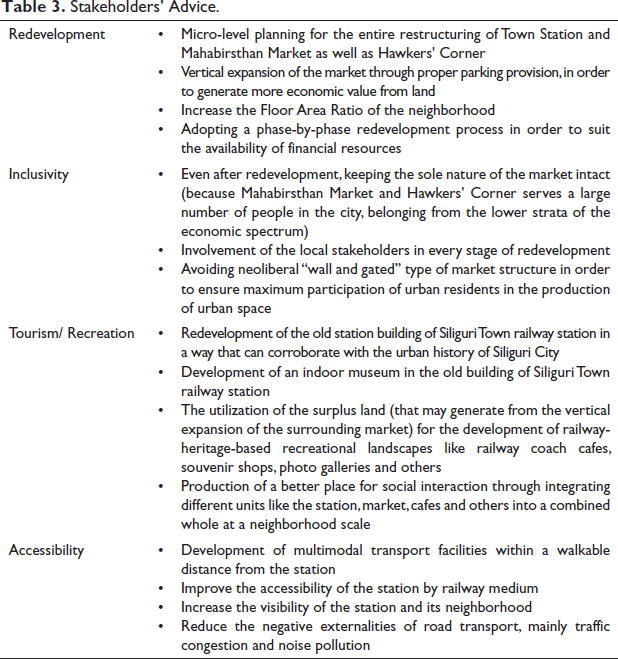
Apart from the contradictory visions on the space, policies and transformation of Siliguri Town station, interviewees were asked to share their respective opinions about the fruitful redevelopment of Siliguri Town station and the market around it. Even though, responses of the stakeholders did vary and comprised some specific ideas, the ambient themes of advice were that the micro-level planning in and around the station should consider the subjects of redevelopment, inclusivity, tourism, and accessibility (Table 3).
Stakeholders’ Advice.
Furthermore, an additional requirement to extend this notion of station area planning beyond the territorial sphere of Siliguri Town station has been particularly fundamental in the responses of institutional stakeholders, where an emphasis on the imperatives to broaden the scope of integrated land-use-transport planning to encompass the adjacent New Jalpaiguri and Siliguri Junction stations and their respective neighborhoods could be clearly visible. It can, therefore, be argued that despite the role of these railway stations as the principal gateways to the city of Siliguri, their neighborhoods represent a highly dilapidated state, which makes it essential for concerted redevelopment efforts to ameliorate the overall appeal and sustainability of urban landscape in all the three railway station neighborhoods of Siliguri City. Moreover, the existing problems of congestion and dilapidated nature of urban landscape in railway station districts of Siliguri and associated needs to undertake station-area redevelopment ventures cannot be separated from the wider debates on a number of other emerging urban challenges in Siliguri that are confronting the aspirations of sustainability and resilience in a negative manner—the proliferation of private automobiles and accompanied shift toward high-carbon mobilities; unavailability of affordable and reliable public transit system; inadequacy of pro-poor transport infrastructure like pedestrian and bi-cycling tracks; acute shortages of housing facilities, especially for marginalized groups; increasing exposure of urban citizens to severely polluted air, are the names but a few (Banerjee, 2023a; MoUD & World Bank, 2015; SJDA, 2013). This research, therefore, takes the stand for adopting a rail-based transit-oriented urban and regional planning layout in and around Siliguri City and corresponding convergence of land use and transportation planning in the railway station neighborhoods of the city and its agglomeration (e.g., Bagdogra, Matigara and others). This mode of integrated land use and transportation planning is “touted worldwide not only for its ability to relieve traffic congestion, reduce energy consumption, and cleanse the air but also for its ability to support sustainable patterns of urban development” (Cervero et al., 2017, p.109). Accordingly, this mode of development would efficiently address a number of other urban challenges that exist in relation to the phenomenon of urban decay in a number of essential neighborhoods of Siliguri as well as high-carbon-intensive mobility practices of the city where movement of people and products continues to be the principal contributor to greenhouse emissions.
Conclusion
The present research puts a discussion forward on the possibilities for the production of aesthetically good urban forms through the redevelopment of one of the most topophobic and neglected neighborhoods in Siliguri City. Moreover, this article argues that the aesthetics of urban space needs to be appraised as one such field which makes ways for creative activities of people to produce aesthetic welfare. This is the reason, the present research endeavored to combine a multi-stakeholders’ perspective on the redevelopment of Siliguri Town railway station and its neighboring market into an aesthetically pleasing urban environment that will promote the notion of “Aesthetic Justice.” Aesthetic justice within urban planning, thus, will not be concerned with the just-distribution of aesthetically pleasing urban environment among citizens, rather will pave the path for a decent distribution of the rights of citizens to participate in the production of aesthetically pleasing urban form. Moreover, citizens or stakeholders participating in decision-making within planning do not necessarily need to be considered as having some definite or stable set of interests; within participatory practices, the participants gain understandings of each other’s points of view and come to share their own (Healey, 1997, p. 33; Mattila, 2002). Collaborative and participatory decision-making within urban planning and its aesthetic dimension can thus be thought of as an arrangement of aesthetic education, where education does not refer principally to the ways through which the stakeholders will get educated by the expert planners, rather it refers to the ways of participation of different groups in urban planning in order to get insights correspondingly from each other.
An in-depth analysis of the potential for redevelopment of Siliguri Town railway station has revealed that this proposition has considerable possibilities to not only contribute to public infrastructure improvements but also for generating financial virtue for a wide range of actors, including Indian Railways, Siliguri Municipal Corporation, and private players. Converting the heritage potential of Siliguri Town railway station into some social, economic and aesthetic virtues can also have significant spatial impacts on the surrounding market. As the suggestions of the stakeholders also indicate, the endeavor of redevelopment of Mahabirsthan market and Hawkers’ Corner by increasing Floor Area Ratio and mixed recreational-commercial-office space development needs to be integrated with the redevelopment measure of Siliguri Town railway station. In other words, the reciprocity between the market and the station needs to be acknowledged while preparing the master plan for the betterment of physical and functional qualities of the neighborhood. Moreover, there is a need to integrate spatial and infrastructural planning in this regard. High level of urban activities, supported by a higher Floor Area Ratio in the neighboring market of Siliguri Town station, may accelerate the existing problem of congestion and traffic bottlenecks in the locality. Therefore, integrating spatial planning with the betterment of transport infrastructure is potent enough to promote a socially inclusive, walkable-sustainable neighborhood, where both the private and public players will share their respective costs and revenues. This small initiative, thus, can put the city of Siliguri at the forefront of innovative and progressive urban development practices in eastern India.
Footnotes
Acknowledgements
The authors want to express their gratitude to Late Professor Ravi S. Singh for his constructive suggestions and support. We thank the Department of Geography, Banaras Hindu University for the material support (books, internet) that facilitated this research.
Author’s contribution
Iman Banerjee contributed to conceptualization of the research, literature review, field survey, preparation of the maps, and writing the draft of the manuscript. Apala Saha helped in supervision, editing of the draft, and revision.
Declaration of Conflicting Interests
We, the authors of this manuscript, have not misrepresented research results which could damage the trust of the journal, the professionalism of scientific authorship, and ultimately the entire scientific endeavor. This manuscript has not been submitted currently to any other journal. This work is original and has not been published elsewhere. No data, text, or theories by any other author are presented as if they were the author’s own. Proper acknowledgements to other works have been given.
We have no conflict of interest to declare. Subject matter and materials discussed in this manuscript have no association with any organization for financial or nonfinancial interest. This research has been approved by the Research Progress Committee, formed in Banaras Hindu University to look after the first author’s PhD research, associated publications, and concerned ethical subjects. In addition, the participants provided their informed consent to participate in this study.
Funding
The authors disclosed receipt of the following financial support for the research, authorship, and/or publication of this article: We also thank the University Grants Commission for the Junior Research Fellowship, granted to the first author (Ref No. 190510006296).