



Abstract
This article examines the politics of the megalith building tradition based on an ethnoarchaeological survey conducted in Liyai Khullen, an unexplored village inhabited by the Poumai Naga tribe in the Indian state of Manipur. I documented and mapped 554 stone monuments in and around the village, revealing a concentration in the habitation area and near footpaths leading to terraced fields. Additionally, I explored the stages of “feasts of merit” and the megalith building tradition through ethnography. Examining the tradition of feasting and building megaliths from the theoretical framework of “paleo-political ecology” reveals that sponsors of such costly undertakings received material benefits. These benefits include a larger share of meat and premium-quality rice beer in the feasts of others, the exclusive right to adorn homes with horns, the privilege of wearing status shawls, acquiring prestigious titles, and gaining more influence within the village. Based on the results, I argue that sponsors derived not only higher status but also material benefits within the traditional socio-political structure. The findings presented herein have archaeological implications for discussing megalithic remains among the Nagas and in Northeast India.
Introduction
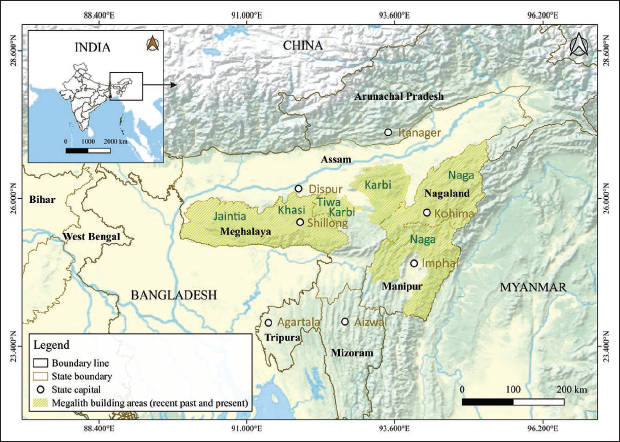
Archaeologists and anthropologists have extensively studied megalithic remains reported in much of the world’s landscape and continue to study with renewed interest, resulting in a vast body of literature (Laporte, 2022; Wunderlich, 2019). In Northeast India, where relatively less archaeological research has been undertaken, megalith remains have been reported in the Indian states of Assam, Arunachal Pradesh, Manipur, Meghalaya, Mizoram, and Nagaland (Hazarika et al., 2020; Jamir & Müller, 2022; Marak, 2022). Furthermore, there are also reports of the persisting traditions of building megaliths among a few tribal communities in this region, such as the Nagas, Karbis, Khasis, and Tiwas (Das, 2021; Jamir & Müller, 2022; Patar & Hazarika, 2023), making the relatively recent and also surviving megalith building traditions remarkable with huge archaeological implications for explaining megalithic remains reported in this region and elsewhere (Figure 1). Among the Naga tribes, recent investigations have shown that the tradition of building megalith was practiced to showcase wealth and earn higher status and recognition in the society until two or three decades back and continues to persist among a few Naga tribal communities (Devi, 1993; Jamir & Müller, 2022; Philip, 2017). The practice of building megaliths among these communities is associated with feastings and forms a stage(s) of traditional feasting, widely referred to as “feasts of merit” in anthropological literature, where intended sponsors expend considerable resources in such endeavors to earn higher status within the society (Devi, 2011; Jamir, 1998; Singh, 2024; Wunderlich, 2019). These feasts progress in stages, each successive one being more expensive and extravagant than the previous, resulting in higher status and recognition of the sponsors (Jacobs et al., 1990; Singh, 2023; Yekha-ü & Marak, 2021). While previous studies have acknowledged that some forms of benefits, in the shape of higher status, accrued to the sponsors of such costly undertakings, there exists a gap in our knowledge regarding whether material benefits were gained by sponsors within the traditional socio-political structure in exchange for the wealth expended on such events.
Map Showing the Areas in Northeast India Inhabited by Various Communities That Practiced Megalith Building Until Recently and Continue to Persist. This Map Is Based on the Locational Information Provided by Das (2021), Devi (2011), Jamir & Müller (2022), Marak (2022), Singh (2024), and Patar & Hazarika (2023). Locational Data Are Projected in WSG 1984 on the Natural Earth Basemap Using QGIS 3.4 (Illustration: The Author).
Against this backdrop, I present the results of an ethnoarchaeological survey conducted in Liyai Khullen, a village inhabited by the Poumai Naga tribe in the Indian state of Manipur. The survey, conducted between March and April 2021, aimed to record and map megaliths and understand the politics involved in their construction. Liyai Khullen proved to be a suitable site for an ethnoarchaeological study in Manipur for several reasons. First, the megalith remains and the megalith building tradition in Liyai Khullen have, until now, gone unstudied, possibly due to its location in an isolated hill landscape in the state. Second, residents claim to have followed traditional practices in megalith construction until 2004. They continue this tradition in modified forms today, such as by purchasing stones from the quarry team instead of searching for stones from the forest areas, and transporting stones on trucks instead of transporting stones on wooden sleds to preserve labor and time. However, they claim that as long as there are intended sponsors who can bear the cost, there are no restrictions on continuing their age-old tradition of building megaliths such as selecting stones from the forest areas, transporting them on wooden sleds, and practicing traditional rituals. Third, the village retains features typical of traditional small-scale societies, with the village chief serving as the nominal head, the traditional village council still performing its functions, and terraced farming remaining the primary economic activity. Finally, residents claim that their village stands out as one of the Poumai Naga villages with the maximum number of followers of the traditional animistic religion, making it a promising location for an ethnoarchaeological study.
To understand the politics involved in the tradition of megalith building, I employ the theoretical framework of “paleo-political ecology,” recently endorsed by Brian Hayden (2016, p. 6) in the study of feasting in small-scale traditional societies in Southeast Asia. The goal of this theoretical strand, as described by Hayden (2016, p. 6), is to comprehend why surplus production occurs in traditional societies and how surplus resources (or wealth) are utilized by ambitious individuals to advance self-interest and acquire power or benefits in small-scale societies. This theoretical approach involves three main premises. First, comprehending the power structure in tribal societies, including their corporate groups and families, is crucial, as power encompasses resources, labor, and disputes. Second, considering risk factors in these societies, such as illness, crop failure, and warfare, among others, and examining how families actively create social safety nets to mitigate these risks is essential. Third, analyzing the scale of surpluses that families can generate in these societies, and exploring how such surpluses are manipulated by aggrandizers or sometimes used to form factions, corporate groups, or other support networks, is a significant aspect of this theoretical framework (Hayden, 2016, pp. 6-7). Ron L. Adams (2007) first applied this theoretical framework in his ethnoarchaeological studies of feasting and megaliths in Sumba, Indonesia, revealing provocative results on how resourceful individuals build megaliths to gain not only power but also material benefits in society. However, this theoretical framework has not been employed in the studies of the megalith building tradition among the Nagas and other communities in Northeast India. Therefore, I choose this theoretical framework to examine the dynamics involved in the feasting and megalith building of Liyai Khullen, revealing for the first time among the Naga tribes that material benefits were accrued to the sponsors of such undertakings.
Megaliths in Northeast India
In India, three regional complexes of megaliths have been identified: (a) Northern and Northwestern; (b) South; and (c) Northeastern (Hazarika et al., 2020, p. 352). The prehistoric megaliths in India are found at Neolithic, Chalcolithic, and Iron Age sites, generally concentrated in South and Northern India. Examples include reports of megalithic remains at localities within the Sanganakallu-Kupgal site complex in Bellary district, Karnataka, South India, which also yielded Mesolithic, Neolithic, and Iron Age remains (Shipton et al., 2012). Recent studies have reported evidence of Neolithic, Chalcolithic, and Iron Age remains (megaliths) at the Paidigutta site in Andhra Pradesh, South India (Gullapalli, 2009, p. 441). However, the living traditions of building megaliths are found in an area extending from the Indian state of Andhra Pradesh, the Chota Nagpur region, and Northeast India (Hazarika, 2017, p. 150).
Concerning megalith remains in Northeast India, they are distributed widely in the areas inhabited by Naga tribes in Manipur and Nagaland (Devi, 1993; Jamir, 1998; Mutum, 2002) and in Meghalaya where Jaintia and Khasi tribes are settled (Meitei, 2020; Mitri, 2019). Megalith remains are also found in Assam, where the Karbi and Tiwa communities inhabit (Das, 2021; Patar, 2021), and also in areas settled by the Garo and Lepcha communities (Jamir & Müller, 2022, p. 456). Nonetheless, megalith building, as noted above, persists as a living tradition among tribal communities such as the Karbis, Khasis, Tiwas, and Nagas (Devi, 2015; Jamir & Müller, 2022; Patar & Hazarika, 2023). Among the forms of megaliths reported across this highland region, the menhir (monolith) is the most common form of megalith documented. Menhirs are built by the Mizo, Jaintia, Karbi, Khasi, and Nagas tribes to mark social events or honor the deceased. The Khasi and Jaintia tribes build dolmens (stone slabs placed over burials) for clan matriarchs, while Zemi Nagas in Manipur raise dolmens over burials as memorials. Cists (compact stone-built containers or ossuaries designed to house deceased bodies) are built as clan burials among the Khasi and Jaintia, and the Angami and Chakhesang Nagas build them for community members who have passed away (Wunderlich et al., 2021, pp. 3–4).
In Manipur, where this study was undertaken, the Naga tribes that practiced megalith building up until the past few decades include the Anal, Chakhesang, Kabui/Rongmei, Mao, Maram, Maring, Poumai, Koireng, Liangmai, Tangkhul, Thangal, and Zeme (Devi, 1993; Mutum, 2002; Singh, 1985). Potsangbam Binodini Devi (2011) classified the megaliths in Manipur into seven groups: (a) menhirs, alignments, and avenues; (b) flat stones or capstones; (c) cairns; (d) stone circles; (e) dolmens; (f) stone seats; and (g) miscellaneous types. Based on functional categories (religious and social significances), she classified the monuments into eight subtypes: (a) memorial stones erected for the dead (commemorative stones); (b) grave stones; (c) watch towers (raised stone structures that served as resting and watch-out places); (d) religious stones (stones associated with traditional religious ceremonies); (e) resting stones (raised stone structures where villagers take either rest or refreshment); (f) witness stones (stones associated with oath-taking events of the villagers); (g) village foundation stone (stone erected during the time of the first foundation of the village). The performers, in their names, erect the first groups of megaliths, while they are still alive or in memory of their parents, any deceased family member, or even distant relatives. Sometimes, such monuments are also built by the villagers in the name of the village. The constructions of menhirs are usually associated with the feasts of merit. The second category is funerary, which is ritualistically tied to burying the deceased people (Devi, 2011, pp. 49–56).
Feasts of Merit and Megalith Building Traditions of the Nagas
The term “feasts of merit” appears to be first used by J. P. Mills (1926, p. 157) when referring to feasting traditions in Naga societies. Later, C. V. Fürer-Haimendorf (1939a, 1939b) popularized the term while discussing the redistribution of resources by wealthy individuals in society through feasts to maintain an egalitarian social structure in Naga societies. H. N. C. Stevenson (1943, pp. 18–137) underscored in his study of Chin communities how agricultural surplus is carefully used to attain temporal power in society. Today, scholars widely embrace this term to discuss the social institutions and social stratifications among Naga tribes (Lotha, 2008; West, 1992; Wouters, 2019), as well as in other traditional societies in South and Southeast Asia (e.g., Hayden, 2016; Kirsch, 1973; Leach, 1954). The feasts of merit (hereafter, FoM) comprise a series of feasts ranked in the importance of merit and scale. The cost of each stage of the feast surpasses the previous one, and only wealthy people sponsor such undertakings. Sponsors of these feasts endure increasing expenses in terms of animals slaughtered and rice beer for each higher-ranked feast. Sponsoring such feasts serves as a means to attaining higher social status in society (Jacobs et al., 1990, p. 77; Lotha, 2008, p. 52; West, 1985, p. 29).
It is worth noting that the Naga identity, as we know it today, does not constitute a conglomeration of more than 30 ethnic tribes. Determining the exact number of Naga tribes in the Northeast India and Myanmar is challenging, and estimates of tribes self-identifying as Nagas vary (Singh, 2023, p. 3). This uncertainty may stem from the evolving nature of Naga identity, with new tribes in this highland region periodically claiming and disclaiming as Nagas (Longkumer, 2019). Among the ethnic groups that form this identity, there are distinctions in terms of traditions, cultures, languages, and even variations in dialects among villages inhabited by the same ethnic group of Nagas, although the practices of FoM, the clan system, headhunting, dormitory system, and village-level polity are shared among the Nagas (Singh, 2023, p. 3).
Even though FoM was widely practiced among the various ethnic tribes of the Nagas, how they were performed differs among the ethnic Naga tribes. For example, in the relatively egalitarian Lotha Naga society, the first genna (an elaborate system of rituals and beliefs or also taboo) entails a feast for the members of the sponsor’s clan, followed by the second and third genna, which involves feasts for the clans from the sponsor. The final genna represents a feast for the entire village. On the other hand, among the hierarchical Thendu Konyak Nagas, the FoM concludes with the introduction of a new log-gong and the erection of a carved post. However, such feasts can only be performed by the members of the Great Ang clan in the village, who use them to enhance their power (Jacobs et al., 1990, p. 78).
Another shared tradition among the Nagas is the construction of stone monuments as stages or parts of FoM (Devi, 2011; Fürer-Haimendorf, 1939b; Jamir, 2004). What is significant is that the specific stages of feasts and how monuments are built vary among the Naga tribes, even among villages inhabited by the same ethnic Naga group (Lotha, 2008, p. 52). For instance, in Phugwumi, a Chakhesang Naga village in Nagaland, a complete series of feasts involves nine feasts, followed by the erection of a row of nine monoliths in the name of the feast giver (Wouters, 2019, p. 165). In Songsong (Chachomei), a Mao Naga village in Manipur, the FoM consists of fourteen stages, and monument construction occurs during the fourth and sixth stages of feasts (Devi, 2011, pp. 133-134). The variations in the practice of FoM and social stratification among the Nagas tribes, ranging from a relatively egalitarian to a hierarchical social structure, provide an avenue to explore the significance of building megaliths within the framework of feasts.
The Study Area
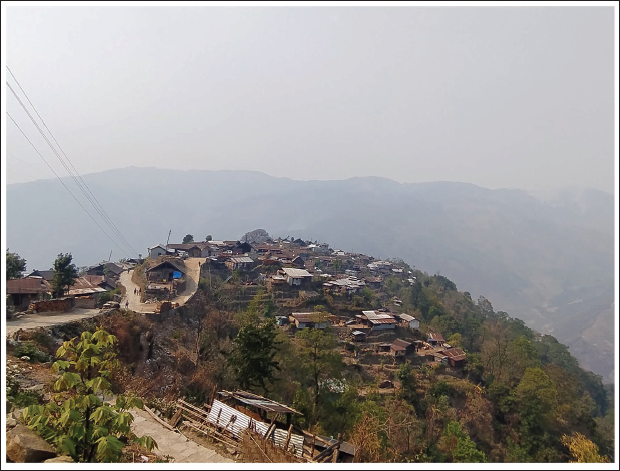
The village of Liyai Khullen (Zhaimai) is situated on a hill ridge in Senapati District of Manipur (Figure 2 and 3). Informants claim that the settlement in Liyai Khullen was established several years ago by the Poumai Nagas, who migrated from Makhel, a village settled by the Mao Nagas in Senapati District. The village is divided into four wards (shagei-zaie): Zhaieimai, Baithrimai, Lurina, and Luthrena. Inhabitants belong to four clans and 14 subclans. According to the 2011 census report, the village has a population of 7,153 individuals residing in 1,220 households. The primary livelihood of the majority of residents is dependent on agriculture, particularly terraced farming (Census of India, 2011). Considering the population growth over the past decade since 2011, it is likely that the current population exceeds 7,400. More than 200 households continue to adhere to their early animistic religion, zhaosomai/mavei nari, although most households in the village are Christian.
The Study Area. Locational Data of the Study Area Is Projected in WSG 1984 on the Natural Earth Basemap Using QGIS 3.4 (Illustration: The Author).

View of the Village of Liyai Khullen with the Concentration of Settlement on the Hilltop (Photo: The Author).
Followers of the animistic religion perform traditional rituals and festivals to this day. Residents claim that Reverend William Pettigrew visited their village in 1928 and started early missionary work, followed by Mr. Kholi Puni, an evangelist in 1938 from Punanamei, a village inhabited by the Mao Nagas in Manipur. Since then, gradually, people have been converting to the Christian religion. However, despite several decades of missionary activities, it appears that a large number of households still resist embracing Christianity. The features of traditional societies with the chief as the nominal head are still present in the village. Furthermore, no previous studies have been carried out in this village.
Materials and Methods
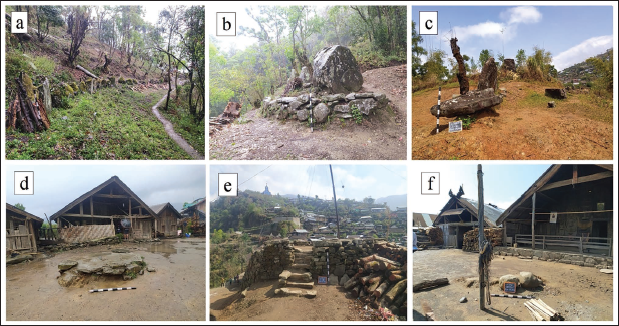
I documented the stone monuments located in and around the village. This was done on foot, walking through the habitation and open areas, following footpaths with the support of the residents. During this process, I categorized and recorded the different forms of megaliths in the survey area (see Table 1 and Figure 4). The shape, size, and Geographical Positioning System (GPS) location of each monument were also recorded. I conducted interviews with elderly residents in the village who have hosted or participated in FoM and built monuments. To do this, I obtained permission from the village authority, consisting of the elected chairperson, secretary, and village chief, and informed consent from the residents. Elderly residents (n = 12) with 60 years and above were interviewed in five interview sessions as they have more knowledge of the local practices and traditions. Each lasted between two and three hours and was attended by two to three persons in the morning and evening as residents were relatively relaxed and free at this time after days’ work.
The Stone Monuments in Liyai Khullen and Surrounding Areas.

The Megalith Forms Documented in Liyai Khullen: (a) Monoliths Located on the Hill Slope Near a Footpath; (b) Monoliths (raised on a stone platform); (c) A Fallen Monolith; (d) A Slab Grave; (e) A Stone Platform; (f) Sacred Stones. Please Note That the Scale in the Photographs is a One-Meter Scale (Photos: The Author).
The interviews were open-ended and semi-structured. I encouraged residents (in most cases, two or three residents) to explain the practices of FoM and the dynamics involved in building megaliths. While doing so, I enquired and requested them to explain in greater depth about the stages of FoM and how, why, and what form of benefits were socially accorded to people who built megalith in society; and also the factors that motivated ambitious or rich people to such expensive undertakings. Whenever confusion arose, I politely intervened and requested clarification. I also took short informal interviews (n = 6) lasting 10–20 minutes in informal settings in and around the village, such as near roadsides or while elderly villagers were sitting and resting in the afternoon. The interviews were conducted in the Manipuri language (Meiteilon), as it is the lingua franca among the communities in the state.
Spatial Distribution of Megalithic Monuments
The survey documented 520 monoliths, 6 monoliths (raised), 22 fallen monoliths, 2 sacred stones, 4 resting places, and 1 renovated village gate. Most monoliths stand in good and erect conditions, except for those that have fallen. They resemble roughly dressed single stone blocks with their stone surfaces displaying varying degrees of weathering, ranging from moderate to high. This suggests a gradual construction over an extended period rather than simultaneous erection. To establish a more precise understanding of the chronological sequences of these monuments, one must acquire radiometric data.
Most of the monoliths are located in the habitation area, particularly in the southwestern portion of the village (Figure 5). They are not located in the most elevated portion of the habitation area, which is a moderately sloped area. Another notable distribution pattern is their tendency to form clusters, with isolated monuments being rare. The only exception is the monoliths located in the terraced field west of the habitation area. The monoliths are found in clusters, either in rows or columns near footpaths. In the habitation area, they are situated near footpaths that lead to paddy fields and courtyards. This suggests a careful selection of erection sites of monoliths so that people could see them after their construction as they walk by the road or pass through footpaths. In other words, the display-oriented nature of the monoliths is clearly expressed as monoliths are not located in the forest. The clustering of monoliths is less on the lower hill slopes. The distribution pattern of monoliths in a few sites is that they are located touching one another or very close to one another (Figure 5).
The Locations of Monuments in and Around Liyai Khullen (Illustration: The Author).

Several monoliths are also positioned in rows between the houses (Figure 5). This raises an interesting question: Were the monuments built before the construction of houses and later absorbed by habitation expansion, or were they later built between the houses? Residents claim that some houses were built after the construction of monuments, and some monuments were built after the construction of houses (Figure 5). Most fallen monoliths are located in the cultivation area (terraced field). It appears that tilling the soil for cultivation may have partly loosened the soil and caused a few of them to fall on the ground. It also appears that residents might not have re-erected them after they fell on the ground. However, no fallen monolith could be recorded in the habitation area. This suggests that residents re-erected them or moved them away from their original locations. The stone platforms are located only in the habitation area. They are located in the elevated areas of the habitation areas, which offer a breathtaking view of the surrounding landscape. During the survey, it was observed that residents use them as resting platforms where people gather in the morning and evening. They are concentrated in the elevated areas of the village, which offer a wonderful view of the surrounding landscapes. The slab grave is located in the courtyard in the habitation area; similarly, the sacred stones (dukako stones) are located in the courtyard of the village chief (Figure 5).
The Stages of FoM
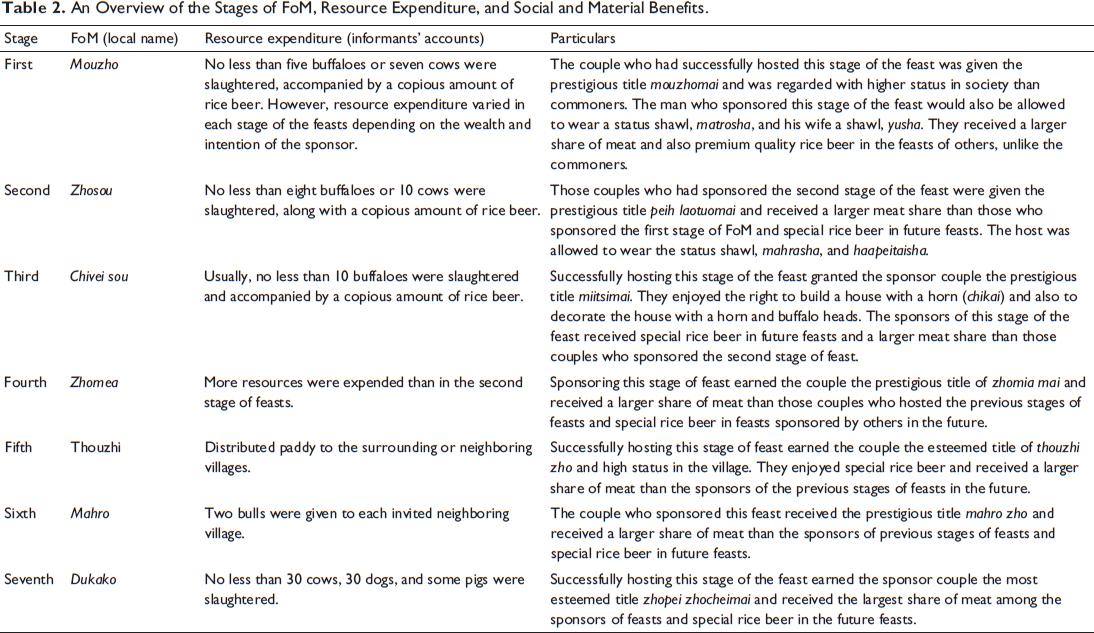
Informants claim that in Liyai Khullen, FoM comprised seven stages. The higher stages of feasts were more expensive and challenging to sponsor (for an overview, see Table 2). They were expensive since many livestock (i.e., cows, buffaloes) were slaughtered, and copious rice beer was prepared for feasts by sponsors for the villagers. Only wealthy couples sponsored such costly events, although sponsoring such events theoretically was open to all village couples. According to informants, every couple’s dream was to sponsor the highest stage of the feast and earn the highest achievable status and recognition in society. The construction of monolith was carried out in the second stage of the feast known as zhosou. However, the construction of burial stones (slab graves) and stone platforms was not traditionally part of FoM, as such events were held separately. Informants claim that as only a few people could manage to sponsor the higher or the later stages of the FoM, the details involved in such endeavors could not be recorded.
An Overview of the Stages of FoM, Resource Expenditure, and Social and Material Benefits.
The First-Stage: Mouzho
The first stage of FoM, mouzho, involved several substages in which rice beer and meat were served to the chief and clan leaders of the village. The couple seeking to host would first invite four clan elders to seek formal permission known as macha. After slaughtering a cow with no injury marks, raw meat was distributed to all households in the village as a symbolic gesture to host the feast. In August, clan members were invited to drink rice beer at the host’s residence. This stage is locally known as hruzhaoso. The couple then abstained from sex, and the intended wife wore headgear and a white shawl until the completion of the feast. The host gave five tin of rice (a tin is about 10 kg of rice) to four ritual specialists of the village. Traditionally, ritual specialists were selected based on seniority and from both genders: male ritual specialists (mangupu) and female ritual specialists (mangupai). Until today, ritual specialists continue to perform traditional ritual practices for non-Christian households in the village, as well as during traditional festivals. Whenever non-Christian individuals fall ill, the ritual specialists persist in performing rituals to aid in their recovery. If a non-Christian passes away in the village, a ritual specialist conducts traditional burial rituals for the deceased, with support from Christian households for the bereaved family members. This suggests that in the past, ritual specialists played a significant role in society, a role that persists in a village increasingly dominated by Christianity.
According to informants, as a part of the first stage of FoM, meat distribution occurred in December or the last week of November and was carried out by two boys selected by the host to assist him in performing rituals. Informants claim that in such cases, a little less than half a kilogram of meat was distributed to each household in the village. Until today, meat distribution is practiced by slaughtering three to four cows or buffaloes whenever a non-Christian passes away in the village as part of an age-old tradition. This is also a reason why villagers still rear a good number of cows and buffaloes, so they don’t have to bear the burden of searching for and purchasing these livestock in surrounding villages if they are needed. According to informants, not all couples could host the first stage of the feast; some failed even after obtaining permission and distributing meat to the villagers. Two boys distributed meat in the village, giving a larger share and special rice beer to those who successfully hosted the stages of FoM. Furthermore, the meat shares of previous FoM sponsors were given first, followed by the commoner villagers. As part of the feast, men served villagers rice beer, zhao, six times in the evening.
Informants claimed that the manner in which rice beer was served to those attending the event indicated some hierarchy of status or rank. For instance, sponsors of the first stage of the feast were served rice beer in medium-sized banana leaf cups called lisao, sponsors of the second stage of the feast on larger banana leaf cups called liso, and commoners who had not hosted the feast on the smallest cups called litro. Those who had already sponsored the second stage of the feast were served special rice beer known as chizao and cooked rice, while commoners received only ordinary rice beer known as phy-zao. During the rice beer drinking, the host (man) covered his leg with kitchen ash and stayed in the kitchen. This ritual practice is called vouhnai phiphaphao. While performing this ritual, sponsors were not allowed to talk with people other than one of his best friends.
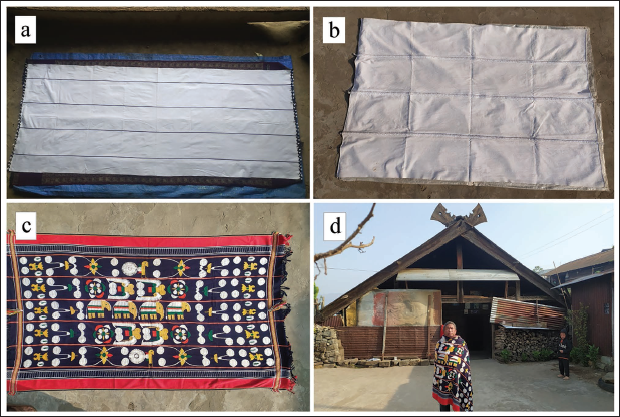
According to informants, one host in the village died while performing this rite. If the host died before the villagers were served rice beer six times while hosting feasts, the esteemed title of hosting the feast would not be given. After hosting the feast, the host offered the villagers rice beer once and twice to clan members in March (loukathro). Those who did not perform zhousou were not served cooked rice. Hosting this stage of feast was believed to bring the sponsor more wealth, progeny, and higher status. The couple who had successfully hosted this stage of the feast was given the prestigious title mouzhomai and was regarded with higher status in society. The man who sponsored this stage of the feast would also be allowed to wear a status shawl, matrosha, and his wife a shawl, yusha (Figure 6a).
The Status Shawls Entitled to the Sponsors of FoM: (a) Yusha; (b) Mahrasha; (c) Haapeitaisha; (d) A Man Who Had Erected a Monolith and is Titled to Wear the Status Shawl Called Haapeitaisha (Photos: The Author).
The Second Stage: Zhosou
The second stage of FoM was titled zhosou. However, couples who had not performed the first stage of the feast could directly host this event. Before hosting, the intended couple had to seek formal permission from the four clan elders/leaders and abstain from sex. Once granted, the couple distributed a small piece of meat to each household in the village as a formal invitation. The hind leg of the cow slaughtered for the feast was given to the chief, and the sponsors of the first and second stages of FoM received a much larger meat share than the commoners.
After meat distribution, the host offered rice beer only to clan members in an event called hrou zoshou, and on the day of paddy harvest, the host performed rituals similar to the first stage of FoM. The paddy was dried in the sun, and clan members prepared copious rice beer for the feast. The rice beer was brewed for four to five days, and two boys were assigned to look after it day and night. On the last day of rice pounding, wooden containers were used to brew the rice beer, and the ritual specialists carried out the rites on the day of the Donii festival (rice harvesting festival).
Usually, the host (man) and two boys would search the forest and stream locations for a suitable stone. This stone searching is known as meinou. Naturally occurring or partially buried sandstones were usually selected. After locating the stone, the host would mark the selected stone with two small sticks. The intended couple would abstain from sex until the feasting day. The host dreamed about the stone, and if it was good, the stone was considered perfect for erection; if bad, a new stone was chosen. The host could select a new stone if the stone told him in his dream: “I don’t like to stay among the people.” The host selected the stone at his discretion. No modifications could be made after the host dreamed about the stone, but minor modifications could be made before dreaming.
According to informants, the intended couple promised in front of 14 clan elders by offering a small feast where a dog would be slaughtered, and special rice beer would be served to them to satisfy them. This small feast is known as chachou. After this, the clan elders were responsible and accountable for the success of the stone-pulling event and for collecting the best creeper for stone-pulling. The wooden sleds were usually made from magnolia trees since they were strong enough to withstand the forces of stone pullers. As part of the preparation for the event, clan members collected banana leaves to make leaf cups for serving rice beer, and a day was dedicated to preparing cups before the feast.
During the stone-pulling event, the host received labor support from relatives, clans, and fellow villagers. The chief and ritual specialist attended the stone pulling but did not participate in the pulling activities. Women also helped prepare rice beer in the village but did not participate in the stone pulling. Once the stone was selected, the host and ritual specialist walked around it holding a small chicken, which was released as a symbolic gesture of paying the price for the stone. Three creepers were tied to the wooden sled, including a small creeper meant for ritual purposes. A virgin man pulled the creeper tied to the center of the sled and prayed before stone pulling. While pulling the stone, it was imperative to prevent the stone from rolling on the hill slopes, and if it did, a new stone would be selected, and the process of stone selection would start from the beginning.
If the stone could not be pulled, it was erected on the site, and if it was erected on someone else’s land or the land of other village wards (shagei-zaie), the landowner received two-and-a-half tins of paddy rice. The sled was also erected with the stone to prevent the latter from falling on the ground. On the day of stone pulling, only rice beer was served to the villagers and labor participants. If ten couples in the village wanted to erect monuments in a year, the elderly people created a sequence of the turn of events. A day after the monolith was erected, the host offered a feast to the villagers. According to informants, the host splashed the blood taken out from the heart of the first slaughtered animal (havei zii zhe) for the feast on the erected stone. Traditionally, the stone erection (chuh-matsu) occurred in the last week of November or the first week of December (donii).
Informants claim that after stone pulling, at least one cow and two buffaloes were slaughtered for the feast. The number of slaughtered animals could be higher based on the sponsor’s choice and resources. A ritual specialist performed a ritual titled veizii and sacrificed one cow, and then one buffalo was tied and beaten to death with pestles (mai) as a part of a ritual called hadava. The village youths competed to show their strength by chasing and beating the buffalo while the elderly and children watched and cracked jokes. This is also similar to the ethnographically documented cases of beating a feast animal before feasting among the Poumai Nagas of Oinam village (Philip, 2017, pp. 271–286). In doing so, the buffalo’s head was left unbeaten during the competition as it was supposed to be used for house decoration. The animal was taken to the host’s courtyard, where the ritual specialist speared the animal in the heart before the relatives and villagers butchered it. The next day, the raw meat of the slaughtered animals would be distributed in the village by two boys. The host distributed buffalo meat and served rice beer to attendees. The meat was also given to the host’s wife’s brothers and previous feast sponsors. The chief was given the right leg of the buffalo as part of the tradition. The heart and tongue of the buffalo were given to the host’s best friends. The intestines were distributed to the subclan, and ritual experts were given meat. The head of the slaughtered animals was reserved for the sponsor for house decoration.
According to informants, villagers gathered in the host’s courtyard the day after the animal slaughter to drink rice beer. The assistants of the host served rice beer six times to those attending the feast. The host covered his feet with ash in the kitchen while those attending the feast drank rice beer. After a year of hosting the feast, the host was allowed to wear the status shawl, mahrasha (Figure 6b), and another shawl, haapeitaisha (Figure 6c and Figure 6d). Such status shawls were forbidden to be used as bed sheets after they became worn out and old. And those nonsponsors of the FoM were not forbidden to wear these status shawls in the village. The slaughtered animal heads were decorated and displayed in the sponsor’s house. Those couples who had sponsored the second stage of the feast were given the prestigious title peih laotuomai and enjoyed special rice beer in future feasts. Further, they received a larger meat share of meat than those couples who hosted the second stage of the feast in future feasts.
The Third Stage: Chivei sou
Those who hosted the first and second stages of feasts were eligible for the third stage of feast, chivei sou. Sponsors of this stage of feast were allowed to decorate their houses with buffalo heads carved on wooden planks known as haapeitaih-taidu and build a house with a horn known as chikai (Figure 7). There are presently 285 houses with horns in Liyai Khullen, indicating that many people have performed this stage of feast. However, newly constructed houses are not permitted to have horns unless the owners have performed this stage of feast or their parents have performed it.
The House Chikai in Liyai Khullen (Photo: The Author).
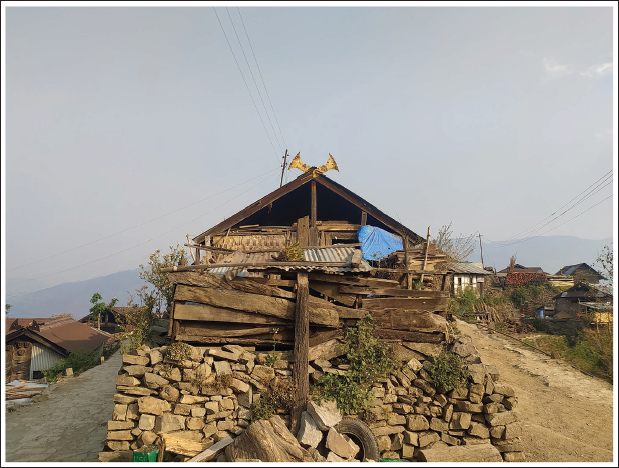
Informants claimed that this stage of the feast, which involved the construction of a new house decorated with buffalo heads and horns, was performed in December. Villagers would gather raw materials and engraved wooden planks with buffalo heads from the forest. The old house (chishra) would be carefully dismantled on the first day of construction (chilou). The host would then perform rituals with the wife holding a fire to ward off spirits, followed by a rice beer-drinking event. The Leemai clan would perform house construction rituals and decorate the house with a horn and buffalo heads. Successfully hosting this stage of the feast granted the sponsor couple the prestigious title miitsimai and received a larger meat share than couples who completed the second stage of feasts and special rice beer in future feasts.
The Fourth Stage: Zhomea
The fourth stage of FoM, zhomea, was reserved for those who had performed the second stage of feast (zhosou) more than once. All couples in the village were allowed to host this stage, and if the man had remarried after the death of his first wife, he would have needed to sponsor the first and second stages of FoM again. The procedures of hosting this feast were similar to the second stage, but more resources should be expended in this stage. Sponsoring this stage of feast earned the couple the prestigious title of zhomia mai. They would also receive a larger share of meat than the couples who sponsored the third stage of feasts and special rice beer in feasts sponsored by others in the future.
The Fifth Stage: Thouzhi
The fifth stage of FoM, thouzhi, involved the distribution of paddy rice in the village and neighboring villages. Permission from the chief and clan leaders was required to perform the feast, typically in August-September when rice ran out of stock for many people. The couple would distribute paddy rice to the villagers during this time. However, it seems that in the present context, distributing paddy rice to each household in the village and also to the surrounding villages inhabited by the Poumai Nagas would be an extremely costly endeavor, considering the residents’ claim that the population in the village and surrounding areas has been gradually increasing. Successfully hosting the feast earned the couple the esteemed title of thouzhi zho and high status in the village. They would also receive special rice beer in future feasts and a larger share of meat than those who sponsored the previous stage of feasts or the fifth stage of the feast.
The Sixth Stage: Mahro
The sixth stage of FoM, titled mahro was sponsored in November and December. The host would seek permission from the chief and clan elders to host the feast. Neighboring villages would be invited, and two bulls would be given to each village attending the feast. Neighboring villages of Liyai Khullen such as Saranamai, Tungjoy, Tungam, and others participated in the event at Liyai Khullen. The couple who sponsored this feast received the prestigious title mahro zho and received a larger share of meat than those who sponsored the fifth stage of feasts. They also enjoyed special rice beer in the feasts of others.
The Seventh Stage: Dukako
This stage was considered the toughest stage of FoM. Traditionally, it was performed to bring peace and stability to the neighboring villages. Small villages would request large villages to observe the rituals of dukako to end wars. Informants claimed that the sponsor slaughtered 30 cows and 30 dogs, and piglets were placed every evening in the barn (bao) to seek God’s approval. A rat bite mark on a piglet’s body was considered a bad omen, and the rite was pronounced only when no such marks were found on the slaughtered piglets. Before sponsoring the feast, the ritual specialist was fed for a year to become fat. On the day of feast, the priest burned a circular stone until it turned red hot. The ritual specialist would pour water on it and say: “The defaulter of this rite will dry up like the water on this stone” (chiichu pei dzii bviia halai).
According to informants, villagers then carried the specialist to as many villages as possible, and those they passed through had to respect the rituals. When Liyai Khullen observed this stage of the feast, they carried the ritual specialist around Poumai and Mao Naga villages in Manipur until Jakhama, a village inhabited by the Angami Nagas in Nagaland; and villages visited by the ritual specialist were tabooed to wage war for seven years. The defaulter and their descendants were believed to vomit blood and suffer from dysentery, resembling water poured on a hot red stone. Successfully hosting this stage of the feast earned the sponsor couple the most esteemed title zhopei zhocheimai and received the largest share of meat among the sponsors of feasts in future feasts. They also received special rice beer in the feasts of others.
Discussion
Although the documentation and mapping of the stone monuments in Liyai Khullen have revealed the monument types and their distribution patterns on the landscape, it is difficult to understand the dynamics involved in the production of these monuments. However, ethnography has revealed that those who sponsored FoM and built megaliths were granted the right to receive a larger share of meat and special rice beer in the feasts of others. Sponsors of feasts were conferred with prestigious titles. For instance, the villagers titled mouzhomai to the sponsors of the first stage of FoM, peih laotoumai for the second stage, miitsimai for the third stage, zhomia mai for the fourth stage, thouzhi zho for the fifth stage, mahro zho for the sixth stage, and zhopei zhocheimai for the seventh stage. Sponsors of such undertakings were socially allowed to build houses with horns and adorn them with animal heads. It is worth noting that the youngest son in the family inherited the parent’s house, including the houses with horns. It implies that material benefits (if not all but some) were passed on from parents to their children. Sponsors of feasts were given a larger share of meat, referred to as bazhii meat, during other people’s feasts. Meanwhile, commoners received a smaller meat share. The sponsors of the first and second stages of feasts were served with larger meat called bazhii than the commoners. For instance, a couple who performed the fourth stage of the feast ten times would receive ten bazhii meat during other people’s feasts. Sponsors of FoM were offered special rice beer during other people’s feasts. The Poumai Nagas called this premium rice beer chizao for sponsors of FoM and phyzao for commoners. Such premium rice beer was served to the village chief, clan leaders, or members of the village councils.
Furthermore, the rice beer was also served in greater quantity to feast sponsors in specially prepared banana leaf cups. The sponsors of the first stage of FoM were served rice beer on a banana leaf cup, lisao (normal size), the second stage of feasts on liso cup (largest), and commoners on banana leaf cups called litro (smallest). Those who had already performed zhosou had to be served with special rice beer, chizao, along with cooked rice, while cooked rice was not served to commoners. Sponsors of the feasts were entitled to wear specially embroidered status shawls that were not locally produced. The sponsor of the first stage of feasts would be entitled to wear a status shawl, matrosha, and his wife with a shawl, yusha; and sponsors of the second stage of feasts were entitled to wear status cloth, mahrasha, but another status cloth haapeitaisha would be allowed to wear after one year. These shawls were a mark of distinction for sponsors of FoM from the commoners. Sponsors of feasts were given special treatment in social events; they also increased their voices in matters of decision-making in the village. Among the Poumai Nagas of Liyai Khullen, sponsors of feasts were allowed to join zhaochi, a special platform for giving rice beer, where they shared rice beer with the chief and clan leaders. Those who joined zhaochi took all decisions in the village. The offspring of FoM givers was more desirable for marriage as their parents acquired higher status in society.
Resource distribution and motives for hosting feasts are crucial aspects of feasting. A few classical explanations on feasting in the Naga Hills viewed it as a wealth-leveling tool while largely overlooking the material benefits accrued to the hosts (e.g., Fürer-Haimendorf, 1939b, pp. 22–29). Such interpretations, in some ways or forms, appear to influence later period literature that discusses the FoM of Nagas (Jacobs et al., 1990; Jamir, 2004; Sanglir, 2021). This is not to argue that the communitarian view of explaining FoM of Nagas is not tenable but to say that the feasts are dynamic social events and can be viewed and analyzed from multiple perspectives given the variations in such practices among the Naga tribes and even among the villages settled by the same Naga tribe. The literature on Southeast Asian feasts in traditional societies has long postulated similar explanations of communitarianism, recognizing status as the eventual motivation for feasting, despite acknowledging material benefits. Others also explained feasts as a wealth-leveling mechanism that wealthy people were pressured into hosting in exchange for status, thus maintaining egalitarian social structures. According to this school of thought, feasts are held at the “trans-egalitarian” and chiefdom societies to create or enhance social solidarity (Hayden 2016, p. 7, 277).
This article has revealed the dynamics of FoM and the monumental building tradition in Liyai Khullen. Such undertakings were crucial instruments of social organization that allowed ambitious couples to attain a higher status and material benefits. Feasts also confer benefits, such as prestigious titles, special shawls, large meat share, and special rice beer during the feasts of others, as well as an increased voice in decision-making processes in the village. Therefore, the construction of monuments among the Naga tribes should not be seen solely from the communitarian perspective, as competition for feasts and status and some form of inequality in society were also promoted by the feasts. Though ethnographic analogy derived from the survey may not apply to megalith remains in the prehistoric contexts as they belong to different and cultural contexts, it, however, has archaeological implications for megaliths built in the past among the Poumai Nagas and various Naga groups in Northeast India. As the available archaeological data on megaliths in the Naga Hills are extremely limited in explaining the dynamics involved in the past, the ethnographic inferences offer an alternative means to understand the megaliths. The study has done that and illuminates that material benefits, among others, may have been key reasons motivating people to build megaliths and sponsor lavish feasts.
Conclusion
To conclude, the megalith building which formed a stage of the FoM practiced by the Poumai Nagas of Liyai Khullen represents dynamic social events that display features of economic redistribution and social inequality. The feasts openly promote some form of inequalities of higher social status and open competition for status and social recognition. The distribution of the surplus in the form of meat and rice by wealthy sponsors as features of economic redistribution should not be completely dismissed. However, it should not be considered the exclusive explanation for the feast. Sponsors of feasts also received prestigious titles and material benefits such as a large share of meat and specially prepared rice beer in the feasts of others, which helped elevate their social status. Other benefits included house decorations with horns, heads of animals slaughtered in the feasts, the privilege of wearing embroidered status shawls, and more voice in the decision-making process of the village. Wealthy individuals may have been motivated by a combination of factors, such as the desire to receive material benefits, psychological gratification, and ritual fulfillment. Despite the competitive nature of the feasts, the cooperation and solidarity of relatives, subclans, clans, and fellow villagers ensured the successful execution of such endeavors. All these ethnographic inferences suggest that there were material benefits accrued to the sponsors of feasts and those who built megaliths. These ethnographic inferences also suggest that megaliths in Liyai Khullen may have been built similarly in the pre-Christian past. Additionally, these ethnographic insights may help understand megalithic remains in the broader context of the Naga Hills.
Footnotes
Declaration of Conflicting Interests
The author declared no potential conflicts of interest with respect to the research, authorship, and/or publication of this article.
Funding
The author received no financial support for the research, authorship, and/or publication of this article.
