




Abstract
Background
Healthcare technical workers are responsible for service delivery and are indispensable to the organisation. However, being in a client facing role, they perform under client pressures thereby experiencing stress. The enormity of the healthcare industry ensures the existence of multiple competing organisations. Therefore, attrition is a cause of concern for these industries. Not only do organisations suffer as a consequence of such actions, the end users of such services may also be affected by attrition.
Purpose
The purpose of this study is to examine whether the intent to stay of healthcare workers is influenced by their job satisfaction and affective commitment. It also attempts to understand if affective commitment moderates the influence of job satisfaction on the intent to stay
Methods
The study has adopted a quantitative survey-based and primary data-based approach. The sample consists of technical healthcare staff such as medical imaging technicians, pathology laboratory technicians and medical equipment technicians. Two stage sampling has been adopted, with convenience sampling being used to approach private sector hospitals, and random sampling being used to select the respondents. Standard and established scales have been used in the study.
Results
The results indicate a significant correlation among job satisfaction, affective commitment and intent to stay. Further, the findings of analysis indicate that job satisfaction significantly influences the intent to stay. Affective commitment also significantly impacts the intent to stay. Moreover, affective commitment moderates the influence of job satisfaction on the intent to stay.
Conclusion
Healthcare organisations need to focus not only on enhancing the job satisfaction of healthcare staff but also pay attention effective commitment. They therefore need to focus not only on enhancing job skills and competencies but also provide a congenial organisation climate conducive to growth and development.
Introduction
Technical healthcare staff, such as medical imaging technicians, pathology laboratory technicians and medical equipment technicians, plays an important role in delivery of healthcare. 1 The most valuable resource in any healthcare organisation is its human resources, which drive long-term service delivery.2, 3 The World Health Organization (WHO) predicts there will be a shortage of 12.9 million workers in the global healthcare workforce by 2035. 4 The physical and emotional wellbeing of such healthcare workers is therefore of upmost importance. 5 Such healthcare workers (technical staff) suffer from stress—physical and emotional which may affect the quality of their work. It may also affect the health and wellbeing of HCWs. 6 It may be observed that the pandemic caused by the Covid-19 virus has caused even impact in terms of higher workload as additional tasks needed to be worked upon. 7 They 7 further infer that burnout, anxiety and depression were associated with patient-facing roles.
Given the context above, it is vital that the physical and emotional health of technical healthcare workers need to be paid attention. Employees are the most vital core of an organisation. 8 Therefore, healthcare service providing organisations need to pay attention to the wellbeing of their staff. 9 Stability, in terms of tenure of employment, among healthcare technical workers is viewed as equally important to providing the desired level of healthcare. The current and increasing global shortfall10, 11 of healthcare workers is one of the most serious healthcare challenges that many countries face. The stability among healthcare workers is thereby considered critical to providing quality healthcare to patients. 12 Therefore, the study considers intent to stay as the outcome variable of the study.
In order to analyse intent to stay with respect to healthcare technical workers, job satisfaction and affective commitment have been chosen as an antecedent. Job satisfaction is an employee’s favourable assessment of their job13, 14 and serves as a sort of omnibus outcome of interest. Job satisfaction is a positive personal perception of work or work experiences that is a powerful predictor of current and future work behaviours. 15 Job satisfaction is a critical variable affecting the efficiency and effectiveness of human resources. 16 India is facing a serious shortfall in human health resources. India is facing a serious shortfall in human health resources. The shortage of professionals in healthcare centres will eventually affect the health of the rural population and exacerbate health inequality. Improving job satisfaction is crucial for reducing turnover intention in township health centers. 17 Job satisfaction is summarised as an employee’s acceptance of a satisfactory position 18 with respect to his job. Job satisfaction plays a significant role in assisting employees to perform better at work. 19 It is also referred to as the level of happiness associated with the work experience. 20
Affective commitment is termed as an emotional attachment. It is associated with one’s organisation and is also referred to as organisational commitment. 21 Affective commitment has been one of the critical influencers of behaviour, such as workplace outcome or employee turnover. 22 Affective commitment has been a powerful indicator of turnover intention. 23 Employees who display a high degree of affective commitment to the organisation possess a definitive sense of belongingness and identify themselves closely with the objectives of the organisation. They, therefore, have an intense desire to stay with the organisation. Multiple studies also show a strong relationship between affective commitment, turnover intention and job performance. 24
The study therefore aims to achieve the following objectives:
To analyse the impact of job satisfaction on intent to stay. To investigate the moderating role of affective commitment on the influence of job satisfaction on intent to stay.
The rationale of the study is rooted in the fact that the job of a healthcare technical worker is highly critical as it influences the physical and emotional well-being of the society. 25 The criticality of job satisfaction is reflected in its role in the fulfilment of job at the workplace, that is, healthcare centres. Numerous studies19, 26 have been conducted on job satisfaction; however, the interaction of job satisfaction and affective commitment has been under-explored. The moderating role of affective commitment towards the relationship between job satisfaction and intent to stay is required to be explored because of business as well as academic reasons. Healthcare has become a business proposition in addition to its societal benevolence. A balance, thus, is required to be maintained between the business perspective and social benevolence with respect to healthcare workers. Affective commitment, theoretically, should play an important role in balancing the two extremes of perspectives—business versus societal benevolence. The study thereby aims to address this issue by considering the moderating role of affective commitment.
The findings of the study would be important both from a theoretical as well as practical points of view. From a conceptual point of view, the study offers insight into the role of job satisfaction and affective commitment on intent to stay. It should also offer an insight into how affective commitment influences the relationship between job satisfaction and intent to stay. The study is also significant because it considers the concept ‘intent to stay’ rather than ‘intent to leave’ or ‘turnover intention’. The considered concept ‘intent to stay’ is a positivist concept which considers employees as assets to be invested upon.
The subsequent sections of the paper discuss the relevant literature and the development of hypotheses. Subsequently, the methodology is discussed followed by the results and an analysis of the results. Finally, the implications are discussed along with the limitations and future research directions
Job Satisfaction and Intent to Stay
While job satisfaction is a perceived feeling pertaining to work, it depends on expectations of employers, characteristics of organisations and workplace conditions. 27 Rapid development of medical technology and increased demand for sophisticated patient care require a skilled and competent healthcare technical workforce. Satisfaction with job is increasingly viewed as an indicator of various human resource management outcomes including the intention to stay. Low job satisfaction can lead to increased staff turnover and absenteeism, reducing the efficiency of healthcare services. Job satisfaction influences service quality, patient satisfaction and turnover intention.28, 29 Numerous studies indicate that various elements affect the decisions of Primary Health Specialists to remain at or depart from their workplaces, including employee-related factors, organisational factors and occupational factors.30, 31 Therefore, it may be surmised that job satisfaction may positively influence intent to stay. The hypothesis is as follows:
H1: Job satisfaction positively influences intent to stay.
Affective Commitment and Intent to Stay
The understanding of affective commitment implies that employees high on affective commitment would be positively inclined to stay longer with their employing organisation. This is more pertinent in the case of healthcare workers delivering critical support not only to medical care seekers but also to care providers. They act as a linking pin between the medical practitioners and the patients. Hence, it may be argued that affective commitment and intent to stay are positively related. The hypothesis is mentioned as follows:
H2: Affective commitment is positively related to intent to stay.
Moderating Role of Affective Commitment
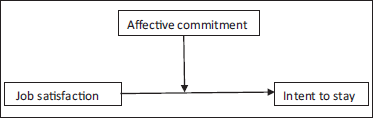
The relationships among job satisfaction, affective commitment and intent to stay can be analysed through a moderation model. It may be posited that affective commitment creates a state of mind among employees wherein they are emotionally favourably disposed towards their employer. Such a favourable disposition creates a context, which affects the impact of job satisfaction on intent to stay. The nature of the context is such that at higher levels of affective commitment the impact of job satisfaction on intent to stay would be stronger than at lower levels of affective commitment. Hence, the hypothesis is as follows:
H3: Affective commitment shall moderate the relationship between job satisfaction and intent to stay.
The proposed conceptual model along with the hypothesised relationships is mentioned in Figure 1.
Conceptual Model with the Relationships.
Methods
This section presents the sample and sampling approach adopted in the study. It also discusses the measures and the data collection process followed in the study. The study being a quantitative one, deals with primary data. It has adopted a survey-based approach wherein questionnaires were used to collect data from respondents.
Sample and sampling: The sample for the study consisted of technical healthcare staff such as medical imaging technicians, pathology laboratory technicians and medical equipment technicians. The technical staff were all associated with hospitals in the private sector and were employees of the hospitals. The hospitals were established brands in healthcare sector and have been in operation for the last 10 years. The respondents were on roll employees of the hospitals who have been with the organisations for at least one year. A two stage sampling was adopted in the study. The hospitals were selected on the basis of convenience sampling while the respondents were selected on the basis of random sampling. A total of 250 respondents were approached out of which 220 usable response forms were received. Male respondents were 120 in number (54.5%), while 100 (45.5%) were females.
Established scales used in previous studies have been incorporated in the research. A five-point Likert scale (1 = strongly disagree, 5 = strongly agree) has been used for all the measures.
Intent to stay: The scale consisted of three items. 32 The reliability coefficient of the scale is 0.85 indicating high internal consistency.
Job Satisfaction: The three-item scale refers to the feeling of contentment; happiness or joy employees derive from their job. 33 The reliability coefficient, Cronbach’s alpha for the scale, is 0.80.
Affective commitment: The scale measured the affective or emotional attachment of employees and consisted of six items. 34 The Cronbach’s reliability coefficient was 0.80.
The data were collected from eight private-sector hospitals. The HR heads of the hospitals were first contacted over emails. The consenting HR heads were appraised about the requirements of the study and the academic nature of the study. They were assured on anonymity of the participating hospital and respondents. Confidentiality and non-disclosure of data were also confirmed to the HR Heads. The questionnaire was given to the HR heads who got it filled out by the respondents. Out of 250 questionnaires distributed, 220 usable questionnaires were returned, achieving a return percentage of 88%. Instructions were provided to the respondents by means of a detailed instruction sheet.
Results
The data were analysed in two stages. SPSS 23 was used for descriptive analysis. AMOS, based on structural equation modelling, was used for obtaining model fit on the basis of the measurement model. The path analysis, including moderation analysis, was conducted by using PROCESS MACRO. Process Macro enables analysing the paths and the moderation effects is robust and user friendly manner. The results are presented in three stages. The descriptive statistics, reliability and inter variable correlations are presented first, followed by the measurement model fit and finally the path analysis along with moderation analysis.
Table 1 presents the descriptive statistics, reliability coefficients (alpha) and the correlations among the variables. The mean of the variables ranges from 3.26 to 3.73, and the standard deviation ranges from 2.50 to 2.94. The reliability coefficient alpha varies from 0.73 to 0.77, indicating adequate internal consistency. The inter-variable correlations are significant indicating a preliminary acceptance of the hypotheses.
Descriptive Statistics, Reliability and Correlations Among Study Variables.

The measurement model shows a good fit (Table 2) and meets the discriminant criteria. The discriminant criteria are as follows: χ²/df < 3; AGFI, CFI > 0.9 and RMSEA < 0.08. Table 2 shows the fit indexes of the measurement model: χ2/df = 2.83, P = .000*, AGFI = 0.94, CFI = 0.97 and RMSEA = 0.06. The measurement model thus meets the fit criteria, and it is fit for path analysis including moderation analysis.
Measurement Model Fit.

Process macro was used for analysing the paths, and the results are presented in Tables 3 and 4. The model summary (Table 3) indicates that the independent variables (job satisfaction, affective commitment and their interaction effect) together explain 18.9% of variance in the dependent variable, and the effect is significant. This implies that the model is robust and fit for analysis.
Model Summary-Moderation Model.

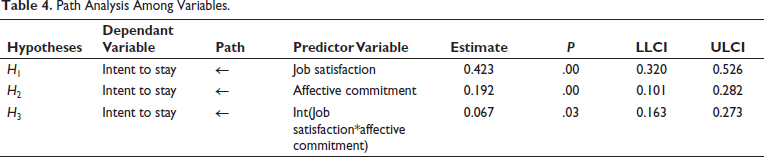
The results of the hypotheses testing are presented in Table 4. The first hypothesis (H1) is about the impact of job satisfaction on intent to stay. The analysis reveals that the hypothesis holds true (β = 0.42, P < .01), implying job satisfaction positively impacts intent to stay and explains 42% of the variance in intent to stay. The second hypothesis, H2, refers to the influence of affective commitment on intent to stay. The result of analysis shows that affective commitment significantly influences intent to stay (β = 0.19, P < .01), implying that affective commitment explains 19% of the variance in intent to stay. The interaction effect of job satisfaction and affective commitment is also significant implying that affective commitment and job satisfaction together influence the intent to stay.
Path Analysis Among Variables.
Discussions
The results of the analysis show that job satisfaction and affective commitment have a positive influence on intent to stay. Further, affective commitment moderates the relationship between job satisfaction and intent to stay. The outcomes reveal that intent to say may be influenced by the job satisfaction of healthcare technical workers. Higher levels of affective commitment strengthen the influence of job satisfaction on intent to stay and on the other hand lower levels of affective commitment dampens the relationship between job satisfaction and intent to stay. Theory and conceptual understandings based on the variables explain the results. Satisfaction with the job indicates a favourable emotional state which may lead to positive outcomes. These positive outcomes may be not only beneficial to the individual but also to the organisation. In terms of individual benefit, these may lead the individual to display the intention to stay. Employees who experience satisfaction at job, intend to stay longer with the employing organisation. For instance, scholars 35 opine that extended levels of job satisfaction usually leads to more loyalty and commitment to the organisation and intent to stay, while dissatisfaction can increase turnover intentions behaviours which add benefit to the employee. The acceptance of H1, the relationship between job satisfaction and intent to stay, finds a support in views of scholars. 36 According to them motivators influence an employee to stay and contribute meaningfully to the organisation. 37 It may also be argued that employees who experience high degrees of job satisfaction have a higher probability to be loyal and committed to the employer and display a lower probability to explore alternate job opportunities. Scholars 38 infer that job satisfaction is a significant predictor of intent to stay, especially in industries where talent retention is a major challenge, such as healthcare.
Hypothesis H2 is about the influence of affective commitment on intent to stay. The acceptance of the hypothesis indicates that affective commitment is a psychological state that glues employees to their organisation. 39 This psychological link is a balancing impact that holds together employees to employer organisations. 40
Hypothesis H3 is about the moderating impact of affective commitment on the relationship between job satisfaction and intent to stay. The hypothesis holding true implies that the interaction of affective commitment and job satisfaction also influences intent to stay. Moreover, it also implies that at higher levels of affective commitment, the degree of influence of job satisfaction on intent to stay shall be higher than at lower levels of affective commitment. The influence of affective commitment stems from emotional attachment to the organisation, thereby strongly influencing job satisfaction and intent to stay. Employees who feel fulfilled and valued are more likely to develop an emotional bond with their organisation, increasing their intention to stay. Thus, employees who are satisfied are less likely to seek alternative employment due to the potential risks of losing their current job benefits. 39
The study has immense implications for practising managers. Organisations which want to retain talent must prioritise job satisfaction as a vital component of their strategy to manage human resources. High attrition (turnover) rates have repercussions in the form of direct financial costs and indirectly in the form of impact on productivity of the organisation and the morale of employees. Focussing on improving job satisfaction, and affective commitment, organisations can improve employee retention, that is, improving intent to stay. Managers should thereby focus on addressing job satisfaction and affective commitment. Business managers should try to provide employees with an understanding of their jobs in the context of the overall business strategy and functional strategy. They must also create conditions for employees to perform their jobs. This implies that employees should be provided with the necessary tools, technical training and competencies to discharge their duties. The HR managers should attempt to address a positive work life balance wherein employee wellness is taken care of. This indicates that not only physical wellness but also emotional wellness should be taken care of by organisations. Such interventions would enhance affective commitment in addition to increasing job satisfaction.
Conclusions
On the basis of the study, it may be concluded that job satisfaction is a crucial element affecting an employee’s intent to stay with an organisation. Similarly, affective commitment also plays an important role in enhancing and employee’s decision to stay in the organisation. Employers, that is, organisations should therefore address skill training, competency-based training for employees. Furthermore, organisations should also focus on improving affective commitment by activities to enhance employee engagement and a positive work life balance. Focusing on these aspects can increase the intent to stay of employees in the organisation and enhancing job satisfaction and affective commitment will be a prime strategy for organisations intending to retain their employees and attain long-term success.
Footnotes
Abbreviations
JS: Job satisfaction; AC: Affective commitment; ITS: Intent to stay; P: P-value; χ2df: Chi-square/degree of freedom; AGFI: Adjusted goodness of Fit; CFI: Comparative fit index; RMSEA: Root mean square error of approximation.
Acknowledgement
The support received from the HR managers and staff of the HR department of the participating organisations is gratefully acknowledged. The infrastructural support provided by the FORE School of Management, New Delhi in completing this paper is gratefully acknowledged.
Authorship Contribution
Chiradip Bandyopadhyay has prepared the entire paper and has written all the sections of the paper.
Declaration of Conflicting Interests
The author declared no potential conflicts of interest with respect to the research, authorship and/or publication of this article.
ICMJE Statement
This article complies with the International Committee of Medical Journal Editors (ICMJE) uniform requirements for the manuscript.
Funding
The author received no financial support for the research, authorship and/or publication of this article.
Statement of Ethics
The study follows all ethical guidelines. As applicable to social science and management studies, this study does not include any clinical trial.
