




Abstract
Background
Breath-awareness practices contribute to stress management and psychological well-being among adolescents. However, their neurobehavioural effects remain underexplored, specifically in the Indian developmental context.
Purpose
This study examined how breath-based Ānāpānasati meditation affects brain electrical activity and the subjective self-reported experiences in adolescent novice meditators posteriori a cognitive workload-inducing task.
Methods
Anapanasati meditation was adapted into a three-stage breath-awareness intervention framework and was administered to 45 novice adolescent meditators. Brain activity was investigated through electroencephalography (EEG), and neural oscillations were measured over the three stages, namely resting state (RS), breath counting (BC) and breath focus (BF). Further, adolescents’ breath awareness self-reports were evaluated employing the Amsterdam Resting-State Questionnaire (ARSQ) following the BF stage and the breath count feedback (BCF) after the BC stage. Both the inventories displayed satisfactory psychometric properties, thus facilitating a neurobehavioural analysis in a cross-sectional within-subjects setting.
Results
Alpha oscillation was significantly increased throughout the intervention, indicating relaxation. Beta power in both the occipital and midline default mode network (DMN) regions during the count and focus stages exhibited significant positive associations with breath count, suggesting enhanced visual and cognitive processing. Blissfulness felt during counting breaths was also associated with enhanced state mindfulness, sharing a notable negative association with the theory of mind (TOM). State mindfulness further correlated with increased frontal alpha activity, while the theory of mind negatively predicted frontal alpha power. Lastly, exploratory analysis revealed gender differences, with females demonstrating greater frontal beta activity and state mindfulness.
Conclusion
Breath-awareness meditation can thus be effective for promoting relaxation and blissfulness in adolescents, with possible gender-based variations influencing its impact. Moreover, the positive association of prefrontal alpha with self-reported state mindfulness and its negative association with TOM underscored an inverse interplay between inward-focused mindfulness and outward-directed social cognitive states in adolescents.
Keywords
Introduction
Adolescents face a range of daily stressors, including academic pressure and reduced quality of life. 1 The ability to effectively manage stress during these formative years is crucial, as coping strategies developed in childhood lay the foundation for future psychological resilience and adjustment.2, 3 A growing body of literature highlights numerous evidence-based, non-pharmacological approaches to stress management tailored for children and adolescents. Among these strategies, breathing practices stand out for their accessibility and effectiveness in reducing stress and anxiety. 4
Breath-awareness practices emphasise conscious monitoring and control of breathing, and are well known for their capacity to promote focus, emotional balance and cognitive functions.5, 6 According to self-reported subjective experiences and brain activity measurements,6, 7 these practices harmonise prana (energy) flow, which improves mental well-being. 8 Furthermore, mindfulness practices are effective for adolescents, helping them regulate their emotions and cope with stress. 9 Research indicates that various forms of meditation, including breath-based meditation, have demonstrated increased frontal alpha amplitude and synchrony, 10 contributing to inner focus 11 and behavioural stillness. 12
Despite the increasing global recognition of these benefits, there is a notable dearth of EEG-based studies investigating the neurobehavioural impacts of mindfulness practices on Indian adolescents. To address this gap, we employed an integrated approach in our breath-awareness meditation study with novice adolescent meditators. Lastly, given its simplicity and efficacy, mindful breathing is an ideal introductory practice for novice adolescents, providing a foundation for developing sustained mindfulness and emotional well-being.
Breath-awareness Novice Meditation Paradigm
The study utilised a pre-established Ānāpānasati-based breath-awareness meditation paradigm to explore its effects following effortful cognition, reflecting the pervasiveness of stress.13, 14 To induce stress and cognitive workload (CWL), the three-stage paradigm incorporated a 15-minute zeroth stage with an arithmetic task, a common method in stress-induction protocols.7, 15 Each of the subsequent three stages lasted three minutes. The initial stage of resting state (RS) required adolescents to close their eyes, facilitating cognitive recovery through the reduction of cortical arousal and the enhancement of parasympathetic activity. 16 During the second stage, breath counting (BC), adolescents counted their breathing cycles, restarting each time they lost count. This stage assisted in focused breathing, improving focus and reducing mind-wandering.13, 17 Following the BC phase, adolescents provided Likert scale–based self-reports on their breath counts, instances of distraction, confidence in their counts and perceived feelings of bliss using the breath count feedback (BCF). 13 In the last stage, breath focus (BF), adolescents focused solely on their breath without counting. To capture their detailed experiences of breath-focused resting states, adolescents completed the Amsterdam Resting-State Questionnaire (ARSQ) immediately after the BF stage.13, 18
Objectives
The tristage Ānāpānasati novice meditation paradigm aimed to induce stress deliberately, followed by guiding novice meditators through three breath-focused stages. This study aimed to explore the neurobehavioural cross-sectional effects of the intervention among novice adolescents through the following objectives:
To assess neural oscillatory patterns across the three stages (RS, BC and BF) in brain regions associated with meditation in novice adolescents. To explore the relationships between self-reported BCF and mindfulness states with neural oscillations in novice adolescents. To study the influence of spectral powers upon the self-reported breath counts during the counting stage. To study the interrelationships amongst the BCF’s self-reports. To study the associations between counting performance and state mindfulness dimensions. To study stagewise alpha oscillations vis-à-vis state mindfulness self-reports. To investigate gender differences in neurobehavioural correlates, including neural oscillations, self-reported mindfulness states and BCF.
Methods
Participants
Adolescents received detailed instructions for tristage meditation in a quiet and isolated laboratory setting, wherein stage-wise neurobehavioural data was gathered. The Ānāpānasati intervention, underscoring the daily life stressors, was subjected to a comprehensive analysis of meditation-induced EEG oscillations alongside ARSQ and BCF self-reports.13, 14 The novice sample consisted of 45 adolescents, comprising 30 females and 15 males (average age = 13.64 years; standard deviation = 0.6 years), in an Indian school setting. The research received due approval (Proposal No. P021/P0101) from the Institute Ethics Committee (IEC) at the Indian Institute of Technology, Delhi (IITD).
Self-report Instruments
Adolescents completed the BCF and ARSQ 18 immediately following stages two and three of the paradigm, respectively. The seven-point Likert scale–based BCF self-reports consisted of negatively scored ‘breath confidence’ and ‘breath blissfulness’, besides a positively scored ‘breath distraction’. Further, the self-report also included the ‘number of breath counts’. Due to extreme skewness, with most participants scoring 6 or 7 on these scales, the former three factors were excluded from any psychometric analysis. In a previous study, however, BCF items exhibited satisfactory internal consistency, with a McDonald’s ω of 0.79 and Cronbach’s α of 0.75. 13 The ARSQ’s comprehensive self-report framework has been substantial in assessing resting state characteristics and is useful towards examining rest-related thoughts, mind-wandering and extrinsic sensory perceptions during the resting state.13, 19, 20 In our adolescent sample, it demonstrated sufficient inter-item reliability pertaining to its dimensions, namely ‘Discontinuity of Mind (DOM)’ (ω = 0.731; α = 0.728), ‘Theory of Mind (TOM)’ (ω = 0.543; α = 0.51), ‘Self (SLF)’ (ω = 0.754; α = 0.734), ‘Planning (PLN)’ (ω = 0.799; α = 0.783), ‘Sleepiness (SLP)’ (ω = 0.8; α = 0.773), ‘Comfort (CMF)’ (ω = 0.691; α = 0.622) and ‘Somatic Awareness (SOA)’ (ω = 0.544; α = 0.537). Further, all its dimensions had also exhibited satisfactory inter-item reliability 21 and construct validity 22 through Jamovi’s ‘Factor’ module 23 within a similar a priori study. 13
Electroencephalography
Electroencephalography (EEG) data were collected utilising the EasyCap (Brain Products GmbH) with 64 Ag/AgCl electrodes, at a sampling rate of 500 Hz, in an extended International 10–20 system.24, 13 Electrode impedance was maintained at 5–15 kOhm, wherein FCz and AFz electrodes functioned as reference and ground electrodes, respectively.13, 14 LiveAmp (Brain Products GmbH) was used to amplify the data during the recordings, which was filtered online through a third-order sinc low-pass (0.01–131.0 Hz) filter. 13 EEGLAB v2023.1 25 in a MATLAB vR2023a environment was utilised for preprocessing recordings and obtaining spectral powers. Notably, only the middle two-thirds of each stage’s EEG segments were retained, post the inclusion of the recording channel details. 13 The data were downsampled from 500 to 250 Hz and subsequently filtered with an IIR-Butterworth bandpass filter (1–60 Hz), with a Zapline notch filter to remove the 50 Hz line noise.13, 26 The Artefact Subspace Reconstruction-Independent Component Analysis (ASR-ICA) based preprocessing pipeline was employed for cleaning the continuous EEG processing.13, 27 Artefacts were identified and corrected utilising the ASR-cleandata method. 13 Any channels with spectral power deviations exceeding ± 3 standard deviations were excluded. Noises with an IC-label value beyond ‘0.5’ were eliminated by IC labelling and IC rejection post ICA decomposition.13, 28, 29 The clean data were reprocessed by interpolating the bad channels and the recording reference channel (FCz), followed by mean-mastoid re-referencing. 13
Three meditation-associated brain regions of interest, namely the midline default mode network (DMN), the prefrontal cortex (PFC) and the occipital region (OCC), were focussed upon. 13 The OCC region was covered by six electrodes: ‘O1-2’, ‘Oz’, ‘PO3-4’ and ‘POz’.13, 30 The PFC region spanned 10 electrodes: ‘FP1-2’, ‘AF3-4’, AFz’, ‘F1-4’ and ‘Fz’.13, 31 The DMN region analysis focused on the midline and posterior channels, namely 14 channels: ‘CP1-4’, ‘CPz’, ‘P1-4’, ‘Pz’, ‘PO3-4’, ‘POz’ and ‘Oz’, 32 notably barring the mPFC channels. 13 The preprocessed data were then converted from time to frequency domain by Fourier transformation through the EEGLAB spectrum analysis plugin, namely eegstats version 1.2. 13 Further, neural oscillation bands were categorised as follows: delta (1–4 Hz), theta (4–8 Hz), alpha (8–13 Hz), beta (13–30 Hz) and gamma (30–60 Hz). 13 Subsequently, powers were calculated in a stage-wise, region-wise and subject-wise manner, specifically in units of dB/Hz. 13
Neurobehavioural Statistical Details
Concerning the first objective, the EEG-yielded neural oscillations were analysed in R-Jamovi, 33 employing a ‘3 × 3 × 5’ repeated measures analysis of variances (rm-anova) design. 13 The design factors were constituted by three meditation-specific brain regions: DMN, PFC and OCC; the three paradigm stages: RS, BC and BF; and lastly, the five neural oscillation-band powers. 13 Any violations of sphericity were examined using Mauchly’s test of sphericity, with Greenhouse–Geisser corrections being utilised to account for such violations. 34 Besides, post hoc comparisons for the significant results were performed utilising Bonferroni and Tukey corrections.13, 35
For Objective 2.1, correlational analysis investigated the interrelationships between regional neural oscillations and breath count during the BC stage. Bonferroni corrections accordingly adjusted significance levels (α = 0.003, i.e., 0.05/15) for comparisons involving five band powers across three brain regions. To address Objective 2.2, the underlying structural-functional associations were examined amongst BCF variables (count, distraction, confidence and blissfulness), utilising principal component analysis (PCA), implemented via the factoextra package, 36 and correlational analysis. Accounting for multiple comparisons, the significance level was positioned at ‘.0083’ for Objective 2.2’s correlational analysis. Employing correlational and linear regression analysis, Objective 2.3 further examined the interrelationships between adolescents’ self-reported breath-counting characteristics (via BCF) and state mindfulness (via ARSQ), adjusting the significance level to ‘.002’ for 32 comparisons. Objective 2.4 focused on the neurobehavioural associations of state mindfulness dimensions with stage-wise alpha spectral powers, utilising correlational and linear regression analyses. Therein, significance levels were adjusted to ‘.006’ for eight parallel comparisons. Necessary assumptions for each regression model were also reviewed prior to linear regression analyses, in Objectives 2.3–2.4. Finally, gender differences across all neurobehavioural variables were examined for Objective 3 using Yuen’s robust t-test for trimmed means via the Walrus package. 37 This analysis was exploratory; thus, no Bonferroni correction was applied.
Results
Objective 1: ‘Regions-powers-stages’ Effects and Interactions Across the Three Stages of the Paradigm
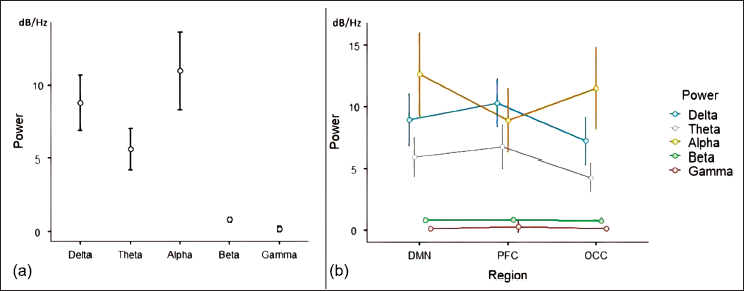
The rm-anova analysis identified a main significant effect of ‘powers’ (F(2.03) = 50.728, p < .001, ηG2 = 0.332), indicating a substantial effect size. Post hoc analyses revealed significant elevations in alpha power (see Figure 1a), reflecting the paradigm’s ability to facilitate relaxation. 38 These results validated the administered meditation’s effectiveness for a novice adolescent sample, aligning with prior research conducted with novice adult meditators. 13 Moreover, a significant ‘region × power’ interaction effect (F(2.00) = 9.064, p < .001, ηG2 = 0.023) with a small effect size revealed distinctions in neural oscillations across brain regions (see Figure 1b). Delta power was greatest in the PFC (mean = 10.300 ± 0.9704), followed by DMN (mean = 8.918 ± 1.0539) and OCC (mean = 7.206 ± 0.9396). Similarly, PFC also exhibited higher theta power (mean = 6.746 ± 0.8523), compared to DMN (mean = 5.905 ± 0.7673) and OCC (mean = 4.264 ± 0.5751). The enhanced delta and theta power in the PFC and DMN regions suggested working memory engagement 39 and memory retrieval,40, 41 resulting from a thoughtful concentration on breath or its enumeration in the BC–BF phases, akin to a priori novice adult mediators study. 13 No significant region–power interactions were identified for alpha, beta and gamma powers. However, in a subsequent analysis involving spectral powers, average gamma (mean = −9.867 ± 0.4043) and beta (mean = −2.019 ± 0.3339) powers were found to be significantly lower than the respective powers observed across the three meditative brain regions (DMN, PFC and OCC).
Interestingly, neither any interaction effects involving ‘stage’ as a factor nor the main effect of ‘stage’ emerged as significant. Adolescents’ limited changes in neural oscillatory activity during the intervention can be attributed to their inexperience with meditation. 42 Lastly, gender was not identified as a significant between-subjects factor in any of the analyses, indicating the absence of gender differences within neural oscillations across brain regions over the course of the intervention.
Objective 2.1: Spectral Powers and Breath Count Performance
The correlation analyses revealed significant associations between breath count performance and beta power across various brain regions and stages. In the DMN, breath count was positively correlated with beta power during BC (r = 0.496, padj < .003) and BF (r = 0.437, padj < .003) stages. Similarly, breath count exhibited significant positive correlations with beta power during BC (r = 0.511, padj < .003) and BF (r = 0.467, padj < .003) in the OCC. Additionally, a marginal correlation was also observed between breath count and occipital beta power during the RS stage (r = 0.414, p = .005). These findings indicate that accuracy in breath counting is associated with enhanced cognitive 43 and visual processing, 44 aligning with results from our earlier study conducted with adults. 13
Objective 2.2: Intra-breath Counting Characteristics Comparisons
Significant interrelations were identified between the observed BCF variables. Specifically, breath confidence was correlated negatively with breath distraction (r = −0.780, padj < .003) and positively with blissfulness (r = 0.450, padj < .003). These results implied understandably that elevated levels of breath confidence are linked with significantly lesser distraction and increased blissfulness while breath counting during meditation. 17 Further analysis using PCA found that only the first two principal components had eigenvalues larger than unity, explaining 80.1% of all variance. Specifically, the first and second principal components explicated for 54.3% and 25.8% of the variance, respectively. Additionally, the PCA-biplot reflected the results of the correlational relationships. As seen in Figure 2, breath confidence lies on the axis opposite to distract count while also being adjacently aligned with blissfulness, reflecting their respective correlations.
Principal Component Analysis Plot of the Breath Count Feedback (BCF) Variables.
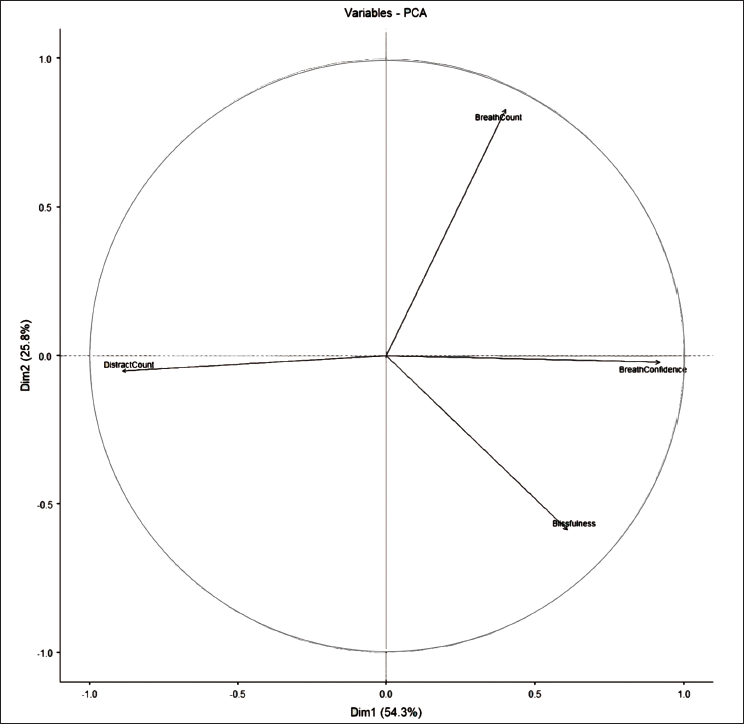
Overall, from the correlation and PCA analysis, it is evident that the self-reported blissfulness experienced by novice adolescent meditators stems from reduced distraction and heightened confidence in breath counting, rather than the number of breath counts.
Objective 2.3: Associations Between Breath Counting and State Mindfulness Self-reports
Blissfulness, as self-reported during BC, demonstrated significant negative correlations with TOM (r = −0.449, padj < .002) and SLP (r = −0.486, padj < .002), and a borderline positive association with CMF (r = 0.393, p = .008). To further explore these relationships, based on previous research, a cumulative dimension was posited as the sum of SOA, CMF and the negation of SLP, SLF, PLN, DOM and TOM, namely ‘state-mindfulness’ (SMind). 13 Notably, SMind was also observed to be strongly positively correlated with blissfulness (r = 0.533, padj < .002).
Regression analyses were conducted to expand upon the observed correlational relationships. In a regression model including TOM, SLP, CMF and gender, the former three explained a significant portion of the variance for blissfulness (R2 = 43.8%, p < .001), blissfulness being the dependent variable. Both TOM (ꞵ = −0.3499, p = .006) and SLP (ꞵ = −0.3773, p = .004) were significantly negatively related with blissfulness, while CMF (ꞵ = 0.261, p = .049) displayed a marginal positive association. In a separate model, SMind was positively associated with blissfulness (ꞵ = 0.552, p < .001), explaining the sole substantial proportion of variance (R2 = 28.8%, p < .001) towards the latter. Notably, gender was not a significant predictor in either model, suggesting a lack of gender differences owing to the covariates (TOM, SLP, CMF and SMind) towards the experience of blissfulness in the paradigm. These results implied that experiencing blissfulness during breath counting is linked to reduced social-cognitive processing, 45 diminished sleepiness and enhanced comfort in breath awareness meditation practices.
Objective 2.4: Studying Alpha Power Stage-wise Correlates Vis-à-vis State Mindfulness Self-reports
Correlational analysis revealed significant relationships of alpha band power with TOM and SMind. TOM demonstrated significant negative correlations with alpha activity across all stages, including RS (r = -0.532, padj < .006), BC (r = −0.478, padj < .006) and BF (r = −0.551, padj < .006). Furthermore, the regional analysis revealed that TOM was negatively associated with prefrontal cortex (PFC) alpha power during RS (r = −0.421, padj < .006), BC (r = −0.425, padj < .006) and BF (r = −0.437, padj < .006). These findings highlighted a consistent negative relationship between PFC alpha activity and TOM across different stages. In contrast, SMind showed positive correlations with alpha activity across all stages. Significant correlations were observed during RS (r = 0.413, padj < .006) and BF (r = 0.450, padj < .006) and a minor significant association during BC (r = 0.365, p = .014). The findings suggested that higher alpha power is associated with greater state mindfulness, particularly during the RS and BF stages. Upon closer examination of PFC alpha activity, positive associations were identified between SMind and PFC alpha power during RS (r = 0.348, p = .019), BC (r = 0.328, p = .028) and BF (r = 0.384, p = .009), showing a borderline significant relationship, overall.
Associations Between ARSQ Dimensions and Alpha Band Power Across Brain Regions and Paradigm Stages.
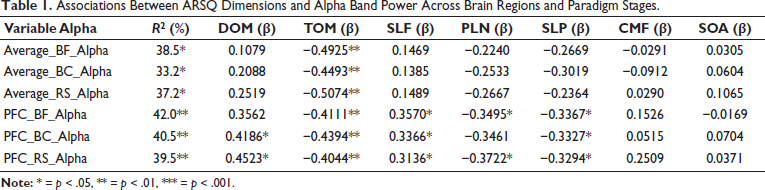
To expand upon the correlational findings, linear regression models (see Table 1) were employed to study the influence of ARSQ-based state mindfulness dimensions on alpha powers stage-wise. TOM emerged as a significant negative predictor of alpha power across all three stages: RS (β = −0.5074, p = .002), BF (β = −0.4925, p = .002) and BC (β = −0.4493, p = .006). Following the average alpha power findings, further analysis revealed that TOM also significantly negatively predicted PFC region alpha power across RS (β = −0.4044, p = .007), BF (β = −0.4111, p = .007) and BC (β = −0.4394, p = .004) stages. Gender did not emerge as a significant predictor in any analysed regressions, suggesting a lack of gender-based differences. These findings suggested that wakeful relaxation during mindfulness practices, reflected in elevated alpha activity, 38 is associated with reduced social-cognitive processing 45 and heightened inner engagement. 46
Objective 3: Exploratory Inspection of Gender Differences Across all the Neurobehavioural Variables Employed
Exploratory analyses employing Yuen’s robust t-test for trimmed means revealed significant gender differences in beta oscillations and state mindfulness, with female adolescents exhibiting higher values for both variables. Across the three stages of the paradigm, females exhibited significantly greater average beta power for all three stages, namely RS (tY(24.8) = 2.329, p = .028, ξ = 0.514), BC (tY(22.8) = 2.449, p = .022, ξ = 0.569) and BF (tY(21.5) = 2.310, p = .031, ξ = 0.520), with medium effect sizes. Post hoc, regional inspection indicated an even stronger gender difference for only beta power within the PFC, with females demonstrating higher values than males. The PFC-beta differences were statistically significant in all stages: with RS (tY(23.1) = 3.837, p < .001, ξ = 0.614) and BC (tY(23.2) = 3.227, p = .004, ξ = 0.649) having large effect sizes, while BF (tY(24.0) = 3.033, p = .006, ξ = 0.583) had a moderate effect size. Lastly, SMind measured post-BF stage also showed a significant gender difference, with females scoring higher on average (tY(22.1) = 3.134, p = .005, ξ = 0.543), with a medium effect size. These findings suggested that enhanced novice frontal beta activity in females might reflect greater attentional engagement 43 in their mindfulness experiences.
Discussion
The study investigated the effects of breath-based meditation following a cognitive workload-inducing task upon neural oscillations and self-reported state mindfulness. The spectral analysis conducted towards Objective 1 revealed diverse yet consistent distinctions across the three brain regions (PFC, DMN and OCC) and neural oscillations over the tristage breath-based paradigm. Notably, alpha power was consistently enhanced across the stages of the intervention, validating the paradigm’s efficacy in facilitating relaxation among novice adolescents. Additionally, elevated delta and theta oscillations, particularly within the prefrontal cortex during the breath counting and focus stages, suggested enhanced memory processes40, 41 and involvement of working memory, 39 given the attention upon the breath context of the meditation. These results aligned with previous research linking mindfulness with higher alpha and theta band powers in both adults 13 and adolescents, 47 thus supporting the observed outcomes.
While addressing Objective 2.1, significant correlations were identified between breath counting and beta power within the midline-DMN and OCC regions. They underlined the associations of the number of breath counts without distraction with enhanced cognitive 48 and visual processing 44 capabilities. Further, correlational analysis and PCA conducted for Objective 2.2 revealed distinct interrelationships among the BCF variables, alluding to associations between enhanced breath confidence, attenuated distraction and heightened blissfulness during the breath-counting stage.49, 50 Moreover, robust self-reported associations were observed between blissfulness and dimensions of state mindfulness through correlational and regression analyses towards Objective 2.3. Higher levels of blissfulness during the breath-counting stage were related with decreased levels of TOM, reduced drowsiness and enhanced comfort within novice adolescents during the last breath-focus stage. 45 Objective 2.4 further demonstrated significant associations between alpha activity, specifically in PFC, and TOM, indicating improved wakeful relaxation 38 to be linked with diminished social-cognitive processing 45 and heightened inner engagement. 46 These results lacked gender-based differences, making them particularly important when considering the significant development of TOM during adolescence. 51 For adolescents, therefore, who are in a critical phase of developing social cognitive skills, this suggests the importance of balancing mindfulness practices with activities that actively engage TOM. Overall, findings observed towards Objective 2 highlight the potential role of both breath-count- and breath-focus-meditation in improving self-focused attention within adolescents.
Finally, Objective 3 revealed gender differences within beta oscillatory changes, with females displaying higher beta activity, suggesting enhanced attentional engagement 43 during the intervention. Further, the current study focused particularly on novice adolescents; a previous study conducted on novice adult meditators 13 showed findings similar to the current study, besides some differences. Both adults and adolescents exhibited heightened alpha oscillation across brain regions and stages, along with increased delta and theta band powers within PFC and DMN, highlighting the paradigm’s cross-age applicability.13, 14 The observed gamma power differences within DMN and PFC regions in adults only may correspond to the lower thresholds of average gamma power in adults.52, 53 Also, adults and adolescents both displayed correlations between breath count accuracy and occipital beta power, indicating improved visual attentional processing. However, only adults demonstrated significant associations between gamma power and breath counts, pointing towards enhanced concentration and cognitive processing, plausibly again owing to the lower adult gamma power thresholds.54, 55
The present study exclusively involved novice meditators, whose neural activities differ notably from those of experienced practitioners. Therefore, when compared to such practitioners, novice meditators do not exhibit significant differences in neural activity between meditation states and neural states. 56 Despite these distinctions, our findings demonstrated that novice adolescents benefit substantially from breath-based mindfulness intervention, emphasising its usefulness and accessibility. Finally, although the present study lacked a control group juxtaposition, identical research enlisting control groups has shown the substantial effects of breath-related interventions, especially in relation to enhanced cognitive function.13, 57, 58 Their findings corresponded with adolescents’ results, indicating that these outcomes were presumably related to the breath-awareness meditation, even in the absence of a control group.
Conclusion
Using a three-stage Ānāpānasati-based meditative paradigm, the study demonstrated that breath awareness and breath counting enhance mindfulness with increased alpha activity, potentially influenced by beta activity–modulated gender variations. Additionally, in adolescents, inward-focused mindfulness states and outward-directed social cognitive processes interact inversely.
The cross-sectional approach and dependence on self-reported data might have introduced bias and restricted causal inferences, indicating the need for longitudinal designs in future studies. A longitudinal investigation is also needed to explore whether such temporary reductions in TOM-related processes during mindfulness practice translate into broader developmental impacts or if they serve as a mental reset, enhancing TOM capabilities post-practice. Finally, incorporating supplementary neuroimaging methods, synchronisation- and source-based EEG analyses will provide deeper insights into the mechanism of meditation that influences novice brain function.
Footnotes
Acknowledgements
The authors thank UX Lab, IIT Delhi, for invaluable support and guidance throughout the research project.
Authors’ Contributions
MB: Overall supervision of the study, conceived the idea, recruitment of subjects, conduction of study, analysis and drafting of the manuscript, approved the final version of the manuscript.
DS: Analysis and drafting of the manuscript, approved the final version of the manuscript.
SS: Analysis and drafting of the manuscript.
AD: Analysis and drafting of the manuscript.
PSS: Recruitment of subjects.
JK: Overall supervision of the study, approved the final version of the manuscript.
Data Availability Statement
The data sets generated and/or analysed during the current study are available from the corresponding author upon reasonable request.
Informed Consent
Informed consent was taken from adolescents and their guardians before participating in the study.
Statement of Ethics
The investigation adhered to the ethical protocols established by the Indian Council of Medical Research (ICMR) and received approval (Proposal No. P021/P0101) from the Institute Ethics Committee (IEC) of the Indian Institute of Technology, Delhi (IITD).
Declaration of Conflicting Interests
The authors declared no potential conflicts of interest with respect to the research, authorship and/or publication of this article.
Funding
The authors received no financial support for the research, authorship and/or publication of this article.
