




Abstract
The case is structured around the infancy problems being faced by the firm Atlas Labs. As a start-up initiated by technocrats with limited financial resources, the firm is struggling to find the financial resources necessary to create adequate facilities to meet quality standards demanded by a sophisticated customer segment. The professional background and expertise of the promoters are impeccable; their goodwill with domestic customers is also very good. They have managed the firm with meager resources, high dedication and great personal sacrifices. The firm has no debt but its volume of operations is constrained by facilities. If the firm fails to find a way out of this situation quickly, it would drift and would become unviable; or it would be grabbed by outsiders with the promoters not getting due return. The firm’s constitution is not ideally suited for the growth that is possible in the business sector. The challenge before the firm is about re-constitution, about finding the optimal financial structure to cater to long-term growth and about coming out of the current crisis. The firm needs to develop an action plan that builds in all these elements.
In July 2012, Dr Ajit Verma, Principal Scientist of Atlas Labs approached Paradigm Consulting to help mobilize funds for the capital expenses required to take his organization to economic levels of operation. Dr Ajit Verma and his partner had invested Indian Rupees (INR) 3,000,000 in Atlas Labs during the period 2009 to 2012; the firm had achieved revenue levels of INR 5,800,000 in 2010–11 and INR 7,400,000 in 2011–12. In early 2012, Dr Ajit Verma realized that certain facilities needed to be upgraded in order to comply with the norms of the regulatory authorities. Additionally, some balancing equipment was also required to ensure economic levels of operation. He estimated the resulting capital expenditure to be in the range of INR 20,000,000. So far the firm had been functioning without formal working capital facilities from any bank. Therefore, Dr Verma approached some of the leading banks with a request to provide funds in the form of long-term loans towards capital expenditure and working capital. Dr Verma also met some of the PE investors 1 to explore their participation. He had not received any positive response to these efforts when one of his friends suggested a meeting with Paradigm Consulting to explore a solution to the situation.
Background
Genesis: Atlas Labs was started by Dr Ajit Verma (37) and Dr Rakesh Kulkarni (30) in 2009. Dr Verma had 15 years of experience in the field of toxicity-testing 2 in various pharmaceutical firms in India. Dr Kulkarni was trained by Dr Verma in his last assignment. The latter was educated in bio-sciences while Dr Kulkarni had a veterinary science background. While working on their previous assignment, they had realized that the scope for toxicity testing for products in the pharmaceutical, agro-chemical, FMCG (Fast Moving Consumer Goods), and fine-chemicals, etc., industry was significant. They realized that the awareness of the need for toxicity testing in the developing countries was rapidly increasing. The regulatory agencies in the developing countries, who were relatively less equipped vis-à-vis their counterparts in the developed countries, were fast catching up in terms of their capabilities and stipulations. All products meant for exports to developed countries required to be put through toxicity testing and certified that certain specific properties were within the specified limits. Scientists anticipated that the day was not too far when products meant for domestic consumption would also require toxicity testing.
Facilities: A building near Baroda, Gujarat, owned by Dr Kulkarni’s uncle, was selected for housing the laboratories. A rent of INR 20,000 per month was agreed upon. Dr Kulkarni’s uncle was a lawyer and social worker; he had once been a municipal counsellor as well as a legislator of the state assembly. The premises needed modifications on the buildings and these were made by the owner himself. The premises had 4,000 sq. ft of built-up space and the firm managed its operations within this space. Basic requirements of testing and other equipment were procured from within the funds mobilized by the promoters. The firm also managed to buy a 50KVA 3 diesel generating set (DGSet) to ensure that the ambient conditions in the lab were not disturbed even during power failure, which was not uncommon in that area. The DG set was a secondhand system procured from Alang, a small town near Bhavnagar where the ship-breaking yard offered plenty of such equipment at fairly low prices.
Finances: The project started with initial investments from Dr Verma and Dr Kulkarni. Over the first year Dr Verma and Dr Kulkarni invested INR 200,000 and INR 900,000, respectively. Drawing annual salaries of INR 2,400,000 (Dr Verma) and INR 1,800,000 (Dr Kulkarni) during 2008–09 in their previous assignments, Verma and Kulkarni decided to draw subsistence salaries of INR 25,000 per month each for this project. The firm was a joint partnership between the two doctors. Along with the orders, the firm was able to get 50 per cent of the value of the orders as cash advance from their customers. Such advances were used by the firm to procure input materials and livestock (animals) to carry out the testing process. This was a great blessing to the firm. The advances that the firm was able to acquire, obviated the need for working capital facilities from a bank, at least in the early stage. However, for smooth operations at higher volumes, this arrangement was not adequate; the firm needed to tie-up with a bank for working capital facilities.
Day-to-day Management of the Firm: Atlas Labs was a lean organization. Dr Verma was the captain of the team in terms of age, professional experience in the industry and also in terms of maturity in handling clients as well as external agencies. He was managing all permissions, licences and approvals from government agencies; along with most of the vendor and price negotiations. He was also taking care of all the clients; lately he had taken on the additional task of talking to banks and consultants. As a result, Dr Verma was travelling for more than fifteen days in a month. Ms Neelam Verma, wife of Dr Verma and Ms Mudra Kulkarni, wife of Dr Kulkarni were both scientists in the same field with 10 and 6 years of experience, respectively. In the second year, they also joined the firm at salaries of INR 20,000 per month each. Dr Kulkarni with the help of Ms Neelam Verma, Ms Mudra Kulkarni, and six junior scientists and two helpers managed the entire day-to-day operations of the lab and its documentation. The final test report after being approved by Dr Kulkarni was always sent to Dr Verma by e-mail for his approval, before being sent to the client. Dr Verma had personal rapport with most of the Indian clients and government officials in the segment.
Business Development: The work-orders for toxicity testing were generally given only to those firms that had all the necessary approvals and facilities as per specified standards. They had to have Good Laboratory Practices (GLP) 4 certification along with qualified and experienced scientists to manage the total testing process. The scientist team had been able to get orders because of Dr Verma’s standing in the industry and the trust he had established with his customers. The facilities created by him were not impeccable, and he was yet to get GLP certification; but he was able to get many orders in the first two years because of his credibility among the scientific community. The customers were also aware that creating facilities to qualify GLP certification required time and investment and that Dr Verma was well in that direction.
The Business
Atlas Labs was in the business of toxicity testing. Toxicity testing (also known as toxicology-testing, safety-testing, etc.) had ‘the objective of determining the degree to which a substance could damage (harmfully impact) other living or non-living organisms’. Such tests were generally initiated by manufacturers of medicines, food products and additives, artificial sweeteners, packing materials, air fresheners, chemical ingredients, skin-supplicants, eye-supplicants, agro-chemicals, etc., to study and ensure that use of such products did not have any potential harmful effect on the consumers and/or living and non-living organisms in the immediate vicinity. Such tests could be conducted only by laboratories licensed and approved by the regulatory authorities. In developed countries, such certifications were mandatory requirements before the relevant products were offered for sale. In developing countries, the awareness was relatively less and consequently the regulatory mechanism was lagging behind. Lately the awareness among developing countries had also significantly increased and as a result the regulatory authorities had commenced proactive steps to catch up to the developed countries.
Some of the tests were chemical in nature, while others used animals in the laboratory. The latter were called ‘in-vivo’ research. 5 Atlas Labs focused on in-vivo research. In Europe alone, around one million animals were being used annually for testing (Abbot 2005). An estimate placed the global size of the market for toxicity testing in 2017 at US$ 10 billion (Global Industry Analyst 2011).
The global leaders in this business were Huntingdon Life Sciences, USA, Inveresk Research International USA, etc. In India, the pioneers were Jai Research Foundation, Vapi, Gujarat (an initiative of United Phosphorus Group) and Advinus Therapeutics, a Tata Group enterprise with facilities at Pune and Bangalore. Both were large organizations with state-of-art facilities of global standards.
The business of toxicity testing involved creating special rooms with HVAC systems (heating, ventilation and air conditioning) to house the test animals. The test animals could be rats, rabbits or piglets depending upon the nature of the tests envisaged. The animals were exposed to traces of the materials under investigation and their impacts on them monitored under controlled ambient conditions for specified periods of time. The facilities needed to be of high quality standards, normally specified under GLP. Moreover, the test animals needed to be of the right quality, the people managing the facilities had to be qualified and trained professionals, and the processes followed should be of the appropriate quality standards.
Contract Research Organizations (CROs) 6 focusing on such type of clinical research had come up in a big way in developed countries. Standards and norms had evolved for various aspects of research (Agency for Toxic Substances and Disease Registry 1999; Center for Drug Evaluation and Research 1996; Van der Lan 2000). The industry had also formulated long-term plans and policy guidelines for future development (Lalla 2010; National Research Council 2007; National Toxicology Program 2000). The concept of CROs was entering the developing countries as well.
This business of toxicity testing was very specialized in nature and required several levels of approvals from local authorities, state and central governments. Usage of animals for testing brought in another level of sophistication in terms of bioethics. Globally, ethical norms regarding handling of animals for research were very rigid (Nuffield Council on Bioethics 2000). National norms in this respect were slightly behind; but they too were catching up at a faster pace (Sengupta 2012).
Bottlenecks of Growth: Even after two years of starting the firm, Dr Verma observed that the firm was not comfortable financially. Both the promoters were drawing meager salaries compared to what they had been drawing in their previous assignments. There was a cash crunch all the time; making payments to the vendors or salary payments to the employees always difficult and sometimes even delayed. The firm had not got any working capital arrangement from a bank. The main sources of funds were the advances the firm was getting from the customers along with every order. The advance was almost 50 per cent of the order value. The sale of INR 600,000 a month (achieved last year) was not a significant amount.
On the business development side, Dr Verma realized that he needed to travel widely to meet customers; this activity also needed funds which were in short supply. Larger and high-value orders demanded stringent quality stipulation, which included GLP certification of the laboratory. Since Atlas Labs did not have GLP certification such orders were not available to the firm despite the goodwill of Dr Verma with the customers. Dr Verma had explored the prospect of getting GLP certification. Certain basic facilities were required to be installed at the laboratory. This needed additional funds. Dr Verma and his team started working on the balancing equipment required for GLP certification and marginal increase in the capacity of the facilities. The capital cost on this account was estimated at INR 20,000,000.
He discussed this with his friends and Mr Sunil Desai, the chartered accountant who was helping in the accounting and auditing of the firm. Since the promoters had exhausted all their sources, the only option they could think of was approaching a bank for a long-term loan for the necessary amount. Sunil Desai indicated that any bank would look for collateral security 7 before giving a loan. Since the promoters did not have any collateral security to offer he came up with the idea that Dr Kulkarni’s uncle may be inducted into the firm as a partner and the premises held by him could be offered as collateral security to the bank giving the loan. Mr Desai’s logic was that the property, consisting of 6000 sq. ft of land and the built-up space of 4000 sq. ft would have a valuation of INR 18,000,000 at a 20 per cent discount of the current market prices. If the property became part of the firm’s assets, then a bank could take it as collateral security and it would be more comfortable in lending funds to the firm.
A former colleague of Dr Verma, a scientist holding a senior position in a contract research firm suggested that venture capital companies and private equity investors could also be contacted for funding the project.
Mobilizing Funds: Dr Verma gave serious thought to Sunil Desai’s suggestion. He realized that once the property became part of the firm any bank would be more comfortable in lending them money. However, could the property be brought into the firm. Sunil Desai explained that there were ways it could be done. The first method was for the firm—a partnership between Dr Verma and Dr Kulkarni—to buy the property. This was ruled out since the firm was already hand-to-mouth as far as financial resources were concerned. A second option was for the firm to buy the property and give a promissory note to its owner to pay the money within a time period of five to 10 years with the appropriate interest. A third option was to take the property on long lease of say 20 years or more. A fourth option was to make the owner of the property a partner in the firm. Since the value of the property was almost INR 18,000,000 and the partners’ capital in the firm was less than INR 3,000,000, the percentage holding of the new partner would be six times the combined holdings of the first two partners. Other options could also be worked out. For instance if the valuation of the property was fixed at INR 18,000,000, the property owner could be given partnership in the firm worth INR 1,000,000 and the balance could be paid within the next five to 10 years, backed by a promissory note or similar other document.
Dr Verma was not enthusiastic about inducting Dr Kulkarni’s uncle as a third partner. He knew Dr Rakesh Kulkarni as a fellow scientist well and enjoyed working with him. However, the owner of the property had a different exposure, different outlook and perhaps a different value system. He felt that the induction of such a person could change the cultural ambience of the firm permanently. The two of them—Verma and Kulkarni—shared the dream and passion of creating and nurturing the firm. Dr Verma was always keen to keep the premises on rent and he had always insisted on paying the rent promptly despite the precarious financial condition of the firm. For Dr Verma, the idea of taking Dr Kulkarni’s uncle as a third partner was the last option to be considered.
Dr Verma and Dr Kulkarni had accepted nominal salaries during the initial years of the firm in order to conserve its fragile finances and to nurture the firm to critical size promptly. This implied significant sacrifices on their part; they expected to reap compensatory benefits once the firm has grown in size and profitability. What will be the impact of the entry of the third partner into the firm vis-à-vis the expectations of the earlier partners? Should not Dr Verma and Dr Kulkarni be compensated for their initial sacrifices? How?
Dr Verma and Dr Kulkarni discussed this matter threadbare. As they could not think of an alternate plan of raising funds, they broached the topic with Dr Kulkarni’s uncle. The latter was keen to help Dr Kulkarni and Dr Verma tide over the crisis. He agreed to offer the property as collateral but was not willing to transfer it either to the firm or to anybody else. In order to allow the property to be offered to the bank as collateral security, he wanted to be included as a 20 per cent partner of the firm. Mr Sunil Desai, after some discussion with fellow professionals and some bankers, said that it was a workable solution. He suggested that in view of the partnership offer, the firm need not pay rent for the premises.
Simultaneously, Dr Verma met a number of consultants who were confident of getting Private Equity (PE) investment into the firm. Many of them visited the premises of Atlas Labs. Most of them were not impressed by the mediocre facilities prevailing at the premises. They were looking for avenues to invest INR 10 crores and more. Their investments would come in as a combination of equity capital, preference capital and debt. Normally, they would expect to exit from the firm in three to five years horizon with a minimum average return of 25 per cent per annum. They would be actively involved in the management of the firm through the board of directors and also by participating in the day-to-day operations. For this purpose, they would expect the firm to be organized as a private limited company. They would be comfortable in participating in a firm that was really ready to take off; Atlas Labs was not in that condition. Consequently their interests in the firm rapidly declined after the initial visit. Dr Verma and Dr Kulkarni were passionate about building a technology-based company. The PE investors would be concerned about its commercial growth in a short span of time so that they could exit the firm with a return that was more than normal. Were these two objectives simultaneously feasible? The pertinent issue was sharing power and authority with a new set of persons with significantly different outlook to business; were the initial promoters comfortable with that?
Sunil Desai’s effort with various banks also produced a continuous stream of bankers to the premises. Bankers were willing to consider nominal working capital facilities of INR 2,000,000–2,500,000 initially with a promise to review again in six months based on performance. Dr Verma was not inclined to accept this suggestion.
Dr Verma and Mr Sunil Desai realized that barring Dr Verma, none of the scientists were comfortable in handling the bankers; they felt such interactions were quite stressful and time-consuming. After meeting more than a dozen consultants, who had promised PE investment, Dr Verma realized that each of them was looking for a financial ticket-size of INR 10 crores (Rs 1000 lacs or Rs 100 million) or more. In fact, many of them had suggested that Dr Verma should enhance the capital expenditure plan to make the financial ticket-size attractive to the PE players. Neither Dr Verma nor Dr Kulkarni felt comfortable with the idea of enhancing the capital expenditure plans just to avail large external funds; they believed in staying within their requirements and limits. They were also afraid that too many external funds would result in the dilution of their control of the business.
Since February 2012, Dr Verma and Mr Sunil Desai had been chasing banks, consultants and PE players; till July 2012 they had not found a solution. This was the situation when Dr Verma met Mr Vivek Nair of Paradigm Consulting.
The Current Challenges: Perspective of Team Verma
In the initial phase the firm had managed to get orders on the strength of Dr Verma’s professional goodwill. Unless the firm managed to get GLP certification, the orders would dry up. This meant immediate upgradation of facilities and hence the need for funds.
The partners were drawing meagre salaries and Dr Verma was travelling across the market in the most economical manner at significant costs to his health. The firm relied on the advances received from customers to cover the business development and promotional expenses; it could no longer prolong the operations without adequate working capital facilities.
Without GLP and without critical equipment and instruments, the firm could not get high value orders; neither could it handle meaningful volumes. Hence major capital investment was an absolute must. Dr Verma felt that the estimate of INR 20,000,000 was modest.
The market for toxicity testing was experiencing a boom due to increasing awareness among the citizens and the consequent regulatory pressures. It had almost become mandatory for all export consignments to get the products tested for toxicity before they were exported. If the firm did not have the minimum facilities it would be a nonstarter.
Dr Verma believed that his team was competent enough to handle the technical and marketing aspects of the business. He needed funds and he needed help only in this aspect of the business.
The Current Challenges: Perspective of Paradigm Consulting
Vivek Nair of Paradigm Consulting visited the facilities of Atlas Lab, held extensive discussions with Dr Verma, Dr Kulkarni and Mr Sunil Desai. He went through the documents and financial statements submitted by the Atlas Lab Team. He also searched the web to know more about the business and its market prospects. Based on this research he summarized the salient features of the situation:
The main assets of the firm were the professional knowledge and experience it had at its command. The credibility of the team was very high and this had enabled the team to get reasonable number of orders in the last two years. In the coming years these would continue to be the competitive assets of the firm. The critical success factors of this business were state-of-art facilities, testing instruments and high quality manpower. While the last factor was available to the firm, the first two factors demanded capital investment much more than what Dr Verma and Dr Kulkarni could mobilize so far. The firm had managed to operate without any debt so far but to continue the operations it needed working capital and it needed to upgrade itself to a higher level. No firm could operate without adequate working capital. This firm has been in operation because of the substantial advances it was able to get along with each order. However, stable operations were possible only with banking support and steady working capital. Any bank would give working capital facilities only gradually and cautiously. The firm should have started with a bank much earlier. However, it was never too late. The firm could start with accepting whatever little working capital a bank was willing to offer and plead for enhancement on the strength of performance. Banks respected steady transactions and robust performance. The upgradation of facilities planned by Dr Verma’s team needed to be funded by long-term capital. Unfortunately, the firm had been established without adequate financial planning. It was a credit to the entrepreneurs that they have achieved this far without any external funding. Now the time had come for stabilizing the finances of the firm. The firm needed short-term funds (in the form of working capital) to cater to its operations; it needed long-term funds to finance its capital expenditure plans. Vivek felt:
First priority should be to tie up short-term funds. The team should explore the feasibility of delaying the capital expenditure plans. He wanted Dr Verma to spell out the order of priority. Getting a bank/institution to agree for a loan of INR 20,000,000 would be quite difficult. However a bank could be more comfortable to commit to a smaller loan initially and based on performance provide additional loans later. This amounted to going through a confidence building exercise for the firm. Right now the financial capability, financial discipline and debt servicing capability of the firm were very low. It needed to build these through operations with the help of a bank. Right now the firm consisted of only technical/scientific persons. The team’s ability to handle non-technical aspects or even interacting with non-technical persons was limited. Dr Verma was perhaps the only exception. The firm needed to build capabilities in this area as soon as it could manage and also needed to work out a gradual, but systematic plan to achieve this. Sudden induction of non-technical persons at senior levels was likely to cause damage to the firm. Private equity investors would be interested in funding only if the firm was a private limited company and was ready for take off. Normally these investors would expect to get back their investments in a horizon of about three years. Their expectations of return on investment could be high. Vivek Nair felt that the firm was not yet ready for private equity investors; the firm needed to do a lot of preparatory work before becoming ready to approach them. For the natural growth and development of the firm, it needed to be converted into a private limited company. The suggestion to absorb the property (building) into the firm was fraught with serious long-term implications. These implications were required to be understood fully before arriving at any decision.
Way Forward
Vivek Nair shared his views with Dr Verma and invited him for a detailed discussion to identify and specify the scope of work that Paradigm Consulting should be assigned to.
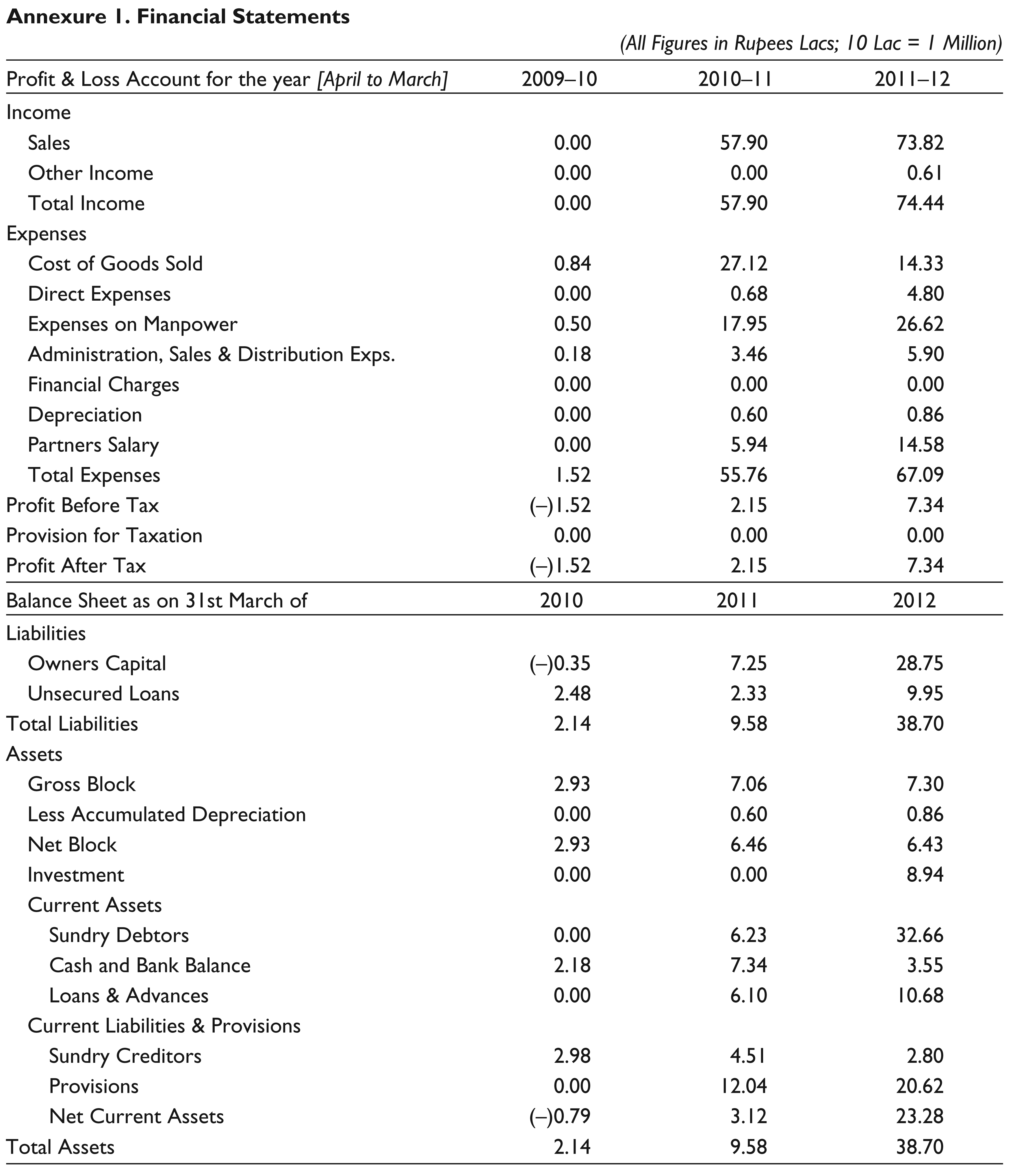
Financial Statements
(All Figures in Rupees Lacs; 10 Lac = 1 Million)
Footnotes
Acknowledgements
This case was written by Professor Bala Bhaskaran to serve as basis for class discussion rather than to illustrate either effective or ineffective handling of an administrative situation. This material may not be quoted, photocopied or reproduced in any form without the prior written consent of the Lahore University of Management Sciences.