



Abstract
Launched by Dr Harish Hande in 1995, SELCO Solar Light Private Limited was a Bengaluru, India-based social venture whose mission was to bring solar energy to the bottom-of-the-pyramid customers. In February 2014, the company had weathered a number of challenges in its start-up phase and had succeeded in becoming a profitable venture without veering from its social mission. However, Hande and his team faced a number of challenges in scaling up the business. An early foray into franchising had failed, while a more recent venture to create replicas of the company (called Baby SELCOs) in other parts of India had gotten off to a slow start. Given that nearly 300 million people in India had no access to electricity, SELCO’s decentralized and low-cost model had tremendous opportunities. The inflection point that SELCO faced was in choosing the best way to leverage the immense potential for solar energy in India without compromising its social mission.
Keywords
Solar is expensive for the rich and affordable for the poor—Harish Hande
In February 2014, as Dr Harish Hande, the Founder and Managing Director of the Bengaluru, 1 India-based SELCO (Solar Electric Light Company) Solar Light Private Limited (SELCO India), contemplated the upcoming end of the nineteenth fiscal year of the company, he reflected on many challenges that the company faced. Founded to deliver solar energy solutions primarily to the bottom-of-the-pyramid customers in India, SELCO India had come a long way since its inception. Along the way, Hande had received the Ramon Magsaysay Award in 2011 and had been named an Ashoka Fellow in 2008, among the many accolades conferred on him personally and on SELCO India. And yet, SELCO India’s future did not appear that sanguine. The company had built its business on a model which, by the company’s own accounts, made it difficult to scale up without losing the social focus that was key to its success. A recent venture to replicate its model by identifying entrepreneurs who would launch and run ‘baby SELCOs’, while successful, was slow (as expected) to yield results. Although the venture was structured to be independent of SELCO, the organization had deputed senior operations people to run it. In his quest to bring low-cost energy solutions using a for-profit economic model, Hande wondered if SELCO India had reached a crossroad. Would emphasizing the creation of ‘baby SELCOs’ be the way forward or could the SELCO India business model be tweaked to promote scaling up?
Company Background
Developing an Interest in Solar Energy
In 1991, the India-born Harish Hande was a graduate student in the Centre for Sustainable Energy at the University of Massachusetts, Lowell. Inspired by his mentor, Professor Jose Martin, whose motto was ‘socio-economic needs are more important than technology’, Hande became interested in solar energy. Hande recalled the reaction to his interest in solar energy:
When I started thinking of solar in 1991, people said ‘you won’t get a job.’ I used to say, ‘I don’t care.’ Early 1990s after all were not the times when people were thinking climate change. I get a lot of invitations for funerals because I had friends in their sixties (at that time)—hardcore environmentalists who grew their own vegetables and baked their own bread. These were the same guys who went to Vietnam and protested against America. Solar power at that time was something that hippies in California would do. (Bhattacharya, 2008)
Hande’s faculty mentor sent him to the Dominican Republic for field work. There, Hande came across Richard Hansen, an American engineer, who had settled down in the Caribbean nation to work on providing solar energy to the poor. While he had been working on centralized solar power in his graduate studies, in the Dominican Republic, Hande was exposed to decentralized power using photovoltaic (PV) technology. Hande recalled his ‘a-ha’ moment:
The trip triggered a lot of changes in my thought process. When I returned (to the U.S.), I dumped my previous thesis. I looked at rural electrification in India…with the Dominican Republic as my inspiration. (Yale School of Management Case Study)
The Dominican Republic solar energy model developed by Richard Hansen consisted of small stand-alone PV systems on a house-by-house basis. These systems were sold and serviced by local entrepreneurs and financed by non-governmental organizations (NGOs) that focused on microcredit. Because a centralized energy system (referred to as the ‘hard path’) was capital intensive, a critical mass of customers was necessary to make the system financially feasible. Hence, those in rural areas and those who could not afford the energy costs were left off the grid. In contrast, decentralized systems (the ‘soft path’) allowed universal access to power because of their stand-alone structure and low cost.
Launching the Venture
By 1995, Hande, having completed his doctorate, was eager to implement his vision of decentralized solar power in India. Meanwhile, Hande’s friend, Neville Williams, a journalist, solar energy advocate and founder of an NGO Solar Energy Light Fund (SELF), received a US$ 40,000 grant from the Rockefeller Foundation to provide electrification to rural households in the developing world. When Williams asked Hande to lead the project in India, the two decided to form the Solar Electric Light Company (SELCO) to parlay some part of the grant money allocated to India, with Hande, acting as the company’s Managing Director. However, the fledgling venture ran into trouble because the then Indian government regulations made it impossible to bring the grant money into India. Hande found a way around this restriction by obtaining PV systems on credit which were guaranteed by the grant money. Such a method, however, involved buying the systems in small lots that significantly delayed any attempt at a large-scale implementation. It was during this early struggle to establish SELCO as a viable business that Hande began to form his entrepreneurial world view:
I wanted SELCO to destroy three myths: that the poor cannot afford technology; the poor cannot maintain technology; and, that you cannot run a commercial venture while running a social venture. (Bhattacharya, 2008)
Hande’s mission for SELCO India was to bring solar energy to the bottom-of-the-pyramid market. He was insistent on using a for-profit model to further a social cause, and he strongly believed that profits and a social mission could coexist.
The Recalcitrant Farmer
When Hande launched his venture, he initially set out to identify individuals who were influential in their village or town. Hande’s rationale was that if such individuals could be convinced to embrace solar energy, they would, in turn, convince others to follow suit. Hande learnt of Arvind Rai, a farmer in a village in the southern Indian state of Kerala, from a friend. Rai’s entire village had no access to electricity. Like others in his village and in nearly two-thirds of India, Rai used kerosene lamps. Kerosene was a light fuel oil obtained by distilling petroleum and was widely used in the rural areas of Africa and Asia. While it was cleaner burning than coal, kerosene was a fossil fuel and so had a negative environmental impact via the release of carbon dioxide during combustion. In addition, in Rai’s village, it darkened the walls and blackened the lungs. However, Rai rebuffed every attempt by Hande to sell him a PV energy system, indicating cost as well as reliability issues as reasons. Seeing a kindred spirit in Rai’s mother, Hande waited for Rai to be out of town and installed a PV system that provided four lights free of cost in his house. When Hande returned to Rai’s village a week later, an overjoyed and a grateful Rai paid Hande the full price of the system (Kazmin, 2009).
Scaling Up the Business
Hande used the cash received from Rai to buy a second system. His supplier was the Tata BP Solar (now called Tata Power Solar), India’s largest manufacturer of both large-scale and distributed solar systems. Between 1995 and 1997, Hande travelled across his home state of Karnataka (in southern India, bordering Rai’s state of Kerala) by bus explaining the merits of solar energy and installing systems. At first, given the then price of ₹ 14,000 for a four-light system, his customers were wealthy farmers, the only ones who could afford them. By 1997, he installed 400 solar light systems. He talked about his early foray into pitching solar power:
It was hand to mouth. I had to create the seeds of faith in rural areas that this technology works. I realized then that I had to have a sustainable rural delivery system and for that to happen I had to provide doorstep service and doorstep financing. (Kazmin, 2009)
Early Issues in Raising Capital
Realizing that the initial grant was insufficient to scale up the business, Neville was convinced that SELCO needed to have a presence in the United States. He set up a for-profit company (SELCO USA) and operated the Indian arm (along with various similar ventures in countries such as China, Vietnam and Sri Lanka) as a subsidiary (by transferring the financial interest from SELF to SELCO). This enabled SELCO India to raise capital both in the form of equity and debt to the tune of around ₹ 10 million. Hande received a 2.5 per cent stake in the venture.
In 2005, the German government offered cash subsidies to its citizens to encourage the use of solar power. This caused a global shortage of solar cells, increasing prices by 47 per cent. Hande talked about its effect on SELCO India:
We were bleeding. We had clients but we couldn’t do the sales—we had no supplies. (Kazmin, 2009)
When SELCO India had just two months of cash remaining, a key investor demanded that Hande retrench much of his staff of about 50 employees. When Hande attempted to explain that the global supply crisis was the reason behind the cash and profit crunch, the investor was unmoved stating that it was ‘expecting the same returns from SELCO INDIA that it was getting from the wine gardens of France’ (Jayashankar, 2012). Realizing that he could lose the company’s mission that he had created, in desperation Hande turned to the International Finance Corporation (the private lending arm of the World Bank), with whom SELCO already had a loan, to push back the key investor and thus buying time to raise money from social venture funds. Good Energies Foundation (a fund that specialized in investing in sustainable energy), Lemelson Foundation (a not-for-profit which supports inventions and innovations) and E&Co (an NGO that specialized in clean energy projects) invested in SELCO India. The investor crisis led Hande to formulate his perspective on raising capital:
Irrespective of whether you want money, you should have control of the company’s mission and this can be done by having like-minded investors. No matter how desperate you are for money, never take it from someone whose mission is not aligned with your own. Now, we do due diligence on funds before we take any money from them. People think we are being arrogant, but if they can do due diligence on us, we also want to talk to their portfolio companies to see if they are happy after taking the money. (Jayashankar, 2012)
Buoyed by the cash flow from the new investors and lower global solar module prices after the Germany subsidy programme plateaued, Hande was able to focus on getting SELCO India back to financial normalcy.
Business Processes
The PV System
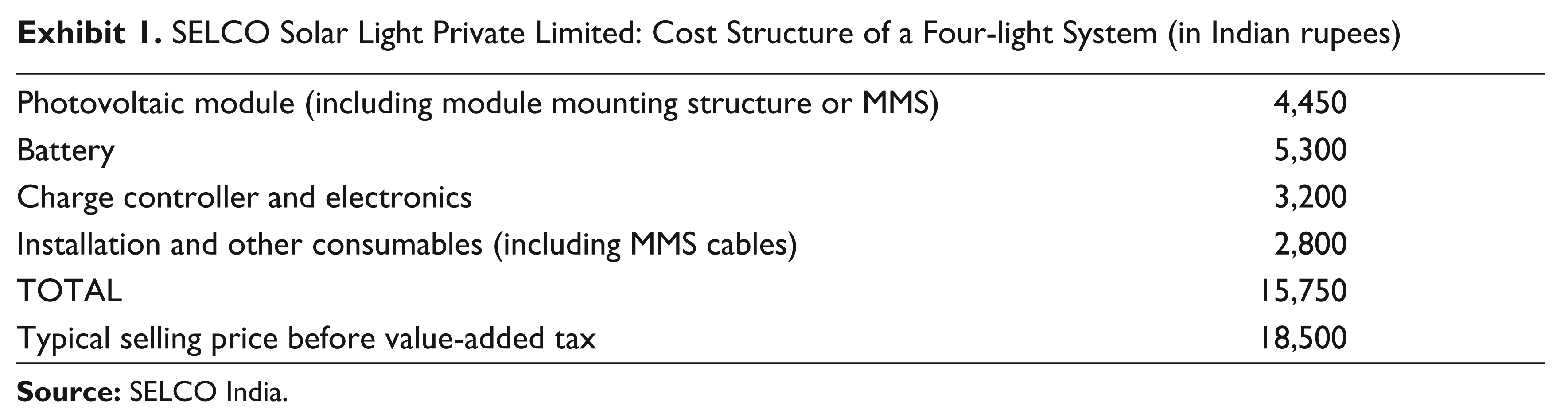
A SELCO India PV system consisted of a panel (the PV cell), a battery, a charge regulator and electronics that were powered by solar. The solar panel’s battery got charged during the day and stored enough energy to power lights and low wattage appliances (fans, radios) for about 12 hours. A SELCO India study indicated that three solar lights cut kerosene consumption by 4–6 litres (about 1–1.5 gallons) a month, thereby reducing around 7 tons of carbon dioxide over 20 years. While SELCO India offered customized products to suit specific customer needs, Exhibit 1 provides the cost structure for a standard four-light system. SELCO India sourced all parts of the PV system from outside vendors.
SELCO Solar Light Private Limited: Cost Structure of a Four-light System (in Indian rupees)
Business Model
Although Hande’s early customers were middle-class farmers, his mission for SELCO India was to bring solar energy to the bottom-of-the-pyramid market. However, at the time of SELCO India’s launch, a single-light cost ₹ 5000 with annual maintenance costs of ₹ 150–200—amounts that were beyond the reach of the target market. A street vendor commented:
300 rupees a month is way too much money, but 10 rupees a day is affordable.
This propelled Hande to think of the company’s business model in broader terms:
The (street vendor’s) comment was when I realized that to sell solar lights the poor need to be provided with financing such that payback patterns were synchronized with their income patterns. (Jayashankar, 2012)
For this, Hande and his team first identified three prongs that underpinned the business model: creating products based on end user needs, installation and after-sales service and standardized financing packages. The first prong envisaged SELCO India as something more than a technology supplier, as one that offered customized products based on end-user needs. The second emphasized the need for doorstep installation and prompt maintenance. The third prong sought to develop financing packages that were matched to user cash flows.
An Indian website reacted to SELCO India’s business model as follows:
Hande believes that the energy needs of a pani puri walla
2
are very different from those of a paddy field farmer. One requires a certain type of light and fuel on a daily basis, while the other requires it on an annual basis. Yet, we continue to apply standardized procedures that have worked with the 1 million haves, to the 5 million have-nots. It’s the inefficient processes that cause losses, and solar power bears the blame. SELCO INDIA helps lighting up by decentralizing the process and creating personalized solutions based on people’s different needs. Their simple but effective innovation has killed the fallacy that solar energy is expensive and impractical. (Mr. Sunshine: Harish Hande, 2012)
SELCO India’s business model was conceptualized as a set of innovative linkages that sought to diffuse sustainable technologies to the poor in an economically viable manner. The first link was between poverty alleviation and energy services. Income generation (to alleviate poverty) in a poor household was seen as dependent upon the availability of one or more type of energy services. The second link connected the provision of energy services with reliable supply chains. The supply chain concept was further elaborated in a new set of linkages that included not only the financing required to access energy but also creating local entrepreneurs who would have a financial incentive to provide energy access to those customers who would find it unfeasible to own power generation (Exhibit 2 visualizes these linkages). Hande realized that for the business model to work, SELCO India had to create a solar energy ecosystem.

The Ecosystem
SELCO India’s ecosystem consisted of company units as well as external stakeholders. The Energy Service Centre (ESC) was the core of the company’s solar energy ecosystem. An ESC was a SELCO India unit operating in a small- to mid-sized provincial town that was tasked with marketing, selling, installing and servicing the company’s energy services in its geographic area. ESCs were staffed pre-dominantly by youth from the local area whose job involved marketing the company’s products via active canvassing and by using motivators (influential people in the area). In addition, the ESC was also responsible for installation and maintenance of the systems. In 2013, SELCO India had forty ESCs.
A set of regional branch offices (RBOs) supervised the ESCs. Typically, an RBO supervised between one and five ESCs depending on the size of the ESCs. An RBO’s role involved coordinating with banks to provide financing as well as ensuring supply of PV systems to the ESCs. The company worked with four types of financial institutions: large commercial banks (such as Canara Bank and Syndicate Bank), regional rural banks (such as Malaprabha Grameen Bank and Varada Grameen Bank), rural farmers’cooperatives and microfinance institutions (such as Self-Employed Women’s Association (SEWA) Bank in the western Indian state of Gujarat). SELCO India’s headquarters in Bengaluru coordinated the RBOs.
Target Market
The primary target market for SELCO India was small farmers earning US$ 1,200–US$ 1,500 annually, small businesses earning US$ 2–US$ 4 a day, individual households with regular monthly income (postal workers, rural school teachers, etc.) of US$ 100–US$ 150 and home-based workers earning US$ 2–US$ 4 a day. Between 65 per cent and 75 per cent, the company’s revenues came from this segment, and the significant part of the company’s marketing and operations effort was focused on this segment. Financing institutions financed up to 85 per cent of the cost of the system to this segment, and with a 5-year loan period, monthly payments amounted to US$ 6–US$ 8.
SELCO India obtained about 10–15 per cent of its revenues from its secondary target market of farmers earning US$ 2,500–US$ 5,000 a year and individual households with earnings of US$ 250–US$ 400 a month.
Institutional clients formed the tertiary target market for SELCO India. This segment included institutions that cared for the poor, religious institutions, refugee camps and government-run institutions, such as vocational training schools. The company did not actively market to this segment.
Finances
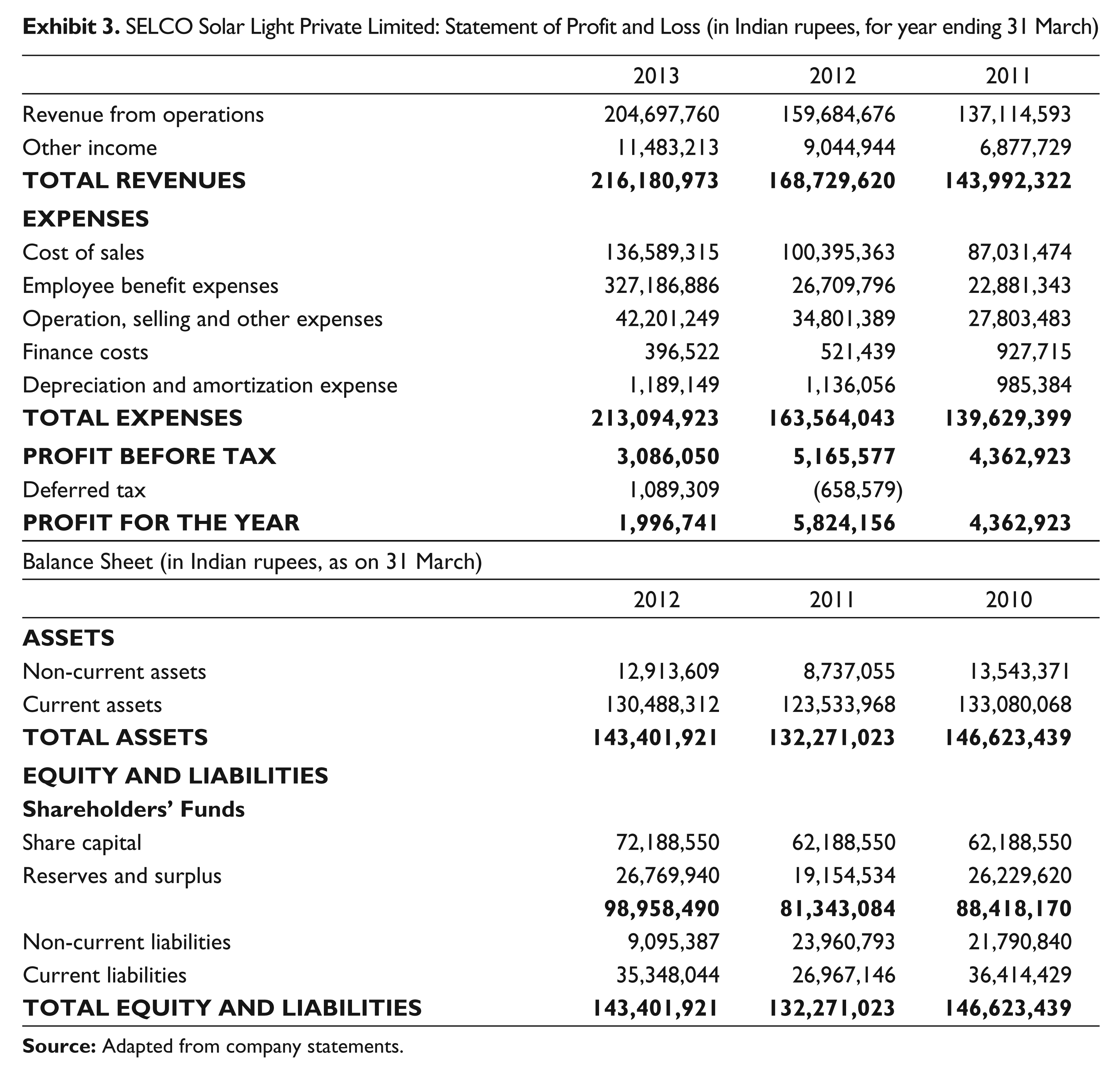
Exhibit 3 gives the company’s balance sheet and income statement for fiscal 2013 and the prior 2 years.
Even as it pursued a social mission of providing solar energy to the poor, Hande was insistent from the start that SELCO India follows a for-profit model. He commented on this aspect of the business:
SELCO INDIA’s products are not subsidized in any manner. There is no state support of any kind, though the government is the biggest beneficiary of SELCO INDIA’s efforts. We help reduce the state’s kerosene subsidy bill by replacing kerosene lamps and stoves with solar-powered products. In return, the government taxes us at 30 percent, while giving tax breaks to IT companies which earn millions. We run SELCO INDIA like a sustainable business. We keep a margin of 22 to 24 percent. (Balasubramanyam, 2012)
SELCO Solar Light Private Limited: Statement of Profit and Loss (in Indian rupees, for year ending 31 March)
SELCO India’s Innovation Department
SELCO India’s Innovation Department was set up as an ‘open’ model to develop customer solutions in the areas of products, financing, and operations. An in-house team developed solutions for identifiable problems (e.g., matching financing with client’s cash flow) and, at the same time, worked with NGOs and academic organizations to find solutions to unidentified or unmet problems. One example of an in-house product was the headlamp for flower pickers and silk farmers. Flower pickers and silk farmers typically worked during the hours of 2 a.m. and 4 a.m. Traditionally, they carried a kerosene lamp in one hand and used the other to pick flowers or feed worms (in case of the silk farmers). This created limitations because the use of a single hand affected productivity. Moreover, spilled kerosene affected what they had picked in addition to causing fire-related accidents. SELCO India designed a solar-powered headlamp that was worn with a band leaving both hands free. The same type of headlamp also found a market in midwives who had hitherto operated with kerosene lamps.
The innovation department was funded by internal cash flows and had a staff of five who reported directly to Hande. A key external partner was the Gujarat-based SEWA, an organization that had a membership of more than 900,000.
India’s Energy Environment 3
As per a 2011 update of its census, India had a population of 1.21 billion, with 68.84 per cent living in rural areas and 31.16 per cent in urban settlements. The census reported that there were 640,867 rural units or villages. Estimates of India’s middle class (considered to be those with at least US$ 10 of income per person per day) varied between 70 and 150 million, of which 60 per cent were urban and 40 per cent rural. A British Broadcasting Corporation (BBC) report estimated that around 42 per cent of India’s population (in contrast to the 37 per cent reported by the Indian government) or around 508 million lived on less than US$ 1.25 4 a day, making India the country with the highest number of poor in the world. India was the tenth largest economy in the world.
Prior to the economic liberalization in 1991 brought about by a severe foreign exchange crisis that necessitated a bail out by the World Bank, India’s power generation and distribution was a monopoly of the state. After 1991, the private sector was allowed to participate in power generation and the vast majority of companies that did focus on conventional (fossil-based) power generation units given India’s abundance of coal supply. Coal accounted for 59 per cent of all power in India, with hydroelectricity’s share being 17 per cent. Renewable sources (with wind energy being the principal type) contributed 12 per cent. In 2013, India had 150,000 megawatts (MW) of installed capacity for all types of energy sources. India was the fifth largest producer and consumer of electricity in the world. While power generation had increased 100-fold since 1947 (the year of India’s independence from Britain), the demand exceeded the supply in 2013 because of the greater rate of economic activity. Power shortages and frequent power cuts were a regular feature of life in India for both commercial operators and the general public whose homes were connected to a central grid. It was estimated that of the 1.4 billion people in the world who had no access to electricity, India accounted for 300 million or a fourth of its population. The vast majority of people in this group lived in rural areas who were precluded from accessing power due to the economics of centralized (or grid-based) power generation and transmission.
As a signatory to the United Nations Framework Convention on Climate Change (UNFCC), in 2008, India launched the National Action Plan on Climate Change. The goal of this plan was to achieve a ‘sustainable development path that simultaneously advances economic and environmental objectives’. Two main principles guided this plan: equal entitlement to the global atmosphere (based on per capita carbon emission) and energy access. One of the outcomes of this plan was the launch of the Jawaharlal Nehru National Solar Mission (JNNSM), named after the country’s first prime minister. JNNSM’s objective was to establish India as a global leader in solar energy. Towards this, in a three-phased approach, India hoped to have an installed solar capacity of 20,000 MW. However, the principal thrust of the JNNSM was in creating centralized solar generation facilities. The launch of the JNNSM was slowed down by 2014 when countries, such as, the United States objected to what they felt were stringent domestic content quotas that favoured local producers contrary to the World Trade Organization rules. In 2013, India had an installed capacity of solar energy of 3 MW.
The Scaling Up Challenge
In 2013, SELCO India was present in the majority of districts in the state of Karnataka and had a small presence in the neighbouring states of Kerala and Tamil Nadu. In addition, through a partnership with SEWA, it was making forays into Gujarat, albeit on a modest scale. The company had installed its products in more than 200,000 households and 4,000 institutions. It had 295 employees, the majority of whom worked in the ESCs.
In a bid to expand its presence, the company had tried a franchise model in 2007. Hande talked about this venture:
We did try a franchise model last year in Karnataka but failed miserably as the model became product-based and not need-based. We got jittery when the basic mission of SELCO INDIA got compromised. (Bhattacharya, 2008)
SELCO India abandoned the franchise model and sought to grow organically. While it believed that its business model was scalable, the key bottleneck was in identifying and working with partner organizations. Partner organizations, such as, SEWA brought not only validation in the market area but also manpower to install and maintain systems and provide access to financing. The challenge was in identifying partners, such as, SEWA in other parts of India. In addition, even when working with partners, SELCO India had to provide the supervisory manpower. Recruiting capable personnel at the supervisory level was not easy in an Indian market where outsourcing and offshoring had raised the salary levels considerably.
In 2012, the company launched the SELCO Incubation Centre headed by chief executive officer (CEO), Ashis Kumar Sahu. The motivation to launch the Centre was to address the specific challenges of bringing energy solutions to the poor:
Delivering energy services to low income families in rural and urban areas faces a number of barriers. Decentralized approaches like SELCO INDIA have been able to overcome some of the barriers or have learnt to work despite them. They reinforce the premise that heterogeneous nature of poverty calls for diverse solutions that are tailored to fit local needs and solutions. Hence the need to tap into latent local human resources and convert them to productive assets to deliver long-term solutions. The Centre will seek to utilize SELCO INDIA’s shared resources, management expertise, intellectual capital, and learning over the past 17 years to enhance the capacity of potential local energy enterprises to deliver energy solutions to low-income communities.
5
Teaming up with external partners for financing, the Centre sought to identify and train entrepreneurs across India to set up ‘baby’ SELCOs, which were independent from the parent SELCO India. Sahu talked about the basic idea behind the Centre:
We want to train, nurture, mentor these entrepreneurs, and in the process transfer SELCO INDIA’s knowledge to them. (This way) they don’t have to go through the same learning cycle or struggles. They can build an ecosystem, and they can grow more easily. We will help them scale up and work with them on technology, business model, and help build the ecosystem required to run an enterprise. Once exposed to the SELCO INDIA model, entrepreneurs will go back and apply a similar model in their respective regions. (Advani, 2012)
From an initial pool of twenty-four, the incubation programme identified four prospects for training and mentoring. By late 2013, three of these were up and running, and one was in the launch phase.
Hande saw tremendous potential for solar energy in India, from both a cost and an environmental perspective. He believed that SELCO India’s low-cost model provided a much-needed product to the bottom-of-the-pyramid customer and, at the same time, offered significant environmental benefits because solar was a renewable energy source. He realized, however, that after 19 years of operations, his company had penetrated a small number of states in southern India. He had ruled out the franchise model of expansion because of potential mission conflict. The ‘baby’ SELCOs model seemed promising and yet posed two challenges. One was the slow pace at which this model produced results. It took SELCO India nearly 2 years to get four enterprises to be launched. It would take many more such enterprises to cover a highly populous country like India. In addition, SELCO India spent enormous time and energy in identifying the candidate pool and in training and mentoring them. This understandably caused strain on the company’s core operations as the time of key executives was spent on both running the company and developing the ‘baby’ SELCOs. Hande wondered if ‘baby’ SELCOs were the way forward to fulfil the mission of bringing solar power to India’s indigent or would simply attempting to scale up his company be the better option.