




Abstract
This case is about a Pakistani non-governmental organization, Educating Voters (EV), which works on projects promoting democracy such as voters’ education, election process transparency, and advocacy of democratic and political reforms. The organization shifted from small scale projects to large scale projects in 2008. However, this change led to increased turnover of team leaders in the Project Department. This position was very critical in EV because the Team Leader played an essential role in the completion of projects. However, as a result of large projects and the ensuing stress, 50 per cent of the team leaders had resigned within a span of two years. After thorough investigation, the HR team identified problems in the hiring process and narrowed these down to the absence of a Job Analysis statement for Team Lead positions. Job analysis statements were created by the HR team over a few months. Now, it was the CEO’s task to design selection methods based on the job description and specification statements.
Discussion Questions
Newly formed organizations shy away from creating an HR department to save costs. Considering the situation in the case, how do you think it has hurt EV?
Design an A4 print media ad for the position of Team Lead considering the information provided in the Job Analysis statement. Make sure your ad fulfils the criteria of AIDA (Attention, Interest, Design, Action).
What type of selection tests EV can design for the team leader position? Design the tests keeping in mind the core requirements mentioned in the Job Analysis statement.
Which interview type (structured, unstructured, semi structured) is best suited to select the team leaders? Explain with reference to organization and job requirements.
Design two-day assessment center activities for the shortlisted candidates. Make sure your assessment center activities coordinate with the job analysis requirements.
In September 2008, Mr Ahsan Sheikh was appointed as the new chief executive officer (CEO) of educating voters (EV), 1 an NGO (non-governmental organization) based in Pakistan. The vision of EV was based on promoting a democratic and just society, and its mission was concerned with enhancing the ability of citizens to work for civil liberties and rights of freedom by augmenting peace and democracy in Pakistan. In early 2010, due to unclear HR policies resulting from the absence of a formal HR department, Mr Sheikh was confronted with the issue of high employee turnover for the position of team leader for the large number of projects that the organization had in its pipeline. The formation of a new HR department not only helped Mr Sheikh to identify the cause of turnover but also enabled him to understand the need to create a clear and comprehensive set of HR policies for the organization. Having established a formal job description (JD) and specification for the team leader position, Mr Sheikh now needed to reach a decision on how to design the most appropriate selection method(s) for the position.
History
EV was established in Pakistan in 2006 as a result of a coalition between thirty NGOs that provided support and finance to help the former perform its functions. Initially, after the NGO’s formation, Mr Ahmad Jabbar was hired as the CEO of the organization. The organization focused on small projects with one year tenure or less. It had three departments (finance, administration and project) with twenty employees. Due to the limited number of employees in the organization, an informal HR department worked directly under the administration department. Each department consisted of a director who reported to the CEO. Mr Jabbar focused on getting small donor-based projects for the NGO because large donors hesitated in awarding big projects to newly-formed NGOs. EV operated in two provinces of Pakistan—Punjab and Sindh. It worked on projects like voter education, election process transparency and advocacy of democratic and political reforms. In early 2008, Mr Jabbar passed away from cancer and Mr Sheikh was hired as the new CEO of EV. Mr Sheikh had served in three different NGOs for more than thirty years. He envisioned increasing the reach of the organization and expanding the network across all five provinces of Pakistan. However, EV was still confronted with a lack of access to large donors and projects. Soon after taking charge as the CEO, Mr Sheikh decided to target USAID (US Agency for International Development) and UKAID (UK Agency for International Development), which were large international donor agencies and had a strong presence in Pakistan. In October 2008, along with the director of programmes (DOP), Mr Sheikh was successful in attracting international donors for projects related to the monitoring of electoral and political violence, analysis of the performance of government institutions in all the provinces and promotion of voter education in less literate areas of Baluchistan. This meant that new teams handling these projects would have to work under intense deadlines and effectively manage limited resources to achieve massive project deliverables. Furthermore, by the end of 2008, EV had received substantial grants from USAID and UKAID for several large projects. Mr Sheikh wanted to successfully complete these projects so that larger grants could be attained. The new projects, obtained as a result of Mr Sheikh’s efforts, were considerably large in nature and required the organization to adopt certain changes, including an increase in the number of staff from twenty to seventy members in all the three departments (see Exhibit 1).
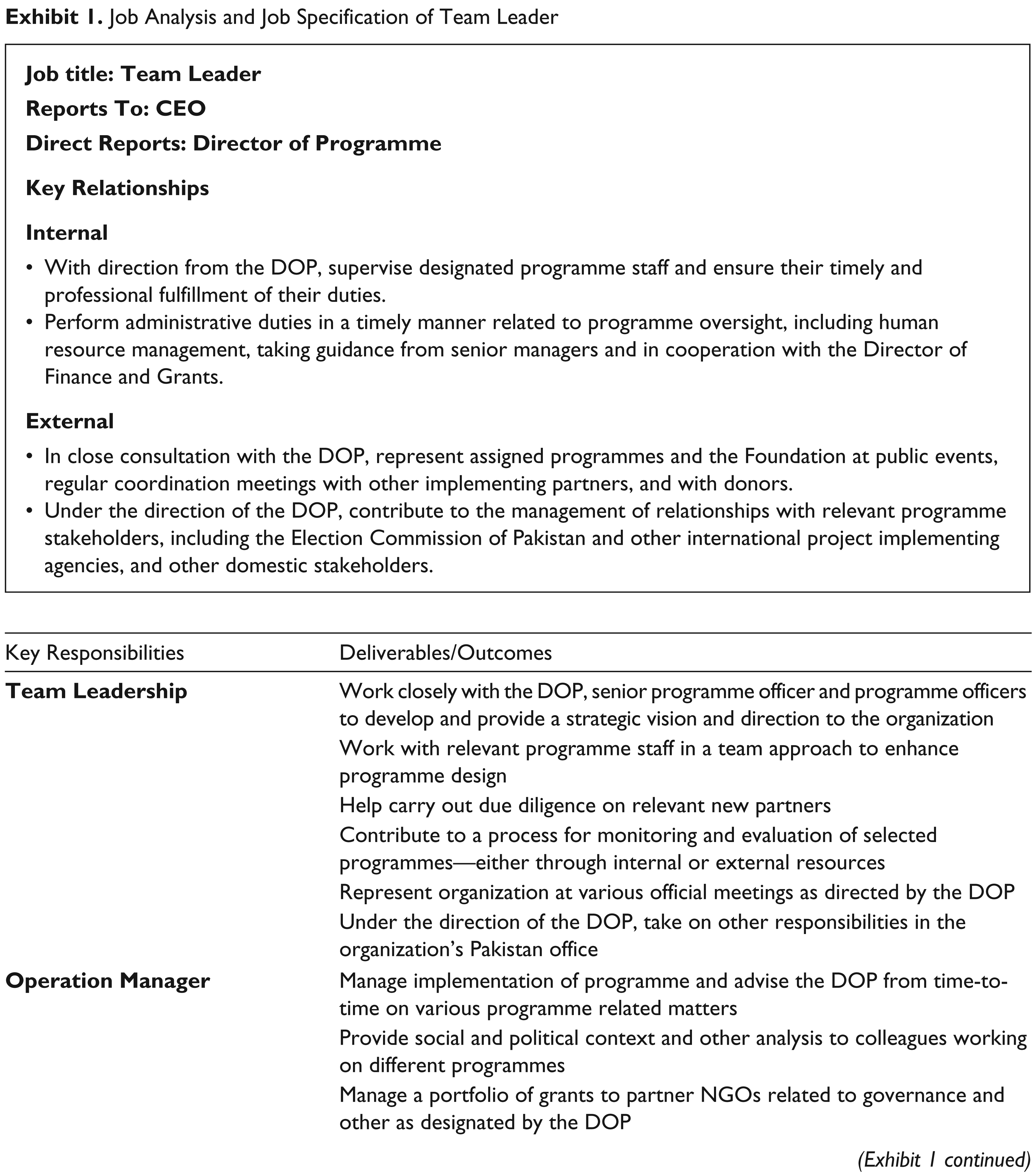
Job Analysis and Job Specification of Team Leader
With direction from the DOP, supervise designated programme staff and ensure their timely and professional fulfillment of their duties. Perform administrative duties in a timely manner related to programme oversight, including human resource management, taking guidance from senior managers and in cooperation with the Director of Finance and Grants.
In close consultation with the DOP, represent assigned programmes and the Foundation at public events, regular coordination meetings with other implementing partners, and with donors. Under the direction of the DOP, contribute to the management of relationships with relevant programme stakeholders, including the Election Commission of Pakistan and other international project implementing agencies, and other domestic stakeholders.

Project Department
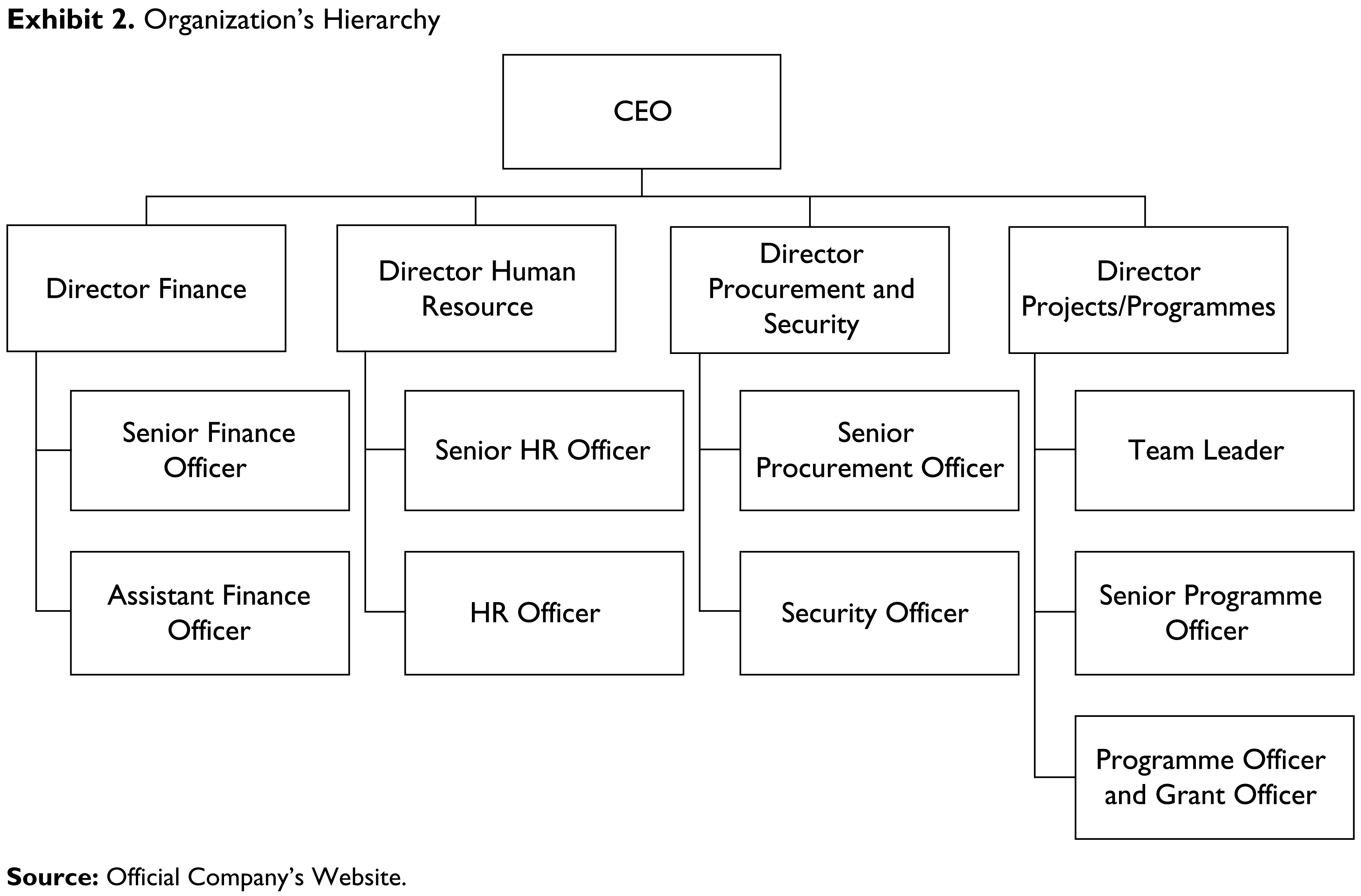
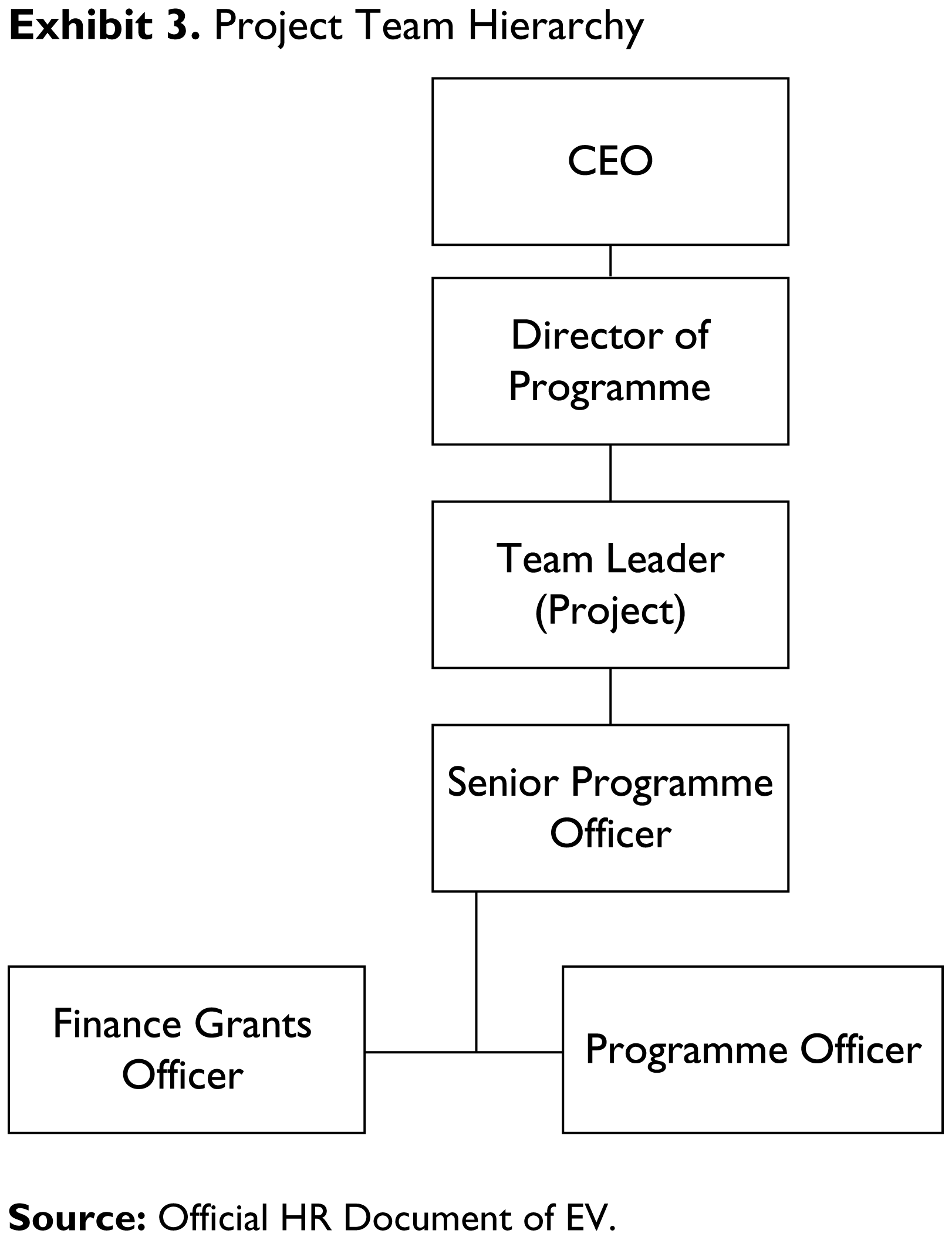
Since the project department brought in the development ventures for the organization to work on, it played the most significant role in the organization with the administration and finance departments playing a support role. The project department usually worked on three to four small projects (one year tenure) simultaneously with the larger projects that usually ran for three to four years. The project department was headed by a DOP who reported to the CEO. The DOP supervised the team leader who supervised the senior programme officer. The senior programme officer was in charge of the grant finance officers (see Exhibits 2 and 3). The number of people engaged in a single project team ranged from three to eleven depending upon the project. On average, three to four teams would be operating simultaneously in the project department. In every project, the team leader played a key role, and the success of the project depended largely upon this position. This was because the team leader was accountable for the manner in which the project was to be managed. According to one former team leader, Mr Hashmi, prior to securing large-scale projects at EV, the team leaders had performed quite effectively because the projects were small and manageable and there were fewer members in the team. Thus, the team leaders did not have to deal with delays and unscheduled issues. However, with new, large-scale, and more challenging projects, the team leaders began facing challenges in meeting deadlines. The new projects, being large and stemming from international agencies, demanded exceptional analytical, research and public speaking skills. Furthermore, these projects required the team leaders to continually interact with international donors as well as monitor and uphold the progress of the project. This translated into the fact that unless the team leaders had the right skill set to deal with complicated deadlines, handle negotiation and conflict management as well as effective project management proficiency, they would probably risk the success of the projects. It was observed that the work on these large-scale projects demanded more time and effort from the team leaders to fulfil their responsibilities, which they were not fully trained to do. Moreover, this led to them working in a stressful and demanding environment, which eventually resulted in missed deadlines and mismanaged resources. A former team leader, Mr Rauf explained:
Organization’s Hierarchy
Project Team Hierarchy
You cannot function in an environment for which you do not have any training. The team leaders were grateful for the new projects and happy for the organization; however, I felt that I had been given too much too fast. The project was unfamiliar and difficult to manage and it got to the point where I felt that it would be best if I stepped aside and let someone else handle it.
Between 2008 and 2010, five out of ten team leaders handed in their resignations and left EV. According to the administration:
‘These new projects were bound to alter the work environment. We lost some good people in the process, however maybe they were given these projects too quickly. Their experience was probably too limited to handle work of this nature.’
In the midst of all this, Mr Sheikh became increasingly worried as projects were left unimplemented and it took longer to complete because of the escalating turnover issue. Moreover, in the absence of standard HR policies and processes, which could help in filling positions faster and providing organizational support, the hiring of new team leaders was a time consuming process. The position itself demanded the right fit due to the challenging circumstances under which it operated. The organization hired new team leaders through informal referral methods. However, as was expected, they took considerable time to adjust to their new work environment in the absence of a formal orientation to the processes and workings of the company, which would have made the transition smooth. The new team leaders were also taking time in understanding the nature of the ongoing projects as well as familiarizing themselves with the details of the failed ones.
Mr Sheikh and the DOP discussed this matter in detail and also spoke to the existing team leaders. Mr Hassan, a team leader with a postgraduate degree in project management coupled with a few years of experience in the field, claimed:
‘The projects require too much from us. There is no training or any set of standards that can help me manage my responsibilities. It’s all coming at us at once.’
Mr Saeed, a former team leader with a degree in project management research and a one and a half year of experience in project implementation, said in his exit interview:
I needed guidance. The projects got too big and too fast. Every day, there is someone who has a new problem that needs solving and I can’t manage the time and the people all at once. You need to hire or train people who can function in such a stressful environment.
Mr Sheikh and the DOP jointly concluded that the work environment and its requirements had definitely changed ever since new projects had been acquired. Since the projects were bigger and had more stakeholders, they required quick troubleshooting, effective management of limited resources and the ability to negotiate well along with working on multiple deliverables at the same time. This meant that the previous team leaders, who were basically hired on reference with many having a postgraduate degree from an HEC (Higher Education Commission) recognized university coupled with two to three years of project management experience, were now facing difficulty. They were used to the previous environment where the projects simply required local research and straightforward implementation. They were struggling because they did not have enough experience to manage large-scale international level projects. Thus, the senior management concluded that the time was ripe to establish an independent HR department. This was necessary to devise and implement correct policies and best practices so that the organization could attract the right kind of people. Earlier, the HR department had functioned as an informal support department which mainly carried out administrative duties rather than focusing on specialist HR functions to attract and retain effective employees. The HR functions were left to those who were acting in a simple administrative capacity. Mr Sheikh explained:
In the beginning, the organization was working on small-scale projects and limited staff was required, therefore, there was no need for the added cost of a formal HR department. However, with the changing dynamics of the organization, a well-developed and proper functional HR department became vital. Formal HR guidance is necessary so that the employees can grow and perform well in the face of challenging circumstances. Our vision is to grow by creating peace and prosperity in Pakistan, and we believe that a well-functioning HR will strengthen our vision by recruiting and retaining the best people.
Keeping these issues in mind, the HR department was formed in August 2010. Mr Haider Ali, an experienced HR manager with seven years of HR management and development experience in the non-profit sector in Pakistan, was appointed as the HR director along with four other individuals who became a team which would manage the new department. Mr Ali was the team leader (Director HR) with the other members reporting directly to him (see Exhibit 2). The HR team got to work immediately and tried to identify the key aspects that were missing earlier. The team started interviewing the DOP, the senior programme officer and the team leaders to get at the root cause of the high team leader turnover.
The DOP, Mr Shahzad noted:
All five team leaders who had resigned had been consecutively scoring poorly in their performance appraisals since the last two years. Retaining team leaders was becoming very difficult and all of them had been struggling with their work. Everything was fine as long as the organization was pursuing small scale projects but when large scale projects were given to them, problems started to arise. It seems that the team leaders lacked the potential for working on a large-scale project.
Mr Shahid Masood, senior programme officer, claimed:
‘My boss, a team leader, had no clue about how to implement the latest project. He seemed confused and was under great stress and burden. He eventually left the company.’
The current team leader, Mr Ramzan Cheema, an MBA graduate with project management as one of his major subjects along with a little over two years of field work experience, acknowledged:
‘The current projects are too challenging […], nevertheless I am dedicating all my energies and hard work towards their success.’
Detailed interview analysis by the newly formed HR department team members showed that team leaders were not used to working on such complicated large-scale projects. Moreover, they did not possess enough experience to deal with the many complexities that these projects presented. The next step for the team was to analyze the hiring process of the organizations to check how the team leaders were hired and whether or not their qualifications and field experience were thoroughly evaluated prior to their selection.
Hiring Process
The HR team found that the previous HR department had been functioning in an informal capacity with no formal policies in place for any core HR functions. There were no properly developed JDs or guidelines for the team leader positions. The recruitment process was based mostly on employee referrals and occasional head hunting. Potential candidates arrived at EV through two channels, with 60 per cent of candidates coming through referrals and 40 per cent applicants responding to print media advertisements. There were no formal shortlisting criteria, and all the candidates were interviewed to assess their relevance. The interview process itself was also not effectively structured. Panel interviews were not conducted and as a result, the DOP interviewed the potential candidates himself and hired people according to his own judgement. Hence, there was a lot of room for interview bias and the objectivity of the interviews was in doubt. There was no consistency in the manner in which the interviews were conducted as both techniques—structured and unstructured—were used interchangeably rather than for deliberate reasons. After analyzing these circumstances, the HR team realized that a faulty hiring process was responsible for ineffective hiring, which resulted in ineffective handling of the projects, which in turn led to a high turnover percentage. Thus, the first task of the HR team was to design and conduct a formal job analysis exercise for the team leader position.
Job Analysis
The team designed a proper JD and job specification (JS) for the team leader position (see Exhibit 1). The process involved the team actually conducting a job analysis process whereby they talked to the senior management as well as looked at the goals of the company to design a JD that would be most effective. The team interviewed managers such as director projects as well as the existing team leaders about the job responsibilities required for this position. They also inquired about how long typical tasks performed by a team leader would take. This required certain time and effort on the part of the HR team because they not only had to talk to the director, but also interview and observe the existing team leaders and programme officers to get a complete idea about what a typical team leader dealt with inside the company. Moreover, the team analyzed the company’s goals and the depth of the projects to chalk out what kind of qualifications should be held by future team leaders. This would also help to establish the right kinds of compensation plans later. Moreover, the HR team started listing down the different responsibilities of the team leaders so that future team leaders would have a clear idea about their role. The whole process was aimed at ensuring that only the most relevant and qualified applicants were hired. As a result, the team established a set of formal standards and specifications on the basis of which future team leaders were to be evaluated and hired. According to the new JD, certain key responsibilities were identified which could prove vital in the success of future projects. The new JD called for a team leader to have strong analytical and research skills, which would enable him/her to analyze the political and social contexts of several projects and their possible impact on the targeted area. The fact that these projects were socio-political in nature meant that the new team leaders would need to have the ability to assess and evaluate multiple environmental contexts while effectively managing limited donor-based resources. The HR team also found that these responsibilities were previously not handled well, which resulted in ineffective project management. These skills were included to increase project feasibility and project success rate. The JD also outlined the responsibility of the team leader to work in close contact with the DOP, the senior programme officer and the programme officer so that an inclusive decision-making process would yield better results. One of the key responsibilities was maintaining a portfolio of grants and working in close collaboration with partner NGOs and donor agencies. Public speaking skills were emphasized in the JD because projects demanded excellent interpersonal skills enabling the team leader to effectively present the stance of the organization to the donor agencies and at public forums. Lastly, seven-year work experience was made mandatory for the position since the NGO could not risk jeopardizing their vital projects by appointing inexperienced employees. Keeping all these factors in mind, the HR team could have some confidence in their recruitment process for future team leaders.
The Next Step
Mr Sheikh was very pleased with the HR team’s performance. He was now satisfied that a proper job analysis process had been defined. He was optimistic about the workability of the hiring process and believed that this would eventually reduce the high turnover rates. However, the job was far from complete at this stage. The relevance of the selection process at the organization was still under question. The team had to analyze the suitability of the different types of tests and interviews that needed to be used in order to select suitable candidates. Mr Sheikh and the HR team reflected on whether to use tests judging analytical skills or professional competencies. They also wondered if personality tests judging leadership abilities, behaviours and motivation level were suitable or if they needed to use work sampling tests incorporating job simulation of some sort. Further reflection took place on the respective merits of using assessment centres combined with structured interviews or situational interviews to solve the problem. Answering all these questions and reaching a consensus upon one selection method was the next major challenge for Mr Sheikh and the HR team.