



Abstract
The President and CEO of Mobilink called a meeting with the HR team to discuss serious issues regarding the performance appraisal system at Mobilink in January 2015, when the regular performance appraisal cycle had already begun. One such issue was the mismatch between employee and organizational objectives. There was a need to reinforce the link between individual and corporate performance as the organization did not meet its expected revenue growth targets. Still, many people were awarded salary increments, bonuses and promotions. The CEO of Mobilink and the HR team agreed that there was a need for changes in the existing performance appraisal system to bring employee objectives in line with organizational goals. The team was given 48h to develop a new system. Eventually, the team developed a new evaluation system, which was presented to the senior management team. The discussion with top management revealed varying opinions regarding the proposed system. The senior management team highlighted potentially serious pitfalls in the proposed system. The HR team left the meeting thinking: should the proposed system be implemented now or later, and did it need further improvements before implementation? They had a deadline to meet.
Discussion Questions
What are the pros and cons of the existing performance appraisal system? What problems can be identified in the system? Can the proposed performance appraisal system address the concerns raised by the CEO? Should the HR department proceed immediately in implementing the proposed changes, or should it wait? How can the additional concerns be addressed?
Evaluate the roll-out strategy of Mobilink regarding the proposed performance appraisal system. Did the proposed performance appraisal system meet the expectations of a good performance appraisal system?
‘How is it possible that our people achieved their annual targets, but the organization did not?’ Jeffrey Hedberg, the CEO of Mobilink, inquired. On 5th January 2015, the CEO called for an urgent meeting with Asghar Jameel, the Chief Human Resource Officer, and Sardar Hasan, the Head of Talent Acquisition and Cultural Transformation, to discuss the annual performance appraisal process that had just begun for the concluded year 2014. Jeffrey had assumed the CEO position and observed a declining trend in revenue growth for the first time in the history of Mobilink. In the meeting, Jeffrey noted that though the organization did not meet its expected targets of revenue growth, many people were awarded salary increments, bonuses and promotions based on their extraordinary performance during the previous year. ‘It is the time to reassess how Mobilink appraises the performance of its employees and to reinforce the link between individual and organizational performance’, Jeffrey commented. The HR team had 48h to review the performance appraisal system and propose an alternative plan.
Mobilink Background
In 1994, Mobilink started operations in Pakistan. Mobilink was the first firm to offer 100% GSM technology in the country, whereas the earlier entrants were using older technologies. In 2001, Orascom, an Egyptian telecom firm, bought 89% shares of the company and assumed the management control of Mobilink. The backing of the Orascom Group brought an aggressive and ambitious culture. Modern technology, a wide network and focused marketing helped Mobilink create and capture Pakistan’s largest telecom market share and become a dominant player.
Over the years, Mobilink continued increasing its customer base. The organization maintained its market position by offering the latest cellular technology, a large range of value-added services and the provision of the internet with 3G technology. It offered a high-frequency transmission technique that enabled a large number of messages to be communicated simultaneously (About Us—Mobilink, n.d.). In 2010, VimpelCom acquired Mobilink, which resulted in a substantial increase in the number of subscribers. With the largest number of annual cellular subscribers compared to its competitors, Mobilink maintained its market leadership position with 38.8 million subscribers and 27.7% market share in 2014 (PTA, n.d., 2014) (see Exhibit A1 for details of the market share of different players in the telecom industry in Pakistan).
Despite adding around a million customers during the year, Mobilink registered a 10% decline in revenues during the first quarter of 2014 compared to the same quarter last year. This was the first time the company posted negative revenue growth in its history (Atta, 2014). In 2014, the average revenue per user (ARPU), a commonly used metric for performance assessment in the telecom industry, fell from PKR 217 to PKR 200 per month. The reason behind the fall in the ARPU was attributed to the stiff competition that characterized the telecom industry of Pakistan (Mehdi, 2014).
Performance Appraisal System at Mobilink (A)
The performance appraisal system at Mobilink included two major elements: (a) assessment of the achievement of annual objectives and (b) evaluation of behaviours driving the performance and reflecting organizational values. Performance objectives defined what targets employees were expected to deliver. Objectives comprised the outcomes or the result of work-related activities. Each department defined its objectives derived from the overall organizational objectives set each year. The objectives were structured around the nature of the work of each employee.
The behavioural attributes included ‘Be Passionate’, ‘Be Professional’ and ‘Lead with Purpose’. The behavioural component of the performance appraisal system addressed the question of how the employees were expected to deliver upon the objectives assigned. Being passionate comprised the accomplishment of exceptional results passionately; being professional included the activities relating to delighting the customers and delivering operational excellence and leading with purpose included leading by example with a focus on execution and empowerment to perform at the highest level.
The appraisal process consisted of two major steps: input and output. Input comprised of assessment regarding performance objectives and behavioural attributes. The assessment process started with the employee self-evaluating her performance in achieving assigned objectives. After self-evaluation by the employee, the supervisor assigned a performance score based on the extent of achievement of performance objectives. In addition, the supervisor also rated each employee on behavioural attributes. The appraisal system included the rating criteria and corresponding performance scores according to which the evaluations were made. The rating scale comprised five categories: a performance score of 95–100% corresponded to an ‘A’ rating, a score of 90–94.99 corresponded to ‘B’ rating, a score of 85–89.99% to ‘C’, score of 80–84.99 to ‘D’ and a score below 80% to ‘E’ rating. For behavioural descriptions corresponding to each rating scale and performance score, see Exhibit A2. Performance objectives comprised 70%, and the behavioural attributes comprised the remaining 30% of the overall performance score. Afterwards, the overall ratings were shared, discussed with the employees and finalized as annual assessments.
Mobilink used a forced ranking system for performance appraisals. Within each department and across the company, 5% of the employees were expected to receive an ‘A’ rating, 10% a ‘B’ rating, 70% a ‘C’ rating, 10% a ‘D’ rating and 5% of the employees received an ‘E’ rating annually. For the proportion of employees categorized in each performance rank from 2011 to 2014; see Exhibit A3.
The overall ratings translated into output, which constituted disbursements regarding increments, promotions and bonuses amongst employees. Increments and promotions were awarded based on behavioural attributes ratings, and bonuses based on performance objectives and corresponding performance scores. 1 See Exhibit A4 for an overview of the current performance appraisal system.
Issues in the Old Appraisal System
In order to meet the deadline set by the CEO to revise the current appraisal system, Sardar Hasan and the HR team worked relentlessly over the next 2 days to evaluate the current appraisal system. They evaluated the data from previous years and talked to the managers about how the appraisal system was used. The evaluation revealed some characteristics of the appraisal system, which could lead to the use of the system in ways creating discrepancies between the way Mobilink appraised the overall performance of the organization and the performance of individual employees.
As the HR team compared the data on the performance appraisals during the last few years with the guidelines for the forced ranking system, it immediately became clear that the forced ranking system needed to be used according to the guidelines. Supervisors preferred awarding ratings ‘C’ and above to their employees instead of identifying employees performing below the expected standards (see Exhibit A3).
The appraisal process empowered the supervisors to finalize ratings of individual employees which could result in favouritism and discrimination. Employees felt they needed to be more involved in the appraisal process as the system allowed supervisors to finalize the ratings. Some supervisors were concerned with maintaining personal reputations as good managers and rated their employees leniently.
The distribution of rewards, including promotions, increments and bonuses, reflected alternating patterns. For instance, one year, some supervisors awarded increments and promotions to some employees and bonuses to other employees to keep all employees happy. Next year, the distribution of rewards changed: the employees who received increments and/or promotions the previous year received bonuses, and those who received bonuses last year received increments and/or promotions. In some instances, rewards were given to avoid employee dissatisfaction rather than to reward real performance according to the performance ratings (see Exhibit A4 for an overview of the current performance appraisal system).
The evaluation of Sardar Hasan and the HR team confirmed the observation of the CEO that the appraisal system needed to be revised to make it more transparent, fairer and a better indicator of the overall organizational performance. The January to December 2014 annual review suggested that employees were rewarded with increments and promotions even though the company needed help to achieve its objectives and targets. There needed to be more connection between the rewards disbursement criteria and the level of achievement of organizational objectives. The team considered all dimensions of the performance appraisal system and developed a revised system.
Proposed Performance Appraisal System
Revised Performance Rating and Scoring Grid
The existing system categorized performance in five ratings from ‘E’ to ‘A’, with corresponding scores spanning from below 80 to 100. The HR team proposed revising the grid with ratings spanning from ‘unsatisfactory’ to ‘outstanding’ with corresponding scores below 85 to 115–120, respectively. The team also revised the corresponding behavioural descriptions to guide managers and help them interpret the ratings and scores so that the process of applying performance standards while doing performance appraisals could be improved (see Exhibit A5 for details on the revised performance criteria).
Integrating Performance Objectives and Behavioural Attributes
The current appraisal system distributed bonuses based on the achievement of performance objectives and salary raises and promotions based on behavioural attributes. Behavioural attributes were not considered while evaluating the achievement of the organization. In other words, how employees achieved organizational objectives should have been considered while determining the extent of achievement of the objectives.
The proposed appraisal system removed the split between performance objectives and behavioural attributes. The new system proposed determining an overall performance score on the basis of both performance objectives and behavioural attributes. The weightage of performance objectives was set at 85% and the behavioural attributes assessment contributed 15% to the overall performance score. A comprehensive performance rating was then assigned based on performance scores according to the forced ranking system.
Performance objectives were given higher weightage in the proposed system as compared to the weightage assigned in the existing system (i.e., an increase from 70% to 85%) to align the employee performance goals with the organizational objectives. An employee’s performance goals were decided based on the objectives to be achieved by the organization. Hence, higher weightage to performance goals was likely to prove useful in resolving the misalignment between the employee and organization goals. The improved alignment was expected to increase the transparency of the system and enhance the productivity and motivation of the employees.
Calibrated Assessment Process
In this system, employees were evaluated by their direct supervisors. Evaluation by a single person sometimes led to biased judgment regarding the performance of an employee. On occasions, a supervisor rated all her employees as good or better performers without implementing the forced ranking criteria and identifying the poor performers. The HR team proposed calibration to increase the level of transparency and consistency in the assessment process and to ensure that the forced ranking system was implemented correctly.
The calibration process proposed meetings of groups of supervisors who would share the performance appraisals of their respective teams with their peers. Each supervisor would provide feedback to other peer–supervisor on each employee. For instance, the sales manager of Region A would give feedback to the sales managers of Regions B and C on the performance of salespersons in their respective regions. Employee ratings were proposed to be finalized in the calibration meetings. The rating allotted to employees by the supervisor was supported by evidence to prove objectivity in the assigned rating. See Exhibit A6 for a sample employee presentation format for the calibration meeting.
The group of peers finalizing appraisals for a large number of employees across different departments, regions or divisions was also assigned the responsibility of implementing the forced ranking system and ensuring that each supervisor applied the revised criteria of performance ratings consistently and objectively. The chairperson of the meeting was assigned the responsibility to arbitrate differences and reach a consensus. An HR representative was proposed to participate in the meetings and facilitate the calibration process, ensure consistency in performance criteria application and decision-making, and confirm sign-off from calibration members on agreed ratings. A record of the calibration discussion was proposed to be kept by respective supervisors. The calibration process was designed as a collaborative approach of performance evaluation where individual performance was to be evaluated on a comparative basis. 2 See Exhibit A7 for an overview of the calibration session.
In the proposed system, division heads reviewed the ratings after they were finalized through the calibration process. Afterwards, the CEO reviewed the ratings to ensure consistency between his assessment of the respective division or department and the collective assessment grounded in the individual assessments. Employees had the opportunity to review their ratings after finalization by the division heads and the CEO. If an employee disagreed with his rating, he could meet the division head to discuss areas of disagreement so a consensus could be reached. If the disagreement persisted, he could approach the HR department for grievance alleviation. See Exhibit A8 for an overview of the proposed system.
Performance Development Plan
A performance development plan was initiated for those employees who were assessed in the bottom category. According to the performance development plan, SMART (specific, measurable, agreed, relevant and time-bound) objectives were proposed to be set for an employee by the supervisor in the presence of the HR facilitator. The agreement of employees on such objectives was necessary. After the consent of the employee, he was assessed for 3 months against the achievement of the SMART objectives. The improvement in the performance of employees was evaluated during the 3-month duration.
The HR team presented the revised appraisal system to the CEO on 8th January 2015. The CEO appreciated the nature of the proposed changes. However, due to the radical nature of some proposed changes, which included full implementation of a forced ranking system and revised performance criteria, and the involvement of peers in group-based calibration, the CEO advised the HR team to present the proposed system to the senior management of Mobilink.
Meeting with the Management
The senior management of Mobilink listened to Sardar Hasan, who presented the revised appraisal system. After Sardar Hasan finished explaining the key changes, a heated discussion ensued to debate the pros and cons of the proposed system. There was a general agreement among senior managers that the existing appraisal system required improvement. They were supportive of the idea that the system needed a thorough review. However, the senior management identified some of the potential problems and deficiencies that the HR team needed to address before the proposed system was ready for implementation.
Some managers expressed concern that the proposed system only represented cosmetic changes. During the last 10 years, the company had shifted from a manual system to a computerized system which provided ease of use and record-keeping which facilitated transparency and objectivity. The existing system had improved over the years and already possessed many features of the proposed system. For instance, the existing system incorporated the forced ranking system and assigned a significant weightage to the annual performance targets. Hence the proposed system appeared to offer no significant advantage over the current system.
Some of the concerned managers suggested that the revised system with forced ranking implementation will create panic in the organization. People would see the revised system as a step toward staff reduction and a tool for the identification of employees to be laid off later. They opined that over the last few years, the total number of employees at Mobilink had reduced while the revenues and subscribers had increased substantially (see Exhibit A9). The increased competition demanded more committed and hardworking employees. If people were to get the impression that the organization was planning to reduce the workforce, then the competent people would likely leave the organization and create unnecessary pressure on the organization to deliver the targets. It was feared that the costs in terms of reduced employee motivation and increased voluntary turnover might outweigh the purported benefits of the proposed system.
According to another pool of managers, they defined the level of performance scores and corresponding performance ratings at the beginning of the year 2015, which might be unfair for employees expecting to be rated based on performance targets set last year. The current system defined that if an employee achieved 95–100% of the performance target, they were supposed to be rated as an ‘A’ class or a top category employee. The proposed system aimed to reclassify the same employee as a middle-category employee who now only ‘met expectations’. ‘How could one change the goal or performance expectations at the time of evaluation?’ asked a manager. ‘Is it not a violation of the contract that the organization has with its employees?’ he continued.
One manager commented:
Both existing and proposed systems have their pros and cons. The existing system relies entirely on the judgment of the line manager, who discusses ratings with their employees after employees have self-evaluated. Employees blame line managers if they get a low rating. On the other hand, the proposed system eases the negotiation process between employees and managers by following a systematic calibration process. In the suggested system, employees become disconnected as they engage in self-evaluation due to the prolonged duration and multiple stages involved in the calibration process. The result may create a sense of panic in an employee, which can be due to associating apples and oranges instead of apples and apples.
Mr Faisal Akram, Vice President of Commercials, highlighted the criteria for the allocation of bonuses:
Under the existing system, bonuses were given to almost every employee of the organization. This did not reflect the fair culture in Mobilink. Instead, it indicated the presence of discrimination and prejudice in the performance appraisal system at Mobilink. According to the proposed system, bonuses would be allocated only based on the performance of an employee.
While Sardar Hasan listened to the opinions of managers, he realized that the best part of the proposed system was the calibration process. Calibration comprised discussion by the supervisor in front of the chairperson, peers and HR facilitator. Supervisors had to prepare thoroughly and collect relevant evidence to sit in the calibration sessions and defend their assessments. Calibration required trained managers to write specific appraisal comments regarding an employee. These specific comments were necessary to justify ratings assigned to an employee. Calibration demanded significant time and preparation from managers. The sign-off by an employee where he was allowed to either agree or not agree with his rating was also considered a very good practice. All such practices indicated a perception of fairness and open culture at Mobilink.
However, there were also some negative views regarding the calibration process. Khalid Ikram, Head of Customer Relationship Management, commented: ‘Calibration is a flop model. Project-wise appreciation and assessment is a more successful performance assessment model than calibration. This will require little time from managers’. Atif Mushtaq, Manager of Enterprise Sales, added:
Introvert managers may struggle to keep up during calibration meetings, while extroverts tend to excel in defending themselves during these sessions. As a result, employees might be assessed unfairly, favouring managers who can effectively advocate for their team members, leading to an imbalanced environment where some managers have an advantage over others.
As Sardar Hasan and the HR team reviewed the feedback provided by the management of Mobilink, they wondered whether it would be appropriate to implement the new system immediately. Implementation of the new system would increase the overall burden of managers. Managers would have to understand the process of calibration, which required a lot of time. The annual performance appraisal cycle at Mobilink had already begun, with some people having completed their appraisals and many in the process. Senior management had rightly identified many potential issues that the HR team needed to address for the successful implementation of the proposed system.
What course of action was in the best interest of Mobilink? Would the management be motivated to appraise employees according to the revised criteria and system? Were the managers adequately trained for the calibration process? Was it the right time to implement the new system? Was it possible and feasible to bring about a large-scale structural change within a very short time? With the implementation of the new system, could disruptions settle down, deficiencies be addressed and the system mature during the year? The HR team had to decide quickly whether or not to implement the system, and if yes, then how?
Mobilink: Redesigning Performance Appraisal System (B)
Sardar Hasan, in collaboration with the HR team, conducted a comprehensive review of the concerns raised by managers regarding the revised performance appraisal system. The managers’ primary area of concern pertained to the timing of the proposed system’s implementation. Moreover, they expressed the need to acquire the necessary skills and training to effectively evaluate employees based on the proposed system. Sardar Hasan engaged in discussions with other stakeholders to explore various initiatives the HR team could undertake to implement the new system successfully. After thorough deliberation, they collectively agreed upon specific initiatives aimed at fostering greater acceptance and enthusiasm among managers towards the new system. The HR team initiated proactive measures to equip managers with the necessary skills to evaluate employees in accordance with the new system. They effectively communicated the recommended enhancements introduced by the revised system to all managers at Mobilink. A series of comprehensive awareness and training sessions were organized, incorporating the trainee programme and FAQs, with the aim of enhancing the acceptance and adaptability of line managers and business heads towards the upcoming system. Through the concerted efforts of the HR team, the proposed system received widespread positive feedback from managers, resulting in its final approval for implementation.
As part of implementing the new system, line managers, employees and heads of departments shared their feedback regarding the new system. Sardar Hasan and the HR team carefully listened to the opinions and concerns of managers and business heads. In the meantime, Sardar Hasan also thought about possible actions which could make the new system more effective in terms of efficiency and execution.
Roll-out Strategy of the New Performance Appraisal System
Sardar Hasan and the HR team made significant efforts to enhance managers’ receptiveness to the new system. All employees working in the HR department were given specific timelines to align themselves on one date. The communication strategy was developed to inform all managers and business heads regarding updates to the appraisal system. The HR team conducted a number of awareness and training sessions to inform and train employees regarding the new system. During these sessions, the concerns raised by managers were resolved. They were given the platform to discuss their apprehensions regarding revisions suggested by the new system. Also, training campaigns were initiated specifically to improve the vocal capability of managers. Such sessions helped a lot in improving deficiencies associated with the calibration process, as they would benefit managers in defending their ratings during calibration meetings.
As a result of significant efforts by the HR team, the new performance management system (PMS) was implemented on 7th January 2016. However, the actual evaluation period started on 8th February and ended on 8th April. The training and awareness session was conducted for almost one month before the actual evaluation started to make employees aware of the new PMS system and train them according to the guidelines set for the new system.
The evaluation process under the new PMS system constituted several phases: employee self-evaluation, line manager evaluation draft, calibration, division review, CEO review, employee and manager dialogue and sign-off. The whole process would take almost 3 months. See Exhibit B1 for annual performance review with timelines.
After approval for implementation, the HR team informed all managers and business heads in Mobilink regarding the main features of the new system. This was done through an email from the HR team to all Mobilink employees. The email constituted a description regarding the main features of the revised system: new performance evaluation criteria (i.e., performance score comprised a total of performance objectives and behavioural attributes for disbursement of bonus, increment and promotion), revised rating descriptors and date of performance calibration meeting along with timelines. See Exhibit B2 for an update email to Mobilinkers.
As part of the implementation of the new system, the HR team undertook several initiatives to ease the process of implementation:
An Open House Day was arranged on 25th February 2016 to address queries of Mobilink managers regarding the new system. An HR Helpline was announced to further acquaint Mobilink managers regarding the new system. This Helpline would make the HR team accessible to all managers at any time. Managers could contact them at any time. An E-learning course was made available to further enhance the understanding of managers regarding the new system. The course comprised a 5-min orientation session, which provided an understanding of the new system and the track of important timelines.
The HR team also played an important role in the successful execution of the calibration process. Calibration meetings included one person from the HR department who facilitated the discussion between supervisors, where a group of supervisors discussed the assigned rating to their team with peers. HR facilitator specifically helped introverted managers to effectively defend their ratings in front of peers.
Opinions of Line Managers and Business Heads
As part of the implementation of the new system, managers and business heads shared their feedback with the HR team. Sardar Hasan and the HR team heard their opinions carefully to make the system more effective in the long run. One manager commented:
The new PMS is more transparent, clear and without ambiguity. A higher weightage of performance-based attributes compared to behavioural attributes will result in increased motivation and productivity of employees as employees will stay focused on achieving performance objectives till the year-end. Furthermore, the quarterly review should be done along with the annual and mid-review as part of the new PMS. The quarterly review will lead to a high frequency of appraisals, which will initiate more practical results as employees will not get anxious at year-end.
The new PMS system was very objective and impartial in its grading. This became possible due to the introduction of the calibration process. The calibration process assigned an employee a rating, whether they were part of Mobilink or not. In one case, an employee who had left the organization was rated Outstanding. This was surprising as line managers could easily give another person Outstanding who was still working in the organization.
Further, the new PMS system could be more effective as some delays were noted in the execution process. Mr Faisal Akram, Regional Head, stated that:
Mega structuring occurring between 2015–16 in Mobilink took the manager out of their comfort zone and changed their false beliefs. KPIs are clearly defined at the start of the year. Despite this, I had two apprehensions regarding the implementation of the proposed PMS. Firstly, quarterly reviews are not being finalized in time. Managers are prone to finalizing year-end reviews only. Secondly, employee evaluation has become system-based under the revised system. Managers can make online changes to the new system. But a few databases are not moved accordingly. Some confirmations regarding the change in databases are still pending.
One manager proposed the idea based on conducting 360-degree feedback during the implementation of the new system. The 360-degree feedback incorporated assessment from multiple sources such as employees’ subordinates, peers, supervisors, customers, suppliers and other stakeholders, along with self-evaluation by the employee himself/herself. However, this idea was not implemented at this stage but could be considered in the future.
Finally, the HR team asked managers to complete the performance appraisal process before 8th April 2016. The last phase of the performance appraisal system comprised a discussion between the line manager and the employee regarding the finalized rating. After an employee agreed with their rating, it was sent to the Finance department for salary processing. See Exhibit B3 for the last phase email of the Performance Management Cycle to Mobilinkers.
As Sardar Hasan and the HR team reviewed the comments provided by the managers and the execution of the new appraisal system, they realized that the new system could address most concerns raised by managers and subsequently ran successfully. There were only 40 disagreements, which were ultimately reduced to 1. None of the disagreements turned into a grievance. The bonus target was not achieved during the last few years. However, Mobilink was able to accomplish its bonus target this year as the organization was able to achieve its objectives. The new PMS allowed a fair and objective evaluation of the performance of employees.
The calibration process sold out well across the organization due to the prominent role played by the HR facilitator. It was expected that the team of vocal managers would win the game due to his enduring influence and inspiring capability. However, this did not become true due to the important role played by the HR facilitator during calibration sessions.
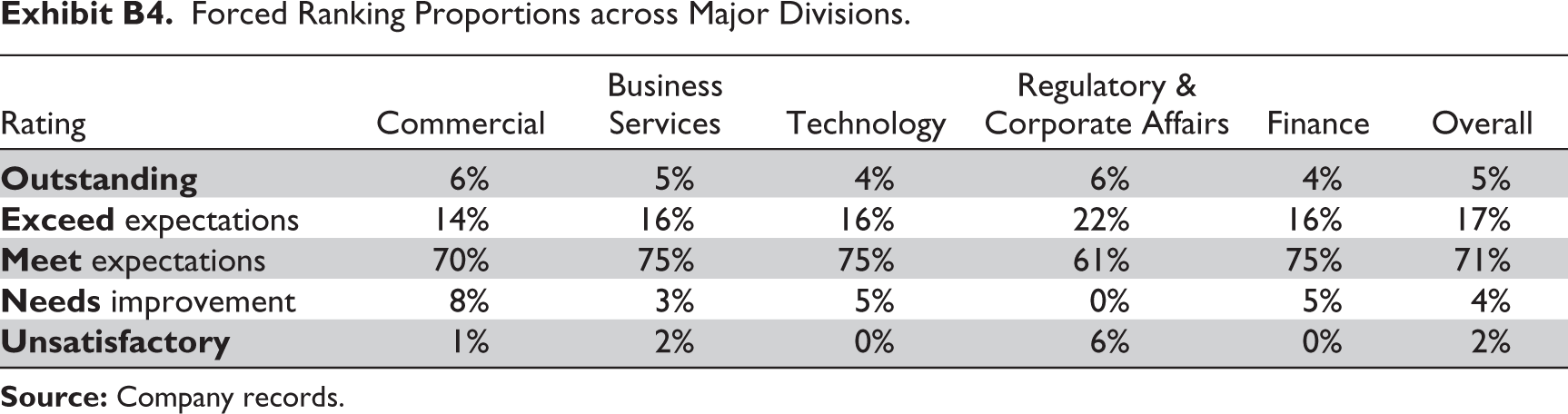
Company records indicated that the ratings allotted by major divisions of Mobilink to employees made significant progress compared to last year. Only employees rated as Needs Improvement and Unsatisfactory needed to catch up to the standard. See Exhibit B4 for ratings allotted by various divisions of Mobilink.
Footnotes
Declaration of Conflicting Interests
The authors declared no potential conflicts of interest with respect to the research, authorship and/or publication of this article.
Funding
The authors received no financial support for the research, authorship and/or publication of this article.
Appendix
Forced Ranking Proportions across Major Divisions.
| Rating | Commercial | Business Services | Technology | Regulatory & Corporate Affairs | Finance | Overall |
|
|
6% | 5% | 4% | 6% | 4% | 5% |
| 14% | 16% | 16% | 22% | 16% | 17% | |
| 70% | 75% | 75% | 61% | 75% | 71% | |
| 8% | 3% | 5% | 0% | 5% | 4% | |
|
|
1% | 2% | 0% | 6% | 0% | 2% |