



Abstract
Agriculture forms a major source of livelihood for many people in Lesotho. The major agricultural activities include crop production and animal husbandry. Many farmers produce agricultural goods, mainly crops for subsistence purposes. There are also some subsistence farmers who participate in animal husbandry. Subsistence farmers keep livestock mainly for social and economic purposes. For instance, some farmers rear animals for prestige, ploughing, paying bride prices as well as producing milk for household use. The traditional breeds of cattle in many parts of Lesotho are kept mainly for domestic use. Despite a large number of Basotho farmers keeping livestock for subsistence purposes, there are some farmers who rear cattle for producing milk. These cattle are purchased from the neighbouring South Africa, while some are crossbred in the country. Some dairy farmers are members of associations, while others are not. Both association members and non-members market the milk in the local dairy industry, Lesotho Dairy Products (LDP). The supply of milk to the local dairy industry is not sustainable due to the small number of farmers participating in dairy farming. This has thwarted the capacity of the dairy industry to produce a variety of dairy products for the domestic market. As a result, the local market is flooded with milk products imported from South Africa. This shows that the forward linkage between LDP and farmers is too weak. This has in turn affected the output (backward linkage) of the dairy industry negatively. The industry specialises in the production of a few dairy products. Besides creating employment opportunities for dairy farmers, farm workers, as well as people working in the industry, the dairy industry has limited backward linkage within the local economy. It does not produce essential agricultural inputs for farmers such as pesticides and dairy cattle. In the light of these, this research study investigates the contribution of the dairy industry in improving the lives of dairy farm households and the economy of Lesotho. This is achieved by looking at production linkages (forward and backward) between dairy farmers and LDP.
Keywords
Theoretical and Managerial Contribution of the Study
While many studies in Lesotho focused mainly on the rearing of traditional breeds of cattle for supply of milk for domestic use, there is little research done on keeping dairy cattle for commercial purposes. In addition, the educational qualifications of farmers participating in dairy farming have not been explored. Theoretically, this research fills a gap in the literature for different uses of cattle in Lesotho. This is because Ferguson (1985) and Dana (1997) focused mainly on the domestic use of cattle. The study also contributes to the literature by showing that many people participating in dairy farming have tertiary education. These results are further in contrast with the finding that traditional systems of milk production dominate many parts of Africa because many farmers have no formal education (Ndambi, Hemme and Latacz-Lohmann 2007). The study further contributes to the managerial improvement of the dairy industry in Lesotho by identifying some challenges hindering the performance of the dairy industry. The problems that need to be paid attention to increase the performance of the dairy industry include the failure to internationalise due to specialising in the production of traditional products, mainly fresh and sour milk. The failure of farmers to form dairy associations/cooperatives is also identified as a challenge that thwarts adequate and sustainable supply of raw milk to the processing plant. This also hinders the dairy industry from internationalising and being competitive on the international market.
Introduction
Agro-industries promote a shift from farming as a way of life to farming as a business. Therefore, the introduction of a processing plant in the rural sector opens new crop opportunities to farmers (Huacuja 2001). This enables subsistence farmers to supplement their low incomes by producing commercial crops. In this regard, Cabello (2003) says an agro-industry is a social production process that preserves and/or transforms agricultural raw materials into finished goods. In addition, agro-industries constitute production of agricultural inputs such as seeds and fertilisers (Wallace, Crowther and Shepherd 1998). Improvement in agricultural production techniques is very important for increasing the quantity of raw materials launched in the industrial sector. Processing of agricultural raw materials always involves the farm households by supplying the raw materials to the processing plants. In this scenario, agriculture and industry contribute positively to the poverty reduction and improvement of living standards of people in some developing countries (Namboodiri 1979). Therefore, there is a mutual relationship between agriculture and industry.
The relationship between agriculture and industry is observed mainly through production linkage (Bakht 1996). This linkage emphasises the interdependence of these two main sectors (agriculture and industry). The symbiotic relationship between farm and non-farm sectors is observed by Sastry et al. (2003) in India. The authors argue that the mutual relationship between agriculture and industry assures that each sector meets its productive inputs. It is further stated by Lanjouw (1999) and Deichmann, Shilpi and Vakis (2008) that production linkages could develop where there is demand for agricultural raw materials in industries, as well as when agriculture needs intermediate inputs or producer services from industries (Reinert 1998). The literature suggests two major types of linkages within production linkages.
Forward Linkage
Agriculture plays an important role for local, regional and national development. The contribution of agriculture to national development is witnessed by supplying raw materials to manufacturing industries, a relationship termed forward linkage in literature (Harriss 1987; Mittal 2007). Therefore, forward linkage takes place when agriculture supplies raw materials to agro-industries to foster the expansion of industry (Meyer 1992). As a result, an industry acts as a market for products produced from agriculture. This is because the agricultural sector promotes the expansion of industry by supplying raw materials such as cotton, jute, sugarcane and food grains for processing (Nachane, Sawant and Achuthan 1989). In this process, farmers are employed directly in agriculture by supplying the processing plants with raw materials. The high demand of agricultural raw materials by industry forces agriculture to employ many people to satisfy the industrial demand. This usually takes place in small-scale commercial farming and subsistence agriculture where the use of mechanised technology is not high. In this respect, agriculture and industry are in a position to generate local employment (Rello and Morales 2002). As a result, the farm workers use incomes derived from the sale of raw materials to meet the households’ needs.
Backward Linkage
According to Tesafa (2014) the role of industry in the local economy can be understood by its capacity to establish linkages or demands for goods produced by other sectors, mainly agriculture. In this context, agriculture demands farm inputs from the industries to increase productivity. This type of linkage or interdependence is often referred to as backward linkage in literature (Harriss 1987). The backward linkage operates when agro-industries supply a range of goods and services to agriculture (Coppard 2001; Anderson and Leiserson 1980), including agricultural inputs to farmers (Brown, Hazell and Haggblade 1988). On the other hand, agriculture acts as a market for the industrial machinery and farm inputs. Agriculture’s dependence on industry is illustrated by the former’s dependence on the latter for modern inputs seeds, fertilisers, pesticides, tractors and many others to increase production (Namboodiri 1979). The agricultural inputs are meant to improve the farming systems and consumer goods for domestic use as well for the international market. The foodstuffs processed by the agro-industries improve the diets and nutritional levels of both farm households as well as the urban people (Nachane et al. 1989). According to Reardon and Barret (2000) the agri-food sector in developing countries affect the consumer welfare of people by changing their diets and increasing product variety.
Agro-industries also create employment opportunities for farm households. Milicevic, Berdegue and Reardon (1999) point out that direct employment in agro-industrial firms in Chile provides about 20 per cent of incomes. It can also be illustrated that there are some people who are employed in the non-farm sectors of the economy (service sector and industrial sector) but use their income to buy agricultural goods to meet their needs and demands. Furthermore, non-farm households also benefit from agro-industries by earning some income through the distribution and processing of farm products. The processing of raw agricultural products into finished goods often eases the consumption levels of farm households and urban people (Sanchez 1991).
The Contribution of the Dairy Industry to Rural Development
Dairy farming contributes to the development of countries in different ways. One, the dairy sector plays an important role in providing jobs for the rural communities. In rural areas where dairy farms are based, and where the career opportunities are often scarce, dairy farming has provided a secure income for rural communities (Chellakumar and Sreenivasaiah 2016). It provides employment, not only to people who work on the dairy farms or in dairy plants but also to the whole sector, from upstream inputs and services providers to downstream marketing of finished products. Provision of employment to people is considered a constant cash flow because, when successfully managed, it provides a constant income throughout the year to farmers. The success of constant continuous cash flow depends solely on the availability of inputs such as feed and fodder as well as better marketing facilities. It is further stated by Alvarez, Solis and Perez (2008) that farming skills, availability of farm technologies (equipment) as well as quality breed contribute to more cash flows.
Two, the dairy industry is a major client of agricultural mechanisation such as milking machines, processing equipment and animal feeds. The mechanisation of dairy farming practices throughout the world has revolutionised food production, thus enabling it to maintain pace with population growth, except in some less-developed countries, most notably in Africa (Alvarez et al. 2008). Three, milk from the farmers is used for the production of different dairy products. For example, about 40 per cent of all the milk produced by dairy farmers is converted to yoghurt, cheese and curdled milk, butter and butter oil, skimmed milk powder, whole milk powder and condensed milk (Berman 2010). The production and processing and all other activities of milk and milk products in the value chain up to the market place provide the means of living to rural communities and the various sectors involved in the dairy enterprise (Zezza et al. 2007).
Internationalisation of the Dairy Business
Internationalisation of the dairy business is facilitated mainly by liberalisation of trade. The removal of trade barriers has promoted technological spillover from the more advanced countries into the poor ones with less resources (Heyder and Theuvsen 2011). The most important technologies acquired due to internationalisation are production and marketing technologies. The modern marketing technologies have made it easy for producers from different countries to export their goods on the international market. This process has promoted internationalisation of businesses by expanding the market outlets for maximisation of profits (Ubrežiová et al. 2009). In an endeavour to be globally competitive, many dairy businesses have to meet some specifications such as international packaging standards and introduction of new, quality products to satisfy both domestic and foreign markets (Mpofu and Sauti 2014). Therefore, the success of many dairy businesses depends on the supply of quality milk to ensure quality control on the international market (Scott, Bowden and Rowarth 2013).
Although dairy industries participate in international trade to generate more profits, their performance is thwarted by different factors. Stiff foreign competition is mentioned as one of the factors that often hinders small producers from being viable (Heyder and Theuvsen 2011; Rantšo 2016). Foreign competition has affected small domestic producers in securing a direct and reliable international market. For example, dairy cooperatives in Zimbabwe are struggling to secure the foreign markets (Mpofu and Sauti 2014).
While the performance of small producers is often hindered by external factors, there are also some internal challenges. It is pointed out that the ability of different dairy business stakeholders to cooperate is very important for their viability. Therefore, dairy cooperatives play an important role in their performance. For instance, it is highlighted that producer cooperatives in India specialise in the collection of raw milk for processing (Mishra and Dey 2018). Despite the ability to cooperate, some dairy associations lack relevant entrepreneurial skills and managerial experiences (Dey 2018).
Access to technology is one of the challenges facing some dairy businesses. However, in India, the availability of processing technology has solved problems related to high supply of milk during the peak seasons. The excess supply (volumes) of milk during the winter season is converted into powder milk to avoid perishability (Mishra and Dey 2018). Furthermore, the problems related to market access are solved through vertical integration in the dairy business. The different stakeholders specialise in different assignments/tasks. For example, dairy cooperatives are responsible for the collection of raw milk, while dairy unions process milk and the dairy federation focuses on marketing (Mishra and Dey 2018).
Methodology
Primary Data Collection Methods
The primary data is mostly collected for the first time and thus happens to be original in character (Denscombe 2010). When the research is a descriptive type and performs sample or census surveys, then we can obtain primary data either through observation or through direct communication with respondents in one form or another (Kothari 2004). Under the observation method, the information is sought through the researcher’s own direct observation without asking the respondent. The main advantage of the observation method is that the subjective bias is eliminated and the information obtained relates to what is currently happening; it is not complicated by either the past behaviour or future intentions or attitudes and is independent of respondents’ willingness to respond (Kothari 2004). There are various types of interviews such as personal, telephone and focused interviews.
This study used observations and structured interviews to collect the primary data. Face-to-face interviews were conducted to collect primary data mainly from dairy farmers, while a self-administered questionnaire was used to get information from the management of Lesotho Dairy Products (LDP).
Secondary Data Collection Methods
Literature Review
The secondary data is information collected by someone else and that has been passed through a statistical process (Marvasti 2004). De Vaus (2002) also defines secondary data as data collected by other people or agencies that can be used to address the research questions of the study at hand.
This research has used secondary data collected from books and electronic sources such as the internet. Therefore, journal articles and documents from the internet provided data. These electronic sources of information were used to get data on agro-industrialisation and rural development in developing countries. Information about Lesotho was collected from policy documents, research reports, books and conference papers.
Population and Sampling
Kothari (2004) defines population as all items in any field of inquiry. Therefore, Kothari (2004) concludes that population can be regarded as an aggregate of the items possessing a common trait or traits. Creswell (2003) points out that if the sample size is too small, it may not serve to achieve the objectives of the study, and if it is too large, huge costs and a waste of resources may be incurred. Therefore, Creswell (2003) concludes that a population sample must be of an optimum size, that is, the population should neither be excessively large nor be too small. In this study the population of the dairy farmers was derived from the dairy milk centres.
The population was made up of Basotho dairy farmers and the management of LDP. There were two different types of dairy farmers interviewed in this study. One, 33 members of dairy associations formed part of the study. Two, 47 dairy farmers who were not part of any dairy association were also selected. As a result, a total sample of 80 dairy farmers was selected, using a simple random sampling technique. In the probability sampling technique every item under study has an equal chance of being selected. According to Maykut and Morehouse (1994) there are probability and non-probability sampling techniques. In probability sampling, the researcher can specify the probability of the element (participant’s) being included in the sample, whereas in non-probability sampling there is no way of estimating the probability of an element’s being included in a sample (Bryman 2007). This means that in non-probability sampling, the researcher selects samples based on subjective judgment rather than in random. The probability sampling examples include simple random sampling, stratified sampling, cluster sampling, systematic sampling and multistage sampling (Walliman 2001). Non-probability sampling includes accidental, quota and purposive or judgement samples (Willaman 2001).
Study Areas
The study was conducted in the following areas that are found in the Maseru district: Botshabelo, Mazenod and Matsieng. Many of the dairy farmers in the Berea district were from Sehlabeng sa Thuathe and Ha Mabote.
Results and Discussion
Distribution of Dairy Farmers by Gender
Subsistence agriculture is dominated by female farmers in many African societies. This is because men mostly migrate to towns in search of paid employment. However, evidence from Lesotho shows that the majority (74%) of dairy farmers are men, while women farmers make a small percentage (7.5%). The dominance of dairy farming by male people can be attributed to some factors. First, Lesotho boys grow up as herd boys and stay in this activity until their maturity. Therefore, rearing cattle is instilled in them at a young age. Second, many Basotho men used migrant labourer remittances from South African mines to purchase livestock for different uses (Uys 1970). Third, customary practices segregate between the different roles of men and women in society. In some societies, women are restricted to household activities, while men are responsible for farming (FAO 2013). Although the international trends show that subsistence farming is the responsibility of women in some African societies, women become farmers by default while their husbands are away working as migrant workers.
Age of Dairy Farmers in Lesotho
Age is an important determinant of development in many countries. This is because the country that has most of the labour force in the old age category is likely to face some challenges. In addition, a country with a young population is likely to develop compared to one with old people. Active labour force is engaged in different types of development activities. In the light of this background, the majority (28.75%) of dairy farmers in Lesotho are found to be in the 66–75 age bracket. According to the international standards, people in this age group are the old (between 60 and 65), and many of them are pensioners. These results suggest that dairy farming is an important source of livelihood for the elderly farmers’ households. However, research on developing countries reveals that the ageing population of farmers is a global challenge (Heide-Ottosen 2014). This is because the dairy industry faces a severe shortage of new and young recruits. Many young people perceive it as an old-fashioned, laborious and unprofitable business enterprise that is impinged by traditional land tenure systems (Kinsella and Velkoff 2001). For instance, the results of this study show that youth constitute only 12.5 per cent of dairy farmers in Lesotho. The low participation of young people in dairy farming contradicts the current reality of increasing youth unemployment in Lesotho. According to the Central Bank of Lesotho (2012), youth unemployment is estimated at 35 per cent. In this scenario, one would expect a large number of unemployed youth (both educated and less-educated) to participate actively in dairy farming.
Educational Level of Dairy Farmers
Educational Level of Dairy Farmers in Lesotho, 2018
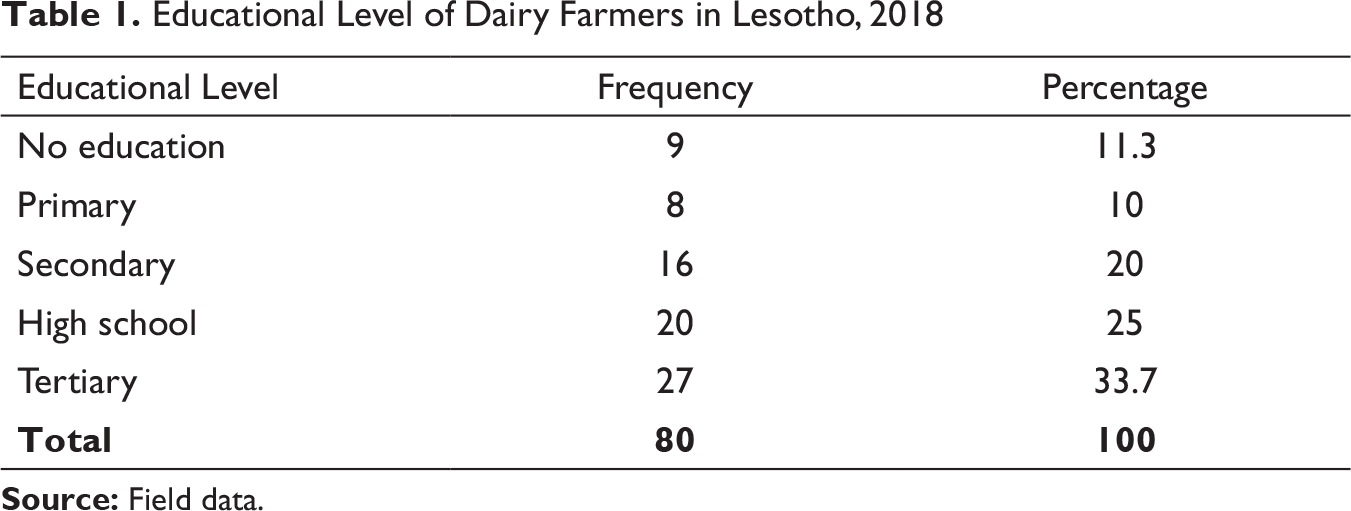
According to research on Lesotho, many farmers rear livestock mainly for prestige and for performing some cultural practices such as bride price payment, providing liquid milk for household members and ploughing (Dana 1997; Ferguson 1985). In this case, animal husbandry is mostly practised by people with a low level of education. However, the current study provides a different view. This is because Table 1 reveals that the majority of dairy farmers (33.7%) have tertiary education. The large number of people with tertiary education in dairy farming can be ascribed to different factors. First, the acquisition of dairy cattle is not similar to the acquisition of normal breeds. Dairy breeds are mostly expensive and unaffordable to many people. Many educated people are employed in government and other sectors. As a result, they use their incomes to purchase the recommended breeds of cattle. Secondly, the management of dairy cattle is not similar to that of normal breeds, therefore farmers have to go through training workshops. In addition, acquisition of modern technologies in breeding can be well understood by educated people.
Although education is important in the diffusion of new technologies, specialised information is more critical to the adoption of skills than mere formal education. It can be noted from Table 1 that dairy farmers with no formal education constitute 11.3 per cent. These research findings show that dairy farming also forms part of livelihood and a source of income for people with no education. Despite the fact that people with no education are unable to acquire technological inventions in dairy farming through learning, many of them adopt new technologies through informal channels such as farmer-to-farmer exchange of knowledge. They share operational skills such as milking methods, feed storage and utilisation.
Acquisition of Formal Training in Animal Husbandry
Training in a particular type of business skills is very important for improved performance. This is why formal education is considered very important in the dissemination and adoption of modern skills in business. In the case of dairy farming, farmers have to manage cattle for maximum production of large volumes of milk. In order to accomplish this objective, they need to acquire skills in proper feeding, administering medication, managing waste and operating milking equipment daily. In addition, some dairy farmers usually grow fodder on their farms and also engage in the breeding of cattle.
The current study reveals that many dairy farmers (70%) have not acquired any formal training in animal husbandry. Field data suggests that in this sector most dairy farmers do not have formal training in animal husbandry, farm management and, particularly, dairy farming. Many farmers participate in this type of farming as a way of making a living. For instance, the dairy farming business plays an important role in reducing the high unemployment rate and poverty resulting from the retrenchment of Basotho men from the South African mines since the 1990s (Maphosa and Morojele 2013; Marais 2013). In this respect, Lesotho can achieve Goal One of the United Nations Sustainable Development Goals (SDGs). Retrenched Basotho mineworkers lack formal training in dairy farming skills but they invest their retrenchment packages in this type of farming to make a living and escape from poverty.
The dominance over dairy farming by people without formal training in animal husbandry is also illustrated by Ndambi et al. (2007) who opine that traditional systems dominate milk production in Africa and account for more than 90 per cent of dairy population in sub-Saharan Africa. Evidence shows that some of the dairy farmers with no formal education in dairy farming acquired the skills of animal husbandry while they were herd boys. They also received assistance from their skilled counterparts or acquired skills by reading dairy farming magazines issued by the Rural Self-Help Development Agricultural (RSDA). They further consult veterinary doctors and personnel whenever they face problems.
Date of Dairy Farm Establishment
Dairy farming is an agricultural enterprise meant for the creation of employment opportunities and incomes for the farmers. Evidence shows that many small-scale, farm and non-farm, enterprises in Africa collapse before they are 5 years old. This observation called for this study to establish the relationship between the date of establishment and the viability of the dairy farm business in Lesotho.
Many dairy farmers (61.3%) have established dairy farms between 2009 and 2018. According to the international experiences, this period was marked by the global recession that led to job cuts and retrenchment. Lesotho was also affected by the global recession (Central Bank 2009). The retrenchment of people in both government and private sectors resulted in people resorting to other income-generating activities such as dairy farming. This study finds that dairy farmers established their farms with some retrenchment and retirement packages in order to have a means of living.
Employment Status of Dairy Farmers
Employment Status of Dairy Farmers in Lesotho, 2018

The increasing unemployment rate in Lesotho has forced many people to establish small-scale businesses to make a living. This is reflected by the data contained in Table 2 which shows that 91.3 per cent of dairy farmers are self-employed in the informal sector (dairy industry). This indicates that dairy farming is the sole means of livelihood for many farm households. Lack of employment opportunities in the country has probably forced them to venture into entrepreneurial activities such as dairy farming. Although the majority of dairy farmers do not work elsewhere, Table 2 shows that about 8.7 per cent of them use dairy farming profits to supplement their salaries from the formal sector. They also have something to fall back on when their business experiences some problems. Besides contributing to the livelihood of dairy farm households, the contribution of dairy farming to employment creation is observed at the local processing plant. LDP has employed people in different activities such as the processing, packaging and distribution of dairy products (interview with LDP manager, May 2018).
Types of Dairy Breeds
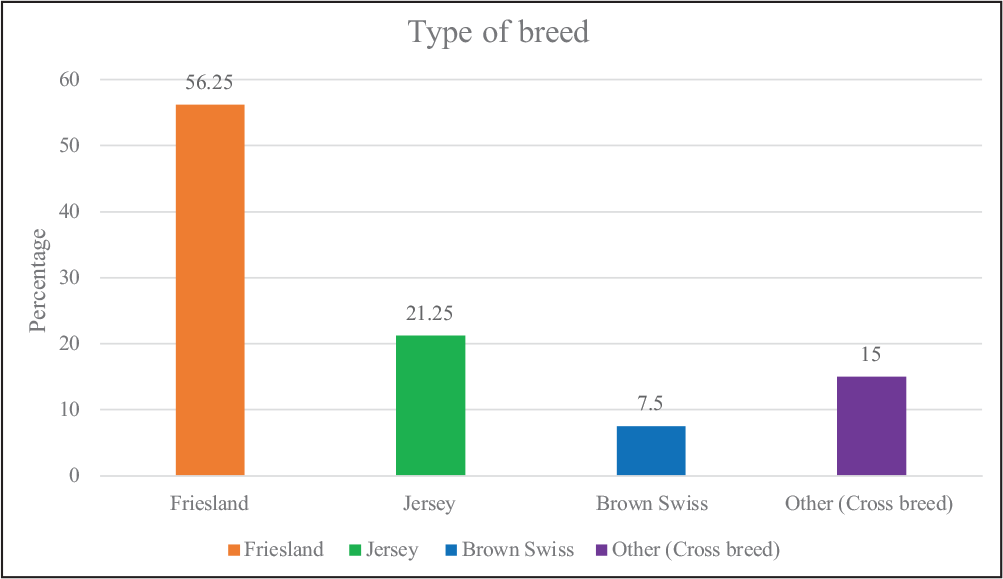
Farmers’ preference of the type of dairy breeds is determined mainly by the animals’ ability to produce the required volume of milk per day or week. In the present case, Figure 1 shows that 56.5 per cent of dairy farmers rear the Friesland breed which is commended for producing large volumes and quality of milk. Friesland is easily available in the country. Therefore, it does not require farmers to import dairy cows from the Republic of South Africa.
The farmers’ preference of a particular breed is further determined by its resistance to the harsh climatic conditions, especially severe drought and heavy snowfall in the country. The Brown Swiss is one of such breeds that are suitable for the agro-climatic conditions of Lesotho. It was reported by farmers that Brown Swiss is suitable for the country’s environment because of its resistance to harsh climatic conditions. However, this type of breed is not easy to get in the country compared to others such as the Friesland.
The Jersey is also noted to be one of the breeds preferred by farmers because of its quality milk that is rich in butter. In this case, farmers are encouraged to rear this particular type of breed for ensuring quality dairy products by the local dairy processing plant (LDP). It was also observed from the study that some farmers (15.0%) crossbreed Friesland and Jersey cattle to produce large volumes of milk that is rich in butter and fat (Figure 1). This type of milk is commended for yielding higher profits per litre from the market, thus increasing the returns for dairy farmers.
An interview with the manager of the local dairy processing plant reveals that the quality of the milk collected from the farmers is tested through different methods, in accordance with the international standards. For instance, dairy farmers undergo screening on health fitness two times annually. The dairy cows are also screened for diseases before milk is supplied to the dairy centres. A sample of the raw milk from the dairy farmers is checked in South Africa. The local processing plant also tests raw milk for mass, water, fat and protein content before it can be processed, packaged and distributed.
Size of Dairy Herd per Farmer
The performance of the dairy farming business is often determined by the size of the dairy cattle, which in turn determines the volume of milk that the farmer supplies to/markets at the dairy industry. Therefore, increasing the herd size assures supply of large volumes of milk by farmers to the dairy industry and, ultimately, good revenues from the sale of raw milk. This is because a large herd size leads to higher profits from the market. However, the research findings from Lesotho show that farmers own a small number of livestock, a situation which has not changed since the 1990s. According to Gilles and Tawfik (2001), in 1998, Basotho farmers owned about three dairy cows on average. The present situation is not very different from the past one. For instance, many farmers (52.5%) own a small herd—between one and five cows. There are few farmers (2.5%) who own a herd of between 18 and 21 cows. The small number of dairy cows affects the supply of raw milk to the local dairy processing plant. As a result, raw milk is often imported from South African commercial farmers to supplement the one produced by the local farmers. The low supply of raw milk by the local farmers has hindered the processing plant from diversifying its output in goods such as yoghurt, long-life milk and different kinds of cheese (interview with the manager of LDP, May 2018). Furthermore, the production of low volumes of milk affects the profits generated by farmers.
It can be inferred from these results that dairy farming in Lesotho is still at its infancy; it is not practised on a large scale like in other countries that practise commercial dairy farming. The small size of livestock per farmer also suggests that the supply of raw milk to the dairy industry is not adequate for the production of goods. This explains why a large quantity of imported dairy products from South Africa floods the local market. Therefore, two main conclusions can be drawn from these research findings. The first one is that owning a large herd is not cost-effective in a situation where farmers deal with one monopoly enterprise that determines the prices and other terms of trade. The second conclusion is that many farmers are not capable of managing large herds of dairy cattle due to finance and the traditional land tenure system that restricts access to finance from commercial banks. One would expect many Basotho farmers to own large numbers of dairy cattle to assure a sustainable supply of milk to the dairy industry and obtain good returns from the sale of raw milk. This is because Rahelizatovo and Gillispie (1999) attest that large dairy herds generate good returns that can be used for the management of farms.
Despite the supply of low volumes of milk by dairy farmers to the processing plant, it is pointed out by the manager of the local processing plant that the capacity of storing and processing milk has improved. The industry has installed new equipment that now collects large volumes of milk compared to previous periods. The current volume of milk collected by the dairy processing industry is estimated at 4000 l per day from 400 dairy farmers (which decreased from 600 farmers because of political instability). The current volume of milk is lower than the required volume for processing (interview with the manager of LDP, May 2018).
Use of Labour in Dairy Farming
One feature of the agro-industrial value chain supply is to create employment opportunities in both industry and agriculture (Karluki, Iravo and Kihoro 2015). Creation of employment can reduce the high unemployment rate in the country, which is estimated at 25 per cent (Bureau of Statistics 2009), and reduce the high incidence of poverty—about 57 per cent of people live below the poverty line (ILO 2012). These social and economic problems intensified in the 1990s during the retrenchment of Basotho mine workers from the South African goldmines (Marais 2013). Therefore, dairy farming can fill the gap left by the loss of jobs and migrant labourer remittances from South Africa.
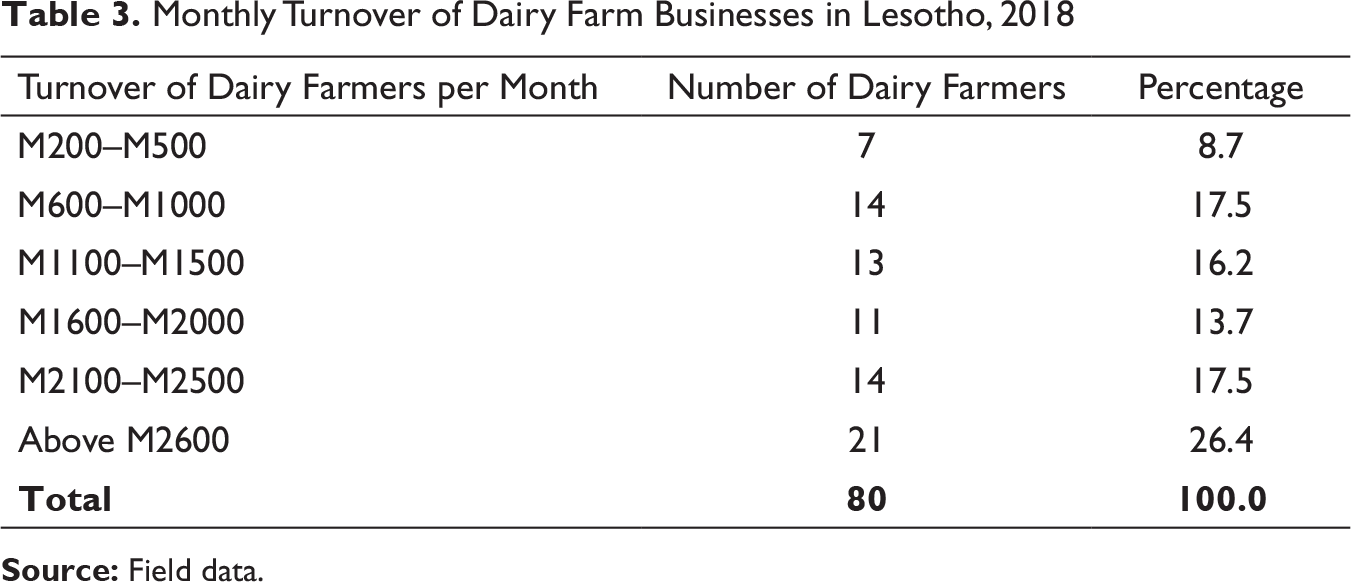
Monthly Turnover of Dairy Farm Businesses in Lesotho, 2018
Monthly Turnover of Dairy Farmers
Monthly Turnover of Dairy Farm Businesses
The size of a business is defined in terms of the number of employees and turnover (Sinclair 2014). Furthermore, the viability of the business can be determined by the amount of money generated per month. Enterprises that are not making profits are faced with the challenge of collapse or closure within the first 5 years of their establishment.
An observation from the field data is that 26.4 per cent of dairy farmers make a monthly turnover of M2600.00 1 from milk sales on average (Table 3). Farmers generating this amount of turnover usually supply between 125 l and 170 l of milk per day to the local dairy processing plant. For better investment in the dairy farming business, an average amount of milk per farm is expected to be more than 10 l per day (Ekesbo 2011). The volume of milk produced by farmers depends on factors such as the methods of feeding, the season and number of cows. For instance, one farmer who owns about 11 dairy cows, mainly the Friesland breed, produces a maximum of 170 l of milk per day to earn approximately M2600.00 per month.
Profitability of the Dairy Farm Business
The profitability of an enterprise is determined by different factors including the costs of running the business, the selling price of raw milk and access to a reliable market. In addition, the farmers’ management styles also play a crucial role. It is also pointed out that the efficient use of farm inputs improves the profits. The majority (72.5%) of farmers find dairy farming to be a profitable agricultural enterprise. They get good returns when selling milk to both the dairy processing plant as well as to community members. However, there are some farmers (27.5%) who perceive dairy farming to be not a profitable business. Many of them cited the high costs of animal feed during the dry season that always reduce the profit margins.
The profitability of dairy farming is also highly dependent on milk price in the market. Good prices increase profits of the business, while low prices affect the business negatively. Research findings in Lesotho reveal that the dairy industry determines milk prices and purchases raw milk from farmers with meagre prices. However, this is not the case in India where the government does not determine milk prices (Mishra and Dey 2018). Regulation of milk prices in Lesotho has forced some farmers to find an alternative, but unreliable market in the communities. Although the market at the community level fetches better returns, the dairy plant still remains a reliable market for raw milk in the country. It was also highlighted by some farmers that when they fail to deliver the milk on time to the dairy firm, it is often returned back. Another factor that affects the profits of farmers is the distance between farms and milk collection points (silos). Some farmers stay far away from the delivery points and incur high transport costs that affect profits.
Membership of Dairy Associations
Networking is very important in business for different reasons. It ensures supply of adequate quantity or volumes of goods to a target market. In addition, producers in a network can be in a position to pool scarce resources such as capital and others. However, the research findings present an opposite view. For instance, more than half of the dairy farmers (58.8%) are not members of any dairy association compared to the 41 per cent of farmers who are members of associations.
Although a large number of farmers are not members of dairy associations, the networking of farmers is commended for stimulating production. For example, it is easy for producers in a network to access certain services such as training, information about new market opportunities and new technological inventions. Furthermore, networking facilitates the pooling of scarce resources. By pooling scarce resources, dairy farmers can operate more efficiently and at lower costs that would have been too much for individual farmers. The research findings show that some dairy farmers in Lesotho have established networks or associations such as Tšemeli Dairy Farmers Association and Phuthiatsana Dairy Farmers Association. While some farmer cooperatives receive government assistance in the form of grant-in-aid in India (Dey 2018), members of dairy farming associations in Lesotho depend on members’ contributions. Some members of dairy associations explained that a certain amount of money is deducted from each litre sold by each member and the accumulations are shared among members at the end of the year. Some farmers use the shared proceeds to purchase animal feed while others purchase dairy cows. Some farmers have also joined an association in order to share transport costs to ferry the milk to the nearby milk collection depots. The milk collected at the centres is cooled and stored in bulk before it is transported to LDP for processing (interview with the manager of LDP, May 2018). The timely delivery to the depots is necessary because milk is an easily perishable product. For instance, Mishra and Dey (2018) point out that milk needs to be transported for processing within 4 hours after milking to avoid spoilage.
Linkages of the Dairy Processing Plant with the Local Economy
The Role of Lesotho Dairy Products in Assisting Dairy Farmers
The relationship between Basotho dairy farmers and LDP is of a supplier and buyer. On the one hand, Lesotho dairy farmers supply liquid and raw milk to LDP from the different districts of the country. On the other hand, LDP purchases milk from the farmers at prices agreed upon by the two parties. Although there might be some disagreements about the price of milk per litre, dairy farmers do not have many alternative options to sell milk elsewhere because, to date, LDP holds the monopoly.
Commercial lending institutions do not support smallholder farmers with credit because they do not have collateral. This is not an exception with the Lesotho dairy farmers. However, LDP often intervenes and supports dairy farmers. It acts as a third party for assisting some dairy farmers to service their debts with commercial banking institutions. Their credit is deducted directly from the milk returns at the company level to repay their loans. This arrangement is made only for the farmers who have joined dairy farmers’ associations such as the Tšemeli Dairy Farmers Association.
Market for Dairy Products and Foreign Competition
LDP produces approximately 2,000 l of fresh milk and 26,000 l of sour milk per week. The market for the finished products is the local community, the shops, the schools, the hospitals, Lesotho Correctional Services and Lesotho Mounted Police Services. Previously, LDP marketed its dairy products in a retail shop in South Africa near the border. However, this opportunity has now closed down, and products are sold only in the local market.
LDP products face competition from the foreign goods in the local market. With the removal of the barriers by the World Trade Organization, free trade has opened up borders for foreign goods to compete with the local products. The management of LDP pointed out that its goods face aggressive competition from dairy products imported mainly from South Africa. The competition from the foreign goods has forced LDP to be innovative and to increase the quantity and quality of its goods to satisfy the customers. The company has purchased new machinery to strive for quality. For instance, LDP has purchased machinery from Europe that processes 42,000 l of milk per day. In addition, the company has lowered its dairy products’ prices in order to attract consumers and counteract foreign competition.
Challenges Hindering the Performance of the Dairy Industry in Lesotho
There are many challenges facing dairy farmers in Lesotho. However, lack of supply of fodder for animal use in the country is the major one. Small-scale commercial dairy farmers do not graze their livestock on the communal land. Instead, they produce or purchase suitable fodder for their cattle. Production of fodder is sometimes affected by severe drought and heavy rainfalls. Therefore, during the dry seasons, many farmers purchase fodder that is imported from South Africa. In this case, it can be rightfully argued that agriculture in Lesotho, particularly dairy farming, is still struggling. One would assume that dairy farmers would produce own fodder in large quantities. For instance, farmers who own land can produce in excess to tap the available fodder market in the country. Furthermore, there can be some farmers who specialise in the production of fodder for sale in the local market. This will reduce the farmers’ dependence on imported fodder from South Africa that lowers their profits. This is because Lesotho is well endowed with water resources and has one of the largest water reservoirs in Africa, the Katse Dam. However, agriculture in the country still depends on unreliable and erratic rainfalls. Therefore, water from the flowing rivers, Katse, Mohale and Metolong dams, can be harnessed for irrigation purposes for the benefit of farmers in all sectors (livestock as well as crop production).
Conclusion
The main objective of the research study is to investigate the contribution of the dairy industry in improving the lives of dairy farm households and the economy of Lesotho, that is, employment creation and reduction of imported manufactured dairy goods. Data was collected from the Maseru and Berea districts, with the focus mainly on farmers supplying milk as a raw material to the processing firm. The research findings show that there are two main actors in the supply value chain of the dairy industry, the producers of raw milk (dairy farmers) and the processor and packager of finished products (LDP). Both actors create job opportunities for skilled and unskilled people in Lesotho. Furthermore, the research findings further show that the majority of dairy farmers are old. They are either on pension, retired, or retrenched from their work and have invested their money in the dairy farming business.
The research findings also show that during the post-independence period, livestock farmers converted to demand-led livestock production, especially dairy farming. As a result, they supply the local agro-industry with raw milk for processing purposes. The demand to supply LDP with raw milk is reflected by an increasing number of dairy farmers found mainly in the urban, peri-urban and rural areas of the country. Therefore, there is a need for the dairy farmers to increase the herd size to satisfy the demand, depending on their financial capacity.
The research findings further reveal that the output from LDP is marketed in the local retail shops. However, LDP fails to satisfy the market because of the low volume of milk supplied to it by the dairy farmers. The volume of milk supplied to the processing unit is below the expectation of the agro-industry. This situation hinders the optimisation of LDP to use modern facilities to collect high volumes of milk. However, the low supply of milk to the industry is supplemented by the purchase of milk from foreign dairy farmers. This measure ensures proper functioning of the industry to prevent closure during periods of scarce supply of milk by the local farmers.
Footnotes
Declaration of Conflicting Interests
The authors declared no potential conflicts of interest with respect to the research, authorship and/or publication of this article.
Funding
The authors received no financial support for the research, authorship and/or publication of this article.
