



Abstract
A rural buyer buys a branded product for its assurance of quality. Rural consumers today, are quite aware of the variety of brands that are available in the market. This change in the behaviour of rural consumers is widespread in respect of FMCG products. The present study stresses on the research framework on properties that induce a purchaser’s confidence in acquisition of a product and structure their relationship with demographic variables and brand choice. The study was carried out in the rural areas of India. The sample size was 1,106. The research methodology consisted of exploratory and descriptive studies. Tools for analysing data included confirmatory factor analysis and modelling of structural equations. It was found that there was a significant relationship between properties that trigger a purchaser’s confidence in acquisition of products and their brand choice. It was also found that there is a significant difference between properties that trigger a purchaser’s confidence in acquisition of products and demographic variables such as age, gender, education and household income.
Keywords
Introduction
Properties that trigger a purchaser’s confidence in acquisition of a product include examining the factors influencing rural consumers’ faith in products and services of a brand or company. There are various stages that a rural consumer goes through while acquiring products and services. These include finding information, exploring available options, choosing among the alternatives, and experiencing post-purchase usage of the product. Hence, it requires diving thoroughly into a rural purchaser’s mindset.
Branded hair oil has a market share of 80 billion INR and a 19 per cent growth (n.a. 2012) with a penetration level of 87 per cent among the rural masses of India. Nearly 50 per cent of the Indian population uses hair oil on a daily basis and its rate of growth in rural India is higher than that of urban India.
Nowadays, rural purchasers are increasingly seeking product information across digital channels. The introduction of mobile phone has been instrumental in raising awareness level of products, brands, types and their use. They acquire products that make their lives easier, are in tune with their environmental condition, give them a feeling of advanced lifestyle and priced according to their level of affordability. They acquire and use brands for their associated element of trust. They recognise brands with the help of colours, symbols, keywords and slogans (The Rise of India’s Rural Super Consumer 2014).
Regarding hair care products, rural people are extremely brand conscious. This is due to their rising earnings, schooling, influence of urban peers and the desire to increase their living standards. They are socially very well bonded. Communication ties are incredibly strong in rural areas unlike the urban areas. Before trying a new product, they take the advice of their friends and family members. So word of mouth is remarkably important for creating a brand image. Parents, family, neighbours, employers, village shopkeepers, opinion leaders, mass media networks like radio and television, and online networks are their key influencers. Folk shows, melas (rural fairs), haats (rural supermarkets), rural sports events and mobile phones are extremely useful in creating awareness amongst rural masses. Consumers in rural markets are evolving in terms of how they recognise brands, draw comparisons, finalise acquiring decisions, and recommend those products.
Female rural purchasers are a desirable segment which cannot be overlooked by any marketer who wants to win a rural share. Rural female purchasers are highly aspiring, independent and socially connected. They are incredibly independent in their opinions about products. Women are gradually becoming employed and are regularly commuting to towns and cities. These women are genuinely ambitious and autonomous. Their level of income and education has offered them a greater freedom with their purchases. They are strongly inclined to raise their living standards and remain competitive.
They are no longer dependent on men. They have a strong impact on purchase decisions. They are able to move out of their villages and make purchases. They are highly aware of the brands as compared to their male counterparts. They are not brand sticky and shift quickly between products if they are not satisfied with the results. They require a variety of products to choose from. When it comes to trying latest products, they are indeed highly experimental. Besides low-value goods, they also acquire high-value goods. They individually make their purchases. Ignoring the demands of these rural women purchasers can therefore prove counterproductive to a company’s success in the rural segments.
Furthermore, hair care offerings which were previously deemed as women’s sphere are now experiencing an increase in their male purchasers who are increasingly interested in enhancing their personality, lifestyle and practices. The key to success in rural sector is to build brand confidence amongst the rural population. Many firms are trying out various rural centric strategies. They are spending in market analysis to uncover realities that are relevant to rural purchasers in India (Devarakonda and Rao 2016).
Literature Review
Mckinsey Global Institute’s study claims that if India maintains its rate of growth, average household earnings will triple in the next two decades and India would become the 5th largest consumer economy in the world by 2025, up from 12th now. Discretionary expenditures consume a majority of purchase expenditure in Indian economy. Trends of purchasing have changed dramatically over the years (Beinhocker, Farrell and Zinulbhai 2007). Rural dwelling is a region with a density of population of less than 400 persons per square kilometre, that has at least 75 per cent of the male population active in farming operations and for which no municipality or board serves (Rural_Urban_2011.pdf 2011). India’s rural hinterland is approaching the era of tremendous economic expansion whose multiplier effect is being increasingly acknowledged by business executives. Growth and international investment opportunities are progressively coming from rural residents(Kapur, Narsalay, et al. 2010). Indian rural leaders contribute greatly to sustainable growth. Companies are intensifying their effort to secure a major presence in the rural areas. They are building and operating economically viable marketing and distribution platforms. They are also using new mechanisms of targeting, attracting and sustaining rural purchasers (Kapur, Ahuja, et al. 2013). Sachets or low marginal value bundles are the most important variable in rural purchase as they induce trials and make them inexpensive to majority of the population (Bhalla and Vasu 2014). Companies face many obstacles while branding in rural markets such as scattered rural population, complex distribution layout, low brand trust, lack of post-sales services, underdeveloped infrastructure, small number of purchasers and low-income consumers (Neuwirth 2012). Companies must hire creative people who can understand rural ideologies and make radical changes in their objectives, competencies and performance, and sustain them. Entrepreneurs should concentrate on building distribution network and supplying goods in smaller quantities through local commercial partners who will boost FMCG business sales. Purchasers in this bracket are highly impulsive, who prefer products based on price and comfort (Emerging Consumer Demand: Rise of small town Indian 2012). Rural purchasers are modifying. They have become more reachable. They use mobile phones to connect with families and businesses (Kapur, Mamta; Nijhawan, Luv; Naokarkar, Ashlesha; Bhavsar, Abhijit n.d.). Rural people prefer natural, luminous and well-groomed hair which is perceived as necessary to maintain a youthful look. Ayurvedic hair care brands are increasingly preferred by the purchasers. Earlier females used to be a target market but now males are progressively preferring styling and fashion items resulting in increased growth of male hair care market (Hair Care Market - Global Industry Size, Share, Trends Analysis and Forecasts 2012–2018 n.d.). Men are increasingly attracted towards hair care products. They believe that good appearance encourage confidence, enables to look stylish and exhibit competence. It is convenient to get males addicted to a product because they do not look for alternatives very often (Terron and Sahu 2014). For a number of factors people oppose new technologies, but the biggest is the refusal to change firmly developed mindsets and habits. Companies may need to reconfigure value chains to meet low-income buyers (Simanis and Duke 2014). The effect of conceptual and practical interest dealing with elements like educational, recreation, wish fulfilment, visual appeal interactions on the shopping centre and enjoyment, and the desire of Indian buyers to purchase from retail outlets at the shopping centre was analysed (Sadachar 2014). India’s hair care industry has grown as a response to increased personal grooming, user engagement, increased discretionary income, rise in middle-class population and increased accessibility of hair products (Research and Markets: India Hair Care Market Outlook, 2021 2015). The key influencing element across all product categories is the need for variety. It presented the professionals with significant marketing considerations in developing successful marketing campaigns as well as attraction approaches to sustain their important clients (Thanigan, Rajendran and Sethuraman 2015). Consumer expectations and product quality information may be of great importance in company production processes. A conjoint analysis is a classic technique for identifying consumer preferences in decision-making on multiple attributes and determining the relative importance of the attributes in consumer choice processes (Mishra 2015). Impulsive buying has long been associated as a significant occurrence in the retail industry. These transactions demonstrate the inclination of buyers to buy randomly. High-impulse shoppers are likely to have ‘open’ shopping plans and are responsive to unforeseen buying ideas (Prashar, Parsad and Vijay 2015). Purchasing orientation towards products, including price awareness, quality perception, brand recognition and brand fidelity for FMCGs can be discovered through consumer decision-making styles (CDMSs) (Kumar, Vohra and Dangi 2016). International businesses will penetrate India with much reduced risk and spending through e-commerce instead of creating a physical presence. E-commerce allows them to sell in the Indian habitat and discover the specific customers who appreciate their distinctive offer. In the Indian market, digital properties, search engine mechanisms, business analytics and web marketing processes can be used easily (Govindarajan and Bagla 2016). Mindset toward brand is the main mediator in the interaction involving attitude toward advertisement and consumer intention to buy (Ganesan, Sridhar and Priyadharsani 2016). The intense competition in the beauty and personal care industries is causing many companies to operate beyond large cities, swiping in to a new wave of users in rural areas who are increasingly becoming smarter and prepared to spend funds on multiple high quality products (Gulati 2017). Businesses have now begun to realise the growing repercussions of disregarding community, ignoring adaptability and constructing corporate image. They are increasingly striving for maintaining ethical behaviour by integrating CSR in their merchandising ecosystem (Singh and Malla 2017). Tags, pamphlets, brochures and classified ads are some, amongst the aids which provide product details. These aids assist consumers in the prudent choice of goods or services and also protect themselves from seller repression. Buyers must be informed of the rights and benefits involved (Chandra and Parvez 2017). Celebrity characteristics is likely to affect customer purchasing intentions; there is substantial correlation between celebrity supporters, neutral and opponents in terms of age, class, profession and level of income, particularly in the case of education and place. As compared to non-celebrity endorsements, buyers also consider celebrity endorsements as more desirable and more impactful (Gauns, et al. 2017). Importance of real worth of a product impacts customer–brand identification (CBI), useful brand commitment and customer–brand engagement (CBE), which in turn makes room for the development of consumer relationships and brand loyalty(Rather, Tehseen and Hussai 2018). The Indian herbal products industry is booming annually; thus the competition between established players is also accelerating. Recognising the fundamental interactions between the numerous demographic and socioeconomic variables of end users is crucial for sustaining and performing in the competitive industry (Chattaraj, Mazumder and Lahiri 2018). The ‘SHIFT’ hypothesis implied that buyers are more likely to participate in environmentally sustainable activities whenever the message or meaning takes care of the following psychological factors: social impact, habit development, individual self, emotions and cognition, and tangibility (White, Habib and Hardi 2019). Consumer orientation has a significant direct impact on business efficiency and the consumer loyalty mediates the effects of consumer orientation on business efficiency. Consumer orientation has a significant impact on consumer satisfaction, which in turn has a positive influence on business efficiency, indicating that consumer orientation has an important and positive indirect influence on business efficiency (Sampaio, Mogollón and Rodrigues 2019).
Objectives of the Study
To ascertain the brand choice of purchasers with respect to hair oil in the rural India.
Ascertain the properties that trigger a purchaser’s confidence in acquisition of hair oil.
To scrutinise the impact of properties that trigger purchaser confidence in acquisition of hair oil.
To examine the direct effect of properties that trigger purchaser confidence in acquisition of hair oil on the brand choice.
To analyse the indirect effect of properties that trigger purchaser confidence in acquisition of hair oil on the brand choice for hair oil, mediating parameters being age, sex, education and household income.
Hypothesis of the Study
There is a significant direct effect of properties that trigger purchaser confidence in acquisition of hair oil on brand choice for hair oil.
There is a significant indirect effect of properties that trigger purchaser confidence in acquisition of hair oil on their brand choice, mediating parameter being age.
There is a significant indirect effect of properties that trigger purchaser confidence in acquisition of hair oil on their brand choice, mediating parameter being sex.
There is a significant indirect effect of properties that trigger purchaser confidence in acquisition of hair oil on their brand choice, mediating parameter being education.
There is a significant indirect effect of properties that trigger purchaser confidence in acquisition of hair oil on their brand choice, mediating parameter being household income.
Research Methodology
This analysis has been an attempt to explain the motivation of rural consumers to acquire branded hair care products. The selected product category was hair oil. Exploratory methodology was used to conduct the study on the properties that trigger purchaser confidence in acquisition of hair oil, through unstructured conversations using simple random sampling method comprising 100 participants.
Thereafter, descriptive research was conducted with a sample size of 1,016 respondents. This study used stratified random sampling using northern, eastern, western, southern and central India as five geographical clusters. A pilot study was performed with 100 participants to evaluate the questionnaire’s accuracy and the study’s efficacy, which was found to be satisfactory. The scaling method being used was comparable to the 5-point scale by Likert. The scale was used to measure the given variable as follows: 1. Extensively disagree, 2. Slightly disagree, 3. Neutral, 4. Slightly agree, 5. Extensively agree. There were 484 respondents who refused to participate in the study. They were asked questions based on four metrics, that is, age, gender, education and family income. This enabled the non-response bias present in the study. Supplementary information was collected from prominent sources via different websites, publications and academic papers.
Research methodology included confirmatory factor analysis (CFA) and structural equation modelling (SEM). Convergent validity was ascertained through statistically significant t-values for each construct across item loadings above 0.50. Structural simulation was used to determine the goodness of fit statistics and other fit indices including the root mean squared approximation error (RMSEA) and comparative fit index (CFI).
Data Analysis
The Cronbach’s alpha was found to be 0.857 which is higher than the minimum acceptable value of 0.70 and the number of items in the questionnaire was 19 (see Table 1).
It was found that 380 respondents comprising 37.4 per cent of the total respondents were less than 20 years old, while 326 respondents comprising a total of 32.1 per cent were of age between 20 and 40 years, and 310 respondents comprising a total of 30.5 per cent were of age greater than 40 years (see Table 2). It showed that there are 459 female respondents comprising a total of 45.2 per cent, 538 male respondents comprising a total of 53 per cent and 19 transgender respondents comprising a total of 1.9 per cent. It revealed that there were 328 respondents comprising a total of 32.3 per cent with family income less than ₹10,000, 352 respondents comprising a total of 34.6 per cent whose family income lies between ₹10,000 and ₹20,000, and 336 respondents comprising a total of 33.1 per cent with family income greater than ₹20,000. It revealed that 368 respondents comprising a total of 36.2 per cent were illiterate, while 370 respondents comprising a total of 36.4 per cent were educated less than or equal to 10th standard and 278 respondents comprising a total of 27.4 per cent were educated beyond 10th standard.
Reliability Statistics

Demographic Characteristics of the Sample

It was also found that 45 respondents comprising 6.2 per cent of the total respondents prefer to use Bajaj Almonds hair oil, 113 respondents comprising 15.5 per cent prefer to use Dabur Amla hair oil, 332 respondents comprising 45.5 per cent prefer to use Parachute Coconut hair oil, 198 respondents comprising 27.2 per cent prefer to use Himani Navratna hair oil, and 41 respondents comprising 5.6 per cent prefer to use any other brand of hair oil (see Table 4).
Development of Measurement Model
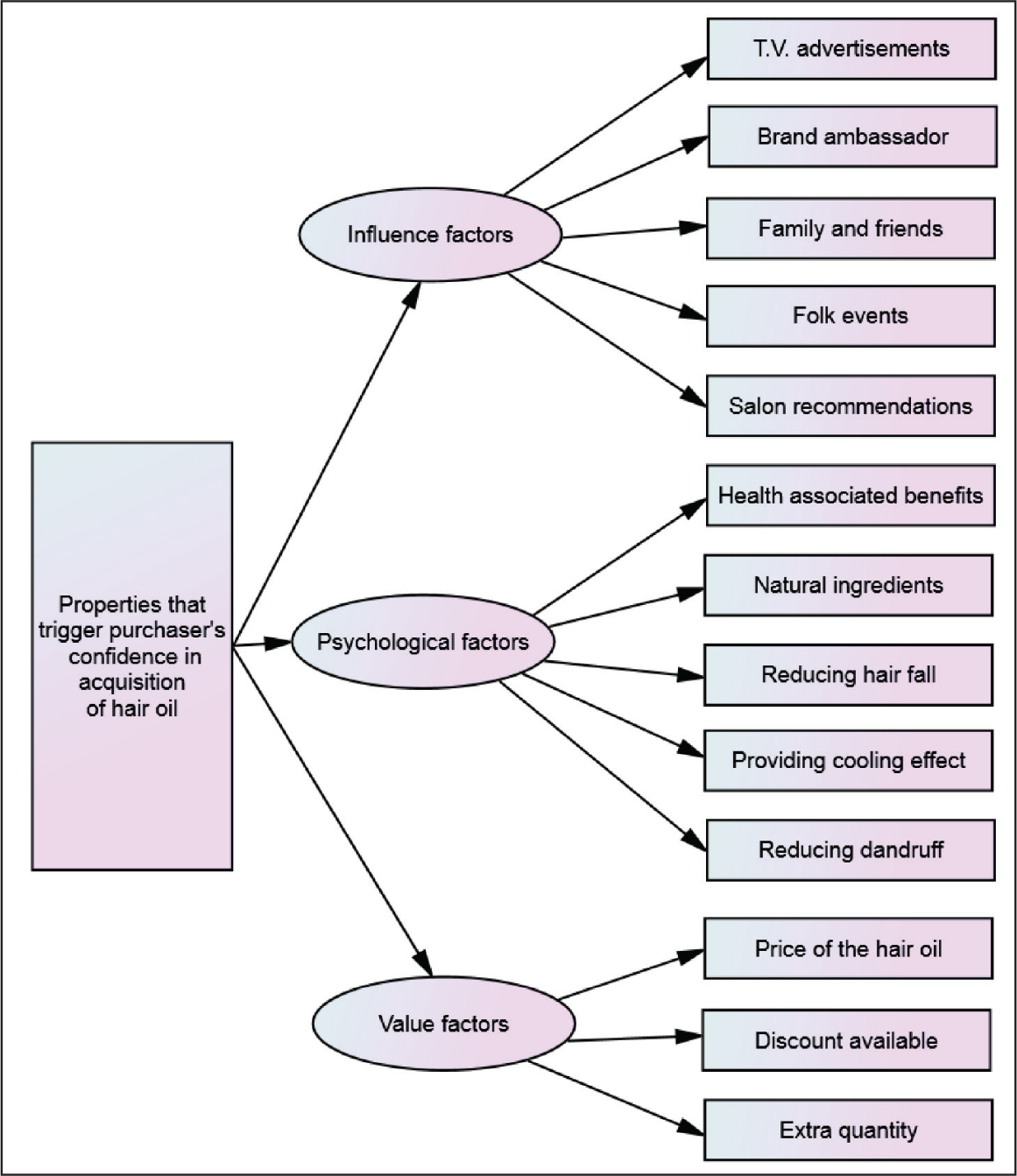
The theoretical framework of the factors stimulating consumer purchase intention is presented in Figure 1. The conceptual model of the study is presented in Figure 2. The model proposes that factors stimulating consumer purchase intention impacts the brand preference of consumers, the mediating variables being age, gender, education and family income.
Descriptive Statistics of Product Used

Purchaser Brand Choice for Hair Oil



Item Wordings Used in the Model

Confirmatory Factor Analysis for Model (for Hair Oil)
Confirmatory Factor Analysis: Hair Oil

As the χ2 statistic is sensitive to sample size, other goodness of fit indices (i.e., CMIN/DF, GFI, AGFI, PGFI, NFI, RFI, CFI and RMSEA) were also reported (see Table 7). The measurement model had an acceptable model fit (χ2 = 195.616, df = 62, p≤.05, CMIN/DF = 3.155, GFI = 0.961, AGFI = 0.942, PGFI = 0.654, NFI = 0.945, RFI = 0.930, CFI = 0.961, PCFI = 0.764 and RMSEA = 0.054) based on cut off values for good, acceptable and poor model fit indices. Next factor loadings were assessed. Each factor loading was statistically significant and positive, thus reporting convergent validity for each factor in the measurement model. Each of the latent variables satisfied the suggested criteria of composite reliability (≥ .70) and average variance extracted (≥ .50).
Hair Oil (CFA) Model Fit Indices Model Fit Indices AMOS® Goodness-of-Fit Statistics

Summary for Validity Concerns for Constructs in Model 3 (Hair Oil)

Testing the Hypothesised Relationships in Model Through Structural Equation Model
Hair Oil (SEM) Model Fit Indices Model Fit Indices AMOS ® Goodness-of-Fit Statistics

The hypothesised relationships were tested through structural equation modelling in SEM showing that age, gender, family income and education variables had a significant effect on properties that trigger purchaser acquisition confidence, that is, influence attributes, psychological attributes and monetary value attributes (see Tables 10). Also the influence attributes, psychological attributes and monetary attributes had a significant effect on brand choice for hair oil. Hence, hypothesis 1 is accepted.
Summary of Fully Recursive Model (Hair oil) Based on Results of SEM

Summary of Fully Recursive Model 3 Based on the Results of Path Model

Testing for Mediating Effects
Results for the Specific Indirect Effects in Model 3

Mediation effect of age between influence attributes and brand choice (β = 0.002, t = 1, p = .278), psychological attributes and brand choice (β = 0.003, t = 1, p = .298) and monetary value attributes and brand choice (β = 0.003, t = 0.67, p = .287) were found to be insignificant. However, mediation effect of gender between influence attributes and brand choice (β = 0.026, t = 4, p = .001), psychological attributes and brand choice (β = 0.028, t = 4.33, p = .001), and monetary value attributes and brand choice (β = 0.018, t = 4.25, p = .001) were found to be significant. Mediation effect of family income between influence attributes and brand choice (β = 0.065, t = 5.08, p = .001), psychological attributes and brand choice (β = 0.071, t = 5.15, p = .001), and monetary value attributes and brand choice (β = 0.056, t = 5.2, p = .001) were found to be significant. Mediation effect of education between influence attributes and brand choice (β = 0.123, t = 8.92, p = .001), psychological attributes and brand choice (β = 0.143, t = 9, p = .001), and monetary value attributes and brand choice (β = 0.123, t = 8.92, p = .001) were also found to be significant. Hence hypothesis 2 is not accepted whereas 3, 4 and 5 are accepted.
Testing the Non-response Bias
Results of the Chi-square Test of Independence for Testing Non-response Bias

Findings
It was found that the measurement system had an appropriate model fit in the confirmatory factor study of hair oil factors. Other goodness of fit indices (i.e., CMIN/DF, GFI, AGFI, PGFI, NFI, RFI, CFI and RMSEA) were also reported as being sensitive to the sample size (µ2 = 195.616, df = 62, p = .05, CMIN/DF = 3.155, GFI = 0.961, AGFI = 0.942, PGFI = 0.654, NFI = 0.945, RFI = 0.930, CFI = 0.961, PCFI = 0.961, PCFI = 0.942, PGFI = 0.654, NFI = 0.945, RFI = 0.930, CFI = 0.961, PCFI = 0.764 and RMSEA = 0.054) based on cut off values for good, acceptable and poor model fit indices. Next, factor loadings were assessed. Each loading factor was statistically significant and optimistic, indicating convergent validity in the measurement model for each variable. Each of the latent variables met the envisaged composite reliability criteria (almost 0.70) and the extracted average variance (almost 0.50).
It was found in the structural equation modelling of hair oil that the measurement model had an acceptable model fit. As χ2 is sensitive to sample size, other goodness of fit indices (i.e., CMIN/DF, GFI, AGFI, PGFI, NFI, RFI, CFI and RMSEA) were also reported. (χ2 = 340.709, df = 118, p ≤ .05, CMIN/DF = 2.887, GFI = 0.951, AGFI = 0.929, PGFI = 0.656, NFI = 0.954, RFI = 0.941, CFI = 0.970, PCFI = 0.748 and RMSEA = 0.051) based on cut off values for good, acceptable and poor model fit indices.
All the factor loadings were statistically significant and positive, thus reporting convergent validity for each factor in the measurement model. Each of the latent variables satisfied the suggested criteria of composite reliability (≥ 0.70) and average variance extracted (≥ 0.50).
A chi-square test of independence analysis did not reveal a statistically significant difference between the two classes of respondents and non-respondents used for representation testing. The respondents and non-respondents have the same proportion of categories of age, gender, education and family income. Therefore, the study respondents (N = 1,106) are representatives of the non-respondents in terms of age, gender, education and family income.
Generalisation of the Research
In five separate geographical areas of rural India, namely northern India, southern India, eastern India, western India and central India, descriptive analysis was carried out. These clusters reflect areas of distinctive underdevelopment, emerging and advanced economies. For the study, 203 respondents were selected from each geographic area, using stratified random sampling technique that ensured adequate representation of all respondents’ economic and social classes and other demographic features. Also, the sample population analysed (N = 1,016) is relatively broad to ensure the results are generalised. Hence, the study findings can be extended to underdeveloped, developing and the developed world economies.
Theoretical Implications
The present study contributes to the emerging body of research on the rural markets of India. The results provide critical insights into the properties that trigger purchaser confidence in acquisition of products and confirm its relationship with brand choice of the consumer. The study also supports the usefulness of demographic variables in stimulating those properties. The model of the study captures and reflects the information processing approach that leads to purchasing decisions of rural consumers in India. The hypothesised model results reveal that in the context of Indian consumers, gender, education and family income plays a strong mediating role between the properties that trigger purchaser confidence in acquisition of products (influence factors, psychological factors and value factors) and brand choice, while age does not play a significant mediating role. Thus, the applicability of the model is useful in understanding the psyche of rural consumers in India.
Managerial Implications
The research can be applied to almost all the categories of FMCG products being sold in rural areas. It provides realistic insights for current application of the results. The present study measured the actual purchase behaviour, which could enlighten retailers and other rural operatives, leading to their financial success. It also focussed on personal traits, such as decision making styles or consumer orientation based on psychographic and lifestyle characteristics that differentiate rural consumers. The applicability of the model is quite useful in designing and marketing a product. Strategy executives may use it in order to design advertisement content of their product targeting a desired population segment. It offers guidelines for policy and decision making authorities like rural marketing stakeholders, rural policy managers and rural retailers, to provide best shopping experience to rural consumers.
Limitations of the Research
The sample may not have fully reflected the population characteristics. This is due to vastness of the country and its diversity in terms of culture. Hence, validation is required in cross cultural analysis of scales and its further use in studies on Indian consumers. Further, people in the villages identify an urban researcher with suspicion. Also, education level is low among people especially among rural women, so they cannot fully understand the scaling methods. Problem of communicating with them worsens when they use regional vocabulary.
Scope for Future Research
The present study should be conducted more minutely in different regions of India, as there is vast regional diversity in India, stemming from cultural, social and economic factors. This could affect the consumption patterns. A cross-cultural study involving other Asian countries should also be undertaken. Analysts should focus on urban and rural clusters separately instead of treating the entire country as one market. Future studies may also compare the perceived value of different brands by rural retailers. They should tap the opinions of rural retailers like kirana (retail) stores, mobile vendors and vans who sell commodities in rural areas. A longitudinal study, where data are collected at different times of the year and over the lifespan of a brand could reveal significant evolutions in perceived value and patronage intensions of consumers. These suggestions would help create a more holistic construct for measuring actual purchase behaviour in Indian markets.
Conclusion
The hypothesised model thus demonstrated that the mediating influence of gender, education, and household income on properties that trigger a purchaser’s acquisition confidence and brand choice of purchasers was found to be significant. It was also found that the age’s mediating impact on properties that trigger a purchaser’s acquisition confidence and brand choice was not significant. The results showed that the brand choice of rural consumers is correlated with the properties that trigger a purchaser’s confidence in acquiring products, that is, product attributes, psychological positioning or emotional advertising called psychological factors and monetary value of the product.
The majority of rural Indian folks were young, informed, affluent, and the females, analogous to previous research regarding the character traits of rural Indian purchasers. Most of these purchasers purchased branded hair care products on a routine basis. Women were more likely than men to patronise branded hair care products, and purchasers with higher monthly household income tended to generate higher patronage for branded hair care products than those with lower income levels. This results supported existing research which showed that disparities in gender play a great role in choice-making over branded hair care products. This indicated a woman’s attitude regarding branded hair products was more optimistic. It was also found out that educated purchasers have a more positive attitude towards marketed hair care products than the illiterate purchasers.
