




Abstract
In Spain, in the last 25 years (1996–2020), more than a million and a half hectares of irrigated land have been modernised with irrigation systems. Almost half of this irrigated surface is immersed in a second generation of modernisation in order to be more efficient and save water and energy. This represents a strategic issue in a climate crisis scenario, to assure the quantity and quality of the productions of these irrigable areas, bases of market supply, agro-industries and sources of employment. Throughout this process, innovation was experienced (pressure irrigation, deficit irrigation, accurate irrigation, fertigation and nutrient solution, energy self-consumption, new crop varieties, hydroponic cultivation with or without substratum, etc.). The drivers of these innovations are the harvesting-exporting companies and the irrigation communities. This research is a diachronic study of regional geography; data are provided by official statistics and through extensive fieldwork and interviews with managers. The objective is to explain the irrigation innovation techniques undertaken in the semi-arid environment of Southeastern Spain, one of the driest regions in Europe.
Introduction
Water for irrigation is the most spread use of water worldwide, accounting 70% of total use (Qin et al. 2018). Sustainable, affordable and safe water supply for irrigation remains one of the challenges of rural development at a global level, especially in dry regions where water is scarce: in Africa like Morocco (Mrabet et al. 2012) or Botswana (Gondo and Kolawole 2019), India (Chaudhuri et al. 2020), Chile (Fernández et al. 2019), and the Mediterranean area, where irrigation is the most effective way to take advantage of sunshine and light for the development of agriculture (Drain 1998, p. 25). When dependent on climate, farmers may turn to crop diversification in order to reduce risks derived from climatic events, although it can reduce the efficiency (Mandal and Maity 2021). In these dry spaces, water is an element of landscape differentiation, which generates a dichotomy between rainfed and irrigated landscapes. Water originates the great differences implied by having sufficient water for cultivation or only the insufficient and irregular rainfall (Gil-Meseguer 2006, p. 19). Reducing water consumption in dry regions through new technologies is a smart strategy to achieve a comprehensive management of water resources.
Innovation is a key issue addressing competitiveness and is strongly related to a high market-entrepreneurial orientation (Yagüe-Perales, Pérez-Ledo and March-Chorda 2020). This is especially of concern within a semi-arid region, where struggle for availability of water has been a constant (Jeder, Dbouba and Fouzai 2020; Mahdhi et al. 2021). In Spain, in the last 25 years, more than one and a half million hectares of irrigated land have been modernised by changing the irrigation system and introducing innovative measures in both irrigation and cultivation, with the aim of achieving water savings and efficiency, as well as the improvement of the irrigator’s quality of life.
The European Union, within the framework of its climate change mitigation objectives, has made a firm commitment to the principles and actions of the circular economy (EEA 2016), in which water is a fundamental element for obtaining the European Green Deal, 2019–24 (European Commission 2019). In this sense, turning wastewater into a resource is imperative, as it represents a continuous flow during the whole year, sustainable and suitable for irrigation, even complying with a water quality rendering a potential potable reuse (Bernabé-Crespo, Olcina and Lahora 2022). The relevance of irrigation in agriculture varies depending on the climatic and agronomic characteristics of each country. In the EU, most of the irrigated areas are located in the Mediterranean regions of France, Italy, Greece and Spain, which, with 12 million hectares, accounting for 75% of the total area equipped for irrigation in the community as a whole (Expósito 2020, p. 38). In semi-arid regions such as the Iberian Southeast, territorial planning plays a vital role in relation to the control of water availability. Irrigation attracts noticeable attention among the uses for its contribution to agricultural production, associated agribusiness, employment and, ultimately, regional income. In addition, it has a cultural significance as it is the generator of agricultural and cultural landscapes (Sylla and Solecka 2020), understood as ‘the result of the interaction in time of people and the natural environment, expressed in a territory perceived and valued for its cultural qualities, and that is support of the identity of a community’ (Cruz 2017, p. 18).
Among the water demand management policies, modernisation of irrigation stands out: This is defined by the set of actions (works and services) organised in a plan to be carried out in phases and whose objective is a significant change (modification or substantial innovation) in the system of irrigation and in the mentality of the irrigator. This process has among its objectives to act on the main water consumer in Spain: irrigation, which accounts for more than 68% of total water consumption (Gómez 2019a, p. 13). Considering the concept of circular economy, the modernisation of irrigation systems tries to meet the objectives of saving water, making the agricultural sector more competitive and profitable, creating employment in rural areas and, above all, improving the quality of life of the farmer-irrigator. However, it entails other negative effects, among which the higher energy costs and the economic amortization of works and infrastructures are highlighted, although these investments present high social profitability. Modernisation of irrigation includes public policies to help improve the efficiency of transportation and use of irrigation water (Berbel and Montilla 2019, p. 191), including new infrastructures such as solar floating panels in reservoirs (Sampaio, Bezerra, and Augusto 2020). In the Southeast of Spain, these aids were intensified after the droughts of 1990–95 and 2005–08, with the royal decrees 678/1993, of May 7, on ‘works for the improvement and modernisation of traditional irrigation’, and 287/2006, of March 20, which regulates urgent works for the improvement and consolidation of irrigation. Attention paid by official bodies regarding irrigation is found in the Advance of the National Irrigation Plan (1996), approved as the National Irrigation Plan—2005 Horizon. Numerous authors have studied irrigation and its improvements in Spain, in different areas such as the Southeast (Gómez 1997), the Duero Basin (Baraja 2006), or globally for the whole nation (Berbel and Gutiérrez-Martín 2017; Gómez 2009; Gómez 2019b). Other authors have reflected on sustainability or positive externalities (Berbel 2020; Melgarejo 2019; Skevas 2020); or the innovations carried out (Boazar, Abdeshahi, and Yazdanpanah 2020; Camacho 2002; Gómez 2007; Gómez and Gil 2014; Maroto and Baixauli 2016). Even more, the COVID-19 pandemic has triggered to pursue a more sustainable approach concerning healthy and sustainable food consumption (Ridolfi et al., 2020), but that also entails a wiser consumption of water and strategies in order to reduce it.
Due to this, the study on the modernisation of irrigation and its innovation has been revealed as a matter of priority interest, especially in a context of global climate crisis and of special regional vulnerability, since agricultural production represents a fundamental pillar of the economy of the analyzed space. This article aims to explain the agrarian model of the Southeast of Spain, including the adaptation to an intensive, dynamic agriculture, with a strong component of R+D+i. It also contributes to transnational experiences, serving as a model for other dry regions with water scarcity and a modernising agriculture. The hypothesis is that these innovations have made possible a growing agriculture in a water-scarce region, directed by exporting harvest companies, where technological changes applied to irrigation and new outdoor and under-roof cultivation systems stand out. After geographically framing the study area, an analysis of the irrigation modernisation process in Spain and the Iberian Southeast is carried out, taking into account the irrigation modality. Next, the innovation measures by harvesting-exporting companies and irrigation communities are examined, allowing a discussion on their effectiveness with respect to agricultural production and water consumption.
Area of Study
Southeast of the Iberian Peninsula has become a laboratory for testing innovative measures applied to irrigation and cultivation in arid and semi-arid regions. The interest of modernisation lies in the affected area, in the number of irrigators involved, in the investment made, in the income it generates and in the dynamics of the irrigated landscapes (Gómez 2009, p. 60). This space has been selected as the area of study due to its experiences of innovation in irrigation and cultivation practices; and the resilience of its farmers-irrigators facing climate change.
The ‘Southeast region’ (Figure 1) corresponds to the southeastern quadrant of the Iberian Peninsula or, in a stricter sense, to the space (within this quadrant) between the Mediterranean coastline that extends south of Cape La Nao (Alicante) to the north of Cape Gata (Almería), and the interior limit marked by the isohyet of 400 mm of rainfall and the isotherm of 16 ºC of average annual temperature. It is a dry Mediterranean region that extends over a large part of the territory of the provinces of Alicante, Murcia and Almería. It presents scarce and irregular rainfall as a consequence of its situation to leeward of the general circulation of the west due to the disposition of the Betic reliefs, which generate orographic shelter and a foehn effect. Due to its latitude, high temperatures and insolation are reached (averages above 16 ºC and more than 3,000 hours of sunshine in some places), which causes a potential evapotranspiration of more than 900 mm per year. This situation of climatic drought occurs in all the observatories in summer, due to the presence of subtropical subsidence. Dry months increase from NE to SW, from five to nine months, typical of semi-arid regions around the globe. It is a region of certain climatic homogeneity in which the littoral steppe would be the response of the vegetation and, the non-permanent flow courses, known as ramblas and rivers-ramblas, the hydrography response to these climatic characteristics. Due to the aforementioned, the area of the Iberian Southeast presents a low productive dry land and, most of the irrigation is specialised in products with high added value and with high productivity of water and land resources.

Methodology
It is a study of Regional Geographical Analysis, considered the most elaborate working method to study the relationships between the environment and humankind, and which combines different scales of work and integration of geographical aspects, keys to spatial planning (Olcina 2009, p. 9). It is a regional study, dynamic and applied to a subject of vital importance in the regional development of spaces like the Iberian Southeast, such as innovation in irrigation and cultivation of semi-arid environments. In order to study the competition with other uses of resources such as soil and water, a quantitative and qualitative analysis has been carried out, along with the subsequent diagnosis and prognosis of irrigated farming systems, especially those undergoing modernisation.
The study of cases is also incorporated (the Communities of Irrigators of Pulpí; Campo de Cartagena; El Saltador; La Purísima in Yéchar-Mula, Huércal-Overa Norte and Arco Sur-Mar Menor) in order to find out if the irrigation communities that have been modernised have greater resources to deal with situations of climatic and hydrological droughts (since, predictably, these will be more extensive and frequent in arid and semi-arid areas according to the global warming and climate crisis scenarios). The hypothesis is that most of these communities are committed to a water mix that includes the water produced by desalination and the regeneration of treated wastewater. Also, with the application of technologies (ICTs and IoTs) that provide advantages such as a reduction in water consumption, an improvement in efficiency, equity and traceability in water distribution, transparent management, a reduction in energy consumption and costs, and an improvement in the services offered to community members and irrigators that provide them with a better quality of life. The adoption of technological changes must be compatible with the practices maintaining cohesion and identity of socio-hydric systems, as is the case in the Ricote valley (Region of Murcia) and in Senyera (Region of Valencia), with the application of flooding in combination with localized pressurized (drip irrigation) (Sanchis et al. 2018, p. 103).
Results
In Spain, from 1996 to 2020, more than a million and a half hectares have modernised their irrigation, that is, the three phases of the modernisation process have been completed. Phase I acts on the upstream distribution network, to collect the different water supplies and ensure the availability of the resource. Phase II deals with the distribution network in lowering the supply to the irrigator’s plot, and the consumption in irrigation. And Phase III involves the integral management of the system, with automation and computerization of the irrigation processes, remote control at the headquarters of the irrigation community, and adoption and dissemination of innovation (Gómez 2019b, p. 72).
Tables 1 and 2 show that the irrigable area in Spain amounts to 3,828,747 ha, of which almost 45% have been modernised. The Iberian Southeast has 6.16% of this irrigable surface, and an intense process of modernisation of irrigation has been carried out in it, reaching almost 70% of its surface. In extension, localized pressure irrigation stands out in its ‘drip mode’.
Modernisation of Irrigation Systems in Spain and Participation of the Iberian Southeast.

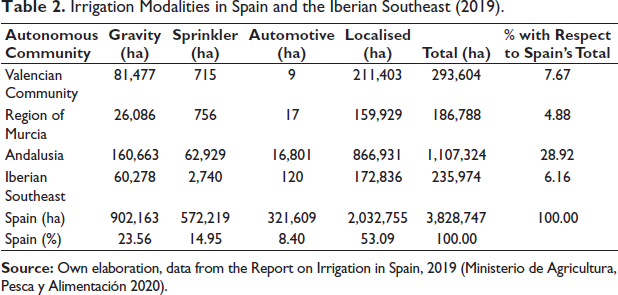
Irrigation Modalities in Spain and the Iberian Southeast (2019).
In the Southeastern area, some 165,000 hectares have completed the three phases of the first generation of modernisation (Table 1) and out of these, 57.58% are immersed in the second generation of modernisation with actions on the use of runoff, reduction of non-beneficial evaporation, reduction of non-recoverable percolation, and lowering-efficiency-self-consumption of energy. At the level of Autonomous Communities, Andalusia is the one that superficially has more hectares immersed in the second generation of irrigation modernisation, but in percentage terms, it is surpassed by the Valencian Community (47.83%) and the Region of Murcia (52.94%). The maximum value is registered by the geographical area of the Iberian Southeast (57.58%).
After the first generation of modernisation of Spanish irrigation, there has been a decrease in the modality of irrigation by gravity (either by flooding, in furrows, etc.) and an increase in pressure and automated irrigation, especially localised irrigation, which was applied in 2019 to more than half of the irrigable area (53.09%). These values rise in the study area of the Iberian Southeast to 73.24%, that is, almost three-quarters of the irrigable surface used the localised irrigation modality, especially the so-called ‘dripping’ (Table 2). Something similar happens in the Valencian Community and the Region of Murcia, where the participation of localised irrigation is 72.00% and 85.62% respectively, with a high incidence in tree plantations.
In the area of study, most of the Communities of Irrigators have completed phases I, II and III, and are immersed in the second generation of modernisation (Table 3). Among them, the C. I. Campo de Cartagena and C. I. Lorca stand out, with more than 40,000 ha and 20,000 ha of irrigable surface, respectively.
Selected Communities of Irrigators in the Iberian Southeast (2020).

Discussion
The modernised hectares in the Iberian Southeast (more than 165,000) contain technological developments applied to water distribution and cultivation cycles (Figure 2). Dynamism of agrarian landscapes is observed in which technification predominates, as reported by Gil-Meseguer et al. (2014, p. 147).

Innovative Measures Carried Out by Harvesting-exporting Companies
In order to analyze the innovation measures applied by harvesting-exporting companies, the company PRIMAFLOR SL has been taken as an example, which was created in Pulpí in the 1970s, and has more than 6,000 ha under cultivation, employing more than 2,000 workers. It has a horticultural plant for fresh handling in Pulpí and a IV Range warehouse in Huércal-Overa. The company has evolved since its inception with the cultivation and distribution of flowers, tomatoes, melons and watermelons to specialise in ranges of horticultural cultivation of green leaf (lettuce, chard, broccoli, cabbage, cauliflower, etc.), also in the so-called ‘Chinese products’ such as Pak-choi type chard (Brassica chinais L.) and Choy-sum (Brassica campestris L.), or Chinese broccoli (Brassica olearacea L.) and in those of the ‘Baby’ type such as ‘Baby Leaf red chard’, to supply the fresh demand and of the IV Range (Gil-Meseguer 2018, p. 470).
In the last 50 years, the areas under cultivation have increased, whether with owned or rented land. This increase regarding the area was done to allow staggering production, with farms from the Mediterranean coast to the highlands of Granada and Albacete. For this, it has also introduced new varieties of crops in order to meet the demands of its national and foreign clients and to occupy staff and productive infrastructure throughout the year. Agriculture is an activity with seasonal characteristics that requires punctual labour as well as the use of the machinery used in the different tasks. One way to make profitable investment in productive infrastructure, as well as to ensure a specialised workforce in the tasks that are carried out, is to occupy it continuously. This staggering of crops serves this purpose as well as retaining markets. Among the new growing systems that it uses, are the use of buried irrigation tape to reduce evaporation (Figure 3) and recirculating hydroponic cultivation (New Growing Systems) to make better use of water with nutrients and avoid contamination.
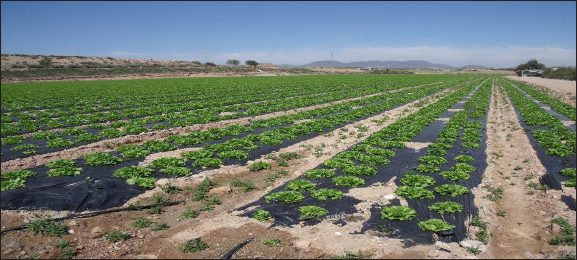
The use of recycling technologies is very useful to reduce diffuse contamination and soil salinization, an example of this is hydroponic cultivation—and especially, if solutions are collected to be reused in the development of the crop. This is the case both outdoors and under the greenhouse of localised irrigation with recycled solution. It is practiced by PRIMAFLOR S, L., on its farms in Las Pilas (in Águilas, Murcia) and in Fátima (in Cuevas del Almanzora, Almería). The same happens when applying this irrigation technology to crops that ‘move’ in the facilities of PRIMAFLOR SL in Las Canalejas and also the SAT Los Guiraos (in Cuevas del Almanzora). This type of technology is inserted within the circular economy, since it is based on reusing water over and over again as it happens in the natural cycle (Melgarejo 2019, p. 38). These harvesting-exporting companies have developed crops in greenhouses under a controlled environment, in which in addition to using hydroponic cultivation with recycling of water and nutrients, which reduces the time of cultivation and generates more productivity, they place the crops on platforms for their rotation and it is cultivated and harvested without interruption, 365 days a year. In this type of ‘smart’ greenhouse of one hectare, more products are developed than in 10 hectares in the open air (Gil-Meseguer and Gómez 2013, p. 134).
Innovative Measures of Communities of Irrigators in the Second Generation of Irrigation Modernisation
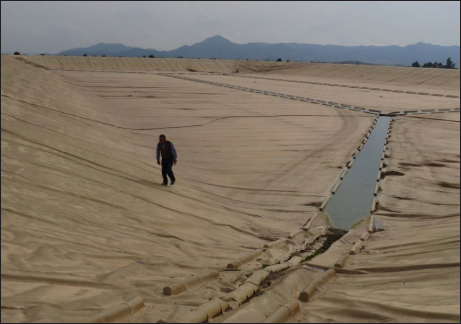
Among the innovative measures of the second generation of irrigation modernisation, it is important to mention the different covers of the reservoirs for accumulation and regulation of water for irrigation. Floating covers, reservoirs covered with plastic balls and shadow spheres are used in order to reduce the evaporation of the water sheet in spaces subjected to high evaporation due to temperatures and the wind that blows on these surfaces in favour of changes of pressure due to the variation of temperature during the day, as it happens in the Southeast of the Iberian Peninsula. An example of this is the C. I. Huércal-Overa Norte, which out of its five reservoirs, four of them are covered (Figure 4). In this case, it is a technology commonly used in tanks for human supply, but here it can even introduce water from possible rainfall into the reservoir.
Reclaimed water is a resource conditioned by the supply and consumption of population centres and the implementation of Wastewater Treatment Plants (WWTP) with the appropriate technology. In regions such as Murcia they represent a volume greater than 100 hm3/year, a volume that is part of the supply of water resources in an integrated planning (Gil-Meseguer, Bernabé-Crespo and Gómez 2019b, p. 33). In the C. I. Miraflores, which uses reclaimed water from Jumilla WWTP, it represents more than a quarter of the annual volume consumed in its irrigations (27%). In the C. I. Arco Sur-Mar Menor, in a year like 2019 (without the tourism crisis in La Manga del Mar Menor caused by COVID-19), reclaimed water accounted for almost two-thirds of the volume used in irrigation (62%). These flows are so important for the communities of irrigators that they carry out an important infrastructure for their use, in addition to assuming the energy expenditure that drives it to the reservoirs that structure localised irrigation.
Considering the water-energy-food nexus, it is necessary to underline the increase in the cost of the food production process, as there is an increase in pumping, impulses to reservoirs (located in the upper parts of the irrigable perimeters to achieve the pressure of systems such as localised irrigation and fertigation). In this sense, Sánchez (2020, p. 99) argues that, in July 2008, the energy costs of irrigation systems suffered disproportionate increases: The disappearance of special irrigation tariffs meant increases of up to 1200% in the amount of the power term, and significant price increases in the energy term with the consequent increase in the final price of energy for the irrigator.
The implementation of information and communication technologies (ICT) takes on special relevance in terms of increasing the efficiency of production. These are based on the use of sensors to monitor the continuous soil-plant-atmosphere system and include geographic information systems (GIS), supervisory control and data acquisition systems, decision support systems, and web applications and Apps for mobile telephony (Maestre and Soto 2020, p. 113).
Based on the above-mentioned, modernised Communities that have accumulation and regulation reservoirs, and with good ICT management, can establish the elevation of water to the reservoirs and the distribution of irrigation in the cheapest energy hours. Some of them even back on self-consumption, with photovoltaic and wind farms associated with their irrigable perimeters. For example, the C. I. Miraflores has a mini solar park next to the Jumilla WWTP; C. I. El Saltador, in addition to the production of energy with wind turbines, has a mini solar park near the headquarters of the irrigation community; C. I. Puerto Lumbreras has placed solar panels floating in the Puerto Adentro I reservoir, which prevent or minimize evaporation and generate photovoltaic energy for self-consumption; C. I. Lorca has also followed the pattern of placing photovoltaic panels on the sheets of water in some of its reservoirs.
Another resource of great interest to increase the supply is the collection of rainwater. In the space of study, farms are being organised to be able to use rainwater, by means of the construction of drains between the greenhouses, or simply waterproofing those corridors and providing them with a slope towards a reservoir—they even receive the turbid waters from street and road runoff, as in C. I. Puerto Lumbreras. The infiltrated waters in the upper levels have also been revalued, through the enhancement of gallery systems for the capture and distribution of phreatic waters such as qanats in the foothills, and a typology of underground channels and reservoirs in the riverbeds of the ramblas (Martínez et al. 2018).
In order to improve the sustainability of irrigation, it is necessary to reduce the load of pollutants in irrigation water. One of the most serious problems is the excesses of certain substances that are applied in fertigation, such as nitrates. In the Region of Murcia, in recent years, tests of denitrification technologies 1 have been carried out with various microorganisms, substrates and supports, within the framework of R+D+i projects between irrigation communities and universities, to avoid contamination in environments like the Mar Menor lagoon.
Automation has allowed irrigators in the Iberian Southeast to apply deficit and precision irrigation on their farms, in order to be more effective in the application of irrigation. This CDI (controlled deficit irrigation) is a technique or strategy, based on the idea of reducing the water inputs to the plant in those phenological periods in which a controlled water deficit does not affect production or the quality of the harvest, and to fully cover the plant’s demand during the rest of its growing cycle. The aim is to reduce to the maximum the loss of water by percolation and by evapotranspiration in the periods of the crop cycle that do not have a negative impact, or this is minimal, on the harvest and the quality obtained (Melgarejo et al. 2019, p. 77).
In irrigation communities such as Campo de Cartagena, the water status of the soil-plant-atmosphere system is monitored in order to control the water stress that the crop reaches at times of water deficit, adjusting the doses of water so that it does not negatively affect the crop and its future harvests in terms of quantity and quality of the product. The idea is to develop an irrigation programme based on precise information through the motorization of water in the soil-plant-atmosphere system (Soto et al. 2014, p. 144).
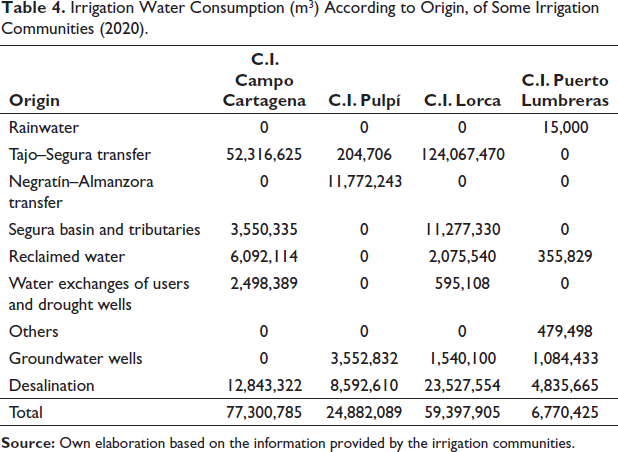
Finally, it should be mentioned that, in recent years, especially in periods of climatic and hydrological droughts, desalination has been used (either brackish groundwater or seawater desalination) has become a strategic resource for human supplies and irrigation (Bernabé-Crespo, Gil and Gómez 2019b). Several irrigation communities have plants to remove brines and obtain water product of desalination, as it happens in the C. I. Sindicato de Regantes de Cuevas del Almanzora, and those of Águilas, Arco Sur-Mar Menor and others. Table 4 indicates the water consumption for irrigation, in 2020, of some of these irrigation communities.
Irrigation Water Consumption (m3) According to Origin, of Some Irrigation Communities (2020).
Conclusions
Irrigation is a pillar for structuring the territory and offers great potential to help in the reconstruction of Spain after the social and economic crisis that arises due to the effects of the COVID-19 pandemic. Irrigation is considered the greatest strength of the Spanish agri-food system, as it leads the fruit and vegetable export in the European Union, with sales of more than 50,000 million euros. With less than a quarter of the cultivated area (22%), it generates more than two-thirds of the final agricultural production (67%). In Spain, of the 3.8 million hectares under irrigation, more than two million of them have undergone some phase of modernisation, with an investment effort in R+D+i activities to increase productivity and improve the efficiency of processes. It seeks to reduce the negative impacts, saving water and energy, reducing the load of fertilizers and environmental pollution, in order to make irrigation sustainable.
The modernisation of irrigation systems has generated savings in gross water withdrawals, due to the reduction of losses with the improvements in the water distribution networks and with the technological change in irrigation systems (such as the localised pressurized). It is noteworthy that the ‘rebound effect’ of expanding irrigated areas with water savings has not occurred, due to the surveillance carried out and the precarious supply balance of the existing area (in recent years growth has been maintained 1% per year). The average saving of up to 25%, due to greater efficiency in the use of water, has been used, in part, to intensify irrigated crops. The increase in energy consumption, which has doubled in the 2000–20 period, has led irrigators to install capacitors or frequency inverters in their water drive centres. The repeal of the solar tax and the cheaper photovoltaic panels has led the irrigation associations to lead a sustainable energy model in which they are committed to self-consumption. The irrigated areas are cultural landscapes that contain a high level of technology, to face the process of land-water-energy interaction and achieve food security.
In the Iberian Southeast, irrigation is becoming a world benchmark in controlled deficit irrigation, in covering ponds with different means that reduce evaporation and even at the same time generate energy, in the use of reclaimed water for reuse, and desalination, and in the application of ICT. Irrigation users try to make their activity compatible with the safeguarding of environmental quality, for this, the management of the modernisation of irrigation is based on the promotion of R+D+i with the incorporation of ICT, the analysis of Big Data and the Internet of Things (IoT). This requires a significant investment that has made this type of agriculture doomed to a forward race that is not at all like the idea of immobility and conservatism that characterised this activity. This irrigation proactively and innovatively faces challenges in the economic, social and environmental environments, characterised by the speed of change. Thus, competition in international agri-food markets and the difficulty of obtaining competitive prices for agricultural products are constant challenges for the sector, which solves them by investing in technological modernisation. The organization of work must be socially responsible, considering the important component of the foreign immigrant workforce, understanding that it is as indispensable as land or water. Managing environmental impacts is a challenge that involves implementing a new production culture that is more respectful of the limits of nature.
Footnotes
Declaration of Conflicting Interests
The authors declared no potential conflicts of interest with respect to the research, authorship and/or publication of this article.
Funding
The authors received no financial support for the research, authorship and/or publication of this article.
