



Abstract
Improving technical efficiency is one of the most effective ways to boost output in any manufacturing process. The efficiency level of enterprises can be improved by identifying their sources of inefficiency. The present article examines the technical efficiency and tries to identify the factors causing technical inefficiency in handloom-based micro-enterprises in Assam. The article used primary data and collected from 312 micro-level handloom enterprises spread across four districts of Assam. The stochastic frontier production with an inefficiency effects model is used for the purpose of analysis. Labour, capital and material inputs are found to be significant and labour is the most effective factor for increasing of output level. The mean technical efficiency of overall enterprises is 0.67 and a wide variation in the level of technical efficiency among the sample handloom enterprises is observed. Inefficiency model shows that a high yarn capital ratio, lower product diversity, entrepreneurs with training, a higher number of employees and adoption of promotional practices tend to reduce the technical inefficiency of the handloom enterprise significantly.
Introduction
‘Rural non-farm micro-entrepreneurial activities’ in the unorganised sector are important for local economic development (Hazarika and Goswami 2014). To achieve many development goals, such as creating employment opportunities, eradicating poverty, reducing income disparity and decreasing rural-urban migration, the policy makers often place emphasis on encouraging more people to engage in entrepreneurial activities. The handloom sector in India is based on a large number of artisanal skill-based enterprises that contributed 11.79% of total textiles production in 2019–20. The sector employed 35.22 lakh handloom workers in the same year (Ministry of Textiles, Government of India 2019). It is also known as the second highest employment-generating sector next to the agriculture sector (Ministry of Textiles, Government of India 2021). Indian textile and handloom products are exported to more than 100 countries around the world, and in 2019–20, the export earnings of the handloom sector amounted to Rs. 2,248.33 crores (Ministry of Textiles, Government of India 2021). In India, the handloom activities are mainly concentrated in the 13 states, namely Assam, West Bengal, Tamil Nadu, Manipur, Uttar Pradesh, Odisha, Andhra Pradesh, Tripura, Arunachal Pradesh, Karnataka, Telangana, Nagaland and Meghalaya as per Handloom Census Report, 2019–20 and 93% of the handloom workforce belonged to these states (Baruah and Saha 2022).
Although the contribution of the handloom sector to the Indian economy has been significant with respect to employment generation, textile production and export earning, the sector faces several challenges in the form of competition from the power loom, low productivity, poor technology, informal production system, weak marketing link, shortage of working capital, stagnant production and sales, conventional products (Dev et al. 2008; Goswami and Jain 2014; Nadh et al. 2013; Ramswamy and Kumar 2013; Sudalaimuthu and Devi 2006). Thus, in order to be competitive, the handloom sector needs to utilise resources efficiently and increase the level of efficiency. Increasing technical efficiency may be the best strategy for the upliftment of the handloom industry in the present competitive economy. Technical efficiency analysis estimates the maximum possible output for a given combination of factor inputs and reveals how far an enterprise or firm can enhance output without using more inputs (Admassie and Matambalya 2002). If the handloom entrepreneurs are able to use efficient input combinations, they can be more profitable and can generate more income and employment. Estimation of technical efficiency is suitable for policy formation in the service of better resource allocation (Chowdhury and Latif 1989). Identification of the causes of technical inefficiency is significant for policy formation and implication to enrich the performance of a firm (Ajibefun and Daramola 2003).
Although technical efficiency has been widely studied in economic literature, but firm-level studies on the efficiency of the handloom sector at the national and international levels are few. A study in Bangladesh uses Stochastic Frontier Analysis (SFA) techniques for analysing the technical efficiency of handloom enterprises and finds that the technical efficiency level is low and it can be improved by raising ‘yarn-capital ratio’, ‘female-male labour ratio’, and reducing ‘hired-family labour ratio’ and ‘labour-capital ratio’ (Jaforullah 1999). A similar study in Bangladesh finds that the ‘capital-labour ratio’, education, experience, number of looms, master weavers and access to loans are significant determinants of the technical efficiency of weaving enterprises (Islam and Hossain 2015). A study in Indonesia finds that the technical efficient level of the weaving industry is high and is significantly influenced by firm age, firm size and ownership (Pitt and Lee 1981). A similar study observed that small-scale textile enterprises are more efficient than medium-scale enterprises (Abdulla and Kumar 2021). A study using Data Envelopment Analysis (DEA) technique to calculate relative efficiency of loom sheds in the handloom industry of India, observed that the scale efficiency of small loom sheds is lower than that of large scale loom sheds (Kumar et al. 2012). A similar study observed that the mean efficiency of the handloom clusters in India is higher while most of the clusters exhibit increasing returns to scale (Bhaskaran 2018).
More than half (52.62%) of handloom workers in India belong to the North East Region (NER). Assam accounted for the highest number of handloom workers (12.84 lakhs) in the country of which 98.64% belongs to rural areas (Ministry of Textiles, Government of India 2019). Assam is the world’s top producer of Muga silk, accounting for 85% of the world’s Muga silk production. Regarding eri silk production, Assam ranks highest in the nation and produces 62% of eri silk in India (Central Silk Board 2019). The weavers in Assam produce diversified handloom products using different types of yarn like cotton, mulberry silk, Muga silk, eri spun silk, etc. According to Assam Government Marketing Cooperation Ltd., 1 a total of 72 varieties of products are supplied by the handloom sector of Assam. Mekhela-Chadar, Gamosa, Saree, Kurta, Shawl and Riha are the major handloom products of Assam made by using different types of silk and cotton yarn. It is also important to note that Assamese Gamosa and Muga silk have already obtained a Geographical Indication registration certificate under the Geographical Indication Act of 1999. Weaving occupies an important space in Assamese culture. The weaving culture is mostly based on skills inherited from previous generations (Hazarika and Goswami 2018). The weavers preserve their traditional arts and skills and represent their community and cultural identity through weaving patterns, fashion and design. It also offers a reliable means of income generation and livelihood security to the weavers and allied workers (Devi 2013).
In this background, the article intends to analyse the technical efficiency level and tries to identify the factors causing technical inefficiency in handloom-based micro-enterprises in Assam with a view to suggest appropriate policies.
The remaining sections of the article are organised as follows. Methodological issues such as data source, sampling design and analytical framework are discussed next, followed by a discussion on the empirical findings. The article concludes with a few policy suggestions in light of the findings.
Methodology
Sources of Data and Sampling Technique
The article used primary data, collected from four districts of Assam, namely Kamrup (R), Barpeta, Sivasagar and Nalbari on the basis of the highest number of weavers. In the first step all districts are ranked according to the number of weavers based on data obtained from the Handloom Weaver Information System, GoI, 2 The four highest-ranked districts are selected for the study purpose. The same principle is followed while selecting the development blocks within each district. The study uses a multi-stage sampling technique at the district, block, village and enterprise levels. Two development blocks from each selected district are selected. Eight villages are selected from the eight selected blocks on the basis of commercial concentration of handloom activities as per information collected from the District Handloom and Textile Department. At the village level, a list of handloom micro-entrepreneurs is prepared after consultations with the master weavers, village head and ward members. From the prepared list of each chosen sample village, 50% of handloom micro-entrepreneurs were selected randomly. A handloom entrepreneur is a person who owns an enterprise with a minimum of one operating loom and produces cloth using family labour or hired labour. The primary data of 312 handloom entrepreneurs are collected from the sample districts of Assam using a semi-structural interview schedule from October 2021 to February 2022.
Analytical Framework
DEA and SFA are the two most established methods for the estimation of technical efficiency. DEA is a non-parametric technique while SFA is a parametric and econometric technique, but both methods have their own merits and demerits. The key shortcoming of DEA is that it does not consider for the impact of random error, and it attributes all deviances from the frontier to inefficiency (Coelli 1995). Another shortcoming of DEA is that it does not support standard hypothesis tests, which are common in the econometric method. The DEA’s constraints are better handled by SFA. So SFA is the chosen method of analysis for the present study.
The earliest of SFA were individually suggested by Aigner et al. (1977) and Meeusen and Broeck (1977). Both these models were established in the framework of production frontier and cross-section data with a composed error structure. Various models have been developed to account for panel data and inefficiency effect such as Jondrow et al. (1982), Kumbhakar et al. (1991) and Battese and Ceoli (1993, 1995). The present article used the approach proposed by Battese and Coelli (1995) and this approach estimates the production function and inefficiency model simultaneously. The Battese and Coelli (1995), model specification can be written as

where i = 1, 2, …, n
yi is the output vector and xi is the vector of inputs. β is the unknown parameter of the input vector to be estimated. vi is the random variables which are assumed to be iid. N(0,Ϭv2) and is independent of ui.
ui is the vector of non-negative error variables due to technical inefficiency in production and ui’s are assumed to be independently distributed as truncation at zero of normal distribution [N(zi,Ϭu2)].
zi represents (1 × k) vector of inefficiency variables and δ represents (1 × k) vector of unknown parameters to be estimated. Thus technical inefficiency effect in the SFA model (1) can be expressed by the following equation:

where wi is the truncation of normal distribution [N(0, Ϭ2)]. The variance parameters of the SFA model can be expressed by the following equations (Coelli 1996):


where Ϭv2 is the variance of the random error term and Ϭu2 is the variance of inefficiency and Ϭs2 is the total variance of the model. Gama (γ) is defined as the ratio of the inefficiency component (Ϭu2) to total variance (Ϭs2). Gama (γ) indicates the extent of variation of output due to technical inefficiency. The value of γ parameter ranges from zero to one. When Ϭv2 tends to zero then γ becomes one, which implies that ui is the predominant error term, that is, all variation of output due to inefficiency. And when Ϭu2 tends to zero then γ becomes zero which implies that vi is the predominant error term, that is, all variation of output mainly due to either random error or external causes that are not involved in the specified model.
Empirical Application of Model
In stochastic production frontier analysis, the two forms of production function such as Cobb–Douglas (C–D) production and trans log production function are generally used in the literature. The translog production function has a limitation such as a high risk of multicollinearity problems and loss of degree of freedom due to several inputs. So the present study used the C–D production function for the estimation of the SFA model with three input variables which is shown by the following equation:

where i = 1, 2, 3,…, 312
where the dependent variable lnyi is the gross value of output produced by each handloom enterprise. Annual cost of labour (labour), expenditure on looms and other accessories (Capital) and expenditure on materials (Material) are the input variables.
The sources of technical inefficiency of handloom enterprises are estimated with the help of the following equation:

where i = 1, 2, 3,…, 312
The independent variables included in the inefficiency model are the yarn-capital ratio, Age, Education, Gender, product diversity, promotion, training, number of employees and Enterprise ownership, which are expected to affect the inefficiency of the handloom enterprise. The descriptions of the variables are presented in Table 1.
Descriptions and Measurement of Variables.

The presence of inefficiency in the handloom-based micro-enterprises is tested by the log Likelihood (LR) ratio test.
LR = −2 [Log likelihood (H0) − Log likelihood (H1)]
The likelihood (H0) and likelihood (H1) are the optimum values of the likelihood function under the null hypothesis and alternative hypothesis. The null hypothesis, H0: γ = 0. The alternative hypothesis, H1: γ ≠ 0. The LR statistics follow ‘a mixed chi-square distribution with degree of freedom equal to number of restriction’ (Battese and Coelli 1993). The critical value for the LR test is obtained from the table given by Kodde and Palm (1986). The software package FRONTIER 4.1 is used for the estimation (Coelli 1996).
Results and Discussions
Descriptive Statistics
The average annual value of the output of sample handloom enterprises is Rs. 386,644.3 (Table 2). The average cost of labour, capital and materials inputs is Rs. 96,953.46, Rs. 46,228.69 and Rs. 144,768.9, respectively. The average value of the yarn capital ratio of sample enterprises is 2.80.
Summary Statistics of Variables.
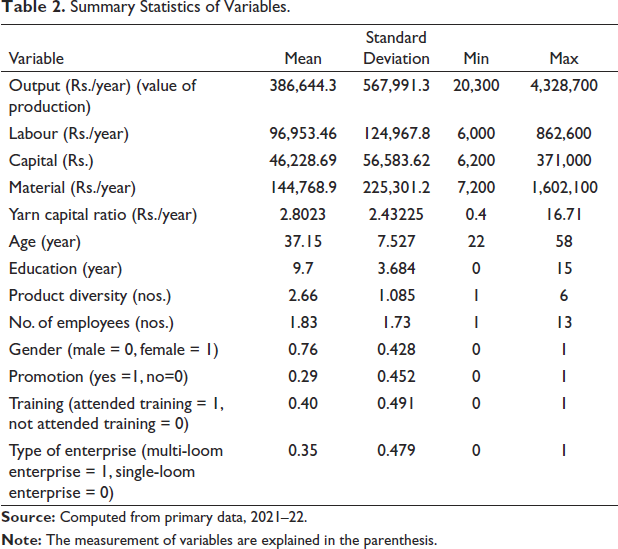
The age of the sample entrepreneurs lies in between 22 and 58 years and the mean years of schooling is around 10 years. The sample enterprises produce a maximum of six items and a minimum of one item. The number of employment of handloom enterprises is taking as a proxy of firm size. The average number of workers in the sample enterprise is around two and it is lies between 1 and 13 workers. In the sample, 76 per are women entrepreneurs while the rest are male entrepreneurs. The sample handloom enterprises adopted promotional strategies for selling their products. An average number of promotional practising enterprises is 29% in the sample. Around 40% of enterprise owners are trained in handloom activities. The ownership of handloom enterprises is categories into two types’, namely single-loom enterprises and multi-loom enterprises on the basis of a number of looms in their enterprises. Around one-third of sample enterprises are multi-loom enterprises.
Results of Frontier Production Function
The results of Maximum Likelihood Estimation of stochastic frontier C–D production functions are presented in Table 3. The gamma (γ) indicates the extent of variation of output due to technical inefficiency. Since gamma (γ) is 0.43 and is significant at 1% level, it implies that a 43% variation in production or output is due to inefficiency. It is observed that the output elasticity of labour is 0.729 and material is 0.133 and these are statistically significant at the level of 1%. While capital is significant at a 10% level with a low coefficient (0.06). It implies that capital has a lower role to increase production compared to labour and material. As the handloom industry is labour-intensive in nature, the higher positive marginal productivity of labour is quite expected.
Results of MLE of Frontier Production Model.

The presence of technical inefficiency is confirmed as LR value 110.7 exceeds the chi-square table value of 24.049 at 11 degrees of freedom and is significant at 1% level. It implies that the inefficiency is present in handloom-based enterprises included in the sample.
The minimum and maximum technical efficiency scores of the handloom enterprises are 0.4 and 0.98, respectively. In view of the variation of these scores among the enterprises, these may be classified into three groups as in Table 4. A higher proportion (74.26%) of single-loom enterprises belonged to the low technical efficiency group (below 0.60). In contrast, in the case of multi-loom enterprises, higher proportions of enterprises (62.73%) belonged to the high technical efficiency group. The reasons for the high technical efficiency score of multi-loom enterprises due to economies of scale in terms of production and marketing.
Categories of Handloom Enterprises by Technical Efficiency Scores.

Among the single-loom enterprises, however, 14.85% have a high technical efficiency score. Examination of enterprise-based data shows that these enterprises use a relatively higher yarn capital ratio, produce high-value-added products and engage in promotional activities. In contrast, around 10% of multi-loom enterprises are classified as having a low degree of technical efficiency. According to the data, these multi-loom enterprises create low-value-added items and have relatively tiny manufacturing units (two to three employees). The owners of low-efficiency multi-loom firms did not attend any training on weaving activity, and their promotional activities are minimal. As a result, these enterprises have lower levels of technical efficiency in spite of being multi-loom enterprises.
The average efficiency score of overall enterprises is 0.67 while it is 0.59 for single-loom enterprises and 0.81 for multi-loom enterprises. This implies that there is still the capacity to enhance output with the same amount of inputs by enlightening managerial practices and creating strategic changes in the external factors that negatively affect the efficiency of handloom enterprises.
Sources of Technical Inefficiency
Identification of sources of technical inefficiency helps in suggesting appropriate policy initiatives. The efficiency level of a firm or enterprise can be improved by identifying their sources of inefficiency as presented in Table 5. It shows that the factors, namely yarn-capital ratio, adoption of product promotion, access to training, type of enterprise and number of employees are found to be significant for reducing technical inefficiency while product diversity positively affected technical inefficiency. In contrast, the demographic characteristics of entrepreneurs, namely age, education and gender are found to be insignificant factors.
Factors Influencing the Technical Inefficiency of Handloom Enterprises.

The coefficient of ‘yarn capital ratio’ is −0.096 which is statistically significant at the level of 1%. It means that 1 unit increase in yarn-capital ratio reduces the technical inefficiency of handloom enterprises by 0.096 units and thus may improve the efficiency level of the enterprise to a great extent. A similar result in the perspective of the handloom industry in Bangladesh is reported by Jaforullah (1999). Thus, the efficiency level of handloom enterprises can be improved by increasing the yarn-capital ratio, as the yarn is the primary raw material for weaving enterprises. The ongoing yarn supply scheme under NHDC for ensuring regular supply of yarn at subsidised price has been recently revamped and renamed as Raw Materials Supply Schemes (RMSS) in 2021–22. Evidence from the survey shows that only 62 enterprises out of 312 enterprises is less than 20% of enterprises received any yarn at a subsidised price under the scheme. So, effective implementation of the RMSS scheme is required for improving the efficiency of the handloom enterprises.
The education level of the enterprise owner has no significant impact on the inefficiency of handloom enterprises. This is contradictory to results found by Islam and Hossain (2015) and Hasan et al. (2020) where education is found to be negatively related to the inefficiency of weaving enterprises in Bangladesh. Handloom weaving in Assam is a household-based enterprise, so the efficiency of enterprises depends on the weaving skills of the enterprise owner rather than his or her educational qualifications. The efficiency of handloom enterprises in Assam does not depend on the age of the enterprise owner and the co-efficient of age is found to be insignificant. Similarly, the efficiency of handloom enterprises also does not depend on the gender of the enterprise owner and the coefficient of the gender dummy is also found to be insignificant.
The co-efficient of product diversity is found to be positive which is significant at 1% level. It indicates that the level of technical inefficiency of handloom enterprises increases as they increase the level of product diversification. The result suggests that handloom enterprises would be able to raise their technical efficiency by reducing a number of varieties of items. To produce a wide range of items enterprises require different varieties of yarn, and weavers having different levels of technical skills and tools to weave fine designs. Thus, expenditure on working capital is likely to be much higher for enterprises engaged in the production of a larger variety of items. Therefore, it is necessary to specialise and improve the quality and design so that products may fetch higher sales revenue and improve the efficiency of the enterprise. Weaving exquisite designs and producing high-quality products, enables the handloom industry to compete with the power-loom and improve the market reach in the competitive economy. For this properly designed product promotion campaigns and product branding would be necessary.
Entrepreneurs’ access to training is another variable, found to be statistically significant at 1% level, for reducing the inefficiency of handloom enterprises, with the dummy being negative in sign. Entrepreneurs, who are trained, are owners of enterprises with lower inefficiency levels compared to the enterprises where the owners did not attain any training programme. This result is quite expected because trained entrepreneurs are more skilled and in addition, have managerial knowledge for running the enterprises. Though, there are many training programmes and training institutions operating under different government agencies, only 126 entrepreneurs out of 312 entrepreneurs in the sample, have received any training till the time of conducting the survey. The directorate of Handloom and Textiles of Assam operate 102 Handloom Training Centres (HTC) and 4 Handloom Training Institutions (HTI), located in different districts of Assam. These training centres and institutions provide training on weaving and designing, and the total intake capacity of HTC is 1,645 persons per year and that of HTI is 97 persons per year. During the last 15 years from 2006–07 to 2020–21, a total of 12,938 persons from HTC and 758 persons from HTI were trained. 3 Thus, these institutions together imparted training to 913 weavers per year on average.
Indian Institute of Entrepreneurship (IIE) also organise training programmes on weaving and entrepreneurship. From January to March 2023, four such programmes were organised in each of the four districts of Assam, namely Barpeta, Kamrup, Darang and Lakhimpur under the Entrepreneurship Skill Development Programme. 4 IIE also organises Digi-Bunai skill training programs under the Ministry of Electronics and Information Technology to provide computer-aided design training to traditional handloom weavers and artisans. As of March 2023, IIE conducted seven Digi-Bunai Training programmes in Assam and Tripura where 210 participants were trained. 5
Product promotion is an effective way to increase demand for that product by highlighting its positive qualities to potential buyers. Adoption of promotional practices is found to have a significant role in reducing inefficiency. The coefficient of the promotional practice dummy is negative and significant at the level of 1%. Hence, enterprises resorting to product promotion are significantly less inefficient than enterprises which do not take any product promotion measures. Therefore, handloom enterprise can boost their output and expand into new markets by implementing a promotion campaign. NER Textile Promotion Scheme (NERTPS) is an important initiative for market promotion of North Eastern Textiles and Handloom products. Handloom entrepreneurs and weavers can participate in different national and international trade fairs or exhibitions, and fashion shows organised by different government agencies under the NERTP scheme. It is evident from the field survey that out of 312 enterprises, only 47 enterprises or entrepreneurs participated in trade fairs or exhibitions at least once ever. In the year 2020–21, 170 weavers and entrepreneurs participated in different trade fairs or exhibitions held in Assam and generated sales revenue of 2.27 crore (Directorate of Economics and Statistics, GoA 2021). During 2022–23, a total of 64 marketing events/exhibitions were organised in the North Eastern States, of which 16 exhibitions were held in Assam (Notes on Handloom, Ministry of Textile). 6 Thus effective implementations of these schemes can increase the promotional practices among the handloom-based enterprises.
Taking a number of employees in the enterprise as a proxy of firm size it is found that a higher number of employees in an enterprise tends to reduce technical inefficiency significantly. This because owners with a larger number of employees can use resources efficiently in the presence of excess capacity of fixed capital (looms). Excess capacity is evident from the fact that the average work hour of a weaver is 7.5 hours per day, which implies that a loom is in operation for only 7.5 hours per day. So, enterprises can increase their production performance by increasing employment. Similar results were also found in small-scale enterprises in India (Nikaido 2004) and Nigeria (Ajibefun and Daramola 2003).
The coefficient of the type of enterprise (single and multi loom) dummy is negative which is significant at 5% level. It implies that multi-loom enterprises are significantly less inefficient than single-loom enterprises. A relatively large number of multi-loom enterprises used modern jacquard loom for producing fine design products (83 out of 110, that is, 75% of multi-loom enterprises and 65 out of 202, that is, 32% single-loom enterprises). They usually employ skilled hired labour, produce a higher volume of output, and have marketing linkages with many retailers and wholesalers compared to single-loom enterprises. It is likely that the lower inefficiency of multi-loom enterprises compared to single-loom enterprises, is due to the combined effect of all these factors. Therefore, rather than relying on a single loom and operating independently, single-loom enterprises may come together and operate collectively to take advantage of economies of scale and other marketing advantages.
Cluster Development Programmes (CDP) under the National Handloom Development Program aim at the development of micro handloom enterprises and loomless weavers by forming weavers groups or handloom clusters. The primary objective of the CDP is to create groups of weavers capable of sustaining themselves and fostering the growth of weavers. This programme offers infrastructure facilities, such as the construction of work sheds, a common facility centre, looms and other accessories and the hiring of a designer, on a need basis in the sanction cluster. From 2006–07 to 2021–22, 203 minor handloom clusters and 1 mega handloom clusters were formed in Assam. 7 It is observed that none of the entrepreneurs included in the sample are beneficiaries of CDP. Hence there is ample scope for extending the coverage of the programme.
Concluding Remarks and Suggestions
Identification of the sources of inefficiency is significant for policy formation and to increase the performance of enterprises. Technical efficiency and sources of technical inefficiency of handloom enterprises is analysed using the stochastic frontier inefficiency model. The estimated frontier production function shows that labour, capital and material inputs are found to be significant and labour is the most effective factor for increasing of output level. The mean technical efficiency of overall sample enterprises is 0.67 and a higher variation of the level of technical efficiency among the sample handloom enterprises is observed. Factors, namely yarn-capital ratio, adoption of product promotion, access to training, type of enterprise and number of employees are found to be significant for reducing technical inefficiency while product diversity positively affected technical inefficiency. Multi-loom enterprises are significantly less inefficient than single-loom enterprises.
Despite the implementation of various schemes such as RMSS, NERTP, CDP and different training programmes by government agencies, only a few enterprises or weavers are benefited from these initiatives. The above findings suggest that organising the independent weavers into a collective will help them in reaping the economies of scale and other marketing benefits. Training on weaving activities is important for increasing the efficiency of handloom enterprises. Therefore, different Government and Non-Government agencies may organise weaving entrepreneurship and product-promotion-oriented training activities. Since promotional activities are identified as a crucial factor of efficiency, one may suggest the use of information technology like social media and other digital methods in widening marketing opportunities, in creating brand names and other promotional activities at minimum costs.
Footnotes
Declaration of Conflicting Interests
The authors declared no potential conflicts of interest with respect to the research, authorship and/or publication of this article.
Funding
The authors received no financial support for the research, authorship and/or publication of this article.
