



Abstract
Roads are bitumen covered concrete metaphors of modernity and development, and they materially represent fantasies, collective hopes, and aspirations of future(s). They symbolize movement, connectivity, transactions and transportation, and eminently reflect governmentality. Our article is about Manipur’s connective infrastructures, and it focuses on internal roads, and a border highway that connects Imphal (Manipur’s capital city) to Dimapur at Nagaland in North-east India. We explain the infrastructural deficit within Manipur and decision-making about them being influenced by a hill-valley socio-ecological ethnic distributional conflict. The road links and is part of the uneven development route. We provide an ethnographic account of a truck journey undertaken between Imphal and Dimapur in 2018, and this enables us to understand routinized corruption and the collusion of state and non-state actors therein. The road is the symbol of hope, and a developmental desire, and epitomizes state’s governmentality and developmental project of progress, nonetheless it also gets transformed into the central locale of political protest, ethnic conflict when ethnic groups appropriate it forcibly to erect blockades and organize protests in its arterial space. The roads and highways spatially produce and reproduce (il)legality, (il)legibility, and (il)legitimacy of the Indian state. Our ethnographic research unpacks and invokes the multivalence of roads.
A road is not merely a human-engineered hardware that spatio-temporal imprints human agency on the built environment and facilitates mobility, rather it eminently indicates the nature of the political and the future of upcoming possibilities. During our ethnographic journeys in Northeast India, 1 local inhabitants perpetually underlined the politico-symbolic significance of roads and impressed upon us their multiple meanings. As an infrastructure, 2 the road is intrinsically relational (Star & Ruhleder, 1996) and reveals itself as a process (Gupta, 2018). Harvey and Knox (2015), in Roads, ethnographically document the construction of the ‘interoceanic highway’ in Peru. They transform the mundane road into a rich ethnographic field that congeals development politics, state power and people’s aspirations, and displays the symbolic power of modernity and expertise.
Roads indicate the relation between things, ideas and practices. The road taken or not taken, the road under construction or not constructed, the ‘finished’ road that requires repair and maintenance, the road destroyed during construction of other infrastructure, the unused decaying road, the road people avoid taking or feel unsafe on and the road that takes people to hopeful futures are all important components of Northeast India’s development narrative, experiences and sociopolitical practices. The emphatic demand voiced by a 55-year-old Kuki tribal villager to a government official that ‘we need a paved road connecting our village to the highway’ vividly condenses the material politics of infrastructure that defines their everyday life and connection with the state. Road networks in Manipur indicate the contours of ethnic politico-economic dominance and the infrastructure deficit. The tribal citizen lives in the shadow of connective infrastructure and is not meaningfully able to use it—what Rahman (2019) terms as a ‘pickled’ state. Inequalities in infrastructure are reflected and reproduced through the rules, practices, and politics around public goods (roads, electricity and water supply), and their bio-political use (Anand, 2017; Gupta, 2015). They are potentially and equally a key aspect of social and political engineering (Dalakoglou, 2012). Infrastructure embodies ‘concrete instantiations of visions of the future’ (Gupta, 2018, p. 63). The demand for shared ‘infrastructural modernity’ in the form of a paved road itself has become a ‘dream’ and is constitutive of a ‘promised future’ (Appel, 2018, p. 46). The road encapsulates the vernacular desire for development and their ‘infrastructural hopes’ (Reeves, 2017). We demonstrate how the promise of road infrastructure and the infrastructure of promised development are intimately connected in specific political geographies and especially in ethnically volatile borderland areas of Manipur.
Roads are generative sites, and as part of infrastructure they have this uncanny ability to politico-materially mobilize multivalent meanings, ideas and practices. They embed the historic pathways of politico-economic transactions and trade, rituals and pilgrimages, 3 and become emblems and monuments of affective histories. Our analysis of roads is eminently guided by Larkin (2013), who highlights the interrelationship between the functional, the physical, the poetic and the semiotic capacities of infrastructure. Contrary to Auge’s argument (cf. Dalakoglou, 2012, p. 572), roads are unlikely to become non-places, the space that lacks social significance. They constitute the critical arteries which integrate political territory and affirm sovereignty. Roads and highways materialize the nationalizing vision and developmental power of the modern Indian state and its contingent legibility. As infrastructure in politicized landscapes, they maintain and refract governmentality. Our ethnographic experience highlights the eminent domain of roads as a contested political space of state legibility, and as a symbol of ethnic-nationalist power that gets ‘routinely’ challenged by non-state actors. 4 The interstate highway gets transformed into an exceptionally political highway in Manipur when it becomes a space of political intimacy and violent encounters between state and non-state actors.
We have organized our reflections into six sections. Analytically our discussions are informed by a review of relevant theoretical and secondary literature, which helps us situate the primary data gathered through interviews and ethnographic fieldwork. 5 We begin by briefly introducing the ethnographic locale to our unfamiliar readers, then discuss the ethnic divisions and the diverse expressions of ethnic conflict, which in turn contingently structure the socio-ecological divisions between the hill-valley areas and situate the development challenges in contemporary Manipur. The second section describes the network of roads and highways that facilitate interconnectivity and transportation and their existential condition. We discuss the uneven distribution and condition of roads between the hill-valley areas and difference between them and the interstate highways. The political-materiality of the roads underlies the infrastructural deficit. The third section contextualizes how roads shape, organize and structure the idea of modernity, development and social hopes for a future. Roads condense polyvocal meanings and reveal the strong interrelationship between their politico-material and symbolic aspects among the tribal inhabitants of Manipur. The fourth section examines the political overtones connected with roads and highways. The politico-economic material highway often gets transformed into a scape of contestations between state and non-state actors. We describe the politically charged space of the highways, where governmentality is affirmed, reproduced, challenged, recovered and fragmented. Highways become sites that facilitate, organize and express ethnic-political dissent and resource distribution conflicts between groups, and for groups who are opposing the state. The fifth section of our article describes an ethnographic truck journey between Imphal (Manipur) and Dimapur (Nagaland) that was undertaken in 2018 by one of the authors of this article. This journey gives empirical insights and added an experiential dimension to information that we had elicited during our interviews. The sixth section describes and analyses the everyday corruption played out on the highway and its impact on Manipur’s infrastructure of development. We emphasize the multivalence of roads in our conclusion and highlight the political choices influencing the roads (not) taken.
Ethnographic Context of Manipur
Manipur is located on the north-eastern border of India and is commonly referred to as a ‘beautiful jewel.’ It shares international boundaries with Myanmar and shares borders with the other Indian states of Assam, Nagaland and Mizoram. It has geopolitical importance in the inland trade route between India and Myanmar. Politically, Manipur was an erstwhile independent kingdom ruled by a Meitei king and became a princely state of British India in 1891. The Manipur State Constitution Act, 1947, established a democratic form of government after the British departed from the Indian subcontinent. For a brief period, this kingdom was completely independent before it joined the India union in 1949. The Maharajah or the King signed the instrument of accession (to prevent Myanmar from taking it over) at Shillong in 1949 and thereafter it was administered as a ‘C’ state in independent India. 6 It became a Union Territory in 1956 and was given full-fledged statehood in 1972 (Arora & Kipgen, 2017). Special provisions are made under Article 371C of the Indian Constitution to protect and foreground the ‘Excluded Area’ status of the hill areas.
Geographically, Manipur is a small state having an area of 22,456 sq. km, which is subdivided into 16 administrative districts. Imphal serves as the capital city. Demographically, Manipur has a population of approximately 2.8 million (Census of India, 2011) with a density of 82 persons/sq. km. The population is subdivided into the four main ethnic-religious groups: Meitei (Hindu), Pangal (Muslims), Kuki (Christian) and Naga (Christian) (Census of India, 2011). The Meitei comprise about 41 per cent, the Pangal about 8 per cent, and the Naga and Kuki tribes about 41 per cent of the total population. In addition, there are some other residents hailing from other parts of India and Nepal. 7 All the ethnic groups regard themselves as indigenous to the area, despite having oral migration histories of their politico-economic settlement and cultural differences. The Naga and Kuki groups are subdivided into approximately 33 recognized Scheduled Tribes in contemporary Manipur. 8 More recently, the Meitei are seeking Scheduled Tribe status, thereby complicating the ethnic situation.
Ecologically, the state is divided into hills (20,316 sq. km) and valley areas (2,040 sq. km). The Naga and Kuki people predominantly inhabit the hills (excluded areas) whereas the Meitei and Pangal (non-tribal groups) exclusively dwell in the valley areas. The capital city of Imphal constitutes the seat of administration, education, health services and government, and the Imphal valley dominates the political economy of Manipur. In contemporary Manipur, the hills comprise about 90 per cent of the total land area where merely 34 per cent of the total population live and work. In contrast, the valley area constitutes 10 per cent of the total area of Manipur, but accommodates nearly two-thirds of the total population (Ziipao, 2016). Other smaller ethnic groups such as migrants from other parts of India (Tamil traders, Marwari businessmen and administrative personnel) are scattered in urban areas, while Nepali and Bangladeshi migrant workers can also be found labouring in the urban and rural areas.
The overlap in the ethnic, the socio-ecological and political-economic divisions has colonial roots. After conquering the hill areas, the British administratively categorized them either as Excluded Areas or Partially Excluded Areas under the Government of India Act, 1935 (Syiemlieh, 2014). To protect the primarily agricultural economies of the Naga and Kuki groups from their economically advanced neighbours who were integrated into the regional market economy, the imperial administration did not permit other ethnic groups to buy land or settle in the hills. The imperial provisions and political decisions to keep the ‘unruly hills’ (Karlsson, 2011) separate from the valley areas have directly contributed to ethnic segregation and strengthened ethnic-territorial attachments. Interestingly, successive post-colonial governments have failed to revise the land law and the ‘excluded areas’ status of the hills, despite acknowledging its critical role in sustaining ethnic and development tensions in Manipur (Arora, 2013; Jilangamba, 2015; Kamei, 2018; Meetei, 2017; Roluahpuia, 2016; Ziipao, 2016).
The perpetual clash of ethnic-nationalist aspirations for territorial homelands by different ethnic groups has aggravated and sustained ethnic militancy and undermined the trajectory and pace of development. The propensity of ethnic groups to engage in inter-ethnic and intra-ethnic conflict is remarkably displayed in the frequent Naga-Kuki, the Meitei-Naga and the Kuki-Paite clashes (Arora & Kipgen, 2017; Baruah, 2009; Hazarika, 2018; Tarapot, 2003), which substantively reinforce the image of Manipur being an ethnic cauldron (Arora & Kipgen, 2017; Ziipao, 2016) or even a ‘Bleeding Manipur’ (Tarapot, 2003). The ethnic elite’s desire to control development resources has undermined the very programme of development, directly contributed to infrastructure deficit and its frequent destruction, and furthered a security perspective (Arora, 2013). Some of the Naga militants have secessionist aspirations, and they have been demanding the unification of the Naga inhabited areas in an autonomous ‘Nagalim’. This explains why since 1980, Manipur has been declared as a disturbed area, and the Armed Forces Special Power Act, 1958, is implemented here (Baruah, 2009; Hazarika, 2018; Kikon, 2009; McDuie-Ra, 2009). Unfortunately, the Government of India has indefinitely extended this ‘zone of exception’ (Hazarika, 2018) every 6 months by following a security perspective, and has heavily militarized the region to quell ethnic-nationalist demands for secessionism and demarcation of exclusive territorial homelands.
The socio-ecological political-economic hill-valley divide continues to be a marker of development disparity and impoverishment in Manipur and the prime source of ethnic contestation (Kipgen & Arora, 2011; Ziipao, 2016). State government reports consistently acknowledge the poor state of infrastructure (such as roads, railways, power and telecommunications) in the hills and how this has adversely impacted the pace of development, perpetuated poverty and undermined the immense potential for tribal development. 9 Despite policy recognition and political pressure, the infrastructural deficit has not diminished in the hills and is being portrayed as a form of injustice (Ziipao, 2016). Intra-development differences and infrastructural deficit are commonly perceived in terms of a ‘hill-valley divide’ in Manipur and also in other parts of Northeast India (Karlsson, 2011; Kipgen & Choudhury, 2016; Suan, 2011; Ziipao, 2016).
Manipur continues to be an industrially underdeveloped state. Its economy is largely rural, with a focus on subsistence agriculture that has ensured the continued underdevelopment of its tribal inhabitants of the hill areas. 10 The government is charged with the primary responsibility for the welfare of the population inhabiting its bounded territory, and the improvement of their living conditions through development resources and programmes. Following Scott (1998), this responsibility acquires legibility through statistics, especially the comparative assessment of the human development indicators. Infrastructural development has been a challenging task for the state government and administration due to inhospitable terrain and heavy monsoons, breakdown of law and order, frequent strikes, insurgency and ethnic violence, high transportation costs through poor quality roads, low revenue due to subsistence agricultural practices and widespread corruption. The marginalized tribal population continues to feel alienated and indirectly excluded from the state development programmes and denied coeval benefits from development investments in education, health, livelihood opportunities and employment (Ziipao, 2016).
Roads are connected with national prosperity, security and peace. People in Manipur are utterly dependent on roads for trade and cost-effective transportation. Manipur has only 1.5 km of railway tracks. 11 The Imphal international airport has limited service due to poor infrastructure facilities, and despite a declared intent, international flights have not been operational. Development of waterways as a means of connectivity is out of the question since Manipur is a landlocked state, although River Barak had functioned as a water-highway during the colonial period (but does not have enough water now). Hence, roads are the only viable mode of transportation within and between different districts of the state, with other Indian states, and with the neighbouring country of Myanmar. The cry of ‘infrastructural deficit’ is more than a trope as the lived experience of rural communities substantiates this reality. The winding roads and highways, the electric pole, the dam, the hospital, the railways, the airport, the water tank and pipes, the special economic zones, the school and the prison are inevitably perceived as infrastructures of modern development and equally as tools of governmentality.
Road Networks and Infrastructure Deficit in Manipur
Roads are a central infrastructural component of any development possibility and design, and a visible yardstick to measure the effectiveness of political and development interventions in Manipur. Roads are infrastructures that translate the nationalist vision and refract the ideology of development. The state tends to ‘ignore’ the tremendous internal variation in the quality of paved roads and the uneven connectivity in the landscape. This indicates the ‘leaky’ outreach of the developmental Indian state (Anand, 2017). The deficit in road infrastructure negates the ‘possibility of a future that is itself future-oriented’ (Reeves, 2017, p. 713).
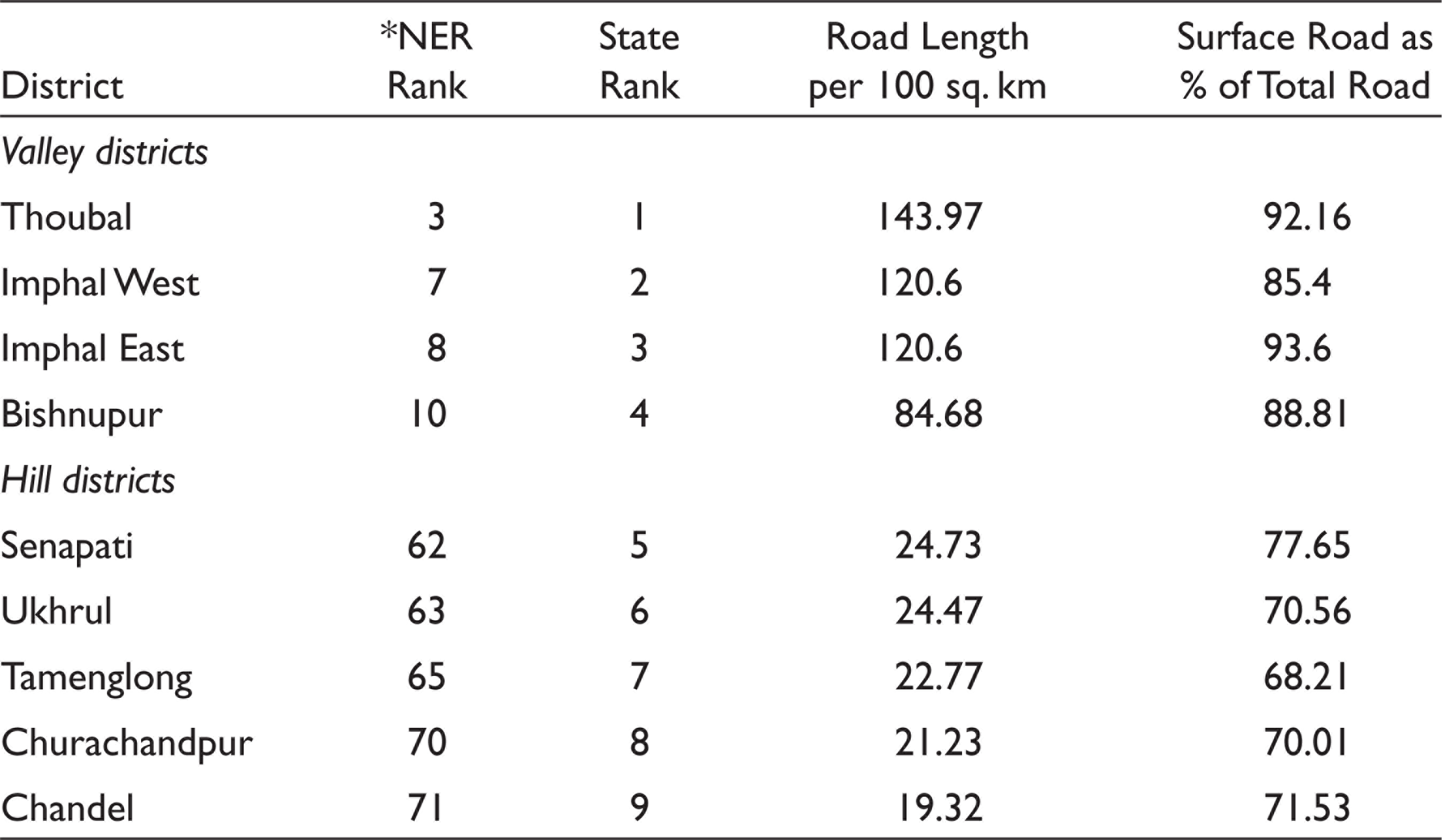
A visible indicator of the persisting hill-valley divide is the presence and absence of road connectivity, and this development gap is perceived to originate from the dominant Meitei community residing in the densely populated valley areas, some of whom are hostile towards the tribal people (refer to Table 1). The Ministry of Development for Northeastern Region (MDoNER) along with North Eastern Council (NEC), Shillong released a report on the district infrastructure index of 80 districts in Northeast India in 2009 (Government of India, 2009). The report empirically revealed that while the valley districts of Manipur are ranked among the top ten in the region, the hill districts are located at the end of the list. There is also a sharp difference in the road length per 100 sq. km for valley and hill districts. For instance, Thoubal district has 143.97 km of road in every 100 sq. km whereas Chandel district merely has 19.32 km. The third section details the impact of this uneven infrastructure on the everyday life of the rural and tribal people.
Road Density vis-à-vis Surface Road
Beyond the popular hill-valley bifurcation and differential in road networks, we immediately note a hypermarked contrast between the proliferation and ready availability of modern well-maintained infrastructure in civilian and military-controlled parts of Manipur. 12 Infrastructural differences are buttressed by the continued securitization and militarization of the highways to safeguard boundaries, counter secessionist aspirations and protect national investments; the sixth section discusses the highway as a political space. According to government sources, there are eight national highways in the state which together cover 1,307.745 km (see Table 2), integrating Manipur within the national territory. Out of this total road length, the Border Roads Organization (BRO) maintains and administers 840.280 km, while 467.465 km fall under the jurisdiction of the State Public Works Department (PWD). Strategically, about 64 per cent of the total highway road-length is being controlled by BRO, and by extension, the Indian Army. Most of the highways under BRO are either located in inhospitable or difficult geographical terrain or comprise highways that the PWD could not finish. NH37 (Imphal to Jiribam), NH202 (Imphal to Tipaimukh), NH102A (Tadubi to Ukhrul), NH137 (Tamenglong to Khongsang) are exemplars. Hence, BRO is tasked with both the construction of new highways and the upgrading of the existing state highways into national highways.
National Highway Under PWD and BRO in Manipur (in km)

Among the existing eight highways, only NH2 (connecting Mao to Moreh) and NH37 (Imphal to Jiribam) are in a ‘functional’ condition (motorable), while the road conditions of the others need much more investment and rigorous maintenance. Interestingly, the PWD controls the lifeline of Manipur, that is, NH2 (Mao to Imphal and Imphal to Moreh). NH2 has been converted into the Asian Highway No. 1 (AH-1) that connects Manipur with Nagaland and Assam and passes to the border town of Moreh. 13 These two highways cover the critical arteries of transportation of goods and inland trade in Manipur. The fifth section describes an ethnographic journey by truck undertaken on the interstate highway connecting Imphal (Manipur) with Dimapur (Nagaland).
Investments in infrastructure invariably involve intricate calculations about the future and return to investment. Policy documents prepared by state and national governments openly acknowledge the urgency and immediate necessity of eliciting public–private investments in improving physical connectivity, electricity and telecommunications infrastructure through national and global sources (such as Asian Development Bank), and the imperative of expanding and constructing modern road infrastructure to facilitate national integration and foster participatory human development. The Vision 2020 (MDoner, 2008) policy document on Northeast India emphasizes that infrastructure development is a prerequisite for realizing progress, ensuring peace, encouraging local entrepreneurship and facilitating the liberalization of the economy. 14
Political-Materiality of Roads and Their Development Promise
Roads as infrastructure reveal the relation between people, things, institutions, development ideologies and inequalities. Edwards argues that ‘infrastructures simultaneously shape and are shaped by—in other words—co-construct, the condition of modernity and serve the interest of the state and dominant communities’ (2003, p. 186). Compared to foot trails and tracks, roads are engineered infrastructures, an institutionalized feature of the landscape marked by state power. The location of the road and the highway configures present mobility and potentially promises a future. As a concrete metaphor, roads shape the direction of the development futures: ‘It generates its infrastructural effects in the location of houses, schools, or businesses’ (Gupta, 2018, p. 63). Development practices and ideology transform ‘nature’ into a material of and for production of infrastructure, which interconnects the state, market and the community (Escobar, 2011).
The promise of infrastructural transformations is a flourishing and ethnographically salient aspect of many ‘developing country’ contexts (Harvey, 2018; Harvey & Knox, 2015). Where is the road cartographically placed in Manipur? Are the villages in the hills getting interconnected or are only certain locales being serviced and getting networked by the highway? The density of population in the hills is low, so does it make any sense to invest in an asphalt road that will be used occasionally by the tribal people living in these hills, who are engaged in swidden cultivation and limited to a subsistence economy? Hence, the lack of paved roads connecting tribal settlements in the hills to markets determines the harsh reality of their everyday socio-economic and material life. A lack of road connectivity deprives the rural folk of market access (for sale of agricultural produce and fish and purchase of goods and services). A gravel road does not signal modernity. The gravel road undermines their connection to a productive secure life, a fast-moving and shining future. The affective distinction made between a muddy gravel-covered road and a paved one reflects the power of the modernization narrative.
The decisions about the site of a road and when to start construction are eminently political. Larkin (2013) discusses the ‘act of defining’ an infrastructure and its discursive function as a categorizing moment. Often infrastructure is perceived ‘negatively’ as a biopolitical project of the state to create citizens (Gupta, 2018). Nevertheless, such projects may reflect citizens’ ‘positive’ assertive demand for public goods. Communities that are not connected by paved roads perceive themselves as marginalized. This explains why local people ‘are often engaged in explicit political struggles to bring a road into being’ (Harvey, 2018, p. 98). This ongoing struggle to beget a road is evocatively captured by a Poumai Naga song, composed during the 1980s by Lounii Rounder. The writer is a Poumai Naga who resides in Senapati district, where road connectivity is extremely poor.
15
We share the English translation of a few lines of this song here:
Onwards to the Poumai world, Come, visit and see, Bare bruised sole feet, Hairless hardened skulls, and sweat dripping chins. There go our men carrying a tin of rice to Maram. And a tin of salt makes brings them homeward. Oh! What a Poumai ways of life? Is there a soul for an answer? Aha! What a misery.
In the song, the Poumai Naga villager is stridently demanding road accessibility in the hills of Manipur, perceiving it as a composite foundation of his developmental aspirations. The poet is explicit in his demand—‘give me a road, connect me to the market and the town, and relieve me of this foot-drudgery’. The road enables timely access to basic services, it reduces drudgery and facilitates an entrée into markets and access to other development resources. Similar aspirations have been documented elsewhere, as in Peru:
Most understandably, they wish to be relieved of the drudgery and isolation of living in a walking world, to stand a better chance of gaining and interweaving livelihoods, to qualify for a higher level of service provision, especially in education and health, and to feel themselves incorporated as citizens in national life. (Wilson, 2004, pp. 525–526)
A road filled with potholes condenses history and unfolds the story of development. The road taken (or not taken) and the road made (or not constructed or washed away) contingently combine the poetic with the sociopolitical aspects. The suspension of the ongoing construction of roads (or other infrastructure) due to legal issues and paucity of funds and the lack of their repair reveals the intricate bureaucracy surrounding them and the development challenges. Our interviewees have shared many stories of some unfinished roads in the Manipur hills due to corruption. They have pointed at other roads that were abandoned due to growing militancy, while in some instances they were damaged during encounters between security forces and the militants.
Overall, the road is part of a desire for an easier life, a life less precarious and exhausting (Harvey, 2018; Harvey & Knox, 2015). Roads and highways are the arteries for interstate transportation and the veins through which Manipur is integrated into the national economy. Enmeshed in the political economy of development, the presence and quality of roads symbolize the resource distributional conflicts, and they concretize the discourse of perceived marginalization and deprivation. The paved road has ascended into becoming a ‘gauge’ of administrative efficiency and the welfare capabilities of the state. We cite an extract from a 2014 interview with Lounii (a 75-year-old Naga man) who lives in Purul (Hiimai) village of Senapati district in Manipur. This village is about 20 km away from Maram and local taxis take 90 minutes to cover this distance. His lament summarizes this situation:
Since my childhood, we were told that the government would construct a pakka road (bitumen road) from our village that will connect us with NH2 at Maram. Every politician before any election promises us that they will construct a pakka road, but it has not happened till today. You see what is the condition of our road today? Rainy season is about to begin and soon we won’t be able to travel on this unsurfaced road. I get sick now whenever I travel and hope the government constructs a pakka road before I die.
The road becomes road infrastructure only when it is constructed, maintained regularly, and is fit and available for traffic; without the asphalt, it quickly degenerates into a muddy track. The rural roads and inter-district roads or the feeder roads that connect the hills to national and state highways are in a deplorable condition. They are mostly unpaved—stretches of rocks and soil that become slush during the monsoons, death traps for vehicles and not quite motorable. While the national highways are wide four-lane roads, maintained regularly and are decently motorable, the internal roads are largely poorly maintained, narrow broken lanes (single or double in some topographies) and full of potholes. As material artefacts, roads require not merely construction but also routines of repair, replacement and restoration. Their crumbling condition indicates decay and ruination (Gupta, 2018).
Roads are equally constitutive sites of popular aspirations, political alternatives, creative imagination, and of future hopes and poetic promise (Appel, Anand, & Gupta, 2015; Appel, Anand, & Gupta, 2018; Harvey & Knox, 2015; Larkin, 2013; Reeves, 2017). They fill us with deep feelings of desire, political power and pride in the possibility of a progressive future, and their absence or lack evokes the sentiment of denial of development. Road building and construction are fuelled by ideas of progress, of modernity, and the hope and desire for development. This is what governments, leaders and people are constantly voicing in their development aspirations, which are summarized as follows: ‘We want more infrastructural development of our roads, and you have to fund their creation, construction of an expansive paved network, and facilitate their year-round maintenance’. 16 Shared infrastructural modernity itself becomes a development dream and hope (Appel, 2018). As material infrastructure, we agree with Reeves (2017, p. 713) that roads ground the material conditions of hope, and political future(s).
Roads, Governmentality and Sovereignty
Who decides to cut a road and cover it with smooth asphalt? Who gives the contract for its construction? Who finally approves its fitness for public use and levies taxes from users? Decisions on these aspects reveal the negotiations between the community, the state, the market and the use of engineering expertise. Roads are one of the commonly cited public works that all hegemonic states are minimally tasked with producing, not merely in India but across the world. Roads are an essential component of the government’s commitment to public welfare, and they are a continuing metric to assess state investment in this responsibility. The material condition of the road, their very presence or absence, register histories of state presence and neglect. Roads are an essential administrative axis, and they reflect dominant political-economic interests and materially represent some form of consensus enacted between competing forces. They are the key component of the infrastructure and technology of government (Joyce cf. Appel et al., 2018, pp. 4, 17). 17
Governmentality (Foucault, 1991) has been central to the emergence and power of the modern state (various institutions, procedures, projects) and its geo-power to conscript the environment, conquer it with science and engineering, and harness its tremendous potential by systematic interventions. Following Foucauldian insights, the technologies of infrastructure and their development are viewed as a mode of deploying and displaying state power and enabling governmentality (conduct of conduct). As James Scott’s (1998) work suggests, roads embody an authoritative power of the state to make its legibility felt among its subjects, constantly and coercively. Wilson (2004, p. 527) underscores their symbolic and political resonance for both states and subjects/citizens. ‘Characteristically they [roads] become a vital element in a state’s territorializing project, enabling sovereignty to be extended up to the frontier’ (Wilson, 2004, p. 527).
Roads politico-materially embody and metonymically reflect state power and the political economy of development. They justify relations between state and citizens, and ‘mete out promissory notes that are not exceptions to their operation but constitutive of them’ (Appel, 2018, p. 53). Our interviewees constantly emphasized that the making of roads was not a community responsibility or should be dependent on individual entrepreneurship, but that it should be declared as a fundamental citizen entitlement. Our interviewees stressed that their ‘right to paved roads’ should be recognized like government’s acknowledgement of their right to water and sanitation. Roads make visible the eminent state responsibility towards ‘care’, as they enable ‘the production of public happiness’ (Larkin, 2018, p. 189). Elected politicians draw immense mileage and legitimacy from inaugurating and being associated with the completion of ‘new’ highways in India. They are integral to the electoral repertoire of politicians at different levels.
Governmentality and capitalist production logic get interwoven in multiple places to reconstitute nature as infrastructure and influence the prime infrastructure of development. The highways and roads become the technological categories through which socio-natures are transformed into a valued resource for capitalist accumulation, enabling the circulation of goods and people in a market economy and greater integration with neoliberal markets. Roads are central to regimes of extraction, capitalist expansion, development and exercise of state control (Harvey & Knox, 2015). James Fairhead (1992) discusses how roads represent ‘paths of authority’ in Zaire in Africa in colonial and post-colonial contexts and have resulted in the impoverishment and exploitation of rural populations.
The interstate and border highways are a critical technological apparatus of resource extraction (including migration from this violence-ridden place). These highways enable primitive accumulation from Manipur into other parts of India and the global political economy. Governmentality gets affirmed, challenged and reconfigured in the political geography of the roads and the border highways; it is equally reconfigured at Imphal, the capital city of Manipur (McDuie-Ra, 2014). Our ethnography of one particular highway reveals how roads eminently function as symbolic sites of political communication where state power is hegemonic and legible in the shape of check-posts and army patrols. Nonetheless, they function equally as political highways that are controlled by non-state actors such as the ethnic militia. Highways become the focal space for undermining the hegemonic power of the state and its legitimacy to extract tax or levy other charges. The fifth section details the ‘parallel’ economy of taxation and governance managed by the ethnic militia, which is not superimposed on the existing ‘state’ controlled political economy. The complicity of the local officials and the Indian Army is equally visible in this ‘political’ infrastructure when militants levied charges on civilians, and in acts of maintaining ledgers of such ‘taxation.’ 18
Moreover, highways in Manipur often become a space for organizing political dissent and forcefully expressing ethnic-nationalist aspirations. NH2 is often in the news for reasons other than transportation. Various ethnic communities, civil society groups and student organizations have erected blockades, stopped traffic and used it as a space of protest to garner public attention on various issues (Ziipao, 2018, p. 12). A Naga student leader explained this rationale of transforming the highway into an intensely political space:
The government of Manipur invites us for talks/negotiations only when we resort to an economic blockade of the highway. We use this as a last resort to placing our agenda before the Government of Manipur and India. The government does not pay any attention to our peaceful mode of protests [holding rallies and sit-in-protests].
In the political economy of ethnic competition and resource distribution, the ecological distributional conflicts are mapped on to the highway and statistically reflected in numerous blockades organized on its terrain. It has become a space of frequent and extended blockades such that some individuals have gone to the extent of preparing a calendar of such blockades, and then circulating it through social media to help the public. For instance, the Nagas of Manipur led by the United Naga Council (UNC) called for an indefinite economic blockade of NH2 and NH37 starting from 1 November 2016, so the Meitei organized rallies, counter-strikes and protests at Imphal. This Naga blockade continued for over 139 days and ended on 19 March 2017. Manipur’s economy was paralyzed and common people suffered under an acute shortage of essential commodities (petrol, diesel, LPG cylinders, electrical goods, spare parts, medicines, food, etc.), since the major supply routes were unavailable. An interviewee shared that an LPG cylinder, if available, was being sold at the price of ₹3,500 (against the original price of ₹1,100) during this blockade. Often an LPG cylinder was doled out to express favour and largely circulated among those families who had members working in the police, the administration or the media, or who had some political connection. The state apparatus initially responded to this blockade by intensifying its military operations in the area and providing an armed escort for the goods vehicle plying over these two highways, even arresting some Naga leaders. It was only after tripartite talks between the UNC, the Government of Manipur and the Government of India were held that this blockade ended in 2017.
The police, security forces and the military occasionally clash on these highways and civilians are sometimes caught in the crossfire. Drivers, passengers and other actors feel ‘trapped’ in the paraded guns belonging to the state and the militants. Militants often indulge in arson and looting on the highway, and occasionally even kidnap civilians seeking ransom. For instance, in 2018, the Naga militants looted about 20 trucks while they were plying on the Assam–Imphal route, and they abducted one of the drivers. In 2017, four soldiers of the Indian Territorial Army were killed by an improvised explosive device planted by Naga militants on a road leading to the border town of Moreh.
Highways occasionally get transformed into a ‘violent space’ where sovereignty and national integrity consistently reveal their performative dimensions. Militants often target road infrastructure to express their discontent in India, and strike terror among civilians and belittle the power of the Indian state. 19 The road has been transformed into a battlefield where the territorial control of the Indian state and military strength gets periodically challenged, and violence is manifest. In some encounters, the security forces have overpowered insurgent militants while in others they have got ambushed themselves. There are numerous recorded instances when militants, rebels and terrorists have planted bombs and mines on highways, launched armed attacks and ambushed security personnel, killing many soldiers and seriously injuring many more. Political violence becomes cyclical and even spills into the transnational terrain. For instance, on 4 June 2015, Naga militants using rocket-propelled grenades ambushed a convoy of the Dogra regiment while it was patrolling the Tengnoupal-New Samtal Road, and killed 20 soldiers and seriously injured 15 soldiers. To avenge this loss, the Indian Army with the support of the Indian Air Force undertook a cross-border surgical strike in Myanmar to eliminate a large number of militants hiding there. The government justified their strike as an essential component of counterterrorist operations. In July 2018, after claiming to have credible intelligence on militants planning attacks in Manipur, the Indian Army once again carried out a cross-border operation in Myanmar to destroy two militant camps and neutralize them. The politically difficult relationship and uneasy ‘peace’ between the security forces and the militants’ impacts the use of these highways.
Trucking from Dimapur to Imphal
In Manipur, the highway is a liminal space connecting two different political-economic zones, but it is equally a contested one where state and non-state actors make their presence visible, for instance by levying legal taxes and illegal tariffs. As part of our travel on highways in Manipur, our vehicle is often stopped, our luggage checked, and even our body frisked for possession of any arms and other possibilities (narcotics, smuggled goods, foreign currency and cash). Depending on the estimated value of what is being carried, both goods vehicles and travellers are subjected to such searches. This process of intimate scrutiny is a normal part of a security regime and is equally used by militants who levy illegal taxes on many roads and highway routes in Northeast India. This pattern has been normalized in the last three decades, such that locals do not even feel that such activities are out of place anymore. When a non-local travels this route, they may need to even justify their presence on particular roads.
NH2, which connects Mao to Imphal and Imphal to Moreh, is regarded as an operational all-weather road. The route exemplifies the ‘illegality’ that is regularized in these two states, and our interviews with some retailers and building contractors indicated its routinized acceptance by locals. This activity also gainfully employs many young men. One encounters multiple actors on any journey on this highway. These range from security maintaining state police, personnel belonging to the municipal authority, private individuals such as cleaners, petty shopkeepers, representatives of driver’s association, representatives of vehicle owner’s association, members of local clubs and even insurgent groups. Nearly every 20 km on this highway one finds some actor stopping the vehicle and demanding a ‘tax’ (an illegal imposition as no receipt is issued) from both passenger vehicles and goods carrying commercial trucks. This mode of extortion and collecting money represents the everyday corruption that pervades daily life here. It is not an exception but has nearly become routinized as a form of travel tax for using these highways. The common person is pressurized to pay up and they meekly submit to travel safely.
The Imphal–Dimapur highway is an essential pathway for anyone routinely travelling on this route, and commercially important for the locals. 20 Nagaland’s city of Dimapur is the main commercial hub from where all significant goods (building materials like iron rod, cement, sand, bitumen, concrete blocks and so on) and essential commodities (rice, dal, sugar, oil, fruits and vegetables) are transported into Imphal city of Manipur. From Imphal (wholesale market), these goods are internally redistributed to other retail markets of Manipur.
Ethnographic documentation requires a studied distance to make the familiar ‘strange’ for analytical scrutiny, and fieldwork was supplemented by a few telephonic interviews in May 2019 to fill the gaps in our knowledge. The decision on who could do the highway ethnography was constrained by who would be acceptable to the truck driver. Ultimately, it was going to be a joint venture between the ethnographer and the driver, who had to anticipate the possible risks involved in dealing with the militants, tax officials, the Indian Army and other actors. In July 2018, Raile Rocky Ziipao (henceforth RRZ) decided to mount a truck carrying commercial goods to acquire first-hand experience of the everyday difficulties transporters face and document the legal–illegal practices of the state (including those of its employees and affiliated agencies) to unravel how they interconnect and structure this ‘highway’ connecting Dimapur with Imphal. 21 Ultimately, this truck took about 15 hours to cover the distance of 208 km between Dimapur and Imphal (see Figure 1).
This highway is a completely gendered terrain, with very few private vehicles being driven by women, and virtually all heavy goods vehicles being manned by men, and multiple actors belonging to different agencies were all men. The insignificant presence of women was limited to the few who were running small refreshment stalls on the highway. Most passengers are subjected to routine and multiple frisking. Furthermore, are hardly any women police officers available to search women at any of the police posts, so men are responsible for monitoring both genders. Many women find this journey very discomfiting, and some have reported sexual abuse and molestation by security personnel and militants. The highway lacks basic infrastructural amenities (oil dispensing stations for petrol and diesel and medical aid), while refreshments are managed by private vendors and the available restrooms/toilets are not very hygienic. Many passengers defecate and urinate in the open due to lack of restroom facilities.

Most drivers on this particular route tend to be affiliated to the ethnic category of Nagas, although one does find drivers belonging to other ethnic groups, such as the Kuki and Meitei. To avoid heavy taxation and physical abuses by Naga insurgents, vehicle owners prefer to employ Naga drivers. The obvious reason is that this route is predominately inhabited by Naga ethnic groups. However, in the context of tankers (those carrying petroleum products), most of the drivers are of Nepali or Meitei origin. The Government of Manipur provides armed escorts to tankers from Dimapur to Imphal daily, and they travel in a convoy. Extra security forces are deployed on those stretches where insurgents normally collect the tax.
Two days before the journey, RRZ contacted a young driver (a friend of 2 years) who regularly transports goods on this highway. We will call him Thoveilou (it is a pseudonym). This driver is about 28 years of age, ethnically Naga, and has been driving heavy commercial vehicles for the past 10 years. Initially, Thoveilou was reluctant and could not fathom why RRZ wanted to undergo this discomfort, but when he explained his desire to document the transactional aspects of Manipur’s highway culture (routinized illegal levies), he relented. He said that he makes about three trips per week in the dry season, and two trips during the monsoons, on this particular route. Thoveilou earns approximately ₹12,000 per month (salary), and has no social security or insurance coverage of any sort.
In this section we provide a short ethnographic account of this memorable journey made by RRZ from Dimapur in Nagaland to Imphal in a truck carrying 18 tons of sand and cement. There were four of us in the truck—two drivers, one helper and one ethnographer. The other driver was about 24 years of age and less experienced than Thoveilou (he earns ₹8,000 per month). The drivers rotate the driving between them. The non-driving driver often gets down to show the goods licence and other papers if required, while it is usually the helper who tackles the different agencies levying these charges.
We started our journey from Dimapur around 10.30
To reach Imphal from Nagaland this is the sole route, and it goes through Kohima. To avoid congestion in Kohima, heavy goods vehicles are not permitted to enter the city’s narrow roads between 8.30
The sheer number of such incidences and the routine manner in which illegal tax is collected in Nagaland is amazing. I asked Thoveilou at this point, ‘How many more check gates are there before we reach Manipur?’ He informed me that only the Khuzama check gate was left. I got down from the truck at Khuzama and proceeded towards the gate with the helper to pay, and noted another 30 trucks similarly lined up for paying ‘dues.’ Three different agencies collected money at this check point. None of them issued any receipt for charges levied, and little goes into the government account. On this single journey within Nagaland, I calculated that ₹3,120 had been paid by our truck. I was relieved that my ‘singular’ presence in the truck had not raised suspicion or been a cause for additional levies.
Table 3 summarizes all transactions we were subject to between Dimapur to Imphal city. On its journey within the Manipur component, I calculated that our truck paid about ₹3,780 in illegal levies to state and non-state actors. Obviously, this explains the inflated price that goods command in the political economy of Manipur.
Illegal Taxes Levied on Goods (Dimapur–Imphal) in 2018

As we ascended towards the boundary of Manipur, I spotted three men in civilian clothes standing adjacent to the highway road at Mao, and our driver automatically slowed down our vehicle and parked it ahead of these men. It was near midnight, and I was filled with unease and a sense of danger. The driver informed me that this was another informal post manned by insurgent Nagas collecting illegal tax at the ‘Mao’ gate, an area largely inhabited by the Mao Naga community. Our helper paid a sum of ₹3,000 to these militants. The truck driver elaborated:
We cannot mess with these people. They are members of a Naga insurgent group assigned to collect tax on every goods and passenger vehicle plying on this highway. Depending on the kinds of goods we carry, they impose a tax ranging from ₹3000 to ₹7000. We cannot even negotiate the amount that they charge us, and often we just pay whatever they arbitrarily demand from us. For the same amount of goods, I have paid different sums during successive journeys.
During our onward journey, I spotted an Indian Army truck parked merely 100 metres away from this Mao gate manned by militants. I discovered fully armed uniformed men belonging to the Assam Rifles standing on this highway. I experienced a sense of disbelief at the simultaneous presence of militants and the security forces, which made me realize how without any fear or hesitation the Mao militant representatives had charged us, knowing that the Indian army personnel were not far away.
At the Mao police check-post, we were required to make an entry in the police register and have a 30 minutes halt. I counted the presence of five men at this check-post and another two inside an office where we registered our entry and provided data on the following heads: licence plate number, different types and quantity of goods, and total headcount travelling in the particular vehicle. At this point, I got down from our truck and struck up a conversation with one of the policemen. They informed me that not many trucks were plying currently due to the monsoon and consequently their earnings were less. In a stark contrast to the ₹3,000 we paid to the militants, we were able to negotiate and scale down from the ₹500 originally demanded to finally give them ₹200. We could bargain with the police who are accountable for their unruly behaviour to some extent, although none could afford to bargain with the militants who are regarded as trigger-happy and uncontrolled in their responses.
I persuaded the policeman on duty handling the register at the check-post to allow me to look at the register, despite his initial hesitation. On my repeated request and being familiar with the driver of our vehicle, they finally obliged. I noted the following statistics from this register: 101 trucks, 113 tankers (carrying petroleum products) and 80 passenger vehicles (bus and jeeps) had passed this route on this particular day. Later, in the truck, I did some quick calculations. If one takes an average of ₹300 per truck and tanker and ₹100 per passenger vehicle, then the policemen on duty had collected approximately ₹64,200 (300 × 214 + 100 × 80) in the form of illegal taxes in 1 day, during what they consider a lean season of monsoons. That means that every month a single police check gate may be generating a sum of nearly ₹2 million. On average every truck spends about ₹6,900 as overhead charges/illegal tax on this highway. With more expensive goods, the charges would go higher.
On reaching Imphal, our truck was emptied and prepared for another journey. About 208 km was traversed in a 15 hours gruelling journey. The travel time should have been much less, but the highway was narrow in some sections, not a smooth paved road. It was filled with potholes and craters with the rain eroding the bitumen, while at some places landslides had blocked the road or damaged it. Hence, RRZ’s body was in severe pain at the end of this journey. Nonetheless, this was an enriching experience and validated what we both had heard from some interviewees.
Everyday Corruption and the Underdevelopment of Infrastructure
Mathur (2017) colloquially captures the idea of corruption in the phrase ‘eating of money’, and demonstrates how it pervades everyday life and political discourse in India. Manipur and Nagaland often get depicted as ‘whirlpools’ of corruption where corruption is not an exception, but the norm of government and governance (Wouters, 2018, p. 172). Extractive rents are cited as one of the chief reasons for the (under) development in Manipur, as costs of construction shoot up for both public and private individuals, and citizens end up paying a highly inflated price for everything. The government, on the other hand, is constantly pointing towards its low revenues and lack of funds to invest in public goods. Development money has been swindled and extortions pervade the political economy of the state. Brigadier Sharma (2019, p. 25) even acknowledges that ‘all government servants contribute to different insurgent groups [salary]. The cashier or accountant of each department deducts the contribution and pays it to the insurgent groups’. Militancy is flourishing, funded by the institutionalization of extortion (Sharma, 2019, p. 158) in places of worship, educational institutions, health centres, commercial establishments and civic spaces in Manipur. Illegal tax, drugs and trafficking are the other sources of funding for the insurgents.
Several interviews with contractors, truck-drivers and some government officials have sensitized us to the huge amounts generated by such illegal taxes. Sharma (2019, pp. 167–168) details the quantum of this taxation for different types of goods and vehicles. However, it was the truck journey described earlier that made us realize the intricacies, the scale and volume of these transactions. At the end of the journey, RRZ asked the driver about the illegal costs and how they will be incorporated in the transactions. Pensively, my friend elaborates and explains:
We add up all those taxes as basic service charges, since we will not be able to survive as a charity. We are after all running a profitable logistics business, and all of us need to earn our livelihood despite this risk, daily abuse, and exposure to militants. Depending on the type and quantity of goods we normally charge from ₹35,000 to ₹40,000 as a service rate (transportation cost) from Dimapur to Imphal.
An intermediary involved in such collections (who will remain anonymous) elaborated the precise calculations made whereby this entire sum of tax/levies is divided among policemen-on-duty at site, while a certain fixed amount is deposited with the duty officers in the police station on a daily basis, which in turn gets redistributed to others (including bribes to politicians and sometimes even militants). We triangulate the information on service rates shared by some drivers with another valuable insight given by a bureaucrat working in the transportation department of the NEC at Shillong in Meghalaya. There is an acknowledgment of inflated costs of transportation, which are incorporated into the rates of the Central Public Works Department (CPWD); these are lower than private organizations. This respondent shared the following insights in 2018:
If the cost of construction is ₹100 at Delhi then the same work will cost about ₹127 in Assam, ₹150 in states of Nagaland, Mizoram and Tripura, ₹160 in Arunachal Pradesh and ₹200 in Manipur.
If we buy X goods then we know why its price is 300 per cent of its marked-up price, and we have little choice but to pay its inflated price in Imphal, and the price increases to 450 per cent of its original value if at all it is available in the markets of Ukhrul or Churchandpur. A bag of cement costing ₹100 at Delhi will sell for ₹400 at Dimapur and retail at ₹600 at Imphal. A tin of sand that costs ₹8 at Dimapur will sell for ₹80 at Imphal. The high transportation costs of importing construction materials, the inflated costs of essential goods, and correlated labour costs with endemic militancy and social conflict transform Manipur into becoming one of the most expensive places for any infrastructural development. Without the roads, this place is cut off completely. This is precisely why militants target this ‘political’ infrastructure foremost to register their political demands and anger.
Extortion and demand for illegal taxes are commonplace on many roads and on all the highway routes. The possibility of damage to persons, vehicles and goods is high under these circumstances. At most checkpoints different personnel (militants, security forces and Indian Army) subject passengers, drivers and their helpers to a combination of verbal and physical abuse. This sets a tone and fosters an atmosphere of intimidation, which ensures their submission and compliance. The highway is not a space for demonstrating strength, but one of meek submission if one wishes to travel safely and without any untoward incident. For the various actors participating in this parallel economy, the legibility of the Indian state recedes, and its hegemonic power is contested in this space.
NH2 is the lifeline of Manipur’s political economy and symbolic space for contested development. State, non-state and extra-state (militants) actors are charging levies from all vehicles plying on this important highway. This ‘parallel’ economy has been persisting for several decades, and is now considered routine by all traversing this route. However, our use of the term ‘parallel’ here does not mean that the competing structures of power and authority are ‘equal’ and that the militants enjoy a level playing field; this is richly demonstrated in the context of illegal timber trade in Assam (Dutta & Suykens, 2017). None of the checkpoints are ‘legal’ in the strict sense and no official record exists of their being manned and collecting amounts.
Gupta (1995) explains how narratives of ‘corruption’ reconstitute the legitimacy of the state and shape our ideas of the rights of citizens and subjects. However, in Manipur ‘corruption’ is not a fictional narrative or an imaginary tale, but an indelible pervasive ‘social fact’ in the full sense as conceptualized by Durkheim. Corruption conjures up disturbing images of illegality and immortality, but this is a problematic distinction. Guided by his ethnographic research in neighbouring Nagaland, Wouters (2018) advocates that greater attention be paid to the ‘narrativization’ of corruption to understand its pervasive acceptance. There is a contextual blurring of boundaries and people give legitimacy and support to both power structures. Faced with the imminent threat of violence, they get sandwiched between them.
Corruption and illegal taxation are (in)calculable yet are redistributed in networks and makes it daily presence felt in any encounter between citizens, state, and the market and on the highway routes in particular. 22 These are not perceived as extraordinary events but as ‘ordinary’ transactions—compromises on the rule of the law that take place with the complicit knowledge of the state officials and the security forces. Everyday corruption recalibrates and creatively conditions our perception of illegality, legibility, ignorance and the rule of the state (Anand, 2015; Anjaria, 2011; Wouters, 2018). The power of the state is not totalizing one, and everyday practices produce what Mitchell (1991, cited in Anjaria 2011, p. 59) has termed a ‘fragmented state effect’. Everyday corruption reveals its porosity and ‘leaky’ state (Anand, 2015; Mathur, 2017).
Conclusion: Multivalent Roads
The poem Road Not Taken by Robert Frost played out constantly in our minds during this research, so we used it in the title of this article. The article highlights the absolute dependence of local people on the roads for transportation and connectivity and the multivalence embedded in them. Our ethnographic experience differentiated between the highway with its immense traffic and the less travelled muddy tracks of the Manipur hills. If the paved motorable road has become the quintessential symbol of contemporary modernity, then the roads available and well-travelled reflect the potential choice(s) available to different actors, while the roads not taken pose a challenge to India’s development futures.
In the north-east region, the road and differences in the density of road networks spatially reinforce the hill-valley divide and the associated ethnic imbalance. The persisting socio-ecological ethnic differentiation and political-economic distributional conflict over development resources coalesce in the everyday space of the road and the highway and contour the infrastructural deficit. The road becomes the pre-eminent infrastructure to distinguish the pace of development, modernization and extant state power in Manipur. Life without a road is unbearable and a life not well lived. For the local villagers and city-folk residing in Manipur, the road is visible sign and symbol of the idea of progress and development. The biomaterial and bio-political importance of the road is enhanced by its lack and deplorable condition in the hills of Manipur. The connective road reveals the outreach of state power in intimate everyday lives, as it shapes their livelihood and controls movement and political-economic exchanges. The road has become the ‘axis’ of people’s development hopes, and their dreams of a future. The road gets politicized as a space that reflects citizen’s tenuous linkages with the Indian state, becomes the focus of the assessment of the government’s ability to discharge its minimal welfare responsibilities, and reveals the contested legitimacy, legibility and governmentality of the state.
We have demonstrated how any highway, and NH2 in particular, represents more than a physical travel route. By describing one such journey, we explicated the complex relationship between the state, market and ethnic-political practices. Endemic bureaucratic corruption and practices of extortion on the highway undermines the legibility and the hegemonic power of the Indian state, and reveal its leaky nature and the differential acceptance among diverse actors. They become politically significant and transformative as locales of strikes and blockades organized by militants. Ethnic conflict transforms the highway into a political field where battles are waged between the Indian security forces and the underground armed militia, in which they affirm their respective ethnic-nationalist visions and their willingness to die for their imagined nations. They spatially produce and reproduce the (il)legality, (il)legibility and (il)legitimacy of the state.
Robert Frost highlighted the difficult choices we often make in our life’s journeys. One of the after-effects of the ‘political highway’ is to promote the out-migration of Manipur’s youth and their integration into the global neoliberal political economy as workers in many cosmopolitan cities, such as Delhi, Mumbai, Hyderabad and Bangalore (Haksar, 2016; Hazarika, 2018; Karlsson & Kikon, 2017). The national and international highways have glossy surfaces for fast mobility and connectivity, but it is the less-travelled, pot-holed and uneven muddy track on which our Poumai Naga bruises his feet, which indexes the pathos of Manipur’s development saga.
Footnotes
Declaration of Conflicting Interests
The authors declared no potential conflicts of interest with respect to the research, authorship and/or publication of this article.
Funding
The authors received no financial support for the research, authorship and/or publication of this article.