




Abstract
In this study, we investigate the effects of textile and garment (T&G) exports on income inequality in Bangladesh. Focusing on T&G exports alone, which contribute more than 90% of the country’s total exports, we hypothesize that the export sector of a country being concentrated on a single industry widens income inequality. Based on time series data over the period 1991–2015, the autoregressive distributed lag (ARDL) bounds testing approach to cointegration indicates that there is a long-run relationship between the variables. It seems that exports from the T&G sector have a statistically significant effect on income inequality in the long run, such that the high concentration of T&G exports contributes to widening income inequality in Bangladesh. This result implies that policies oriented toward export diversification are necessary so that people working in other sectors can also engage in income generating activities from exports. Our results also demonstrate that income inequality rises in the initial stages of economic growth. Then, after reaching a threshold level of growth, income inequality falls. This result confirms the validity of the Kuznets hypothesis in the case of Bangladesh.
Introduction
Bangladesh adopted the import substituting industrialization strategy under a restrictive trade regime soon after its independence in 1971. Although the strategy attempted to replace foreign imports with a strong manufacturing base in the economy, it did not work as expected. In the early 1980s, Bangladesh introduced an export-led growth strategy with a view to liberalizing the trade regime. Liberal policy measures worked well to promote the export performance of the country. The T&G industry took a leading role in the Bangladeshi export sector. The industry also benefitted greatly from the quota facilities under the Multi-Fibre Arrangement (MFA) which governed a major portion of world trade in garments and textiles during the period 1974–2004. Thus, the industry has expanded rapidly over the past four decades since the 1980s. Although Bangladesh produces and exports both textile and garment products, the export performance of garment items (usually called ready-made garments—RMGs) is more satisfactory than that of textile items (Bangladesh Bank, 2020). Today, Bangladesh is second amongst garment exporters in the world, after China (WTO, 2019).
According to WITS dataset (1991–2015), the Bangladeshi export sector is highly concentrated in the T&G sector, which contributes more than 90% of total exports from the country (see Figure 1). In 2015, the T&G sector’s contribution to the GDP was approximately 12.52%. More than 4 million workers are currently working in garment factories according to the BGMEA (2020). Apart from this, exports primarily benefit the economy in a number of ways, such as economies of scale, efficient utilization of resource factors, and incentives for technological progress. Although the T&G industry has been making crucial contributions to the continuous advancement of the country’s economy in a number of ways, the effect of exports from this industry on income inequality remains unexplored.

The fundamental theory that explains the relationship between trade and inequality is the Stolper-Samuelson (Stolper & Samuelson, 1941) theorem. The Stolper-Samuelson theory posits that international trade makes unskilled labour better off and skilled labour and capital worse-off in an unskilled labour abundant country in a two-country framework, which prevents widening income inequality. However, the literature has also documented contrasting views to the Stolper-Samuelson theory. The skill premium model argues that skilled labour becomes better off due to the skill premium effect of trade, which widens income inequality. In this study, we want to go into more detail than has been provided previously in the literature. How does inequality respond to export growth if a country’s exports are highly dominated by a single sector? Thus, the central objective of this article is to explore the effect of Bangladesh’s T&G exports on income inequality.
We hypothesize that T&G exports contribute to widening income inequality in Bangladesh for at least three reasons. First, the labourers in the export sector are relatively skilled and highly paid compared to those of other industries. Thus, increases in exports can raise the incomes of T&G workers, which can widen inequality. Second, in contrast to the Stolper-Samuelson framework for the long running framework of free mobility across industries, an export sector dominated by a single industry results in inequality by rewarding and encouraging the development of stakeholders in a specific industry, rather than the entire economy, in the short run framework. In such a situation, workers and owners in this export industry can enjoy high wages, salaries and income through profits. It is to be mentioned here that only the T&G sector in Bangladesh has been able to set a minimum wage, which is at present BDT 8,000/USD 96, while other sectors do not have legally binding minimum wages. Third, as in the case of other developing countries, Bangladesh’s economic activities agglomerate in either Dhaka or Chittagong. The production activities of Bangladesh’s T&G factories are also concentrated in the suburbs of these two cities, in pursuit of the productivity advantages originating from agglomeration economic activities, such as easy access to an abundant supply of cheap labour, knowledge spillover, and so on.
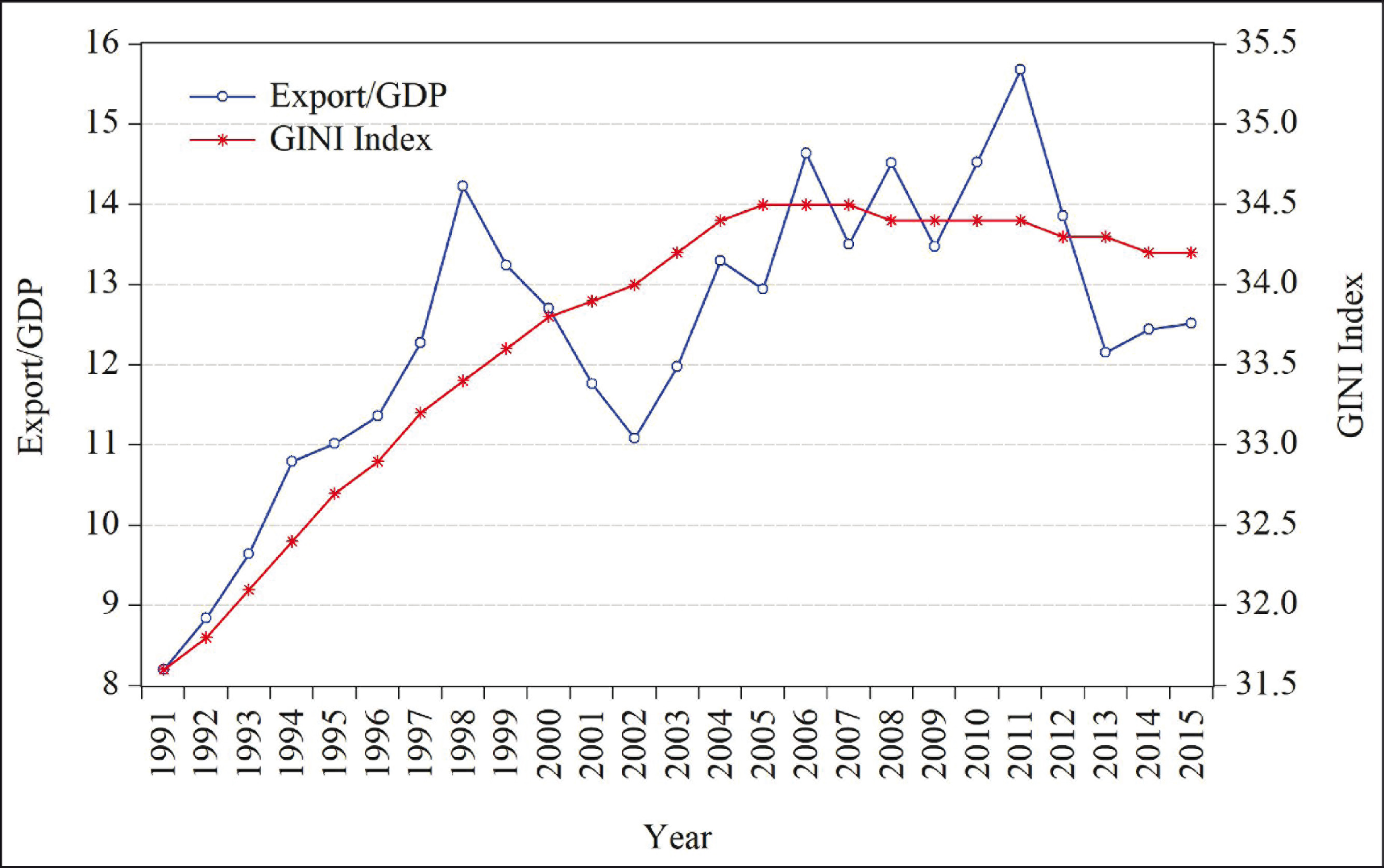
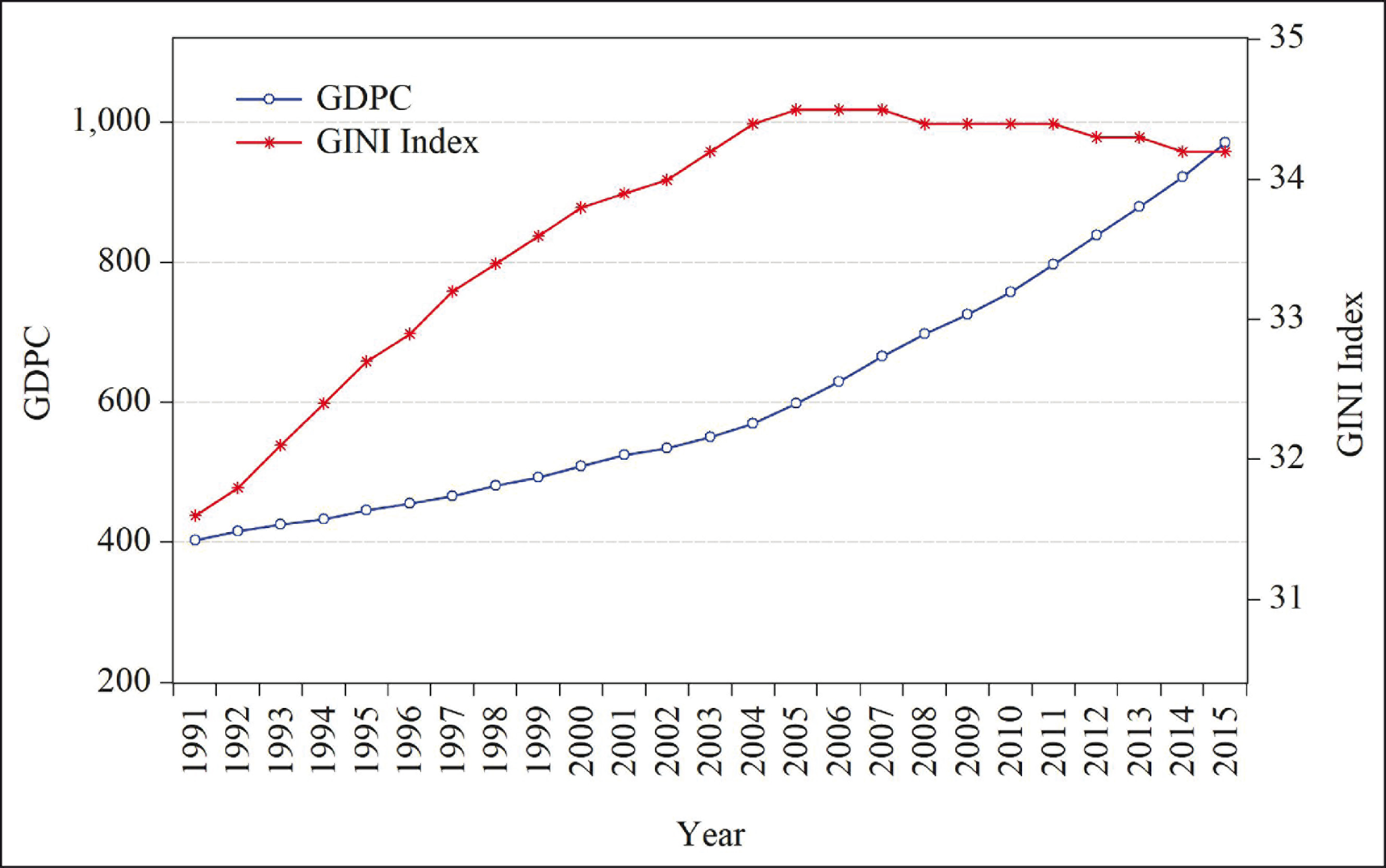
Figure 2 shows the trends in T&G exports as a share of GDP and income inequality (measured by Gini index) in Bangladesh for the period 1991–2015. The figure shows that T&G exports as a percentage of GDP increased from 8.2% in 1991 to 14.2% in 1998. However, there was a declining trend from 1998 to 2002. This decline may be attributed to fear of the phase-out of the MFA and the world textile recession of the mid-90s. Bangladesh’s T&G exports declined further over the period of 2011 to 2013 due to various deadly incidents (such as Garib and Garib Garments and Hameem Group’s Factory fire in 2010, Tazreen Fashion fire in 2012, and Rana Plaza collapse in 2013) and subsequent withdrawal of orders by some foreign buyers. A glance at the trend in income inequality indicates a rising pattern until 2007 and a declining pattern thereafter. By looking at both trends, there seems to be positive relationship between export and income inequality that supports our motivation for researching the effects of exports on income inequality in Bangladesh. However, when we look at the trends in economic growth (proxy of GDP per capita), as in Figure 3, the continuously increasing trend of economic growth and a mix of increasing and decreasing trends in income inequality leads us to hypothesize the existence of a Kuznets curve in Bangladesh.
Literature Review
In recent times, much research has been dedicated to understanding the effects that liberalization policies may have on income inequality. The effects of liberalization policies on income inequality have usually been documented in the literature from three perspectives: financial liberalization, institutional or political liberalization, and trade liberalization. Chong and Calderón (2000) found that institutional quality has a positive connection with income inequality in developing countries, but the opposite result holds for developed countries. Batuo and Asongu (2015) used panel data of 26 African countries for the period of 1996–2010 and reported an inverse relationship between political liberalization and income inequality. Sehrawat and Giri (2015) recorded that economic growth, financial development and inflation increases income inequality in India. Bumann and Lensink (2016) suggested that countries with high financial depth will experience declines in income inequality under financial liberalization.
The empirical evidence on the effects of trade liberalization on income inequality is ambiguous. The most important and fundamental economic theory explaining the relationship between trade liberalization and income inequity is the Stolper-Samuelson (SS) theorem. The SS theorem is based on the Heckscher-Ohlin (HO) model, which rests on the concept that trade primarily occurs due to different factor endowments. The HO theory posits that trade openness would result in the specialization of production, as per the principle of comparative advantage and an upsurge in the trade partners’ national incomes. In line with the HO model, the SS model posits that trade openness will reduce income inequality in developing nations, which have an abundant supply of unskilled labour. However, it will widen income inequality in developed countries, which are characterized by highly skilled labour forces. An analysis of the literature shows that there are a number of studies that support the SS argument (Calderón & Chong, 2001; Reuveny & Li, 2003).
However, empirical evidence from many studies contradicts the SS theory. The skill premium model argues that trade liberalization provides a wage premium to high-skilled workers, which gives rise to wage inequality in developing countries (Bourguignon & Morrisson, 1998; Feenstra & Hanson, 1996; Savvides, 1998; Wood, 1997). Hanson and Harrison (1999) studied the consequences of trade liberalization in Mexico and found that it widens the wage-gap in the country. Milanovic (2005) reported evidence that the main beneficiaries of greater trade in the least developed nations are the rich. Galiani and Sanguinetti (2003) observed that trade liberalization widened wage inequality in Argentina. Meschi and Vivarelli (2009) showed that trade with developed nations has a negative impact on income distribution in developing nations, through both exports and imports. They argued that the interplay between trade liberalization and the adoption of technology is an important mechanism that fixes the levels of income differentials during the liberalization processes of developing countries, through the skill premium effect. Gourdon et al. (2008) found that trade openness widens income inequality in countries with an abundance of highly skilled labour and capital, or in countries with an abundance of labour but very low education levels. Le et al. (2020) studied a balanced panel of 90 countries divided into three sub-samples and found the evidence of positive association between trade liberalization and income inequality across all the three sub-samples.
Instead of trade openness, many researchers have also used exports as a share of GDP to investigate their effect on income inequality. Prechel (1985) presented the hypothesis that exports enhance income inequality significantly more in developing countries than in developed countries. He also indicated that income distribution worsens even further at the later stages of development in less developed countries when export-led production is pursued. Wei and Wu (2001) used data across Chinese regions over the period 1988–1993 and reported that exports decrease income inequality in both the rural and urban regions of China. Barlow et al. (2009) found that exports significantly raise inequality in transition economies. However, they recorded that the effects of exports on inequality are less pronounced than those of both privatization and price liberalization. Halmos (2011) found evidence in eastern European countries that the introduction of new technology by domestic investors contributes to upsurges in the returns on skilled labour, thus enhancing inequality. Yasushi (2017) reported that exports as a share of GDP has an inequality reducing effect in the case of low-income developing countries, but no significant effect was detected in the case of high-income developing countries. Georgiev and Juul Henriksen (2019) studied firm level data of Denmark and reported that exports increase the within-group wage inequality, whereas between-group inequality is unaffected. Zhu et al. (2020) studied regional income inequality based on exports and income survey data of China and found that upgrading export activities reduce income inequality only in urban areas of China.
However, the question of how exports respond to income inequality in an economy whose exports are highly concentrated in a single sector remains unanswered in the previous literature. This motivated us to initiate this study and assess the effects of exports on income inequality in Bangladesh, whose export share is highly concentrated in the T&G sector. The current study augments the literature by empirically testing the hypothesis that the export sector of a country being concentrated on a single industry widens income inequality, focusing on the highly concentrated textile and garment sector of Bangladesh.
Methodological Approach
We empirically investigated the effect of exports on income inequality in Bangladesh, following a time series approach using annual data for the years 1991 to 2015. We measured income inequality based on the Gini coefficient, whose value ranges from 0 to 100. A value of 0 represents perfect equality, while a value of 100 implies perfect inequality. The data on the Gini coefficient were obtained from the Standardised World Income Inequality Database (SWIID) (Solt, 2009). Instead of total exports, we took exports from the T&G sector in Bangladesh, because this sector contributes to more than 90% of its export share. The inclusion of T&G exports in our model helped us to measure how exports contribute to income inequality in a country whose exports are highly dependent on a single sector. T&G exports as a percentage of GDP was used to measure their effect on income inequality.
Income inequality is heterogeneous, as its intensity and diversity vary by income level. (Chauvel, 2016; Odusola et al., 2017). As such, factors affecting income inequality are neither homogeneous nor universal. Since the main objective of this article is to explore the effect of Bangladesh’s T&G exports on income inequality, we tried not to derail from our main objective by addressing all the possible factors of income inequality. In order to control for drivers of income inequality other than T&G export, we took other explanatory variables into consideration following a detailed analysis of the existing literature (see Table 1). GDP per capita is introduced in the model as a control for development, as income distribution in a country may be affected by the stages of economic development. We added the quadratic term of the per capita GDP as a control variable in order to test whether a curvilinear relationship between development and income inequality exists (Kuznets, 1955).
Description of Variables

It is quite difficult to isolate the effects of foreign capital inflows on income inequality. Given that, we included the foreign capital inflows as control variables following the empirical literature, including FDI (Alderson & Nielsen, 1999; Chintrakarn et al., 2012; Khan & Nawaz, 2019), remittance (Acharya & Leon-Gonzalez, 2012; Acosta et al., 2008; Adams, 1989; Barham & Boucher, 1998; Shams & Kadow, 2020; Taylor & Wyatt, 1996; Zhu & Luo, 2008) and ODA (Chong et al., 2009; Herzer & Nunnenkamp, 2012; Younsi et al., 2019). As the data of foreign capital inflows in T&G sector are not available separately, we took the total foreign capital inflows in the country. In this study, the basic form of the estimation model used to establish the influence of exports, along with other explanatory variables, on income inequality is developed as follows:

where GINI is the Gini coefficient, EX is T&G exports as a share of GDP, GDPC is the per capita GDP, GDPC2 is the quadratic term of the per capita GDP, and F is foreign capital inflow variables, such as foreign direct investment (FDI), remittance (REM), and official development assistance (ODA). All of the monetary variables are in real terms with a base year of 2010.
Although there are a number of methods available to assess long-run estimates of variables based on time-series data, we used the autoregressive distributed lag (ARDL) bounds testing approach to cointegration. The ARDL model was first proposed by Pesaran and Shin (1998) and extended further by Pesaran et al. (2001). The ARDL approach enjoys a number of econometric advantages compared to other traditional models, that is, Engle and Granger (1987), Hansen (1982), Johansen (1988) and Johansen and Juselius (1990). This approach does not necessarily require the variables of equal order to be cointegrated. Thus, it is possible to apply this method when we have variables that are cointegrated with similar or mixed orders. Another benefit of using the ARDL model is that it can provide relatively efficient results, even when the sample size is small. However, the main shortcoming of the ARDL model lies in its inability to provide robust results when we have an I(2) series.
Based on the unrestricted error correction mechanism (UECM), the ARDL approach for estimating the long and short-run relationships between variables takes the following form:

where Δ is the operator of first-difference, ln implies the transformation of variables into natural logarithms, α0 is the intercept term, t represents the time, α1,α2,α3,α4,α5 indicate the short-run dynamics of the model, and β1,β2,β3,β4,β5 are the long-run coefficients, while εt is the white noise error term. These are intended to fulfil all of the fundamental assumptions of the classical model of linear regression.
The bounds test is applied to investigate whether there are long-term relationships between the variables, specifically whether the equilibrium relationships prevail. The joint F-statistic of the bounds testing approach are examined under the null hypothesis of no cointegration, that is, H0: β1 = β2 = β3 = β4 = β5 = 0 (no cointegration) against the alternative H1: not H0 (cointegration exists). The F-statistic generates two sets of critical values (Pesaran et al., 2001). If the calculated F-statistic is within the bounds, then the inference is inconclusive. If it goes below the lower bound, the null hypothesis of no-cointegration is accepted. Contrarily, if it crosses the upper bound, then the null hypothesis is rejected, and this implies the presence of long-run cointegration between variables in the model. We can then estimate the long-run model.
In this study, the orders of the ARDL (p, q1, q2, q3, q4) model are designated based on the Akaike information criterion (AIC), as it gives a lower prediction error compared to the SBC model (Shrestha & Chowdhury, 2005). Once the optimal lag orders of the ARDL model have been established and the long-run effect is estimated, we can then generate short-run dynamics based on the error correction mechanism (ECM) and the long-run coefficients. The ECM based model is defined as follows:
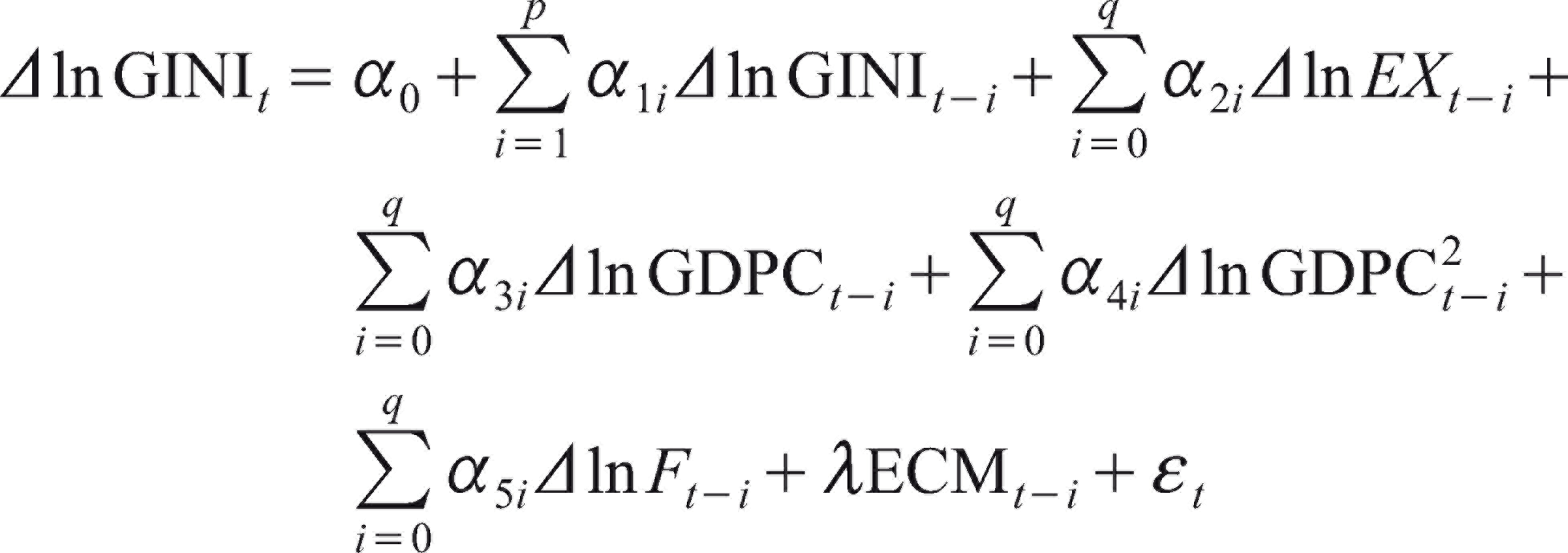
where λ is the adjustment speed and ECM is the error correction term resulting from the verified long-run estimates. The error correction coefficient (λ) typically falls between –1 and 0. A value of less than zero implies the convergence of the short-run dynamics to the long-run cointegration relation, while a value of zero indicates the no convergence once a shock has arisen in the process.
We further verified and validated the results of the ARDL model using a series of diagnostic and stability tests. These tests include the serial correlation, heteroscedasticity and normality tests of the models. Finally, the cumulative sum of recursive residuals (CUSUM) and cumulative sum of squares of recursive residuals (CUSUMSQ) tests were applied with a view to analysing the structural stability of the estimation equation.
Empirical Results and Findings
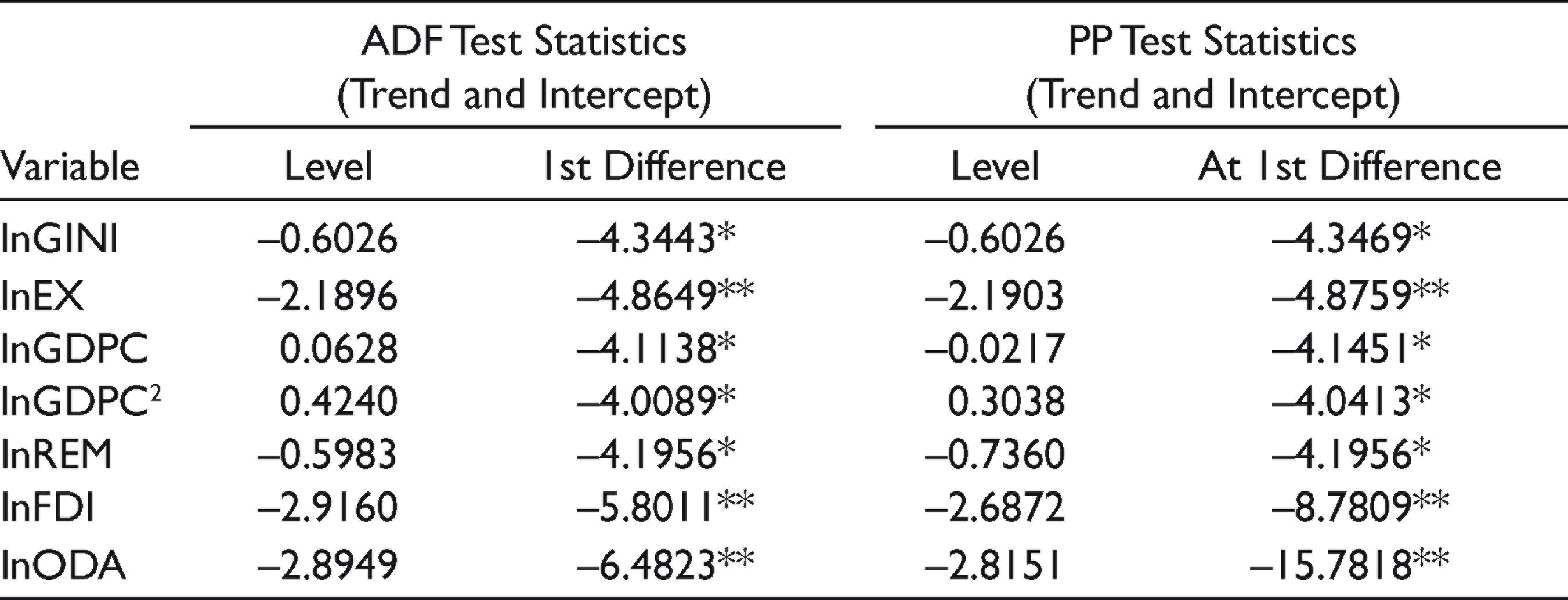
The ARDL cointegration presented by Pesaran et al. (2001) is said to be valid if we have variables that are cointegrated through the order 0 or 1, or a mixture of both. The series cointegrated with order 2 or higher are not valid when running the ARDL model. To confirm the above condition, we applied both the augmented Dicky–Fuller (ADF) (1979) and Phillips–Perron (PP) (1988) unit root tests and the results are shown in Table 2. Our results confirm that the variables are non-stationary at level, but stationary at the first difference. Thus, we can apply the ARDL bounds testing approach to investigate the existence of cointegration relationships between the variables.
Results of ADF and PP Unit Root Tests
The results of the ARDL bounds tests are summarized in Table 3. Evidence from Table 3 confirms the cointegration relations as the F-statistic goes above the upper bound at the 5% significance level. Accordingly, the null hypothesis of no cointegration cannot be accepted, implying that a long-run cointegration relationship exists between the variables. The appropriate lag structure was designated based on the AIC principle.
ARDL Bounds Testing to Cointegration
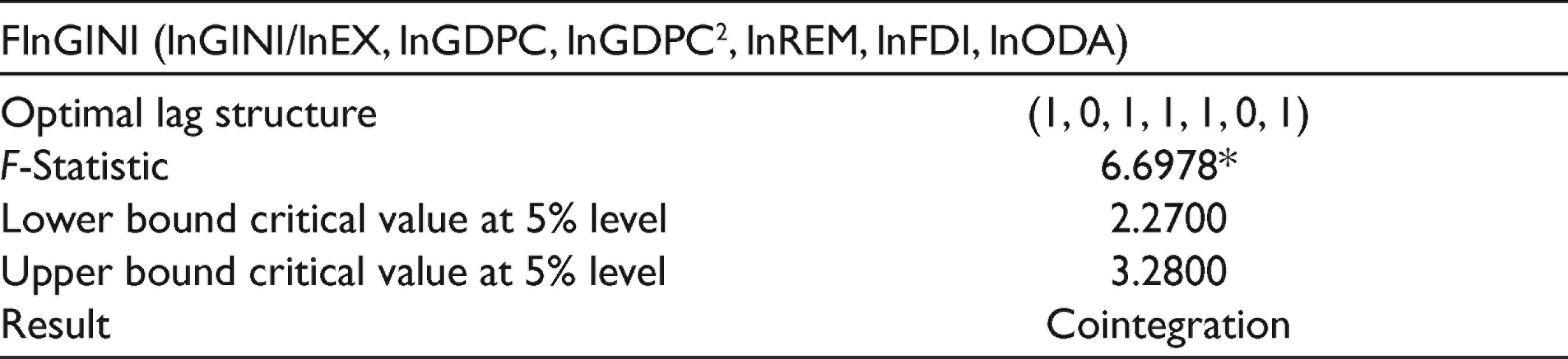
Optimal lag structure is based on the Akaike information criterion.
Before estimating the short and long-run models, we plotted the curvilinear relationship between lnGINI and lnGDPC to test the possibility of the existence of a Kuznets curve in Bangladesh, as shown in Figure 4. The fitted quadratic curve exhibits an inverted U-shape relationship between economic growth and income inequality for the period 1991–2015, which enables us to infer the existence of a Kuznets curve in Bangladesh.

After confirming the cointegration relationship between the variables, we estimated both the short and long-run models. The long-run obtained estimates using the ARDL approach are shown in Table 4. The results reveal that the increase in exports (lnEX) is associated with the rise in income inequality (lnGINI) in Bangladesh. The long-run model reveals that income inequality rises in the initial stages of economic growth (lnGDPC). The sign of the quadratic term was found to be negative, which confirms a fall in income inequality after a certain threshold level of growth was reached. This result thus confirms the validity of the Kuznets hypothesis in Bangladesh.
An increase in the remittances (lnREM) will reduce the widening effect of income inequality, which is in line with previous studies (Shams & Kadow, 2020; Taylor & Wyatt, 1996; Zhu & Luo, 2008). This is due to the larger participation of the poor in the migration process. Every year, more than 400,000 workers from Bangladesh migrate for overseas employment (ILO, 2018). Remittances from more than 10 million citizens abroad have become a major contributor to the Bangladeshi economy and reduce income inequality. On the other hand, official development assistance (lnODA) and foreign direct investment (lnFDI) have an insignificant negative effect on income inequality.
The ECM was applied to check the short-run relationship between variables. The results of the short-run dynamics along with the ECM are presented in Table 4. The results reveal that the lagged error term (ECMt–1) is significant and negative, which ensures the long-run relationship between the variables and indicates the adjustment speed between short-run dynamics and long-run coefficients. The short-run results show that exports, per capita GDP, remittances and official development assistance reduce income inequality in the short-run. On the contrary, FDI widens income inequality in the short-run. The short-run estimates indicate the invalidity of the Kuznets hypothesis in the short-run, as the quadratic term of the per capita GDP has a positive sign and a significant p-value. This finding from the short-run estimates is in line with the studies presented by Ali et al. (2017), Nasir and Rehman (2011), and Saboori and Sulaiman (2013).
Long-run and Short-run Results

Diagnostic and stability tests associated with the ARDL model were carried out to investigate whether the residuals are independent of the fitted model. The residuals must be independent for us to obtain robust results from the ARDL model. Diagnostic tests of the estimated model in terms of serial correlation, heteroscedasticity and normality tests were carried out and the results are summarized in Table 5. At the 1% significance level, the Lagrange multiplier (LM) test for serial correlation specifies the non-existence of serial correlation and the autoregressive conditional heteroskedasticity (ARCH) test implies the non-prevalence of heteroscedasticity. Evidence from the diagnostic test results also reveals that the null hypothesis of the multivariate normal distribution is accepted at the 1% level of significance, which implies that the ARDL residuals are distributed normally.
Results of Residual Diagnostic Tests

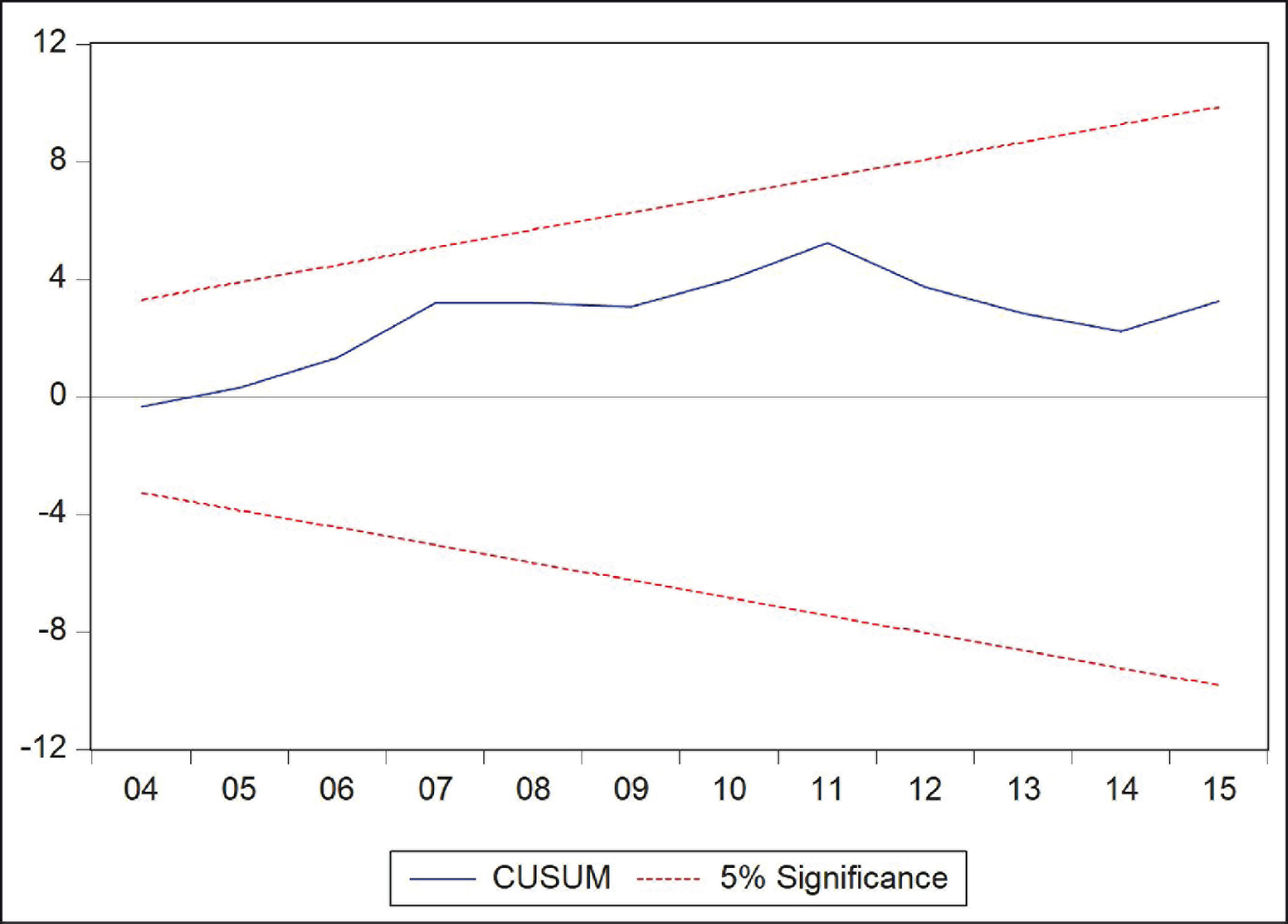
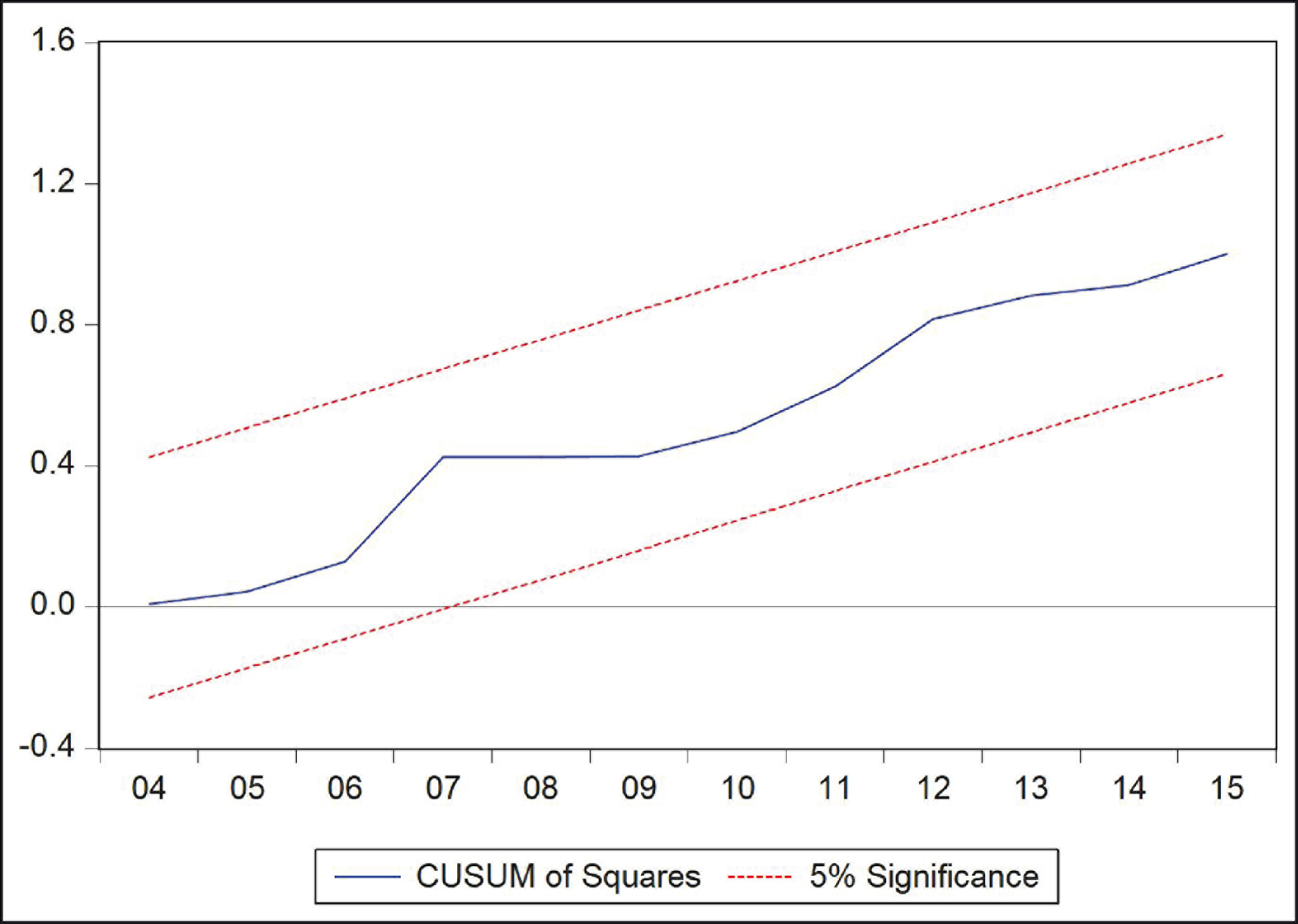
Finally, the CUSUM and the CUSUMSQ tests were applied to confirm the existence of the structural stability of the ARDL estimation equation. Figure 5 shows the results of the CUSUM and CUSUMSQ tests. As shown in Figure 5, the CUSUM and CUSUMSQ statistics fall inside the critical bounds at the 5% significance level, indicating the stability of the long-run estimates. Based on this, the error-correction term was generated based on the short-run estimates. As the parameters in the estimated model appear to have a stable pattern over the study period, the model validates our hypothesis from a Bangladeshi perspective.
Conclusion
In this study, we investigated the effects of T&G exports on income inequality in Bangladesh. Our focus was on this single sector, rather than using the total export data for Bangladesh, because we hypothesized that the export sector of a country, being concentrated to a single industry, will widen income inequality. Using time series data over the period 1991–2015, we applied the ARDL approach to investigate the long-run relationship between income inequality and T&G exports.
The key findings of the study are as follows: The results of the bounds tests indicate that there is long-term relationship between variables. The significant positive sign of the regression estimates reveals that exports from the T&G sector widen income inequality in the long run. This finding seems to have several implications. First, when the labourers in an export sector are more skilled and highly paid than those of other industries, increases in exports can raise the incomes of T&G workers, which can widen inequality. Second, an export sector dominated by a single industry can cause inequality by rewarding and encouraging the development of stakeholders in a specific industry in the short term. Third, the higher degree of agglomeration of T&G firms is in just two cities (Dhaka or Chittagong), which disturbs the process of equal income distribution in Bangladesh. Policies on export diversification are necessary so that people from other sectors can also engage in export-based income generation activities. Furthermore, the government should motivate new firms to establish their production facilities in the northern part of Bangladesh, where there is an abundant supply of cheap labour, but no industrialization initiative is observed.
Our results also suggest that economic growth has the effect of raising income inequality, while the quadratic term is negative, which confirms the Kuznets hypothesis in the case of Bangladesh. This result indicates that continued economic growth after a certain threshold level is reached will reduce income inequality in Bangladesh. Another significant discovery of the study is that an increase in remittances will reduce the widening of income inequality. This is due to the larger participation of the poor in the migration process. Remittances from more than 10 million citizens abroad have become a major contributor to the national economy and reduce income inequality in Bangladesh.
It would be interesting to look at the issues of working condition and gender wage gap using the firm-level based micro data analysis from the perspective of our research finding, but we do not address such issues because of the data reasons. We suggest that similar studies should also be conducted in other regions or countries whose export sector is highly concentrated, considering different time periods and using more recent data of both firm and country level. Moreover, it would be worth controlling for productivity differences depending on the latest technology used or the skill of labour in the sector, an issue we do not tackle due to data scarcity.
Footnotes
Declaration of Conflicting Interests
The authors declared no potential conflicts of interest with respect to the research, authorship and/or publication of this article.
Funding
The authors disclosed receipt of the following financial support for the research, authorship, and/or publication of this article: This work was supported by the Ministry of Education of the Republic of Korea and the National Research Foundation of Korea (NRF-2018S1A5B8070344).