




Abstract
In the multilingual, multicultural emerging economy of India, the language debate may seem to have settled with the adoption of the Three-Language Formula in the first National Policy of Education 1968. However, 50 years later, does this policy still hold? Has research on language acquisition informed our education policy and classroom practices, at the school level and the system level?
This research attempts to understand how language practices manifest themselves in an urban middle-class English-medium school with multilingual and non-English-speaking students. We examine the students’ communicative practices to uncover some of the patterns in language acquisition across three primary grades and two income levels, using empirical data from survey questionnaires, classroom observations, videography and closed- and open-ended interviews. We present some hypotheses and analyse these against the organisational structure and culture of the school and the larger socio-economic and political context of the education system.
The findings suggest that strict compartmentalising of languages for learning, at the cost of isolating social and linguistic identities, is likely to be counterproductive and unsustainable. The sooner we adapt our education policies and practices to support the multilingual practices of students and by association, their diverse identities, greater the possibility of building a strong and confident citizenry.
Keywords
Introduction
Language is an integral part of our social existence and marks its presence in every domain of life. Yet, two interrelated facts about language and its sustaining power evade us and have crucial implications for society and education. First, languages are fundamentally porous, fluid and continuously evolving systems that human beings acquire and change to define themselves and the world around them (Agnihotri, 2014). Second, multilinguality is a norm, not an exception. Notably, each of the 29 Indian states is multilingual with the 1991 census recognising 1,576 classified ‘mother tongues’ spoken across the country. We have a ‘linguistic repertoire’ that enables us to engage in multilingual languaging—to move easily between language systems that have some common and some unique characteristics. But multilinguality and the porous nature of language suggest that languages are constantly evolving and interacting in a dynamic process. Thus, no language can be ‘pure’. In fact, the pursuit of purity in a language is untenable and will probably lead to its loss.
However, the Indian education policy on language is by and large flouting the above-stated first principles. Although there are 33 languages used in education in India, including English, and 41 languages which are available for study in school (NCERT, 1993), monolingual and monoglossic 1 language ideologies, policies and practices are imposed by the state and schools. As Mohanty (2006, p. 279) puts it, ‘education in India is only superficially multilingual, and it remains monolingual at an underlying level. The official three-language formula is more abused and less used’. The NCERT (2006, p. 12) position paper on English language teaching notes, ‘linguistic purism must yield to a tolerance of code-switching and code-mixing if necessary’. The position is rather careful by advocating a ‘tolerance’ rather than ‘acceptance’ of the natural fluidity between languages. If we truly recognise multilingualism, then we must recognise translanguaging, 2 a natural act performed by multilinguals accessing different linguistic features of autonomous languages to maximise communicative potential.
The purpose of this article is to inquire if there is a case for formally recognising and valuing multilingual communicative practices in Indian schools, by exploring both linguistic aspects and sociopolitical realities. To understand the linguistic aspects, we examine the patterns in the language acquisition of English among primary school students from middle-income to high-income families (largely Kutchi- and Gujarati-speaking families), primarily focusing on code-mixing. From the sociopolitical–economic point of view, we analyse the demand for purity, the ‘one medium, one school’ policy (NCERT, 2002), the role of English and examine the views of teachers and school administrators. Further, we will uncover some of the underlying patterns in language acquisition for this subgroup. Finally, we propose tangible solutions for leveraging the inherent heteroglossic multilingualism and transforming language awareness and attitudes in the education landscape in India.
A School and its Language Practices
School Selection and Background
There were four key reasons to focus on a middle-income, urban, elementary school: first, there is inadequate research available on language acquisition structures and patterns in this socio-economic group in an urban Indian setting compared to the large body of knowledge available on low-income groups. Second, sociologically speaking, it is imperative to understand where and how the process of English language acquisition becomes a mechanism for social class mobility even among the communities that occupy the narrow top-end of the economic pyramid. Third, the effect of ‘school processes’ on developing English proficiency would be significant, controlled through self-selection, as over 80 per cent of children come from non-English-speaking backgrounds. Finally, this contextual setting will allow a comparative analysis of English acquisition patterns across grades and income groups.
Given these factors, the study was conducted in Shishuvan 3 School, an Indian Certificate of Secondary Education (ICSE) Board English-medium school with 1,000 students in AY 2014-15, set up in 2001 by a private community–based Trust in Matunga, a high-density area in the urban cosmopolitan city of Mumbai. While 80 per cent of students have Gujarati and Kutchi roots, 100 per cent are multilingual with Hindi, Kutchi, Gujarati and English as their dominant languages. All teachers are female and belong to middle-class, English-speaking families, with a majority from the Kutchi–Gujarati sociolinguistic community. The school follows a participatory, democratic pedagogy and claims to have an integrated learning philosophy covering eight domains—cognitive, aesthetic, social, spiritual, emotional, cultural, physical and ethical—in pre-primary and primary schools.
School Structure and Processes
The school is structured as primary (grades 1–4), middle (grades 5–7) and high school (grades 8–10), each with its own Principal. There are three divisions in each grade, named Karma (K), Dhyaan (D) and Shraddha (S) with 28–35 students per division.
In the primary school, besides each division’s class teacher and subject teachers, there is a teacher-cum-manager (also called as a ‘Floating teacher’) who offers inputs to a new class teacher, conducts extra classes and manages timetables and external events. Middle school only has subject teachers. Subject experts, shared between primary and middle schools, work with subject teachers. Each division has a dedicated female teacher assistant. The classrooms are airy, spacious and well equipped. In the primary division, furniture is lightweight, movable and often arranged in a semi-circular fashion. Middle school has a grid-like seating, but the arrangement can be changed depending on session requirements.
The school has an additional division starting in fifth grade called ‘Neeti’ for Kutchi boys from economically weaker backgrounds and coming from distant parts of Maharashtra and Gujarat, who are accommodated in the school hostel. This classroom is located adjacent to other fifth-grade divisions. Students complete middle school in Neeti but are integrated in high school. Being Kutchi speakers from regional-language primary schools, they undergo a rigorous English remediation programme by Mindsprings, a private training company, during school hours. For other subjects, teachers are explicitly asked to communicate in English but be more accommodative of Kutchi. Since these 12-year-olds struggle with English, the new school environment and the hostel experience, the school provides two special support staff for administration and childcare/therapy to bring them up to speed with the mainstream.
The school’s systems, processes and cultural practices appear balanced between the ‘alternative’, constructivist approach and the ‘traditional’, didactic approach based on ‘visible’ observations made over the research period. This understanding is crucial in defining the nature of the interactive spaces to provide deeper insights into language transmission and acquisition practices in the school. Several processes suggest an attempt at a flat organisational structure such as addressal by first name for all, including teachers, heads of departments and principal, flexible timetables allowing situational adjustments, an open-door policy and an inviting principal’s room designed for collaboration.
Language Policy
All conversations inside and outside the classroom must be in English, except Hindi and Marathi sessions. Teachers demonstrate strict adherence to this policy. They also pretend ignorance when students speak in other languages. However, most informal zones (e.g., playground, peer conversations, art/dance/music sessions, staff room discussions, lunch breaks) involve all languages in varying degrees.
Theoretical Approach
In this study, we have relied on the innatist approach to linguistics as well as drawn from educational theories pertaining to language acquisition, as these offer a helpful basis for understanding and analysing multilingual communicative practices in schools. Our linguistic analysis will use theoretical frameworks offered by Chomsky, Krashen, Cummins and borrow from Agnihotri, García and others for the sociopolitical analysis.
Noam Chomsky (1965) proposed that humans have an innate ‘Language Acquisition Device’ (LAD), which helps to encode and decode sounds through underlying structured patterns creating a shared meaning for its users. These patterns have commonalities across languages (called ‘principles’) and unique identity markers (called ‘parameters’). However, the association between the orthographic symbols and their meanings is completely arbitrary. Although the treatment of LAD as a black box has been critiqued, there is broad agreement about the structured nature of language. Chomsky focuses on the commonalities, termed as Universal Grammar, and suggests that the goal of linguistic theory is to show that the diversity of linguistic phenomena is illusory (Chomsky, 1995). His interest is in the innate Universal Grammar that is biological and linguistically unique. Thus, for him, linguistically speaking, all children are equally competent and have innate potential. But from an educator’s perspective, such as of Krashen, Cummins and others, there arise questions that are relevant for schooling and learning, which go beyond the idea of innate potential and relate to interfaces such as those between language and education, between orality and literacy, between psychosocial factors and language development and, finally, the reality of linguistic diversity and plurality in lived experience (as opposed to the idea of universality of ‘a language’).
Building on Chomsky’s idea of innate language capability of humans, Stephen Krashen developed the theory of second-language acquisition in education (Krashen, 1982; Krashen & Terrell, 1983). He considers ‘acquisition’, the product of a subconscious process of natural communication, more important than ‘learning’, which is the product of formal instruction ‘about’ the language (e.g., knowledge of grammar rules). The consciously ‘learnt’ component performs a monitoring and correcting function, effective when three conditions are met—the second-language learner has sufficient time, is able to focus on form and correctness and knows the grammatical rules. The role and usefulness of such conscious learning are and should be limited to self-monitoring and self-correction in second-language learners (Schütz, 1998). Acquisition progresses when the quantum of second-language ‘comprehensible input’ received is one step beyond the current competence level, wherein acquisition of language structures tends to follow a natural predictable order where some structures are acquired early, while others late. Variables such as low motivation, low self-esteem and anxiety raise the ‘affective filter’, preventing the use of comprehensible input for the acquisition process. While this theory induced a spark in the field of second-language acquisition, it also furthered the idea of linguistic boundaries between languages.
Jim Cummins, in his studies of bilingualism (1979, 1984), also propagated the view of distinct languages but posited that the proficiency in two languages was not stored separately in the bilingual brain, and that each did not behave independently of the other. Basing his work on the innatist approach, he proposed the idea of the common underlying proficiency (CUP), hypothesising that knowledge and skills of different languages occupy the same part of the brain, reinforcing each other at the base (principles), while differing at the surface (parameters). Furthermore, Cummins stated that students in an additive bilingual environment succeed more than those engaged in subtractive bilingual environments (where the students’ first language and culture are devalued by their schools and society). While this conceptual framing has been immensely important to draw attention to and explain the human ability to build proficiency in more than one language and links the treatment of L1 to its effect on L2 acquisition, this view continues the perception of distinct languages with strong boundaries, that is, in terms of plural monolingualism or multiple monolingualism. Increasingly, the work of many researchers such as Agnihotri, Makoni, Heugh, Stroud, Garcia and others are arguing against this idea of distinct and strict compartmentalisation of languages and are embracing the fluidity and diversity of the human linguistic phenomena, albeit to varying degrees, substantiating these perspectives using neurolinguistic and cognitive studies conducted in recent years.
Ofelia García’s work raises important questions on the assumptions and practices in multilingual education programmes that are prevalent today (García, 2009; García & Menken, 2015). This involves developing an understanding of the ‘regulated’ language practices in schools to uncover the invisible hegemonic power wielded by some social groups over the others. She proposes that the Western scholarly ideas of additive and subtractive bilingualism are based on monolingual and monoglossic language ideologies and further argues that these are inadequate to explain ‘hybrid language use’ and the twenty-first century linguistic complexity. García asserts that when multilingualism and languaging multilingually are the normal modes of communication, then distinguishing between first and second language becomes difficult. Thus, bilingual language programmes, insistent on two separate languages, end up denying the complex and highly prevalent multilingual languaging practices. Heteroglossic discourses and practices that recognise multiple voices must be valued as these assert the functional relationship of languaging multilingually and break the cycle of power of one or two dominant languages. Giving India as an example of heteroglossia, she cites Pattanayak (2003, p. 129):
One of my students, an Oriya boy, married to a Tamilian, speaking English at home, lives in Calcutta in Bengali surroundings, where the children are brought up by a Hindustani ayah and a Nepali gurkha security man.
She further states that to truly recognise multilingualism, ‘we must recognize translanguaging, a natural act performed by multilinguals of accessing different linguistic features of so-called autonomous languages, to maximize communicative potential’ (Garcia, 2009, p. 140) and calls for multiple multilingual education, implying the intertwining of language practices as the modus operandi of schools that cater to heteroglossic ethnolinguistic groups.
Agnihotri (2014, p. 6), on the other hand, takes this further and states that ‘multilinguality subsumes the kind of biodiversity we associate with plants, animals and ourselves. It implies that the boundaries we construct between different languages are artificial and often sociopolitically motivated. In practice, language boundaries are porous and languages flow effortlessly into each other. It is not that there is X and Y and that there is fluidity between them; it is that human linguistic behaviour is fluid and this fluidity is multilinguality, constrained only by the highly abstract principles of universal grammar’. In this study, we will examine this phenomenon of fluidity in the communicative practices of multilingual children.
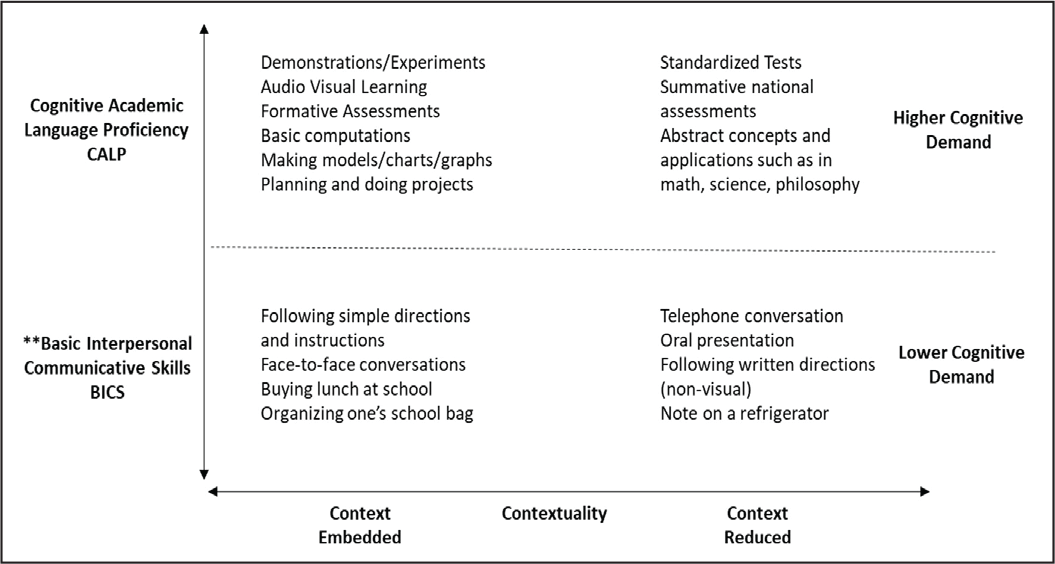
To bring focus on the communicative aspects of language proficiency, we turn to Cummins again who makes a distinction between basic interpersonal communicative skills or BICSs (conversational fluency) and cognitive academic language proficiency or CALP (oral and written academic fluency at the level of concepts and ideas), with the former being cognitively less demanding than the latter. Activities for both BICS and CALP can be developed in a continuum of contexts from heavily context-embedded to completely context-reduced settings. This matrix of contextuality against cognitive demand leads to the four-quadrant theory. Some examples of activities in each of these quadrants are described in Figure 1. Cummins argues that while BICSs are cognitively less demanding skills, these need to be acquired in both the mother tongue and target language (in case of bilingual education), but with CALP, which involves cognitively more demanding skills, it is possible to transfer these from one language to another with relatively less effort. We refer to this frame of BICS and CALP to clarify the boundary of this research to include BICS, but not CALP-related skills.
In this study, our aim is to uncover language ‘acquisition’ patterns in a multilingual urban primary school. For this, we will purposefully focus on multilingual practices for developing BICS (conversational fluency) in both context-embedded and context-reduced settings (Figure 1). Thus, we engage with students in activities like face-to-face conversations, following oral and written directions and answering a survey. These types of activities embedded with efforts towards ‘acquisition’ can provide insights into the innate and natural languaging practices of the students. We are not making any implicit assumptions that conversational fluency is a good indicator of ‘language proficiency’, but that it is, more than an add-on necessity, an integral and foundational component of language acquisition. We will use the term ‘proficiency’ within this context.
Study Design and Methodology
This study is based on a small sample size of students and uses both ethnographic research and quantitative (descriptive) research methods for analyses. The study was conducted over a 2-month period, involving 25 school visits, and focused on one division each of third, fourth and fifth grades and fifth grade Neeti. Surveys, interviews and observations were the three primary tools used to capture the language practices in the school. We also accompanied the students for a theatrical performance, which included use of several Indian languages and two storytelling events, one in English and one in Hindi during a public library visit as part of a weeklong ‘Literary festival’.
First, to understand the students’ overall language profile, a survey was conducted, covering languages that the students spoke with their parents and grandparents and the languages they spoke in school with their friends.
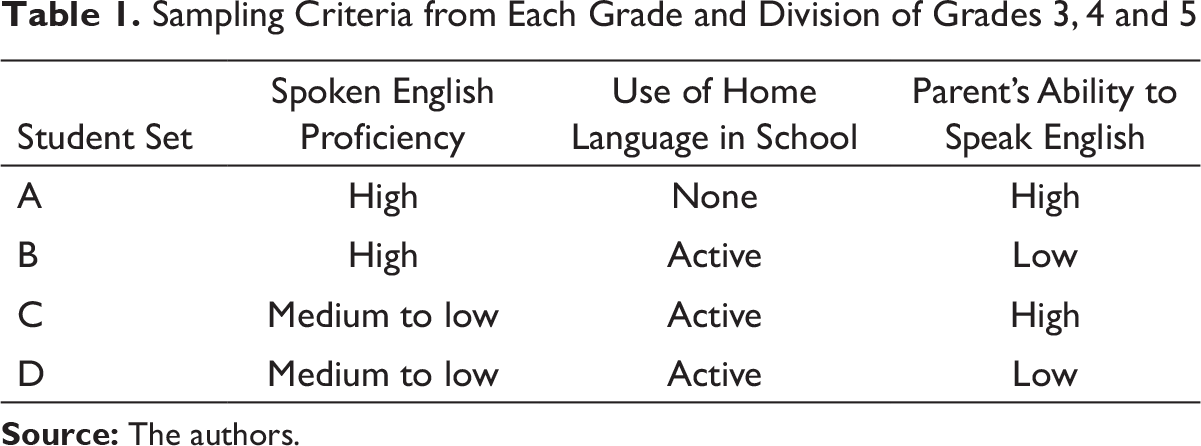
Second, interviews were conducted with 16 students, a set of four students selected from each division based on pre-defined sampling criteria used as control variables across grades (see Table 1). The criteria for selecting students was composed of three variables: proficiency in spoken English, active usage of regional/home language in school and parents’ ability to speak English. The interviews involved a spontaneous conversation starter, followed by audio recording of a conversation on familiar situations/objects/persons and broad topics such as climate change, favourite books and favourite places. More details regarding this will be provided in the following section.
Third, 14 pre-planned sentences were orally presented one by one to each of the 16 students, as part of the interview. These sentences were primarily in English, some having grammatical errors, some having code mixing with Hindi, or both. A few examples of sentences used were: ‘These people work hard magar they don’t get paid well’. 4 ‘You didn’t caught me!’ The purpose was to determine the degree of acceptability of such sentences by students and the reasoning filter applied by them to justify their response. More details on the linguistic rationale for the chosen sentences are provided in the following section on patterns of language acquisition. Each student was asked, ‘How does this sound to you? Would you accept this sentence? Why?’ Responses were accepted as ‘Okay/Not okay/Don’t know’ and the reasoning noted verbatim.
Sampling Criteria from Each Grade and Division of Grades 3, 4 and 5
Finally, several observations were carried out, both inside and outside the school. Class observations included both language periods (English, Hindi and Marathi) and non-language periods (Environmental Studies and Mathematics). Outside school, students were observed during the Literary Week over two story-reading sessions (one English and one Hindi) in a city library and during a multilingual children’s play (covering over 10 Indian regional languages and English).
Patterns of Language Acquisition: Observations and Analysis
Following are the key observations and analysis, which point us to multiple areas of field research:
1. Children exhibited an innate potential to understand the deeper structure of language. Performance of their communicative competence implicates highly systematic and complex mental representations rather than simply rule-based conjoining of sounds, words and sentences.
Interestingly, this is different from knowing the structure of a language, that is, in terms of a string of words put together in a sentence with some rules to make meaning. A sample set of 16 students, across grades and income groups, were individually asked to listen to the four sentences below one by one, in the same order and state how the sentence ‘sounded’, classifying them on a 3-point scale of acceptability (okay/not okay/cannot say). Here, acceptability was defined as a function of socialisation, the ability to understand and personal preferences. All sentences were code-mixed (Hindi and English) and conveyed the same meaning. But they were structured differently. Students could also suggest how they would formulate and convey the meaning implied in the sentence.
hum sab will be holidaying in Goa next month.
we all will be holidaying in Goa next month.
‘We will go for a holiday in Goa next month.’
next month, hum sab holiday karengE in Goa.
next month, we all holiday will do in Goa.
‘We will go for a holiday in Goa next month.’
next month, hum sab Goa main holiday karengE.
next month, we all Goa in holiday will do.
‘We will go for a holiday in Goa next month.’
next month, hum sab Goa main holiday manAnE jAyengE.
next month, we all Goa in holiday celebrate will go.
‘We will go for a holiday in Goa next month.’
In the first sentence, only the subject was in Hindi and the rest of the sentence was English; the verb ‘will be holidaying’ is a derivative of the noun holiday, and a prepositional phrase is used ‘in Goa’. In the next three sentences, the word ‘holiday’ is treated as a noun rather than a derived verb as in the first sentence. Also, the noun phrase ‘next month’ is used as a time adverbial followed by a comma to create focus on mixing up of the subject–verb in different ways. These make the first sentence distinctive from the other three sentences. In the second sentence, both the subject and verb are in Hindi, the base verb used is ‘karnA’ (to do), but we keep the prepositional phrase ‘in Goa’. The third sentence not only changes the subject verb but also changes the prepositional phrase as used in Hindi, while in the last sentence, the verb changes even further (manAnA, to celebrate) to indicate associative meanings with the words Goa and holiday. Thus, the linguistic choice of sentences was made in such a way that all the sentences were mixed, each was unique yet only incrementally different, especially due to the verb formation. The use of structural parts hum sab, ‘next month’, ‘in Goa’ and ‘holiday’ were consistent within the rules of that language but may not necessarily work well when taken together when moved around while also playing with the verb.
This is what we observed. All students, irrespective of their age or income level, exhibited the capability of distinguishing between the sentences. An overwhelming 85 per cent of the students (14 out of 16 students) consistently responded that sentence options 1 and 2 were ‘not okay’, while option 3 was ‘okay’ and option 4 was ‘best’. However, none could pinpoint the reason. The average response time was under 5 seconds (immediate).
Options 1 and 2 were characterised as ‘weird’, ‘wrong’, ‘sounds off’, ‘something isn’t okay’. A few offered justifications such as incorrect word use (‘holidaying’) or compared correctness using literal Hindi-to-English translation. 5 For option 3 and 4, they gave responses like ‘better’ and ‘sounds right’. While most students frowned upon mixing, older and more proficient students gave primary importance to meaning.
The objective and subjective responses indicate that although students had never been ‘taught’ sentence making in mixed coding, they exhibited no difficulty in asserting their discomfort with the first two options. The students’ superior and near-perfect understanding level of sentence structures exhibited a deep understanding of language in general than a language in particular, going beyond the covert grammatical structures using learnt concepts of verb, noun, etc., to an overt level of ‘knowing’ without ‘knowing why’. Further, when the same exercise was done with a group of adults, the responses were identical.
Significantly, this leads to a hypothesis that regardless of code-mixing, humans have an innate ability to recognise the deep-rooted structure of language, and that it cannot be reduced to simply sentences and words put together using grammatical rules. Further analysis of this hypothesis in the Indian classroom context with multilingual learners can call into question the second-language teaching practices prevalent in schools today, focusing heavily on grammar rules driven by curricular demands and textbook content. Research evidence is required to make specific recommendations for changes in curricular, textbook design and pedagogic practices. It further suggests that as language evolves, newer forms based on such hybridised structures can and do take shape, which, in turn, create new languages. But, only the interactions with society and its hegemonic forces would determine their future.
2. Language variability is seen across age and income groups in second-language acquisition and is a function of comprehensible input and affective variables.
The student survey conducted across the four divisions to determine trends in the spoken language profile shows both commonalities and differences. We present our findings in each grade and division individually and then compare across grades and income groups.
English was the official dominant language and Hindi the unofficial one. Each student spoke at least two languages and, on average, four. Living in an extremely crowded part of Mumbai, almost all students spent their time mostly around parents and, at best, grandparents, except at tuitions and during extracurricular activities. However, their interactions with the outside world (visitors, housekeeping staff, markets, etc.) constituted multiple languages.
In Grade 3 (Figure 2), the students’ average age was 8 years with at least 8 languages spoken among them. There was a high correlation between the home languages of both the child and parents, indicating that a high comprehensible input at home was having a significant positive effect on their language skills. Interestingly, only 50% of all students received some input in English and Hindi from their parents. The less dominant languages were not used in school at all.
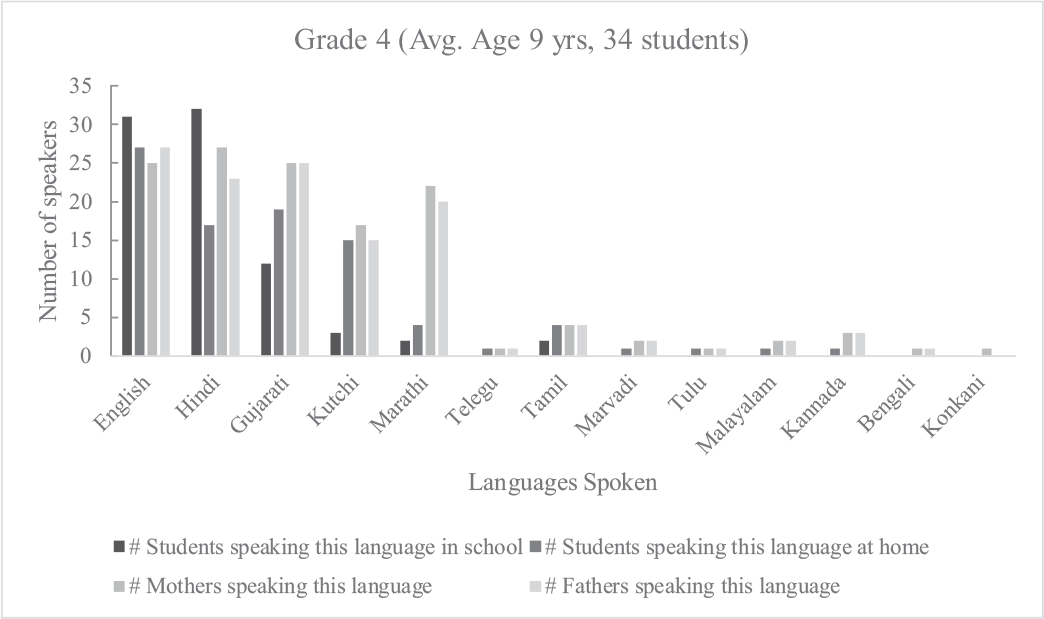
In Grade 4 (Figure 3), students’ average student age was 9 years with 13 languages spoken among them. Except the limited use of Gujarati, Kutchi and Marathi in school, no other native/home language was permitted. Compared to the third grade, the graph has shifted upwards for English and Hindi speakers, that is, more parents and children are speaking English at home. The number of students using English at home is lower than in school, indicating the use of other languages at home. The number of Hindi and English speakers in school is almost equal, indicating an increase of use of Hindi in school compared to Grade 3. Children of Marathi- and Gujarati-speaking parents have shifted away from their native tongue. Despite the multiplicity of languages, less dominant ones are not used in school at all.

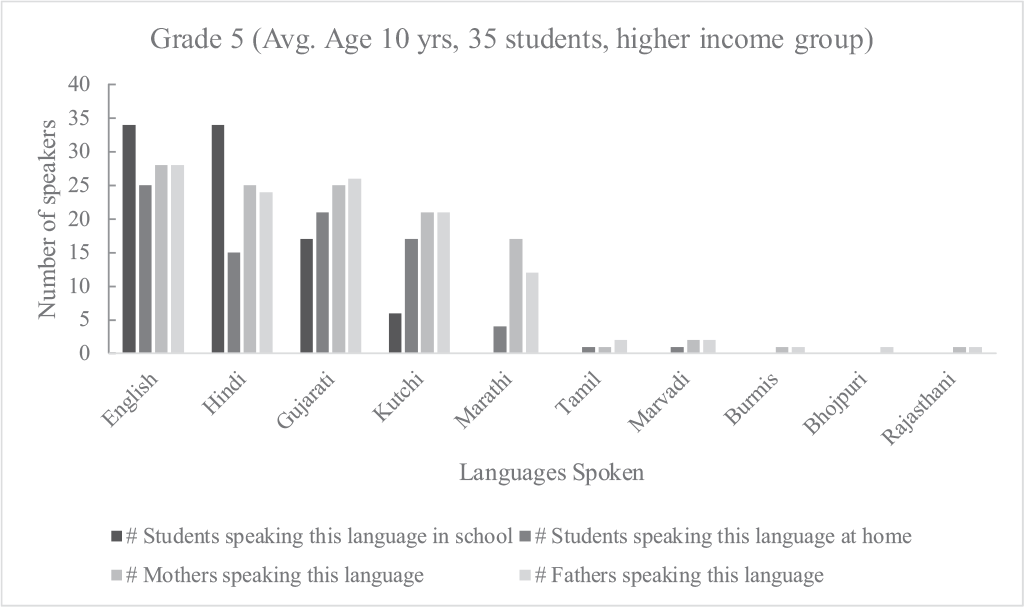
In Grade 5 Dhyaan division (Figure 4), the students’ average age was 10 years with 10 languages spoken among them. English and Hindi were primarily used in school. Most other observations paralleled Grade 4, only more accentuated. The number of students using English and Hindi in school is higher than Grade 4, and more parents are speaking English at home. The lack of use of native languages in school is even more prominent compared to the previous grades, giving credence to the idea that the school’s sociological process may be actively alienating students’ linguistic identity.
In the all-boys Grade 5 Neeti division (Figure 5), the language composition was much more consistent. Not surprisingly, Kutchi was the most dominant home language. Yet, it is to be kept in mind that these students live in an on-campus hostel. Less than one-third of the class spoke Hindi or English at home. These were treated predominantly as school languages. Interestingly, Hindi was the predominant school language for this group. Parents’ language was mostly aligned/overlapping with students’ home language. From the survey data and interviews, the affective filter appeared relatively higher for these students, which will likely affect their performance. This is likely because these 10-year-old boys come from economically weaker backgrounds from rural parts of Maharashtra and Gujarat, living for the first time in a hostel, in the megapolis of Mumbai, away from their families, some even stepping out of their town or village district for the first time. At the time of the survey and interviews, these children had been in a hostel environment, in a new city and a new school for the very first time and for just over 4 months. When asked what they liked and disliked about their new life and how they have adjusted in individual interviews, several students expressed sadness, anxiety and distress, shared their stories of missing their parents or other family members, the reasons for being sent here, challenges in adjusting to the restrictions imposed by hostel life like fixed sleep and meal times, etc. At the same time, many also expressed enthusiasm and joy towards learning, access to the playgrounds, the company of their classmates and expressed that they felt supported by the school’s programmes for language learning. Many students found it hard to communicate in a language other than Kutchi. More rigorous cohort investigations can help identify specific linguistic challenges that may be increasing or decreasing the affective anxiety levels of this student profile.
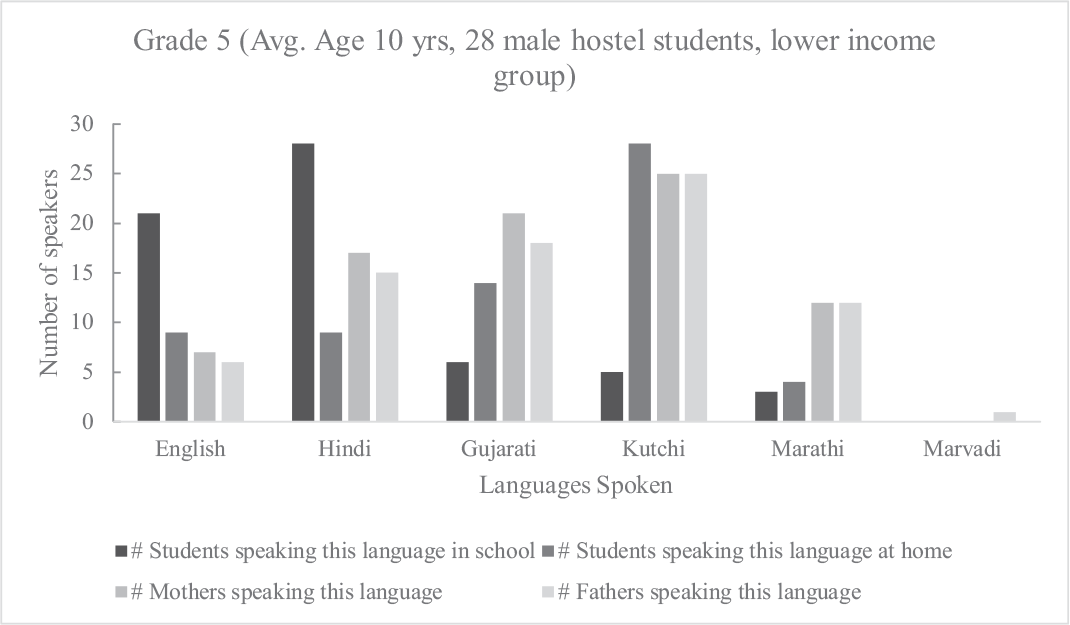
Overall, for all the grades, four observations can be made:
Both the parents’ home languages were moving in tandem, including English and Hindi. However, the number of children who spoke a certain language at home was always less than or equal to the number of parents who spoke that language. Moreover, this gap increased gradually from Grade 3 to Grade 5.
All the students were both acquiring and learning English. But as they grew older, those who received higher levels of comprehensible input for longer periods acquired it faster and better than those who did not, considering only communicative competence. Further, those students who faced relatively far greater psychosocial risks and received tailored but limited comprehensible input over a short time frame exhibited a higher affective filter to develop linguistic competence. This leads us to a hypothesis related to the speed of acquisition, that higher the comprehensive input received in a language and lower the affective filter, more likely the child will acquire the same faster. It is unclear, however, how increasing the input in the school language affects the acquisition and usage of home languages.
The minority home languages had no place in the school, where English and Hindi were predominant. From Grade 3 to Grade 5, use of native language decreased not only at school but also at home, barring the Neeti class. By Grade 5, all students mainly spoke English in school. Although subtractive bilingualism may seem to be at play, it is critical for researchers to determine the impact of the treatment of the students’ own languages in the school on the multilingual faculties of the individual, and the diverse communicative practices in families and communities.
Although a direct survey of the parents would further validate the survey data, all students who participated in the survey, even as early as Grade 3, predominantly demonstrated the ability to distinguish and recognise different languages in spoken form, especially the dominant ones (English, Hindi, Gujarati, Kutchi and Marathi), even when they could not always comprehend them. This is also an area that lends itself to further study.
3. There appears to be a relationship between language proficiency and code-mixing acceptability moderated by the age or grade of the student.
A small sample of four students (Table 1) was individually asked to accept or reject a mixed pool of 14 grammatically correct and incorrect sentences of pure and mixed form of Hindi and English and comment on their choice. Students of Set ‘A’ across grades 3, 4 and 5 were compared. Similar comparative analysis was done for students of set ‘B’, ‘C’ and ‘D’. For analysis purposes, we have defined three terms, Language Level, Grammatical Acceptance and Code-Mixing Acceptance. Language Level is a combination of a student’s language proficiency as determined by their subject/class teacher and Floating teacher, parents’ language ability and the use of home language at school, where proficiency is limited to spoken conversational English. Grammatical Acceptance is the extent of acceptance of a grammatically incorrect sentence even when the student could spot the error and suggest ‘correct’ change. Code-Mixing Acceptance is the extent of acceptance of code-mixing when she/he can spot the multiple codes being used. A summary of the patterns that emerged from the analysis is presented in Table 2.
The third-grade students considered incorrect grammar and code-mixing as ‘wrong’ and unacceptable, irrespective of the language level. Even students who were highly proficient in multiple languages were uncomfortable with mixing. A third-grade Language Level C student responded: Don’t mix up the languages. When you speak English, speak only English. When you speak Hindi, then only Hindi.
Relationship Between Language Proficiency and Acceptability of Code-Mixing Moderated by Age or Grade of Student
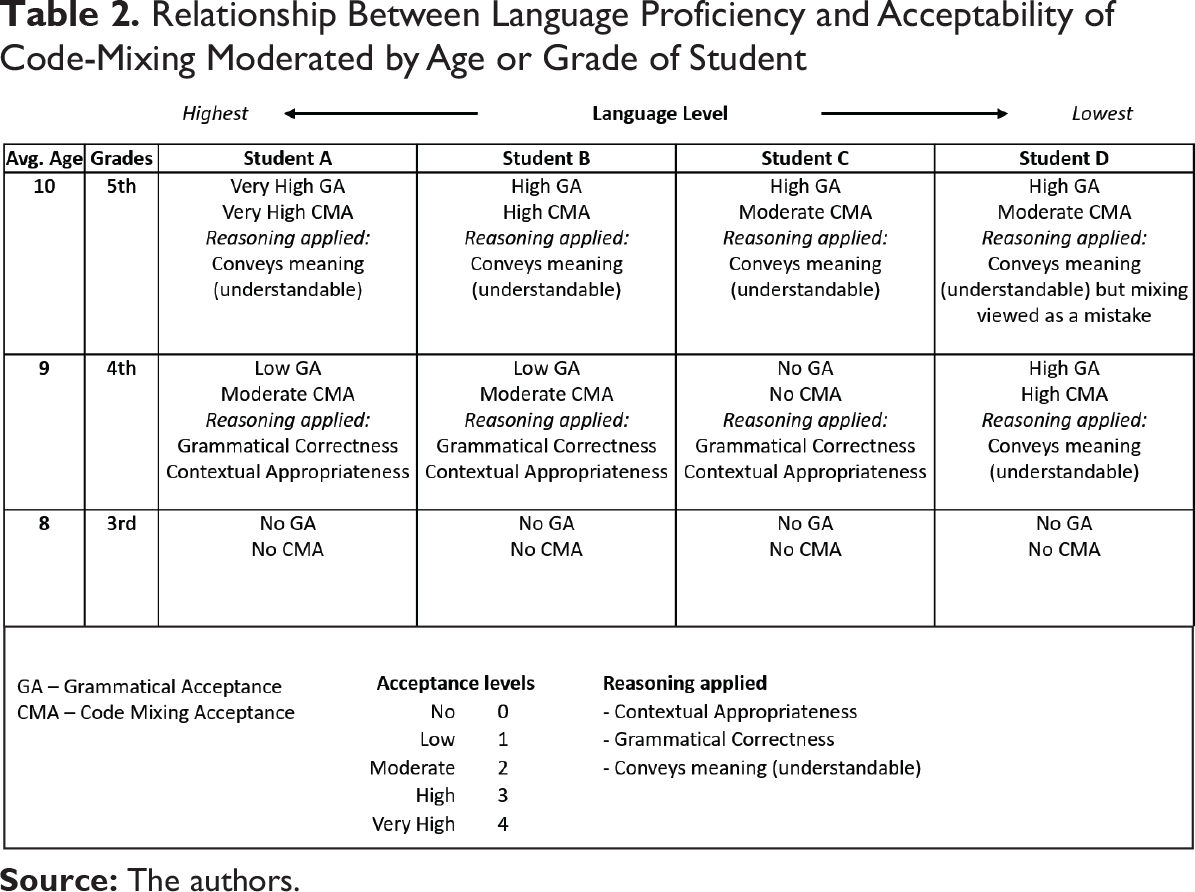
Three of the fourth-grade students exhibited a moderate, low and no acceptance for code-mixing and grammatical errors, reasoned through the lens of appropriateness. A fourth-grade Language Level ‘A’ student responded: I think we should not mix but I don’t know. In writing it’s not okay but in a play it is fine. I understand but I don’t think it’s correct grammatically. Student at Language Level D exhibited high acceptance of both grammar and code-mixing. This anomalous result needs further investigation.
The fifth-grade students had the highest grammatical and code-mixing acceptance, across grades. Also, the acceptance increased from Language Level ‘D’ to ‘A’. Although there were mixed views about code-mixing, students demonstrated acceptance based on ‘ability to understand’, ‘articulation’, sounding ‘right’ and making meaning. A Language Level ‘A’ student stated: If you can comprehend the sentence then it’s fine and a Level ‘D’ student said, Mixing is okay but only when it makes sense like Mujhe kitchen main se spoon chahiye. 6
Overall, a few observations can be made. First, the students having a higher language level (more proficiency in more than one language, including English) showed higher acceptability for deviance in that language, reasoned through the ability to understand meaning. Second, across grades, for students of the same language level, acceptability of code-mixing and errors increased with age. Students who were highly proficient in multiple languages were more comfortable with the idea of mixing, whereas students who had low or medium proficiency tended to be more rigid about the importance of the purity of language. This could indicate a natural and reasoned approach to code-mixing and grammatically ‘incorrect’ sentences in communicative and conversational language.
When there is a greater cognitive demand on the students for a task using their developing language ability, they may rely on stricter boundaries and codes of acceptance and correctness, but as their proficiency improves, the cognitive demand for the same task is lower, leaving room for a more flexible approach to acceptance and correctness. In other words, as children strengthen their multilingual abilities in cognitively less demanding activities of basic interpersonal communicative skills in a context-reduced setting, their focus shifts to understanding meaning and purpose rather than on purity. This leads to the hypothesis that with greater proficiency, there may be a greater innate acceptance of porousness of language in everyday life, and that this ability to some extent is moderated by the child’s age.
4. There was no link observed between oral speech and written script.
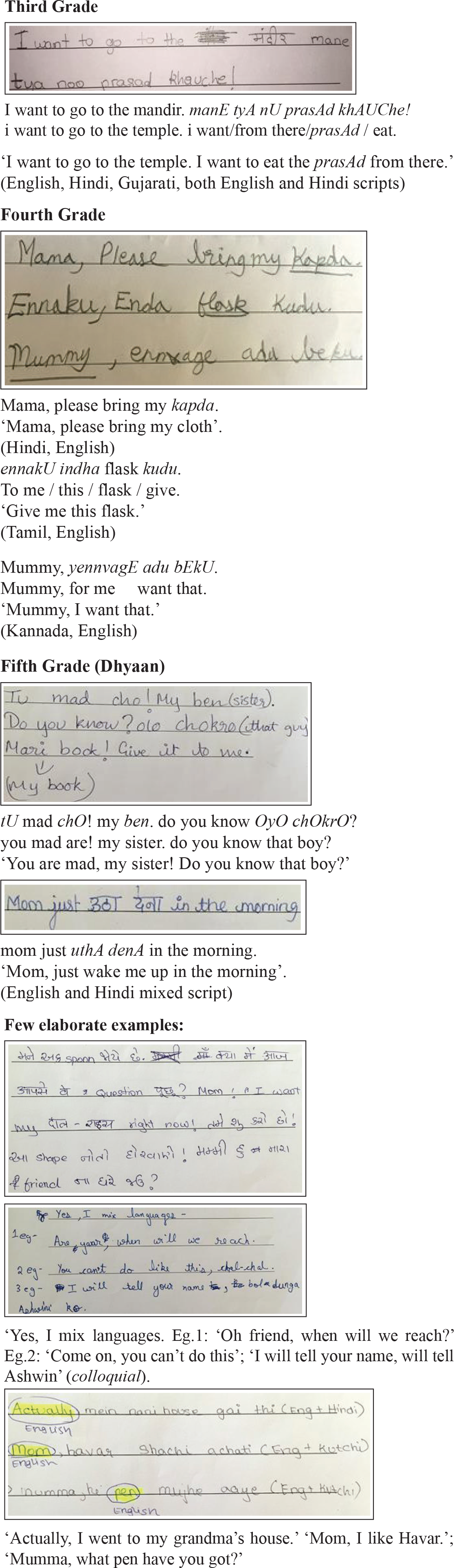
Students were asked if they mix any languages and, if so, to share examples in any script. During the survey and from the student writing sample analysis, 95 per cent of all students from all grades could write their home languages in English script with no help at all. Several students also chose their native script besides using Hindi. It is also notable that children chose and comfortably used the English script to write any language, with no instructional prompt. Some of the striking student writing samples are highlighted below.
First, children expressed their conversational use of language in different ways in Figure 6. In the example given below, five students, working independently, wrote sentences on the simple task of asking for water (Pani or paani), of which three are presented here.
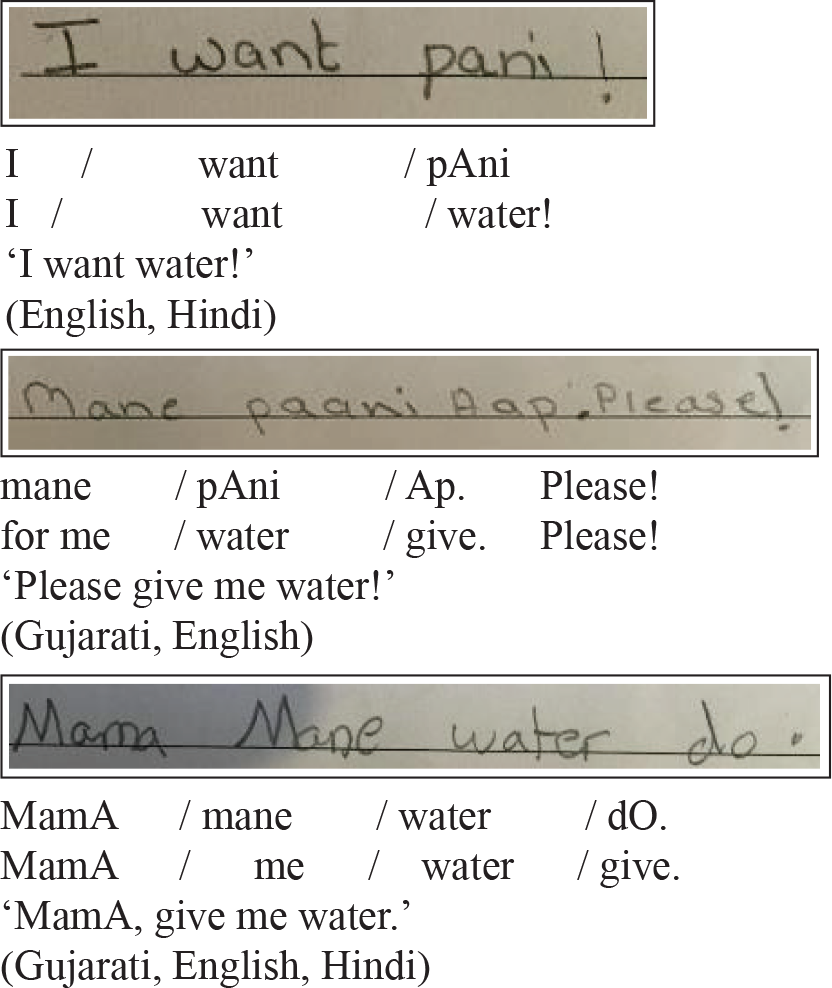
Second, the student writing samples allow us to form reasonable inferences about both code-mixing and choice of script. While some students used the formal language script, most were language agnostic and used the English script. With age and grade, students also proactively started identifying the different forms, meanings and languages they used in their examples.
Following are some samples with transliteration in Figure 7:
5. The interplay between the first language and the acquisition of English not only affects the students’ linguistic abilities but also affects the formation of their social identity providing them implicit clues about power structures built around language.
First, students speaking minority home languages (other than English, Hindi, Gujarati, Kutchi and Marathi) did not use these in the school setting at all. Second, the sound ‘Dh’ frequently used in Gujarati and Kutchi was stressed in the use of words such as ‘that’, ‘these’, ‘then’ as ‘Dhat’, ‘Dhese’, ‘Dhen’—by both students and teachers during conversations. Third, four students in Grade 4 preferred speaking Hindi and their home language, Gujarati, in school in spite of English fluency, in what appeared to be an explicit act of defiance to assert their identity, also confirmed by the class teacher. Also, few students commented on their experience of learning English in school and its implications at home (see Figure 8).
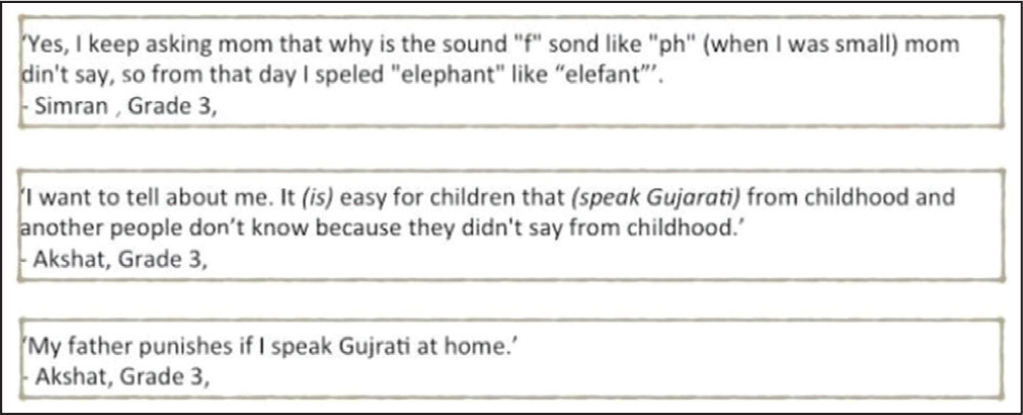
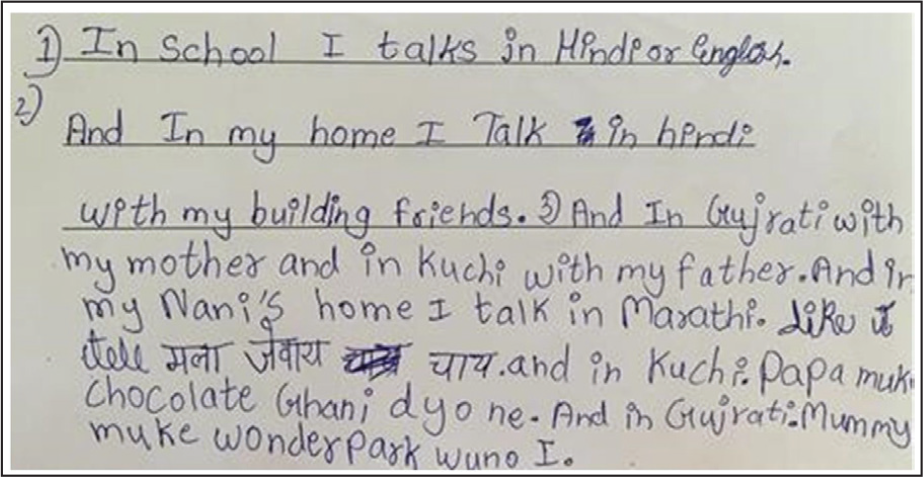
6. Subtractive monoglossic language practices were observed as there was no ‘official’ recognition of the fuzziness of language practices of its population and, hence, the potential of heteroglossic translanguaging remained unexplored.
The school follows the three-language formula, implying a monoglossic approach to language learning, where neither the fuzzy, porous nor fluid nature of language is recognised, nor are the multiple identities of children or adults.
Figure 9 clarifies a fifth-grade child’s experience of his/her multiple multilingual identities. A member of the Neeti class, this student is from a low-income Kutchi community, is away from home for the first time and lives in the school’s boys’ hostel. He not only shares the many languages he speaks but also implicitly conveys the contexts in which they are predominant. The fluidity of language use is exhibited in the sentence structure here as well as the complete delinking of language with script. At a meta-level, the child is expressing a cognitive recognition of the various autonomous languages he speaks—Hindi, English, Kutchi, Marathi and Gujarati—and through these, activating memories of his protective social linkages and identity with his family. But, in practice, his usage of language and script appears truly fluid and unrestricted, suggesting that these are emanating from an innate multilingual faculty.
Discussion
Children exhibit a deeper understanding of the innate structure of languages, in general, in conversational fluency. This leads us to argue that:
Code-mixing and code-switching are not ‘flaws’ in language learning and practice that need to be strictly corrected but are to be perceived and communicated as stepping stones to a more nuanced use of each language form on its own. This means that the various artefacts in school culture and the learning environment need to communicate that all languages are welcome, have differential usefulness and applications, and open the door to cultures and ways of being. While developing strong competency in one or more languages is essential, the acquisition process is a continuum with several dynamic feedback loops for improvement. Thus, mixing and switching are not only acceptable but also needed to move up to the next proficiency level. For building communicative and academic proficiency, there is a struggle to either choose a single-minded and systematic focus on one language, while negating the others from the environment, lest these become a ‘crutch’ or choose spiralled and scaffolded strategies that recognise translanguaging and hence recognise different languages and accept that multiple pathways can exist to support proficiency. The latter approach builds focus both on a single language and on mixing based on the application. For example, to learn how to write a short informal letter to a friend can be script-agnostic and language-agnostic, whereas a letter to the prime minister could be exclusively in Hindi. Also, in a writer’s workshop, writing the initial draft of a story can be in any language and script as the goal is a strong creative process. The final version can be rewritten in a specific language if so desired. For younger children, letting them engage in the languages they understand and engaging other students who can act as ‘translators’ also build interaction-based learning. It is necessary to make a policy shift from a purely formulaic approach to a principled approach that fundamentally considers multilingualism as a strength and a learning resource (Agnihotri, 1995; Mahananda, 2013). Finally, this analysis raises several important questions for a variety of Indian classroom contexts. For instance, while learning grammar can play a monitoring and correcting function, it is important to rethink curriculums, textbooks and pedagogic practices in highly multilingual contexts, assessing for what purpose, at what stage and in what form grammar needs to be included. Several findings from this small-scale study of the microprocesses have enabled us to draw reasonable hypotheses, although these need to be measured and analysed with larger sample sets to draw conclusions for application in design and practice. There is also further scope for extending the analysis to study context-embedded settings in basic interpersonal communication as well as in cognitive analytical language proficiency.
Implications of the School Language Policy for Multilingual Speakers
The school policy pushes for strong compartmentalising of languages with very limited presence and no valid recognition for the home/native language(s) of students. In each division, Marathi and Gujarati are taught in one 40-min period per week, while Hindi is taught over two periods. In contrast, English is taught everyday over one or two periods. The English classes are organised in three parts, Reading, Comprehension and Grammar. Although use of any language other than English is discouraged as policy, several teachers shared their view that the implementation gets weaker with increasing age and at higher grades. This was found to be true especially in non-formal settings like lunch breaks, in the playground and other ‘free’ or ‘personal’ time of students. Several staff hypothesised that at lower grades, students may be more ‘obedient’ and therefore English may be predominant, but across grades, there is a gradual shift towards mixing with inclusion of the more dominant regional languages of Kutchi, Gujarati and Marathi. Notably, out of the 18 languages identified in the survey, 13 minority languages continued to be absent from the school domain, identified with by 13 non-unique students, 10 per cent of the 132 students surveyed.
While code-mixing, both students and teachers exhibited low conscious awareness of ‘actively engaging’ in such practice. This was observed particularly when the participant’s affective filter was low such as in an impromptu conversation or an interview that evolved into a casual chat. Code-mixing seemed natural. But when cognitively conscious, they exhibited control over language use and an aversion to the natural process. This occurred in constrained situations such as during assessments, formal interviews, etc. Teachers were driven by personal motivation and performance expectations. For students, an invisible pedagogy and socialisation seemed to be at play. The implicit message was that the children’s home languages are of lower or insignificant value compared to the official school languages. This consequence, possibly unintended, is likely to impact children’s perspective of their language, culture and continued connections with it.
Challenges and Opportunities in Leveraging Multilingualism for Learning in India
The widespread prevalence of monoglossic language policies, school cultures and practices, and their normative acceptance suggest a slow and difficult process of change. There are challenges at multiple levels: (a) the sociopolitical nature of power, market demands and economic drivers influence the language preferences of its population (Rajasekaran & Kumar, 2016). There is a lack of awareness among the public at large of empirically proven positive correlations between multilingual skills and scholastic achievement. Further, there is a lack of feasible learning pathways and, hence, continuity of opportunities across all levels of education for students who wish to pursue a career trajectory that does not necessarily and primarily require mainstream languages. In this context, parents are invariably encouraged to accept the one medium, one school policy, irrespective of its impact on the educational outcomes (cognitive and socio-emotional skills) of the children; (b) The systemic drivers of language policymaking have historically evolved through highly political and social processes in the messy democracy of India, influenced predominantly by factors such as group identity, national identity and international relevance, giving very little priority to the educational needs and outcomes for children and the science of learning 7 ;(c) The industrial-age design 8 of the school organisational structure positions one medium of instruction as central to the functioning of the school. Operationally, a one language policy is perhaps easier and practical to implement. Yet, such a choice has consequences for children’s experience of language, learning and identity. The schools fail to recognise and clarify to students that the languages they individually identify with are not unworthy of recognition. They are not inferior but rather hold a cultural, social and educational value. Implicitly, the schools mimic the hegemonic forces in society, alienating the multiple languages, cultures and identities of its staff and students (Mohanty et al., 2009); (d) Teachers as practitioners perceive the use of home languages as a crutch. Influenced by his/her practical constraints of facilitating, supporting and assessing students’ learning as well as pressures from rigid syllabi, a textbook culture and parental and school management demands, this view seems realistic. However, the rich heteroglossic multilingualism of the students does not earn a legitimate place in the process of language acquisition.
Importantly, leveraging the strengths of multilingualism in the learning environment would not just amount to giving voice and legitimacy to the identities of children. There is ample and growing empirical evidence from systematic reviews, independent studies and surveys proving that there is a ‘positive correlation between multilingualism and scholastic achievement, divergent thinking, cognitive flexibility and social tolerance’ (Agnihotri, 2008). Being multilingual is a strength and this strength can be tapped into as a key resource by organizing the pedagogic process in a manner that the languages of the children are not ignored and English is also acquired (Agnihotri, 2010). Its immense advantages and value need to be communicated through widespread awareness efforts, sparking a mindset shift, especially among parents so they demand that education systems value and appreciate the multilingual skills their children bring into schools in their daily functioning. Given the complex political landscape around language as well as the limited federal oversight of any language policy in education, creating a consensual language policy that supports better learning outcomes for children and even, more importantly, implementing it would be a challenge, as experienced from the language policy formulation process in the past (Naik, 1982). However, supporting and commissioning compelling action research on multilingual education in India as well as lobbying for education start-ups to develop innovative ways of incorporating multiple multilingual practices in schools are ideas with potential to create the momentum to drive demand and to influence policy. From the ground up, efforts are necessary to create model schools where the practices, policies and ethos of running a school with multilingual languaging strategies in the learning environment are practised, borrowing from experiences of education systems globally and testing them in diverse Indian contexts. The curricular objectives and overall teaching–learning methodology should be founded on well-proven principles of language acquisition, cognitive linguistics and child development theories grounded in strong empirical and qualitative research. Evidence from analysis of learning and teaching experiences (Aggarwal, 2013; Bedadur, 2013) as well as performance of students in scholastic and non-scholastic areas need to be used to inform policy formulation.
Building Multilingual Ecologies in the Learning Environment
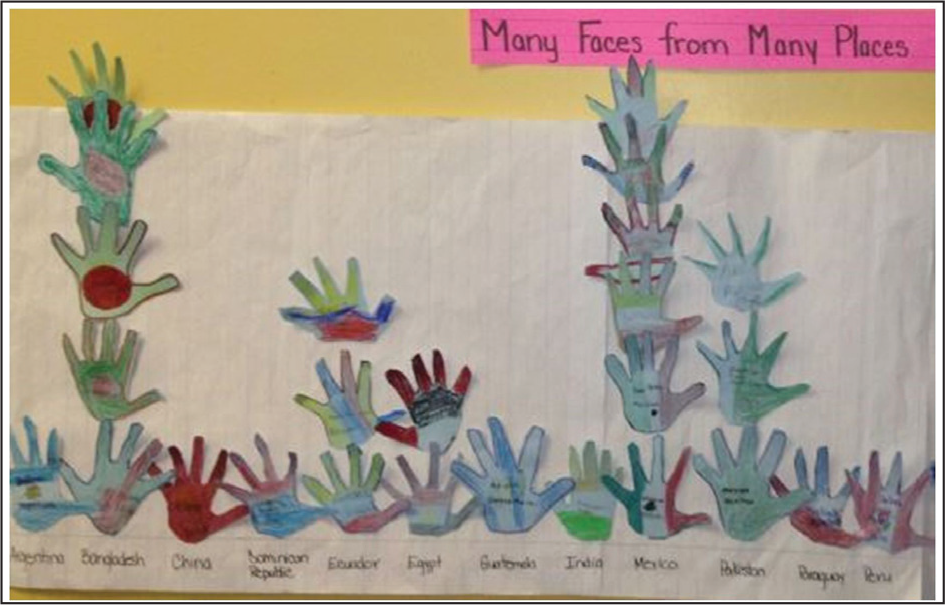
Building a multilingual ecology in a school’s learning environment would reflect the multilingual nature of society (Garcia & Menken, 2015). It is important here to note that schools are not only a location for academic learning but are also institutions of socialisation. The recognition of each student’s identity coveys an acceptance of the child in the sociopolitical and economic structure of the school, causing his/her affective filters to be eased, allowing for more active participation and engagement in developing both conversational fluency and academic proficiency in multiple languages.
Following are some examples of practices in schools (see Figures 10–12) for embracing the multiple identities and linguistic repertoire of students (Hesson, 2013). In a continuously evolving area of work, the intention here is to suggest ways to begin the design and development process of multilingual ecosystems by actively and consciously taking steps to accept and welcome all students.
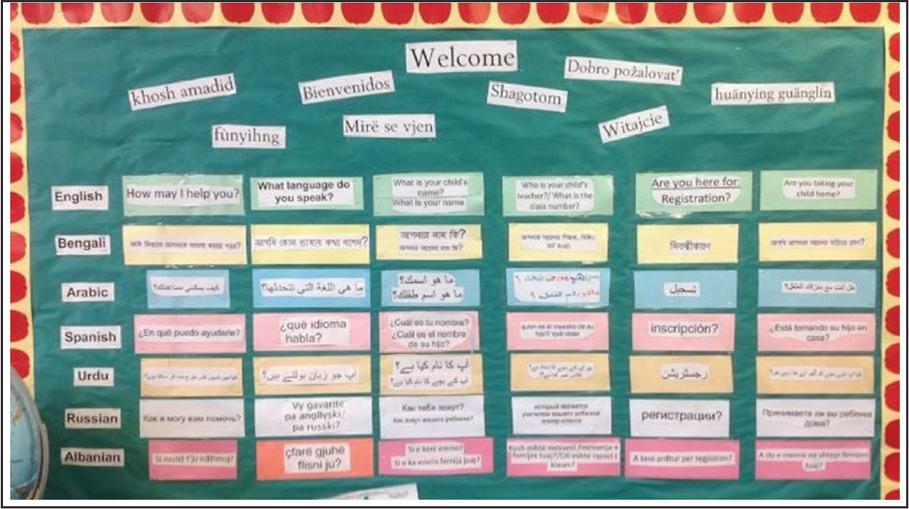
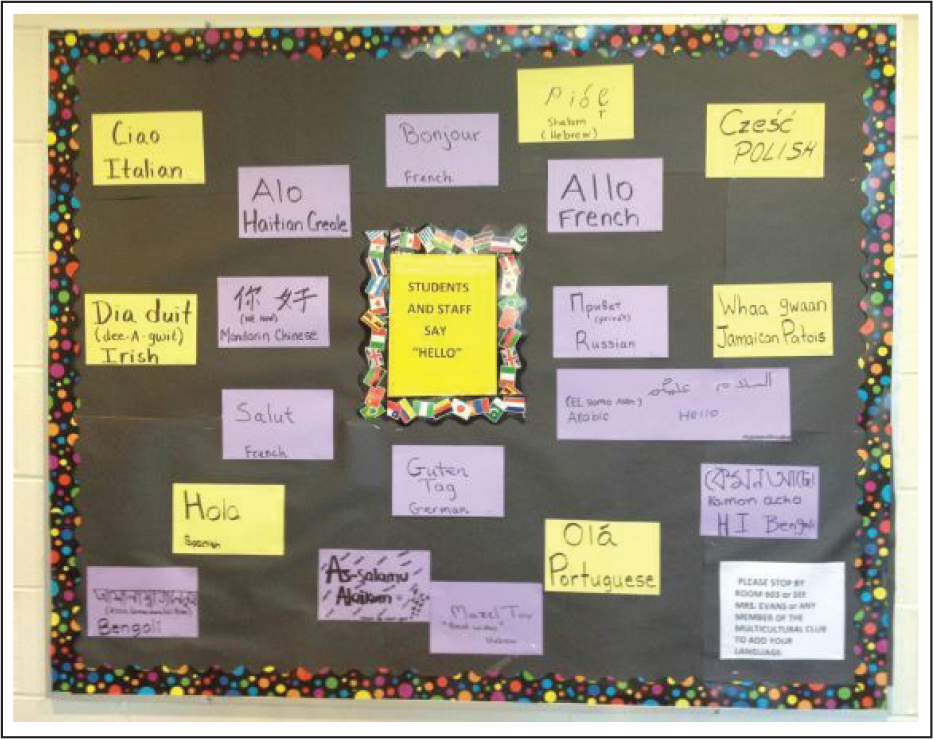
Conclusion
While enquiring into the English language learning patterns as well as the socio-economic and political realities of primary school children in an urban Indian school and analysing the broader policy context in which these operate, one realises how the values of ‘purity’ and ‘compartmentalisation’ of languages are deeply entrenched in popular culture. In spite of the multiple multilingual communicative practices that are commonplace and the natural reality of daily life, among both teachers and students, there is no official recognition of the same, be it at the national, state or local level. The ‘one medium, one school’ policy is prevalent in the larger monoglossic discourse, and English plays the role of reinforcing the hegemonic forces already existing in society (Mohanty et al., 2009). Therefore, communities that have traditionally had extremely strong linguistic identities are increasingly interested in expanding this arena to include English, Hindi and other languages through mainstream schooling. This does not necessarily mean a desire to consciously ‘move away’ from their own linguistic roots but rather to develop the cultural capital that will ease access to an increasingly globalised world by adopting its most dominant languages. Inadvertently, this process of language acquisition also becomes a process of socialisation into new cultures, and new ways of being. Thus, while learning English or Hindi is crucial in the current reality, we must also concern ourselves with the development of the overall linguistic repertoire of the child.
The patterns of acquisition children exhibited across grades and across income groups in this study throw up important observations. Children exhibit an innate understanding of the deeper structure of language at the level of mental computation rather than simply at word or sentence level. Their use of English and Hindi is significantly higher in school than at home, where these have been relegated a relatively inferior place compared to the native tongue. Higher levels of comprehensible input and lower affective variables positively impacted the language acquisition. Higher the language proficiency and/or age of the child, greater the acceptability of code-mixing and grammatical errors, as the focus is significantly shifted to ‘understanding’. There is no observable link between oral speech and written script. Overall, the language practices in such a school setting were subtractive monoglossic, as there was no ‘official’ recognition of the fuzziness of language practices, and hence the potential of heteroglossic translanguaging remained unexplored. This was further accentuated by the personal experiences and views held by the on-ground practitioners in the educational process.
In an increasingly globalised, connected and technologically advancing world, language boundaries are fuzzy and fluid. Given the multiplicity of language practices and neo-cultural identity formations, as well as the growing empirical evidence-base on the long-term advantages (cognitive and socio-emotional) of multilingual skills, it is imperative for India to embrace these diversities, for supporting the future of its overwhelmingly young population. 9 There is an urgent need to move beyond the restrictive policy perspective of multilingualism as additive and/or subtractive monolingualism while also creating a shift in understanding in the society at large. This can be initiated by objectively determining the socio-economic and political drivers of language policy on learning outcomes in different states and districts and supporting scientific research to study the impact of multilingual practices on learning in localised contexts. This evidence-base can be used in reforming policies and practices at the central, state and school levels and among education professionals. Further, through wider dissemination, it can create greater awareness among parents and students potentially driving demand for multilingual teaching and learning environments in schools from the bottom-up. In sum, multilingual heteroglossic education programmes must be developed to support multiple languages and identities, creating the environment for their interrelationships and complementarities to not simply coexist in quiet tolerance of the ‘others’ but thrive through acceptance and synergistic efforts.
Footnotes
Acknowledgements
We thank the management, staff and teachers at Shishuvan School, Mumbai, India, for their participation and support during the field observations. We also thank Ms Kavita Anand and the faculty and student body of MA Education at Tata Institute of Social Sciences, Mumbai, India.
The findings, interpretations and conclusions expressed in this article are entirely those of the authors. They do not necessarily represent the views of the International Bank of Reconstruction and Development/World Bank and its affiliated organisations, or those of the Executive Directors of the World Bank or the governments they represent.
Declaration of Conflicting Interests
The authors declared no potential conflicts of interest with respect to the research, authorship and/or publication of this article.
Funding
The authors received no financial support for the research, authorship and/or publication of this article.
