




Abstract
In the Indian context, the problem of the high proportion of out-of-school underprivileged children as well as the learning deficits in many such children in primary schools have raised concerns. Preparing these children for their journey through schooling has therefore been under the spotlight. The national Early Childhood Care and Education (ECCE) policy recognises pre-school education (PSE) of these children as one priority area. Given that the increased privatisation of pre-schooling marginalises a large section of underprivileged children in rural India, the role of public pre-schools always remains significant. Although many pre-primaries in government and aided schools contribute to the PSE of these children, the public pre-school system at community level in the form of anganwadi centres (AWCs) under the national Integrated Child Development Services (ICDS) programme remains the most viable and cost-effective opportunity for a high proportion of these children. This article examines the state of the PSE at AWCs through the lens of coverage, mechanisms of service delivery, quality of learning opportunities and inclusiveness. The paper draws evidence largely from a sample survey covering 4,800 households and over 200 AWCs spread across 192 villages in three sample states, besides other macro-level data and relevant literature on PSE. The findings show that the implementation of PSE through AWCs does not comply with many ECCE norms. There is a lack of targeted PSE interventions for learning opportunities and developing socio-emotional skills. Among other factors, functioning of AWCs for less than the stipulated duration in a day, inadequate earnestness among AWC workers and unequal opportunities even in scarce PSE services adversely affect the PSE of underprivileged children. The article calls for increasing the efficiency of this largest public pre-school system through professional development of service providers and setting up monitoring mechanisms to ensure school-readiness of underprivileged children.
Introduction
Over the years, a growing body of evidence in India has provided insights into several predisposing factors that interlink access to schools, sustained participation in schools and learning outcomes. Despite the success of getting virtually every school-ready child enrolled in school through sustained interventions, the problems of a significant proportion of out-of-school children and learning deficits in many children, particularly those from socio-economically backward communities in rural areas, have remained concerns at many levels. About one-fifth of children from disadvantaged backgrounds in the age group of 6–18 years remain out of school (NSSO, 2014). Most of these children in schools tend to show poor learning outcomes (Annual Status of Education Reports [ASER], 2018). Preparing these children for their journey through schooling has therefore been a subject of major interest for quite some time, drawing more attention towards the quality of early childhood education (ECE) for these children. The national Early Childhood Care and Education (ECCE) policy recognises pre-school education (PSE) of underprivileged children as one priority area (Ministry of Women and Child Development [MWCD], 2013). Drawing insights from various Annual Status of Education Reports, Banerji (2019) argues: ‘if we are to move beyond every child enrolled in school to learn well in school and complete school; then there is a need to shift attention to pre-school education of most disadvantaged children who have a lot to prove in schools’.
The link between the socio-economic background of young children and their school-preparedness has also been widely recognised in global contexts. It is argued that ‘being born into the poorest households carries a learning penalty’ (Rose & Alcott, 2015). It is therefore stressed that for education to play its role in human development and success, ‘it must begin with early childhood development and continue with quality learning opportunities for all children, with a special focus on the most disadvantaged’ (UNICEF, 2016). The Global Monitoring Reports on ‘Education for All’ (UNESCO, 2015), while calling for ensuring inclusive and equitable quality education, recognises that a good, quality ECE programme ensures the smooth transition of the most vulnerable and disadvantaged children from pre-school to school and narrows group inequalities in education. Similarly, the latest World Development Report (World Bank, 2018), while looking into many facets of learning crisis, states that ‘children from disadvantaged background tend to exhibit learning deficits years before they start schools, and these leave them ill-equipped for the demands of formal education’.
From an economic perspective, it is argued that since young children from underprivileged backgrounds are not able to achieve their full potential due to adverse early experiences, investment in ECCE for these children yields maximum returns as compared to later years in the education continuum (Gracia et al., 2016; Heckman, 2011; Williams, 2016). Any inequality of opportunity in the early years of these children is therefore likely to drive inequality in their school participation and school learning outcomes. With the recognition of the significance of ECE in developing foundational skills and ensuring school-readiness, ECE programmes have expanded considerably around the world (UNESCO, 2015). According to the Annual Report of UNICEF (2019), globally, ‘a total of 80 countries have adopted multi-sectoral early childhood development (ECD) programs, with at least two interventions, for addressing stimulation and responsive care in early years’. India, as a signatory to international commitments in education, has been part of this transformative and universal ECE goal. However, the positive impact of any ECE programme can be accrued only if the quality of intervention is ensured. This is directly related to developmentally appropriate learning strategies, quality human resources and interpersonal relationships in pre-school settings.
Pre-school Interventions in India: An Overview
India, like any other developing country, has a huge number of children 3–6 years old who need pre-school education. A large number of them come from socio-economically disadvantaged groups. It thus remains a hard task for the state to make pre-school provisions accessible for children from diverse sections of the population. There have been different strategies for PSE under the ECCE services provided by the public, private and non-governmental organisations. Pre-schools are sometimes segregated into three mutually exclusive categories: proprietary, franchised and pre-primaries (Yasmeen, 2015). Proprietary pre-schools are normally owned by a brand, whereas franchised pre-schools are owned by well-known franchisor companies. However, pre-primaries are attached with or affiliated to primary schools, sometimes known as ‘feeder’ pre-schools. Following the Right to Education (RTE) Act (Government of India [GOI], 2009), the government took new initiatives to set up pre-primary sections in government-run and public-aided schools, with a goal to better prepare children aged 3–6 years for induction into primary sections. It may be noted that although the Act has not included children under the age of 6 years within the purview of the ‘basic rights to education’ till now, Section 11 of the Act acknowledges the importance of ECCE for children above the age of 3 years. Further, in 2018, PSE has been integrated with school education under the Samagra Shiksha Abhiyan, but the Act still only covers children between ages 6 and 14.
Besides the pre-primaries as a public-school system, the national flagship programme of the Integrated Child Development Services (ICDS) has an inbuilt PSE component for children in the age group of 3–6 years. With the universalisation of ICDS in 2005, this has been the most significant government-run intervention and the single largest mechanism in India which prepares young children to cope with formal schooling. A network of community-based centres, popularly known as anganwadi centres (AWCs), remains the focal point for the delivery of PSE services under the programme. Outside the public systems of pre-primaries and AWCs, the government has supported many crèches run by non-governmental organizations (NGOs) under special grant-in-scheme, which cater to the PSE needs of children from disadvantaged backgrounds.
Although privately run pre-schools contribute substantially towards ECE goals, the highest percentage of children of 3–6 years are with AWCs. According to Williams (2016), about 15 million middle and upper class 3-6 years aged children in India receive ECE in about 3 lakh private pre-schools. According to the Rapid Survey on Children (RSoC), about 31 per cent of the total children aged 3–6 years get these services at privately run pre-schools (MWCD, 2015). The ASER (2018) reveals that ECCE centres run by private sector organisations cater to the PSE needs of nearly one-fourth of the total children aged 3–6 years enrolled in rural India. However, the official data on these children receiving PSE at AWCs shows that more than two-third of the children in rural India attend over 1.3 million AWCs (MWCD, 2017), making it the largest community-based ECCE programme in the world. Importantly, the PSE services provided by AWCs reach out to a large number of underprivileged children, although government-supported crèches largely cater to the PSE needs of such children. The RSoC reveals that children attending AWCs in rural areas are more than double those in urban areas. Around 52 per cent of children from households with the lowest wealth index attend AWCs, as compared to only 9 per cent children from such households attending private pre-schools (MWCD, 2015). Further, a considerably higher percentage of scheduled castes (SCs) and scheduled tribes (STs) children attend AWCs as compared to other caste groups. Like government-run primary schools, children from socially and economically disadvantaged households participate in government-run AWCs (Kaul et al., 2017).
Recognising the significance of AWCs in providing PSE for underprivileged children, the ECCE policy places a special emphasis on developing and expanding the education component of ICDS. The key question that needs to be answered is: To what extent do the AWCs meet the educational needs of these children and make them school-ready? Based on limited literature in the Indian context, the following section provides an overview of the effectiveness of the PSE services provided by AWCs.
Since the launching of the ICDS in 1975, many studies have assessed its effectiveness. A majority of them, however, have focused on the operationalisation aspect of the programme and delivery of nutrition services. Officially, it has also been acknowledged recently that ICDS tends to prioritise nutrition, and the programme’s educational component is deficient in quality (Ministry of Human Resource Development [MHRD], 2019; MWCD, 2013; NITI Aayog, 2015). This often gives rise to perceptions that ‘nutrition bias’ dominates service delivery under the ICDS. It is sometimes argued that ICDS has focused more on establishing elements of well-being that are essential for children to learn rather than focusing explicitly on providing opportunities to learn. The ECCE policy recognises that a large number of disadvantaged children in India are ‘at risk’ in terms of developing their full potential. Despite the constitutional provision (Article 45) on the ‘right to early childhood care and education to all children until they complete the age of 6 years’, the ‘school-readiness’ of underprivileged children, which has larger implications for the smooth transition to formal schooling, continues to remain an important concern. The sustainable development goals (SDGs) (Goal 4) on education therefore recognises that comprehensive ECE for these children is one of the major goals for achievement of quality education for all, and by 2030, all children should have access to quality care and pre-primary education so that they are ‘ready’ for primary education.
The concept of ‘school-readiness’ is normally understood as a set of skills and behaviours across domains of development and learning in early age groups to enable children to cope with the new school environment efficiently. The key issue is that pre-school education for children always remains an enabler for school education. But the fact is that participation in pre-school education may not always guarantee entry to schooling and positive learning outcomes in schools. Moreover, all ECE programmes may not have a similar impact on children from diverse groups. As Magnuson et al. (2004) report, specific programmes for disadvantaged pre-school children have long-lasting academic benefits for them. The importance of interventions for school-readiness also depends on the socio-cultural context of the children.
A plethora of studies in the global context demonstrate the positive impact of quality pre-school education. Based on a review of several studies in different contexts, Barnett (1995) concludes that ECE programmes positively affect students’ ‘readiness’ in terms of self-control, attention and social skills, and these in turn produce sizable long-term effects on school achievement, grade retention and social adjustment. Similarly, Rao et al. (2014), based on a review of studies on ECE in developing countries, establish that high-quality ECE can boost development not only in children’s cognitive and social skills but also in long-term educational, health, economic and labour market outcomes. Several longitudinal studies also demonstrate that quality ECE programme can have a significant impact on children’s life chances and, by extension, on the well-being of entire societies (Williams, 2016). Recently, Klees (2017), based on a review of the impact of pre-schools, found that children who attend pre-schools have higher attendance and better achievement, and they are less likely to repeat or drop out from primary school. These reviews thus point towards the significance and impact of quality pre-school education has on several educational outcomes.
In the Indian context, several studies have also shown the correlation between exposure to pre-school education and education outcomes in schools in terms of attendance rate, retention rate and, importantly, learning outcomes in primary school and beyond. However, Kaul (2002), after a review of the Indian programmes for ECE, indicated that it is only a programme of a certain quality that facilitates learning in schools. In a recent longitudinal study on the impact of ECE, Kaul et al. (2017) systematically assessed the quality of pre-school education in building children’s school-readiness using a school-readiness instrument and an adaptive behaviour scale. They find that a significant proportion of pre-primary children in both the public and private sector do not have the needed school-readiness competencies, but some centre-based ECE leads to higher levels of school-readiness in children. Both AWCs and private pre-schools have a few elements of good practices in terms of the quality and child-centredness of the foundational stage of education. This is corroborated by ASER (2018), which indicates that children in primary schools fail to attain basic skills because of lack of school-preparedness during pre-school education, and children from socio-economically disadvantaged families who have limited exposure to strong learning environments at home remain highly vulnerable to poor achievement in schools. However, it must be noted that pre-school participation and preparation may not always lead to positive learning outcomes in schools. The quality of subsequent learning environments in schools is also an important determinant of the long-term effects of pre-school programmes (Ahtola et al., 2011; Johnson & Jackson, 2017). As Ahtola et al. (2011) puts it, ‘the child’s readiness for school and the school’s readiness for children, both are equally important’.
The higher registration rate of the underprivileged children in AWCs, at the same time reportedly their poor learning performance in primary schools besides deficiencies in psycho-social domain, thus, calls for an understanding of quality dimensions of PSE services at AWCs. The limited number of studies on pre-school provisioning at AWCs and the extent of benefits of PSE services provide evidence of a weak PSE system. However, the coverage of PSE in AWCs, the forms and intensity of the PSE delivered at AWCs, the factors that facilitate or hinder the access to quality PSE service, and the experiences of underprivileged children that AWCs largely cater to, along with the perspectives of service providers on the delivery of PSE services, still remain neglected dimensions. This article examines the state of the PSE at AWCs through the lens of coverage, service delivery mechanisms, quality of learning opportunities and inclusiveness. The findings will inform the recent policy debates and discussions on the quality of pre-school education for all young children under ICDS, the issues and challenges of accessing AWCs and delivery of quality PSE services and its linkages with the educational outcomes of underprivileged children in formal schools.
Methods
The analysis draws upon evidence based on recent official data on beneficiaries of PSE under the ICDS programme and a large sample survey of households and AWCs. This is further supplemented by existing relevant literature. The analysis of official data on PSE has a major focus on the decade after the universalisation of the ICDS programme in 2005 in order to understand the trend in the coverage of PSE beneficiaries. The study uses data collected from a sample survey covering nearly 4,800 households and over 200 AWCs spread across 192 villages in three sample states—Karnataka, Madhya Pradesh and Uttar Pradesh—during the year 2012–2013. Data was collected using research tools such as semi-structured interview schedules designed specifically for the survey of households and AWCs. This is supplemented by data collected from 228 focus group discussions (FGDs) with mothers in sample villages, on-spot observations of delivery of education services and conversations with young children at AWCs. The sources of survey data thus include the household beneficiaries and service providers. With access to both quantitative and qualitative data, a mixed method approach is adopted for the purpose of analysis. An attempt is made to triangulate the data collected from household survey, FGDs with mothers and accounts of service providers in AWCs to understand the state of PSE services provided.
Key Findings
The overall results indicate that public provision of PSE under the ICDS, in principle, exists in a majority of AWCs. Expectedly, a higher proportion of underprivileged children have access to AWCs. For many reasons, the implementation of PSE does not comply with the ECCE and ICDS norms. In the following sections, some of the key findings based on both macro-level data and field survey are discussed around the research questions.
Regressive Coverage
Percentage of Children 3–6 Years Old Who Obtain PSE at AWCs (by category)
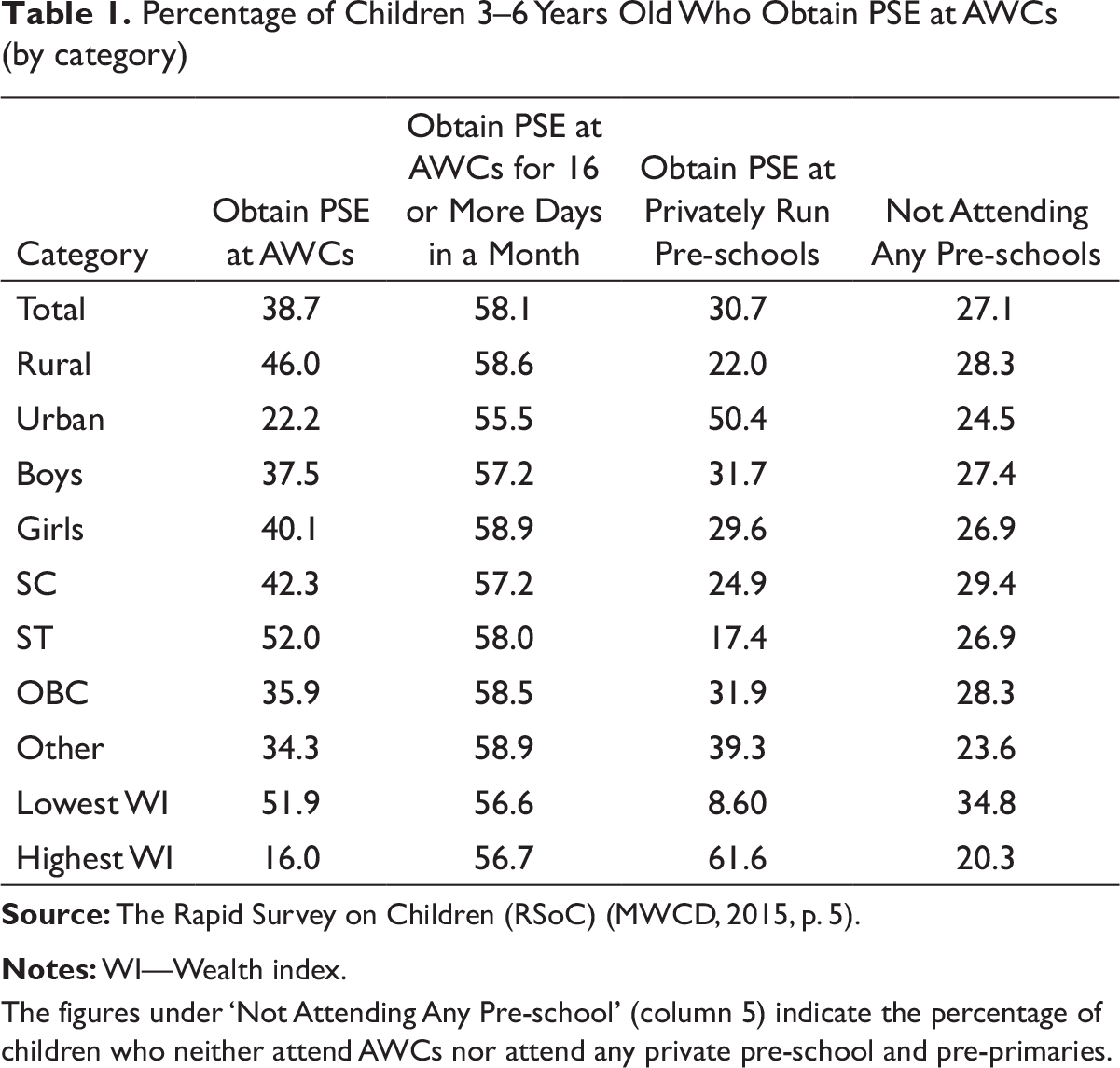
The figures under ‘Not Attending Any Pre-school’ (column 5) indicate the percentage of children who neither attend AWCs nor attend any private pre-school and pre-primaries.
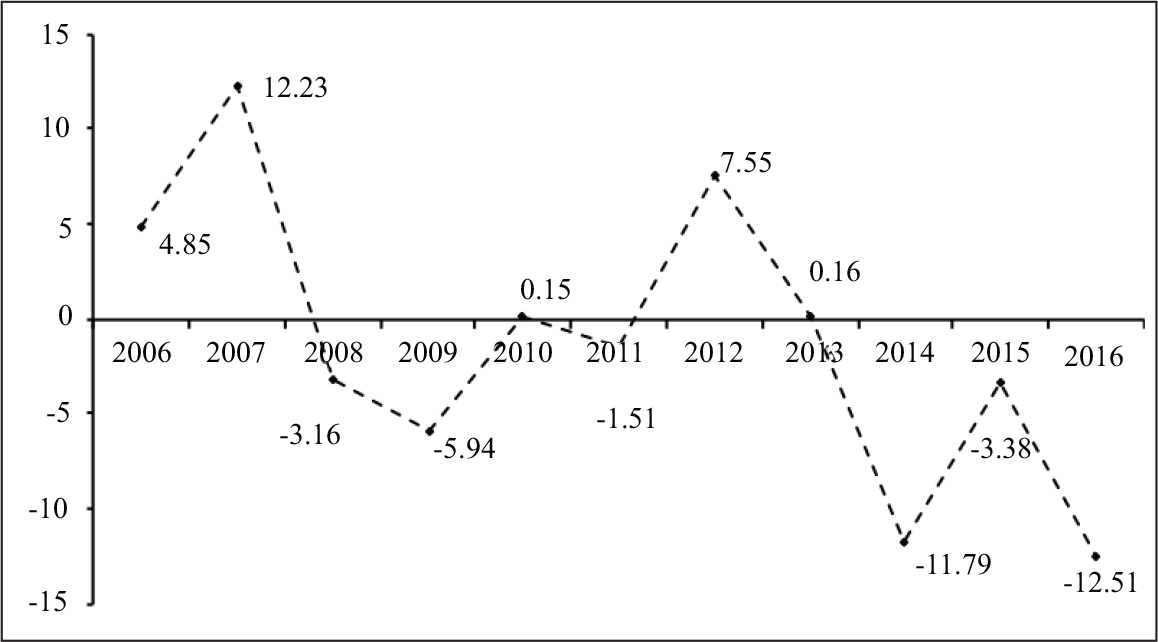
Another issue is about the disparities in access to nutrition and PSE services among children in AWCs aged 3–6 years. It is expected that children who attend AWCs and have access to nutrition benefits should inevitably be beneficiaries of PSE. However, the official data reveals that during 2006–2016, the overall increase in beneficiaries of nutrition has been relatively higher than that in the beneficiaries of PSE, although a definite pattern is not observed over the years (Figure 1). The number of PSE beneficiaries has been remarkably lower than that of nutrition beneficiaries, particularly after 2013. This incongruity suggests that perhaps not all the children aged 3–6 who attend AWCs and have access to nutrition services, receive to PSE. This indicates that almost all AWCs may be providing nutrition, but a lower number of AWCs provide PSE, or that many children attend AWCs at the time of food distribution only, and leave thereafter.
The findings from the present sample survey to some extent are consistent with the macro-level picture. It is found that on average, about half of the total pre-school-ready children in sample villages are registered in AWCs. Jha (2019) finds that the ICDS programme reaches out to 48 per cent of these children. The present study also found that on an average about one-fifth of the registered children in AWCs remain absent regularly. As far as the actual attendance is concerned, on an average, nearly 20 children per AWC attend regularly. The average attendance of children from marginalised communities like scheduled castes is higher than that of ‘other’ children. In 45 per cent of AWCs, the average attendance is less than 16 children, whereas in another 21 per cent of AWCs, it is less than 10 children. Thus, in two-thirds of AWCs, the attendance pattern deviates from the ECCE policy prescription of the quality standard of an adult/child ratio of 1:20. Despite the fact that many AWCs have a relatively better pupil/service provider ratio, children are found to have limited engagement in learning activities.
The reasons for low registration and attendance of pre-school-ready children in AWCs can be understood from the parental expectations from AWCs. Nearly one-third of the household respondents report that they send their children to AWCs with the goal that the ‘child learns something and becomes ready for schooling’, besides the benefits of supplementary nutrition. Importantly, about one-fourth of the household respondents report that ‘children dislike AWCs the most because AWWs do not engage in any play or learning activities’.
Thus, the trend of regressive coverage of children aged 3–6 years by AWCs remains a critical issue. The draft new National Education Policy (NPE) (MHRD, 2019) also reflects on how AWCs tend to contain fewer children in the educationally critical range of 4–6 years. Another issue is that the increased figures on the PSE coverage by AWCs over the years may not be reflecting the actual achievements in terms of access to quality educational services, besides gaps in the process of delivery of PSE services. The draft NPE recognises that PSE needs have not been addressed properly by the AWCs. This calls for an understanding of the factors that facilitate or hinder access to quality pre-school education.
Factors Affecting Pre-school Education
From the field survey, it is observed that in practice, the delivery of PSE services is less visible in a majority of AWCs, although anganwadi workers (AWWs) proclaim to provide PSE services regularly. In 72 per cent of FGDs, the participants mentioned the ‘poor quality of educational services in AWCs’. In 19 per cent of FGDs, group members viewed this as causing ‘disinterest among parents to send their children to AWCs’. It is therefore important to ask why there is poor delivery of PSE services at AWCs or why children do not find opportunities for learning in many AWCs. The results indicate several interrelated factors affect the delivery of PSE services. These include: opening of AWCs for less than the stipulated hours per day, alleged lack of infrastructure facilities and PSE materials, lack of priority on PSE services (AWWs consider delivery of PSE services as a secondary goal), non-visit of anganwadi helpers (AWHs) to households to bring children to AWCs on time, differential treatment against certain sections of children and lack of adequate demand for PSE among parents.
The negligence of the PSE component is subtly linked to shorter duration of opening of AWCs. Although a large majority of AWCs open for 6 days a week, most of them open for considerably less than the stipulated duration. The delivery of nutrition services takes away the maximum time. As observed, there are cases where both the AWC workers are preoccupied with the preparation and distribution of food, and in some other AWCs, they remain preoccupied with something else, leaving children to play on their own. A majority of AWWs report on the lack of time for PSE. There are also cases where children are sent back home immediately after they take food or are allowed to take food home.
A good number of AWCs are located in primary schools, as in the case of Uttar Pradesh. However, the AWCs function for half a day only. The children leave immediately after having food. There are cases where food is supplied to AWCs by NGOs or self-help groups (SHGs), as in the case of Madhya Pradesh. Hence, it can be expected that AWCs workers find sufficient time for PSE activities. The delivery of PSE services still remains neglected as most of the children tend to arrive at AWCs before the supply of food. Many of them leave AWCs shortly after food is distributed. Thus, like the delivery of nutrition services, no daily routine or planned activities on PSE is strictly followed in AWCs, having a bearing on children’s school-readiness. It indicates that AWWs do not show earnestness and accountability to the delivery of PSE service. How the duration of functioning of AWCs affects PSE can be understood from the feelings of parents during FGDs:
AWC opens for few hours. After the distribution of food, children go back to homes. Children lack opportunity to learn. They sit around and spent time doing nothing. AWC opens for few hours. Many parents engaged in wage labour are forced to take children with them to the work site or make alternative arrangements in neighborhood for looking after them. Then ‘what is the use of AWC for us? Children go to AWC only to play and eat, and come after two-three hours. They do not learn anything useful. For three hours, AWW makes children sit silently. She does not teach anything. She is wife of Pradhan (head of village) That is why no one says anything.
Another related issue is the non-visit of AWHs to children’s homes to bring them to AWCs and drop them back at home regularly. Poor families in which both parents work outside home find little time to drop children at AWCs and bring them back home. Also, they are not in a position to take their children to their workplace but sometimes have to do so. In this context, they look forward to AWCs to act as a safe day-long care centre for them, which in fact is the secondary goal of the ICDS programme. The short duration of functioning of many AWCs coupled with the non-visit of AWHs to homes makes their situation precarious. This affects the coverage of underprivileged children. The well-off parents manage to send their children to AWCs either on their own or with others’ help, but poor parents lack viable options. As a result, many underprivileged children remain deprived of opportunities for pre-school activities.
From the perspective of service providers, another factor that affects the regular engagement of children in PSE is the lack of adequate infrastructure and play and learning materials. While 65 per cent of AWWs report AWCs have some learning and play materials, about 60 per cent AWWs report inadequacy of such materials for children. But this needs a critical look to understand how this is responsible for poor PSE services. In case play and learning materials are made available, how can they be used? As argued, about two-thirds of AWCs do not have their own buildings; they operate from safe places such as school premises, community centres and private houses. Children are engaged in playing on their own, in some cases even in the absence of AWWs. There are AWCs where children are found engaged in reciting rhymes or/and reading letters written on a blackboard in the presence of AWWs. However, these are not routine practices, but rather can be attributed to the visit of research team members. When many AWCs have space for children to sit together and play by themselves, many group-learning activities are very much possible in the absence of standard learning materials. The availability of learning and play materials may not always get children engaged in learning activities. In the survey, nearly two-thirds of AWCs had some play materials that were hardly used. Inadequacy of learning materials is relative to the number of children attending AWCs on a regular basis.
A majority of AWCs are found to do relatively better at pupil/service provider ratio. Still, children have limited engagement in learning activities. The AWWs therefore may be well trained to develop alternative materials to enable children to develop a few basic skills rather than relying heavily on PSE kits. A majority of parents are of the view that this is a case of negligence of pre-school education by the AWWs. This issue is taken up in the new draft NPE (MHRD, 2019), which states that ‘teachers are less dedicated to ECE’. The lack of learning opportunities in AWCs forces many well-off families to send their children to other nearby private schools. There are also cases of poor parents who like to send their children to low-cost private pre-schools to ensure the school-readiness of their children. Still, many AWCs by design remain a place for underprivileged children. The dissatisfaction of poor parents with the state of PSE at AWCs can be understood from some of their responses:
In AWC, children do not learn. They go to AWC for 1 to 2 years, but do not have even knowledge of letters. Only food is given, what is the benefit from this? In AWC, except food distribution, no knowledge is given to children. If money is given to parents, they can give food to their children. There should be arrangements for learning. Neither AWW nor AWH teaches anything at AWC. Only the children of the poor people come to take food. The lack of learning makes many parents not to send their children to AWC. There is no space for learning something. AWW never pays attention to children rather remains busy in some other things. My child is going since last 1 year, but he does not know anything. In the name of education, AWC plays with us.
The lack of focus on PSE by AWWs is due to the lack of professional training to plan learning activities. Although a majority of AWWs receive in-service training, the PSE component draws less attention. The RSoC (MWCD, 2015) finds that 70 per cent of AWWs have special training on PSE, but it may not be of any use if there is a lack of commitment towards PSE. The present study finds that many AWWs, specifically those belonging to the lower age group, have higher-than-required qualification. In a majority of the cases, AWWs are hired from the locality. As such, they are in a better position to learn new strategies or design learning materials to ensure play-based learning. Appropriate training or mentoring on the PSE component and regular monitoring of delivery of PSE services are likely to orient AWWs towards better PSE services.
The poor delivery of PSE in AWCs is also substantiated by some teachers in village schools in informal interactions during fieldwork. Most of them did not observe any remarkable difference in the performance of children who attend AWCs and those who do not. This, however, needs to be further studied in a systematic manner.
Besides the deficiencies in the supply side, the lower level of awareness about PSE and the indifference of many parents to some extent are responsible for neglect of PSE services by AWWs. About one-fourth of household respondents were not aware of the PSE performance of AWCs. The level of awareness was relatively lower among parents from poor households and socially marginalised groups. While the household data reveals that many parents do not show interest in sending children to AWCs because of poor PSE services, the responses of over 200 AWWs provide a different standpoint. About half of the total AWWs report disinterest among parents in sending their children to AWCs. While 57 per cent AWWs report on the disinterest of economically well-off and high caste parents, 29 per cent even report the same for SC parents.
A considerably higher percentage of the SC AWWs (76%) than the high caste AWWs (49%) report on the lack of interest among high caste parents in sending their children to AWCs. About one-fourth of AWWs find difficulties in registering children because of the disinterest of parents. Moreover, a majority of AWWs were of the view that all registered children do not attend AWC regularly. About half of them report more than 50 per cent registered children normally remaining absent, whereas 22 per cent AWWs report absenteeism up to 30 per cent, and another 27 per cent report it between 30 and 50 per cent. If we consider AWW responses on face value, it clearly points towards an ‘attendance gap’ in children aged 3–6 and deprivation of PSE opportunities among many underprivileged children.
Thus, several factors are responsible for poor PSE services at AWCs. Given that the role of PSE in AWCs is to counter home- or individual-level disadvantages of many underprivileged children, poor PSE service at AWCs means a larger proportion of these children are at higher risk so far as school-readiness is concerned. Since school-readiness is linked to educational outcomes in school and even afterwards, the lack of it is more likely to allow group inequality in human development to persist.
Social Inclusion in Pre-school Education
The coverage gap tells more about the systemic failure to provide educational opportunity for all pre-school children. This also indicates that many children are excluded from access to PSE service at AWCs. Given that a higher proportion of socio-economically disadvantaged children have access to AWCs, the poor PSE service delivery at AWCs means the figures on access may tell little about benefits of PSE services for all these children. With limited opportunities for learning activities in AWCs, it is pertinent to ask what have been the social experiences of these children. In recent times, a growing body of evidence shows that the exclusionary nature of social relations in community life based on group identities often impedes equal access to public services. In the school setting, lower caste children, in particular, experience exclusion of different forms (CES, 2014; Nambissan, 2010; National Dalit Movement for Justice and National Campaign of Dalit Human Rights [NDMJ-NCDHR], 2017; Ramachandran & Naorem, 2013). These experiences normally have two dimensions: structural and relational. The RTE Act prohibits exclusionary behaviours against children from marginalised sections in formal schools. However, no such provision is explicitly mentioned for children below 6 years, failing to draw adequate attention in public pre-schools. Although there are some studies which have reported exclusionary practices based on caste and other similar group identities in the delivery of nutritional and health services under ICDS (Mamgain & Diwakar, 2012; Pal, 2016; Swain & Kumaran, 2012), a significant knowledge gap exists on the delivery of PSE services. Data obtained from household survey, FGDs with mothers and on-spot observations suggests that caste-based exclusions in the delivery of PSE services is prevalent in different forms even in limited learning engagements, often preventing SC children from equal opportunities. As observed by the researcher during the AWC survey, in one AWC in a mixed caste village:
Some children sit quietly in one corner of a room in AWC. They are visibly good in number. Some other children in the room play with toys, and do something on their slates. Children sitting at the corner look at them. They must also socialize, play and learn. But, they belong to lower caste households, and hence hardly receive any attention. They sit patiently till food is distributed.
Similarly, in another AWC, a few low caste children recounted:
Children from our community are made to sit at one corner of AWC room, away from the rest. AWW asks something to other children. But we silently listen to them. Some children say that we will not play with Chamar (low caste) children.
From the household survey, it is found that overall, about 36 per cent respondents report some form of caste-based exclusion in AWCs during play and learning activities. Even among high caste respondents, 28 per cent report the same. These mainly include lower access of SC children to available play and learning materials and less interaction of service providers and high caste peers with SC children. As some SC parents report:
High caste children don’t want to play with SC children at AWC. Sometimes they fight with the SC children. OBC and high caste children taunt SC children in the name of caste. Because of this, sometimes they fight each other, and SC children do not want to interact with others. AWW makes our children sit in one room and children of her community sit with her in another room.
As noted, high caste parents were also disinterested in sending their children to AWCs. Nearly 48 per cent AWWs were of the view that high caste parents ‘feel bad’ because of the ‘presence of other poor and SC children’ at AWCs. They ‘do not want their children to sit with them in a closed space’ or ‘consume food at AWC because it hampers social position and self-respect’. SC parents also have similar observations. Some of them told the researchers that ‘high castes view AWCs are for SCs’, and ‘in the presence of more number of SC children at AWCs or/and SC-AWC workers, many high caste parents do not like to send their children’. Thus, AWCs, as community-level centres, remain sites of social discrimination against young children associated with marginalised group identities, which often affects equal access to essential education services.
Discussion and Conclusions
Underprivileged children are more likely to have delayed developmental and foundational skills because of less exposure to support structures at the family and societal levels. School-readiness of these children therefore remains a major concern. In India, although various strategies have been available for pre-school education, these children do not have equal access to them. The public pre-school system in the form of AWCs remains the most cost-effective opportunity for many such children, despite other pre-primary schools. As a matter of fact, AWCs provide opportunities for the highest proportion of underprivileged children in rural areas. It is found, in contrast to common belief, that the nutrition service provided by AWCs is the main driving force for many children aged 3–6 years to register in AWCs; the PSE service is also considered a motivating factor for many parents who believe that it can help their children cope with the new learning environment in school. Like a few other large-scale studies in recent times (Kaul et al., 2017; MWCD, 2015; NITI Aayog, 2015), this article has argued that the implementation of PSE services under ICDS remains weak. Despite it being a universal programme, there has been a coverage gap. Many eligible children are not able to avail AWC facilities. Due to the lack of targeted PSE interventions, the children who attend AWCs find limited opportunities for learning. Certain sections of children experience unequal and discriminatory social relations at AWCs that would have a bearing on socio-emotional skills critical to school readiness.
The lack of opportunity for quality PSE at AWCs deters many parents, particularly those from upper social strata, from sending their children to AWCs. However, they have alternatives to ensure that their children enter schools with certain preparedness. A large majority of children from marginalised sections of society, however, do not have that alternative. AWCs thus remain the only viable option for them despite deficiencies in PSE services. The irony is that parents from upper social strata, who are in a higher social position, do not take initiatives to bring changes in the delivery of PSE services at AWCs, and rather go for better alternatives available in their locality, leaving many underprivileged children to suffer.
The findings indicate that for specific reasons, the implementation of PSE at AWCs does not comply with the ECE norms of the ICDS programme and the ECCE policy. Among others, the opening of AWCs for less-than-stipulated hours, inadequate earnestness among AWC workers and unequal opportunities for learning and developing socio-emotional skills are found to be wanting. These affect the PSE of underprivileged children the most. Although these cannot be seen in isolation, the lack of material resources is not responsible for reducing AWC to a ‘feeding centre’. One does not always need adequate standard materials to run a successful pre-school programme. There are ‘good practices’ of a variety of low-cost and teacher-made local materials that engage children in learning activities. Without an overemphasis on structured academic programmes, engagement with certain play and learning activities on a regular basis based on local-made materials can transform AWCs to centres of ‘learning’ and can launch underprivileged children successfully on learning trajectories.
Unlike the nutrition service, PSE draws inadequate attention in the course of implementation of the ICDS programme. Given that the largest segment of young children from disadvantaged families access AWCs, they often experience social discrimination. Exclusionary bias based on group identities that are deep-rooted in social life seep into the institutional setting of AWCs and affect service delivery and social relationships. Such institutional disadvantages are more likely to instil negativity in the mind of these children, which, in turn, will affect socio-emotional skills that are a pre-requisite for school-readiness.
Several studies have identified ‘effectiveness factors’ in relation to ECE. It is well recognised that programme effectiveness may not always be related to structure-based features but rather can depend more on considerable opportunities for development. The effectiveness of the PSE programme at AWCs, therefore, to a large extent would rest on the competence, motivation and engagement of service providers. The majority of the service providers at AWCs lack professional knowledge and skills of ECCE, which reflects negatively on their responsibilities towards PSE. The neglect of PSE in AWCs means putting many underprivileged children at risk of no access to primary schooling, additional disadvantage in school outcomes and in the subsequent course of human development.
In the post-RTE-Act period, the poor PSE performance of AWCs has paved the way for the establishment of pre-primary sections in public schools in urban and rural areas, beside the expansions of other privately run pre-schools. It is recognised that ‘the opening of public pre-schools or nursery pose a threat to the enrolment of children in AWCs’ (NITI Aayog, 2015). In this context, the proposal of the draft NPE (MHRD, 2019) for reforms in public pre-school systems may sound logical, but there are several questions regarding its implementation strategies. The draft NPE recommends for locating pre-schools education provided by AWCs within the school system as a preparatory stage with a new integrated curricular framework for 3–8 year old children. As proposed, this framework would be implemented by training and strengthening AWC capabilities and collating and linking AWCs to local primary schools. This means that the draft NPE proposes pre-primary and early primary grades to be a single pedagogical unit. The draft policy thus aims at not only narrowing down the transaction of pre-school education to broad categories of public and private pre-schools but also extending the RTE Act to cover pre-school education. However, the nature of proposed reforms raises concerns over the scientific nature of PSE and its viability.
The recommendations of the draft policy are more likely to dilute the idea of holistic development of children through integrated provisioning, where young children need to be cared and nurtured within a community rather than in a formal institutionalised space. To ensure school-readiness, the policy prescribes teaching young children, among other things, basic literacy and numeracy, that too within curriculum and pedagogical frameworks, which is likely to dilute the early childhood education landscape under the ECCE policy that accepts it to be different from formal education. Moreover, the proposed shift of focus from an informal to a formal learning approach deviates from the vision of the landmark NPE 1986 on full integration of childcare and pre-school education.
The draft policy, while taking note that PSE needs have not been addressed properly by AWCs, recognises the failure on the part of the state in taking definite steps to ensure the delivery of quality education services. Hence, instead of recommending rectification and strengthening of the PSE component of ICDS, it rather proposes a separate system. However, when there is plentiful evidence that government-run primary schools face problems of low-quality education, how can relocating or linking AWCs with local primary schools overcome existing deficiencies of AWCs and ensure quality PSE services? Furthermore, the proposed downward extension of primary schools (the practice of pre-schools within a school system) has already been in operation in many schools, particularly in urban India, meeting the demands of relatively privileged families. It may be noted that many states are yet to take up this programme fully for various reasons. We need to ask how effective these pre-primaries within schools are with regard to school-preparedness. Also, do these pre-primaries ensure universal access?
It must also be noted that there are cases where AWCs function in school premises. These AWCs have not been able to register all eligible children, particularly those from disadvantaged families, because of the locational inequality of AWCs coupled with distance, besides other structural and social barriers within the community and deficiencies in service delivery (Pal, 2016). There is hardly any evidence to show AWCs located in primary schools are performing better than other AWCs. Can the location of AWCs in local primary schools be more cost-effective for a large number of children from diverse sections? Thus, the proposed framework of the draft policy is more likely to increase the complexities arising out of specific guidelines for ECCE. As Suresh (2019) has argued, it seems that the recommendations of the draft NPE for reforming early ECCE are beset with the structural defect.
Instead of strengthening public school functioning, any such restructuring may not serve the purpose of diverse social groups in the long term. The system can be enhanced through capacity building of service providers to equip them with the demands of PSE and address their difficulties. Stepping into relocating or linking AWCs with or opening pre-schools in public school system means forcing many underprivileged children to follow a rigid learning pattern to make them ready for entry to primary grade without recognising other aspects of development. There are many questions on the adaptability of many underprivileged children to such an environment. They are likely to fall into the trap of ‘learning outcomes’ at an early age without being exposed to psycho-social and emotional development through proper ‘care’. As Suresh (2019) argues, it is a ‘schoolification’ of early childhood years without considering the ‘childcare’ aspects, which children from underprivileged background need most. It is not that the proposed structural reforms are likely to weaken the AWCs; rather, for underprivileged children, it may create higher ‘access barriers’. There is a need to weigh upon whether to bring reforms in the functioning of AWCs to cater to the PSE needs of many underprivileged children as a viable and cost-effective option or to relocate it to within the school system totally.
Given that the ICDS programme has been universalised over the last decade with the goal of providing integrated services, it is critical that the functioning of AWCs be strengthened. The national ECCE policy emphasises the significance of providing children with a protective and enabling environment where care, health, nutrition, play and early learning are ensured through integrated services. The efficiency of AWCs and the role of AWWs remain critical to the school-readiness of underprivileged children. Focusing on the PSE component of ICDS through the provision of regular orientations for AWC workers on early childhood pedagogy and effective quality regulation can create a positive environment at AWCs and improve the levels of school-readiness. There are cases of well-performing AWCs under the aegis of the ICDS which have worked with great success in the delivery of PSE services in many parts of India. There are certain states which run PSE programmes effectively. In recent times, a few states have adopted innovative strategies where linkages of nutrition with education have been formed at AWCs to promote optimal development of pre-school children through stimulating activities with a focus on school-readiness. Among others, a few examples of PSE through AWCs are anganwadi pathshalas in Rajasthan, phulwaris in Chhattisgarh and mohalla playschools as ‘AWC hub-centre’ in Delhi. The key issue is that in all these models, AWCs have been successful in creating pre-school environments, more importantly, through the engagement of local government and other stakeholders in their operations.
To conclude, the neglect of PSE will have a larger bearing on the school-preparedness of a large proportion of underprivileged children. In the light of available ‘good practices’, the PSE component of the ICDS programme can be revamped to meet the PSE needs of many children in rural areas. The social pedagogy approach to school-readiness, which combines ‘care’ and ‘learning’ in order to develop motivation and confidence in learning, has been integral to such an early education system. When we acknowledge that many AWCs fail to deliver appropriate play- and activity-based learning for specific reasons, it calls for appropriate measures to address the implementation gaps. Efforts should be made so that PSE for underprivileged children becomes universal, equitable and inclusive in order to ensure their school-readiness.
Footnotes
Acknowledgement
This article is based on the research programme on ‘Social Inclusion in Multiple Spheres’. The author would like to thank UNICEF, India, for the support.
Declaration of Conflicting Interests
The author declared no potential conflicts of interest with respect to the research, authorship and/or publication of this article.
Funding
The author received no financial support for the research, authorship and/or publication of this article.
