




Abstract
One of the major challenges in contemporary science is to develop new and innovative ways to engage society in science and scientific topics. One attempt to create new ways of communicating with the public has been the use of the artistic languages to explore scientific subjects. Theatre, in particular, allows the exploration of emotions, and to raise awareness of ethical and social questions. This art of expression can therefore have the power to engage people in specific subjects, the science-related included. Here, we present a creative project that articulates science and theatre in order to bridge the communication gap between researchers and the public(s). The European Researchers’ Night (ERN) is an ‘edutainment’ initiative—education plus entertainment—of the European Union that allows people to be closer to researchers and their world. The theatre company Marionet, together with researchers from the University of Coimbra, took the challenge of creating and performing a theatre play that would be part of the Researchers’ Night events. From 2009 onwards, five plays were devised and staged with the active involvement of 38 researchers, as actors, authors or sources of inspiration. In this study, we explored the involvement of the researchers in the artistic process, their motivations, limitations and professional and personal outcomes, as well as the feedback from the public regarding the potential of theatre plays to bring to light the scientific world singularities, and to disseminate scientific ideas.
Introduction
Modern societies are deeply influenced by science and technology in several aspects: political stability, economic growth, prosperity of the countries, health, social well-being, education and citizenship (Bodmer, 1985; Bubela et al., 2009; Durant, Evans & Thomas, 1989; European Commission, 2007; Jasanoff, 2014; Rédey, 2006). However, there is an extensive gap between scientific communities and the society (Burns, O’Connor & Stocklmayer, 2003; Rédey, 2006). This lack of communication does not allow a valuable and complete understanding between these two worlds and impairs the construction of relationships of trust and appreciation (European Commission, 2007). Science communication is key to find the answer for these problems by bringing science and its publics closer. The main goal of science communication initiatives is that researchers and the publics can learn from each other by an interaction and cooperation process. The role of the scientific community in demystifying science and in public engagement is vital, potentially contributing to increase scientific literacy and involvement (Davies, 2008).
The use of artistic languages to explore scientific subjects is a creative way to communicate and to involve the publics (Fruguglietti, 2009; von Roten & Moeschler, 2007; Riesch, 2014). Theatre is an art expression that has the power to engage people in specific subjects, namely science and technology and all of its ethical, political and social issues (Shepherd-Barr, 2006). One sign of the growing importance of science in society is its presence in artistic creations, as one of the topics raising more interest in theatre in the last three decades (Rocamora, 2000; Shepherd-Barr, 2006; Zehelein, 2009). Science theatre plays have covered a wide range of areas and scientific ideas, such as neuroscience, physics, biology, astronomy, genetics and mathematics, among others. The theatre has the power to scrutinize the social impact and ethical and historical issues of science and scientists, embodying these themes on stage. The appropriation of science by playwrights may take many forms. Some plays analyze the social and ethical impacts of scientific progress—some examples are ‘The Burning Glass’ (Morgan, 1954) that focuses on the invention and use of the atomic bomb and Wendy Lill’s ‘Chimera’ (Lill, 2007) that focuses on genetic engineering. Other address questions about the history of science, the daily life of scientists or the scientific process. There are numerous examples, particularly in the last decades, such as ‘Copenhagen’ (Frayn, 1998) which focuses on a secret meeting between two renowned physicists during the second World War, or Timberlake Wertenbaker’s ‘After Darwin’ (Wertenbaker, 1998) which explores Charles Darwin’s voyage on the Beagle, or more recently Anna Ziegler’s ‘Photograph 51’ about Rosalind Franklin and the discovery of the structure of the DNA (Ziegler, 2011). There are many other plays that use science as a subject and scientists as protagonists. The history of science in theatre is long, multidisciplinary and proves that many scientific themes succeed in theatre (Shepherd-Barr & Lustig, 2002).
The project presented here constitutes a creative form of articulating science and theatre, which aims to promote the involvement of scientists in the creation and representation of theatre plays and to be a reflection on the social context of science. While doing that, this initiative may potentially diminish the gap between science and society and demystify the image of the scientist and of science itself (Haynes, 2014).
Methods
The Project
The theatre company Marionet, together with researchers from the University of Coimbra, undertook the challenge of creating and performing plays presented during the European Researchers’ Night (ERN), in Coimbra, Portugal.
The ERN, an initiative promoted by the European Union, aims to join education and entertainment creating multiple meeting places between scientists and the publics (European Commission, 2015). This is a large-scale event, promoting a real interaction through science communication strategies such as scientific demonstrations, hands-on activities, one-on-one conversations with scientists, exhibitions and artistic performances. This engagement initiative is a Marie Sklodowska-Curie action, launched in 2005 and has been organized annually in several European cities. In 2014, it was organized in 300 cities in 24 European countries and had an investment of eight million euros (European Commission, 2014). Data from 2013 indicate that more than 1.3 million visitors attended the ERN activities developed throughout Europe (European Commission, 2013).
Portugal is one of the European countries that have been actively involved in ERN, joining different institutions across the country. Coimbra is one of the participant cities since 2009, bringing together different research centres, two science centres, and the science museum as project coordinator. The Centre for Neuroscience and Cell Biology (CNC), in particular, has been a partner of this event since 2009. Data collected from the coordinating institution indicate that more than 3,800 visitors and more than 460 researchers have been involved in the ERN in Coimbra from 2009 to 2014.
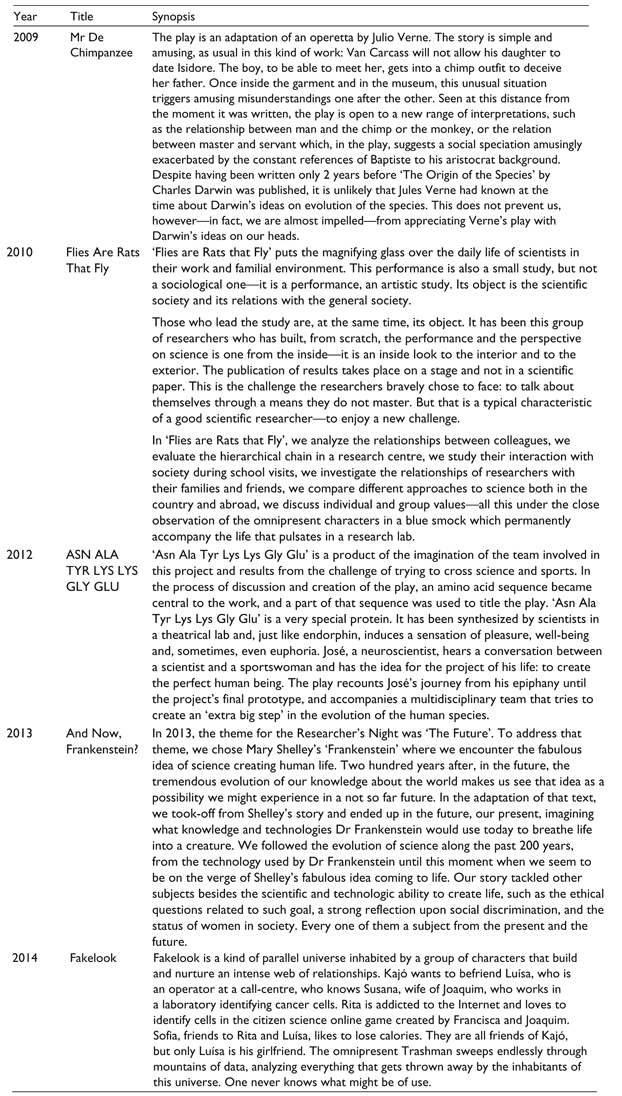
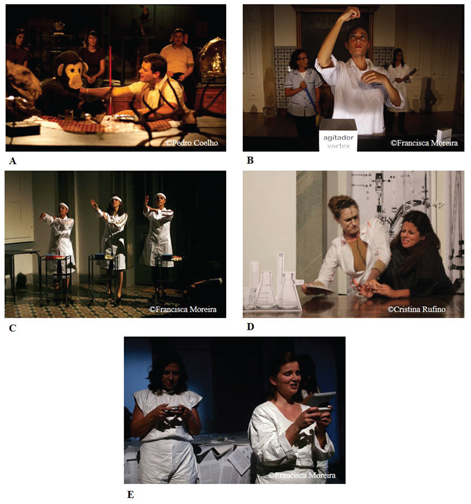
The artistic project described here led to the presentation of five plays (Table 1, Figure 1), which used science and scientific life as the central theme. Researchers, together with actors and directors of the Marionet theatre company, were involved in the entire process of creation—the discussion of ideas, writing of the script and performing as actors. In order to build a valuable theatre play, it was taken into account the balance between the artistic language, desirable in a theatrical context (with the use of metaphors, hyperbole and humour), and the scientific truth that involves not only concepts and mechanisms but also peculiarities of the scientific world and the daily life of researchers.
Year, Title and Synopsis of the Theatre Plays Performed in Coimbra during the European Researchers’ Night
The Evaluation
The process of evaluation is a way to reflect, learn and improve science communication practices. Sharing evaluation results avoids unnecessary repetition of studies and is imperative to support innovative and improved science communication strategies (Trench, 2014; De Semir, 2011).
In order to explore the potential of the theatrical performances to bring to light the scientific world singularities, and of such art and science project as a vehicle for the promotion of scientific culture, we present here a qualitative assessment of the researchers’ involvement throughout the process. Their motivations, limitations and benefits of being engaged in this project, as well as their views on the subject, were addressed in two focus groups conducted with a sample of the researchers who participated in the plays. This qualitative methodology was adopted considering its main goal of bringing out contents on the subject in study by the participants and hence its efficacy in gathering perceptions, feelings, opinions, beliefs and attitudes about themes (Hara & Solomon, 2003; Peek & Fothergill, 2009; De Semir, 2011). For this purpose, a topic guide was created (Appendix A) which was no more than suggestive, affording the moderator to address three main key points: motivation, involvement and consequences. Open questions were launched in order to encourage self-disclosure and exchange of ideas (Hara & Solomon, 2003) thus systematically exploring the interplay of the personal and social dimensions (Millward, 2000).
The focus groups were conducted with a heterogeneous sample of researchers 1 who participated in the plays, who came from different scientific areas, including social and biomedical scientists, architects and engineers, and also are at different stages of their careers, including master and doctoral students, technical assistants, postdoctoral researchers, principal investigators and professors. The two focus groups were composed of seven and five subjects, respectively, and lasted for about 2 hours each. The moderators attempted to create a favourable context for an equitable contribution of all participants through a non-obtrusive balance out of discussion process. While conducting focus groups, it is common to have less control when compared to regular interviews to individuals. However, in both focus groups, leverage could be exerted, as most of the participants did not reclaim the ownership of the session. Also, some of the problems usually emerging during focus groups were absent, namely, the problem of having two or more participants speaking simultaneously. As a downside, the level of interaction was somehow more reduced also because a common agreement was found on the majority of the themes discussed. For that, it was important to give voice to all participants involved.
Groups were recorded (audio), with the written permission of all participants, and a full transcription was completed. After transcription, the files were imported into the application MAXQDA 11 in order to be analyzed in an exhaustive and systematic way. A system of categories was established to proceed to the categorization of all data, in order to identify patterns and regularities. Content analysis is a deductive approach that tests a previously known or theoretical framework applying a categorization grid (Bardin, 2014; Krippendorff, 2013). However, the emergence of new categories is frequent during the analysis and interpretation. After performing the required steps in the methodology, the final results were aggregated by using summary grids. Finally, the data were described and interpreted. The quotes presented in the results section were selected on a relevance basis, not in terms of quantity but in relation to the research questions, without relying on the professional role of the proponent. It was then important to rely on software as a strategy to organize all the data, as to anonymize participants in order to blindly select the more relevant text passages. In that respect, greater attention was devoted to textual analysis.
Results and Discussion
From 2009 to 2014, 38 researchers participated in this project and the audience of the five plays was: ‘Mr De Chimpanzee’, 540; ‘Flies Are Rats That Fly’, 440; ‘ASN ALA TYR LYS LYS GLY GLU’, 300; ‘And Now, Frankenstein?’, 300; and ‘Fakelook’, 300.
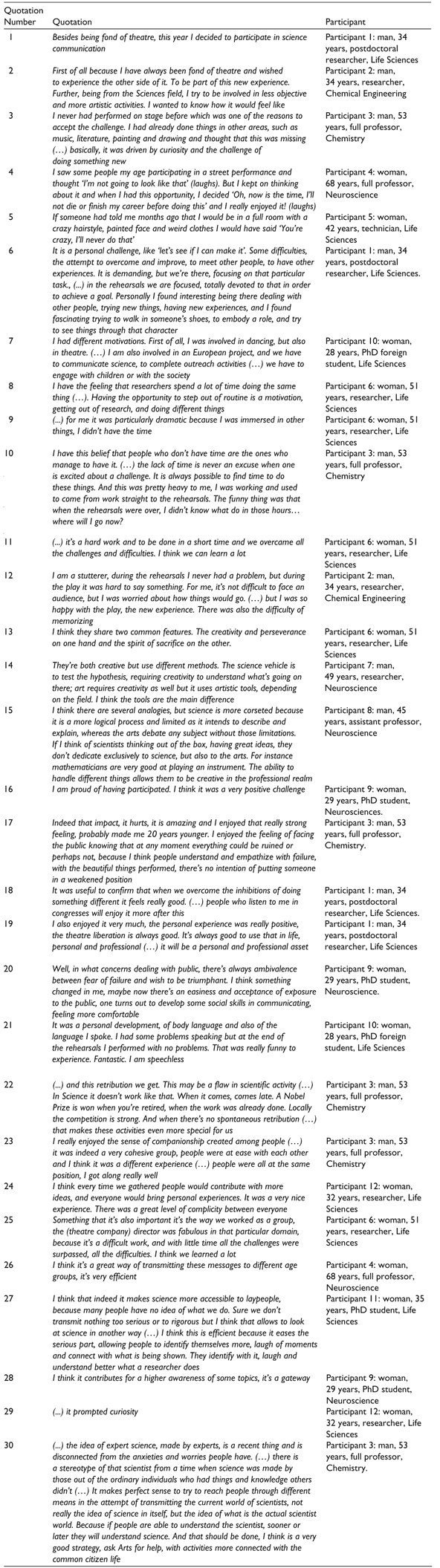
The data collected and analyzed during the study is based on the perceptions that participant researchers have about several aspects of their experiences (complete quotations in Table 2). There were three main starting points for discussion in the focus groups: motivation to participate, involvement in the process and consequences of the participation. Regarding the first aspect, a series of motivational factors emerged and the researchers ascribe their engagement to different factors: the simple opportunity, the challenge, a way to continue an artistic activity and a way of getting involved in science communication activities. These different motivations are expressed during the discussions, and below we highlight some examples:
Besides being fond of theatre, this year I decided to participate in science communication. (quotation 1, participant 1: man, 34 years, postdoctoral researcher, Life Sciences) First of all because I have always been fond of theatre and wished to experience the other side of it (…) Further, being from the Sciences field, I try to be involved in less objective and more artistic activities. (quotation 2, participant 2: man, 34 years, researcher, Chemical Engineering) I never had performed on stage before which was one of the reasons to accept the challenge (…) basically, it was driven by curiosity and the challenge of doing something new. (quotation 3, participant 3: man, 53 years, full professor, Chemistry)
Complete Quotations from the Focus Groups
We can understand that the challenge of theatre itself plays a motivating role, a motivation that often arises by chance, and not in a planned manner and with a specific goal. The majority of scientists are able to identify the important reasons that led them to participate in the project, and even several state that they had never imagined to perform on a theatre stage.
I decided ‘Oh, now is the time, I’ll not die or finish my career before doing this’ and I really enjoyed it! (laughs). (quotation 4, participant 4: woman, 68 years, full professor, Neuroscience)
If someone had told me months ago that I would be in a full room with a crazy hairstyle, painted face and weird clothes I would have said ‘You’re crazy, I’ll never do that.’ (quotation 5, participant 5: woman, 42 years, technician, Life Sciences)
It is a personal challenge (…) I found interesting being there dealing with other people, trying new things, having new experiences, and I found fascinating trying to walk in someone’s shoes, to embody a role, and try to see things through that character. (quotation 6, participant 1: man, 34 years, postdoctoral researcher, Life Sciences)
I had different motivations (…) I am also involved in an European project, and we have to communicate science, to complete outreach activities (…) we have to engage with children or with the society. (quotation 7, participant 10: woman, 28 years, PhD foreign student, Life Sciences)
I have the feeling that researchers spend a lot of time doing the same thing (…). Having the opportunity to step out of routine is a motivation, getting out of research, and doing different things. (quotation 8, participant 6: woman, 51 years, researcher, Life Sciences)
While analyzing the qualitative data regarding the involvement of the researchers, we found a remarkable commitment and effort from all during the entire process. There are many references in the discussions related to the dedication to the project. This group of ‘part-time artists’ reveals that they had to deal with a number of constraints and hardships. On the one hand, the scientific work is hard and very demanding, leaving little space for extra activities, an obstacle already documented in previous studies (Borrow & Russo, 2015; Hamlyn, Shanahan, Lewis, O’Donoghue, Hanson & Burchell 2015). On the other hand, the persistence needed throughout the artistic process to reach a positive outcome is very demanding. However, the enthusiasm and the motivation made possible to overcome all of these adversities.
(…) for me it was particularly dramatic because I was immersed in other things, I didn’t have the time. (quotation 9, participant 6: woman, 51 years, researcher, Life Sciences)
I have this belief that people who don’t have time are the ones who manage to have it. (…) the lack of time is never an excuse when one is excited about a challenge. It is always possible to find time to do these things. (quotation 10, participant 3: man, 53 years, full professor, Chemistry)
(…) it’s a hard work and to be done in a short time and we overcame all the challenges and difficulties. I think we can learn a lot. (quotation 11, participant 6: woman, 51 years, researcher, Life Sciences)
I am a stutterer, during the rehearsals I never had a problem, but during the play it was hard to say something (…) but I was so happy with the play, the new experience. (quotation 12, participant 2: man, 34 years, researcher, Chemical Engineering)
Another interesting consideration that comes up in the focus groups is the perception of the similarity between scientific and artistic processes. The researchers highlighted many connections between the two endeavours. They were able to draw several connection points between the production of science and the production of theatre such as the exhaustive repetition of experiments, the need of intensive practice, the experimentation and the importance of the error.
I think they share two common features. The creativity and perseverance on one hand and the spirit of sacrifice on the other. (quotation 13, participant 6: woman, 51 years, researcher, Life Sciences)
Some researchers address the great value of creativity and aesthetics in the scientific process, also essential to artistic production. They shared a particular view of science, without stereotypes, as a space for emotional dimensions. In general, scientific and artistic processes are not seen as opposite worlds but as realities that intersect in many ways.
They’re both creative but use different methods. The science vehicle is to test the hypothesis, requiring creativity to understand what’s going on there; art requires creativity as well but it uses artistic tools, depending on the field. I think the tools are the main difference. (quotation 14, participant 7: man, 49 years, researcher, Neuroscience)
I think there are several analogies, but science is more corseted because it is a more logical process and limited as it intends to describe and explain, whereas the arts debate any subject without those limitations. (quotation 15, participant 8: man, 45 years, assistant professor, Neuroscience)
The qualitative analysis also shows that researchers have a very positive attitude regarding the outcome of the plays and the consequences of their participation.
I am proud of having participated. I think it was a very positive challenge. (quotation 16, participant 9: woman, 29 years, PhD student, Neurosciences)
Indeed that impact, it hurts, it is amazing and I enjoyed that really strong feeling, probably made me 20 years younger. (quotation 17, participant 3: man, 53 years, full professor, Chemistry)
The discussion focused mainly on the consequences at the individual level but also at a broader level concerning the use of theatre for science communication. The list of individual consequences, both in their personal lives and in their careers, is large and varied. The researchers acknowledge that being engaged in a theatrical project improved their communication skills, led to overcoming shyness in public presentations and to obtain a higher degree of body control.
It was useful to confirm that when we overcome the inhibitions of doing something different it feels really good. (…) people who listen to me in congresses will enjoy it more after this. (quotation 18, participant 1: man, 34 years, postdoctoral researcher, Life Sciences)
I also enjoyed it very much, the personal experience was really positive, the theatre liberation is always good. It’s always good to use that in life, personal and professional (…) it will be a personal and professional asset. (quotation 19, participant 1: man, 34 years, postdoctoral researcher, Life Sciences)
Well, in what concerns dealing with public, there’s always ambivalence between fear of failure and wish to be triumphant. I think something changed in me (…) develop some social skills in communicating, feeling more comfortable. (quotation 20, participant 9: woman, 29 years, PhD student, Neuroscience)
It was a personal development, of body language and also of the language I spoke. I had some problems speaking but at the end of the rehearsals I performed with no problems. That was really funny to experience. Fantastic. I am speechless. (quotation 21, participant 10: woman, 28 years, PhD foreign student, Life Sciences)
Another theme that emerged was the recognition of the advantage of hard work and intensive training, in a different context from the scientific daily life of researchers. Scientific work demands it, and then is not unusual. But doing it in a different context and with different goals seems to be understood as a challenge with many professional advantages, including public recognition of the work.
(…) and this retribution we get. This may be a flaw in scientific activity (…) In Science it doesn’t work like that. When it comes, comes late (…) that makes these activities even more special for us. (quotation 22, participant 3: man, 53 years, full professor, Chemistry)
They also addressed the question of the potential of this project for the creation of a team spirit, despite the heterogeneity of the groups. During the artistic process, people in different career stages worked together at the same level and with a common goal. The involvement in the artistic process seemed to have a role in the dissolution of hierarchical barriers that exist in the workplace, allowing each of the researchers to share not only their scientific knowledge and experience but also their personal experiences. This contribution to team building, by establishing interpersonal relationships and creating ties, is seen as an advantage by the researchers.
I really enjoyed the sense of companionship created among people (…) it was indeed a very cohesive group, people were at ease with each other and I think it was a different experience (…) people were all at the same position, I got along really well. (quotation 23, participant 3: man, 53 years, full professor, Chemistry)
I think every time we gathered people would contribute with more ideas, and everyone would bring personal experiences. It was a very nice experience. There was a great level of complicity between everyone. (quotation 24, participant 12: woman, 32 years, researcher, Life Sciences)
Something that it’s also important it’s the way we worked as a group, the (theatre company) director was fabulous in that particular domain, because it’s a difficult work, and with little time all the challenges were surpassed, all the difficulties. I think we learned a lot. (quotation 25, participant 6: woman, 51 years, researcher, Life Sciences)
Concerning the question of the potential of theatre to communicate science, and although they did not have explicit evidences, researchers believe that it could be a good way to address complex scientific issues because its artistic features and tools can often uncover and demystify the scientific jargon and the peculiarities of scientific reality. For the researchers, the theatre might play an important role in the communication of scientific messages by sharpening the curiosity and revealing what is science and the scientific life, rather than teaching science.
I think it’s a great way of transmitting these messages to different age groups, it’s very efficient. (quotation 26, participant 4: woman, 68 years, full professor, Neuroscience)
I think that indeed it makes science more accessible to laypeople, because many people have no idea of what we do. Sure we don’t transmit nothing too serious or to rigorous but I think that allows to look at science in another way. (quotation 27, participant 11: woman, 35 years, PhD student, Life Sciences)
I think it contributes for a higher awareness of some topics, it’s a gateway. (quotation 28, participant 9: woman, 29 years, PhD student, Neuroscience)
(…) it prompted curiosity. (quotation 29, participant 12: woman, 32 years, researcher, Life Sciences)
Simultaneously, the audience surveyed in an exploratory study 2 conducted alongside the core methodological qualitative research technique also considered that science could attract more interest through theatre and also that the initiative was artistically successful. This artistic approach is perceived as a good vehicle for the transmission messages and complex scientific ideas, not through an educational perspective but from an approaching point of view, as a stimulus to better understand new scientific topics and to sharpen curiosity.
Theatre is perceived by the researchers as capable of dissolving the idea of science as something very distant, not accessible or understandable to the average citizen. It is also viewed as a translation work not only of science itself but also of their own work, in order to overcome widespread stereotypes. Indeed, they are eager to communicate their work to the audience, like most of the transcripts reveal. The transformation of science making is also debated—from an activity performed only by an elite of intellectuals to a common professional career.
It makes perfect sense to try to reach people through different means in the attempt of transmitting the current world of scientists (…) Because if people are able to understand the scientist, sooner or later they will understand science. (quotation 30, participant 3: man, 53 years, full professor, Chemistry)
Although there are many other traditional vehicles for scientific dissemination, creative forms of communication, such as theatre, should not be undervalued. Theatre, and the potential it has to disseminate messages, can also trigger the establishment of new forms of interaction between science and the publics. This theatre project created the opportunity to reveal how the world of science works and to bring citizens and scientists closer. Marionet theatre company has a long history of exploring science in its plays, having established links with scientific interlocutors at different levels, such as consultation with specialists about scientific issues, artistic residencies and theatrical presentations in scientific institutions, or creating and performing plays together with scientists. With the collaborative work with scientists developed in the project presented here, the company explores two main ideas. First, writing plays from scratch together with them, regardless of a specific scientific theme, aims to convey a closer look into the scientific society in their own words; and second, having the plays performed by scientists, tries to reveal an alternative image of those individuals, out of their scientific environment, and at the same time talking about it but using a different medium. The differences and similarities between science and theatre processes have previously been addressed and identified by professionals on both sides (Rossiter, 2008; Stoppard, 1994). Also in this project, those aspects were discussed. On the side of the similarities, we might indicate the need for creativity, the repetitive experimental work, the learning from error, an aesthetic concern with the final result of the scientific or artistic research. On the side of the differences, one might point out the use of different tools and different languages between science and theatre, epistemological issues of truth and validity, and of course, their different goals.
The vision of the researchers and of the theatre company about the potential of this theatrical project to communicate science generates many clues for further research regarding the connections and collaborations between science and art, and their potential in the engagement of society in scientific research.
Conclusion
The project presented is a renewed form of intersection between science and art, fitting in the set of plays that have been exploring scientific themes over the centuries. During the discussions, the researchers established several points of intersection between these different activities such as creativity, aesthetics, hard work and repetition. They also reinforced the success of the initiative as it offered advantages for both parts, scientists and artists. It is also important to highlight the advantages regarding the potential of the project to engage scientists in science communication activities, leading to the development of personal and professional skills, as already described in other science communication studies (Clark et al., 2016; Jensen, Rouquier, Kreimer & Croissant, 2008). Previous data show that the difficulty of science communication tasks is usually associated with a negative image perceived and therefore the removal of scientists from this kind of initiatives (Borrow & Russo, 2015; Davies, 2008; Dowell & Weitkamp, 2011; Jensen et al., 2008). In this project, despite the difficulties and challenges, the researchers showed a positive perspective and revealed a great involvement in the initiative which is vital, not only for the success of a particular event but for the engagement in more and more diverse forms of science communication. This perspective was already described in other similar science communication projects, including the stand-up comedy initiatives ‘Cientistas de Pé’, a Portuguese project (Pinto, Marçal & Vaz, 2013), or the British ‘Brightclub’ (Bultitude, 2011). It is noteworthy the ability of the project to show the singularities of the scientific world and the daily life of researchers, approaching science and society and demystifying the complex image of scientists, which are the main objectives of the ERN (European Commission, 2013, 2014, 2015). By lifting the veil of the scientific world, theatre has the ability to show its nature and its actors.
Although the ERN is intended for the general public, the public of the ERN at the Science Museum in Coimbra is composed by a great number of people from academia, many already involved in the scientific process. It would be of the great interest to present this project in non-scientific contexts, as generic spaces might have a greater potential for involvement of society in science (Bultitude & Sardo, 2012; Falk & Dierking, 2010; Leão & Castro, 2012). By reaching a more heterogeneous audience, as well as exploring new themes and areas of knowledge (and involving more researchers), we believe the project could possibly have a greater impact. A new and deeper evaluation study regarding the perspective of the publics would allow drawing more solid conclusions regarding the potential of the project as a science communication approach.
Funding
Sara Varela Amaral, Mário Montenegro, Francisco Freitas and M. Teresa Girão da Cruz were funded by Fundação para a Ciência e a Tecnologia (fellowships SFRH/BD/79648/2011; SFRH/BD/45285/2008; SFRH/BD/52258/2013; and SFRH/BGCT/113575/2015, respectively). Teresa Forte was funded by the European Commission project HOME/2012/ISEC/AG/THB/4000003932. Center for Neuroscience and Cell Biology was funded by FEDER, Programa Operacional Factores de Competitividade – COMPETE 2020 and by Fundação para a Ciência e Tecnologia (UID/NEU/04539/2013). The European Researchers’ Night events were funded by the European Commission seventh Framework Programme and Marie Skłodowska-Curie Actions of the Horizon 2020 programme (PNIGHT-GA-2009-245061; PNIGHT-GA-2010-265788; PNIGHT-GA-2012-316517; PNIGHT-GA-2013-609809; H2020-2014-MSCA-NIGHT-633379).
Footnotes
Acknowledgements
We thank the researchers involved in the theatre plays and those who participated in the focus groups. We also would like to thank the Municipality of Coimbra and Direção Geral das Artes for supporting Marionet Theatre Company and the Science Museum of the University of Coimbra for hosting the theatre plays.
Semi-structured script used in Focus Groups