



Abstract
Accredited as the provenance of creative art and appreciated for its verisimilar mimetic virtues, drawing is a cathartic form of visual art. Specifically, the curative utility of drawing is anchored on its multifaceted health-enhancing qualities. Drawing is often practised either as a technique of narration, as in visual communication, or as a therapeutic exercise, as in clinical contexts. Interestingly, in the field of graphic medicine, which is a productive intersection of comics and medicine, drawing is practised both as a narrative technique as well as a mode of therapy. Analysing scenes of drawing in selected graphic medicine memoirs such as David Small’s Stitches: A Memoir (2009, New York: W.W. Norton & Co) and Katie Green’s Lighter than My Shadow (2013, London: Random House), this article investigates how these graphic medical narratives offer an insight into the healing potentials of drawing. This article uses the term ‘drawing’ in two distinct yet interrelated senses: one is the process of drawing which denotes the depiction of the artist himself/herself involved in the act of drawing, and the other is the end product of drawing such as the picture/image or painting. By elaborating the psychological benefits of drawing, the article also brings into relief how the act of drawing facilitates self-reclamation by assisting patients or traumatized individuals in resolving their chaos through creative expression.
Introduction
Accredited as the provenance of creative art and appreciated for its verisimilar mimetic virtues, drawing is a cathartic form of visual art. Specifically, the curative utility of drawing is anchored on its multifaceted health-enhancing qualities. Drawing is often practised either as a technique of narration, as in visual communication, or as a therapeutic exercise, as in clinical contexts. Interestingly, in the field of graphic medicine, which is a productive intersection of comics and medicine, drawing is practised both as a narrative technique as well as a mode of therapy. Analysing scenes of drawing in David Small’s Stitches: A Memoir (2009; hereafter Stitches) and Katie Green’s Lighter Than My Shadow (2013; hereafter Lighter), this article investigates how these graphic medical narratives offer an insight into the healing potentials of drawing. This article uses the term ‘drawing’ in two distinct yet interrelated senses: one is the process of drawing which denotes the depiction of the artist himself/herself involved in the act of drawing, and the other is the end product of drawing such as the picture/image or painting. By elaborating the psychological benefits of drawing, the article also brings into relief how the act of drawing facilitates self-reclamation by assisting patients or traumatized individuals in resolving their chaos through creative expression.
Sketching Trauma: Comics and Graphic Medicine
Irrespective of the medium, narrating an experience of trauma is an individual’s attempt to confront and communicate an intangible and incoherent experience. However, articulating an experiential agony is challenging when trauma affects human cognitive capacities such as speaking and writing skills. Therefore, experiences that ‘cannot be spoken as they are felt’ often necessitate the use of ‘alternative cognitive structures of the visual’, such as drawing, painting and other media, to externalize the trauma (Hirsch, 2004, p. 1211). Accordingly, drawing is identified as a symbolic method of communication that exposes the artist’s psychological involvement in the experience (Crawford, Brown, Baker, Tischler, & Abrams, 2015, p. 113). Since drawing is a highly sensory artistic exercise which integrates multiple senses such as ‘the sense of balance, the sense of vision, the sense of audition [and] the sense of touch’ (Ramm, 2006, p. 66), it can help sufferers to express cognitive as well as corporeal memories of trauma or illness through imagination, metaphors, symbols and a wide range of drawing techniques. According to William Steele and Cathy A. Malchiodi (2012, p. 157), ‘[T]his iconic symbolization gives experiences a visual identity because the images created contain all the elements of that experience—in other words, what happened, our emotional reactions to what happened and the horror and terror of the actual event.’ In essence, drawing is one of the most creative non-verbal methods of self-expression that can evocatively convey experiences and memories that are beyond the grasp of verbal expression. Further, the ‘relation of visuality to the experience’ enables sufferers to resort to a non-verbal medium where the ‘unspeakable may be better communicated emotionally and viscerally’ (Hirsch, 2004, p. 1211). In essence, as a reflective and reflexive mode, drawing facilitates a logical assimilation of incoherent experiences into a meaningful narrative and effectuate a vital psychological settlement.
It is in this context that comics gain importance as an innovative approach towards addressing and processing personal trauma through drawing. Identifying comics creation as a form of self-restoration, Matthew J. Mulholland (2004, p. 43) observes that ‘as a medium, comic books provide their creators a wide variety of resources to aid their mental health. They allow for expression of the self in terms of body image, verbal expression, physical action, and emotion.’ Certain structural elements of the medium of comics, such as panels and gutter spaces, manifest the fragmentary nature of traumatic experiences. Accordingly, Mulholland (2004, p. 43) notes that ‘as a therapeutic tool, creating comics is a safe avenue of release for clients.’ In order to restore the shattered self of the subject and to redeem his personhood, narrating the experience of suffering is substantial. In the Graphic Medicine Manifesto, Ian Williams (Czerwiec et al., 2015, p. 119) observes that ‘making autobiographical comics is a type of symbolic creativity that helps form identity—a way to reconstruct the world, placing fragments of testimony into a meaningful narrative and physically reconstructing the damaged body’. Accordingly, comics creation facilitates the reconstruction of identity from fragmented lives by providing a sheltered space for individuals to negotiate and reflect on their past. Through ‘an expressionist mix of posture, expression, and visual metaphor’ (Czerwiec et al., 2015, p. 127), comics enable individuals to revisit the experience, recreate it and process the emotions while logically assimilating the incoherent experiences into a narrative. Similarly, reading comics can also be beneficial in multiple ways. Comics is also an artistic form that ‘uses a spatial matrix which enables numerous ideas to be expressed simultaneously, unlike the typically linear mode of verbal expression’ (Crawford et al., 2015, p. 108). Further, reading comics is ‘an image based process of bearing witness’ (Guerin & Hallas, 2007, p. 12) where the reader not only becomes a creator of meaning, but also a witness to the sufferings of the author. Thus, the participatory nature of the medium enables readers to empathize with the narrator effectively and affectively. In this way, both creation and reading of comics help to create a brotherhood of sufferers that acknowledges the myriad experiences and practices of healing and confronting experiential horrors. Art Spiegelman’s The Complete Maus (2003 [1986]), Marjane Satrapi’s The Complete Persepolis (2007 [2000]) among others are some of the notable comics on trauma.
At this juncture, graphic medical narratives, graphic illness memoirs or graphic pathographies can be considered as ideal modes for processing and expressing traumatic experiences. Identified as an evolving sub-genre of the medium of comics, graphic medicine interlaces verbal and visual elements in order to effectively convey affective realities of the author. Defined as a nexus of comics and medicine, graphic medicine is an emerging interdisciplinary field which ‘explores comics’ distinctive engagement with and performance of illness experience’ (Venkatesan, 2016, p. 2). Primarily, graphic medical narratives are visual manifestations of sufferers’ self-reconciliation through writing and drawing their emotional states. Utilizing the medium-specific characteristics of comics in achieving therapeutic, educational and community-building goals, graphic medicine offers a visual language to represent the silent moments of affective connection’ (Czerwiec, 2015, p. 167). As a creative anodyne, drawing effectively registers the artist’s tacit dimensions of experiential truths and, ‘helps to organize the emotional effects of an experience as well as the experience itself’ (Pennebaker & Seagal, 1999, p. 1249). Therefore, graphic medicine offers a creative zone for individuals to visually negotiate their emotional, social and subjective experiences that largely ‘escape both the normal realms of medicine and the comforts of canonical literature’ (Squier, 2008, p. 130).
In contrast to the surplus of critical studies available on the healing and curative dimensions of drawing outside the text, there is a dearth of graphic medical narratives that describe the psychological benefits of drawing and art within the text. While a majority of illness memoirists provide autobiographical testimonies about the therapeutic potential of drawing through interviews, personal websites, magazine articles and essays, and certain graphic memoirists demonstrate the process of drawing and its psychological benefits within their illness accounts via their alter egos or narrative avatars. Perhaps the first graphic memoir to provide a definitive insight into the recuperative properties of drawing within the narrative is Al Davison’s The Spiral Cage (1990). Davison’s memoir is a graphic elucidation of coping with spina bifida through creativity, martial arts and Buddhism. Specifically, Davison resorts to drawing as his life-force and one of the means to unshackle his body from the psychological woe caused by his orthopaedic abnormalities. Adroitly merging realism and fantasy, the memoir is a materialization of Davison’s aspiration which he expresses thus: ‘I want to be an artist’ (1990, p. 101). Elucidating the psychological benefits of art, The Spiral Cage demonstrates how the act of drawing helps the memoirist to express the specificities of his illness conditions, and how drawing facilitates restoration from physical and psychological enfeeblements. In a similar vein, Small’s Stitches and Green’s Lighter are unique examples of graphic memoirs that not only offer a commentary on the process of drawing but also a definitive insight into the recuperative properties of drawing through the author’s narrative avatar or alter-ego.
‘A Way of Expressing Myself Wordlessly’: Stitches and Lighter Than My Shadow
Published in 2009, Stitches is a visual memoir which concerns David’s (Small’s narrative avatar) disconsolate childhood and early adulthood experience of vocal impairment and psychological abuse in a dysfunctional family. Marked by the perpetual absence of the father and frightening presence of his mother, David’s childhood was punctuated by ‘fear … humiliation and pain’ (2009, p. 97). Small introduces his mother as resentful and hostile, his father as a pipe-smoking radiologist and Ted as an unfeeling sibling who withdraws into playing drums in the basement. Characterizing his house as a place where ‘silence reigned and free speech was forbidden’, David deploys raucous and discordant sounds to signify the lack of communication within the family (2009, p. 18). Accordingly, if the thumping of the punching bag was his father’s voice, then the subtle noises of coughing, slamming and sobbing constituted his mother’s language. Describing how the unsympathetic family neglected his biological imperatives when he developed throat cancer at the age of 11, the graphic memoir takes the readers through his delayed surgery and how David relies on drawing to escape from the paralyzing silence and abuse of his insensitive family. With his actual home as a site of emotional warfare, David learns to transcend familial constraints and emotional catastrophes through drawing. Gradually, David finds a personal space and creative haven through drawing and accredits art as his safe zone by stating ‘art became my home’ (2009, p. 302). Essentially, against the terror and silence that reigned over his family, drawing provides him the quintessence of home. David leaves home at the age of 16 after his surgery and eventually turns his passion into a profession by becoming a drawing teacher in New York at the age of 30. The theme of the narrative as a misery memoir is stylistically made explicit through the choice of water colour pages, borderless panels and the pervading grey shade of monotony. If at one level the memoir is the dissection of Small’s traumatic childhood in an abusive and inexpressive family, on the other, it is a visualization of how he regains his individuality and sovereignty through art and drawing.
In a similar vein, Lighter is Green’s debut graphic narrative which is widely appreciated for the intense visual narration of her struggle with anorexia and subsequent recovery. Deploying Katie as Green’s narrative avatar, the memoir foregrounds the significance of drawing as a means of self-restoration from psychosomatic trauma. Portraying the progressive psychological arc of her illness and the consequent feeling of culpability, the memoir affords a factual and affective narration of the cycles of recovery, relapse and survival. Beginning with elaborate illustrations of young Katie’s struggle to express her disparaging relationship with food, the memoir meanders through her adolescent experiences of anorexia, sexual assault and binge eating. As a result of the adverse bearing of anorexia on her self-confidence and creative capabilities, Katie stops practising the art of drawing. However, at a critical juncture, Katie returns to drawing and utilizes its therapeutic potentials to restore her well-being. Essentially, the very act of drawing which was explored by Katie in her childhood as a creative pathway to an inoffensive world of imagination is used in adulthood as a survival tactic to recuperate from the ordeals of her eating disorder and sexual abuse. In order to communicate her ineffable and inconsolable psychological agony and concurrently to reinforce the expressive potential of drawing, Katie uses the visual metaphor of a patch of dense scribbles over her head. Drawing not only provides tactility to Katie’s repressed and unapparent emotions but also offers a distinctive voice to communicate with herself and others. Deploying drawing as a creative endeavour that provided her with prospects of recovery, Katie illustrates art as ‘an effective container for, and liberator from, the ambivalence that persons with eating disorders feel about recovery’ (Hinz, 2006, p. 12).
‘When I Grow Up, I Am Going to Do Picture Books’: Bridging Childhood and Adulthood
At the very outset of the memoir, Small provides three successive images of David nose-diving into a drawing sheet (see Figure 1), which not only foreshadows the thematic significance of drawing in Stitches but also emphasizes how drawing, in general, helps people to move beyond the difficulties of real life. In the first image, David is depicted as immersing his head into the drawing sheet by rupturing the white surface. Depicting his creative and corporeal involvement in the act of drawing, David completely submerges his head and hands into the sheet and magically disappears into the paper in the next image. Interestingly, the surfaces of the drawing paper and the page of the memoir in which it is drawn conflate into one inseparable plane. Through the skilful deployment of cinematic lighting techniques such as chiaroscuro and soft light, David’s shadow is cast on the paper as well as on the page, reiterating the oneness of the drawing space and the material space of the page. Here, David’s engagement with drawing is also lucidly illustrated by attentively leaving three unused crayons that are symbolic of the material moorings of drawing. While it serves as a diacritical graphic attestation of the autobiographical claims of the memoir, the image sequence also functions as an invitation to the reader to delve deep into the imaginative world instantiated by art and drawing. By envisaging the drawing sheet as the gateway to creative enclaves, the entire act of drawing also lays the ground for the conventions of an escape narrative.

Having provided such an introduction to the significance of the act of drawing in the memoir, the author immediately introduces himself as a young artist indulged in artistic creation. Accordingly, Small deploys the definitive features of an archetypal artist in David through his expression of unrestrained confidence and non-chalance. Exploring a cinematic style opening by zooming into the nightscape of Detroit, the readers’ eyes follow the artist into the house in search of the protagonist. Here, Small provides three significant aspects of art: the artist at work, the act of drawing and the content of the drawing. Portraying himself unruffled on a floor, Small adeptly crafts the introductory scenes to express his inveterate passion for drawing. Throughout the narrative, David prefers drawing as his language and establishes ‘manual drawing as a communication act’ (Lyon, 2016, p. 3). Depicting himself as an artist, in all possible ways, Small visually literalizes his own statement that ‘art became my home’ (2009, p. 302). With his actual home as a site of emotional warfare, David transcends the constraints of conformity and emotional cataclysm through drawing, thereby gaining a psychological space and creative haven. Essentially, drawing provides him the quintessence of home as against the terror and silence that reigned his house.
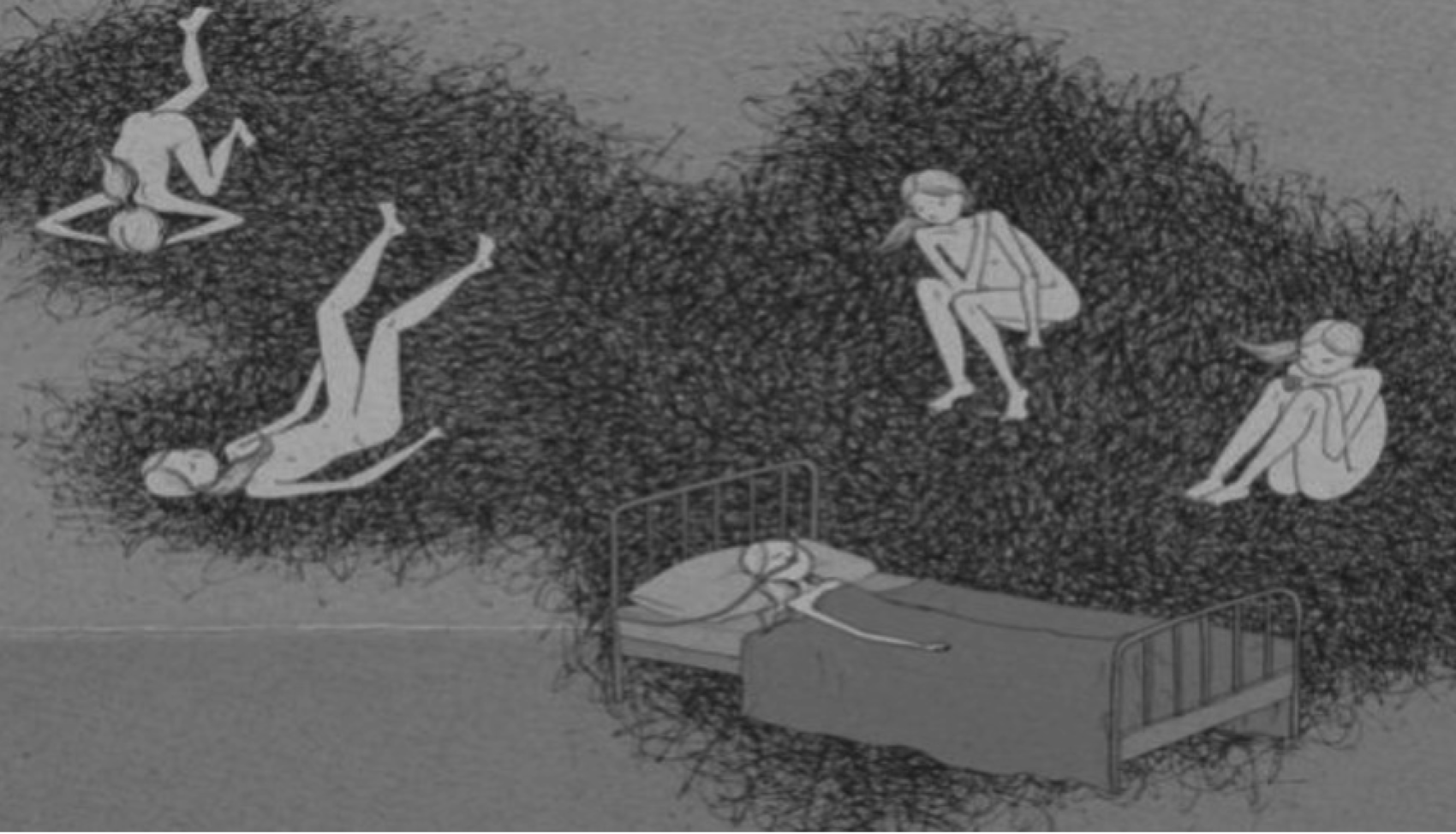
Similarly, in the first eleven pages of Lighter, which also serve as a visual exordium to anorexia, the narrator is introduced as an artist. Here drawing enables Katie to visibilize and concretize her frightful memories of desolation and distress caused by eating disorder and sexual violence. In order to communicate her ineffable and inconsolable psychological agony and concurrently to reinforce the expressive potential of drawing, Katie introduces the visual metaphor of a patch of scribbles over her head. Through a series of unnerving images of Katie’s emaciated body immersed in dark scribbles, the memoirist communicates the intensity of her appalling life conditions (see Figure 2). Through visual cues of nudity, emaciation, nasogastric intubation and the hospital bed, Green forcefully illustrates the vulner-ability and trauma experienced by Katie. Portraying the protracted and onerous period of cognitive gestation and watchful waiting involved in any act of creation, Green shows how Katie, the narrative avatar of the author, recedes into an embryonic stage. In short, through the prelude which in itself is an ingenious exemplification of creativity, Katie visually prefaces the precedence of drawing and its restorative promises.
Akin to David, Katie also enjoys drawing as a unique way of creating a safe space away from the world of restrictions caused by her anorexic habits. As a kid with picky eating habits, Katie is portrayed as a child who is under constant intimidation and compulsion to eat. However, she develops a sense of contentment and delight in an alternate world which she creates through drawing. Growing up neglecting the ‘early signs of an eating disorder’ as mere dislike for food, Katie gets medically diagnosed as anorexic only at the age of 17 (2013, p. 36) and it disrupts her habitual relationship with herself and others. Worse still, the deleterious bearing of anorexia on her self-confidence and creative capabilities eventually dissociates her from the art of drawing which she enjoyed during childhood. Katie retracts from further artistic ventures when her career advisor reports that she does not have ‘any real flair in art’ and she ‘struggles to show any creativity’ (2013, p. 83). Here, Green echoes Czerwiec’s (2015, p. 146) observations on the popular segregation of individuals into those who ‘could draw’ and those who ‘couldn’t draw’ by extant institutional ideologies. The insentiently internalized standards of drawing and the cultural redefinition of the talent to draw as the ‘ability to realistically render objects beyond the expected ability for their age’ prevent children from continuing artistic endeavours in which they were confident during childhood (Czerwiec, 2015, p. 146). Hence, reinforcing Czerwiec’s finding that the majority of kids stop utilizing the medium of drawing as they grow up, Katie who aspired in her childhood ‘to do picture books’ (2013, p. 25) when she grows up, warps into a hesitant and perplexed artist in adulthood. However, in spite of a transitory dissociation from creative pursuits, Katie returns to drawing at a critical moment and utilizes its manifold curative potentials to reclaim her physical and psychological haleness.
‘Searching for that Other Land’: Drawing as a Surrealistic Transcendence
Immured in a calamitous childhood, David expresses his ardent yearning to evade the quagmires of life right from the beginning of Stitches. Growing up in a world of sadistic violence and repression, David becomes exhilarated and ensorcelled by the delightful world of Alice in Alice’s Adventures in Wonderland. In his persistent ‘search … for that other land’ (2009, p. 57), David attains ‘the magic ability’ that gave Alice access to the anthropomorphic wonderland, by utilizing his power of imagination and expertise to draw. Against his real world of ‘dread’ and ‘silent withdrawals,’ (2009, p. 16), he creates a topsy-turvy world of fantastic characters similar to the alluring territory of Alice’s world characterized by ‘talking animals, singing flowers and dancing teapots’ (2009, p. 56). For David, drawing offers a private space populated by unoffending and cheerful anthropomorphic characters (see Figure 3). Accordingly, by exercising its intrinsic potency and immediacy in providing consolation and companionship to the sufferer, drawing offers a sense of belonging and acceptance to David. David’s utilization of drawing in order to escape into an alternate spatiotemporal plane during moments of distress by ‘rupturing the plane and partially disappearing through it’, thus ‘reveals the liberty that depthless graphic media has on the constraints of space that usually rules physical bodies’ (Orban, 2014, p. 175). In essence, by performing the act of drawing as a comparatively simpler way to create an alternate world, Small not only alerts readers to the affordances of drawing but also reinforces how drawing can be a constructive psychological escape from the harsh realities of life.
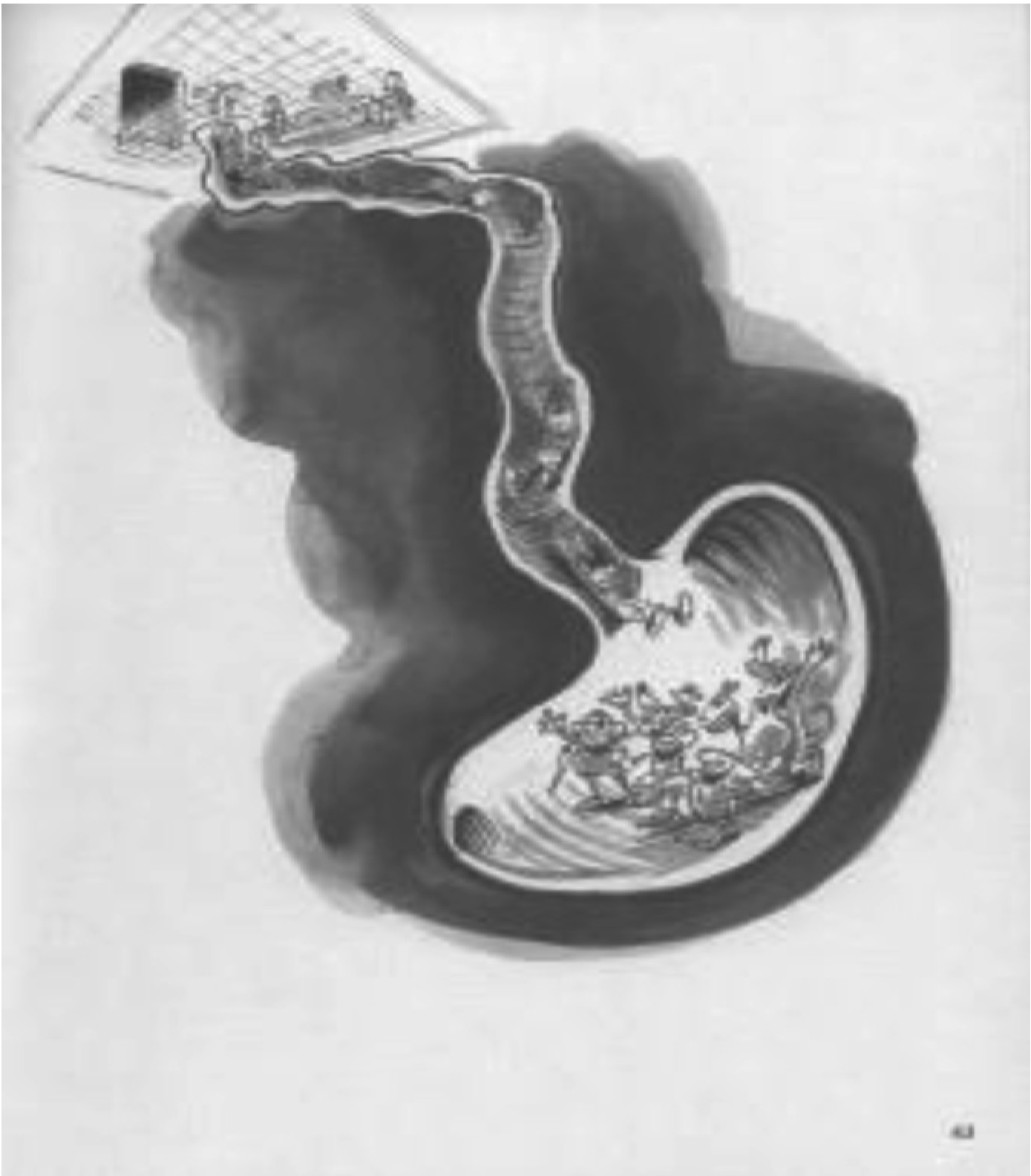
Katie also enjoys drawing as an idiosyncratic way of forging a sequestered space away from the world of curtailment caused by her anorexic habits. Marking the significance of drawing in her life, Katie recollects: ‘[T]here was always something better to do than eating’ (2013, p. 22). Through the visual metaphor of a voyage that commences and concludes in her pencil (see Figure 4), Katie’s engrossed involvement in drawing as a creative odyssey in search of an alternative space is demonstrated in the expansive canvas of the page. As such, the author deploys a full-page panel to portray Katie’s desire to slither away from the familiar yet disquieting environment of her home into an unreal yet exhilarating environ of natural splendour and creative excellence. A closer look at the choice of figures (smiling fishes and sun, dolphins, birds, a giant teddy bear, bunny, mermaid) in Katie’s drawings encapsulates diverse allegorical meanings that inhere in her psyche. Reinforcing the psychoanalytical observation that the content of a drawing is suggestive of the artist’s desires and distresses, her metamorphosis into a mermaid, a mythical aquatic creature, epitomizes Katie’s symbolic letting of heart and passion overrule her analytic mind. As Farokhi and Hashemi observe, ‘A vast amount of psychological information is generated, and the depths of the drawer’s psyche can be felt through the drawing’ (2011, p. 2221). With a profusion of symbols related to liberty and creativity, Katie’s art is an externalization of her desire for an unobtrusive and non-threatening world. Essentially, in her quest for comfort and delight, the quixotic and non-conformist world of non-human beings that Katie creates through drawing holds a sway over the real. Put differently, through multiple depictions of her yearning for an alternate world, Katie not only provides a microcosm of her psychic-scape but also suggests the psychological accomplishments of drawing such as helping the artist to transcend a difficult experience. Hence, in Stitches and Lighter, both David and Katie demonstrate how art creation is equivalent to world creation; through drawing, they secure a benign world of imagination which provides them respite from the disturbing real world.

‘Art has Given Me Everything’: Drawing as an Act of Reclamation
Distinct from her childhood experience of drawing, Katie relies on drawing as a language of communication and as a means of recovery during her anorexia-induced phases of adulthood. Having failed to find any substantial signs of recovery by following biomedicine, Katie switches to an alternate therapy. Even though Katie partially recovers from anorexia with the encouraging approach of Jake, the alternate therapist, his sexual advances not only destroy her confidence but also shift her from the restrictive tendencies of anorexia to the compulsive overeating and purging of bulimia. Caught in the vicious circle of hunger, consumption of food and guilt about eating, Katie believed that she will be ‘stuck with an eating disorder for ever’ (2013, p. 360) and that the ‘whole recovery was a lie’ (p. 377). Katie loses hope in redeeming herself from the clutches of eating disorders and attempts to commit suicide. After consuming a handful of pills, Katie slips into a state of oblivion where she recognizes that drawing can help her recover from her ongoing psychosomatic decline. She picks up a cartooning pen and begins to draw, stating: ‘I want to live. I want to draw’ (2013, p. 403). Katie’s act of picking up the drawing pen is not only indicative of her belief in attaining recovery through art but also depicts her yearning to return to her artistic self. By portraying drawing as Katie’s ultimate means to redeem her lost self, Green skilfully elucidates the therapeutic capabilities of drawing. When the background colour of every other page of the memoir has a symbolic monochromatic shade of grey, Green uses three white coloured pages to depict Katie’s revelatory experience of enlightenment. Here, the absence of any characteristic background shade and dark scribbles maps Katie’s psychic-scape which was unaffected by traumatic memories of sexual abuse or eating disorders at that time. Therefore, the plain white shade is so unique to the memoir that it stylistically denotes the significance of Katie’s psychological transformation into an improved self. Soon after recognizing drawing as her real passion which could heal her psychological wounds, Katie joins the school of art and gradually surpasses her past by externalizing the agony through drawing. As a process that requires long hours of silence and introspection, drawing helped Katie to restore her unhinged emotional and physical state by ‘promot[ing] a sense of mastery and control that is not rooted in eating disordered behavior’ (Hinz, 2006, p. 12). Katie becomes emboldened to confront the terrors of her childhood, transcend her discomforting past and negotiate her loss by externalizing the pain through drawing, which being ‘an opportunity for escape and emotional catharsis’ (as cited in Antelo, 2013, p. 462). Further, drawing as a public expression of private agony eased Katie’s social and psychological isolation. Towards the end of the memoir, Green symbolically represents how drawing emotionally strengthened Katie and allowed her to reconcile with herself by depicting Katie’s reunion with her childhood self-portrayed as a child holding a teddy bear tightly in her arms. Through the memoir, Katie visually attests that ‘when involved in making art’, as Hinz contends, ‘the person is no longer a prisoner of the eating disorder’ (2006, p. 12). Essentially, Katie’s deployment of drawing as her unique means of communication and self-restoration reinforces the multifarious potential of drawing.
Beyond the quintessential authorial imperative of bringing into relief the transition of a traumatized child to a talented illustrator, Small’s Stitches establishes drawing as a definitive artistic pursuit for self-restitution and emotional health. Alienated from his family members and deceived by the conspiracy of silence at home, David fathoms the world of art until it transforms his creativity into his identity. Aligning with Hinz’s theory that art ‘fill[s] periods of silence with productive activity’, David liberates himself from the asphyxiating confines of his familial and social settings by resorting to the therapeutic and invigorating potentials of art (2006, p. 11). Although David was exceptionally skilled at drawing, the first half of the memoir does not provide any instances of David receiving appreciation for his talent. However, towards the end of the narrative, Small demonstrates that through his genuine compliments on David’s ability to draw, Dr Harold Davidson (David’s psychoanalyst) could facilitate David’s self-restoration. Dr Harold appreciates David’s drawings and endorses his intelligence, perception and artistic dexterity by exclaiming thus: ‘David, you are so bright. So sensitive! Just look at the drawings! How marvellous!’ (2009, p. 269). Consequently, by gradually gaining confidence in his creative skills and utilizing the strengths of drawing, David liberates himself from familial constraints at the age of 16 to become ‘a world-renowned artist’ (2009, p. 297). Expressing his contentment at receiving recognition and reverence through art, David emphatically underscores that ‘not only did [art] give me back my voice, but art has given me everything’ (2009, p. 302). Accordingly, Stitches finds a logical Künstlerromanian closure in that the protagonist, introduced as a child artist, undergoes severe privations and emerges as a distinguished artist. Essentially, reaffirming the miraculous powers of imagination in reclaiming his identity and virtuosity, David recognizes drawing as a means for actualizing the true self. In conclusion, by deploying drawing as an access point to the undisclosed labyrinths of their psyches, David and Katie’s graphic renditions of their traumatic memories and experiences performs the act of reclaiming their obliterated selves.
Unlike most other graphic memoirists, these authors are idiosyncratic in that they visually authenticate and demonstrate their passion for drawing in their works through their narrative avatars. In Stitches and Lighter, the authors’ early engagement with drawing bears an astonishing similarity. While both artists considered drawing as a creative causeway to their imaginary world during childhood, it is through drawing that they piece together their fragmented lives in adulthood. As an intellectual act, the retrospection facilitated by drawing enables David and Katie to situate themselves in the recollected experience and to externalize their agonies. Both memoirists also utilize the creative freedom of drawing to wrestle new regimes of time/space. Illustrating Clinton’s observation that ‘more figurative and conceptual forms of drawing [are] an alternative to the limits of text in … [depicting] memory, emotions, senses, sexuality, time and space’ (2016, p. 11), drawing allows David and Katie to resolve the incertitude caused by their conditions of pain (Leavitt, 2011, p. 653).
Graphic Medicine in Practice: Healing through Art
In the essay ‘Visual Art and Transformation’, Crawford, after describing some of the ways in which visual art impacts health research, points out that ‘further interdisciplinary collaboration is essential to effectively extend the role of art in healthcare’ (Crawford et al., 2015, p. 118). Accordingly, graphic medicine which combines comics and medicine efficiently demonstrate the therapeutic benefits of visual art. Graphic medicine allows the artist and the reader to reflect upon experiences, to productively use unstructured time, to enhance self-awareness, and it empowers them to communicate their agonies in a much more effective manner. Due to its close association with creativity and imagination, comics do have artistic merits. Because it involves creative processes such as drawing, writing and painting, the creation of graphic medical narratives helps artists to resolve their psychological conflicts, process their grief, alleviate trauma and gain a larger picture of themselves. In addition to organizing the creator’s fragmented experiential realities into a coherent narrative through writing, the meditative quality of drawing helps to divert one’s attention from one’s pain and trauma. The exercise of externalizing stifled emotions or memories using colour, texture, drawing and writing techniques and formal affordances of the medium clears the way for healing. Furthermore, comics is a familiar and secure medium that can be used by anyone. It provides ‘many safe opportunities to visually form and contain conflict’ (Franklin, 1992, p. 81). Likewise, reading autobiographical comics on illness and trauma is also beneficial as it would alert readers to the possibilities of processing and expressing their experiential realities. In totality, creating or reading graphic medical narratives (autobiographical memoirs on illness in verbo-visual format) offers patients a secure place to confront their unresolved past, helps individuals to redefine their selves and enhances their mental well-being.
Owing to its ability to convey inexpressible emotional realities and to foreground patient’s perspectives, graphic medicine is included in the American medical curricula as a course to inculcate holistic values in physicians and healthcare professionals. As Crawford et al. (2015, p. 113) contend, ‘[V]isual art can provide an alternate narrative particularly where patients may find it difficult to communicate or where illnesses are hard to articulate.’ Indubitably, the appreciation that the graphic medicine collective is receiving in clinical and non-clinical realms reinforces the fact that ‘using comics as a therapeutic outlet is becoming recognized by academia’ (Mulholland, 2004, p. 43). In the conclusion to the Graphic Medicine Manifesto, many comic artists, such as Sarah Lightman, Nancy K. Miller, Shelly Wall, John Swogger among others, attest to the liberating and invigorating dimensions of graphic production or art. For instance, Juliet McMullin states that ‘graphic medicine is inspiration’ in that it ‘create[s] space to imagine the world otherwise’ (Czerwiec, 2015, p. 169). Elsewhere, Sarah Leavitt reminisces: ‘[G]raphic medicine has comforted and sustained me in hard times: both reading others’ work and creating my own’ (Czerwiec, 2015, p. 168). In a similar vein, Wende Heath (2000) confirms to the therapeutic potential of comics creation by sharing her experience of creating a comic series named Cancer Comics, the Humor of the Tumor. In general, as a combination of both verbal and visual media, comics offer patients or traumatized individuals the possibility of ‘a tangible representation of their triumphs and failures—fictitious or real’ (Mulholland, 2004, p. 43). Essentially, Stitches and Lighter effectively communicate how indulging in drawing as part of comics creation is therapeutic. In the light of this, art therapists can make patients or trauma sufferers create graphic medical memoirs which would help them to ‘release some of the negative aspects of their feelings in a constructive and creative manner’ (Mulholland, 2004, p. 43).
Coda
Irrespective of the medium of communication, externalization of personal calamities helps individuals to gain a fresh perspective on their experience. Through comics, a productive intersection of verbal and visual media, graphic medicine enhances the expressivity of unspeakable subjective experiences and emotions. Within comics, the process of drawing is also recognized as a means of therapy. Since drawing is a sensory experience, it can help individuals in revisiting, confronting and externalizing the experience of bodily or psychological trauma. Furthermore, graphic medicine facilitates psychological healing in both the artist as well as the reader. As a therapeutic exercise, drawing graphic medical narratives not only helps patients to enrich their sense of well-being but also aids caregivers and physicians in understanding and expressing their thoughts and experiences with respect to illness conditions. Similarly, reading graphic medical narratives allows readers to bear witness to the author’s experiences and become a part of a larger community. Interestingly, graphic medical narratives create an emotional, bio-social community of individuals dealing with similar conditions of trauma. As Squier states, ‘[C]ommunity building is a central strategy of graphic medicine’ (2008, p. 53); it helps patients realize that they are not alone. In essence, drawing and graphic medicine can foster a sense of accomplishment, satisfaction and well-being in patients or traumatized individuals by enabling an intense expression of emotions.
As unique examples of graphic memoirs that offer access to the narrative avatar’s engagement with drawing, David Small’s Stitches and Katie Green’s Lighter visually and thematically perform the act of restoration through drawing. Drawing empowers David and Katie, the narrative avatars of Small and Green, respectively, to prioritize self-reclamation over their psychosomatic disruptions caused by personal and medical traumas. Anchored in the healing potentials of drawing, these narratives underscore David and Katie’s irrefutable faith in drawing as a unique way for self-healing. Illustrating how drawing facilitates advantageous ways of coping with subjective realities, these narratives use drawing as a method of communicating not only with others but also to their past selves. Appropriately, Stitches and Lighter are potent visual expressions of what Astrid Böger identifies as ‘drawing cure’ or ‘graphic healing’ (2011, p. 605, 614). Similarly, by asserting agency through art, both David and Katie utilize drawing as a declarative act to reaffirm their existence. In essence, as profound visual ruminations on the impact of art in dissolving the inner obscurity caused by trauma and pain, Stitches and Lighter offer a kaleidoscopic view of how drawing as a process and product can facilitate both creativity and catharsis.