



Abstract
Storytelling video advertising has emerged as a cost-effective creative technique to engage consumers with an advertised brand. Unlike traditional television commercials and print ads, long-form video ads can persuade consumers with an authentic and engaging brand story to develop favourable branding outcomes. Using a structural equation model with SPSS Amos 25.0, we empirically tested the effects of narrative transportation evoked by video storytelling ads on brand sensory, intellectual, behavioural experience, brand love, and brand loyalty. Our findings support the relationships between ad-elicited narrative transportation and branding outcomes across different product types. Discussions and implications are provided.
Introduction
The Rise of Video Storytelling Advertising
Video advertising in the United States is estimated to grow from USD$35.45 billion in 2020 to USD$69.43 billion in 2024 (eMarketer.com, 2020). Video advertising is particularly effective among 16–24-year-olds (70%) and 25–34-year-olds (64%) who have watched some types of social media videos in the past month (Williamson, 2019). Because of its popularity, 24% of marketers in North America have invested in brand storytelling videos (HubSpot, 2020). In terms of delivering branded contents, video storytelling advertising is very similar to narrative advertising that has been popular since 1998 (Bacon, 2013; Brechman & Purvis, 2015; Chang, 2008; Chiu et al., 2012; Escalas, 1998; Lien & Chen, 2013). Both formats enable advertisers to use drama ads, slice of life ads and transformational ads (Escalas, 2004) to tell a brand story. This advertising format has the benefit of conveying an emotional appeal about a brand, in particular, when consumers are transported into the narratives in the ad to facilitate brand attitude changes (Brechman & Purvis, 2015) and word-of-mouth communication (Langaro et al., 2019). However, unlike narrative ads in traditional television or print media platforms, video storytelling advertising relies on connected television, desktop and laptop, and mobile platforms (eMarketer.com, 2020).
Given its growing importance in the digital advertising industry, scholars have applied narrative advertising theories to study video storytelling advertising (Chen & Chang, 2017). In this study, we use video storytelling and narrative advertising interchangeably because both perform the same function to convey ‘the core message by telling a [brand] story’ (Escalas, 1998, cited in Lien & Chen, 2013, p. 517) and to create a connection ‘between brands in an ad story and the achievement of self-related goals’ (Escalas, 2004, p. 168). A brand story also makes consumers feel that the brand resonates with their own personal life to create better engagement (Kim et al., 2016). Its fidelity and narrative probability also make a brand story ad believable (Lim & Puspita, 2020). A successful video storytelling advertising campaign can cause ‘brand energy; capable of brand differentiation. A strong and valuable brand also contributes to its growth in the age of a global coronavirus pandemic (Kantar, 2020).
Existing research has generally confirmed that a narrative advertising campaign can generate better persuasion results (Lien & Chen, 2013). Past studies examined this phenomenon by studying consumer’s information processing of video storytelling elements (such as music, humour or spokespersons) and product features, or mediating mechanisms (such as ad-induced feelings, narrative transportation and self-brand connections—SBCs) (Lien & Chen, 2013). Duration, flow, frequency and relevance of video storytelling ads were also found to predict retention of ad messages (Dhote & Kumar, 2019). Brechman and Purvis (2015) further examined whether brand narratives can stimulate consumers’ attitude changes after being transported into a fictitious world. Their study concluded that the effectiveness of narrative advertising also depends on consumers’ receptivity to narrative advertising.
Justifications of This Study
Previous studies have confirmed that the effects of narrative advertising seem to be consistent and are not dependent on product types. For example, positive narrative effects were found in studies using search goods and experience goods (Chiu et al., 2012; Gallo et al., 2013), luxurious perfume products (Ardelet et al., 2015), food service and restaurants (Mattila, 2002), financial and investment services (Brechman & Purvis, 2015), among others. These studies have also been conducted in different countries, ranging from Australia (Kim et al., 2016), France (Ardelet et al., 2015), South Korea (Kim, et al., 2016), Taiwan (Chen & Chang, 2017), India (Dhote & Kumar, 2019) and the United States (Mattila, 2002). Most studies have also relied on conveniently recruited undergraduate and graduate students (Lien & Chen, 2013; Mazzocco et al., 2010). Customer types have not been studied and considered to be important because this variable is likely to be related to different product types selected to be examined.
Unfortunately, many advertising researchers have put much emphasis on dissecting print narrative advertisements into different message elements to assess their effects on advertising-related variables. For example, Lien and Chen (2013) concluded that narrative advertising can influence attitude and product evaluation when ads are presented verbally. However, contemporary advertising practices have increasingly relied on video, instead of print, advertising particularly in the digital media (Coker et al., 2017), and, as a result, this shift could have reduced the managerial relevance of these print-only studies. Until recently, few studies have investigated how narrative advertising could help establish a brand–consumer personal linkage with a brand (Ardelet et al., 2015) by evoking favourable brand experience. A less explored research area is to examine whether video storytelling advertising could similarly affect consumers’ experience and branding outcomes.
In other words, a pertinent question that this study aims to answer is, ‘Will video storytelling advertising help enhance consumers’ experience, love, and loyalty with an advertised brand?’ We reason that the integration of narrative transportation with the branding outcome variables from Brand Resonance Model (Huang, 2017; Keller, 2013) will contribute to the understanding of these two previously separate sets of variables in narrative advertising research and will offer a more thorough investigation into the video storytelling advertising phenomenon. To assess whether these relationships remain consistent across different product types, we also include a functional and an experiential product to assess if such effects exist.
Literature Review and Theoretical Framework
Video Storytelling Advertising, Narrative Transportation and Persuasion Effects
As an emerging format of narrative advertising, video storytelling advertising can describe brand meanings by presenting self-relevant experiential benefits of brand use through an engaging story (Boller & Olson, 1991). The theory of narrative transportation has been applied to study mini-film advertising (Chen & Chang, 2017). Narrative transportation is defined as ‘a convergent process, where all mental systems and capacities become focused on events occurring in the narrative’ (Green & Brock, 2000, p. 701). We reason that when consumers are exposed to a brand’s video storytelling campaign, they are absorbed into the branded narratives and are transported inside the brand story like the characters (Kim et al., 2016). Consumers are also motivated to adopt a peripheral route of processing by depressing their motivation to focus on argument strengths in an ad (Brechman & Purvis, 2015). Positive mood evoked by an engaging video storytelling ad is likely to suppress consumers’ elaboration, promote heuristic processing and enhance persuasion (Myers & Sar, 2015; Wen et al., 2017). It has been argued that when consumers are emotionally engaged with branded contents in the ad, they are less resistant to persuasion (Green & Brock, 2000) and less likely to generate counterarguments to reduce advertising effectiveness (Brechman & Purvis, 2015).
The majority of research on the effectiveness of narrative advertising has relied on traditional advertising variables such as aided brand recall (Brechman & Purvis, 2015), attitude towards the advertised product (Wang & Calder, 2006), the advertised brand and intention to purchase or use (Chen & Chang, 2017). However, variables borrowed from the popular information processing paradigm that many advertising studies are based on fail to address a more important question—that is, how will these favourable advertising effects generate similarly positive branding outcomes as desired by many marketing researchers and brand managers. Therefore, from the branding perspective, what makes brand storytelling advertising different from conventional advertising executions has been its ability to create a stronger brand by telling an engaging story (Bacon, 2013) capable of influencing brand experience and other branding outcomes.
The Relationship Between Narrative Transportation and Brand Experience
Brand experience is a subjective consumer response (Huang, 2017) related to their ‘sensations, feelings, cognitions, and behaviors’ (Brakus et al., 2009, p. 53) that can be evoked by brand’s narrative messages. Brand narratives can also be considered as a ‘managed advertising effort’ that can evoke more desirable brand experience and subsequent persuasion outcomes (Roswinanto & Strutton, 2014). As ‘one of the most promising concepts to emerge in consumer research over the last decade’ (Andreini et al., 2018, p. 123), brand experience has been used to investigate its effects on campaign outcomes, ranging from brand trust, brand loyalty and brand recommendation (Xie et al., 2017), brand attitude, brand distinctiveness, to brand satisfaction (de Oliveira Santini et al., 2018). This construct has also been studied as a multidimensional construct in marketing literature (Brakus et al., 2009). For example, Brakus et al. (2009) examined four dimensions of brand experience in terms of its sensory, affective, intellectual and behavioural dimensions. In the context of video storytelling advertising, sensory brand experience is defined as what consumers experience in response to colours, sounds, images and texts, while affective brand experience refers to emotions, feeling and sentiment (Xie et al., 2017). On the other hand, intellectual brand experience refers to problem-solving abilities, provoked thoughts and stimulated curiosity about the brand, while behavioural brand experience is defined as consumer’s bodily experiences, physical actions, purchase and consumption behaviours (Xie et al., 2017).
Theoretical Model and Research Hypotheses
We developed a model to integrate the narrative transportation construct into Keller’s (2013) Brand Resonance Model. This model postulates that brand resonance (often operationalised as brand attachment, community, engagement and loyalty) can be accomplished through emotional and rational routes in processing advertising messages. Keller’s (2013) pyramid model states that brand resonance is built upon and derived from imagery and feeling (i.e., the emotional route) and judgement and performance (i.e., the rational route), once salience (i.e., like brand awareness and category identification) is developed after exposure to storytelling advertising messages. We reason that engaging brand storytelling narratives are likely to create instant brand awareness upon ad exposure. Brand imagery and feeling embedded in these narrative contents are likely to contribute to brand sensory experience, while judgement of brand’s functional benefits and performance of brand’s problem-solving capabilities are related to brand intellectual experience. Resonance with the advertised brand will be related to brand behavioural experience. Based on the close relationships among these conceptually relevant branding outcome variables, our integrated model postulates narrative transportation as an antecedent of the persuasion effects on brand experience, brand love and brand loyalty (see Figure 1). We argue that narrative transportation, as a measure of how much consumers are immersed into branded narratives in an ad (Gallo et al., 2013), helps fill the gap in existing advertising and branding literature.
Based on Figure 1, we reason that brand experience can be elicited by exposure to a video storytelling ad that will initiate the narrative transportation process (RH1). A high level of transportation is expected to increase persuasion effectiveness (Wang & Calder, 2006) operationalised as a list of branding outcome variables such as brand experience, love and loyalty. Particularly, brand sensory experience positively predicts brand love that subsequently leads to consumers’ behavioural loyalty of a brand (Huang, 2017). The demonstration of a product’s functional benefits and its problem-solving attributes is also likely to enhance consumer brand intellectual and behavioural experience.
RH1: The level of narrative transportation (in a storytelling video ad) positively predicts consumer brand experience.
RH1-1: A high level of narrative transportation will lead to higher brand sensory experience.
RH1-2: A high level of narrative transportation will lead to higher brand intellectual experience.
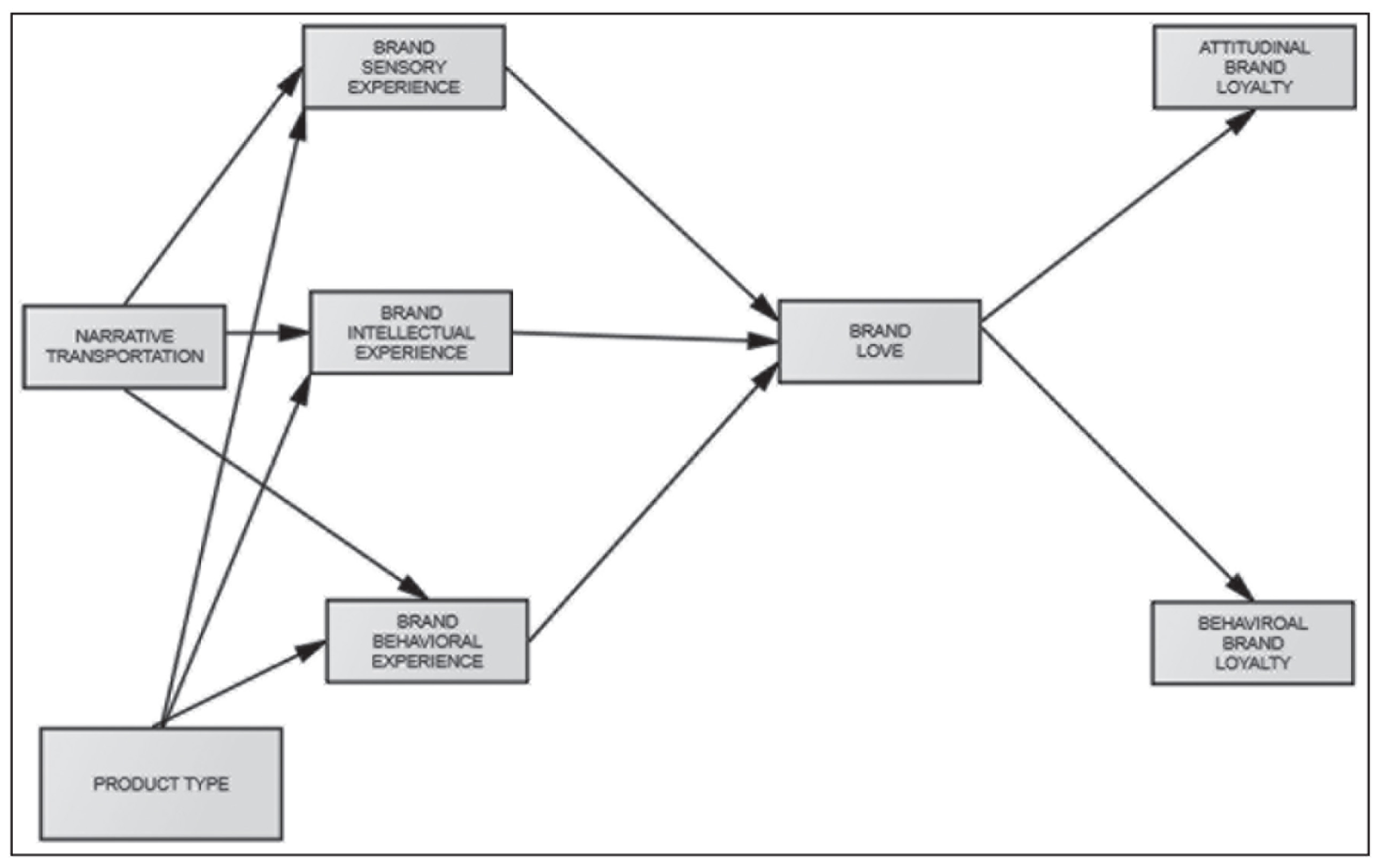
RH1-3: A high level of narrative transportation will lead to higher brand behavioural experience.
The variable, brand love, is defined as passion, intimacy and commitment to a brand (Shimp & Madden, 1988, cited in Zarantonello et al., 2016). Carroll and Ahuvia (2006) argued that brand love is created when consumers feel emotionally connected with a brand that is able to integrate with their sense of self. Brand love is made up of different emotional components (like positive attitudes and evaluation) and has been found to increase brand loyalty (Huang, 2017). In the marketing literature, brand love has been used to explain several branding outcome variables, including active engagement, brand commitment and brand loyalty (Zarantonello et al., 2016). According to Huang (2017), brand sensory, behavioural and intellectual experiential dimensions positively predict brand love. Therefore, RH2 was proposed as follows:
RH2: Brand experience positively predicts consumer brand love. RH2-1: Consumer brand sensory experience positively predicts their brand love. RH2-2: Consumer brand intellectual experience positively predicts their brand love. RH2-3: Consumer brand behavioural experience positively predicts their brand love.
We also postulated that brand love culminates in brand loyalty (Huang, 2017). Existing marketing literature has often defined brand loyalty as either attitudinal or behavioural (Zhang et al., 2020). The attitudinal brand loyalty refers to when consumers have intention to purchase and recommend the brand to others, in spite of its premium price, while the behavioural loyalty refers to when consumers prefer the brand and are willing to purchase in the future (Huang, 2017; Zhang et al., 2020). Ample marketing literature has supported that brand love positively predicts brand loyalty (Zhang et al., 2020); therefore, we proposed the following RH3:
RH3: Brand love positively predicts consumer brand loyalty. RH3-1: Consumer brand love positively predicts their attitudinal brand love. RH3-2: Consumer brand love positively predicts their behavioural brand love.
The Moderation Role of Product Type
Product type has been found to influence how consumers evaluate product features in their decision-making process (Chiu et al., 2012). Different product types were found to affect advertising effectiveness (Wright & Lynch, 1995). For example, consumers are more likely to rely on informational advertising to provide them with product information to help their evaluation of search/functional product, while direct and personal experience plays a more important role in making their decision about purchasing an experience product (Chiu et al., 2012). Chiu et al. (2012) confirmed that different message elements in narrative ads vary in their impacts, depending on whether the advertised brand is a search or experience product. For example, Chiu et al. (2012) reported that an authentic narrative ad has more effect on the evaluation of an experience product, while conciseness (in the ad) influences a search product more. Furthermore, the moderating effect of product type has often been studied in the literature (Luan et al., 2016). Therefore, in this study, we employed the search and experience products in the video storytelling ad as a moderator to examine if the effects of narrative transportation on branding outcome variables will vary (RH4).
RH4: The effects of narrative transportation on brand experience, love and loyalty are expected to vary between experience and search products.
Research Method
We employed a post-test-only experimental design to examine the effects of narrative transportation on these branding outcome variables. Experimental method is one of the popular research methods in studying brand storytelling advertising effects (Chiu et al., 2012; Lien & Chen, 2013) and brand experience (Khan & Rahman, 2015). We also relied on two existing and professionally produced video storytelling advertising campaigns as our stimuli.
Product Selection
To avoid confounding effects of product involvement level, we chose campaigns from two low-involvement products. We have followed the search and experience product paradigm commonly used in narrative advertising research (Chiu et al., 2012; Luan et al., 2016) because advertising messages for these products will be different to reflect how consumers make their purchase decision (Weathers et al., 2007). For example, if consumers place more emphasis on experiencing a product before their purchase decision, then, the product is considered to be an experience product, and an emotionally charged storytelling ad will be needed. On the other hand, if consumers emphasise product information in their decision to purchase a search product, then the demonstration of these functional attributes and benefits will be considered critical (Luan et al., 2016). We did not use the traditional high- versus low-involvement product dichotomy because a low-involvement product can be a search product (like household cleaning products) or an experience product (like AXE deodorants for men). Furthermore, the Dollar Shave Club razor is a subscription-based service whose survival will depend on whether customer engagement and brand loyalty can be fostered and maintained (Subscription DNA, 2020).
Additionally, unlike traditional narrative advertising research that often used one page print ad or poster (Escalas, 2004, 2006; Lien & Chen, 2013; Phillips & McQuarrie, 2010), our study relied on existing full-length, ‘long-duration’ (Dhote & Kumar, 2019, p. 31) video storytelling advertising campaigns that do not allow us to artificially manipulate certain message elements to create a complex design and to include too many variables in this study. Furthermore, an emerging trend in narrative advertising research is the increased use of real video advertising (Chen & Chang, 2017) as experimental stimuli to evoke ‘the full extent of emotional responses’ (Chen, 2015, p. 22). With this in mind, we do not include a control group because ample research has already established the positive effects of narrative transportation (Chen & Chang, 2017; Kim et al., 2016). The objectives of this study are not to reconfirm these relationships or to attest whether the existence of ad-induced narrative transportation has effects. Furthermore, it is not feasible and unrealistic to identify a similar minute-long campaign that does not try to tell a brand story in contemporary advertising practices.
Sampling Method and Characteristics
One hundred and fifteen student participants were conveniently recruited to complete the study voluntarily for extra course credits from the instructor. Participants were randomly assigned to watch either Extra Gum (N = 58) (i.e., an experience product) or Dollar Shave Club (N = 57) (i.e., a search/functional product) campaign once they have read and signed the informed consent form. Among them, 42 participants were male (36.5%), while 73 were female (63.5%). Their average age was 24.35 years (SD = 6.06). The majority of them were single (N = 110, 95.7%). Our participants were mostly single (95.7%, N = 110) and Hispanics (87.6%, N = 99). Over 90.4% (N = 104) of the study participants had received some college education.
The use of student participants in our study is justified by the followings. First, student sample would be a concern if the research objectives are to expand these relationships to real-world situations. However, many narrative and storytelling advertising studies have employed experimental (Lien & Chen, 2013) or quasi-experimental (Chen, 2015) methods and conveniently recruited college students to take part in their studies. Second, existing experience and search product research (Chiu et al., 2012; Luan et al., 2016) have similarly employed college student population in their study. Third, there is a strong and realistic fit between student participants and two featured products in the experimental stimuli. Both chewing gums and disposable razors are inexpensive products that all college students can afford and consume in a private setting without the pressure from their peers. Fourth, using student participants also produces managerially relevant insights because 18–24-year-old demographics have been found to be heavy users of social media platforms that could deliver many video advertising contents. Additionally, 90% of the participants in the same demographic segment regularly use YouTube, while 75% of them use Instagram and 73% use Snapchat (Perrin & Anderson, 2019). In terms of the sample size, Matilla (2000) recruited 222 undergraduate students who were randomly assigned to 1 of the 8 groups, meaning each experimental condition had about 27 subjects. Mattila (2002) also recruited 222 undergraduate students who were divided into 4 experimental conditions, with about 55 students for each group. Our present sample size in each condition is also comparable to published research.
Instrumentation, Reliability and Validity
The online questionnaire instrument was placed at the end of the ad exposure and included demographics and multidimensional brand experience, brand love and brand loyalty items (Huang, 2017).
The independent variable, the three-item narrative transportation scale (α = 0.82), was adapted from Chiu et al. (2012) and Green and Brock (2000) to measure not only the elements of a good brand story (Chiu et al., 2012) but also how consumers feel when reading brand narratives (Green & Brock, 2000).
The brand experience variable was developed from Huang (2017) and included the following sub-dimensions: three-item brand sensory experience (α = 0.84), three-item brand intellectual experience (α = 0.89), three-item brand behavioural experience (α = 0.78), four-item brand love (α = 0.89), two-item behavioural brand loyalty (α = 0.85), and two-item attitudinal brand loyalty (α = 0.89). These scales used the 5-point Likert statement with 1 representing ‘Strongly Disagree’, while 5 represented ‘Strongly Agree’. All study constructs have acceptable Cronbach alpha coefficients of 0.70 (Nunnally, 1978).
Composite scores were used in the confirmatory factory analysis and path analysis using Amos 25. Composite reliability (CR) and average variance extracted (AVE) of study constructs were used to assess reliability and convergent validity of the study constructs in the model. Most CR statistics range from 0.68 to 0.90 and generally exceed the cut-off criteria of 0.70 to ensure acceptable reliability (Fornell & Lracker, 1981; Nunnally, 1978).
We also used the maximum likelihood procedure to extract factors for confirmation factor analysis. AVE statistics are generally higher than the recommended cut-off of 0.50 (Fornell & Larcker, 1981), indicating a good convergent validity for all study constructs. To summarise, the following report presents the CR and AVE statistics for each construct: narrative transportation (CR = 0.83, AVE = 0.62), brand sensory experience (CR = 0.85, AVE = 0.67), brand intellectual experience (CR = 0.88, AVE = 0.71), brand behavioural experience (CR = 0.77, AVE = 0.54), brand love (CR = 0.83, AVE = 0.50), attitudinal brand loyalty (CR = 0.94, AVE = 0.88) and behavioural brand loyalty (CR = 0.68, AVE = 0.51) (refer to Table 1).
Factor Loading, CR and AVE of the Study Construct
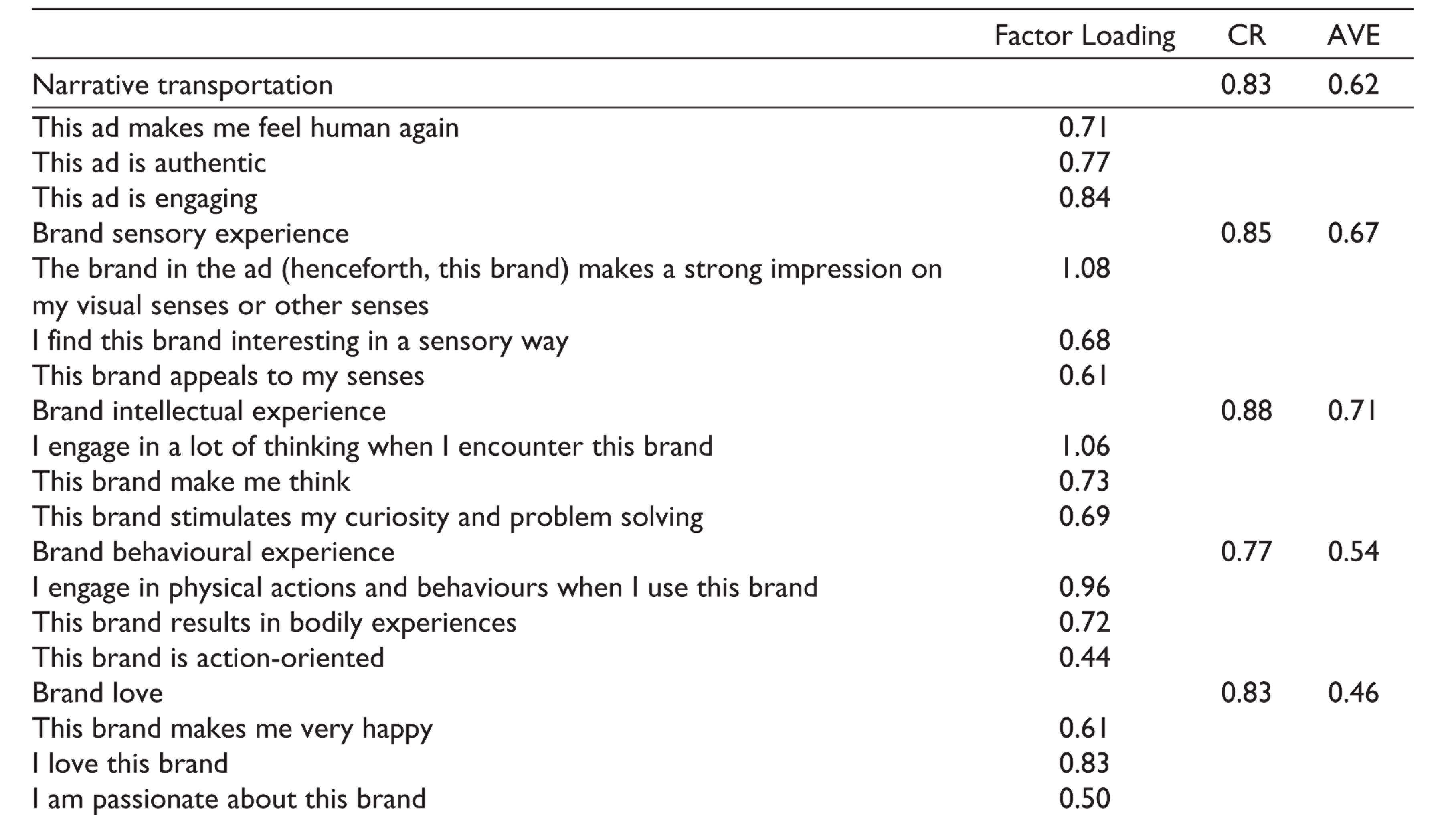
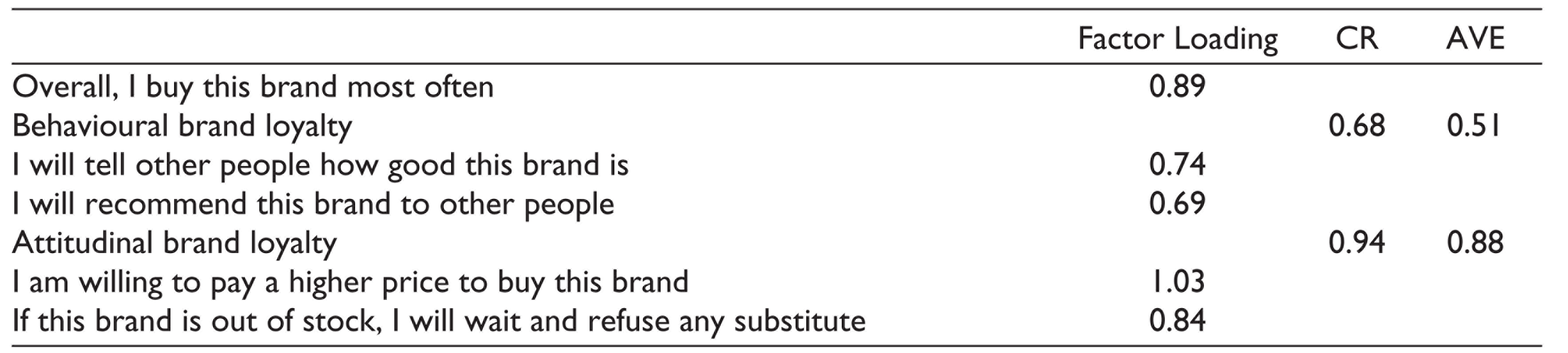
Factor analysis was based on maximum likelihood with promax rotation method.
Stimuli Selection
The Extra Gum’s 2015 campaign (2:00) (
The second experimental stimulus, DollarShaveClub.com—Our Blades Are F***ing Great (1:33) (

Measurement Model
Before the measurement models were developed, we employed maximum likelihood extraction with Promax rotation method to identify factor structure of the observed variables. Using SPSS Amos 25, we began with two confirmatory factor analyses to determine whether the factor loadings in each path model differed across the search/functional and experience product samples. We ran two multiple-group confirmatory factor analyses to examine if the factor loadings in both constrained and unconstrained models are statistically different. The statistics from the model comparison show no statistically significant differences in the factor loadings (χ2 = 35.61, df = 38, p > 0.05). The metric equivalence across the functional/search and experience product groups enables the researchers to combine both models in our later analyses (Chiu et al., 2012). Model fit statistics were reported to examine the effects of narrative transportation on branding outcome variables (χ2 = 1071.58, df = 486, comparative fit index [CFI] = 0.82; goodness-of-fit index [GFI] = 0.70; adjusted goodness-of-fit index [AGFI] = 0.61; root mean square error of approximation [RMSEA] = 0.07). The extracted factors corresponded to past literature in this area (see Figure 2).
Structural Model
We also examined the metric equivalence of the hypothesised model among the study constructs across the search/functional and experience product groups. Because the unconstrained and constrained models are not statistically different (χ2 = 10.55, df = 16, p > 0.05), we combined the two product types to test the hypothesised relationships among the study constructs. The model fit statistics found an acceptable fit to the collected data (χ2 = 78.80, df = 46, CFI = 0.96; GFI = 0.92; AGFI = 0.85; RMSEA = 0.056). The majority of our hypothesised relationships were statistically significant, except for the relationship between brand behavioural experience and brand love in the combined model of two product types. Overall, narrative transportation explains 42% of variance in brand sensory experience, 20% of variance in brand intellectual experience and 25% of variance in brand behavioural experience. Brand experience dimensions in total explain 36% of variance in brand love, while brand love accounts for 42% of variance in behavioural brand loyalty, and 35% of variance in attitudinal brand loyalty (see Table 2 and Figure 3).
Standardized Regression Weights of Path Analysis Results

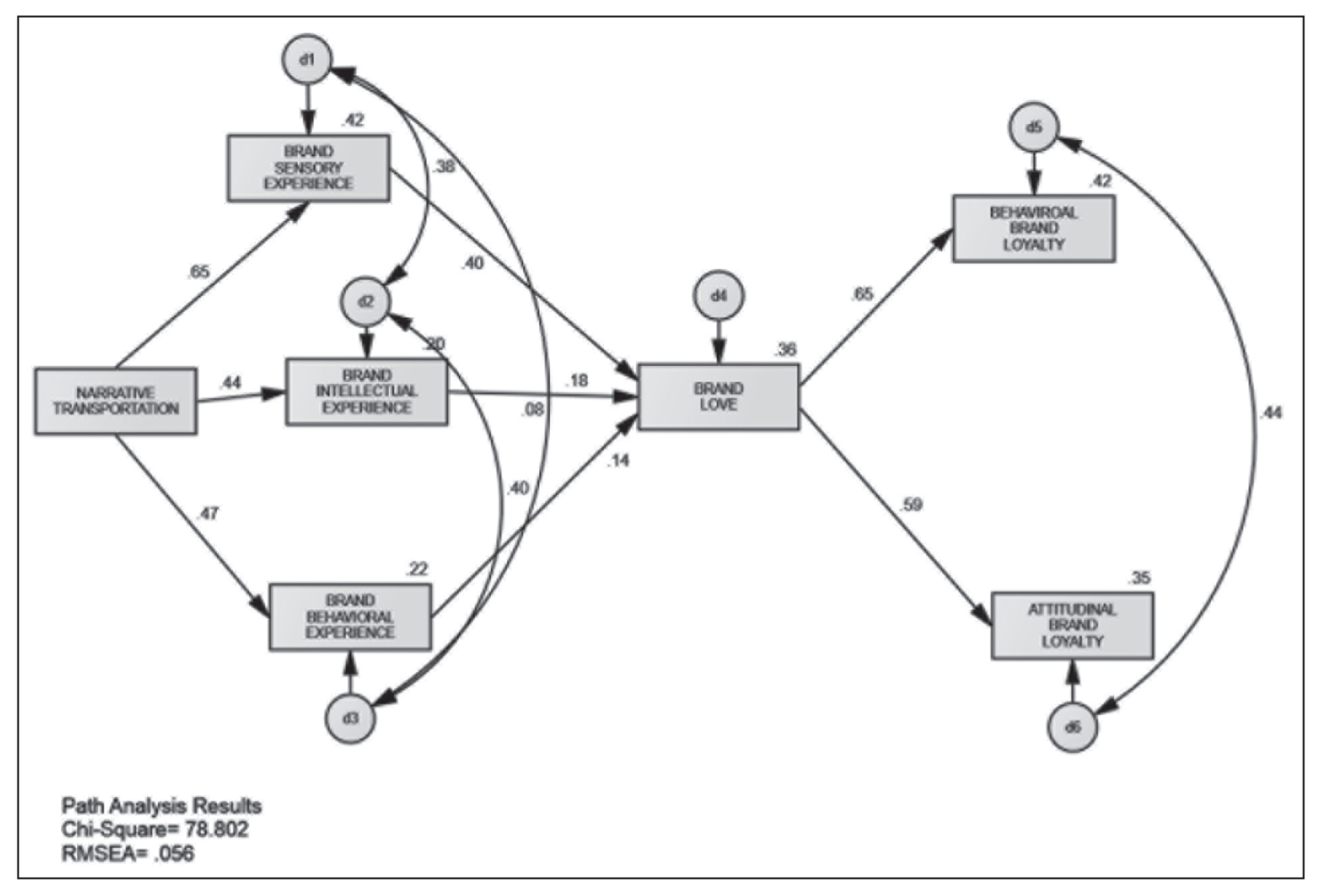
As shown in both Table 2 and Figure 3, narrative transportation explained changes in brand sensory experience (β = 0.65, p < 0.001), brand intellectual experience (β = 0.44, p < 0.001) and brand behavioural experience (β = 0.47, p < 0.001). The positive standardised regression weight estimates suggest an excellent predictive power of narrative transportation on how consumers would experience the brand. When a video storytelling campaign has a high narrative transportation level, consumers feel more positively about the brand. Furthermore, our data showed that narrative transportation level best predicts brand sensory experience, regardless of product type of an advertised brand. The empirical findings provide support to RH1, RH1-1, RH1-2 and RH1-3 (see Table 2).
In concurrence with Huang (2017), brand sensory experience accounts for changes in brand love (β = 0.40, p < 0.001) (RH2-1), and brand intellectual experience accounts for changes in brand love (β = 0.18, p < 0.05) (RH2-2). The positive coefficients of these two brand experience dimensions suggest an excellent predictive power of brand love. Among all three brand experience dimensions, brand sensory experience is the strongest predictor of consumers’ brand love, regardless of product type, similar to the findings reported in a study performed by Huang (2017). Unexpected, brand behavioural experience does not predict consumer brand love in the combined model (β = 0.14, p > 0.05) (RH2-3), even though it is a predictor of consumer brand love in the experience product category. Our findings provide partial support to RH2 (see Table 2).
Brand love explains changes in consumer attitudinal brand loyalty (β = 0.59, p < 0.001) and behavioural brand loyalty (β = 0.65, p < 0.001). The empirical findings provide support to RH3, RH3-1 and RH3-2 (refer to Table 2).
To test the last hypothesis to examine whether the effects of narrative transportation will vary between search/functional and experience products, we conducted a multi-group structural equation model procedure to examine if the estimated parameters between two product groups are different (Chiu et al., 2012; Jap & Anderson, 2003). Both unconstrained (χ2 = 78.80, df = 46, CFI = 0.96, GFI = 0.92, AGFI = 0.85, RMSEA = 0.056) and constrained models (χ2 = 85.08, df = 54, CFI = 0.96, GFI = 0.92, AGFI = 0.87, RMSEA = 0.050) provide a good fit of our data. We began by examining estimated parameters in both unconstrained and constrained models and observed no statistically significant differences across different product types (χ2 = 6.28, df = 8, p > 0.05). The non-significant difference in the Chi-square statistics rejects the hypothesis that narrative transportation effects will vary between search/functional and experience products (RH4). Furthermore, critical ratios for difference between parameters’ statistics from the pairwise comparison table that compares relationships between hypothesised path coefficients ranged between 0.82 and −1.53 and did not exceed the absolute z-value of 1.96 in a two-tailed test. This indicated path coefficients in the search/functional and experience product groups were not statistically significant. Our empirical data from these procedures did not lend support to the moderation effect of product type. RH4 was not supported.
The lack of moderation effect of the product type as a moderator has been confirmed by a separate structure model that reports no interaction effects between [product type X narrative transportation] and brand sensory experience (β = 0.11, p > 0.05), brand intellectual experience (β = −0.01, p > 0.05) and brand behavioural experience (β = 0.09, p > 0.05). Because there are no effects of the product type (Aguinis & Gottfredson, 2010; Baron & Kenny, 1986), we determined to simplify our structure model by removing product type, its moderation effect and related paths from the model (Kenny, 2011).
Discussions
One of the major contributions of this study is to provide empirical data to support narrative transportation evoked by video storytelling advertising, which will generate not only positive advertising effects but also favourable branding outcomes. Digressing from traditional information processing theories (Lien & Chen, 2013), we have demonstrated the linkage among narrative transportation, brand experience, brand love and brand loyalty. We divide our discussions into the following two major sections:
The Effects of Narrative Transportation on Brand Experience
Our findings have supported the positive effects of ad-elicited narrative transportation on three brand experience dimensions, and these effects generally remain consistent across different product types. Our findings concur with predictions about narrative transportation effects, using movie posters and print ads (Lien & Chen, 2013). This implies that once advertising messages have evoked narrative transportation, it could generate favourable branding outcomes, regardless of product and platform types. In the following sections, we attribute the positive effects of narrative transportation to three possible explanations: narrative transportation processing of advertising messages, SBC and customer brand engagement.
First, as a creative execution to stimulate consumers’ mental activities (Escalas, 2004), video storytelling advertising, with its various length formats can easily transport consumers to enter the story world by leaving their real world behind and to experience the fantastical world (Phillips & McQuarrie, 2010). With its long format, video storytelling ads have the advantage of delivering persuasive and creative contents and cues to consumers (Trivedi, 2017). These effects can contribute to enhance brand sensory, intellectual and behavioural experience due to prolonged exposure to product-related messages in the ad. From a cognitive perspective, transportation should be considered as an active ‘participatory response’ (Wang, 2006, p. 406) that allows consumers to generate thoughts when they are exposed to the video storytelling ad, which is likely to generate more favourable brand intellectual experience. For example, the dramatisation and demonstration of the advertised product help consumers to think about what the product will mean for them (Gallo et al., 2013). In other words, when watching a video storytelling ad, consumers will be ‘absorbed into the flow of a story in a pleasurable and active way’ (Wang, 2006, p. 406) to virtually experience the brand. For example, in the chewing gum campaign, the romantic story and touching music can generate enhanced sensory brand experience by transporting consumers into their first love encounter. Consistent with the extant literature, a high level of transportation is likely to enhance overall brand experience (Phillips & McQuarrie, 2010) and advertising effectiveness (Wang, 2006).
Second, related to narrative processing after exposure, Escalas (2004) introduced the mechanism—SBC—to explain how brand experience can be created. SBC refers to the result of consumer interpretation of their own personal stories to be related with the brand storytelling campaign. We speculate that narrative transportation evoked upon exposure to video storytelling ads can contribute to their recall of ‘autobiographical memories’ or to simulate about future romantic experiences as described in these campaigns. For example, the romantic story described in Extra chewing gum campaign can cause many mature consumers to recollect their first love in high school, or to motivate young consumers on what to expect in the future, generating what Escalas (2006) described as ‘affect transfer’ (p. 407) that helps establish consumer connections to the advertised brand that will generate more positive sensory brand experience. These mechanisms can explain the positive relationships between narrative transportation (in video storytelling ads) and brand experience in this study.
Third, the positive effects of narrative transportation could also be attributed to whether consumers feel engaged with the advertised brand after their ad exposure. In other words, video storytelling advertising provides advertisers with a creative platform to generate strong engagement with the advertised brand. According to Hollebeek (2011), the concept of ‘customer brand engagement’ refers to ‘the level of an individual customer’s motivational, brand-related and context-dependent state of mind characterised by specific levels of cognitive, emotional and behavioural activity in direct brand interactions’ (p. 790). We reason that when consumers watch a video storytelling advertising campaign that shows how character(s) in the ad interact with the brand in a story event, they could resonate with what the characters have felt to generate brand’s experiential meaning (Boller & Olson, 1991) or instrumental meaning (Mollen & Wilson, 2010) to form the so-called customer brand engagement (Brodie et al., 2013, p. 106). The instrumental and experiential meanings with the advertised brand can enhance brand experience in the sensory and intellectual dimensions. In other words, consumers become empathic with what the character(s) may have experienced in brand storytelling events and vicariously participate in these events (Boller & Olson, 1991) to ‘personally experience’ the benefits of product use. Our data have shown a high path coefficient in brand sensory experience for both products (ranging from β = 0.65 to β = 0.74), suggesting that video storytelling ads have stronger impacts on consumers’ both intellectual and sensory brand perceptions through the pseudo-brand interactions as described in both video storytelling campaigns in this study.
The Relationship Between Brand Experience, Brand Love and Brand Loyalty
Exposure to a video storytelling ad will enable consumers to learn ‘consistent and compelling content’ of a brand communicated by marketers (Bacon, 2013, n.p.). Both cognitive and behavioural brand experience will arouse consumers’ brand love (Huang, 2017), resulting in brand satisfaction and brand loyalty (Xie et al., 2017). Previous marketing research has confirmed that brand experience, in total, explains about 37% of brand love variance (Huang, 2017). Our path analysis results have reported a similar 36% predictive power of brand love variance. Similar to Huang (2017), brand sensory experience was found to be the most powerful predictor of brand love (β = 0.40) for the experience product because sensory experience may contribute to short-term psychological reactions (such as brand love). Unlike the experience product group, brand intellectual experience was found to be the most significant predictor of brand love (β = 0.36) in the search/functional product group. The result can be explained when consumers are considering a disposable razor product, whether the brand ‘stimulates [their] curiosity and problem-solving’ and ‘makes [them] think’ are crucial to their brand intellectual experience. This also implies that marketers’ need to develop product-specific strategies to evoke different types of brand experiences.
Furthermore, while Huang (2017) reported a statistically significant relationship between brand behavioural experience and brand love, our findings did not support the relationship. It is likely that Huang’s survey research only includes an experiential product type to allow participants to evaluate the statements about brand behavioural experience. It is also likely that an inexpensive disposable razor in our study is considered to be ‘action-oriented’ to ‘engage [consumers] in physical actions and behaviours when I use this brand’ or to result ‘in bodily experiences’ as measured by three Likert statements.
However, consistent with what Huang (2017) and other scholars (Bıçakcıoğlu et al., 2018) have found, our study has also lent support to the positive relationships between brand sensory and intellectual experience on brand love in the combined model. Brand sensory experience is a good predictor of brand love in the experience product group. Our findings support that brand love can be considered as ‘a short-term romantic passion’ (Huang, 2017, p. 14) that can be explained by brand experience evoked by exposure to an emotionally charged video storytelling ad.
The positive relationship between brand sensory experience and brand love is likely to attribute to whether watching these video storytelling ads may affect their mood to affect consumers’ information processing and subsequent persuasive effects (Myers & Sar, 2015). In other words, the emotionally charged video storytelling advertising is likely to influence people’s mood in processing advertising messages to influence product evaluation and purchase intention (Sar, 2013).
The relationships among brand experience, brand love and brand loyalty have been well studied in the marketing literature (Ong et al., 2018). To explain these relationships, Bıçakcıoğlu et al. (2018) argued that brand experience can be considered as an experience-based antecedent of brand love. Extant literature has often explored the antecedents and outcomes of brand love on word-of-mouth communication after taking into consideration the mediating role of brand loyalty (Bıçakcıoğlu et al., 2018). Their study has confirmed the positive relationships between brand experience and brand love (β = 0.30), and brand love and brand loyalty (β = 0.70) (Bıçakcıoğlu et al., 2018). Our data concurred with existing research (Zhang et al., 2020) and reported similarly high coefficients between brand love and loyalty, but we further explored if the relationships remain the same in attitudinal and behavioural brand loyalty by examining the multidimensionality of brand love (Ong et al., 2018). Brand love was found in our study to influence consumers’ brand preference and future purchase intention (i.e., behavioural brand loyalty) more than their intention to recommend to others, despite its premium price (i.e., attitudinal brand loyalty) (Huang, 2017; Zhang et al., 2020). Because brand love is an important determinant of brand management strategies (Bıçakcıoğlu et al., 2018), our findings also help understand ad-induced brand experience and its effects on creating brand love and brand loyalty to foster strong brand equity.
Conclusion
While traditional television commercials are often constrained by their length restriction, video advertising on YouTube and other social media platforms has the advantage of delivering long-format or -duration video storytelling advertising. Additionally, longer branded advertising contents do not necessarily cost more for advertisers than traditional television advertising buys (Parekh, 2010). These cost and creative benefits have made video storytelling advertising more effective than traditional advertising formats. Evoked by prolonged exposure to video storytelling ads, narrative transportation has been found to persuade consumers better (Kim et al., 2016). It is noteworthy that its effects are not constrained by the types of advertised product, suggesting that the narrative transportation is a powerful and consistent predictor of consumer brand experience. The findings also imply that video storytelling advertising could be a useful creative technique for different product types. Furthermore, the growing popularity of multi-platform brand storytelling (Feng, 2018) will justify a systematic investigation of the relationships among narrative transportation, self-referencing and narrative structures/elements in multi-platform advertising.
Theoretical and Managerial Implications
The contributions of this study lie in both methodological and theoretical areas. First, we digress from the dominant approaches and theoretical foundations used in most of the existing narrative advertising literature (Chiu et al., 2012). Many of these studies have mostly ignored that narrative transportation could also have impacts on branding outcome variables. Our study pointed out that brand experience, as a subjective and behavioural responses to ad stimuli (Xie et al., 2017), is rarely studied as an effect of narrative transportation in the extant narrative advertising literature. Intuitively, when consumers are told a story about a brand through minute-long video advertising, they are bound to be transported into ‘a state of experience that allows the person to immerse himself/herself in the story itself, instead of focusing on any consequences extrinsic to the branded narrative’ (Chen & Chang, 2017, p. 28). Immersion into branded contents and engagement with a brand can lead to favourable brand experience. Nevertheless, in spite of the strong emphasis on experience in the earlier definition of narrative transportation, advertising scholars have rarely tried to link narrative transportation with brand experience. Our study could fill this gap by bridging traditionally separate areas of research in narrative advertising and brand management research by linking narrative transportation with brand experience, brand love and brand loyalty. It is also interesting to note that, regardless of the product type of an advertised brand, the positive effects of narrative transportation do not vary significantly between search/functional and experience products, implying the strong effect of narrative transportation on branding outcomes. Findings reported in this study can lend support to other similar studies to examine if narrative transportation remains in high-involvement products, products consumed in a public or private setting, or imported products from other countries.
Managerially, we have further established the effectiveness of ad-evoked narrative transportation as a useful creative technique for both search and experience products. We also reaffirm that brand experience is an important construct to enhance brand satisfaction (de Oliveira Santini et al., 2018), as well as brand love and loyalty (Huang, 2017). Furthermore, this study also helps connect narrative advertising and brand management practices by showing that marketers could increase consumers’ brand experience by creating engaging brand storytelling ads to develop an effective brand management plan. Advertising-elicited brand experience can be as effective in creating positive branding outcomes as other marketing tools.
Limitations and Future Research Directions
There are several limitations when interpreting results in this study. First of all, the external validity of the study results should not be overgeneralised to other high-involvement product types. We have limited our study to examine two low-involvement products. Results from this study should not be extended to other product types with a different involvement level.
Another limitation is related to the employment of a video storytelling platform to deliver branded narratives to consumers. Previously, we cautioned that many studies have employed print or poster ads as experimental stimuli; however, these two-dimensional print ad stimuli are considerably limited in evoking emotions even though participants may be primed during an experiment. However, contemporary integrated marketing communication campaigns often include different touchpoints to deliver branded contents to consumers (Feng, 2018).
Finally, our dependence on the student sample in the USA will limit the generalisability of our findings to other consumer segments around the world. Our sampling decision is based on existing narrative advertising research that similarly recruited students for their research. However, our decision also partially considers young demographics that the student population represents who are heavy users of video content, and their responses will be managerially relevant.
Footnotes
Declaration of Conflicting Interests
The authors declared no potential conflicts of interest with respect to the research, authorship and/or publication of this article.
Funding
The authors received no financial support for the research, authorship and/or publication of this article.