



Abstract
Mizoram, one of the smallest states in India, has a very dynamic and flexible culture. The internet reached the state during the late 1990s; the general public started accessing it by the early 2000s. Digital enhancement, facilitated by technological devices, is becoming a reality in various professions as well as daily life. The problem of the digital divide—tangible availability of computers and internet connections as well as issues of content, language, skills and social resources—is yet challenging to eradicate. Whilst a group called the ‘choose nots’ are not interested in engaging with technology, several questions arise—Will digital know-how be useful in bridging the gap of the digital divide? Can digital understanding outdo the divide demarcated by the native–immigrant separation? Or does digital enhancement widen the gap by endowing the ‘haves’ while the ‘have-nots’ keep adding numbers to the ‘digital left behind’? This study focuses on the influence of the internet on Mizo culture, nature of the digital divide, and traces the internet history of Mizoram while trying to map the perceived difference in communication behaviour before and after the existence of the internet among digital immigrants.
Introduction
The dawn of the internet era has immensely influenced mankind. Though not intended for public use initially, its existence has undoubtedly influenced culture of every kind. Haigh et al. (2015) believed that the internet can be multidimensional and its history can also be more than just one kind. As the global culture focuses more on internet policy and governance, paying heed to the internet history could have a remarkable effect on its growth, use and development in the present as well as the future. Technology and culture cannot be separated as the cultural setting can shape technologies while they can also reshape their cultural context as well (Reed, 2019). The age of the internet also ushers users to digitalisation of culture (Coteli, 2019), which can be the outcome of individuals’ detachment from real life and acquiring digital identities as they strive to build up their identities in that medium. The concept of the digital divide—the ‘disparity between households having access and those that do not have’ since the mid-1990s (Van Dijk, 2006)—can be seen as obsolete or inappropriate since those who want computer and internet access can easily afford them in the richest countries and the ones who do not have internet access may not actually need it (Warschauer, 2003). The glitch between the skill in human resources and facilities are digital divides that stay on regardless of the steps taken to get devices that are affordable (Pierce, 2019) as digital divides are multilayered and not just a binary concept. Whether the gap in the digital divide is great or small, digital devices have become an intrinsic part of the everyday life of almost every ethnic group which is creating a multifaceted divide. Since the internet is still a new phenomenon for researchers in Mizoram and yet very dominant in the life of the people, it is high time for researchers to pay attention to the history of the internet while studying how it influences the lives of the people. This article will focus on the role played by the digital media on Mizo society by tracing the history of the internet, mobile operators and internet service providers (ISPs) in Mizoram while conducting a study on the pioneering Mizo IT (software developer) companies. How the digital culture shapes or reshapes Mizo culture and the nature of the digital divide in the Mizoram context will be looked upon and the perceived difference in communication behaviour before and after the existence of the internet among digital immigrants will also be mapped.
‘Digital enhancements’, according to Thomas (2011), means that digital tools enhance our memory and capabilities, complement our innate abilities and facilitate wiser decision-making as they help us gather more data than we could on our own. In this study, it will be considered as a digital competence (or know-how)—the ability to use digital devices efficiently. Therefore, this study will try to look at the following objectives:
To trace the history of the internet in Mizoram. To observe the nature of the digital divide in Mizoram. To map the perceived difference in communication behaviour before and after the existence of the internet among digital immigrants.
And ponder on these research questions:
Will digital know-how be useful in bridging the gap of the digital divide? What role do digital media play in Mizo society? Does digital enhancement widen the gap by endowing the ‘haves’ while the ‘have-nots’ keep adding numbers to the ‘digital left behind’?
Methodology
The research design of this study is qualitative in nature where ‘what things exist’ are more important than ‘how many’ for the researcher (Heyink & Tymstra, 1993). In-depth interviews were conducted among internet pioneers to learn the history of the internet in Mizoram and among digital immigrants to see the perceived difference in communication behaviour. A case study was done on the pioneering IT companies, viz., Lailen Consulting Pvt. Ltd. and ViaMizo, to look at the nature of the digital divide and the influence of digital culture in Mizo society (see the Appendix). Aizawl and Serchhip districts are selected for this study because all the government and non-government headquarters offices are in Aizawl city and Serchhip district has the highest literacy rate in the state. Even though the original definition of Digital Natives by Marc Prensky (2001) includes people who are born on or after 1980, the case is different in Mizoram. Since the general public started accessing the internet by the early 2000s, people who are born on or before the year 2000 can be considered as digital immigrants. This modification will be used in this study.
Internet and Culture
Cisler in 1998, mentioned by Mobley and Wilson (1998), wrote that the internet’s influence on culture cannot be escaped regardless of how hard a country tries to control or repress the internet. They also believed that cultural factors can be very important considering the internet’s effect in the long run, even though it may seem less apparent and far more challenging to evaluate than the economic factors. Katz et al. (2012) suggested that community-specific and ‘culturally relevant’ effort is required to explain the need when it comes to broadband or internet diffusion among specific ethnic groups. Digitalisation of culture brought by the age of the internet is an outcome of the abstraction of individuals from real life in order to attain digital identities (Coteli, 2019) which can result in identity confusion among users. Marlowe et al. (2017) stated that social cohesion can be enhanced by digital media platforms, and, on the other hand, these platforms can also disrupt the creation of social bonds across greater distances. This is becoming a reality among Mizos who are living inside Mizoram and those who are not. In his study about family relations and internet use among Mizo youth, Lallianzela (2014) found that the generation gap created by the existence of the internet frequently results in disputes and deterioration of family bond/relationship as the two generations blamed one another for not respecting or understanding the other. Family problems at a larger scale often become a societal problem. Theodore (2019) indicated that digital media is gradually taking over other media because of its numerous advantages, and it will be preferred by the modern-day generation to other types of media; hence, researchers need to pay attention to this media. Digital culture in its existing precise form is a historically dependent phenomenon, recognisable solely in the milieu of recent technological developments which is historically as well as culturally constructed but not superimposed (Balbi & Ortoleva, 2014). Sukanya (2012) also wrote that understanding the micro-level influences between culture and online communication is necessary. How users act in response to the new media and what the new media provides to the users should be considered as well. Coleman (2010) stated that to fully comprehend the wide-ranging significance of digital media, various frames of analyses, attention to history, indigenous context and the lived experiences of digital media should be involved in the study. Likewise, focusing on cultural aspects of digital media use specifically on how, where and why can also be necessary. Hence, the history and lived experiences of Mizo internet users will be looked upon in this article as we dive into the influence of the internet on Mizo culture and society.
Digital Divide
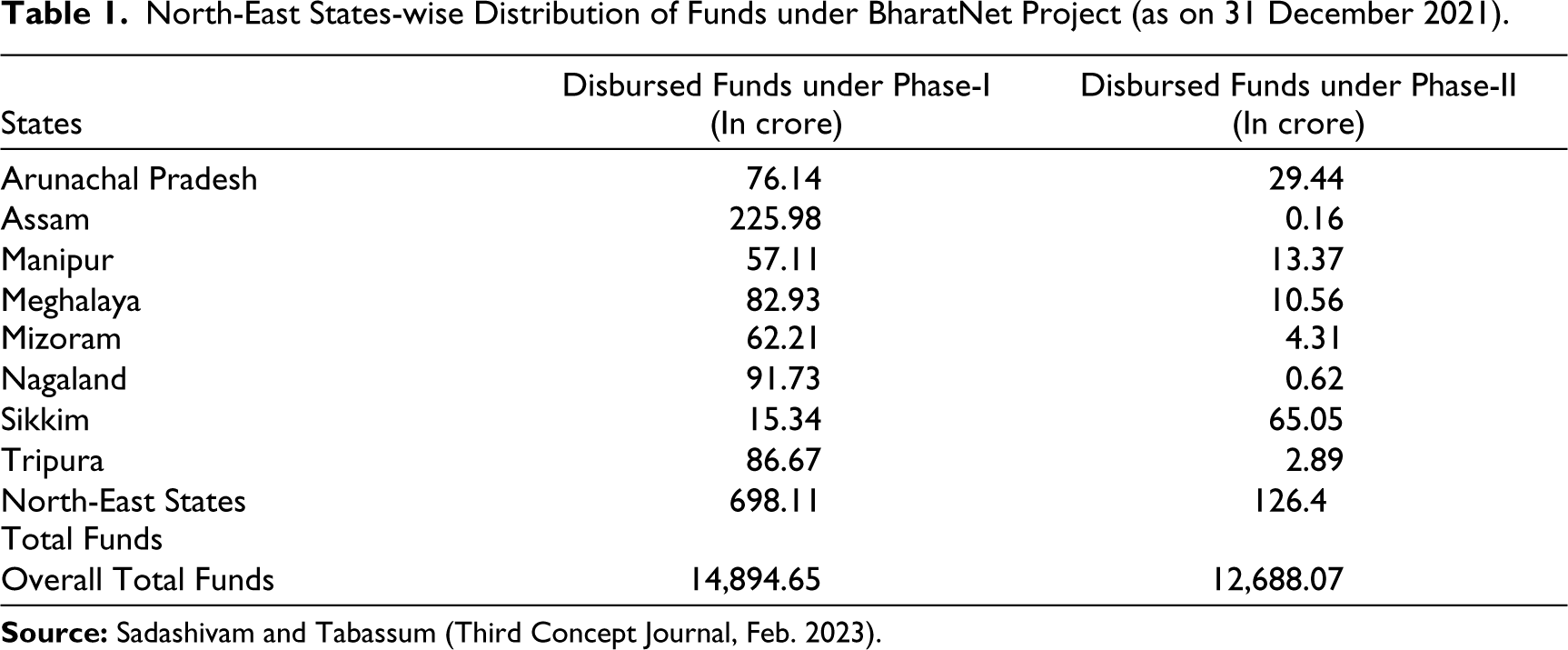
The concept of the digital divide came to be primarily used for referring to the gap existing between those that have access to the internet and those that do not since the mid-1990s (Pierce, 2019) or the latter part of the 1990s (Van Dijk, 2006). Henry Jenkins claimed that the discourse of the digital divide connotes the separation between literate tool users and non-civilised nonusers (Warschauer, 2003). As digital communication technologies are progressively embedded into the everyday lives of people, the idea of the ‘digital divide’ brings out the issue of inequality of access within the connectivity culture (Marlowe et al., 2017). This divide is more multiplex than just a dichotomy of those who have and those who do not have (Coleman, 2010) as the term can also be seen as either obsolete or irrelevant because rich countries can easily afford it and those who do not feel the need to have internet or information and communication technology (ICT) facilities simply ignore the need. In order to study the reasons for the lack of interest among the ‘choose nots’ on a large scale, quantitative studies along with qualitative methods in specific communities and ethnic groups must be required (Van Dijk, 2006). However, this study will focus only on the qualitative aspect and if the need arises, a quantitative study will be considered accordingly. Pierce (2019) stated that there is cynicism among some scholars who consider mobile phones and tablets as instrumental in digital inclusion. This can be relevant in the context of India as the government is providing digital devices to students in order to promote digital inclusion. Nations that restrain their residents’ digital connection make an informational divide which may not necessarily be visible in the physical, intellectual or economic realm. ICT adoption and the potential to use are positively linked to education (Asrani, 2020). Reed (2019) also wrote that the age factor as the main distinction between the digital natives and immigrants is quickly fading because digital communications raise a query such as whether or not the generation gap is solely the causal agent of the divide. Moreover, he is of the opinion that digital immigrants also possess some knowledge which digital natives do not as they are in the transition period witnessing certain transitions brought into the digital culture that are not evident to the submerged natives. Sadashivam and Tabassum (2023) considered the BharatNet project (started as the National Optical Fibre Network under Manmohan Singh’s government) to be the backbone of Digital India as they studied the state-wise distribution as well as implementation of the Universal Service Obligation Fund in North-East India. Their report in the Third Concept Journal, February 2023 issue, highlights that Mizoram got the least amount of share amongst all the eight states (as shown in Table 1). This calls to attention the need to cover areas such as internet penetration and its related issues including the digital divide in this state while keeping in mind the cultural and societal background where it takes place.
North-East States-wise Distribution of Funds under BharatNet Project (as on 31 December 2021).
In a rural developing area, digital divide engagement is often entwined with the requirement to pay heed to the needs of an individual along with material provision (Venkatesh & Sykes, 2013). Lalrinhlua (2014) suggested that the digital divide subject matter should be studied by Mizo researchers and emphasis must be laid on factors such as location and socio-economic conditions. Development often connotes quantitative growth, be it technological or in any area; the cultural and societal aspects are often neglected probably because they cannot be quantified to see the change. Therefore, this study looks at the matter of the digital divide in a qualitative manner.
Theoretical/Conceptual Framework
Diffusion of Innovation
This theory tries to define how the public adopt innovations in a given time and place where this innovation could imply an idea, behaviour or any physical entity that is new to its users or receivers (Robinson, 2009). Rogers (1983), who popularised this theory, synonymously used innovations and technology. The internet—a technology or innovation, reaching Mizoram in the early 2000s—is yet a new phenomenon in the field of research, and this study will also look at the stages of adoption among the people. Valente and Davis (1999) mentioned that adoption behaviour is greatly influenced by interpersonal contacts along with many other factors. As long as it is adopted by individuals, this theory can also be applied to a wide range of innovations such as commercial products, ideologies, culture attributes, and so on (Brown, 1969). Rogers (1983) classified adopters into five categories: innovators—those who initiate a technology or innovation; early adopters—the first ones adopt them; early majority—a large number of people who utilise an innovation shortly after it is available; late majority—who adopt only after seeing the verdict of others’ experiences; laggards—who are sceptical to try out new things (GarcíaAvilés, 2020).
Social Learning Theory
Bowers (1973) cited in Bandura (1976) noted that behaviour is the outcome of the interaction of individuals and situations and not only a single factor can be a determinant of variations in behaviour. Media is considered to facilitate the construct of modelling as it captures people’s attention in order to inculcate the modelled behaviours in their lives to make it a part of them as people can see and acquire multiple styles of conduct from their homes. Behaviours are shaped through the amalgamation of numerous activities of varying origins and are not formed by unitary patterns (Bandura, 1976) and can also be learned by having a direct experience as well as observation of others (Barclay, 1982). Liu and San (2006) believed that in exhibiting the information technology diffusion’s speed, factors affecting social learning play a very crucial role as social learning is of pragmatic use. So, this study will look at whether a new behaviour is acquired or perceived to be acquired by digital immigrants as they incorporate the internet into their daily lives.
Emergence and Growth of the Internet in Mizoram
The advent of the internet in Mizoram started in the late 1990s; hence, there are limited records or resources that can be utilised for in-depth research. It is indeed a challenging task as the Director General of the Telecommunication Department also commented on the presumptive difficulty regarding this stating that the pioneers were also negligent in keeping a written record of their progress while setting up the internet in Mizoram. With very little source to rely on, the key persons involved in setting up the internet in Mizoram were visited and interviewed. As Haigh et al. (2015) said that the ever-unfolding history of the internet consequently has the possibility of landing into no-man’s land discipline—which probably is obsolescent for scholars of sociology and policymakers, yet too contemporary and unsteady, on the other hand, making most historians uncomfortable to work on it. Let us consider communication discipline to be an appropriate one to fill this gap.
BSNL also provides some wireless services. Wireless Local Loop (WLL) service was started in 2008. The scheme was meant for rural areas. With the arrival of better schemes, WLL service (which provided internet service for a decade) was discontinued in 2018 due to the declining number of users. Wimax internet wireless service, a rural development scheme, was installed after 2012. The internet speed offered by this service was also slow, and was, therefore, closed in 2019. WiFi Hotspot is another wireless service installed in 22 places in Mizoram. Despite the relatively good internet speed offered by this service, only a few users remain as it is not very user-friendly. However, in the midst of better and more advanced networks, this service still exists today and is used in various vital public places including Mizoram University and Lengpui Airport.
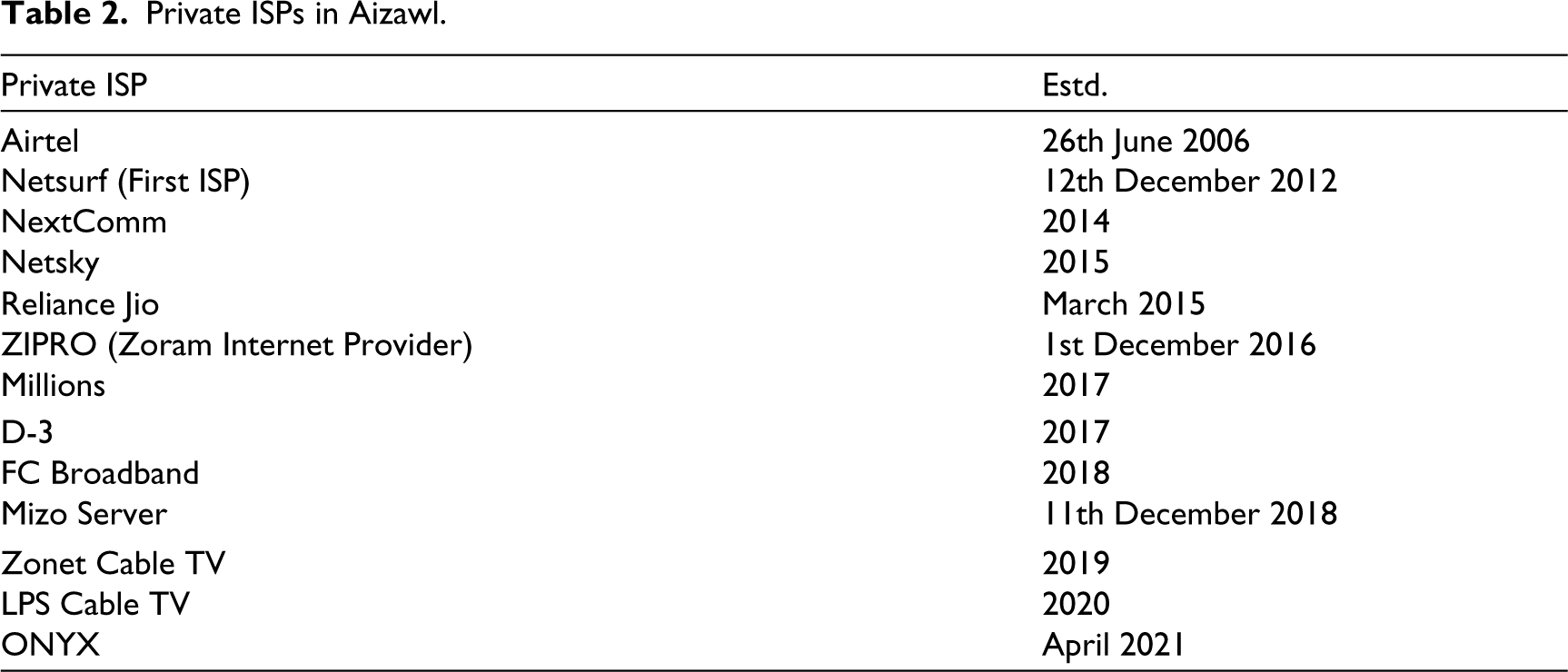
Several private ISPs are also available in Mizoram. The ISPs in Aizawl are listed in Table 2. This is not an exhaustive list but includes only those functioning in the capital district, and, hence, ISPs of other districts are not covered. Internet connection to the districts and rural areas is still very poor in Mizoram. Some initiatives have been taken by the government such as installing GPON, one of the government projects, BharatNet aims to connect 763 Village Councils in Mizoram (Economic Survey, 2021). The problems faced by the government sector when it comes to internet service are the formalities (to be followed) and the restriction from higher authorities as they cannot merely compete with their rival private companies who keep coming up with exciting offers and tariffs to expand their business. The common problem faced by the ISPs is the restriction made by the local or higher authorities regarding cable placement as they have to rent electric poles from the Power and Electricity Department to give new connections, which costs around ₹5–7 per cable.
Private ISPs in Aizawl.
Internet and Mizo Society
The opinions shared by the participants depicted that Mizo culture is very flexible in that it is easily swayed by the dominating practices. In-depth interviews with the digital immigrants of Mizoram found that the internet has significantly brought changes to Mizo culture and society, which they believe will be more discernible in the future with continual use. Christianity, which now has become a part of Mizo identity, has undergone changes as the dominant worldview has become more equivocal due to excessive debate and numerous arguments available on social media. The participants believed that the internet triggered the rise of atheism. Various church events, including weddings, conferences and other activities, have become very social media oriented as photo booths are now being set up on such occasions. ‘It seems like we are competing with other churches in terms of decoration to have the best photo booth on important church services and conferences which was never a part of church events before the internet existed’, said a participant. During church services and other various social events, the thought patterns of the people gathered are often governed by a post event plan of ‘how to portray such memories on social media platforms’.
The concept of tlawmngaihna, a highly esteemed attribute in the Mizo society, which, according to Vansanglura and Deori (2022), is ‘an altruistic and chivalrous quality of a person that always put others’ welfare before oneself where the self-interest is subdued by the interest of the community’, seems to lose its place due to the emergence of the internet according to the participants. It can also be considered as the sacrificial commitment that fulfils the need of others at the cost of compromising one’s own needs. The original term is used in this study since there is no better or equivalent single English word to replace it. With the availability of anonymity, the participants showed great concern towards the declining tlawmngaihna as the online community is less hierarchical. The participants also repeatedly mentioned that the excessive use of the internet has escalated laziness and wastage of time, making Mizo people unproductive in their daily lives. The internet is believed to hamper the daily performances of the people, which also results in their diminishing contribution towards family as well as society.
An important aspect of Mizo culture, which is not new to other cultures, is the practice of respecting elders (aia upa zahna). This practice has also been taken lightly since the emergence of the internet as people can easily hide their identity behind the veil of anonymity. The seriousness of this practice could be seen in the past when the younger folks never talked back to their elders in any manner and dared not start taking their food unless the oldest person present in the gathering began to eat. They would obey what their elders say by hook or by crook. However, due to the lack of hierarchy in the online community, the attitude and mindset of the people have tremendously changed. People no longer understand the value of showing respect to their elders and rather developed the ‘I think I know better’ kind of attitude which can be seen when the younger participants expressed that the internet enabled them to communicate certain things which they dare not convey offline. The participants also believed that the internet has prompted people from the Alphabet (Queer/LGBTQ) community to become more blatant.
Another distinguishing feature of Mizo culture, khawhar lenpui, has been interrupted by the internet in a way that it disturbs the attention of the people, making them engage with their phones instead of paying attention while attending funerals or house of mourning (khawhar in). People from the various localities would gather and sing in the khawhar in for several days. There are specific songs to be sung on these occasions called khawhar hla, which could be considered as traditional folk songs or dirge to mourn the death and to console the bereaved family. If a person dies before 10 a.m., the funeral will be held on the same day; otherwise, the funeral will be held the next day. It is the role of the youth to gather on such nights and sing overnight. Many participants expressed their concern about the great distraction of such social gatherings by mobile engagement. Even though people gather to comfort and console the lamenting family, individuals tend to submerge themselves into the virtual world where people become what Sherry Turkle called ‘alone together’. According to the participants, community bond in a typically close-knit Mizo society has been weakened by the excessive use of the internet.
As the internet wave crashed in without prior warning to the public, the digital divide became much more perceptible within two decades of its existence. With regard to the digital divide, apart from the material divide—issues with accessibility and affordability, the unwillingness of digital immigrants is the main deterrent. Most of the senior citizens interviewed believed that it is not necessary for them to try learning and adapting to the various digital devices. The Mizoram Upa Pawl (Mizoram Senior Citizens’ Association) President said, ‘The state government had taken initiatives through some institutions to teach and train us, but since most of us are not willing to participate, the plans usually become unsuccessful’. Not only senior citizens but also people in their late 30s and early 40s consider themselves to be out-of-date in order to catch up with the digital natives.
Mizo digital immigrants believed that there was little difference in their communication behaviour before and after the internet existed, but it brought more changes among the digital natives as social learning theory argued that behaviour can be learned through observation. New behaviour is not believed to be acquired consciously from the internet by the immigrants, but they also admit that they might do so subconsciously. Further, they believed that the internet has broadened their outlook, making them more open, affectionate and considerate after having better exposure to how people are communicating in the other part of the globe. Some apparent changes could be seen in verbal communication such as adopting new vocabularies. For instance, ‘Hi/Hello’ is becoming the norm of greeting, making the Mizo term chibai sound more formal than ever. As Dobrikova (2019) opined that communication is behaviour, and Bandura (1976) argued that behaviour is not only a single factor but the outcome of the interaction of individuals and situations, digital immigrants assumed the difference in communication behaviour to be more evident amongst the digital natives since they (the immigrants) have a sort of established behaviour after attaining a certain age, even though the behaviour is not static in nature.
Mizo Mobile Application Developers
To further look at the matter of the digital divide and the influence of digital media on Mizo society, two innovative IT companies (software developers) who pioneered in making Mizo mobile applications were visited: Lailen Consulting Pvt. Ltd. and ViaMizo.
Lailen considered their novel mobile application Sulhnu as the most successful invention in terms of purpose fulfilment. Sulhnu is a contactless visitor recording app which helps users log-in to a particular location by simply scanning a QR code. This application was of immense help during the COVID-19 pandemic since it reduced the need to use a pen and notebook for jotting down personal information as there is a high chance of getting infected if a common one is shared. Lailen saw the need and developed and published the Sulhnu app within four days. The chief secretary of the Mizoram government commended them for this innovative idea and the government of Mizoram declared it mandatory to have this app installed in all shops and public places during the 2019 pandemic. It became one of the most downloaded Mizo original mobile applications with more than two lakh users. Organisers of public gatherings and shop owners set up and generated their own QR code using this app which automatically registers the user with the information provided during installation. This app is also one of the few applications that run in the Mizo language.
Most of the applications made by Lailen are intended for internal use by various private businesses and companies. Their most popular apps intended for public use are Lersia Play, Darbu, Laisuih college management app and Sikul school management app. The first Mizo OTT platform Lersia Play is considered to be their most successful app in terms of revenue. It is an online video streaming platform for Mizo movies, short films and television series. Lersia Play is a collaboration of Lailen Consulting Pvt. Ltd. and Leitlang Pictures—an original Mizo filmmaker. They were willing to run this app without profit for at least three years but started earning revenues right from the fourth month. The other app, Darbu (a music streaming app named after Mizo musical instrument—gong) launched in April 2022, has the potential to revolutionise the stagnated music industry of Mizoram. Some Mizo professional singers also have other sources of income but for those who solely depend on music for a living, performances at various events become the only source of income which can be quite minimal. Seeing this, Lailen created Darbu where artistes and musicians can sell their music through this digital platform. The artistes get 90% of the share while the app developer has 10% share. It helps in preserving Mizo’s original music and also makes good income for talented musicians and singers.
The Tlangau application, launched in 2022, was designed to supplement (and not replace) the present community information system where most localities use a public address system (sound amplification) for delivering necessary information to the local residents. The disadvantage of this system is that the public may forget the details of the announcement made in no time. Thus, in order to tackle this, Lailen decided to create an app that allows people to easily access and retrieve community announcements using their smartphones. This can also be considered as digitisation of tlangau (also translated as ‘town crier’) which used to be the only source of information in the community as it played a vital role in society in the past. There are options for users to subscribe to news from their preferred sources including community-wise information as registered by their local NGO leaders along with obituaries that have Google Map directions for those who would like to go to khawhar in.
Coming to the digital divide, Lailen believes that development in general, brings divide among the people as there will always exist the ‘haves’ and the ‘have-nots’. Since the Tlangau app is meant for all households, some community leaders agreed to buy at least one mobile phone for every household in their locality that does not have one so that families without a smartphone can get the same information given in the app via SMS. The CEO said that 100% inclusion may not be possible as it will require a huge amount of money to fill the gap of the digital divide. He further said:
The best way to bridge the gap could be to find a way that the ‘have-nots’ in some way will be able to catch up with the ‘haves’. It is also crucial to focus on the differently abled section of the society by incorporating features that can enable them to use technology without difficulty. It is not merely about buying a device for those who do not have but also about giving awareness to those who need it as capacity building is one of the biggest chunks when it comes to technology implementation.
Lailen also believes that technology brings along its own culture, which is adopted by humans and uses it to develop new cultures as well. The CEO also commented on the extremely unstable nature of the Mizo culture saying that the changes brought by the internet are tremendous. Since the internet makes the world a global village, propaganda or popular trend is easily followed or adopted by the Mizo internet users, the lifestyle of the people has been greatly swayed by the norms and practices on social media. The CEO is also concerned about children’s mobile use behaviour, particularly about the significantly decreasing attention span as they now prefer watching short clips to lengthy YouTube videos. He believed that content filtering is required as Mizo kids consume all kinds of content on various digital platforms without proper censorship.
Another Mizo mobile application developer, ViaMizo, was started in 2018. The managing director of the company migrated from Lailen Consulting Pvt. Ltd. with a desire to pursue his own dream of creating products and service delivery apps. Their main focus was on Android at first, but since iOS users are increasing among Mizos they are also aiming to cater to the needs of Apple users. They started merging with a delivery service Tirhkohdawla from 2022 that initially used Instagram and WhatsApp for promoting their services. With one of its mobile applications, Doorbell Mizoram, ViaMizo is providing a better platform for Tirhkohdawla while enhancing its services.
Their novel app Doorbell Mizoram helps users make appointments with various services such as plumber, home nurse, electrician, beautician, massage therapy and many more. This application provides household utility and personal care services within Mizoram. It provides services to people while giving opportunities to job seekers who want to engage in full-time and various part-time jobs. This app won the ‘Most Promising Idea’ award in 2019 at the Business Plan Competition organised by the government of Mizoram and IIM Calcutta Innovation Park. Besides these, ViaMizo has made various mobile applications as per the request of their clients like online admission platforms for colleges and so on.
The owner of ViaMizo opined that digital media is what the world comes up with and is not just the work of technical enthusiasts. He decided to start this company as most of the mobile applications available are made by developers from outside Mizoram. The name ViaMizo simply means ‘through Mizo’, named with a heart of Mizo endorsement. The director of ViaMizo reckoned that the computer age has moved forward to the mobile age as most computer websites have a mobile app version of their web content. This prompted him to study a course on mobile applications after his postgraduation (MSc IT). The outbreak of COVID-19 accompanied by a total lockdown has resulted in the birth of many mobile applications in Mizoram.
ViaMizo believes that as long as there are digital immigrants in the population, the digital divide will remain, but can probably be narrowed after several decades when the present generation of digital immigrants is gone. The managing director called digital immigrants ‘classics’ who are lagging behind when it comes to adopting even the simplest mobile applications. He also mentioned that even though the government makes an effort to promote e-governance and digitisation, the digital immigrants’ sluggishness could still hinder the progress of various public and private institutions in many ways. Mizo society easily adopts and follows certain trends and practices from various sources; hence, the internet helps users get acquainted with cultures across the globe. Mizo food culture has also gone through hybridisation by accumulating more variety of recipes and ingredients. Many Mizo YouTubers have earned a status of micro-celebrity by webcasting. ViaMizo’s owner asserted that violence and sex were already prevalent even before the existence of the internet, it was no less common before the digital era since it was in the mind of the people and it is not just a result of the existence of the internet and digital devices. The internet has boosted many businesses by giving them a platform to sell their products to wider customers. Do-It-Yourself culture has also improved people’s creativity and innovative thinking. ViaMizo also showed great concern towards children’s use of the internet and mobile devices including their obsession with gaming.
Conclusion
In spite of its short history, the internet in Mizoram has an extensive reach. The arrival of mobile phones boosted its growth, making it accessible to wider users. There is negligence among the private ISPs about getting (legal) licence from the government; many of them are running their services illegally. The community information system is witnessing a process of digitisation where people are getting information through their mobile phones—supplementing the tlangau system, where an appointed individual announces information by word of mouth since the olden days. Digital immigrants perceived that difference in communication behaviour is more evident amongst the digital natives than digital immigrants who learn new behaviours mostly from various online sources. Except for the internet pioneers who are innovators, digital immigrants mostly consider themselves to fall into the category of ‘late majority’ when it comes to the adoption of the internet. Since the Mizo language uses the Roman script, there is increasing confusion in Mizo and English spellings as the two languages share the same alphabets. This worried the participants about the deteriorating knowledge of Mizo grammar among the youth, which is considerably aggravated by the use of the internet. The digital divide in Mizoram seems to be more about digital immigrants’ uneasiness or hesitancy to get acquainted with the digital platforms rather than an issue of mere material access. This study found that digital enhancement will not bridge the digital divide in Mizoram at the present scenario because digital immigrants are unwilling to adapt the digital culture and are not ready to speak the language of the natives. The gap will likely be narrowed once the generation of the present digital immigrants is gone. Digital enhancement is believed to widen the gap of the digital divide instead of bridging it as the advanced ones are moving ahead while the ‘digital left behinds’ still remain at the back.
Footnotes
Acknowledgements
The authors thank Esther Ramdinmawii, a Research Scholar of the Computer Science and Engineering Department, Tezpur University, for giving insights and lending a helping hand throughout the preparation of this research paper.
Declaration of Conflicting Interests
The authors declared no potential conflicts of interest with respect to the research, authorship and/or publication of this article.
Funding
The authors received no financial support for the research, authorship and/or publication of this article.