



Abstract
The Mara-Serengeti is an ecosystem of immense importance to both Kenya and Tanzania, contributing significantly to the economies of both countries and forming a rich biodiversity reservoir. This ecosystem is among the most threatened ecosystems on the African continent. Increasing human population density and changing lifestyles have escalated demand for ecosystem services including timber and non-timber forest products (NTFPs). These activities have resulted in reduced land productivity and threatened livelihoods. This environmental communication study is aimed at providing a link between effective environmental communication and participatory sustainable natural resource management. It sets out to identify and prioritize natural resource challenges within the Mara region. It subsequently contextualizes the available and effective communication sources and channels to promote participatory approaches to natural resource management in light of several pressures challenging the Mara region. Specific attributes of the community under study are also taken into account in addition to the correlation between the information source and the message.
Keywords
INTRODUCTION
This ecosystem contributes immensely to the economies of both countries, especially from tourism-related undertakings such as collection from park entries, hotels and camps, and hot air balloon expeditions. The annual wildebeest migration has been described as one of the seven wonders of the world. The ecosystem is also an important biodiversity reservoir, being home to numerous plant and animal species.
Over the years, patterns of land use have changed in the ASALs from, principally, nomadic pastoralist to sedentary pastoral and agro-pastoral production, or to pure cultivation (Muriuki et al., 2005). This trend has in most cases adversely affected livestock production and the productive capacity of these lands. Vast areas of these lands are experiencing some degree of degradation that has been precipitated by unprecedented population growth, excessive cropping pressure and overgrazing. Although moderate grazing is necessary to maintain a range savannah ecosystem, severe grazing affects biodiversity, productivity, carrying capacity and soil fertility, which in extreme cases lead to desertification (Nyariki et al., 2009). The current livelihood practices in the study area are not sustainable. In light of the aforementioned, it is necessary to use environmental communication to promote new agrobiodiversity practices to enhance the livelihoods of the communities in this region. There is also the challenge of how to manage the land that, for centuries, has been communally owned but held in trust on behalf of the communities by the local authorities. There have been complaints in the recent past over how this land is given out to individuals or corporate entities for various commercial undertakings without sufficient community engagement.
An environmental education programme, espousing the tenets of education for sustainable development, could play an important role in trying to ameliorate some of the challenges facing this ecosystem. Environmental communication bridges the subject matter of environmental issues and the related socio-political processes of policy-making and public participation. It bridges ‘hard’ technical expertise and the ‘soft’ action-oriented behavioural change. Its potential for high public participation is indispensable for the acceptance, credibility and sustainability of environmental programmes.
The objective of this study was to identify appropriate environmental information sources and communication channels to enhance the uptake of alternative and more sustainable agro-biodiversity practices to enable the migratory communities within the Mara region adapt to the challenges of land degradation, reduced productivity and the emerging phenomenon of climate change.
METHODS
An action research approach was used based on an identified community problem (challenges in environmental communication) and the community’s role in the definition, prioritization and solution of the problem. The community identified and prioritized environmental problems in the study area and the communication approaches and channels that could be used to resolve the identified problems. There was full and prior disclosure to the community as to the nature of the study and the obtaining of consent before commencement of the study. Bi-lingual (Kiswahili-Masaai) translators were used to facilitate both entry and translation of responses.
A naturalistic method of inquiry covered all stages of study from reconnaissance to validation of field results. Both qualitative and quantitative data types were collected and analyzed. A number of tools were used to undertake the research, which included leadership focus groups, interviews, field observations, workshops, administration of questionnaires and archival data.
The triangulation of qualitative data sources ensured the representative integration of views and experiences of the different categories of the study population including key informants such as government workers, ranch workers, community-based organizations and traditional leaders among others. The multiple perspectives employed with respect to the information sources enabled compensation for possible weaknesses in either of the sources.
RESEARCH SUBJECTS
A diverse group of subjects participated in the study. Subjects included representatives from primary schools (teachers), public administration, farmers’ associations, district environment committee members, representatives from wildlife conservancies and ranches, cultural guides, base camp workers, Kenya Agricultural Research Institute, youth groups, community-based organizations and religious representatives.
SAMPLING PROCEDURES
Purposive sampling procedures were used. Samples consisted of stakeholders from the community and key informants in the community. Maximum variation sampling was used, which involved purposefully selecting a wide range of stakeholders for variation on dimensions of interest.
DATA COLLECTION TECHNIQUES
Data were collected through a combination of the following techniques:
Questionnaires Workshops Focus group discussions Observations and field notes
QUESTIONNAIRES
Open-ended questionnaires were administered to 45 respondents/institutions. The questionnaires were used to solicit information from the respondents on the trusted and efficient sources of information in the community. Other information included practices that the community engages in that may promote or degrade the environment and key messages that could be included in environmental education and awareness campaigns. In the administration of the questionnaires, local community professionals were engaged to overcome language, literacy and trust barriers.
WORKSHOPS
Consultative workshops were conducted to gather information from the communities on the best way to disseminate environmental information, and understand the stakeholders’ needs and perspectives as related to natural resource management. Four workshops, each with stakeholder numbers ranging from 45 to 70, were conducted. Through these workshops, observations were made and discussions on intricate issues with local people were conducted in an informal environment. Consultative workshops also provided opportunities for validating some of the information gathered earlier (triangulation) from the questionnaires. Workshop data was captured through the recording of proceedings and observation notes.
FOCUS GROUPS
Focus groups were used to collect information from the communities that reside within the Greater Mara Region. The information gathered was in relation to environmental education access and information needs in the area. Focus groups were designed to collect information about potential communication/informational intervention strategies from key stakeholder groups and to determine factors that might influence successful implementation of these strategies. Based on literature review of, and discussions with leaders in the field, a list of potential intervention strategies was generated and provided to the groups to initiate discussion. The focus groups also provided an informal and non-intimidating avenue for the ‘silent voices’ that did not come through during the questionnaire administration and workshop discussions to be heard. In the sessions, participants were interviewed to determine what environmental education strategies were currently in place and how best new knowledge on community-based natural resource management can be communicated effectively. Open-ended interviews were employed.
The focus group sessions were moderated by members of the research team and were about an hour in length. Five focus group discussions were held, wheregroup sizes ranged from eight to ten participants; participation was voluntary, and responses were recorded anonymously. The key informants were basically the local chiefs, sub-chiefs, women, youth, community-based organisations and representatives of government ministries. The focus group discussions provided the basis of developing effective communication channels for disseminating alternative agro-diversity practices that are compatible with environmental conservation. This helped the researchers identify and understand the characteristics, interests, behaviours and needs of target populations that influence their decisions and actions in the use of natural resources and biodiversity conservation.
OBSERVATIONS AND FIELD NOTES
Evaluation fieldwork was critical during this study. As the research team traversed the area, several observations were recorded. This approach had the advantage of being unobtrusive and preventing change in behaviour occasioned by awareness that one is under observation (Patton, 2002). Field diaries were used to capture this data to complement information already captured using the other tools. For each of the observations made, other accompanying information such as the date, location and practise was recorded.
DATA ANALYSIS
Statistical Package for Social Science (SPSS) and Microsoft Excel Spreadsheets were used for data capture, reduction and generation of thematic findings. The other data was qualitatively analyzed.
RESULTS
Environmental Challenges of Concern to Local Communities (In Order of Priority)
Overstocking and overgrazing.
Extensive bush clearing for farming has intensified, causing further degradation.
Deforestation, both for commercial timber and to make room for agriculture.
Poor farming methods that lead to environmental degradation, such as cultivation on the river banks and other water catchment areas.
Poor waste management practices, which were attributed to lack of latrines, and poor effluent management from the service industries, e.g., hotels, lodges and campsites.
Trusted Sources of Information
Various sources of information were ranked as shown below based on perceptions by the local communities. This was with to leverage them in addressing the environmental challenges highlighted above.
community elders
barazas (community meetings)
CBOs
radio
church and schools
organised groups/peer groups/friends
telephone
publications and pamphlets/posters
seminars
government officers
newspapers
TV programmes
Efficiency of Information Sources
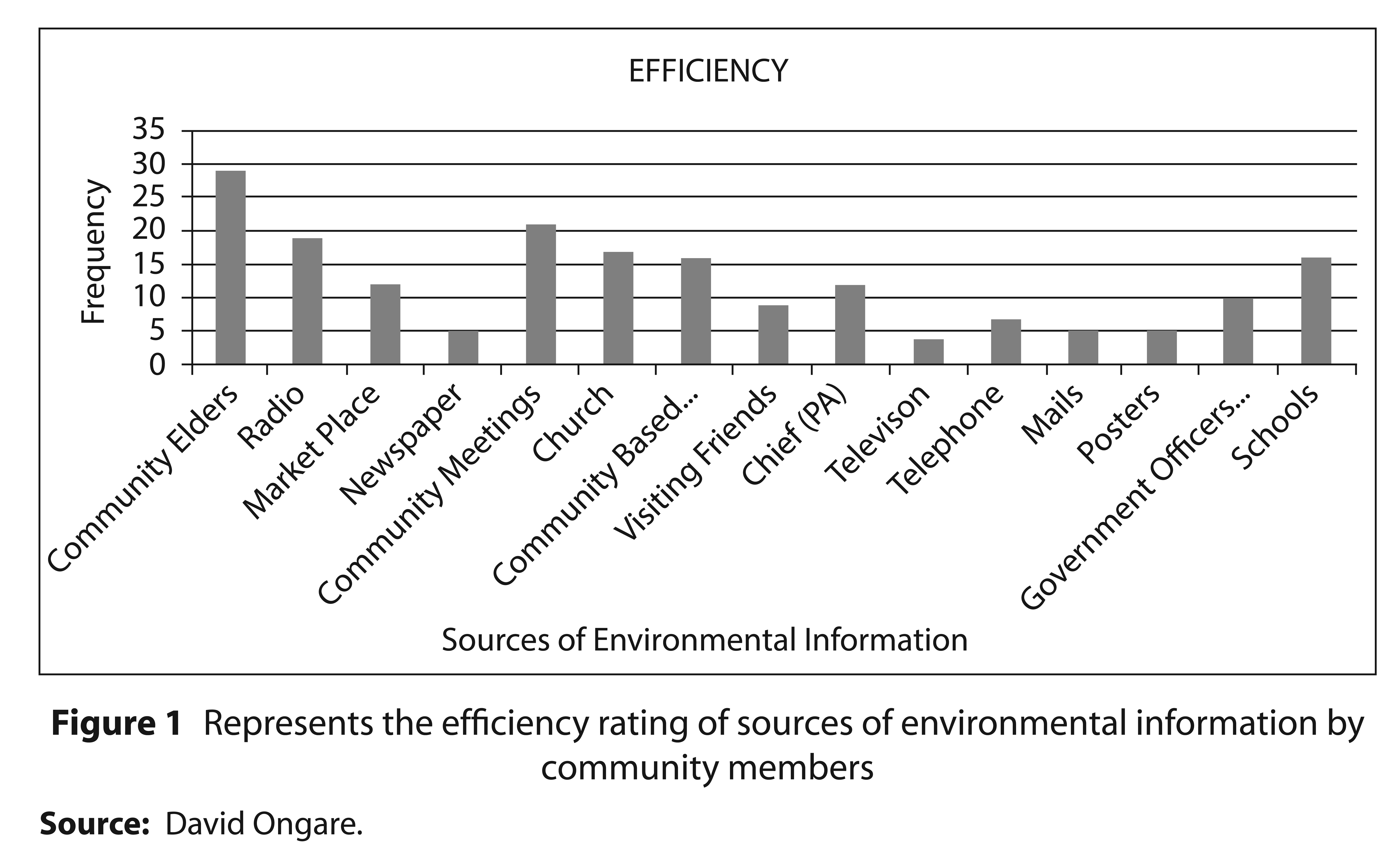
Efficiency here integrates components of penetration, speed and to a lesser extent cost.
DISCUSSION
There was need for a slow and structured entry into this community to ensure success of the study. Residents in the study area generally do not trust strangers and thus there was need to involve local data gatherers in the research. Secondly, there was a language barrier and thus the need to have translators during the planning and implementation of communication and education interventions, especially on ways of disseminating innovations and the best bets for agro-biodiversity conservation. It was also important to be mindful of the fact that the community in this area is highly patriarchal and proud of their pastoralist and moranic (warrior-like) way of life.
The approaches employed in this study conform to the six steps to behavioural change advocated by Day and Smith (1996) that moves through from observing subjects to effecting and monitoring behaviour change.
Use of consultative workshops is a widely used method in data collection for focus group discussions, interviews and in disseminating the research information and project objectives. It is used for inquiry. The researchers identify a problem, analyse the activities needed to solve the problem and eventually come to logical conclusions about the best course of action. Focus groups provided an avenue for audience segmentation. According to Patton (2002), the maximum variation method provides for unique or diverse variations that adapt to different conditions and situations.
For sustainable-community based natural resource management (CBNRM), prioritized issues must resonate with the communities. This is what informed the need to identify and prioritize pressing natural resource challenges from the community’s perspective. Generally, people will not change their environmentally relevant behaviour if they do not have a say in planning, implementing and evaluating the action for change (GTZ, 1999). The aspect of possibilities inherent in co-management of natural resources then becomes quite important (Hesselink et al., 2007) as it exposes avenues for direct benefits to communities. The communities have to be part of the process of prioritizing environmental concerns to be addressed all the way to providing the solution, implementation, monitoring and evaluation. To get a starting point for environmental communication interventions, the questionnaire provided a snapshot of the Knowledge Attitudes and Practises (GTZ, 2006) of the community, bearing in mind that instructive information and awareness alone is not enough to initiate sustainable behaviour change (GTZ, 2006). As advocated for by Taylor (2010) communication becomes an enabler towards behaviour change and action in natural resource management. The community under study acknowledged that current practices might not only be unsustainable, but could also be contributing to the deterioration of their environment.
Community elders and community meetings turned out to be the most efficient information channels. This could be attributed to the fact that they are embedded within communities and are not constrained by frequent migrations, a constant feature of pastoral life. It is possible that some latent attributes were not ‘visible’ to the study team, which was from outside the community.
POTENTIAL COMMUNICATION INTERVENTIONS
The study focused on the trust ascribed to various information sources as well as the efficiency of the various channels of communication. This pointed to the need to integrate communication interventions with the socio-cultural attributes of this community. The community was fairly well versed with the environmental problems in the study area and basically needed new knowledge on sustainable, alternative practices from an agro-biodiversity standpoint. An appropriate environmental education model would then act as the link between the two aspects in order to stabilize the rapid pace of environmental degradation. This would enable the community to adapt better to the realities posed by the degraded environment, population growth and climate change phenomena. The starting point would therefore be the provision of education and communication on the benefits of new sustainable agro-diversity practices, which correlate well with the framework of Waisbord (2001), based on where people are at a point in time and the required communication interventions, all the way to sustaining a new behaviour pattern. The combination of trusted information sources and an effective communication channel would therefore provide a convenient vehicle to disseminate environmental education for sustainable natural resource management, keeping in mind that the area under focus is quite vast. An example would be to have community elders record messages; or host programmes in local languages that are then transmitted over the radio to be accessed at any point. Community meetings are an important feature for communities in this area. Some of them are used for rites of passage. Such community meetings could serve as platforms for oral dissemination of environmental information to community members.
The lifestyle and socio-cultural patterns inherent in the Mara community require a combination of communication channels to be effective. As mentioned at UNCED (1992), environmental education is closely linked to environmental communication. ‘To be effective, environment and development education should deal with the dynamics of physical/biological and socio-economic environment and human development and should be integrated in all disciplines and employ formal and non-formal methods and effective means of communication’(UNCED, 1992). GTZ (1999) points to the commonality of purpose between environmental education and environmental communication in that they are both geared towards environmental sustainability. This is especially pertinent in a rural setting such as the one where the study was conducted, linking what should be changed with the ways in which change should be brought about. The migratory nature of the community requires a communication channel that is not limited by the exigencies of movement. Purely from the perspective of effectiveness, community elders and the radio score quite high. A large number of pastoralists were observed to carry small transistor radios with them wherever they went. The radio and cell phones offer further opportunities here, especially based on their high penetration levels, despite the latter not being used much in environmental communication. The level of trust in community elders and community meetings as sources of information is very high and needs to be leveraged as it provides space for quick mass communication. This is informed by access, familiarity and lack of a language barrier. The ecological setting is a hostile one and conflicts over natural resources have been witnessed between the study community and neighbouring ones, in addition to the prevalent human–wildlife conflict in the region. Similar to other African communities where cultural norms and values were transmitted from one generation to another through folklore and teachings, it makes a case for why community elders and cultural events are trusted settings for dissemination of important information to community members. The latter present a huge potential as entry points for new ideas and also for the uptake of new technologies and conforms to Rogers’ (1995) findings on the diffusion of innovations where the elders could form a potent group of innovators and early adopters to facilitate behaviour change in this community. It is therefore possible to formulate environmental communication approaches based on various combinations of these tools. The strongly patriarchal community system needs to be taken into consideration when planning environmental education and communication.
CONCLUSION
In this study, it emerged that it is difficult to separate substance (in this respect a piece of information) from its source. Good and credible environmental information could be treated with mistrust because of its point of origin; the converse was also true. It is therefore important to link the information to its source as indigenous communities are mobilized for environmental management. The latter would then need to be channelled through an effective information channel for the required impact when designing an environmental information campaign in this region. A successful environmental communication campaign would therefore need to combine appropriate aspects of trust and effectiveness if it is to bring about change in environmental behaviour within this community.
A package containing various combinations of village elders and community meetings (from a trust perspective) and radio and cell phone (from a reach perspective) would seem to present the highest potential for change communication that could enable the introduction of innovations to support sustainable natural resource management in this ecosystem. The findings of this study present the initial steps in the process of moving from awareness, attitude and ultimately behaviour change aimed at sustainable use of local natural resources.
Footnotes
Acknowledgements
This study was made possible through funding support from ASARECA.