



Abstract
This article is based upon a longer concept paper commissioned by UNESCO in preparation for the World Conference on ESD, and entitled ‘Winning the Future We Want—the pivotal role of education and learning’. Neither this article nor the original paper necessarily represents UNESCO’S views. The brief for this paper was to make a strong case for education for sustainable development (ESD) as a critically important means of realizing sustainable development goals and was based upon UNESCO’s analysis that the sustainable development discourse—including high-level reports associated with the post-2015 agenda—largely does not recognize the central role that learning and education must play in supporting individual and social change. The commissioned paper therefore covers a broad sweep including the place and role of education and learning in the context of the need for urgent social change; an outline of relevant ESD theory including learning strategies; a desk-based critical review of the post-2015 debate; and an outline of the role of ESD as a key to sustainable development. This article is a shortened and updated version of the paper.
In the summer of 2013, I was asked by UNESCO to write a paper to inform the end of Decade conference planned for November 2014. Interestingly, the brief was not primarily to write for the education for sustainable development (ESD) community, but for the sustainable development community, and also, to a degree, for education stakeholders and policymakers. The full terms of reference included a requirement to ‘develop clear, concise arguments as to how ESD can contribute to making education relevant and to fostering 21st century skills and competences’, as well as drafting a paper that shows how ESD helps realize the goals of sustainable development. This included a request to ‘market’ ESD to the sustainable development community, based on UNESCO’s analysis that the nature and potential of ESD was largely under recognized by this community.
To meet this challenge, I tried to present a clear briefing on the current debate on the relationship between education, learning and sustainable development, and point to ways in which—working together—they can help ensure a more sustainable and safe future. What follows is an edited and updated version of the paper.
Executive Summary
Section 1: Context
Recognizing the critical potential of ESD and learning:
The quality of the human and biospheric future depends on our collective capacity and ability to learn and change. In the absence of such learning, we will get ‘the future we deserve’—and that nobody will want. Sustainable development is not itself sustainable (i.e., lasting and secured), unless relevant learning among all stakeholders is central to the process. Whilst sustainable development can be promoted through policy instruments, legal measures, financial incentives and disincentives, information and campaigns, these tend to be effective for only as long as they are applied. Education can enhance the effectiveness of each and all of these instruments through developing informed engagement, agency and empowerment among all affected stakeholders. Further, education can build lasting change—that is, sustainable change, because it is owned by the learner and reaches hearts and minds. Yet in the sustainable development debate, the key role of education in realizing sustainable development is often ignored, downplayed and underestimated—or viewed in isolation from the other instruments of change. In this debate, education is rarely regarded as a major factor in making the world more sustainable, and its potential is overlooked. Thus, despite the successes of the UN Decade of Education for Sustainable Development (DESD), we are in an undesirable situation where much sustainable development discourse and policy underplays the role of education, whereas much education discourse and policy underplays—or ignores—sustainable development. This has to change, and fast. The ESD community and the sustainable development (SD) community have both emerged strongly since the Rio Summit of 1992. Whilst they are pulling in the same direction, they tend to operate on separate tracks: significant opportunities for synergies, mutual learning and enhanced effectiveness are largely not recognized and tend to be missed. ESD means and implies far more than those working outside the ESD field often perceive it to mean—it offers a renewed vision for educational policy and practice fully in tune with the needs and issues of the twenty-first century. However, the role of education—even among sustainable development experts—tends to be narrowly interpreted and seen as confined to such areas as basic literacy and education for all (EFA). The fundamental challenge is this: How can education more strongly impact sustainable development—and sustainable development be embedded at the heart of education and learning—so that there is both mutual benefit and accelerated positive effect, sufficient to win breakthrough towards an economically secure, ecologically stable and socially just world, way into the future?
Section 2: Education for Sustainable Development (ESD)
ESD, learning strategies, competencies and change:
The ESD movement and related educational movements are concerned with identifying and advancing the kinds of education, teaching and learning policy and practice that appear to be required if we are concerned about ensuring social, economic and ecological viability and well-being, now and into the long-term future. There is no change without learning and no learning without change. Learning can entail progressively deeper levels of engagement between simple learning such as of factual content, and higher orders of learning which involve deeper reflection and can be transformative, involving change of personal frame of reference or world view. These levels are associated with different learning and teaching methods: from transmissive (which is dominant in most educational systems), towards transactional which is more interactive and participative and finally transformative which leads to deeper personal and social change. Higher order learning can lead to the development of sustainability competencies characterized by such qualities as an anticipative perspective and future orientation, an ability to think critically, creatively and systemically, an action competence, an ethical sensibility and ability to manage in conditions of change, uncertainty and risk. The four main categories of educational/learning strategies that can be employed to advance sustainable development (whether advanced by ESD practitioners or by SD practitioners) are information, communication, engagement and capacity building. These can be seen as a progression in the ability, capacity and motivation of the individual, group, community or institution to participate effectively in owned change.
Section 3: Reviewing the Post-2015 Debate
An analysis of the role of education and learning as reflected in key sustainable development reports and Sustainable Development Goals (SDGs).
In these reports, education tends to be equated with—and limited to—‘Education for All’, that is, the right to basic quality education, normally in the formal sector.
The role of non-formal, informal and life-long learning for SD is greatly underplayed.
The recognition of education and learning as a positive force and driver in the achievement of other SD goals and SDGs is largely unacknowledged.
Whilst ‘transformation’ of policy and practice is often mentioned, the reports tend not to recognize that transformation is a learning process or recognize the role of education in facilitating transformational learning.
The role of education and learning is similarly underplayed as regards their key role in translating SDGs into terms that are meaningful and actionable and engage different groups and cultures.
The SDG agenda needs to recognize the vital role of education and learning as a cross-cutting issue and an essential vehicle for realizing sustainable development across all SDGs.
Further, SDGs relating to education must include—but also go beyond—EFA and basic educational entitlement to reflect wider sustainable development outcomes.
Section 4: Sustainable Change
ESD as key to sustainable development:
Whilst the SDGs are deeply challenging, the instruments intended to achieve them are presented as: policy, assistance, monitoring, finance and incentives and legislation and regulation. These are necessary, but not sufficient. Unless stakeholders, policymakers, legislators, businesses, agencies, non-governmental organizations (NGOs), media and civil society are involved in learning processes, the proposed SDGs will not be achieved. This is because change cannot happen without learning. Change towards sustainability needs itself to be sustainable, and education and learning is central to this process. ESD can operate in two modes—remedial—which helps limit damage and develop new practices that can address and ameliorate issues across human activities, rendering them ‘less unsustainable’; and solutions-led preventive (or curative) mode—which is about building a sustainability-oriented culture which ‘designs in’ positive solutions and synergies in the first place: developing resilient systems which manifest economic, social and ecological health and well-being through a continuous and dynamic learning process. Globally, the policymakers, politicians, scientists, technicians, engineers, economists, bankers, law makers and legal experts, farmers, industrialists, media personnel, academics and researchers, transport industry, teachers and so on—all professional groups—need to attain a level of sustainability literacy consistent with their impact in and on the world, through pre-service and in-service education and training. Necessarily, this involves a rethinking of the purposes, policies, provision and practices of much current education and learning to fit the realities and conditions of the twenty-first century.
What is learning?
This article emphasizes the importance of learning, which is commonly seen simply as the ‘acquisition of skills and knowledge through experience or study’. But it is important to go a little deeper than this definition. Learning is a response by the individual or group to external change or feedback. This has two aspects: first, meaning making, that is, making sense of the change and second, making some internal adjustment or (in systems terms) ‘correction’ to take account of the change such as acquiring a new understanding or perspective or a modification or shift in assumptions or beliefs. The changes and challenges that sustainability entails present a profound learning challenge—including unlearning some established patterns of thinking and behaviour, relearning sustainable patterns where appropriate and new learning to be able to recognize, create and engage with necessary alternatives. Where this occurs at a deep level, it is called transformative learning. Learning occurs at all levels: individual, organizational and social.
Note: There is no change without learning, and no learning without change.
Context
Introduction
It is widely known that—seen from a global perspective—humanity is now in a critical position without precedent in our long history (Assadourian et al., 2013; Randers, 2012). In the next few decades, collectively we will either choose a path that sustains us and the planet into the foreseeable future, or one marked by worsening crisis and disruption at all levels, for us and succeeding generations. So, decisions that we take, individually and collectively over the next several years, will either edge us farther down a terminal road, possibly irretrievably, or—by a historic effort—divert us onto a pathway towards a more secure future.
The assumption behind this article is as follows:
The quality of the human and biospheric future depends on our capacity and ability to learn and change.
The purpose of the article is to unpick and substantiate this statement and to illuminate the critical role of learning and education—interpreted here in a broad sense—in securing development which is more sustainable. And to argue that sustainable development is not itself sustainable (i.e., lasting and secured), unless relevant learning (see Box 1) among all stakeholders is central to the process. In this way, there is still a strong possibility we can win the future we want. But in the absence of such learning—and this is the single most important point in this article—we will then get the ‘future we deserve’ and that nobody will want.
Change towards sustainability can be advanced through a number of means or instruments:
Policy, governance and agreements Planning and legal regulation Financial incentives and penalties Information and campaigns
And, of course, education. But there is a significant difference between education and the above instruments. It is this: Education can enhance the effectiveness of each and all of them through developing informed engagement, agency and empowerment among all affected stakeholders; also, through unlocking and fostering their creativity, ideas, abilities and enthusiasm. More and more people in different sectors have come to realize that ‘business as usual’ is no longer tenable and seek constructive alternatives—a growing energy that ESD can release constructively.
There is a further and important qualitative difference between education and other instruments of change: Whilst they are often only effective for as long as they are in operation because they are externally applied, education can build lasting change—that is, sustainable change, because it is owned by the learner. Whilst other instruments tend to treat symptoms of unsustainable activities and behaviours, only education and learning can reach hearts and minds and therefore address root causes.
Education is claimed as ‘the bedrock of sustainable development, contributing to its social, economic and environmental dimensions’, underpinning peace and security and ‘creating a lasting impact on health and gender equality, and leading to safer, more resilient and stable societies’ (UNICEF, 2013: 2).
Yet, the key role of education in realizing sustainable development is often ignored, downplayed and underestimated or viewed in isolation from the other instruments of change. Two of the conventions coming out of the 1972 Rio United Nations Conference on Environment and Development (UNCED) conference, the Convention on Biological Diversity (CBD) and the United Nations Framework Convention on Climate Change (UNFCCC), developed communication, education and public awareness (CEPA) strategies. In addition, the United Nations Convention to Combat Desertification (UNCCD) established an awareness raising, communication and education (ARCE) unit. However, education has not played a significant role in the programmes relating to the conventions (Sarabhai et al., 2012q). As Sarabhai notes (2012: 167), education ‘is rarely seen as a major factor in making the world more sustainable’.
Meantime, and despite hyper-interconnectivity accentuated in recent years by the rise of communication technologies and globalized trade and culture, the majority of people, institutions and governments tend to think and work in accustomed and familiar patterns that neither recognize wider consequences and effects of decisions and actions, nor take real account of the environment or of the future. Back in 1987, the Brundtland Report called for a ‘vast campaign of education, debate, and public participation’ to secure changes in human attitudes (WCED, 1987: 23). It has not happened. Rather, change expert Otto Scharmer suggests that throughout society there is a ‘massive institutional failure: we have not learned to mould, bend, and transform our centuries-old collective patterns of thinking, conversing, and institutionalizing to fit the realities of today’ (Scharmer, 2009: 3).
Yet at the same time, at the international level, there has been and continues to be significant effort to advance the thinking, policies, tools and actions that can lead towards the more sustainable development pathway, and particularly since the first Earth Summit held in Rio de Janeiro in 1972, as a follow-up to Brundtland. This is evidenced in the considerable activity and discussion around the post-2015 agenda and in anticipation of the SDGs. However, as the DESD ends, we are faced by a major paradox, which concerns the relationship between the ESD and SD communities, both having emerged and grown, particularly since the Rio Summit of 1992. They are pulling in the same direction, but often in isolation of each other, so significant opportunities for synergies, mutual learning and enhanced effectiveness are largely missed. This is not only a problem of different communities of practice, usage of different terms, different working contexts and lack of communication, but also a problem of misperception: ESD means and implies far more than those working outside the ESD field often perceive it to mean. As UNESCO states:
ESD is far more than teaching knowledge and principles related to sustainability. ESD, in its broadest sense, is education for social transformation with the goal of creating more sustainable societies. ESD touches every aspect of education including planning, policy development, programme implementation, finance, curricula, teaching, learning, assessment, administration. ESD aims to provide a coherent interaction between education, public awareness, and training with a view to creating a more sustainable future. (UNESCO, 2012: 33)
Hence, as UNESCO has stated, ESD can be seen as offering a renewed vision for educational policy and practice as a whole. Yet, the role of education—even among sustainable development experts—tends to be narrowly interpreted and limited to such areas as basic literacy and EFA. These are clearly important, and much has yet to be done to meet the goals of EFA and education-related Millennium Development Goals (MDGs; UNICEF, 2013). However, education and learning has a much bigger additional potential role. This is a serious issue as many of the key sustainable development reports (later in the third section) underplay or omit entirely the role and potential of ESD. Alternatively, they do not recognize the potential of ESD to enhance and support other instruments of change but see it as a separate category. At the same time, however, in wider society there has been a rise of interest in learning, and particularly the role of social learning in facilitating the need for adaptation to a rapidly changing world, and this affords an opportunity for heightened communication.
This problem of omission in SD is echoed in educational discourse—but conversely. Key policy papers, debates and conferences on the future and purposes of education, whether national or international, often miss any reference to the wider and critical socio-economic and ecological context that will directly affect the lives of both this generation and of those to come. This is a striking and grave omission, not least as education is in essence about preparation for life; further, it undermines the otherwise valid maxim that education is ‘part of the solution’. It is for this reason that UNESCO and many leading commentators have, for some years, been calling for transformation in educational thinking and practice, whilst the vision of the DESD was ‘a world where everyone has the opportunity to benefit from education and learn the values, behaviour and lifestyles required for a sustainable future and for positive societal transformation’ (UNESCO, 2005: 6).
However, we are in an undesirable situation where much sustainable development discourse and policy underplays the role of education, whereas much education discourse and policy underplays—or ignores—sustainable development. Meanwhile, ‘actors in ESD’ and ‘actors in SD’ tend not to communicate with each other. The DESD has made a major and highly important impact in addressing and ameliorating this pattern, but it is still manifest. Hence, in the ‘Future We Want’ document resulting from the UN Conference on Sustainable Development (Rio+20) in Rio de Janeiro, Brazil, in 2012, member states agreed ‘to promote education for sustainable development and to integrate sustainable development more actively into education beyond the United Nations Decade of Education for Sustainable Development’: in other words, after 20 years, there is still a big job to do.
The challenge is to meet this fundamental question:
How can education more strongly impact sustainable development—and sustainable development be embedded at the heart of education and learning…
… so that there is both mutual benefit and accelerated positive effect in wider society, sufficient to win a breakthrough towards an economically secure, ecologically stable and socially just world, way into the future?
Reorienting education through the four ‘R’s—Beginning the discussion
Evaluating educational policy or programmes in relation to the sustainability agenda:
* What is of real value that we need to * What might need * What elements, if anything, might we need to * What
First, however, some key ideas about ESD are set out to inform the later parts of the article.
Education for Sustainable Development
Mapping Some Key Ideas
For some decades, and particularly since the Rio Earth Summit of 1992, and Agenda 21—which in chapter 36 laid out the challenge of educating for a more sustainable society—an international ‘education for sustainable development’ (ESD) movement has strongly emerged, which draws on longer established approaches such as environmental education, conservation education, development education, human rights education and global education. This movement is concerned with identifying and advancing the kinds of education, teaching and learning policy and practice that appear to be required if we are concerned about ensuring social, economic and ecological viability and well-being, now and into the long-term future.
This calls for a particular quality and orientation of educational and learning policies and practices, across all societies and contexts. UNESCO defines ESD as education which ‘allows every human being to acquire the knowledge, skills, attitudes and values necessary to shape a sustainable future’ ( Transformation of educational systems…is essential because our current systems have not supported sustainable models of development…change is needed to ensure that the system provides education that predisposes learners to consider sustainability across their life choices. (UNECE Expert Group, 2013: 52)
Forms and stages of ESD: A model of progressive engagement and deeper learning
So it is important to clarify what education and learning which is reoriented towards ESD looks like. There is a very large literature on the nature of ESD, but some key ideas and models are suggested here.
The following simple ‘C’ model helps identify the direction of ‘reorientation’ towards ESD. As a starting point, any educational policy or programme can be evaluated in terms of how far it takes account of:
Context—does its stated purpose and boundaries of concern embrace the wider context of sustainability and futures? Congruence—is it sufficiently grounded in real world issues and concerns, reflecting the systemic nature of the real world and the current threats and opportunities this presents? Culture—is it sufficiently attuned to the culture in which it is located, and to the existing values, understanding and needs of the learners? Criticality—does it help the examination of dominant assumptions and values in relation to building a more sustainable future? Commitment—does it engage with the ethical dimensions of issues to facilitate building an ethos of critical commitment and care? Contribution—through this policy and programme, will the learners, outputs and learning outcomes of the policy or programme make a positive (or negative) difference to sustainable development?
Each question requires evidence. Further, Box 2 offers a simple practical model by which any educational policy or strategy operating at any system level can begin to be evaluated and re-thought in terms of how far it currently contributes to sustainability education, and how far it can make a stronger contribution.
Keywords that typically characterize ESD are: participative, holistic, interdisciplinary, iterative, life-long, future oriented and values based. There is an emphasis on critically reflective thinking, systems thinking, multi-method pedagogies, real-world inquiry and practical application.
UNESCO recognizes that such education should lead to higher-order learning (UNESCO, 2005). But, it is helpful and realistic to recognize that ESD can occur at progressively deeper levels of engagement. This makes a distinction between different ‘orders of learning’ (Bateson, 1972), that is, between simple learning such as of factual content, and higher-order learning which involves a personal change of frame of reference or world view (see Box 3). This has direct relevance to how ESD can be employed as a change strategy (see ‘Change strategies and ESD’).
continuum of change strategies (Based partly on Scott and Gough, 2003)
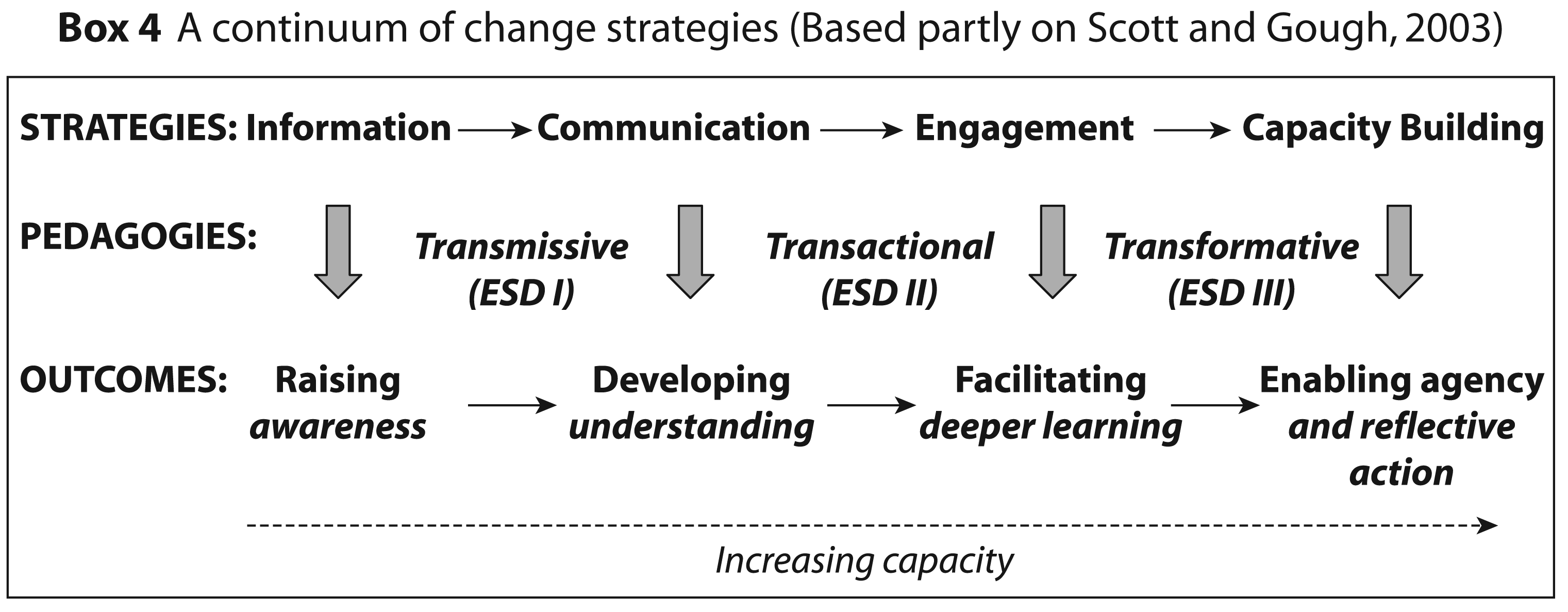
Each of these forms and stages of ESD—emphasizing respectively knowledge, values and capability—has value. The first form, acquiring some basic sustainability literacy, is important but may well be insufficient given the deep challenges of sustainability. The second form is vital to individual and social change, but it is the third form—capability—building on the first two, which makes significant difference both to the learner and to the real world. Each stage is associated with particular pedagogies, that is, teaching and learning approaches or methods. The first is often largely transmissive or instructive—involving the transfer of knowledge; the second is more transactional—involving dialogue and inquiry; and the third is potentially transformative—where a change of perception and frame of reference arises from full engagement of the learner. It should be recognized that the ‘learning journey’ through these stages—whether for an individual, an organization or community—is progressively challenging because at each stage, more is asked of the learner as their deeper beliefs, assumptions and values are brought to the surface.
The ESD journey nurtures competencies which, arguably, are necessary both to the possibility and flourishing of sustainable development at all levels and sectors of society. Much debate has arisen recently about the nature of ESD competencies with a good deal of consensus arising. Key sustainability competencies commonly identified include such areas as:
Anticipative perspective and future orientation Ability to see connections and think critically, creatively and systemically Interpersonal and collaborative skills Strategic and action competence towards sustainability Ability to manage in conditions of change and uncertainty Normative competence embracing values and ethical principles
These competencies, at the level of the individual, are developed through education and learning programmes which may include but go beyond transmissive ESD I forms. Translated to the group or community level, well-developed ESD policies and programmes will lead to most or all of the following outcomes:
Unlock and foster creativity, enterprise, resourcefulness and resilience Build competence, confidence and willingness to engage Raise awareness, build understanding and shift attitudes and values in favour of sustainability Promote reflection on behaviour and facilitate practical change Help build social capital and promote partnerships and collaboration Promote participation and engagement among target groups and stakeholders Create mandate both for policy development and implementation
Change Strategies and ESD
This model maps out four main categories of educational/learning strategies that can be employed to advance sustainable development (whether advanced by ESD practitioners or by SD practitioners). The three forms of ESD and associated pedagogies (Box 3) are shown, and the four kinds of main outcomes also indicated.
Information is the one-way dissemination of sustainability messages, aimed at raising awareness of issues, and this includes campaigns. Communication takes more account of the existing knowledge and values of the target group and may involve exchange and dialogue, although assumptions among both teachers/leaders and learners may not be questioned. Engagement involves people in their own learning, and second order ‘learning about their learning’—developing not only understanding and skills, but also critical questioning and clarifying of assumptions, values and commitments. Capacity building enhances individual, group, community and institutional ability to participate effectively in owned change through building the kinds of competencies and outcomes outlined earlier.
Each strategy has value depending on the context in which it is applied. However, the idea of continuum—represented by the horizontal arrows—is to suggest that each strategy, from left to right, can contribute to the next: that is, a shift towards deeper learning and engagement moving from left to right across the spectrum. The capacity of the learner increases as deeper learning takes place.
It is clear from educational research that just providing information (first strategy shown above), that is, raising awareness of sustainability issues, may make little difference to people’s real understanding, caring or sense of engagement. It can be a first step, but clearly—taking climate change as a prime example—it is important to develop agency and engagement if we are to make significant progress in winning ‘the future we want’.
As noted in the diagram (Box 4), the four strategy modes are relevant whether change is sought by ESD practitioners or by SD practitioners: therefore, there is significant opportunity for better and closer dialogue, collaboration and synergy between these two communities. The article now employs some of this mapping of ESD as a kind of benchmark to critically review some key international reports—both those on ESD, and those on SD—to see how far the contribution and rich potential of ESD is properly recognized.
Reviewing The Post-2015 Debate
The Role of Education and Learning in Selected SD Reports
This section looks at how far the role of education and learning is recognized as key to the realization of broader SDGs. The analysis is based on the logic that learning is inherent to personal and social change.
An Action Agenda for Sustainable Development—Report for the UN Secretary-General (June 2013)
The Global Thematic Consultation on Environmental Sustainability in the post-2015 Development Agenda (July 2013)
These can only be ‘drivers of change’ if sufficient learning takes place, otherwise old assumptions, policies and patterns of activity will remain. The critical issue, which is not really addressed, is how such learning can be encouraged, supported and scaled up.
United Nations Secretary-General’s High-level Panel on Global Sustainability (2012): Resilient People, Resilient Planet: A Future Worth Choosing. New York: United Nations.
There is strong emphasis on integrative and systemic thinking taking account of interconnections both between areas of concern and proposed ways forward—‘seeing the whole picture’ (p. 15).
From Green Economies to Green Societies: UNESCO’s Commitment to Sustainable Development (2011)
Putting People and Planet First: Concord—Beyond 2015. European Task Force Recommendations for the post-2015 Framework (May 2013)
Adequate civic education programmes must be envisaged to enable an informed, critical and meaningful engagement and systems must be created or strengthened to allow civil society and individuals, particularly the most vulnerable, to participate fully—both in decision-making processes (such as in the elaboration of national sustainable development policy, plans and budgets) and in monitoring and reporting on progress made. (p. 40)
It also argues for more attention to learning outcomes in educational policy and programmes towards those ‘values, behaviour and lifestyles required for a sustainable future’ (p. 32), thus echoing DESD principles. However, despite some cogent arguments and the quote above, the links between ‘education and learning’, on one hand, and ‘participation and empowerment’, on the other, receives little attention. Further, the role of learning among all stakeholders in facilitating movement towards the key 21 goals laid out is not really addressed.
Summary Comment on Reviewed Reports
These reports commonly share three weaknesses with regard to the role of education and learning:
Thinking about education tends to be equated with—and limited to—‘Education for All’ (EFA), that is, the right to basic education, normally in the formal sector. (This is corroborated by an overall review of eight key post-2015 agenda institutional reports which finds that prime emphasis is put on quality EFA (King and Palmer, 2013)). Universal basic education is a necessary component of SD, but ESD offers a new vision, values, concepts, skills and methods for education as a whole, which is largely unrecognized here. Non-formal, informal and life-long learning for SD is greatly underplayed, not least in terms of how the goals set out in the reports can be addressed. The recognition of education and learning as a positive force and driver in the achievement of SD goals and SDGs is very largely unacknowledged.
There is a good deal of common ground in the reports about the challenges facing us globally, and about their complexity, severity and urgency. There is much agreement that ‘business as usual is no longer tenable’, that integrated thinking and responses are required, and that this will necessitate ‘transformation’ in thinking, policies, structures and actions. However, this should not be seen as a once and for all process, but rather, on-going: Donald Schön, an expert in learning theory, asserts that in situations where there is no stability, ‘we must become able not only to transform our institutions…we must develop institutions which are “learning systems”, that is to say, systems which are capable of bringing about their own continuing transformation’ (Schön, 1973: 30).
Transformation—a shift in perception, understanding and ability to act differently—is essentially a learning experience, but there is very little attention given in these reports to cultivating basic sustainability literacy (ESD I above), let alone transformative capacity building (ESD III above). This is a serious omission. Further, the SDGs beg a critical question of translation and scale: what will the proposed SDGs mean to particular groups, to different cultures and contexts, from global to national to regional and local scales? Again, education has a vital role in helping people translate very generic goals to more specific plans and actions appropriate to their current interests, understanding, role and context.
With this in mind, a revised or new SDG might be along the following lines:
Further, education and learning has to be properly recognized as a cross-cutting issue and essential element of delivery across all prospective SDGs (TST, 2013; UNICEF, 2013).
The Role of Education and Learning in ESD Reports
The Bonn Declaration: UNESCO World Conference on Education for Sustainable Development held in Bonn, Germany on 31 March to 2 April, 2009
UNESCO World Conference on Education for Sustainable Development: Proceedings
Although the conference recognized that much more needs to be done to realize the potential of ESD across all sectors, there is an optimistic note sounded in the Executive Summary (p. 8): ‘By dealing with the problems faced by humanity in a globalized world, ESD will shape the purposes and content of all education in the period ahead—ESD is, indeed, education for the future.’ There is, therefore, some tension between ESD as a new paradigm or vision for education as a whole, or less ambitiously, as an important dimension of educational thinking and practice.
Learning for a Sustainable Future—Maximizing the Synergies between Quality Education, Learning and Sustainable Human Development, John Fien/Inter-Agency Committee for the UN Decade of Education for Sustainable Development, June 2013
Sustainable Change: ESD as Kyy to SD
This section emphasizes that change towards sustainability, if it is to be lasting and long term, is fundamentally an on-going learning process and needs to be recognized as such.
The SDSN’s ‘Action Agenda for Sustainable Development’ (reviewed earlier) details ‘ten priority challenges of sustainable development’ which are proposed as SDGs—as vital goals to be achieved. The means by which these SDGs and associated sub goals are to be achieved are presented as: policy, assistance, monitoring, finance and incentives and legislation and regulation. The need for ‘transformation’ in values, in systems and activities is widely stressed. Yet unless stakeholders, policymakers, legislators, businesses, agencies, NGOs, media and civil society are involved in learning processes, the proposed SDGs will not be achieved. This is because change cannot happen without learning. For any positive social and economic change to happen towards SD—from micro to macro scale—people need to:
Be aware that change is needed otherwise why change? Understand something about the change involved otherwise it will mean little Have sufficient ownership, agency and ability to make a difference otherwise little can or will happen Have some commitment or change will be short lived
This is about developing capacity through learning, and it is key, for these reasons:
Legislation, policy change, financial incentive and sanctions will have some effect, but if all affected stakeholders understand the change involved, particularly where this may be uncomfortable or demanding, these instruments are likely to be far more successful. Conventional instruments are only effective as long as they are applied. If they are withdrawn, people are likely to revert to former practices and behaviours: the change is not sustainable. Those involved in framing policies and practices may not themselves be familiar with sustainable development. Indeed, this is often the case. So reliance on policymakers and legislators to help implement SDG goals is risky without their understanding of and commitment to SD. Levered or enforced change without participation of stakeholders requires compliance; whereas participative change engendering a sense of ownership, self-interest and agency is often self-perpetuating.
In essence, change towards sustainability needs to be sustainable, and education and learning is central to this process. This view is reflected in much of the high-level documentation that has arisen over recent years. For example, the 2005 meeting of ministers of the UNECE countries endorsed an ESD strategy which affirms that ESD:
…develops and strengthens the capacity of individuals, groups, communities, organizations and countries to make judgments and choices in favour of SD. It can promote a shift in people’s mindsets and in so doing enable them to make our world safer, healthier and more prosperous, thereby improving the quality of life. Education for sustainable development can provide critical reflection and greater awareness and empowerment so that new visions and concepts can be explored and new methods and tools developed. (UNECE, 2005)
This kind of thinking on ESD illustrates a critical point. ESD can operate in two modes. One is remedial. Given the extent of unsustainable policies and practices occurring across all sectors—for example, in agriculture, energy, business, housing, transport, production and consumption—education and training can help limit damage and develop new practices that can address and ameliorate issues. In reality, this might often mean making established modes of activity ‘less unsustainable’.
However, the second mode is solutions-led and preventive (or curative). This is about building a sustainability-oriented culture, which ‘designs in’ positive solutions and synergies in the first place. This is manifested through such areas as sustainable agriculture, green building, sustainable design, green chemistry, renewable energy, fair trade, ethical investment, the circular economy, ecosystem restoration, genuine participatory democracy and the transition town movement. Whilst we certainly need to address and lessen existing problems (tackling unsustainability symptoms and damage limitation—remedial ESD), the real promise of systemic sustainable change comes from developing modes of living, and creating resilient systems, which manifest economic, social and ecological health and well-being—through a continuous and dynamic learning process.
This mode of ESD is not only preventive, addressing directly the issues raised by unsustainable practices and behaviours, but also proactive, creative and constructive. People engaged in these initiatives and movements can be said to be involved in learning characterized by ESD III: education/learning ‘as’ sustainable development and change (see Box 3). This engenders a shift away from unthinking individualism, materialism, competition and consumption towards a more relational (some would say, ecological) world view, which is more connective, cooperative, holistic, open-minded, caring, engaged and future oriented.
Many key documents stress the need for a significant cultural shift if, collectively, we are to surmount the profound challenges of unsustainable patterns and attain a safe, healthy and liveable future for all. But as Rosen et al. (2010: 15) state, ‘such a deep shift in values and institutions can only emerge as a collective project of global citizens for a Great Transition, a development that is far from guaranteed’. Realistically, it will not be possible, or indeed necessary, for entire societies to attain the deep level of change of outlook and practice associated with ESD III, but it is vital that sufficient people, particularly those in positions of influence and power, experience at least ESD II (involving a questioning of dominant assumptions and values) or ESD III (a shift towards a more relational world view). The centrality of learning to developing effective leadership for sustainability is increasingly recognized in the business world (Courtice, 2012). At the same time, the sustainability revolution, ‘requires each person to act as a learning leader at some level, from family to community, to nation to world’ (Meadows et al., 2005: 280). For this to happen everywhere, at least some basic sustainability literacy (ESD I) is crucial.
For developed countries, it is not a lack of education that is at stake—as there is some correlation between countries with high educational attainment and high ecological footprint (Orr, 1994)—but education which makes a positive rather than a negative difference to sustainable development. Globally, the policymakers, politicians, scientists, technicians, engineers, economists, bankers, lawmakers and legal experts, farmers, industrialists, media personnel, academics and researchers, transport industry, teachers and so on—all professional groups—need to attain a level of sustainability literacy consistent with their impact in and on the world, through pre-service and in-service education and training.
The sustainable development agenda begs myriad ‘what, why and how’ questions, from the global scale to the local- and micro-scale. There is no blueprint. It is complex, contested, sometimes conflicting, and ways forward are diverse and emerging over time, through innovation, experimentation, research, collaborative effort, learning and reflection. To move towards more sustainable living patterns in conditions of uncertainty and complexity, people at all levels of society and in all sectors need to be empowered and engaged in this movement. For many, initial involvement is learning around these kinds of questions:
What is this about? How does it affect me/us? Why is change necessary or desirable? Why should we change? How might we need to see things differently or do things differently? How is our voice heard? How can we make a difference? What do we need to learn to make that difference? What have we learnt from making a difference? How can this be taken further?
This is how ESD begins. It is a life-long process and is in essence about building resilient and socially responsible citizens, communities and economies within a context of healthy ecological systems. It is relevant to all and needs to be made available to all.
Necessarily, this involves a rethinking of the purposes, policies, provision and practices of much current education and learning to fit the realities and conditions of the twenty-first century. The following paragraph from the Global Thematic Consultation on Education in the post-2015 Development Agenda indicates the kind of changes that are required:
In order to be relevant, education must prioritize the acquisition of knowledge, skills and competencies that are linked to twenty-first-century livelihoods, and must also contribute to shaping learners’ attitudes and behaviours that promote social inclusion and cohesion as well as environmental sustainability. These skills include critical thinking, problem solving, conflict resolution, living and learning to live together in a multicultural world. Other relevant content knowledge should include environmental and climate change education, disaster risk reduction and preparedness, sustainable consumption and lifestyles, and green technical and vocational education and training. (UNICEF, 2013: 7)
Summary and Conclusion
We need both the thinking and the feeling: to reframe public engagement, we need creative solutions in every sense. We need to win hearts and minds to achieve change. (Buckland, 2012: 61)
It is clear that the evolving debate around sustainable development, particularly since the launch of Agenda 21 in 1992, is evidence in itself of a deep learning process among all sectors and players involved, as the need for questioning ingrained assumptions and practices has become clearer and the need for new pathways been recognized. Yet, the key role of learning is often unacknowledged and underplayed in this discourse, despite the important endorsements such as from the Open Working Group of the UN General Assembly on SDGs:
Education is absolutely central to any sustainable development agenda. It is not only an essential investment but an important basis for human enrichment through life-long learning. (OWG, 2013: 12)
Similarly, the UN Global Compact annual survey, reviewing evidence from some 1,700 companies worldwide, identified education as the most urgent development priority of all, and that ‘sustainable development should be incorporated into curricula at all levels’ (UN Global Compact, 2013: 8).
Yet, the global reports continue to reflect, for the most part, a restricted view of the nature and purposes of education, still less the centrality of learning to all. This is curious and regrettable, given that for many people, there is either nil or minimal understanding or recognition of the unprecedented challenges that genuine SD now presents.
The global reports reviewed above, understandably, are addressed largely to governments, government agencies and high-level decision-makers. As the reports emphasize, better governance is crucial. But policy and structural change has to be mandated, understood and supported, and its ramifications translated, adopted and implemented right across civil society. And wherever appropriate, there should be meaningful participation in the decision-making process, both influencing policy and holding policymakers at all levels to account where necessary. Without the participation and engagement of civil society in all its diversity, the SDGs will not succeed. And without inner change—in the way that many people perceive and think and towards a more relational and holistic world view—outer change in the form of policy change will never be enough.
ESD is not just necessary to introduce people to sustainability thinking, ideas and practices. Genuine and radical progress will depend on tapping and cultivating ideas, imagination, creativity and enthusiasm and engagement of as many people as possible across all walks of life and sectors. Every person, adult and child, without exception, is a stakeholder in the future of the Earth and the world. ESD can unlock their contribution—it is less about inculcation and more about cultivation.
Learning is an inherent part of change, whether at the level of the individual, the group, the organization or entire societies. Where there is no learning, there is no lasting change. Sustainable development seeks lasting change in a desirable direction. So where there is no learning, sustainable development cannot flourish.
The global ESD community sometimes lacks real world contexts, case studies, research and data. The global SD community tends to lack educational expertise. Each has got what the other needs, so the scope for much closer collaborative working, synergies and exchange is considerable.
‘The major challenges to sustainability’ write Moore and Rees (2013: 49), ‘are in the social and cultural domain’. ATkisson adds (2011: 16), ‘We must do sustainable development as though our lives depended on it—because increasingly, many people’s lives do’. As far as sustainable—or unsustainable—development is concerned, we are all actors. ESD is not about ‘telling people what to do’; it is about harnessing the power of ownership of ideas, of enlightened self-interest, of self-organization, world view change and leadership as powerful keys to the kinds of deep systemic change and building of resilience that sustainable development requires. It is essential to making and winning the ‘Future we want’.
Cross-cutting Questions
How can the considerable expertise and body of knowledge of the sustainable development community be best used to exert leverage on the purposes and policies of educational decision-makers and providers, so that the huge resource of the education community worldwide can be much better aligned to the imperatives of sustainable development?
Taking the established consensus of opinion on sustainability competencies as a baseline, what additional or specialist competencies are needed for advancing policies and practices in specific areas such as biodiversity, climate change, sustainable production and consumption, etc.?
Taking the major post-2015 reports as a benchmark, what are the main elements of possible sustainability scenarios over the next 10–20 years with regard to such areas as water and sanitation, energy, health, sustainable cities, climate change, etc.? What competencies will (i) policymakers, (ii) specialists and (iii) the public need to ensure that desirable scenarios are realized?