



Abstract
Award-winning Green Preschools in Bali, Berkeley and Hong Kong were selected to explore the characteristics of Green Schools using measures developed by educators (Environmental Rating Scale for Sustainable Development in Early Childhood (ERS-SDEC)) and architects (simplified Leadership in Energy and Environmental Design (LEED) development). Classrooms for 4- to 5-year-olds were systematically assessed over a 10-month period. A 35 years’ timeline of the Green School movement was produced. The Bronfenbrenner Ecological Theory has been used to frame and analyse this cross-national study. Results indicated striking similarities from both scales that the Green Preschool in Bali received the highest rating followed by Green Preschool in Berkeley and Hong Kong. Three distinct Green School characteristics were found to be: (a) holistic, (b) building and (c) curriculum. The schools’ green characteristics appeared to be influenced by cultures, city regulations and the external institutions that established the green awards.
Introduction
The visions and implementations of Green Schools can be seen as a response to the call of education for sustainable development (ESD) to varying degrees (Iwan & Rao, 2017); however, the operational understanding of Green School is still negotiable (Iwan, 2013). The United States Green Building Council (USGBC) considers that a Green School is one that has a physical building constructed or renovated according to the ‘Leadership in Energy and Environmental Design’ (LEED) rating scale (USGBC, 2013). On the other hand, the Environmental Campaign Committee-Hong Kong (ECC-HK) uses the term to refer to a school that enhances environmental awareness, develops environment-friendly attitudes and promotes green practices among school managers, teachers, non-teaching staff, students and their parents (Environmental Campaign Committee, 2013). Green Schools provide healthy environments that are conducive to learning while saving energy, resources and money (Gutter, 2009). Presumably, Green Schools can play a significant role in support of recent global movements. These include the United Nations 17 goals for Sustainable Development, launched on 15 September 2015 (United Nations, 2015), and the pledge by 196 nation state leaders at COP-21 on 11 December 2015 in Paris to halt a rise in global greenhouse gas emissions (UNFCCC, 2015). Green Schools support these goals either through providing eco-friendly school facilities or by teaching students about environmental awareness. This empirical study observed award-winning Green Schools that were carefully selected to serve as unique examples in the exploration to understand what characterizes a Green School. Three sites were selected: Bali (to represent the East); Berkeley (to represent the West) and Hong Kong (to represent a meeting point of the East and the West). Bronfenbrenner’s Ecological Theory (Bronfenbrenner, 1979) was selected to frame and analyse this research.
The Global Green School Movement
The global Green School Movement has been rooted in two parallel initiatives to promote ESD: in the field of education through the Foundation for Environmental Education (FEE) and in the field of built environment through the USGBC Centre for Green School (Iwan & Rao, 2017). The FEE used the term Eco-Schools instead of Green Schools, which has become the reason for FEE’s Eco-Schools to be excluded from the selection of Green School participants in this study. The World Organization for Early Childhood Education (OMEP) set in motion significant efforts to promote ESD, including the launch of the Environmental Rating Scale for Sustainable Development in Early Childhood (ERS-SDEC) in 2013, one of the two scales used for measurement in this study. Soon after the selection of the Greenest School on Earth by the USGBC Centre for Green Schools, the World Green Building Council (a network of national green councils spanning over 100 countries) launched the Global Coalition for Green Schools (Shelter, 2013). This Coalition selects and awards ‘The Greenest School on Earth’ annually to recognize K-12 schools that exemplify how sustainability can integrally be woven into infrastructure, culture and curriculum of a school (USGBC, 2015). The first author created a timeline of the Green School Movement in 35 years to outline the establishment of key organizations significant for promoting Green Schools and to indicate the year when the Green Schools’ participants of this research won their awards (see the appendix).
The Green School Movement In The United States, China And Indonesia
The Green School Movement in the United States, China and Indonesia have had different origins, approaches and stages of development. The USGBC was established in 1993 and set up the Center for Green Schools in 2000. It serves as a driver for dialogue on Green Schools, policy development and innovation. Two approaches towards Green Schools exist under the USGBC: (a) the technical approach through launching the LEED scale for new schools’ construction in 2009, and (b) the recent focus of the Center for Green Schools (established in the United States in 2000) that embraces environmental impact, human health and eco-literacy as its three pillars (The Center for Green Schools, 2016).
The Green School Movement in China (the Mainland China, Hong Kong SAR and Macau SAR) has also been influenced by different organizations. The State Environmental Protection Agency (SEPA), the Ministry of Communication and the State Education Agency jointly released the ‘Outline of Environmental Promotion and Education Activities’ (1996–2010; Zhang, 2004), which focuses on the educational approach of Green Schools (Iwan, 2013). A government statutory body (ECC-HK) and a green NGO in Hong Kong that is an affiliate of the World GBC (Hong Kong Green Building Council, aka HKGBC) spearheaded the Green School Movement in Hong Kong. The ECC-HK’s mission is to educate and encourage the general public to contribute actively in improving the environment. The ECC-HK has co-organized the Hong Kong Green School Award since 2000. The objectives of this scheme are encouraging schools to formulate their environmental policy and strategizing an environmental management plan around the concept of Green School, to enhance environmental awareness, develop environment-friendly attitudes and to promote green practices among stakeholders. Starting from 2006, the Hong Kong ‘Green Preschool’ Award has been incorporated into the Hong Kong ‘Green School’ Award (Environmental Campaign Committee, 2013). Macau SAR, on the other hand, is still in the preliminary stages of acknowledging the importance of Green Building, without envisaging a scheme to promote Green Schools but only its casinos (Crea, 2015).
The Green School Movement in Indonesia was pioneered by Green School Bali. Founded in 2006 by Western entrepreneurs, Green School Bali soon gained worldwide popularity since it was the first recipient of the ‘Greenest School on Earth’ Award from USGBC in 2012 (Macrory, 2012). The Green Building Council, Indonesia (GBCI) was incorporated in 2009. Nevertheless, it does not have any Green School scheme since incorporation.
Research Gaps And Research Questions
Presently, there is a dearth of empirical studies that evaluate Green Schools, not to mention award-winning Green Schools. To our best knowledge, this study is the first to provide empirical data on Green Preschools from an interdisciplinary angle of architecture and education with research participants coming from three distinct cultures. To understand the characteristics of Green Schools, the following questions were used to guide the study:
What characteristics does the school embody to receive the status of a Green School, according to the measures developed by educators (ERS-SDEC) and architects (Simplified LEED)? What influences and motivates these schools to adopt a green approach?
Methodology
Participants’ Selection Process
The selection of schools to participate in the research followed strict criteria. It was assumed that award-winning Green Schools would reflect a deep commitment to the environmentally sustainable approach. The locations were narrowed down to three areas: (a) Bali, a developing region in a developing country (to represent the East); (b) Berkeley, a developed city in a developed country (to represent the West) and (c) Hong Kong, a developed city in a developing country (to represent a meeting point of the East and the West). Due to the limited number of award-winning Green Preschools at the time of the school selection process, this study was constrained to use two different organizations that gave Green School awards—the USGBC and the ECC-HK.
School Settings
Preschool A is located in Bali, an island of 5,632.86 square kilometres, with a population of 3.16 million in 2012. This preschool is part of a larger campus, which includes a K-12 school that was awarded the ‘Greenest School on Earth’ designation by the USGBC in 2012. The observed classroom in Preschool A had 2 teachers and 16 children.
Preschool B is located in Berkeley, a city of 45.84 square kilometres, with a population of 115,301 in 2012. Preschool B received the LEED Silver Award from USGBC in 2006 (designated as a Green Building) and fell under the criteria of Green School when we selected the school participants for this research. The observed classroom in Preschool B had 3 teachers and 16 children.
Preschool C is located in Hong Kong, a city of 1,104 square kilometres, with a population of 7.155 million in 2012. It won the ‘Outstanding Green Preschool’ Award from the ECC-HK in 2012. The observed classroom in Preschool C had 2 teachers and 28 children.
Measures
The ERS-SDEC and Simplified LEED scales were selected because they were found to be suitable for the purpose of this study. The first author completed the LEED course provided by the USGBC, prior to simplifying the LEED (Green Building Education Services, 2009). The LEED has many specific criteria and was designed specifically to train professionals in the built environment industry.
The ERS-SDEC scale, which consisted of three categories and three items, was used to assess whether the schools had introduced sustainable principles to children in curriculum and pedagogical practices (software). The Simplified LEED consisted of 6 categories and 19 items, and it was used to evaluate whether building design and construction of the preschool fell under the ‘green’ criteria (hardware). Both instruments used ascending rating, Likert-type scales, with the following indicators: 1 (inadequate), 3 (minimal), 5 (good) and 7 (excellent).
Procedure
The first author visited each school in Bali, Berkeley and Hong Kong to solicit permission to conduct the research in their preschools. Ethical clearance was obtained from the University of Hong Kong prior to data collection.
In the first stage, the school site was observed in order to study the school’s culture (diversity of stakeholders, medium/language of instruction, dress code of teachers and students, and other aspects) in relation to the broader shared cultural values of each region. The second stage focused on the school’s physical environment in relation to neighbourhood buildings. In the third stage, the first author selected the target classroom to be observed and considered the layout of the participating classroom in relation to the school’s overall floor plan. In the fourth stage, systematic observation of one class was conducted using the ERS-SDEC and the Simplified LEED.
The first author produced detailed field notes throughout the data collection process. Time to turn away from observation towards a separate place of writing—a place for reflection, analysis and interpretation is considered to be important (Geertz, 1973). The first author’s reflection time consisted of daily journaling in various private spaces (a rented bungalow in Bali; a private house in San Francisco, a city near Berkeley, and a university dormitory in Hong Kong). This reflection time was critical to facilitate data analysis and enabled the first author to draw connections among the collected data, the literature review, the overall research topic and their relationship to the research questions.
Results
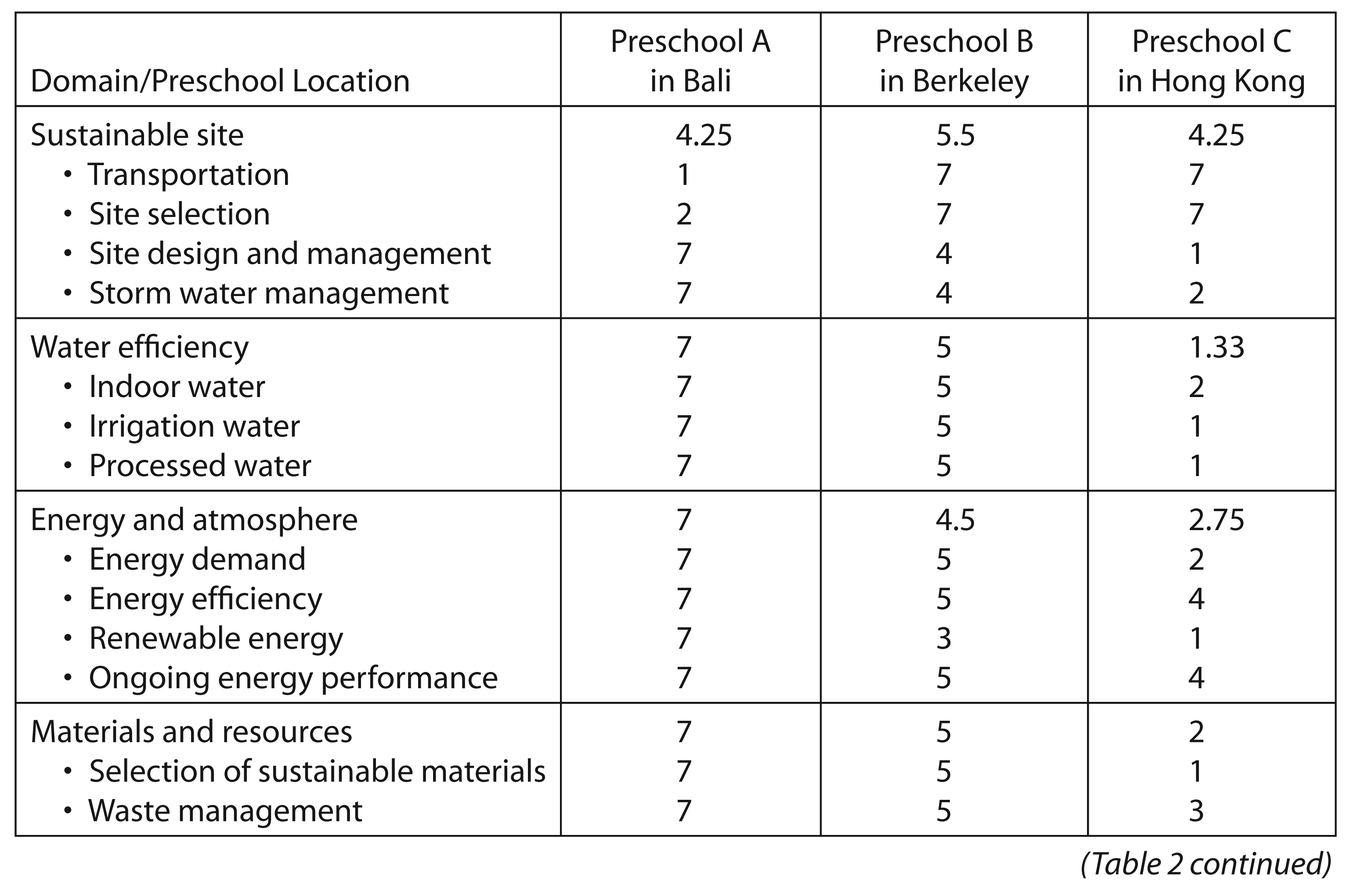
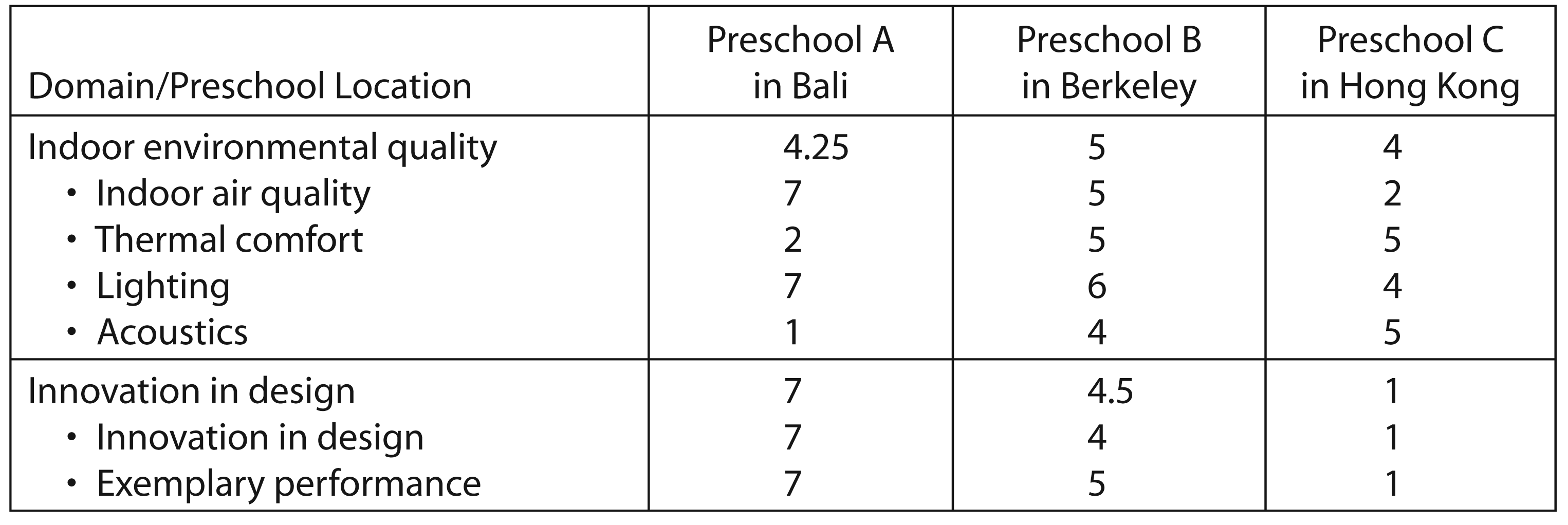
Results from ERS-SDEC (Table 1) and the Simplified LEED (Table 2) scales showed a consistent pattern in which Preschool A received the highest scores, followed by Preschool B and Preschool C in almost all categories from both scales, suggesting that the two scales were complementary, with the Simplified LEED (α = 0.89) covering the measurement of the hardware of the green building, and the ERS-SDEC covering the measurement of the software of the green curriculum. An α coefficient for ERS-SDEC could not be generated due to the small number of categories in this scale.
OMEP ERS-SDEC Comparative Data from Preschools in Bali, Berkeley and Hong Kong

Simplified LEED Comparative Data from Preschools in Bali, Berkeley and Hong Kong
ERS-SDEC Results
In the category of Economic Sustainability, Preschool A received a rating of 7. Children in Preschool A were also introduced to the hidden costs and benefits of a range of products that explained sustainability. Teachers showed students the cost–benefit of eating fresh corns from organic gardens versus eating canned corns from the supermarket, with the reasoning that canned corn produces waste materials that are difficult to recycle. Teachers explained that if children ate fresh corns, then waste materials such as cornhusks and corncobs could be recycled as pigs’ food. Preschool A often invited parents to share their knowledge on sustainability or to be involved in different sustainability projects. Preschool A used e-mail for all communication in order to reduce wastage of paper. It provided scholarships for local Balinese children from low-income households and 20 per cent of students in Preschool A would receive scholarships.
In the category of Environmental Sustainability, Preschool A received a rating of 7. Preschool A’s curriculum incorporated Green Studies, and the building had been constructed using sustainable material (treated bamboo for the structure and reed for the rooftop). Throughout the day, children were constantly reminded about the importance of living sustainably, and this was integrated into all aspects of curriculum and not segmented to one particular section. A few examples are as follows: (a) children’s activities in exploring the composite school complex gave them the opportunity to observe different plants and fruits grown in the school’s organic garden, the pet animals that the school owned and various student projects such as the solar panels that primary students built in the midst of rice paddies; (b) children were taught about the life cycle of plants and animals not solely from books but from real-life examples since the school premises was located in a natural setting and (c) children were taught recycling through a classroom activity to create toys from used boxes brought by the head teacher. This approach enabled children to switch their mindset to see the value of trash recycling.
In the category of Economic Sustainability, Preschool B received a rating of 2. Preschool B’s children were taught to recycle and to use recycled materials. However, they were rarely taught about money or about saving money.
In the category of Environmental Sustainability, Preschool B received rating of 3. Children in Preschool B had weekly walking activities around the campus. Children often collected plants and rocks while walking. The collected materials were turned into a poster that was displayed in the classroom.
In the category of Economic Sustainability, Preschool C received a rating of 1. Preschool C provided identified trash cans to sort through plastic, glass and paper, but the children were rarely given the opportunity to talk about money, saving and/or the need for economizing. Furthermore, there was little reference made to paper, electricity and water consumption in the setting.
In the category of Environmental Sustainability, Preschool C received rating of 3. Environmental teaching materials were limited to creating artwork utilizing recycled materials and growing plants. The recycled materials artworks were displayed in the Preschool’s Lobby Wall and also on the classroom walls. They also made an effort to organize an occasional field trip to a nature park (once or twice a year). During data collection, the first author joined such a field trip, where she observed that children were equipped with magnifying glasses, pencils and notes during their nature walk.
Simplified LEED Rating Explanations
Preschool A received a rating of 7 in the category of Energy and Atmosphere, considering that all four subcategories: energy demand, energy efficiency, renewable energy and ongoing energy performance received a rating of 7. Its building did not need much energy for operation because there were no air conditioners, fans or artificial lighting. The building only had a skylight, where natural light could penetrate the structure from morning until late afternoon. The building was left dark at night, which means that it saved energy. Preschool A installed solar panels and windmills nearby, generating enough energy to support the school building, which is considered to be superb use of renewable energy.
Preschool A received a rating of 7 in the category of Material and Resources. Both subcategories in sustainable materials and waste management received a rating of 7. It deliberately used treated bamboo in its building construction that had been manufactured by a nearby bamboo factory, and it used reed for its rooftop structure. Bamboo is considered a natural and renewable resource that is capable of rapid growth. Its hollow tube section also gives it nearly twice the strength of a solid wood beam. In addition, Preschool A had an excellent waste management system because it composted almost everything, from leftover food to withered plants.
Preschool A received an average rating of 4.25 in the category of Indoor Environmental Quality. In its following subcategories: (a) indoor air quality—it received a rating of 7 because the facility used low-emission materials that reduced off-gassing of harmful contaminants; (b) thermal comfort—it received a rating of 2 because the design did not allow occupants to control their environmental conditions; (c) lighting—it received a rating of 7 because the project used bamboo scaffolding for its skylight, which allowed ample natural light to penetrate the room and (d) acoustics—it received a rating of 1 because the facility had no walls or door, which means there was no separation between the indoors and the outdoors.
Preschool A received an average rating of 7 in the category of Innovation in Design. In the subcategories of: (a) innovation in design—it received a rating of 7 because its design is considered to be unique with an interesting shape of the building and furniture, and (b) exemplary performance—it received a rating of 7 because it showcases an excellent example of green building through the usage of bamboo materials and through generating renewable energy on site through solar panels.
Preschool B received an average rating of 5 for the Water Efficiency category. In the following subcategories of: (a) indoor water use—it received a rating of 5 because its building was designed to reduce 40 per cent of interior water consumption (this design is considered to be above average to save water; however, it is still below Preschool A’s water efficiency); (b) irrigation water—it received a rating of 5 with 61 per cent reduction landscape water consumption and (c) processed water—it received a rating of 5 because it used double-flush toilets to manage processed water.
Preschool B received an average rating of 4.5 for the Energy and Atmosphere category. In the subcategories of: (a) energy demand—it received a rating of 5 because the building was designed to allow plenty of daylight to penetrate through big windows; (b) energy efficiency—it received a rating of 4 since its building reached 26 per cent greater efficiency as compared with Title 24 (California Building Energy Efficiency Standards) for its annual energy savings; (c) renewable energy—it received a rating of 3 because the building did not have any solar panels, windmills or other renewable energy features and (d) ongoing energy performance—it received a rating of 5 because the building had suitable maintenance in terms of ongoing energy performance.
Preschool B received an average rating of 5 for the material and resources category: It received a rating of 5 for its use of sustainable materials. Its carpet had 15 per cent post-industrial recycled content that met the Carpet and Rug Institute’s Green Label Plus standards, ensuring that low-emission criteria were satisfied for 13 chemicals. The interior walls were coated with Eco Spec paint, which contained less than 10 grams of volatile organic compounds (VOCs) per litre. Preschool B’s interior also utilized materials that were both safe for children and environmentally responsible, such as the SkyBlend Particleboard cabinetry made from 100 per cent post-industrial waste wood fibre. Formaldehyde emissions from this product are less than 0.01 ppm, the same level as outdoor ambient air. In addition, the architect carefully considered its toddlers’ vulnerability to toxins because of their higher metabolic rates as compared with adults (Berkeley Early Childhood Education Center, 2006). In terms of waste management, its building was composed of 96 per cent construction waste diverted from a landfill and for this effort it received a rating of 5.
Preschool B received an average rating of 5 for the Indoor Environmental Quality category. In the subcategories of: (a) indoor air quality—it received a rating of 5 because of low toxicity of its selected green materials such as Eco Spec paint for interior walls and carpet that met the Green Label Plus standard, automatically enhanced indoor air quality, which in turn improved occupants’ health (Berkeley Early Childhood Education Center, 2006); (b) thermal comfort—it received a rating of 5 because the occupants had some control in adjusting the room temperature with the option of opening or closing the windows or using fans to reduce the heat. At the same time, the elimination of air conditioning was considered to be positive for the environment; (c) lighting—it received a rating of 6 because of its large windows and skylights that allowed plenty of natural light to penetrate into the building; (d) acoustics—it received a rating of 4 because the room did not use floor-to-ceiling partitions, which often caused minor acoustics problems, such as the cries of infants and toddlers in one room that could affect the other room.
Preschool B received an average rating of 4.5 for the Innovation in Design category. In the subcategories of: (a) innovation in design—it received a rating of 4 because its architecture was considered to be typical for a building in the Berkeley neighbourhood and (b) exemplary performance—it received a rating of 5 because its design purposely promoted an eco-lifestyle, such as the accessibility of bicycle storage at school as a feature to encourage stakeholders to bike to school.
Preschool C received an average rating of 1.33 in the category of Water Efficiency. In the following subcategories of: (a) indoor water—it received a rating of 2 because it used a normal flush for its toilets; (b) irrigation water—it received a rating of 1 because there was no system to use irrigation water for other means and (c) processed water—it received a rating of 1 because the school did not have a unique way of saving processed water.
Preschool C received an average rating of 2.75 in the category of Energy and Atmosphere. In the subcategories of: (a) energy demand—it received a rating of 2 because the building design did not include any scheme to reduce energy; (b) energy efficiency—it received a rating of 4 because its design considered the comfort of the occupants with appropriate heating, cooling, ventilation and natural lighting schemes; (c) renewable energy—it received a rating of 1 since the building did not generate power from any renewable source and (d) energy performance—it received a rating of 4 because of the incentive for occupants to reduce energy use, such as the policy for building occupants to turn off air-conditioning when the temperature reached 25 degrees Celsius.
Preschool C received an average rating of 2 in the category of Material and Resources. In the subcategory of (a) sustainable materials selection—it received a rating of 1 because the building material was not sustainable; and (b) in the subcategory of waste management—Preschool C received a rating of 3 because only minimal effort was made to segregate trash and sort plastic, glass and trash. In addition, it did not have any composting programme.
Preschool C received an average rating of 4 in the category of Indoor Environmental Quality. In the following subcategories of: (a) indoor air quality—it received a rating of 2 because the indoor flooring and the wall painting did not consider the use of green material; (b) thermal comfort—it received a rating of 5 for its policy of allowing occupants to control their own thermal comfort by operating windows, air conditioners or heaters accordingly; (c) lighting—it received a rating of 4 because it had many windows in the classrooms and corridors that allowed natural light to come into the space and (d) acoustics—it received a rating of 5 because it had good interior space acoustics for individual classrooms and particularly for its music room.
Preschool C received an average rating of 1 in the category of innovation in design, because both of the subcategories received a rating of 1. The school did not produce any innovative architectural design and it did not consider any environmental sensitivity that could justify it as an example of a green building.
Discussion
Three Distinct Green School Characteristics
Factors Influencing the Establishment of Green Schools
Preschool B was established in Berkeley, which is known for its strict regulations in terms of building codes for childcare centres. A design team was formed comprising architects and educators to increase the functionality of this school for future users, namely, children, teachers, staff and parents. The architect was selected because she was knowledgeable not only regarding the requirements of green buildings (LEED criteria) but also conversant with Title 22 of the California Child Care Building Code. The status of Berkeley as a developed city in a developed country matters in relation to bringing common awareness to its population about green living. Furthermore, Preschool B is located in the same country where the USGBC was founded, the United States, where the movement for Green schools and Green Buildings is considered to be accelerating.
Hong Kong’s culture is known to be practical, fast-paced, efficient and cosmopolitan. The focus on environment, however, has long been the aim of the Hong Kong government, evidenced by the creation of the Environmental Protection Department (EPD) in 1986 and the Environment Bureau in 2007. Both institutions showcased the Hong Kong government’s progressive efforts to promote ESD. It is also the Hong Kong government that oversees the ECC-HK. Preschool C is an example of a school that responded to the government’s effort in promoting ESD. Despite its low ranks on both scales, Preschool C could be considered as one of the pioneering schools in Hong Kong to educate children about sustainability.
Green Schools in Three Cultures: Analysis with Bronfenbrenner
The Bronfenbrenner Ecological Theory was introduced earlier to frame this study, which assisted data analyses and interpretations. Dr Iwan created a modified Bronfenbrenner Diagram based on research data, literature review, and field notes (Figure 1). We wanted to determine the extent to which different levels of the ecosystem would influence child development. Inside the microsystem circle, three boxes have been drawn to contain three different microsystems; Preschool A in Bali, Preschool B in Berkeley and Preschool C in Hong Kong. At the mesosystem level, several aspects were considered, such as the student’s family home, parents’ workplace, neighbourhood play area and places of worship, with the family home and parents’ workplace being the primary focus.
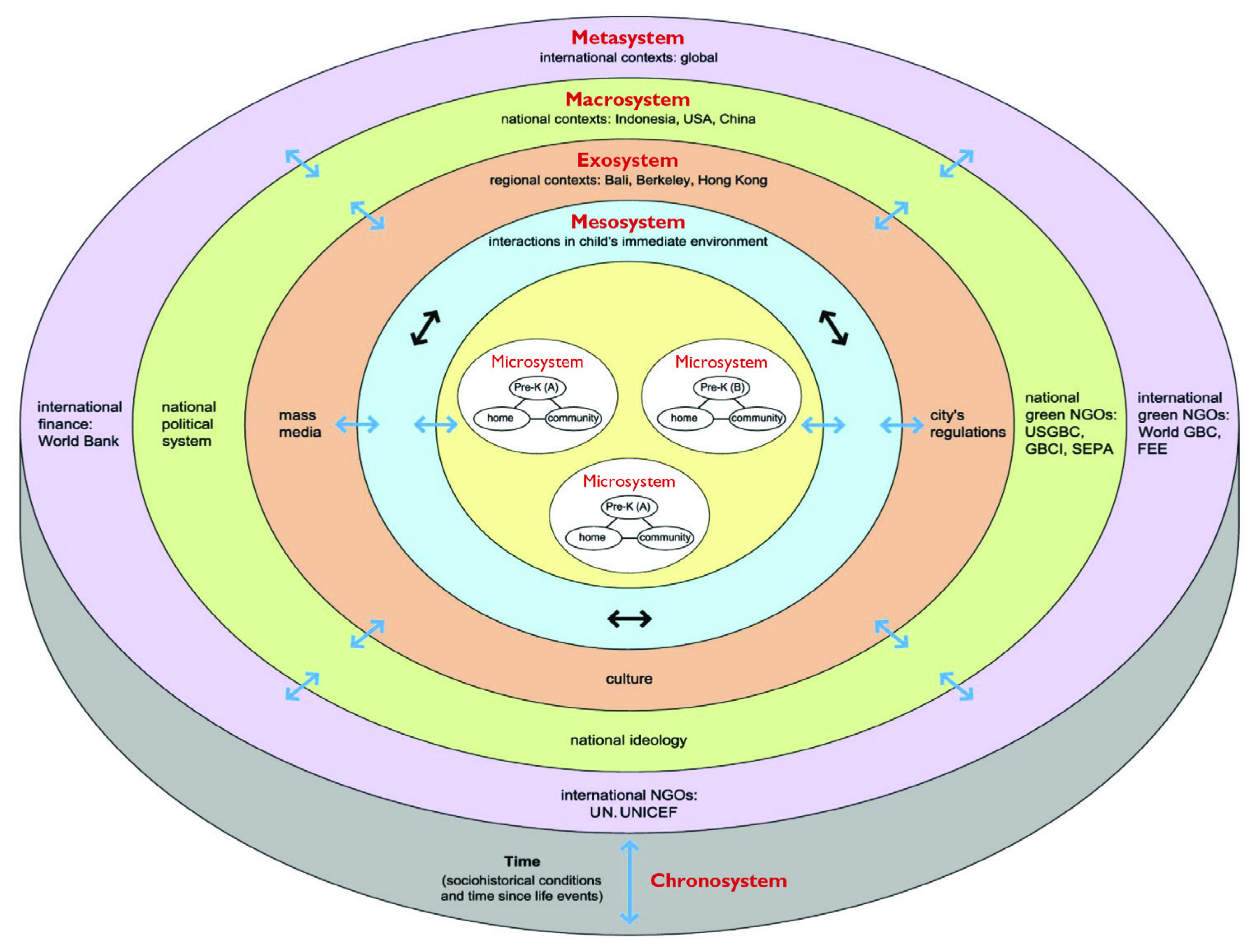
The exposure of children in the three preschools were different because of their varying family socio-economic and cultural backgrounds. The working and living places of parents from Preschool A were unique. During data collection, it was observed that several mothers raised their children alone in Bali, while the fathers worked in distant regions, such as in Jakarta and Singapore, apparently only coming back on the weekends to see their family. The majority of children in Preschool A came from other countries rather than being locally born.
Children in Preschool B came to school using different forms of private and public transportation, although most parents took their children to school by bicycle in an effort to be environmentally conscious. Hong Kong is known to be a compact, efficient and densely populated city, and children in Preschool C typically had a shorter commute to school, making it convenient for them to use public transport; only a few parents would drive to school. Clearly, the families’ homes and parents’ working places created an interesting dynamic that contributed to richer cultural exposure for children in Preschool A, in comparison with children in Preschool B and Preschool C.
At the exosystem level, the mass media played a huge role in promoting the significance of ‘green’ awards in these three cultures. Preschool A received international media coverage for being the first Greenest School on Earth in 2012 after being nominated for the award by the Cable News Network (CNN) from the United States and journalists from other countries. Furthermore, the awarding institution, the USGBC, is not only more influential than the ECC-HK and other existing international green institutions, it is also more progressively focused on expansion, as shown by its creation of the Global Coalition for Green Schools in 2013. This media attention and the progressiveness of the USGBC enhanced the prestige of the Green School Award that Preschool A received. This did not occur for Preschool B and Preschool C, both of which received some local media coverage but were not acknowledged internationally.
At the macrosystem level, as discussed earlier, the three Green School Movements in Indonesia (Green School Bali, GBCI), the United States (the USGBC) and China (the SEPA) are influenced by the culture, sociopolitical environment, economy and laws of their respective nations. An expansion to the fourth level of Bronfenbrenner’s framework, a metasystem, is needed to contextualize the level of influence by international NGOs, such as the World GBC, FEE and OMEP, each of which have recently reoriented their focus towards sustainable development.
Limitations
Researching a recently new and progressive movement such as the Green School requires a lot of time, effort and financial resources. Given the novelty of the Green School research, particularly in the context of ECE, we encountered difficulty in finding award-winning preschool participants due to the scarcity of such school selection in 2012. The schools in this study have received awards from two different institutions; Preschool A and B received their awards from the USGBC, and Preschool C received its award from the ECC-HK. We also need to acknowledge that ERS-SDEC is a new scale and has not received a proper validation, while the Simplified LEED is a modification of the original one.
Conclusion
Characteristics of Green Schools can be categorized in three aspects: (a) holistic approach where the building construction and teaching curriculum embrace sustainable solutions (e.g., Preschool A in Bali); (b) building approach where only the building construction follows green building guidelines (e.g., Preschool B in Berkeley) and (c) curriculum approach where the lesson plans, pedagogical approach and nearly all activities centre on environmental awareness (e.g., Preschool C in Hong Kong). The significance of this study arises from its interdisciplinary approach to assess the characteristics of Green School exemplified by the use of the Simplified LEED scale for the building aspect and the ERS-SDEC for the curriculum aspect. While the assessment for Green Building can be considered to be comprehensive and well-developed even after we simplified the LEED scale, the ERS-SDEC has not been widely utilized. The ERS-SDEC has limited categories that prevented SPSS from generating a coefficient alpha for more in-depth analysis. This situation can be considered to be an opportunity for educators to further develop a scale that can assess green curriculum not only for the early years but also for K-12 education. The present research also put forward a 35-year timeline to highlight the key players in the Green School Movement. Our data analysis indicates that a holistic Green School approach is superior in comparison with the Green School that only looks at the ‘green’ building or curriculum aspects. Preschool A in Bali serves as a model of the Green School with a holistic approach which successfully provides a rich and stimulating learning environment for students. Their approach can be replicated for future Green Schools’ establishment. A post-occupancy review for existing Green Schools is deemed to be important to evaluate its effectiveness in promoting environmental sustainability through the construction of green building and/or the implementation of a green curriculum. We predict that the Green School field will continue to evolve and expand in different ways, given the multidisciplinary nature of this field and the growing interest of our global society to be environmentally conscious. We hope this research will stimulate further dialogue between the two disciplines for future collaboration to innovate and further develop a Green School model that will benefit child development not only in theory but also, most importantly, in practice. Future research can observe how different green institutions intersect and even possibly collaborate or compete with one another in spreading the idea of Green Schools.
Declaration of Conflicting Interests
The author(s) declared no potential conflicts of interest with respect to the research, authorship and/or publication of this article.
Funding
The author(s) disclosed receipt of the following financial support for the research, authorship, and/or publication of this article: Scholarship from the University of Hong Kong enabled this research to be conducted, and Mr Susanto Iwan and Mrs Suzy Wirawaty partially financially assisted this research.
Footnotes
Acknowledgements
The authors would like to thank Professor Stephen S. Y. Lau and Dr Li Hui, the first author’s co-supervisors for their insights; participants from all the three award-winning Green Preschools in Bali, Berkeley and Hong Kong for their active participations and professional volunteers for their assistance in data collection.