




Abstract
The focus of this article is on the evaluation and outcomes of a professional learning opportunity that focused on 13 current K–12 public school science educators in the United States. This teacher training concentrated on sustainability education that utilized marine sciences as a unifying concept. Findings from this training helped to identify models within teacher professional development in marine science that lead to comprehensive adoption of presented curricula. Four established models/frameworks of professional development were identified and their subsequent classroom implementation was evaluated. Results include adoption rates of the various session materials, the impact and effect size of differing variables (such as deliverables or standards alignment) among the four models and their frameworks and changes in perceptions towards sustainability initiatives. These outcomes underscore several methods and strategies for successful science teacher professional development implementation in regard to marine sciences.
Overview
Academic work involving the assessment of ocean literacy has focused not only on content knowledge involving the seven core principles but also on environmental attitudes and dispositions. Cudaback (2006), Kolstø (2001), Schroedinger et al. (2005) and Zeidler and Keefer (2003) have all presented findings and outcomes that support that ocean literacy is a socio-scientific issue. That is, it requires both an understanding of scientific principles and a worldview with respect to stewardship to be ‘ocean literate’. Teachers’ professional development evaluated within this article reflects this socio-scientific approach. Sustainability is linked with environmental stewardship, and both focus on the wise use of resources and best practices to conserve and preserve our natural environments. The ocean is a big part of this environment. Within the teacher training, we utilized the four basic principles of Education for Sustainability (EfS) and a method to teach about stewardship and environmental concern. Marine science and the ocean served as the central theme to teach about EfS as the teacher participants were from coastal regions and the related classroom content would have a minimum geographic relevance to students. Table 1 details the four elements of EfS and how ocean literacy and marine science were incorporated in the teacher training and subsequent student lessons and activities.
Integration of Education for Sustainability and Ocean Literacy Standards

The format of the professional development sessions included several workshops and field experiences associated within four broad themes of sustainability, environmental integrity, economic prosperity and social equity with respect to the ocean ecosystem and marine sciences. In summation, the theme of ‘sustainability’ focused on school-setting initiatives involving water use, waste management and carbon production and their potential impacts on marine ecosystems. The theme of ‘environmental integrity’ looked at pollution/environmental damage prevention and remediation of anthropogenic influences on the marine environment. the topic of ‘economic prosperity’ focused on balancing the needs of businesses, the economy and personal and recreational utilization and their potential impact on the health of the marine environment. Lastly, ‘social equity’ investigated the phenomenon of the ‘tragedy of the commons’ and effective environmental management practices to mitigate human need and consumption of limited resources such as fisheries and natural resource exploration. Teachers were immersed in training that elucidated broad perspectives on the environment from informal environmental educators, business leaders, environmental scientists and professionals in academia.
The overarching goal with respect to project evaluation was to identify models within the science teacher professional development in marine science that lead to comprehensive adoption of presented curricula. The four differing themes of sustainability produced four differing and established models/frameworks of professional development and therefore their subsequent classroom implementation and impact could be assessed and compared. Specific findings reveal differences in curriculum adoption rates of the various session materials and the impact and effect size of differing variables among the frameworks. These outcomes will underscore several methods and strategies for successful science teacher professional development implementation in regard to marine sciences.
Perspectives
Environmental conditions affect everyone, and an informed public is essential to establish sound environmental policy and stimulate environmental improvement. Vital components in developing positive perceptions of the environment include adequate levels of environmental knowledge and stewardship. Environmental education and sustainability initiatives occur on many levels but are rarely rigorously assessed for impact.
Teachers are viewed as both subjects and agents of change. They have their own theories of education, including environmental education, that shape their pedagogical decision-making and exhibit their understanding of the practical and conceptual constraints on their work (Stevenson, 2007). Many environmental advocates view the solution to addressing the absence of environmental education in schools as convincing teachers of its importance (Stevenson, 2007). The problem environmental advocates face is persuading teachers to weigh different areas of concern differently as they make moment-by-moment instructional decisions (Hart, 1993). In short, teachers’ professional development needs to demonstrate when and where their message fits and to reduce as many barriers as possible that may impede adoption. This, among other issues, divulges why environmental education has continued to be marginalized and not taken up widely in schools (Dillon & Teamey, 2002; Gough, 1997). In addition, the scarcity and sporadic quality of environmental education practices suggest that we are still learning how to create meaningful and effective environmental education in school settings (González-Gaudiano, 2006; House, 1995).
This paper presents two aspects that can move sustainability education forward with respect to integration into formal K–12 settings. The first aspect is the pre- and post-assessment of teacher knowledge and attitude towards environmental issues. This provides for a more prescriptive meaningful training. The second aspect is the utilization of professional development models that address the issues presented previously by Stevenson et al.
Relevant Research Literature
Importance of Ocean Literacy
Less than 0.05 per cent of the ocean floor has been mapped to a level of detail useful to scientists, and the global map of the ocean floor is admittedly less detailed than maps of Mars, the Moon or Venus (Copley, 2014). We are now reaching a state where we need to establish new marine-protected areas within the US Exclusive Economic Zone for conservation purposes in order to preserve biodiversity from human abuses. In addition, one of every six jobs in the United States is marine related, which demonstrates how little is known about something of vital importance to our economy and long-term fiscal well-being (Sullivan et al., 2005). Similarly, an ocean-literate person understands the fundamental concepts about ocean science, can communicate about the ocean in a meaningful way and is able to make informed and responsible decisions regarding the ocean and its resources (COSEE, 2005). Both the US Ocean Commission and Pew Oceans Commission in 2003 suggested that it is essential to provide the general public with understandable information about the structure and functioning of coastal and marine ecosystems. The call for ocean literacy is far reaching because all regions of the country contribute to the deteriorating conditions on our coasts and oceans (Pew Oceans Commission, 2003). In addition, over half of the U.S. population resides in coastal states, and it is imperative to enhance the levels of knowledge evident among these communities that directly affect coastal ecosystems (Pew Oceans Commission, 2003). To meet these demands, a new wave of marine and ocean scientists is needed to continue ground-breaking research but they also need to be versed in communicating the significance of their findings to broader audiences that include teachers, students and the general public.
Exacerbating the issues of an uninformed citizenry with respect to marine science is the fact that the ocean is a relatively unimportant topic in general K–12 classrooms. If there are few explicit standards that focus on the ocean and related maritime topics, there is little impetus for teachers to undertake professional development or integrate ocean-themed curricula within their practices. A short time ago, a consortium that includes the National Oceanic and Atmospheric Administration, Sea Grant, National Geographic and the Centre for Ocean Sciences Education Excellence developed a framework for ocean literacy, which outlines vital concepts and themes for teachers and students to learn about the ocean. Nonetheless, even with this resource, teachers still have to take personal initiative to integrate these concepts into their practice. Moreover, the recent release of the Next Generation Science Standards still fails to adequately address the importance of marine science and related ocean education concepts.
Connecting Ocean Literacy with Environmental Education and Sustainability
Historically, much of the focus in environmental education has been terrestrial in nature. Education dealing with the environment became persistent after the 1962 publication of Silent Spring (Carson, 1962), commonly identified as the event that triggered the environmental movement of the 1960s and 1970s. This movement spurred environmental education initiatives such as Project Learning Tree, which began in 1976 and has reached over 675,000 teachers. In comparison, the ocean literacy initiative came to fruition in 2009, and even though the National Oceanic and Atmospheric Administration has always had directives to engage in education activities, it was not until 2007 that it received an agency-wide mandate for education. Undeniably, terrestrial-based education initiatives have had a 30-year jumpstart with respect to outreach and professional development with respect to teachers and the general public. Going forward, it is important that environmental education equally focuses on both land- and marine-based initiatives, as they are intertwined and dually important with respect to environmental health and integrity.
Professional Development
The concept of professional development (PD), of which both the teacher and student initiatives fall under, has been widely researched. Effective science educator PD has been shown to enhance inquiry-based teaching practice and foster an investigative classroom culture (Supovitz & Turner, 2000) and in some instances subsequent student achievement (Huffman et al., 2010). However, an important aspect of PD is its structure. A 2001 study by Garet et al. suggests that core features of PD that significantly affect learning consist of the form of the activity, collective participation of teachers from the grade or subject and the duration of the activity. Likewise, utilizing federal, state and local dollars, school districts on average spend $10,000.00 per teacher for PD, and with 3.1 million teachers nationwide, annual expenditures for teacher PD tops 30 billion dollars (Jacob & McGovern, 2015). However, various evaluation studies have found that only three out of 10 teachers improved their performance with respect to implementing PD as evidenced by several performance factors (Jacob & McGovern, 2015). Regardless, teacher PD is viewed as a worthwhile cause with respect to teaching quality and student achievement and engagement and is on average funded at an adequate level. Like any education initiative, there is room for improvement in the delivery and implementation of teacher training and the best practices from research should be utilized to improve the efficiency and quality of teacher PD initiatives that are inclusive of environmental and marine science.
Programme Format
This teacher PD initiative that focused on sustainability in the marine sciences and coastal ecosystem occurred over five days in the summer of 2013. First, a call for proposals went out across the southeast United States and the state of Georgia marine and environmental education communities. This competitive mini-grant opportunity sought proposals for four distinct teacher workshops that focused on one of the four separate themes of ‘EfS’ while incorporating an ocean or marine science subject or issue. Workshops were required to teach formal content, incorporate a field-based trip or experience and present curricula that could be integrated within a K–12 classroom. Teachers were immersed in training that elucidated broad perspectives on the environment from business leaders, environmental scientists and professionals in academia. General activities associated with the four overarching themes of EfS included a building audit based on LEED and ISO 14001 certifications, green chemistry, balancing business profit and the environment, the impact of sea-level rise and human development on sea turtles and sustainable school yards. All perspectives had the overarching premise that a healthy economy can coexist with a pristine environment. Each of the workshops had a school-related activity or project to utilize in the traditional secondary science classroom. In all, the four chosen workshops focused on the following:
‘Sustainability’ focused on school-setting initiatives involving water use, waste management and carbon production and their potential impacts to marine ecosystems ‘Environmental integrity’ looked at pollution/environmental damage prevention and remediation of anthropogenic influences on the marine environment ‘Economic prosperity’ focused on balancing the needs of the economy and personal and recreational utilization of marine resources and their potential impact on the environment ‘Social equity’ investigated the ‘tragedy of the commons’ and highlighted management practices to mitigate overconsumption of marine resources such as fisheries
A fifth and final workshop reviewed ways to incorporate presented curricula and activities into school-based settings. In total, 13 area teachers were selected to participate in the training; they were presented a stipend of $750.00 for their participation and willingness to incorporate a variety of projects within their classrooms. A condition of the stipend was the granting of permission to follow up with each teacher to evaluate the effectiveness and impact of the learning opportunity.
Evaluation Goals and Metrics
The overarching goal of the PD initiative was twofold. First, the project intended to identify models within science teacher PD in marine science that lead to comprehensive adoption of presented curricula. To achieve this, the four varying, yet, established models of PD in EfS and their subsequent classroom implementation were evaluated. Metrics included teacher curriculum adoption rates of the various session materials and the impact and effect size of differing variables among the workshops (such as deliverables or standards alignment). These outcomes underscored several methods and strategies for successful science teacher PD implementation in regard to marine sciences.
The second goal focused on the growth of knowledge and attitude towards concepts of sustainability and environmental education. Participants were given a pre-test, post-test and assessed on their knowledge and attitude towards basic principles of sustainability. This assessment was modified from a 2009 study conducted by Michalos et al., titled ‘Measuring Knowledge, Attitudes and Behaviours towards Sustainable Development’. Provided the explicit directive that the workshops connect ocean and marine science to principles of sustainability, one could contend that the outcomes from this modified measure can indirectly provide insight as to the participant’s growth in ocean stewardship and literacy. In short, it indicates that environmental advocacy and concern are not solely tied to terrestrial based initiatives.
Outcomes
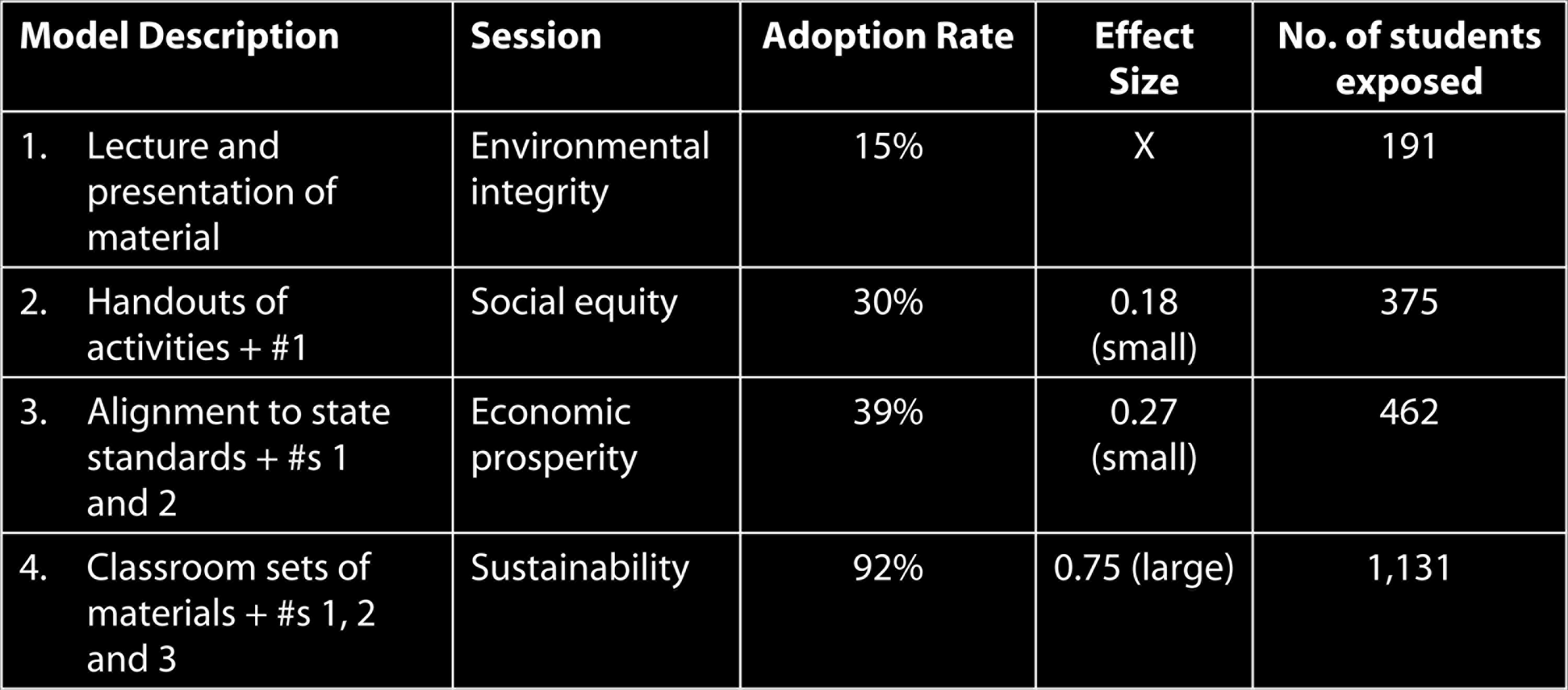
In evaluating the programme outcomes, there were four general themes associated with sustainability and marine science, and each theme was presented on a different day with varying presenters. However, the differences that emerge from each session offer a unique evaluative measure of PD. A unique materialization from the PD was that sessions expanded upon what was provided from prior offerings. Each session had basic presentations of their materials, but others added additional elements such as handouts, alignment to standards and classroom sets of materials. All had varying impact on the subsequent adoption of the presented content and curricula. In addition, we are able to calculate the effect size of adding a specific element to a PD offering. In the end, the primary goal of most PD is the successful and effective adoption of the presented intervention. Table 2 depicts four models that emerged from the initiative and the subsequent rate of adoption, the effect size of PD variables and the number of students subsequently impacted in the public K–12 classrooms of the participating teachers.
Rate of Adoption and the Effect Size of Differing Professional Development Workshop Variables
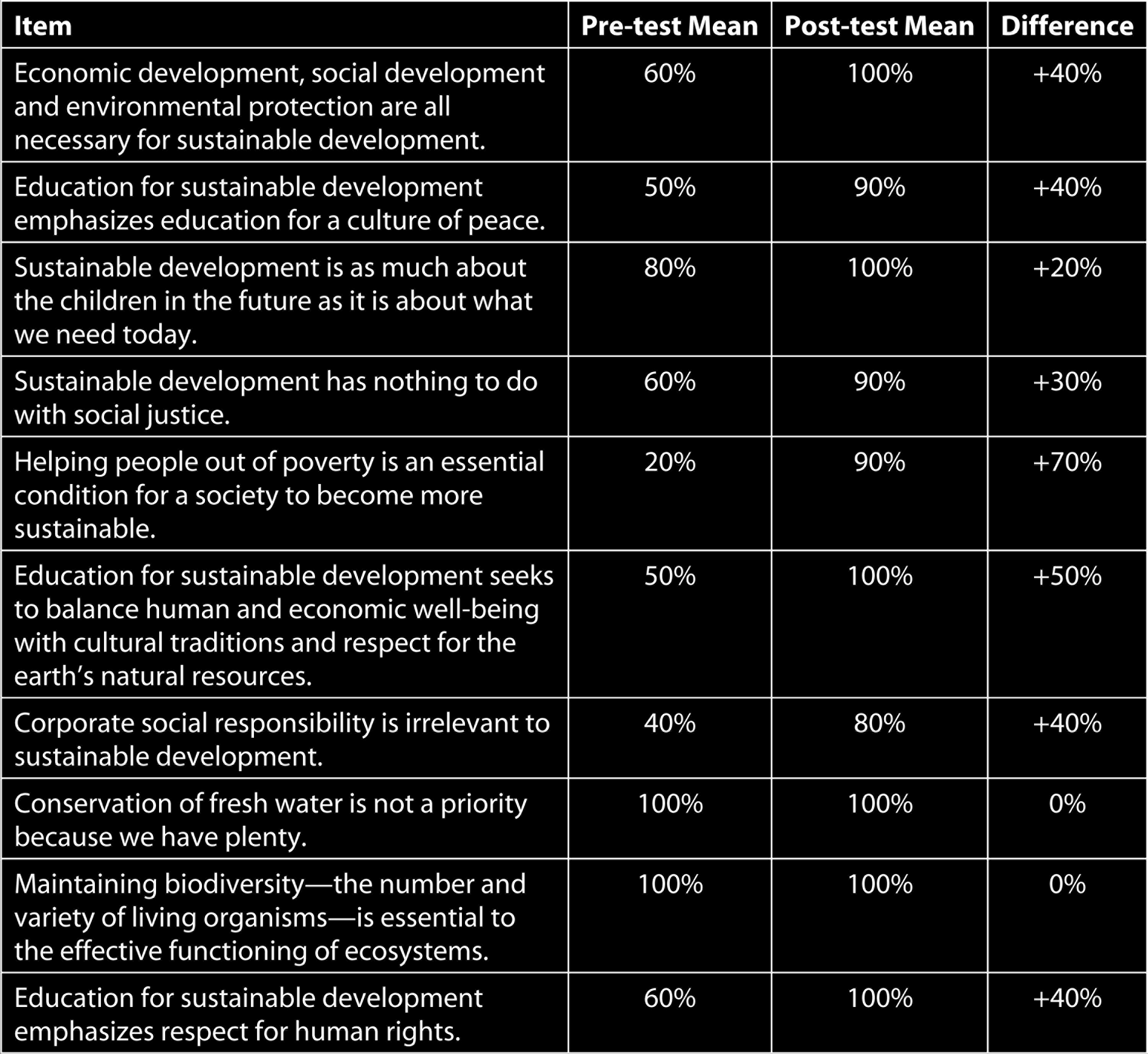
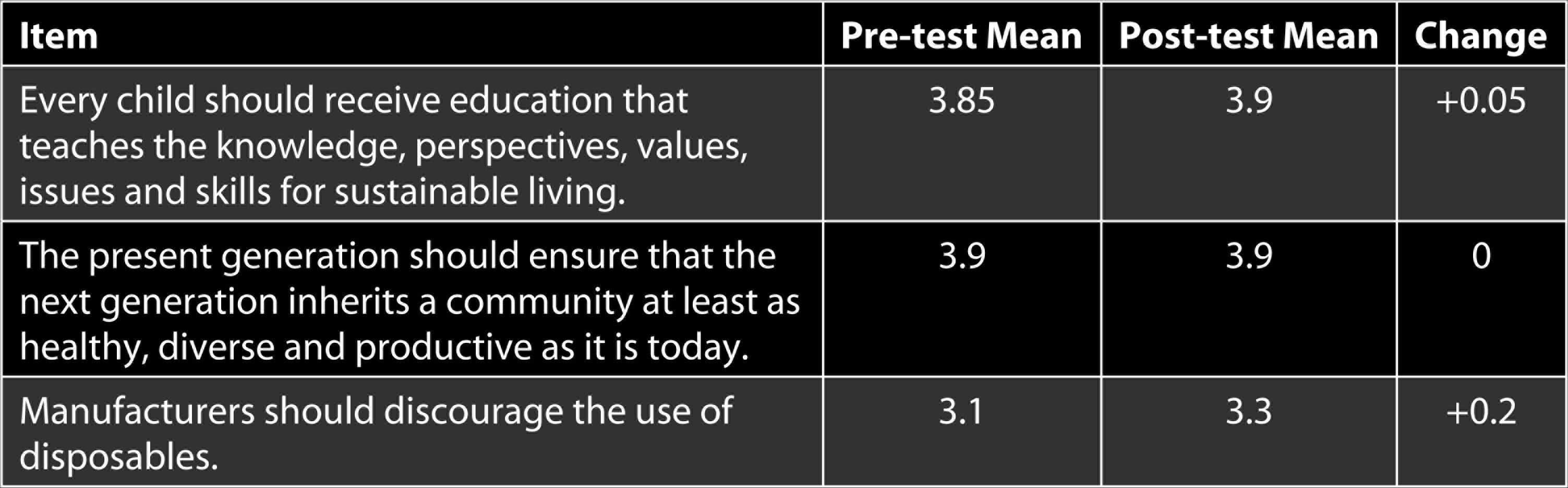
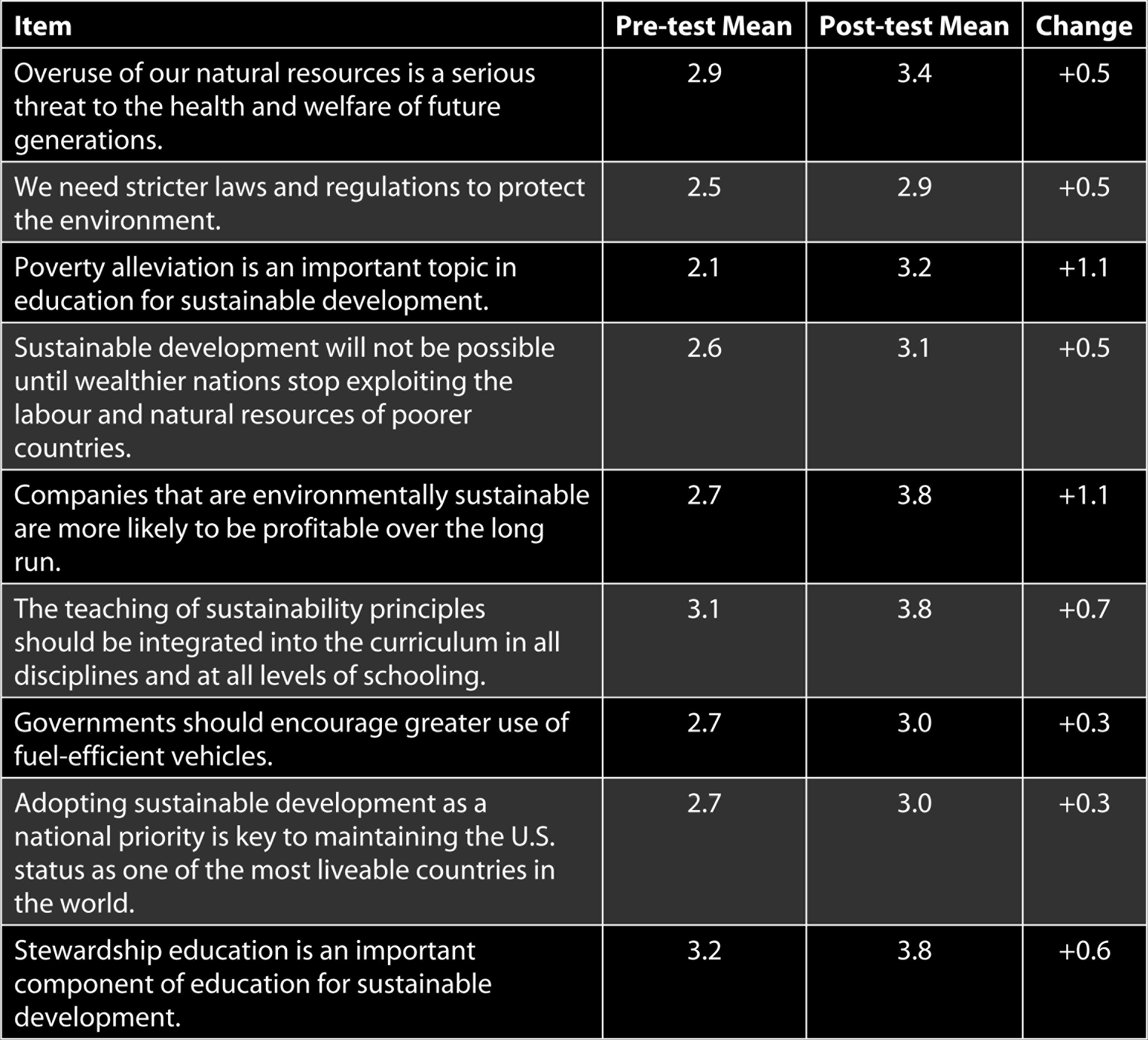
A second outcome associated with this project involved the impact of the teacher training on the participant’s knowledge and attitude towards sustainability and associated practices. Growth of knowledge can be determined by comparing the differences from the pre-test and post-test means and can generally be attributed to the participation of the training initiative. Table 3 presents the assessment questions associated with the assessment of sustainability knowledge and depicts the calculated group means. Table 4 depicts group means on attitudes towards sustainable development and percent change from pre- to post-assessment.
Pre and Post-test Results of Content Knowledge of Sustainability
Participant Attitude towards Principles of Sustainable Development
Conclusions
Generally, professional learning initiatives and training have a poor rate of adoption unless mandated by the school or principal. The fact that the EfS in the marine sciences programme had a range of adoption of practice rate from 15to 92 per cent (depending on session) with an average of 46 per cent is impressive in and of itself. Teachers demonstrated a commitment to the values and practices shared during the summer teaching institute. Students of the participating teachers have benefited from having educators who have brought project-based initiatives to the classroom along with real-world application and problem solving. Each of the workshops that culminated in the four distinct PD models is reviewed below and relevant statistics, features and takeaways are also reviewed. Overall, marine educators should be able to compare features of their respective outreach and education initiatives, particularly those that focus on teacher training and envision reforms that could improve dissemination of their curricula and/or organizational message.
The first workshop focused on preventing pollution and environmental damage to marine environments and sought to highlight means of remediation due to anthropogenic influences. Specifically, sea-level rise, point and non-point source pollution and shoreline erosion were examined. To link these elements, their collective impact on turtle nesting and the future health of that species was explored during a field visit to a rapidly changing barrier island. A part of the field experiences had teachers participate in a turtle nest relocation due to the volatile location of the original nest caused by potential erosion and coastal flooding. This workshop was probably the most engaging to the teachers; however, out of the four it had the weakest connection to the classroom. As denoted in Table 2, presenters from this learning opportunity merely presented content in a lecture-based format during the training initiative and allowed participation in the field experience, which was a unique practice in an exclusive location. There was a lot of ‘cachet’ with respect to the topic and teachers gained an invaluable experience and poignant content knowledge. However, with respect to the goal of taking this message to the classroom, this workshop fell short. For example, in follow-up visits and evaluations with teachers, two of the 13 participants (15 per cent) stated that they utilized content, examples or curricula associated with this particular training. Those that did not adopt the curricula cited a weak connection to applicable standards and a lack of necessary resources or materials. These features will play out as to their impact on the other models/workshops. Nonetheless, this training initiative served as a baseline to determine the effect size of particular variables in teacher training. Going forward, the impact of providing copies of lesson plans and content, linking outreach materials to state or national standards and providing classroom sets of materials can be determined. Provided the low adoption rate of the classroom curricula from this particular workshop, the power of teacher training is exposed. With only two middle school teachers utilizing the training, these presenters were still able to spread their message to almost 200 students.
The second workshop emphasized social equity and focused on the phenomenon of the ‘tragedy of the commons’ and effective environmental management practices to mitigate human consumption and pollution that impacts the ocean. The ocean was construed as the preeminent ‘common’ area for the world. This session applied environmental management practices, policies and frameworks to elucidate Garrett Hardin’s premise of ‘mutual coercion that is mutually agreed upon’. First, the presenters demonstrated environmental management through the design and audit processes associated with the ‘Green Building’ initiative known as ‘LEED’. This helped demonstrate the reduction of resource consumption and long-term benefits to society, the economy and the environment. To provide an ocean perspective, the presenters shared a classroom activity associated with overfishing. Utilizing candy to represent fish, this lesson demonstrated total population loss at the onset, and then with a management approach, students were able to sustain populations over a longer term. This workshop differed slightly from the first model in that it provided copies of the lesson plans and activities (both energy audit and overfishing) to incorporate into the classroom. In follow-up visits and evaluations with teachers, four of the 13 participants (30 per cent) stated that they utilized content, examples or curricula associated with this particular training. Those who did not adopt the curricula cited a weak connection to applicable content standards. However, it can be determined that the utilization of copies and handouts of materials in addition to standard presentations provides a small measurable impact as indicated by effect size of 0.18 in the adoption of curricula. In addition, the number of students exposed to the outreach effort almost doubled from 191 to 375, respectively.
The third workshop underscored the principles of ‘economic prosperity’, which viewed the ocean as an ‘untapped’ resource for energy, natural resources and medicine. The session focused on balancing the needs of businesses, the economy and personal and recreational utilization and their potential impact to the health of the marine environment. Learning opportunities utilized a scenario-based cooperative learning exercise that integrated the De Bono Group’s ‘Six Thinking Hats’ activity within a context associated with offshore drilling for oil exploration. The group was able to experience differing perspectives associated with the development of environmental policy and the varying belief systems of stakeholders. This workshop differed from the first two models in that it provided a presentation of the material, copies of the lesson plans and activities to incorporate into the classroom that were linked to state and national science standards. In follow-up visits and evaluations with teachers, five of the 13 participants (39 per cent) stated that they utilized content, examples or curricula associated with this particular training. Those who did not adopt the curricula cited a lack of physical materials and time. However, it can be determined that the linkage to standards in addition to the utilization of copies and handouts of materials and standard presentations provides a modest impact as indicated by effect size of 0.27 (which is a jump of 0.09 from the previous model) in the adoption of curricula. Lastly, the number of students exposed to the outreach effort increased to 462.
The last and final teacher training session focused on the broad concept of sustainability. This workshop emphasized school-setting initiatives involving water use and monitoring, waste management, and carbon production and their potential impacts on marine ecosystems. Demonstrations highlighted classroom and personal actions and their potential benefit to marine ecosystems. Activities included water quality monitoring, studying the impact of drought on estuaries and utilizing native and sustainable landscapes to migrate human impact on watersheds. This workshop differed from the first three models in that it provided a presentation of the material, copies of the lesson plans and activities to incorporate into the classroom that were linked to state and national science standards and provided classroom sets of materials and resources to incorporate the curricula in school settings. In all, each teacher was provided with classroom sets of water quality monitoring kits, a rain barrel and a gift certificate for the purchase of native plants and landscapes. In follow-up visits and evaluations with teachers, 12 of the 13 participants (92 per cent) stated that they utilized content, examples or curricula associated with this particular training which included the creation of native pollinator gardens, the utilization of rain barrels at school or home and the incorporation of a water-quality monitoring project. The inclusion of sets of classroom materials in addition to the utilization of copies and handouts of materials that are linked to state standards in conjunction with content presentations provides a large impact as indicated by the effect size of 0.75 (which is a jump of 0.5 from the previous model) in the adoption of curricula. Lastly, the number of students exposed to the outreach effort increased to 1,131, respectively.
In examining the findings with respect to the second goal of determining growth of knowledge and attitude towards concepts of sustainability and environmental education, the pre- and post-assessment results showed an overall growth in content knowledge. Those items that showed little to no growth were easy for the majority of science teachers to answer and address. Concepts that teachers had a general lack of knowledge in was the role of poverty in environmental integrity and the role of businesses and corporations in building sustainable communities. Lastly, a general misconception held by the group was the concept of economic development as an ingredient in sustainable development. When probed further, most teachers viewed economics (business) and the environment as competing interests and that the two really could not coexist.
Recommendations and Implications for Practice
Based on the evaluation findings, an initial recommendation for organizations and individuals that offer teacher PD, especially in the sciences (environmental and marine), is to try and incorporate more ‘turn-key’ curriculum options. The term ‘turn-key’ insinuates that a teacher can simply employ the activities or curriculum without much outside help or resources. The session with the highest rate of adoption of activities was ‘sustainability’ that had a specific focus on water conservation. In that session, teachers were provided with classroom sets of water-quality monitoring kits, gift certificates for native plants and a completed rain barrel. Given the materials and the wherewithal, few excuses existed for the teachers not to utilize sustainable landscaping at school. In addition, comments from the evaluation demonstrated that teachers sought to utilize the concepts but lacked the materials to do so in some sessions. For example, in the ‘social equity’ session and with specific reference to the energy audit exercise, teachers who did not enact this activity stated that they would have found it useful to have access to a classroom set of ‘Kill-a-Watt’ metres. Many successful curricular initiatives, such as ‘Project Learning Tree’, ‘Project Lead the Way’ and ‘FOSS’ scientific kits, utilize this turn-key approach. That is, lesson plans and activities are already developed and aligned to standards and are provided in either digital or print format. In addition, these initiatives offer classroom kits of materials that are either provided or are available to purchase in addition to the initial training. As cited earlier, these programmes have been highly successful in ‘infiltrating’ the K–12 PD market. If any ocean literacy or marine science–based curricular initiative is to be successful, it should reflect the successes found in this evaluation and mimic the strengths demonstrated in prior science education training, be it of an environmental, engineering or inquiry focus.
A second recommendation to consider for marine science professionals is to revisit and examine education and outreach budgets. With reference to this particular project, several sessions could have been more successful by focusing more of their budget towards materials and resources compared with expenditures for personnel or events. With respect to this specific teacher training initiative, each session and respective presenters were provided an equal budget to expend; however, they could spend that dollar amount in any quantity on personnel, materials and field excursions. The most successful session in terms of utilizing and adopting curricula expended a greater amount of resources with respect to materials for the participants. It should be noted that the most popular session had the highest expenditures on field excursions but also had the lowest rate of curriculum incorporation. In all, those involved in education and outreach initiatives with respect to teacher PD should consider focusing on the ‘depth’ of some mission-specific concepts compared with presenting a breadth of curricula that spans many disciplines. In short, it could be beneficial to some organizations or individuals that are engaged in ocean literacy or marine science outreach to audit or conduct a cost–benefit analysis of their current initiatives and efforts to broaden the impact of their message.
Findings from this evaluation should be of use for marine science organizations in considering priorities for outreach and education. These entities would be well served to examine the respective mission and goals for message dissemination. For example, if a marine science–focused organization was truly committed to establishing an ocean-literate society and influencing the content knowledge, attitudes and behaviours associated with that initiative, it would be well served to evaluate their current methods and strategies for outreach and education. Most organizations have three basic methods for outreach that consist of general public engagement, teacher training and direct K–12 classroom outreach. Engagement with the general public typically involves short-term (think 10–15 minute) discussions at large gatherings (i.e. festivals) or speaking engagements for civic groups that detail the mission and goals of that particular organization or initiative. In comparison, teacher training often looks like many of the workshops presented in this chapter. That is, trainings typically involve one or several days of workshops that preview classroom activities or disseminate content knowledge about the mission and goals of that particular organization or initiative. In contrast, direct K–12 classroom outreach consists of informal educators visiting schools and executing an activity or a field trip experience to the organization. Each of these methods has merit, and it is not a recommendation to eliminate any of the modes of outreach and education. However, the principal finding from this evaluation is that marine science–based PD that integrates elements of a ‘turn-key’ curriculum has a much higher probability in reaching intended secondary (indirect) audiences and enacting real change with respect to knowledge and stewardship. If organizations are serious about spreading their messages to teachers, school children and even the general public (via parents), the data above with respect to ‘essential variables’ of PD are a necessary component to reach students in their classrooms. Over a 20-year career of a teacher, the number of students that would be influenced if 92 per cent of participants implement a training compared with 15 per cent is in the thousands, and hence organizations would have greater efficiency of their outreach and communication. Furthermore, many studies on student motivation, attitudes and belief system development and future career preference have often cited that middle and early high school is where those particular attributes are formed and solidified (Durlak et al., 2011). In closing, a final recommendation to organizations involved in marine and ocean education is to review their current education and outreach programmes and evaluate the initiatives based on their ability to meet the broader goals of the particular institute. The opportunity for self-study may provide insights as to where fiscal resources would be better directed and what programming can be reformed. In the end, depending on the overall institutional message and goals, some organizations may find it beneficial to condense their programme offerings, offer more intensive and resource-rich training and invest more intensely in youth and teacher programming to influence future citizens and policy makers.
Footnotes
Declaration of Conflicting Interests
The author declared no potential conflicts of interest with respect to the research, authorship and/or publication of this article.
Funding
The author received no financial support for the research, authorship and/or publication of this article.