



Abstract
The knowledge content of university-level introductory sustainability courses elicits emotional reactions by students that are novel within the typical classroom context. Common negative reactions include ‘sadness’, ‘worry’, ‘guilt’ and ‘disgust’, while more positive responses include ‘feeling angry’, ‘empowered’, ‘like trying to make a difference’ or ‘having raised awareness’. These emotions are indexical of a deeper social epistemic collision between historically established social identities, including behavioural scripts consistent with, and generative of, unsustainability on the one hand, and a growing collective awareness of the consequent unsustainability that threatens students’ future well-being on the other. The authors argue that introductory sustainability courses set up the potential for not only a learned eco-anxiety, but also an ontological adjustment. That adjustment might bring student, historical inheritance and environment from a state of living in a suffering, but still separate, world to a practice of becoming with a world into which we extend and that also extends into us. Therefore, it is arguably important for instructors to be aware of the possibility of students getting into a negative state of eco-anxiety and for instructors to also have some tools for supporting a more positive ontological adjustment. We recommend that they become skilled in facilitating transformational learning by including some discussions about the ontology of self in any introductory sustainability instruction. Directing students’ attention to their own emotional responses can also be useful for grounding such classroom discussions and transformational learning.
Introduction
This article explores the characteristics, consequences and potentialities of emotional atmospheres arising within the context of introductory undergraduate courses in sustainability. The authors offer their interpretations of data collected in 2016 from a survey of students’ emotional reactions to an introductory undergraduate course on sustainability at a Canadian University. Our hypothesis that the course material elicits emotional reactions and feelings not well theorized by the conventional image many instructors have of the educational process (i.e., theories based on metaphors such as filling empty containers with knowledge) is tested and evaluated. Our findings support the conclusion that when confronted with new sustainability knowledge, issues and dilemmas, as typically presented in the first-year sustainability courses, the students’ experience is not simply one of mastering neutral data, theories, models and so on. Rather, when students encounter introductory sustainability curricula, a process of negotiation is initiated to accommodate and integrate pre-existing cultural identities with the suddenly self-contradictory new knowledge they confront in the classroom lectures and course materials.
Literature Review
Sustainability courses push the limits of contemporary Cartesian-dualist, globalized and neoliberal social identities from both epistemological and ontological perspectives (Graham, 2020; Graham & Arshad-Ayaz, 2016; Hinchliffe, 2007; Hoffmeyer, 2008; Keeney, 1983; Reiber, 1989). As students approach the limits of their internalized autobiographical narratives, the stories used to stitch themselves into the world in meaningful ways, the confrontation between that pre-existing internalized image of the right way to live and the sudden knowledge of the consequences of living that way, something has got to give. Sustainability courses can be experienced as a disorienting dilemma triggering ontological adjustment and/or an induced form of eco-anxiety, where understandings of who we are and what our world is become open to transformation. That opening does not generally last very long. When first confronted with sustainability knowledge, either students’ behaviour, attitudes and values change or they do not. Even if there is a transformation in the students’ behaviours, attitudes and values, it is difficult to maintain the change without a corresponding change in the mundane cultural tools and mediational means, both conceptual as well as material tools and artefacts, of unsustainability (Boivin, 2008; Malafouris, 2013; Wertsch, 1998). If routine practices and corresponding mediational means do change, then students’ identities can be transformed to some extent. If students’ cultural/cognitive tools and routine practices do not change, then students still need to find ways to suppress or accommodate the new knowledge while maintaining a consistently unsustainable identity, which includes maintaining the same cultural/cognitive tool set and the same routine practices of unsustainability. What determines the amount of potential change, even when sustainability course content is conceptualized by instructor and students as black-boxed, abstract knowledge, is essentially the flexibility of the students’ historical inheritance. Very brittle cultural tool sets imply less potential for social change. When flexibility is embedded in the cultural identity constituting tool set, then there is greater potential for transformative change (Boyd, 2018; Cranton, 2016; Mezirow, 2000). However, it is clear that transformative change is rarely engaged and administered with the goal of the type of epistemological and ontological paradigm shift envisaged by the authors of this article. We are not talking about a transformation from one knowledge to another per se but, rather about shifting the situatedness of students, that is, a change in their mediational means and thus relations with everything, including their ‘self’. This kind of shifting involves much more than ‘knowledge’. We need to find and make available new mediational means that get beyond the caveats and loopholes such as, for example, market failure, creative destruction, tragedy of the commons, infinite substitutability or sustainable growth that are often enlisted to maintain the status quo in the face of contradictory evidence as represented in the curricula of sustainability courses. We also need to reimagine what the ‘things’ that we engage with in our collective becoming with the world are. We hope that a better understanding of the transitory emotional experiences we found in our survey may provide insights into broader opportunities for social and cultural transformations in the direction of sustainability.
Methodological Considerations
There are inevitably problems with trying to produce knowledge from survey questions about respondents’ subjective experience. For one thing, Western science traditions have generally led us to be sceptical of such seemingly ephemeral evidence as one’s emotions. We tend to prefer examination results in black and white on paper or as retrievable and on-demand digital data or, perhaps even better, brain scans where we can see what is really going on in the brain (and supposed mind). Yet, there are good reasons why asking students about their feelings and emotional reactions to course content should not be dismissed so lightly. There are good reasons why we should be paying attention to such forms of evidence in classrooms generally, but especially when it comes to teaching courses about sustainability.
It is not possible for students to respond to such surveys of their emotional responses except as thoroughly pre-constituted sociocultural persons (see, e.g., Popkewitz, 2018). The cultural/cognitive tools we routinely employ to give structure, tone, texture, rhythm and vibrancy to our thoughts and feelings are always already formulated, both implicitly and subconsciously as well as more consciously and deliberatively, in alignment with our specific historical inheritance. The tools available to us for the sociocultural construction of our identities are those available to us in our immediate environment, including the languages, frames, metaphors, myths, conventional wisdoms, as well as the materiality close at hand providing us with perceptual, cognitive and emotional tools such as carpentered buildings, paved roads, tables, tableware, computers and air conditioners.
When we refer to the structure of those tools, we mean the basic categories that our historical inheritance supplies us with to sort the various elements of our world into. The way we carve the world into pieces gives us, as well as our world (because our image of the world guides our actions with it), a specific structure, much like a bedrock of limestone results in a different ecological structure than a bedrock of granite. At a certain stage of cognitive development, for example, we learn not to put wasps or earwigs in our mouths and not to fall or jump from high places. Watching television situates us in the world in a different way than spending time playing the piano or wading barefoot in a swamp, or learning how to dissect frogs in a classroom would. We come to know the world differently through our daily practice with the world in each case. This process of coming to know the world by the establishment of categories, such as safe or not safe, delicious or vomit inducing and so on, provides us with a basic template to guide our continuing development with the world throughout our lives. The basic structure of our cultural identity, our operating categories, is perhaps the characteristic least influenced by our cultural historical inheritance. It is also the most foundational for determining the level of (un)sustainability, generally a characteristic of any given cultural inheritance.
We use the word tone to describe the way our perception, cogitation and emotional practice become directed actions. If our development occurs in a carpentered environment, for example, our perception becomes susceptible to the distortion of the Müller–Lyer illusion (Hundert, 1995). Our perception is directed by the experience of carpentered buildings to perceive the world in a three-dimensional way that makes us misperceive the two-dimensional lines of the illusion. If our psychological and mental development occurs in a culture where shoe wearing is prescribed and enforced, then specific parts of our brains that receive perceptual input through our feet atrophy, leading to corresponding changes in perceptual capacity and perceptual distortions, just as the Müller–Lyer illusion similarly lead our vision astray. Likewise, language provides a specific experience of the world by at least partially foreclosing the possibility of other alternative ways of experiencing the world (Bateson, 1989). That direction received from the cultural environment ultimately situates us, for example, as being entangled with an empathetic and lively world or, alternatively, as being on top of an inert and infinitely passive tabula rasa. The texture of our cultural identity comes partly from the ways in which the world has already been culturally structured, the way cultural knowledge are already distributed across material artefacts and shared practices. The reflexive aspect of the extended mind, its texture, describes the way the material cultural world invades and extends into our individual and social minds, mainly through routine material engagements with things such as plastic straws, antibiotic soaps, mowed lawns, screen devices or box-like classrooms (Upitis, 2010). These material artefacts transmit tacit knowledge through implicit learning and peripheral participation.
The rhythm of identity emerges from the tempo of cultural life as it emerges from those routine material engagements. How much emphasis is placed on punctuality, or moving through the stages of life on time? How are schedules imposed on students? How are the rules enforced? Who (or what) sets the pace? Does the temporal experience of life influence ones’ capacity for attention, empathy, distraction, and so on? The vibrancy of ones’ cultural identity comes down primarily to an ontological question. Is the world believed to be and practised as an inert container (Weiss, 1995) or does one’s sense of self extend outward and merge with an essentially lively and vibrant world (Abram, 2010; Bennet, 2010)?
The cultural tools we acquire, and which in turn acquire us, work reflexively to co-constitute persons and societies with the specific behaviours, attitudes, values and emotional repertoires that come to characterize specific social groups and social identities. It is important then to bear in mind that our survey interrogates a culture as much as it interrogates individual students and that the sociocultural aspect of identity also makes our subject—the student’s experience of sustainability knowledge-less fluid, changeable or ephemeral as a constitutive aspect of the students’ identity, whether individual or collective.
Our findings, therefore, should be considered at least slightly more durable and thus more valid than generally acknowledged, as anyone who has undergone a significant paradigm shift or cultural immersion process could confirm. Cultural identities are not generally surrendered without some level of discomfort and resistance. We tend to carry and continue to practice the bulk of whatever cultural tool set we are acquired by throughout our entire lives. Transformative paradigm shifts are difficult (Kuhn, 1962). They entail a considerable level of discomfort and disorientation as our identities undergo constitutive adjustments and realignments. Our goal here is to understand whether the knowledge presented in the context of a sustainability course would be sufficient to trigger enough of that discomfort and disorientation to overcome the normal resistance one would expect from a direct, but mostly implicit, de-legitimization of the established practices, artefacts, and habits of mind that characterize the students’ pre-existing unsustainability identities.
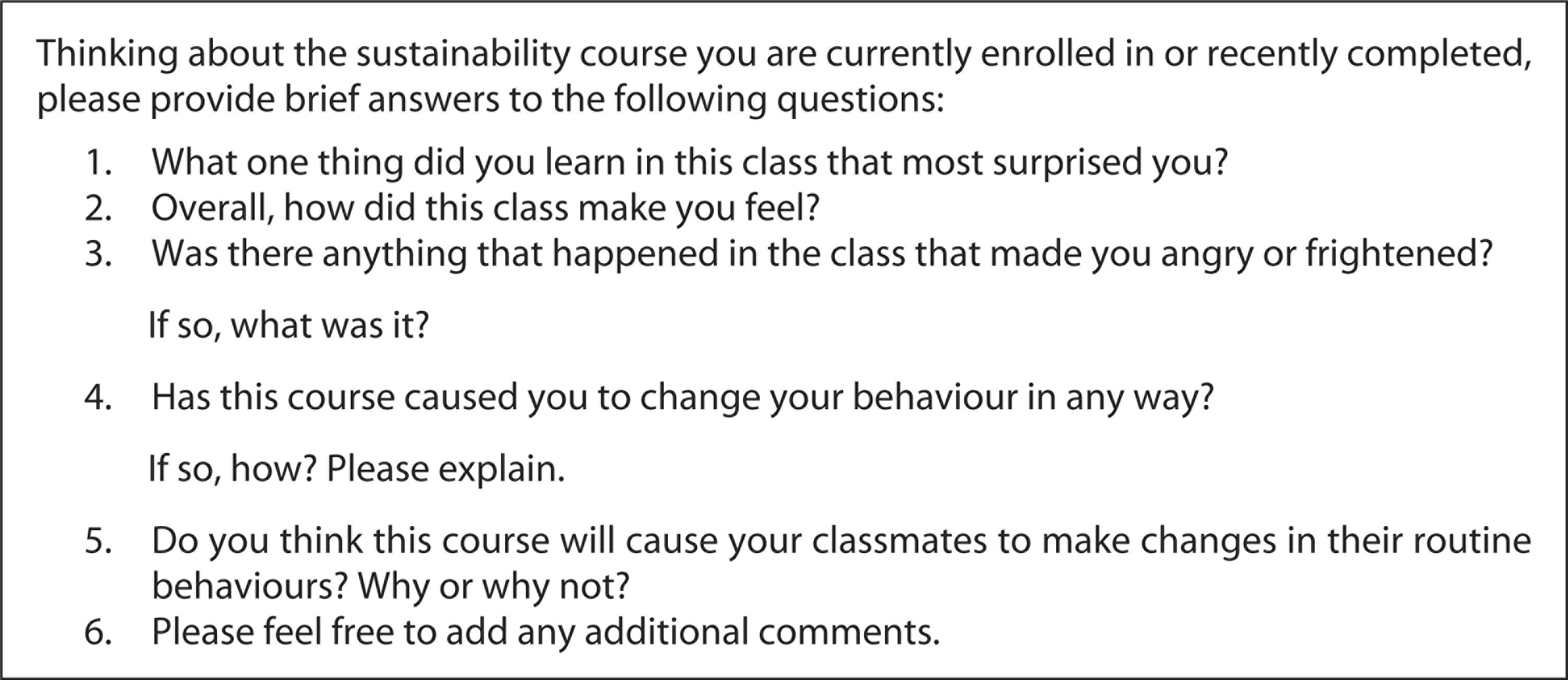
The research reported here received ethical clearance from the General Research Ethics Board of Queen’s University. Instructors of an introductory course in sustainability advised their students during class time of the research project and asked them to watch for and access the short survey (see Figure 1) through a link on the course website. Once the course was completed, participants were invited to fill out a self-report survey that was administered through the online form. Responses were anonymous. The six open-ended questions were designed to invite reflection and self-interrogation. Some of the scaffolding implicit in these questions would have been at least slightly familiar to students, based on their participation in the course. For example, the idea that it would be normal to be surprised when confronting novel (sustainability) information, or any course material for that matter, is consistent with the idea that learning transforms the student from novice to expert through a process of new knowledge acquisition and mastery. Other aspects would probably be less familiar and less comprehensible, such as questions specifically about the respondent’s feelings or emotions in relation to the course curriculum. We sometimes, in Cartesian fashion, make the mistake of holding an image of education and learning as activities divorced and separate from emotions. Of course, nothing could be farther from the truth as learning would be infinitely complicated in the absence of emotions, as is sometimes unfortunately demonstrated with specific types of brain injuries that impair the victims’ capacity for emotion (Damasio, 2005; Hundert, 1995).
The results of the analysis of the surveys are described under two broad experiential themes: the emotional impact of the study of sustainability in the classroom and the presence of eco-anxiety.
Introductory university courses about sustainability always entail something that is more than the simple mastery of a prescribed curriculum. Courses that introduce sustainability are different, in other words, from the usual types of courses first year students normally encounter at university. Certainly, there are facts to learn in sustainability courses. There are theories, working hypotheses and data to be encountered, reflected upon, digested and regurgitated on examinations or expounded upon in term papers. But then, there is still something more involved in sustainability courses, something that makes them qualitatively different. That difference shows up in how sustainability courses are normally experienced by students and instructors alike. The experience of introductory courses in sustainability generally includes, we argue, an element of distress that goes well beyond the normal tension students experience when navigating an externally imposed learning process with built-in deadlines and achievement standards.
That experience is also different, at least in part, because of what is absent. In sustainability courses, there is a missing thing, a very obviously and very troublingly missing thing. That missing something is not exactly like the missing cure for cancer or the missing original ‘true’ meaning of the cave paintings at Lascaux either. Certainly, there are many university courses about topics and knowledge that have not been entirely settled and, in fact, almost any academic endeavour or research programme, when studied long enough, reveals at least the dimensions of what remains inevitably unknown and likely unknowable. The known unknowns of any academic discipline that emerge in this way are still not the same as the surprises students routinely encounter in introductory sustainability courses can sometimes etch into the student’s psyche. Sustainability courses can be a bit like a course on the lemmings’ occasional practice of mass suicide or studying some whales’ unfortunate habit of entire pods beaching themselves, except that on the final page of the textbook it is revealed, without any explanation whatsoever, that the course is not about lemmings or whales, or bees, birds, or salamanders at all. Sustainability is, of course, about people, humans, homo sapiens, or is it homo economicus? or homo faber? And that is precisely the point—sustainability courses entail an implicitly forced realization of a heretofore unperceived, yet extremely profound, self-ignorance.
Sustainability courses thrust a sort of mirror into our faces with which we confront not only an unrecognizably monstrous, but somehow also a sympathy inducing, seemingly helpless, if somewhat pathetically overconfident, creature. Yet sustainability courses generally offer no ointment or crème, no prescription drug or shamanic practice to tame and transform the monstrous and troubling image in the mirror back into the persons we previously perceived ourselves to be. This is, again, the tension between the part of ourselves constituted by our historical inheritance and the implicit realization of the need to reject and re-constitute that same part of our self.
The tension of that missing thing, underscored by the experience of sustainability courses, can sometimes act like Mezirow’s disorienting dilemma (Mälkki, 2012). Sustainability courses raise the uncomfortable and implicit possibility that education may not be helping, but rather that education might in fact be diminishing the prospects of peoples for a materially stable and happy future. The content of sustainability courses tends to crash up against many dominant cultural narratives involving, for example, consumerism, progress, scientific knowledge and so on. These narratives as well as other even more (and less) concrete sociocultural tools are always primary aspects of what distinguishes us as who we are. The emotional aspect of sustainability courses arises partly from the glimpse offered of who we might become in a better-tooled (sustainable) world while at the same time confronting a previously unknown, or at least an unexamined, aspect of the self (whether individual or collective).
Arguably, it is precisely this encounter with the unrecognizable self that triggers the emotional reaction students expressed in our survey (see Table 1). Of course, not all students allow themselves to take a close look. Many shut their eyes, but still they implicitly know the ugly reflection in the mirror, whether seen and engaged with or not. In their reactions to various environmental issues, the modes in our data set include expressions such as sadness, disgust, guilt, helplessness and fear. Only when discussing the issue of energy resource use was the term optimism most used by students. This, in and of itself, is revealing as energy consumption is so thoroughly conflated with a very peculiar way of life (Huber, 2009) and is thus a particularly salient aspect of contemporary mainstream identity.
Initial Questionnaire: Emotions, Action Competence and Engagement by Issue
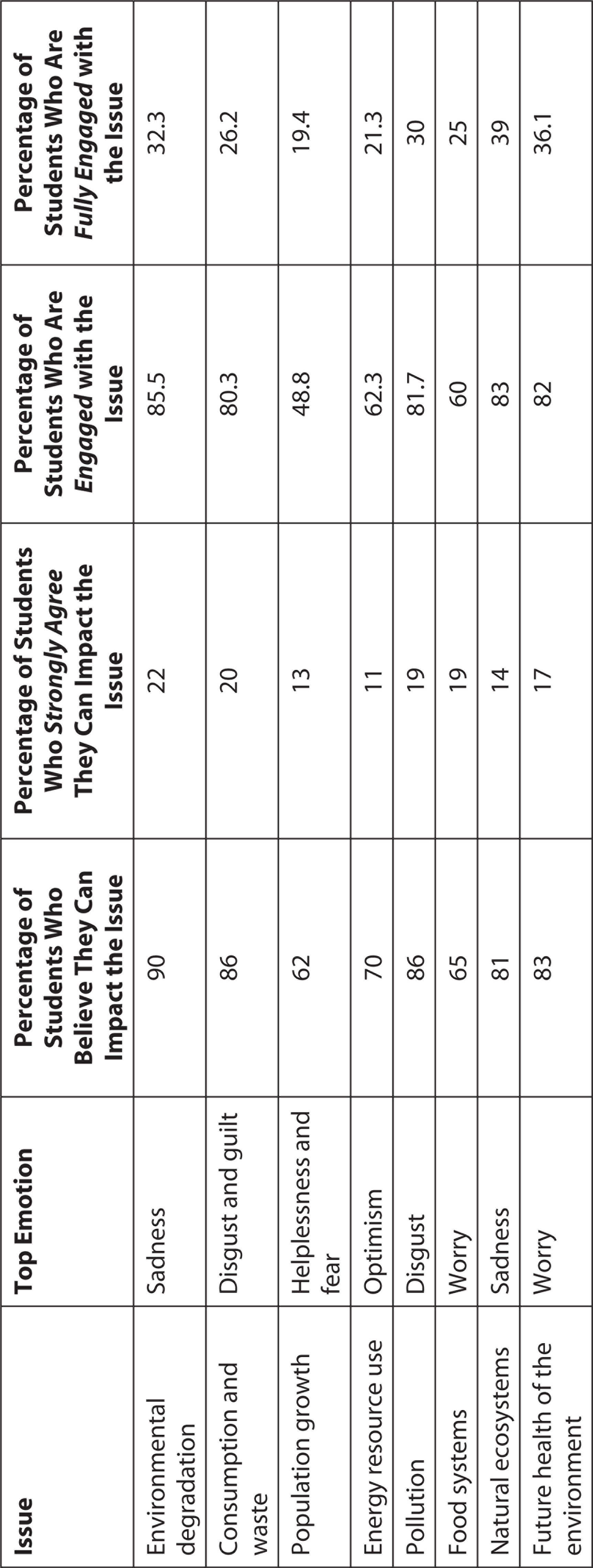
The data were examined individually by each of the authors of this article, with each researcher beginning by reading through the responses several times before initial group discussions took place (Creswell, 2002, 2005, 2008). Responses were coded by Environmental/Sustainability Issue corresponding to material covered in the course curriculum. Several types of responses were tabulated, from extremely negative, such as ‘disgust’ to somewhat positive, for example, ‘optimism’.
The students’ emotional reactions were multi-faceted, often encompassing several conflicting emotions simultaneously—dichotomies such as fear and hope, frustration and passion, stress and happiness. As one respondent put it, ‘this class made me a little scared and anxious for what the future will hold, but it also makes me hopeful as there are so many young people like myself that are taking initiative…[to] make the world a better place’. These layered, nuanced emotional responses demonstrate the complexity of sustainability issues, namely, that there are highlights and pitfalls of learning about the environment that are experienced concurrently. Many students expressed their desire to learn and develop forms of resistance to ‘failures of our time and failures to come’, while others felt overwhelmed at the ‘impossible obstacles to overcome’. This also speaks to the internalization of these narratives about environmental change; students feel like they are responsible for solving these large-scale, inherited issues. In fact, this brings up another interesting theme in the dataset: students felt like they were not necessarily responsible for initiating the world’s environmental issues but felt disproportionately responsible for ‘solving’ these problems.
People often equate environmentalism with deprivation. Changes toward sustainability will necessarily involve an economic system with a much lower level of material throughput but, identity is generally tightly coupled with consumerist expressions. Personal responsibility is then often overestimated as no level of individual austerity can be realistically expected to achieve a societal level of sustainability. Nevertheless, many respondents expressed a kind of nihilistic attitude; ‘problems are too big to change’, ‘change is not convenient—some will change [their behaviours], others won’t’, ‘ignorance is bliss…even if they know the information, it still may not be enough to make them actually desire to change’. As mirrored in the literature, attitude does not necessarily dictate behaviour, and real changes can be hard to sustain—this is a tenet that students grappled with, as they felt inspired to change their own behaviours but distrustful of others taking similar responsibility for large-scale environmental change. This brings up another theme of looking at temporary changes versus long-term change: ‘I think the larger importance is the systemic and political change and this is where the focus of my environmentalism will come from’, or ‘this course was a lot of common sense. But when I look at my friends and their routines, I don’t think they realize how much impact their actions have, and how easy it is to change them’. If nothing else, the data reveal that students engaged with the course material, even when the material was challenging or inspired feelings of fear and eco-anxiety.
What is eco-anxiety? The potential disorienting dilemma in the classrooms of sustainability courses emerges from and merges with what has been termed ‘eco-anxiety’ (Gifford & Gifford, 2016, p. 292). Let us begin our discussion of eco-anxiety with the more general concept of anxiety: ‘Anxiety is generally used to describe an unpleasant emotional state that is experienced in anticipation of some uncertain risk, threat, or danger’ (Cossman, 2013, p. 893). The current state of unsustainability thus makes anxiety the correct answer in sustainability course classrooms. There is much research suggesting that our society is, in fact, responding appropriately with rising levels of anxiety as sustainability knowledge slowly leaks out from the copyrighted knowledge of the academy to challenge the conventional wisdoms of the broader society. There are also new related sources of anxiety associated with technological change, globalization and the removal of social safety nets according to the dictates of the neoliberal ideology (see, e.g., Geiselberger, 2017; Turkle, 2011; Wild, 2013). Anxiety is on the rise and marketing that responds to and magnifies anxiety is also becoming more prevalent. This is a trend, and a potential positive feedback loop educators would be well advised not to ignore.
What then of eco-anxiety? ‘Eco-anxiety is characterized by severe and debilitating worry about risks that may be insignificant and is not associated with the more proactive behaviour associated with habitual ecological worrying’ (Gifford & Gifford, 2016, p. 292). Eco-anxiety is, although possibly appropriate, not productive and something that should not be induced by the educational process, whether deliberately or incidentally. Many who have been teaching over the past several years will have anecdotal evidence of rising anxiety in their classrooms, regardless of the subject matter. It may be impossible to disentangle the various stressors and distill the impact caused by unsustainability alone from other factors such as the political, socioeconomic or technological. These other factors can be expected to only compound the anxiety caused by global climate change and other environmental and ecological concerns.
As we saw above, introductory sustainability courses raise troubling questions for students, and especially for younger students. As the ecological/climate crisis gathers momentum, it is becoming increasingly clear to younger generations that they will pay an unquantifiable but growing price for the (in)actions of previous generations. This intergenerational injustice raises the potential for the experience of ‘relative deprivation’ (RD). Smith and Pettigrew’s (2015) definition is the following: ‘RD: the judgment that one or one’s group is worse off compared to some standard accompanied by feelings of anger and resentment’ (p. 1). Even our primate relatives, such as chimpanzees or bonobos, react negatively to perceived injustices. The deprivation associated with increasing unsustainability might not seem to be relative but rather environmental collapse is often considered to be only too universal. This is mainly because environment is experienced within Western cultures as the container that holds everyone. Perhaps by re-framing sustainability as intergenerational or interregional or interspecies injustice students, it might be expected to develop a group awareness that might trigger more political action aimed at bringing about broad social change. The work of Greta Thunberg is one remarkable example of how this might be done. By making the case that future generations are being deprived of the potential future that past generations have taken for granted, Thunberg frames the issue as a clear case of profound injustice.
It should not come as a surprise if students’ recognition of intergeneration injustice implicit in sustainability curricula adds to the emotional stress in the classroom. There is, however, one relevant difference between students in sustainability courses experiencing RD and our primate relatives: the students’ capacity for abstract thought. Students are, ceteris paribus, more able to consider previous generations through the lens of their sociocultural historical inheritance. The public understanding of the issue depends upon the dominant frames and other cognitive tools used to interpret it. Based on the dominant cultural tool kit, previous generations are still misperceived as helping benefactors: parents, teachers, care givers, guides, sources of wisdom and knowledge and mentors. The descriptors implied from sustainability curricula such as oppressor, future destroyer or narcissist thus generally fail to stick by failing to overcome the normal psychological development that occur in normal parent–child dyadic relations, although this, too, seems to be changing (Turkle, 2011; Wild, 2013).
There is also the open question of who is really to blame for unsustainability. This ambiguity is evidenced in the uncertainty students exhibit about whether the problem should be addressed by me or us. Some students responded from the perspective of I or me, while other students perceived the problem as concerning the collective us or we. This brings us to the ontological problem of unsustainability. We are, after all, born into a world of unsustainability. It is what we come to know from birth. It is tacitly embedded in such mundane objects as the plastic toys we play with or the car seats that parents routinely strap their babies in from the moment that they leave the hospital.
Discussion
We now explore several overarching themes that arise from the experiences of the student respondents, beginning with the notion of ontological adjustment. Next, we discuss notions of sustainability and self, and close with a discussion of the implications for instructors of introductory courses on sustainability.
Ontological adjustment refers to a paradigm shift in our understandings of what things are and consequently in our experience of reality. Our psychological development occurs in a world that is practised as a container, a tabula rasa, to be rightly modified according to human ideas and imagination. We are acquired by this type of sociocultural world from birth. It takes us over through our peripheral participation in habits of unsustainability carried out with the artefacts of unsustainability (Graham & Arshad-Ayaz, 2016).
Historical examples of ontological change would include the genesis of the market economic system emerging from and enabled by the Enclosures and when the widespread social practice of land and people as mere economic commodities began, or the end of the Inquisition, when women healers began to be practised as witches, albeit never recovering their previous ontological status as leaders, healers and sages. Similar changes are currently underway as gay people, previously thought to contain an internal defect, are increasingly included within the category of normal.
These are examples of changes (ontological adjustments) of what people are, and not simply the labels we use to identify them. The change is a relational change. The land might be transformed from a mere commodity to an active constituent of one’s self through a change in our practised relations with the land combined with a new understanding of those practices, for example. The land does not simply acquire a new label; it becomes something different by putting it into a different shared practice. It has different ecological capacities and constraints within the new relational regime. This kind of ontological transformation might also one day become possible for students of sustainability courses.
Sustainability and Self
A paradox operates within introductory courses on sustainability. On the one hand, unsustainability can be theorized as emerging from and maintained by an inherited affective repertoire that tends towards a collective will to mastery over nature. Our educational system is complicit in the maintenance of a collectively practised ontology that situates us in opposition to brute nature. That affective tendency is transmitted from one generation to the next through formal education as well as in the forms of mastered and mastering mediational means, peripheral participation, normal scaffolding and other human developmental processes through routine cultural practices. These are indexical of humanity’s inevitable entanglements with mythic metanarratives, myth’s enactment in ritual and materialization in artefact. On the other hand, knowledge of accelerating unsustainability is very likely to exacerbate and reinforce that same cultural tendency towards an affectively stabilized compulsion for control. As environment responds to Western knowledge with increasing environmental problems (e.g., plastic pollution and species extinctions), the prescribed reaction is more Western knowledge and bigger problems triggering more collective trauma, and so on, continuously cycling through widening positive feedback loops.
The emotions students experience in introductory sustainable courses may provide the road map to the exit from that spiralling dead end of unsustainability. Consider, for example, what kinds of emotions you might experience if your life had been spent in a sensory deprivation tank. Where would your emotions come from if you were sealed off from the world? Our perceptual, cognitive and emotional development can only occur in relation to a lively and meaningful world. Children in Ceausescu’s Romanian orphanages demonstrated that after 1982, just as children in Trump’s concentration camps can be expected to confirm in research that will undoubtedly be conducted over the coming months and years.
Unsustainability comes from forgetting or overlooking this deep entanglement we have with the world. That forgetting is sometimes even embedded in the normal university curriculum. When we become lost in the abstractions of mathematics, or disinterested in the biology laboratory, or the abstraction of supply–demand models, or even in the letters printed on the pages of our first school books and our doctoral theses, we risk losing sight of our essential entanglement with an animate world.
As is evident in the data, both positive and negative emotions are prevalent responses to the experience of sustainability curricula. Guidance in this regard is generally not part of the way we think about doing university level courses, so the courses can simply add to the already rising levels of social distress. When instructors guide students to become self-reflective about their emotional responses to the course content, the affordance of an ontological transformation might occur. There are no guarantees, but without awareness and willingness to engage students in such self-reflective exercises, exercises that underscore our visceral entanglement with the world, the course runs the risk of reinforcing the cultural tools of obfuscation, denial and unsustainability.
Students are at risk of constructing blind spots or alibis to justify inaction when faced with sustainability course materials. They might, for example, rationalize the problem with the constructed expectation that however bad it gets, they will be less affected (positive asymmetry) because they will be university educated, or because they live in a wealthy country. If, on the other hand, their own emotional reaction can be presented as evidence of an irreversible, reciprocal and complete investment with the world, then transformational change becomes more than possible.
Recommendations and Conclusion
Thus, it is not about forcefully pushing against the unpleasant emotions, as if deliberately taking students out of their comfort zone as a guided learning experience was simply good pedagogical practice. It is also not about mindlessly flowing with it to avoid dealing with the unpleasant issues. Rather it is about being there to mindfully recognize that it is entirely normal to experience unpleasant emotions when we, for example, become aware that a friend, a relative, or our entire world is in distress. In this way, we may move beyond the emotional reaction and reveal the underlying cultural assumptions our emotions push us to question in the first place. We are empathetic by nature. Our psychological development depends, from the start, on healthy empathetic relations with the world. When that empathy breaks down, it should not come as a surprise that we experience that breakdown emotionally. Instructors of sustainability courses have a responsibility to guide their students away from eco-anxiety towards an ontological transformation.
The rooted beings among us twist and flex in the invisible surge; other creatures are carried aloft by the whirling currents. The denser life of rock may seem impervious to those winds, yet the crevassed contours of the mountains have been carved over eons by the creativity of wind and weather, as those mountains now carve the wind in turn, coaxing spores out of the breeze and conjuring clouds out of the fathomless blue.
The wild mind of the planet blows through us all, ensconced as we are in this illusive medium. (Abram, 2010, p. 271)
Footnotes
Declaration of Conflicting Interests
The authors declared no potential conflicts of interest with respect to the research, authorship and/or publication of this article.
Funding
This research received financial support from Queen's University Centre for Teaching and Learning and from the Principal's Dream Course Grant program.