




Abstract
This article presents a practice-based case study of embedding sustainability within a Bachelor of Arts course through a hybrid ‘One-to-many/Many-to-one’ pedagogy. Sustainability was positioned both as a cross-cutting theme within majors and as a shared problem space for interdisciplinary dialogue. Drawing on a compulsory sustainability unit at a regional Australian university, we analysed student forums and reflective essays to examine two dimensions: how majors aligned their disciplinary practices with selected SDGs and how sustainability competencies emerged through reflective and experiential pedagogies. Distinctive disciplinary strengths were evident: some majors emphasized systems and anticipatory reasoning, others normative critique and cultural analysis, and still others strategic, creative or collaborative practices. Collectively, these complementary profiles enriched sustainability literacy. The study contributes by showing how arts courses advance sustainability education, by operationalizing competency-based proximity coding to map disciplinary strengths and by aligning SDG engagement with competency development as a transferable scaffold for curriculum design.
Keywords
Introduction
Universities are increasingly expected to prepare graduates who can act on complex sustainability challenges while retaining strong disciplinary expertise. Although sustainability education has expanded rapidly in STEM, its uptake across the arts—encompassing the humanities, social sciences and creative disciplines—remains uneven. Yet arts education brings distinctive capacities for ethical reasoning, narrative framing, cultural critique and attention to human–environment relations. These strengths suggest sustainability in the arts is best treated not as an add-on, but as a pedagogical foundation that couples disciplinary depth with interdisciplinary problem-solving.
Efforts to integrate sustainability into higher education often sit at two extremes. On one side, standalone sustainability units risk being treated as peripheral to core disciplinary inquiry. On the other, specialist sustainability programmes sit apart from the mainstream, restricting access for students outside these pathways. Arts courses face additional challenges: fragmented staff expertise and institutional structures that limit cross-disciplinary collaboration. However, the urgency of contemporary sustainability problems—social, cultural and political as much as scientific and technical—demands responses that extend beyond technical interventions. In this regard, the arts hold considerable though often under-recognized potential: their traditions of ethical deliberation, narrative persuasion and systemic critique make them important sites for cultivating sustainability thinking and leadership.
This article examines a Bachelor of Arts (BA) course at a regional Australian university that addresses these tensions through a compulsory sustainability unit. We investigate how sustainability can be meaningfully embedded in a multidisciplinary BA course while preserving disciplinary integrity and fostering interdisciplinary learning. To this end, we present a hybrid pedagogy, which we term One-to-many (sustainability → disciplines) and Many-to-one (disciplines → sustainability). The model positions sustainability as a cross-cutting theme within majors while also inviting majors to contribute their tools and perspectives to shared sustainability problem spaces. We analyse how course design balances disciplinary rigour with interdisciplinary engagement, how experiential and reflective pedagogies help students connect global imperatives to local contexts, and which sustainability competencies emerge across arts majors.
Our study demonstrates how course-level design can support sustainability integration in a BA course without eroding disciplinary identity. We therefore foreground not only pedagogy but also assessment and competency mapping, alongside institutional enablers and constraints. We present the embedding model for arts curricula that maintains disciplinary ownership while integrating sustainability. We also show how competency mapping can be used to capture discipline-specific strengths and differences across majors. Finally, we reflect on enabling conditions and barriers that may inform other institutions considering course-level integration.
The article proceeds as follows. The next section reviews the scholarship on sustainability in higher education, with particular attention to embedding sustainability education in arts curricula. It then introduces the case and hybrid pedagogy, outlining the unit design and its rationale. The methods used to assess learning outcomes are described next, followed by the results, which report both the alignment of individual majors with the SDGs and the patterns of sustainability competencies across majors. The article concludes with a discussion of implications for sustainability education, aiming to inform broader efforts to embed sustainability meaningfully within the arts.
Literature Review
The accelerating pace of global transformation has positioned sustainable development as a central priority for higher education. Universities are increasingly tasked with preparing graduates who possess not only disciplinary expertise but also the capacity to address complex sustainability challenges. While much attention has focused on STEM disciplines, where sustainability is often framed through technical and environmental lenses, the arts and humanities also hold significant potential to foster competencies such as critical thinking, ethical reasoning and narrative engagement. To situate this study, the review focuses on examining four areas: (a) strategies for embedding sustainability in higher education, (b) frameworks for embedding sustainability and assessing learning outcomes, (c) the opportunities and challenges of arts education as a site for sustainability learning and (d) the specific benefits and constraints of embedding sustainability within a BA course.
Embedding Sustainability in Higher Education
Sustainability has long been a concern in higher education, from the 1972 Stockholm Declaration and the Brundtland Report to the more recent adoption of the SDGs. In response, higher education institutions (HEIs) have pursued diverse strategies to integrate sustainability into curricula. One approach is the creation of dedicated sustainability programmes, for example, environmental studies and sustainability planning. These courses provide specialized expertise but attract only students who deliberately choose such pathways, limiting broader engagement (Robinson et al., 2022). An alternative is to embed sustainability across existing courses through cross- or multidisciplinary units, ensuring it is interwoven into diverse fields (Dmochowski et al., 2016). This approach fosters interdisciplinary engagement, critical thinking and systems-based problem-solving. However, even widely adopted units often remain siloed within environmental studies, constraining their wider impact (Hill & Wang, 2018).
Increasingly, HEIs have turned to SDGs as a curriculum framework. Franco et al. (2019) highlight that SDGs provide higher education with a globally recognized reference point for aligning teaching, research and institutional practice with urgent sustainability challenges. Kioupi and Voulvoulis (2019) extend this argument, presenting SDGs as end goals that can guide educational transformation when paired with competency-based learning. Their systems approach links visioning, enabling conditions, competencies and pedagogies in a back-casting model, offering universities a road map for reform. More recently, Adams et al. (2023) illustrate how universities are increasingly mapping courses and programmes to SDGs. This systemic approach grounds higher education curricula in global imperatives, enabling institutions to demonstrate alignment with the UN 2030 Agenda and to highlight interdependencies across ecological, social and economic domains. This trend is also evident in Australia: universities are increasingly aligning their strategies and operations with the SDGs, including the development of new sustainability-focused majors and units. The SDGs thus provide not just a shared language for curriculum innovation but also a systems perspective that links local educational contexts with global priorities.
Despite these advances, comprehensive integration remains difficult. Barriers include limited faculty awareness, inadequate resources, overcrowded curricula and misaligned institutional priorities (Abo-Khalil, 2024; Filho et al., 2017; Gale et al., 2015; Higgins & Thomas, 2016; Parry & Metzger, 2023). Addressing these challenges requires both curricular reform and institutional commitments to interdisciplinary teaching, sustainability governance and transdisciplinary engagement (Hunter et al., 2018; Sterling, 2004). While some universities, such as Portland State University, have pioneered institution-wide approaches, many continue to struggle with consistency and depth (Dmochowski et al., 2016; Natkin, 2018).
In Australia, initiatives have included master’s programmes in sustainability, standalone units, capstone projects and project-based learning (Sustainable Development Solutions Network (SDSN), 2017, 2020). Yet sustainability often remains a fragmented component rather than a mainstream principle (Higgins & Thomas, 2016). Embedding it more fully into pedagogical frameworks will require transformative approaches that position HEIs as drivers of sustainable development (Tilbury, 2011). To evaluate such strategies, scholars have increasingly drawn on competency frameworks as tools for assessing student learning outcomes.
Sustainability Competencies in Higher Education
Alongside SDGs, a major development in sustainability education has been the articulation of key competencies that equip graduates to address complex challenges. Whereas the SDGs define what higher education should contribute to, competencies define how graduates can act effectively in these contexts. Together, they form complementary frameworks: the SDGs anchor curricula in global priorities, while competencies provide a systematic lens for evaluating student learning.
Wiek et al. (2011) identify five widely recognized competencies for sustainability: systems thinking, anticipatory competence, normative competence, strategic competence and interpersonal competence. They argue that these competencies are mutually reinforcing, with systems thinking supporting anticipatory analysis, normative reasoning grounding decisions in ethics, and strategic and interpersonal capacities enabling collaboration and adaptability. Building on this foundation, Brundiers et al. (2020) introduce two further dimensions: intrapersonal competence, which encompasses self-awareness, reflexivity and adaptive learning, and implementation competence, which emphasizes the ability to translate sustainability knowledge into action. Wiek and Kay (2015) similarly highlight the interdependence of these competencies, showing how they combine to equip graduates with the capacity to respond effectively to complex sustainability challenges.
Kioupi and Voulvoulis (2019) extend this framework by proposing a systems-based model that explicitly links SDGs with competencies. Using backcasting and participatory visioning, they demonstrate how curricula can co-create a sustainability vision, identify enabling conditions, select relevant competencies, design pedagogies and monitor progress. Their approach underscores that SDGs and competencies function most effectively when treated as interdependent: SDGs define the goals, while competencies provide the means to achieve them. Nevertheless, operationalizing competencies across diverse disciplinary contexts remains challenging. Standardized approaches to integration risk undermining disciplinary diversity, while highly flexible approaches can result in inconsistency (Roy et al., 2020). In BA courses—where traditions range widely across the humanities, social sciences and creative arts—the framework raises persistent questions about how competencies manifest and how they can be assessed without eroding disciplinary integrity.
Embedding Sustainability in Arts Education
Over the past decade, sustainability education has expanded beyond the sciences and technical fields to include the humanities, social sciences and creative arts (National Academies of Sciences, Engineering, and Medicine, 2020). The interdisciplinary structure of BA courses positions them as promising vehicles for embedding sustainability, enabling students to interrogate the social, cultural and political dimensions of global challenges (Natkin, 2018). Such programmes cultivate competencies in critical thinking, ethical reasoning, creativity and cultural awareness—capacities that align strongly with both SDGs and competency frameworks.
Sherren (2008) identifies competencies crucial for sustainable development— critical thinking, empathy, creativity, independent inquiry and problem-solving—that resonate with humanist educational traditions, including Greene’s (1995) emphasis on understanding ‘the human condition’. These traditions position BA courses to advance sustainability learning in discipline-specific ways. For example, literature units can explore ecological narratives, history units can interrogate colonial legacies of inequality and visual arts subjects can translate sustainability themes into communicative forms. Linking such disciplinary approaches to selected SDGs provides a meaningful global anchor, while competency-based assessment enables the evaluation of how students develop transferable capacities such as systems thinking, anticipatory analysis and normative reasoning. Moreover, sustainability integration aligns with the broader mission of BA education, which emphasizes critical analysis, cultural awareness and ethical reasoning—attributes essential for preparing graduates to ‘participate in the defining issues of our times’ (Lagemann, 2003, p. 13).
Despite these opportunities, challenges remain. Many faculty lack sustainability training (Willats et al., 2018), disciplinary silos limit collaboration (Clark & Wallace, 2015), and institutional structures often resist reform. Integration is frequently inconsistent, risking overburdening staff and students without delivering transformative outcomes. Variability in disciplinary perspectives, and at times outright contradictions, can fragment student learning. Moreover, the absence of standardized assessment methods complicates evaluation and comparability across majors.
Contextualized integration—embedding sustainability themes within existing disciplinary frameworks—appears more effective than treating sustainability as an add-on subject (Hunter et al., 2018). When disciplinary strategies are explicitly linked to SDGs, they provide a meaningful global anchor; when assessed through competencies, they offer a mechanism for evaluating student outcomes. Without coordinated institutional support, however, such efforts risk remaining piecemeal and dependent on individual champions. To move beyond this, sustainability in arts education needs to be framed as both a structural scaffold, via the SDGs, situating disciplinary inquiry within global priorities, and a skills framework, via competencies, ensuring that students gain capacities to act on those priorities.
The Benefits and Challenges to Embed Sustainability in the Bachelor of Arts Course
Embedding sustainability into BA curricula is increasingly recognized as essential for preparing graduates to navigate challenges such as climate change, inequality, gender equality and political instability. BA courses provide fertile ground for this integration, offering multidisciplinary breadth, opportunities for interdisciplinary collaboration and the cultivation of intellectual and ethical capacities (Wiek et al., 2011).
The combined use of SDGs and competency frameworks has proven particularly influential. SDG 4 (Quality Education), and especially Target 4.7, calls for all learners to acquire the knowledge and skills needed to promote sustainable development. In higher education, this has been interpreted as embedding sustainability across curricula, ensuring that it is reflected in learning outcomes, graduate capabilities and institutional strategies (Adams et al., 2023). Competency frameworks complement this structural orientation by specifying the practical capacities students require to act on sustainability priorities. Taken together, SDGs and competencies ensure that BA graduates engage not only with what global agendas demand but also with how they can contribute effectively.
Disciplinary applications illustrate this dual alignment. For example, a history unit linked to SDG 16 (Peace, Justice and Strong Institutions) situates disciplinary inquiry within a global agenda, while competency-based assessment emphasizes systems thinking and normative reasoning in analysing historical legacies. Similarly, a creative writing unit focused on climate fiction may be aligned with SDG 13 (Climate Action), with assessments designed to foster anticipatory skills and creative capacities for imagining alternative futures. In this way, BA curricula can connect disciplinary expertise with global imperatives while cultivating transferable, future-oriented skills.
Yet challenges remain substantial. Students may resist sustainability themes that conflict with personal values, while faculty often face capacity gaps, rigid curricula and competing institutional priorities (Filho et al., 2017; Parry & Metzger, 2023). Empirical evidence on the long-term impacts of sustainability integration in BA courses is also limited. Franco et al. (2019) caution that without institution-wide adoption, SDG initiatives risk remaining fragmented. These issues underscore the need for systemic strategies that embed sustainability across BA curricula while preserving disciplinary integrity.
To ground these challenges in practice, the following section outlines the institutional context and course design that form the basis of our case study. The analysis focuses on a hybrid pedagogical model—One-to-many (sustainability → disciplines) and Many-to-one (disciplines → sustainability)—that combines experiential and reflective pedagogies with competency mapping. Through this approach, the study demonstrates how sustainability can be positioned as a unifying foundation in arts education, bridging disciplinary expertise with interdisciplinary problem-solving while aligning with both SDGs and sustainability competencies.
Materials and Methods
Context
The case study is situated within a BA course at a regional Australian university that was recently restructured to embed sustainability as a cross-cutting foundation while retaining the flexibility and disciplinary diversity characteristic of BA study. The reform was explicitly informed by SDGs, aligning the programme with global priorities while cultivating the intellectual, ethical and practical capacities graduates require to act on them.
The BA course provides a broad, multidisciplinary education across the humanities, social sciences and creative arts, equipping students with diverse perspectives on the human condition and societal change. A hallmark of the course is its flexibility, enabling students to tailor their studies through a wide choice of majors and minors spanning creative arts, communication, history, politics, geography and cultural studies. The revised course introduces a new core structure, including a sustainability unit that develops systems thinking, anticipatory analysis and normative reasoning while linking global sustainability challenges to local and regional contexts. This orientation is reinforced across majors and minors, embedding sustainability not only in disciplinary content but also in graduate capabilities and institutional strategy, thereby contributing to SDG 4.
Students complete the degree by selecting two majors and one minor. The curriculum integrates interdisciplinary and transdisciplinary approaches to foster critical thinking, creativity and sustainability literacy, bridging science, the arts, humanities and communication to prepare graduates for contemporary global challenges.
A case study design (Yin, 2009) was adopted to provide an in-depth analysis of this reform within its institutional context. This approach enabled a detailed examination of pedagogical strategies and student learning outcomes while also attending to the institutional conditions shaping curriculum innovation. The sustainability unit offered a particularly valuable case because it brought together students from across majors, creating opportunities to investigate how sustainability can be embedded both within and across diverse disciplinary traditions in the arts.
Design and Assessments
The design of the sustainability unit was informed by ongoing debates in sustainability pedagogy, particularly concerning the respective strengths of competency-based and SDG-based frameworks. The competencies approach, developed by Wiek et al. (2011) and refined by Brundiers et al. (2020), has been a central reference point for curriculum design, though debates persist over standardization versus contextual adaptation (Wiek & Kay, 2015) and the value of explicitly transdisciplinary competencies (Roy et al., 2020). In parallel, SDGs have emerged as a complementary pedagogical framework, offering a globally recognized set of priorities around which curricula can be structured (Sachs et al., 2019). Mapping curricula to SDGs anchors disciplinary inquiry in global challenges and highlights interconnections between ecological, social and economic domains. Case studies illustrate how institutions have mapped curricula to the SDGs, including entire university’s course offerings (Chang & Lien, 2020). Scholarship increasingly advocates for the integration of both approaches—competencies and SDGs—as the most comprehensive model, combining skills development with alignment to global imperatives (Kioupi & Voulvoulis, 2019).
Informed by this literature, the sustainability unit was structured around a hybrid One-to-many/Many-to-one pedagogical model. The One-to-many approach positioned sustainability as a cross-cutting theme woven into disciplinary learning, aligning with SDG 4. The Many-to-one approach required students to apply their disciplinary expertise to shared sustainability challenges—such as climate change, inequality, gender equality and biodiversity loss—thereby fostering interdisciplinary dialogue and collaboration.
Weekly study topics were developed through a participatory process. Proposed themes were circulated for review and refined through course meetings and consultations with lecturers across the humanities, arts and social sciences. This ensured that study topics resonated with disciplinary traditions while creating opportunities for cross-disciplinary engagement. For example, history and politics lecturers emphasized themes of colonial legacies, social justice and institutional change, while visual arts staff highlighted sustainability as communication and representation. Embedding disciplinary ownership in this process maintained academic integrity while situating sustainability as a shared concern across majors.
The unit design combined experiential and reflective pedagogies. Reflective approaches encouraged students to interrogate their assumptions, explore ethical dilemmas and connect sustainability debates with personal and professional identities (Guthrie & McCracken, 2010). In the Australian context, pedagogical openings that blend ecological, relational and posthuman philosophies have been shown to disrupt default practices and expand possibilities for sustainability learning (Young & Malone, 2023). Structured reflection, supported by models such as ‘What–So What–Now What’ (Rolfe & Freshwater, 2020), fostered metacognition, empathy and ethical reasoning. At the same time, effective implementation of such practices requires educators’ own capacity for pedagogical reflection and transformation (Sandri & Holdsworth, 2022). Experiential learning, grounded in Kolb’s (1984) cycle of action and reflection, complemented this by immersing students in problem-solving and real-world application. Such approaches are increasingly recognized in sustainability education as fostering adaptability, creativity and applied problem-solving.
Assessment design operationalized this pedagogical framework through three key tasks. First, students participated in an online discussion forum, contributing at least three posts and two replies. These forums served as collaborative spaces in which disciplinary insights were shared, contested and reframed in relation to sustainability challenges, with lecturers adopting a light-touch facilitation style to encourage peer-to-peer learning.
Second, students completed two reflective essays. The first required an analysis of the relevance of a chosen SDG to their discipline, profession or industry using the ‘What–So What–Now What’ model. The second asked students to examine the interplay between global sustainability challenges and local responses, encouraging them to assess their preparedness to contribute to sustainability initiatives. Together, the essays connected global agendas with personal, academic and professional contexts. Finally, a research paper served as the capstone task, requiring students to produce a discipline-specific analysis of a real-world issue that integrated sustainability principles and ethical reasoning. This assessment foregrounded adaptive problem-solving, interdisciplinary synthesis and application of sustainability across academic, professional and civic domains.
Together, these assessments scaffolded student learning from personal reflection to collaborative analysis and applied research. By aligning competencies with SDGs through the hybrid pedagogical model—and grounding content in both faculty consultation and experiential/reflective pedagogies—the unit cultivated both disciplinary identity and interdisciplinary fluency, equipping graduates with the intellectual, ethical and practical capacities to contribute meaningfully to sustainability transformations.
Analytical Approach
This study draws on teaching and assessment data from two cohorts of students enrolled in the unit in 2023 and 2024. Two complementary sources of data were analysed.
The first data set comprised teaching materials, including weekly lecture notes, readings and learning activities. These were systematically analysed to evaluate how sustainability themes were embedded across disciplines in line with the One-to-many model. The analysis focused on three dimensions: (a) the extent to which materials explicitly referenced SDGs and sustainability challenges, (b) the mechanisms through which cross-disciplinary integration was facilitated and (c) the ways in which experiential and reflective tasks were designed to support student engagement. This provided a baseline for assessing whether the unit design created structured opportunities for interdisciplinary learning and competency development.
The second data source consisted of student assessment artefacts. Forums were examined through structural metadata, including number of posts, participation rates, frequency of replies and thread lengths, and de-identified textual content. Reflective essays were also collected in a de-identified form and analysed for sustainability themes, disciplinary applications and evidence of competencies. In total, the data set comprised 112 forum posts and 69 reflective essays.
A mixed-methods approach was adopted to evaluate both pedagogical effectiveness and the development of sustainability competencies. Quantitative analysis of forum participation mapped student engagement with SDGs and identified patterns of interdisciplinary interaction. Qualitative analysis of reflective essays was conducted in NVivo using a competency-based framework adapted from Wiek et al. (2011) and Brundiers et al. (2020). Seven competencies were employed as outcome measures: systems thinking, anticipatory competence, normative competence, strategic competence, interpersonal competence, intrapersonal competence and implementation competence. A five-point rubric was developed to evaluate the extent to which each competency was demonstrated in student work. Scores were weighted for evidence quality, with additional points awarded for the use of peer-reviewed sources and deductions applied for anecdotal or unsupported claims.
This design enabled a systematic evaluation of how sustainability themes were embedded in teaching materials and how students developed sustainability competencies through their learning. It also illuminated disciplinary variation and highlighted the integrative potential of the hybrid pedagogical model, which combined experiential and reflective learning with the One-to-many and Many-to-one approaches.
Analysis and Results
This section examines how the BA course fostered sustainability learning within and across disciplines. As Sandri et al. (2018) argue, real-life contexts and interactions are essential for developing sustainability competencies. It is therefore important to note the regional setting: environmentally, the university operates in major population centres along Australia’s eastern coastline, adjacent to the Great Barrier Reef; socio-economically, the region faces persistent challenges of employment, infrastructure and housing affordability. These contextual realities shaped the themes addressed in the unit and provided a foundation for connecting SDGs to lived experiences.
Learning Material for Fostering Sustainability Learning
The unit design provided a structured yet flexible framework for embedding sustainability within majors. Rather than treating sustainability as a discrete topic, the learning materials framed it as a dynamic theme shaped by geographical, historical, cultural, political and creative narratives. This interdisciplinary structure enabled students to engage with sustainability through their own disciplinary lenses while fostering cross-disciplinary dialogue. Central to this approach was explicit engagement with SDGs, ensuring that theoretical insights were connected to real-world sustainability challenges.
Geography served as a fundamental lens, positioning sustainability through spatial analysis. By examining human–environment interactions across multiple scales, students grappled with tensions between local practices (e.g., indigenous land management) and global governance imperatives, for example, SDG 13, SDG 14 (Life Below Water), SDG 15 (Life on Land) and SDG 16. This scalar perspective dismantled disciplinary silos, highlighting how local actions and global systems shape one another (Wilbanks, 2007).
History and politics situated sustainability within governance and historical legacies, especially in relation to SDG 10 (Reduced Inequalities) and SDG 16. For example, the topic ‘Development and Inequality’ examined economic, social and political transformations, including colonial resource extraction as a case study for how historical patterns of exploitation continue to shape contemporary inequities.
Literary studies approached sustainability through narrative and metaphor. As Buell et al. (2011) note, literature not only represents ecological crises but also constructs them. Students analysed case studies of stories such as accounts of ecosystem collapse, linked to SDG 15, as cautionary tales of ecological overshoot. Creative writing extended this interpretive work into practice, with students crafting climate fiction (cli-fi) that merged ecological data with human narratives. This aligns with Mitchell and Walinga’s (2017) argument that storytelling dissolves disciplinary silos and fosters integrative thinking, positioning creative writing as both expressive and analytical.
Visual arts students engaged with sustainability through artistic and digital media projects, translating complex ecological issues into accessible visual forms. For example, the topic ‘Global Biodiversity Is Crashing’ invited students to explore biodiversity loss through changes in colour and form, fostering emotional and experiential engagement with SDG 15. Strategic communication, by contrast, examined the role of media in shaping public perceptions and influencing sustainable behaviour. The topic ‘Becoming an Agent for Positive Change’ introduced students to advocacy campaigns and rhetorical strategies, prompting the critique of corporate sustainability narratives and the development of context-sensitive communication strategies aligned with SDG 13.
Taken together, these disciplinary framings embedded SDG-aligned perspectives into learning materials, advancing sustainability education beyond siloed exposure towards dynamic, multi-perspective exploration of human–environment relationships.
Integrating Sustainability with Disciplinary Expertise
Evidence from online forums confirmed that disciplinary engagement was both distinctive and complementary. Figure 1 illustrates how majors within the BA aligned their engagement with SDGs. While SDG 4 served as both a cross-cutting framework and an overarching aim, each major applied its own disciplinary methodologies to interrogate sustainability challenges. In doing so, the learning reinforced disciplinary identity while embedding sustainability as a shared framework and creating opportunities for cross-field dialogue.
Alignment of Disciplinary Approaches with SDGs and Sustainability Education.
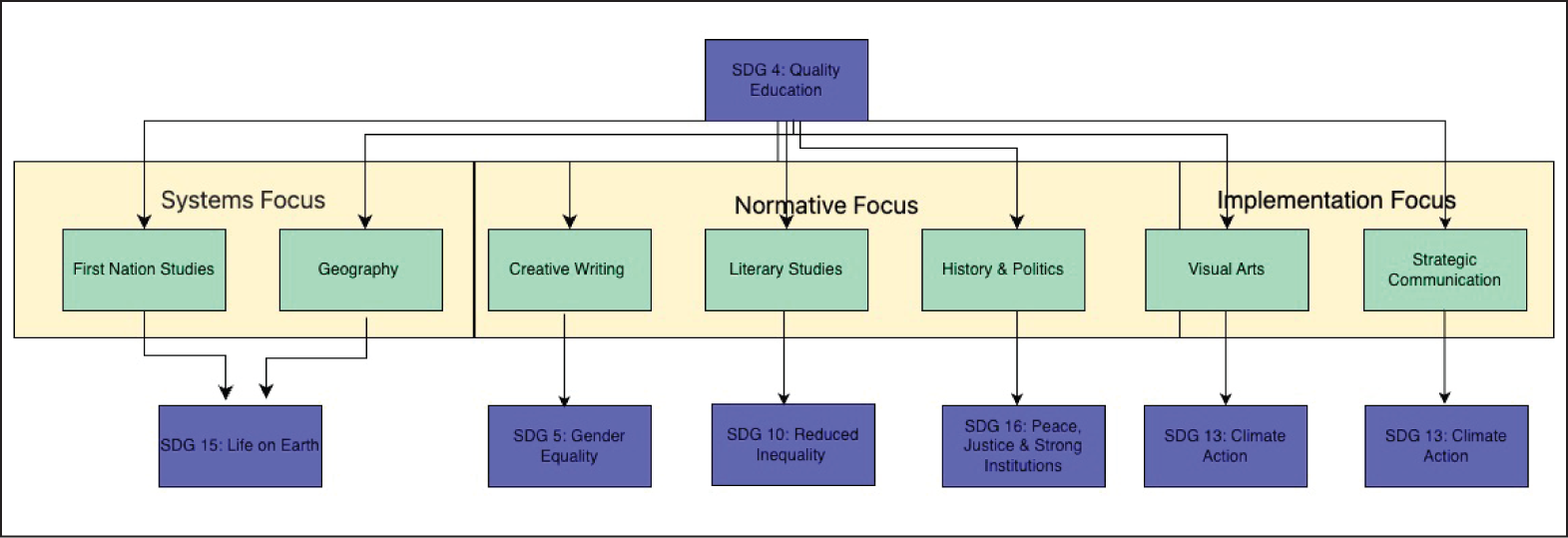
Clear disciplinary patterns emerged in forum discussions. Creative writing students often critiqued cultural narratives that shape or undermine gender equality, linking sustainability to cultural production and representation. Strategic communication students tended to focus on corporate practices, particularly deconstructing greenwashing strategies and interrogating how fossil fuel companies manipulate messaging to balance economic interests with sustainability claims. Students of literary studies explored speculative fiction as a way of imagining climate futures. Students of First Nations studies consistently emphasized principles of ‘caring for Country’, often drawing on debates surrounding indigenous fire practices. Geography students tended to engage with ecological consequences of land management, reflecting a strong concern for environmental processes and spatial impacts.
Online forums provided critical spaces where disciplinary perspectives intersected. For example, a history and politics student drew an analogy between climate policy and the delayed regulation of asbestos, provoking strategic communication students to highlight how corporate messaging strategies often resist or delay such regulation. A thread on food waste highlighted how students combined perspectives to reframe sustainability challenges. One student reflected on behavioural limits: ‘While I can be passionate about this topic, I too buy far too much food annually that we don’t consume’. Another pointed to community solutions through sharing networks: ‘Neighbourhood and buy nothing groups are taking steps to reduce food waste … a single lemon from their garden means one less wasted bunch’. Others emphasized structural barriers, such as supermarkets discarding edible food, before concluding that ‘for any change to be truly sustainable, we all need to work together’. This exchange demonstrated how students moved beyond single-discipline framings to integrate historical, scientific, policy, communicative and practice-based perspectives, surfacing more robust solutions and exemplifying the kind of cross-disciplinary learning the unit aimed to cultivate.
Other threads broadened the scope of debate in equally generative ways. Strategic communication students critiqued media framings that shift responsibility from structural emitters to individuals, pointing to the ways communication can obscure accountability. Geography students challenged the assumption that ‘green’ is always ‘good’, arguing instead for biome-appropriate aesthetics and native planting—reminding their peers that ‘deserts are not “empty”; watering lawns to fit a Western ideal erodes biodiversity’.
The mapping underscores the dual contribution of BA majors to sustainability learning: first, by grounding disciplinary inquiry in specific SDGs and, second, by fostering dialogue that revealed how SDGs interact in complex ways. As Nilsson et al. (2016) note, SDG interactions can be reinforcing, enabling, constraining, counteracting or even cancelling. Students recognized this from their discussions: for instance, sustainable land management (SDG 15) contributes to climate mitigation (SDG 13) but can also generate equity concerns (SDG 10) and governance challenges (SDG 16). By situating disciplinary insights within the SDG framework, the unit proved effective in reinforcing disciplinary expertise while cultivating interdisciplinary literacy, equipping students to recognize sustainability as a complex, interconnected challenge.
Developing Sustainability Competencies
This section maps how students developed sustainability competencies across majors within the course, with emphasis on transformative learning outcomes. The analysis draws on Wiek et al.’s (2011) foundational competencies, together with Brundiers et al.’s (2020) extensions of intrapersonal and implementation competence.
The data set comprised students’ reflective essays, which were systematically analysed in NVivo using a competency-based proximity coding (CBPC) framework that combined qualitative and quantitative methods. The process unfolded in three phases. First, qualitative thematic tagging identified sustainability competencies (e.g., systems thinking through keywords like ‘feedback loops’), using NVivo’s text search queries, with coding stripes helping to distinguish superficial mentions from critical applications. Coding was conducted at the paragraph level to preserve contextual meaning while avoiding inflation from isolated keywords; a 10% sample was double-coded to check consistency. Second, quantitative contextual weighting scored evidence on a 1–5 scale through NVivo’s node properties and classifications, with adjustments applied for evidence quality (−1 for anecdotes, +2 for peer-reviewed citations). This allowed each competency—systems thinking, anticipatory, normative, strategic, interpersonal, intrapersonal and implementation—to be assessed on a continuum from minimal (little or no evidence) to advanced (critical application or integration). Third, relational proximity analysis employed matrix coding queries to map intersections between competencies (e.g., normative–strategic linkages in climate ethics essays) and word tree visualizations to surface discipline-specific semantic patterns, such as differences in how ‘causal networks’ were framed in First Nations studies compared with visual arts.
The results of this analysis are reported in the heatmap (Figure 2), which visualizes disciplinary patterns in competency development across the course. The heatmap confirms that different majors focused on distinct sustainability competencies. For example, First Nations studies and geography achieved the highest scores in systems thinking and anticipatory competence, reflecting traditions of ecological stewardship and long-term risk awareness. One essay on indigenous fire management described ‘fire as ecosystem governance’, exemplifying advanced systems reasoning and anticipatory awareness of climate risks.
Sustainability Competencies Across Disciplines.
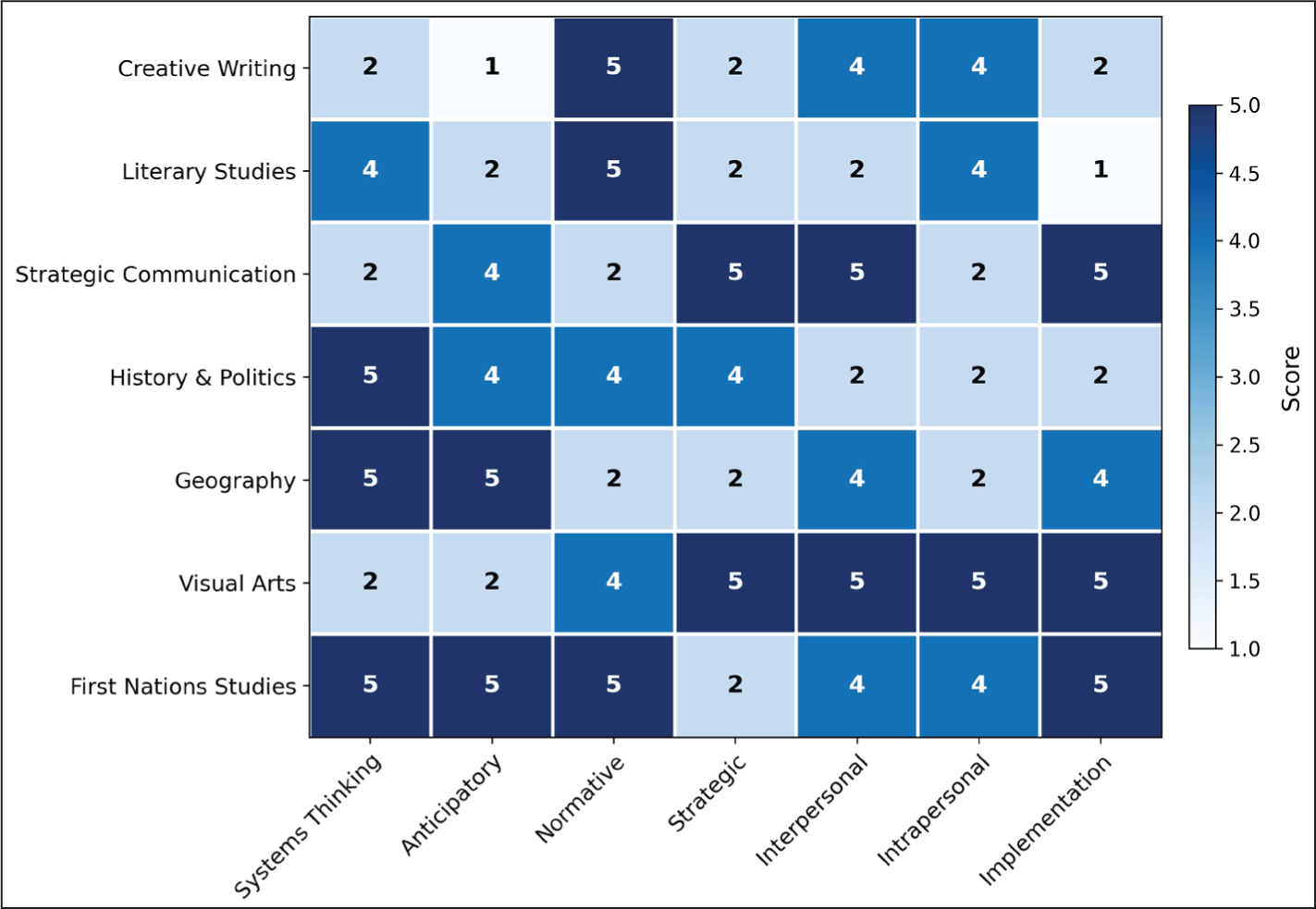
By contrast, creative writing and literary studies showed strong normative and interpersonal competencies but showed weaker engagement with anticipation and implementation. Students frequently used cultural critique to interrogate hierarchies of gender and representation in sustainability activism. As one creative writing student observed: ‘They say Barbie is “just a toy movie.” So why is Oppenheimer not “just a war movie”? Women’s work—whether in film, care, or sustainability—is dismissed as frivolous’. This illustrates the normative framing of equity and recognition.
Strategic communication displayed notable strengths in strategic and implementation competencies, linking communication practices to applied problem-solving. As one student reflected: ‘Understanding the SDGs allows me to guide companies toward responsible practices and communicate sustainability efforts more effectively’. This highlights a professional orientation towards applied sustainability leadership.
Visual arts presented a more balanced profile, with particular strengths in implementation and interpersonal competencies, reflecting the field’s emphasis on creative practice and collaboration. As one student explained: ‘In my art project, I used fading colours to show how biodiversity loss feels like the world losing its vibrancy—art can make people care in a way numbers cannot’. Such work translated ecological decline into affective and experiential terms, mobilizing engagement through visual communication.
History and politics produced moderate scores across most competencies but demonstrated the potential for mobilizing historical case studies in sustainability policymaking. For instance, one essay compared asbestos regulation to climate policy, showing how past governance failures inform anticipatory and normative reasoning.
Taken together, these findings demonstrate that the unit fostered distinctive competency profiles across majors. While no single discipline developed all competencies equally, their complementary strengths created a more comprehensive learning environment: Geography and First Nations studies anchored systems and anticipatory reasoning, creative writing and literary studies contributed normative critique, communication and digital storytelling emphasized applied and strategic action, and visual arts provided communicative and collaborative strengths.
Overall, the analysis shows that the unit successfully reinforced disciplinary expertise while cultivating interdisciplinary literacy. Through the integration of reflective and experiential pedagogies, students developed complementary competency profiles— analytical, ethical, creative and applied—that prepared them to engage critically and collaboratively with complex global sustainability challenges.
Discussion and Conclusion
This study demonstrates that embedding sustainability within a BA course yields two interrelated outcomes. First, hybrid pedagogies foster integration across disciplines by positioning sustainability as both a shared foundation and a disciplinary application. Second, competency development, though uneven across majors, proved complementary in ways that collectively enriched sustainability learning.
The One-to-many/Many-to-one model created structured opportunities for students to connect global challenges with the conceptual tools of their own fields while engaging in interdisciplinary dialogue. Consistent with Sherren’s (2008) argument that the arts cultivate competencies such as narrative framing and critical analysis, our findings show that reflective and experiential pedagogies created spaces where students interrogated assumptions, tested disciplinary boundaries and collaborated across epistemologies. Online forums reinforced this by supporting peer-to-peer learning and fostering dialogue and reflexivity, echoing calls in sustainability pedagogy for more participatory and critical approaches (Young & Malone, 2023). Together, these insights suggest that hybrid pedagogies can move arts courses beyond fragmented exposure and towards integrative literacy.
The analysis also revealed that no discipline developed all competencies equally. Geography and First Nations studies demonstrated particular strengths in systems thinking and anticipatory competence, while creative writing and literary studies contributed normative critique and interpersonal engagement. Strategic communication prioritized strategic and implementation skills, and visual arts bridged creative expression with applied problem-solving. This unevenness is better read as complementarity than limitation. As Wiek and Kay (2015) argue, sustainability competencies should be adapted rather than standardized across contexts. Our findings affirm this, showing how disciplinary strengths—when brought into dialogue—produced a fuller competency portfolio. Structured peer exchange proved especially effective in bridging gaps, reinforcing Sandri et al.’s (2018) claim that real-world contexts and interactions are critical for competency development.
While most sustainability education scholarship has centred on STEM-based curricula, the arts and humanities remain underexplored despite their capacity to engage values, narratives and cultural contexts. This study helps fill that gap, illustrating how disciplines such as creative writing, literary studies and visual arts make critical contributions through normative critique, narrative reframing and creative representation. These contributions are not supplementary but essential, expanding sustainability learning beyond technical problem-solving to encompass ethical reasoning, cultural analysis and the imagination of alternative futures.
The study makes three contributions to sustainability education. First, it demonstrates that arts and humanities courses—often marginal in sustainability debates—offer distinctive strengths for developing sustainability literacy. Normative critique, narrative construction and creative reframing emerged not as supplementary but as essential practices for interrogating values, shaping discourse and envisioning alternative futures. Second, it extends competency-based approaches by operationalizing CBPC analysis in the arts, providing a replicable method for mapping disciplinary strengths and gaps. Third, it shows that aligning SDG engagement with competency development offers a powerful scaffold for curriculum design, supporting Kioupi and Voulvoulis’s (2019) call to integrate global imperatives with personal and disciplinary learning.
Embedding sustainability in the arts requires pedagogical models that preserve disciplinary identity while enabling interdisciplinary engagement. The One-to-many/ Many-to-one framework served this aim by positioning sustainability simultaneously as a disciplinary resource and an interdisciplinary meeting point, while online discussion forums fostered dialogue across fields. Although competency development was uneven, disciplinary strengths complemented one another, collectively enriching sustainability literacy. This study advances sustainability education by showing how the arts contribute to sustainability leadership through narrative, critique and creativity. It also underscores the value of adapting competencies to disciplinary contexts.
Nevertheless, the study was confined to a single unit in one institution and drew on coded reflections and participation metrics rather than extended student voices. Competency development was assessed for two semesters, so longitudinal studies are needed to examine persistence and transferability into professional contexts. Future research should investigate how graduates apply these competencies in practice and explore faculty development models that sustain interdisciplinary teaching in the arts. Comparative studies across institutions would clarify the scalability of hybrid pedagogical models.
In sum, while no single unit can equip arts students with comprehensive sustainability expertise, it can serve as a transformative entry point. By leveraging disciplinary diversity and fostering structured collaboration, arts education can reposition sustainability not as a marginal theme but as a foundation of higher education.
Footnotes
Acknowledgements
The author would like to thank Dr Michael Hewson for his insights and feedback on an earlier version of this article.
Data Availability Statement
The data analysed in this study comprise de-identified teaching and learning artefacts. They are available upon reasonable request, subject to approval by the CQUniversity Human Research Ethics Committee.
Declaration of Conflicting Interests
The author declared no potential conflicts of interest with respect to the research, authorship and/or publication of this article.
Ethical Approval
This study was approved by the CQUniversity Human Research Ethics Committee (Ref: 25532). The research analysed de-identified teaching and learning artefacts drawn from online platforms of past offerings.
Funding
The author received no financial support for the research, authorship and/or publication of this article.
Use of Artificial Intelligence
The author used ChatGPT (OpenAI) solely to assist with improving the readability and language of the manuscript. All content was reviewed and approved by the author, who take full responsibility for the accuracy and integrity of the work.