



Abstract
This article contests that the classical regional integration theoretical frameworks are too broad to bring out conceptual clarity and explain the emerging interstate tensions. The paper identifies two specific indicators that together can explain the dynamics: economic domination and institutional (interest groups) domination. It evaluates the applicability of the Onditi’s dominatarian theory by constructing an alternative thinking framework—regional trade dominance (RTD), to explain the dynamics of the regional integration based on trade data from the East African Community (EAC) Development Strategy, 2016–2021. The paper addresses this conceptual-policy lacuna by demonstrating how Kenya’s economic performance and institutional (interest groups) leverages have sustained its dominant interest, leading to interstate cynicism and mistrust. The persistent mistrust driven by the perceived asymmetric power balance among the EAC Partner States points to the importance of framing the debate in a way that constructs the outcome of the regional integration to accommodate both powerful states and those perceived weak. In this case, the RTD analytical framework, offers the option for constructing the outcome of a regional integration, either as a noun, dominance or as an act of domination.
Introduction
World over countries with geographical and historical commonalities and diversities can decide to engage in the processes that would lead to a collective action across spheres of life-security, economy, culture, and politics. This collectivism leads to the establishment of a community. One aim of building a community is to treat market deficiencies such as economic size, fragmentation of national markets, and the disenchanted political systems (Tuluy 2016). In Africa, Pan-Africanists envisaged the regional economic integration as the gateway for African states to overcome not only the destructive politico-economic legacies of the Berlin Conference (1884–1885), but also as a tool to unite Africans across the globe (Tavares and Tang 2011). Examples of Pan-Africa groupings can be gleaned from the works of Kwame Nkrumah, W.E.B. Du Bois, Marcus Garvey, Martin Luther King, Leopold Senghor, and George Padmore. Since then, a number of frameworks have been developed to drive the integration process, including: The Lagos Action Plan and the Abuja Treaty established in 1980 and 1991, respectively; the New Partnership for Africa’s Development (NEPAD) established in July 2001; and the Free Trade Area (FTA)-created to facilitate fair trade among African states. The assumption underlying most of these frameworks is that, they would produce the same effect on trade benefits for all member countries. However, over the years, it has emerged that trade competitiveness and structural differences tend to produce economic imbalances, elevating some countries to be more powerful or dominant (Gibb 2009). In the East African Community (EAC), Kenya emerges as the largest trading partner in the trading bloc (Buigut 2012; Chingarande et al. 2017). The country’s economic and geopolitical influence in the region produces different forms of dominance.
What is dominance? In the international relation studies, the concept of dominance attracts diverse thinking. Legal scholars view dominance as a sign of power, justifying the exercise of authority in the regional governance structure (Von Staden 2016). Contrary to this, scholars in regional studies caution that domination of one country in a regional bloc may lead to coercive or benevolent leadership (Hulse 2016; Ikenberry 2005). Similarly, political institutionalists view dominance as a process of gaining control over the formal and informal integration structures, processes, rules, regulations, and compliance procedures (North 1981; Yarbrough and Yarbrough 1992).
Political scientists categorize dominance into four different balance of power structures: (1) divide and rule, (2) compensation, (3) armament, and (4) alliance building (Morgenthau 1985). These structures and processes are in fact designed by state bureaucrats to constrain and shape the human interaction. The predetermined fashion of influence is then applied to maximize the wealth of other actors in the integration ecosystem (Mattli 1999). Perhaps, this is the reason why political economy readers view regionalism as an endogenous mechanism designed to challenge the western-dominated world economic order (Draper 2012). However, it is important to note that these legal regimes, intergroup relations, and institutional (mal) functioning are the various means through which domination sustains itself in an ecosystem. It is not clear though, whether the manner in which dominance is constructed in the society shapes some of the outcomes of integration such as economic conflicts and power constellations (Weyland 2016), especially among those forming part of a regional community. The EAC regional bloc, like any other African Regional Economic Community (REC), is steeped with political contradictions, ethnic diversity, cultural identity issues, ideological differentiation, and economic disparities (Burrow 1976; Green 2013; Repkin 2014; Robinson 2017). In these economic and political diversities, one thing remains grey: does the Kenya’s progressive economic performance and institutional leverages present comparative advantage or pose threat to the regional integration order? Can the Onditi’s (2021), dominatarian theoretical framework explain this phenomenon?
To address this question, this paper draws on a case study of EAC from three substantial study reports: (1) EAC Development Strategy (2016/17–2020/21): Accelerating People-centered and Market-driven Integration; (2) EAC Trade Report 2011–2014; and (3) the 2016 report on African regional integration by the United Nations Economic Commission for Africa (ECA), African union (AU), and African Development Bank (AfDB). The EAC Trade reports facilitated detailed comparative analysis of how balance of trade among the six (Burundi, Kenya, United Republic of Tanzania, South Sudan, Rwanda, and Uganda) Partner States have been perceived. The article focused on the ECA/AU/AfDB reports because it provides both interstate and interregional comparisons of productive integration performance indicators, namely; preferential trade, liberation, trade creations, and diversion effects.
The paper proceeds as follows. The second section contextualizes the study by drawing linkages between dominance as a concept and the integration dynamics within the EAC’s geography and geopolitics. The next section reviews the critiques of the classical regional integration theories. The subsequent section frames the study within the three common models of dominance. The fifth section tests and evaluates the applicability of the dominatarian theory to the two main indicators of integration: economy and institutions. Finally, conclusion offers alternative thinking on how dominance as a trading dispute resolution mechanism ought to be reconstructed to take into account both the economic and the human factor (values, perception, and ideological orientation) when analyzing and planning for the regional integration in Africa.
Contextualizing Dominance in the Regional Integration Processes
The East African Community regional integration aspirations, like any other regional bloc on the continent are bound by the common history, geography and the quest for a collective security community. The original Partner States of the bloc, namely Kenya, Tanzania, and Uganda, forged a regional cooperation glued by language, culture, infrastructure, and the trans-boundary natural resources such as the waters of Lake Victoria. Owing to ideological differences between the founding fathers, mainly President Jomo Kenyatta and Mwalimu Julius Kabarage Nyerere, the Community collapsed in 1977. The revival of the bloc on 30 November 1999, and the subsequent enforcement of the Treaty on 7 July 2000, ushered in Rwanda and Burundi. The Republic of South Sudan joined the Community in April 2016 making it a six-member bloc. The ultimate goal of the EAC is to achieve a political federation through a common market and socio-cultural interdependence.
It is the hope of the Partner States that the universally acceptable principles of good governance would govern the management of benefits and liabilities emerging from the integration process. In the performance of their key functions of legislation, representation, and oversight parliaments can actively engage in the development and implementation of laws, policies, and practices that promote democracy and good governance. Article 6(d) of the Treaty for the establishment of the EAC provides for upholding the fundamental principles of good governance. These include adherence to the rule of law, accountability, transparency and respect for human rights, gender equality, and equal opportunities. As a general principle, neither economic nor political domination of one state over the others will lead the bloc to the desired political unity.
The economics of integration does not obviously guarantee equal opportunities for all member states (Kelly 2005). In fact, in some situation, regional economic imbalances breed hegemonic traits and geopolitical ‘powerism’ (Zongyou 2006). The concerns on lack of the equitability mechanism continue to emerge from the EAC bureaucrats:
The positive developments taking place within the region are indicative of the right path EAC is pursuing. For example, we have implemented diverse initiatives aimed at providing East Africans with adequate, reliable, and cost-effective access to means of production such as road, railway line, and energy. However, there is much to be done in resolving the perceived or real economic disparity at partner states level and lack of the equitability mechanism. (Interview with one of the bureaucrats at the EAC HQ, Arusha, Tanzania, 7 March 2018)
On this note, it will be remembered that disproportionate benefits to members of the Community was one of the concerns that led to the collapse of the Community in 1977 (Apuuli 2004). It is doubtful that the Community has risen above these traditional grievances. Recent studies have revealed that the Community’s Common External Tariff (CET) has disproportionate impacts on intra bloc trade for individual Partner States (Bunder 2018). Such outcomes continue to deepen interstate tensions, with most Partner States feeling unease with Kenya’s dominance traits. This influence poses both conceptual and policy dilemma as to whether the dominance by Kenya in the region could possibly threaten the regional integration order? The complexes associated with regional integration processes have elicited several trade dispute resolution mechanisms. Such mechanisms include the application of dominance as a response to problems of “collective good.”
In the regional integration context, dominance is expected to promote order, stability, and predictability in the manner in which members interact and function (Pratto et al. 2006). However, dominance as a trait comes with bitter taste. In social sciences, for example, in-group prejudices, confusion, and truculence are among some of the issues that policy makers and researchers have to deal with. Sociologists contend that even after centuries of human evolution; discrimination, oppression, brutality, and tyranny remain common features of a contemporary society. The problem of dominance is that, while one social (or economic) group enjoys special privileges, the others have limited powers and influence (Pratto and Andrew 2012). This results in trading and policy asymmetries:
Although the EAC Court of Justice has managed to institutionalize the fundamental principles of the Community (e.g., rule of law, good governance, upholding human, and peoples’ rights), lack of enforcement mechanisms, the ad hoc approaches to resolving issues including those related to trade insolvency, hinder progression of the community. (Interview with one of the bureaucrats at the EAC Headquarters, Arusha, 7 March 2018)
Resolving the above issues can sometimes go beyond economics or legal frameworks to personalities and individual perceptions. In short, the human factor, that defines dominance, remains a key in determining the future of the regional integration. In this paper, we define dominance from a social science perspective, referring to institutional discrimination sustained through disproportionate allocation of resources and information asymmetries. It is not possible to appreciate the linkages between dominance and regional integration processes before understanding the weaknesses and strength of the classical regional integration theories.
From Classics to Dominance
In several instances, regional integration scholars, such as Hettne (1991), have offered frameworks for explaining regional integration processes, globally. However, given Hettne’s focus on the European integration, what he offers as an “alternative” thinking approach lacks contextual fitability. He constructs the world by “mixing” geopolitical differentiation criteria and social constructivism. This approach presents an ontological complication. For instance, when countries undergo the various forms of the integration, they do not necessarily dissolve into homogenous communities. Hettne and other neofunctionists (Haas 1964; Mitrany 1948; Soderbaum and Shaw 2003) have, on different occasions, constructed the concept of interdependence of regional communities as the solution to the integration. However, claiming that integration leads to a solution of regions is a fallacy of non-causa pro causa (causal fallacy). Indeed, such a theory would imply that all partner states in a regional organization are equal in all aspects. In Africa, RECs are in fact admixtures, and not solutions. As such, both the functionalists and neofunctionalists’ thought of regionness presents yet another conceptual misfitability.
Classical Theoretical Frameworks
The idea of rethinking the classical regional integration theories in 1980s and 1990s arose as an alternative thinking framework for addressing the challenges of globalization from a regional perspective. This was particularly important for the global south as most economies were undergoing the effects of structural adjustment programs (SAPs). Hettne (1991), who is one of the key pioneers of this thinking, was trying to reconstruct Europe in the post-Cold War era. Hettne argued that the regional integration goes beyond economics, to embody cultural, social, and political aspects of the society. Later on, Hettne was joined by Soderbaum and Shaw (2003) to strengthen the argument that political communities are constructed through regional interactivities.
The Hettne’s approach seems to portray an advancement of the globalization scholarship from below. He tries to link regionalism to the global system by arguing for greater participation of civil society entities. In other words, globalization could be achieved through the regional integration—it becomes the proxy tablet for achieving the structural global transformation. Unfortunately, the attempts by empirics to illustrate Hettne’s point of view by linking globalization to the economic stability in post-independence Africa (Milanovic 2006) fail to acknowledge the changing African vision and development models that greatly impacted the integration process. On this issue, De Melo and Tsikata (2014) fault the linear model of the integration applied to Africa. But as demonstrated in this paper, the problems of the integration are deeper than the material drivers. Leaving out attitude, value systems and personalities are like building a mosque with a crucifix on the top.
The Hettne’s proposition of the significant role of the civil society in the integration hangs over the difficult relational atmosphere in Africa. The relationship between African organizations and civil society has been disharmonious. In Malawi, for example, even though the country transitioned from dictatorship to a multiparty system, the government–CSO relationship remains fraught (Makumira 2011). It seems that the Tocquevillian thesis that CSOs are likely to survive in fragmented societies (Spires 2011) does not apply to African states. What Hettneism fails to capture is the regional integration complexities brought about by personalities and other human-centered factors. Nevertheless, Hettne introduced to the debate the term regionness that defines regions’ identities. It is easier to liken Hettne’s point here to what this article coins, dominance superpowerism. For instance, historically, Kenya has been accused of taking the role of the “great power” in the Community (Busse and Shams 2003). Although the dominance “superpowerism” could function to caution other “weak” states in the trading bloc, for decades this notion has ended up creating “trade wars,” tensions, and mistrust.
The regionalism approach proposes the creation of a regional community. However, in the case of the EAC, despite efforts to harmonize foreign and security policies in the region, a lack of a coherent strategy to manage the structural and institutional imbalances remains unresolved. This leads to the perception of some trading partners of being too protectionist, while others being perceived too domineering. In fact, the intergroup tensions more often exert pressure to the Partner States to use the “unilateral exemptions” to scuttle any form of trading solutions. States are compelled to adopt such unilateral and irrational decisions for fear of dominance by the “other.” With this conceptual incoherence, it would be constructive therefore to mirror the process of the regional integration from a human-centered approach. This is because the contemporary integration dynamics cannot be explained exhaustively through the classic regional integration theories and the regionalism approach which emphasize materialism, rigid structures, power relations, and globalization at the expense of the human factor. In order to have a sense of how the dominatarian theory stems out from the classic theories, the next section examines the three models of dominance as espoused by Charlesworth (1979).
The Three Models of Dominance Framework
As discussed earlier in this paper, dominance traits are known to hutch power hierarchy system. Dominance, however, comes with costs of oppression and resentment by the so-called lower ranking members of the community. As a form of political maneuver, political elites or bureaucrats apply dominance to gain expediency. This power structure rewards responsive agencies or punishes recalcitrant ones (Abbott 2007). In some cases, a country may dominate trade without the ability to lead. However, this form of domination remains a major source of economic conflicts and trade wars. A case in point is China’s controversial role in the International trade relations (De Vault 2002). In the case of EAC, interstate tensions between Kenya and Tanzania continue to blight possibilities of achieving full economic and political integration (International Monetary Fund 2016). Kenya, in particular, has been accused of taking the role of “great power” in the region (Busse and Shams 2003). Although the dominance “superpowerism” could function to caution other “weak states” in the trading bloc, for decades, this has ended up creating “trade wars” and interstate tensions.
Dominance as a concept dominates the literature in the natural sciences (Charlesworth 1979), especially concerning its role in shaping “survival” of species or human population dynamics. Notwithstanding this, social scientists too, have attempted to theorize its application to intergroup relations, prejudice, and discrimination (Sidanius and Pratto 1999). On one hand, it is plausible to argue that dominance, as a human behavior, is responsible for entrenching individuals with “powerful” traits. On the other hand, “recessive” or “weak” individuals are reduced to less useful members of the ecosystem. High dominance feeling involves self-confidence, assurance, high evaluation of self, feelings of general capability or superiority, and lack of timidity (Maslow 1939). There are three models explaining dominance in the human social system.
First, the social dominance orientation (SDO) theory can be used to predict future intergroup attitude and political behavior (Ho et al., 2012). This theory, therefore, can provide insight for understanding how each state responds to dominant traits. In considering the complexes related to the regional integration, it is usual to hear frustrations emerging from the EAC boardroom meetings or regional border points.
“Kenya is too aggressive for us” or “Tanzania with its trade barriers is not going anywhere…” or “is Burundi a member of the EAC?” or “why did Uganda decide to redirect their oil pipeline project to Dar es Salaam away from Mombasa?”
Second, the cultural perspective of dominance presents an interesting relationship in the global system. It explains why powerful countries such as United States and China are able to dominate the global markets. Why? Some scholars have observed that this occurs because of the ability of these countries to evolve a distinct trading culture. Once a culture is established, what follows is how Preferential Trade Arrangements (PTA) could help to create global welfare and not domination (Anchan, 2012). However, it is still possible that the greatest beneficiary of a welfare culture is considered a “dominant actor.” It should be remembered that the PTA negotiating environment strongly favors powerful economic actors such as the US and the European Union. It is natural that dominating trading partners will cascade to become dictators in the international trading relations. This eventually creates the asymmetric relationship compelling the Less Developed Economies (LDCs) to bear the title, “recessive.” This raises more of moral philosophical questions than it does economics. Serrano et al. (2007), in their efforts to understand this phenomenon, concluded that the global trading system is yet to achieve “real” trade interdependence.
The third and final is the psychological model, it argues that, dominance, as a product of competition, is sustained into three humanistic factors: (a) personality dynamics; (b) individual basic values—anxieties and beliefs; and (c) individual information processing (Otto and Richter, 2018). Yet, others argue that the authoritarianism behavior commonly associated with dominance can post higher organizational productivity (Smither 1993). Both the positive and the negative outcomes of dominance as a human behavior fit well in this paper’s postulation of tensions emerging from the EAC regional integration. But also, the revolutionary work of Sigmund Freud (The Library of Congress 1939), on human behavior, is critical in understanding why, for instance, regional economic/political or security arrangements such as the EAC do not find it necessary to make rational decisions. Does this reflect the institutional preferences or the individuals’ attitude toward each other? Should there be mechanisms for ensuring that the decisions made in such entities are entirely guided by rational logic and reason, and not human affection? How possible is it to detach political feelings of political elites from the professional mandate of regional organizations?
Studies show that in any social or economic ecosystem, domination is perpetuated through social relationships, ethnic cleavages, racial discrimination, and national stereotyping (Thompson, 2013). Lovetta (2009) referred to this condition as “social power.” All these are manifestations of basic features of groups’ motivation, rather than as a rationally held economic or political ideology. Sociologists are in agreement with the view that people or systems that are prejudiced against certain ethnic groups tend to be prejudiced against other nationalities (Loftus, 2008). Similarly, in political arrangements such as the EAC, authoritarian tendencies with conservative views are most likely to construct asymmetric power game leading to domination by one state.
In an effort to understand how global trade networks interact, Hilpert (2014) offered a typology of a dominant state. A typical example in the 21st century is China’s domination in the international trade as the US did in 1970s. The positive aspect of this classification comes out strongly when Hilpert caution that although China’s domination in the world trade and the World Trade Organization (WTO) has led to economic tensions and trade wars, these fears are unfounded because the country portrays features of an established actor in the world trade system. This implies that while the original dominance thinking among social scientists posited a direct linkage between social group formation and evolution of inequalities, evolution of the concept continues to draw relevance in the field of International Relations, particularly in its application to regional economic and political integration of Africa.
The same concept of dominance is used to explain evolution of institutions. As a form of dominance states may decide to legitimize “myths”—cultural mores and ideologies being formalized to guide decisions and policy direction (Grossman and Helpman 1995). Myths legitimization may take various forms: (a) national security, (b) national trade interest, and (c) national liberation. The challenge with economic domination is that the other member of a group considered “weak” or less beneficial are usually excluded through stereotype imaging and eventually labeled as “a less member.” Such forms of imaging can give rise to the negative taste, justifying wars, or political jittery. If such imaging relates to the economic integration, it might lead to trade wars through the “domino effect.” Imaging, at times, can lead to the promotion of universal rights. In the regional integration framework, the equal treatment of members may pave way for reduced disparities, increased access to resources, power, and legitimacy.
Differences between RIT, Regionalism Approach, and Dominatarianism.
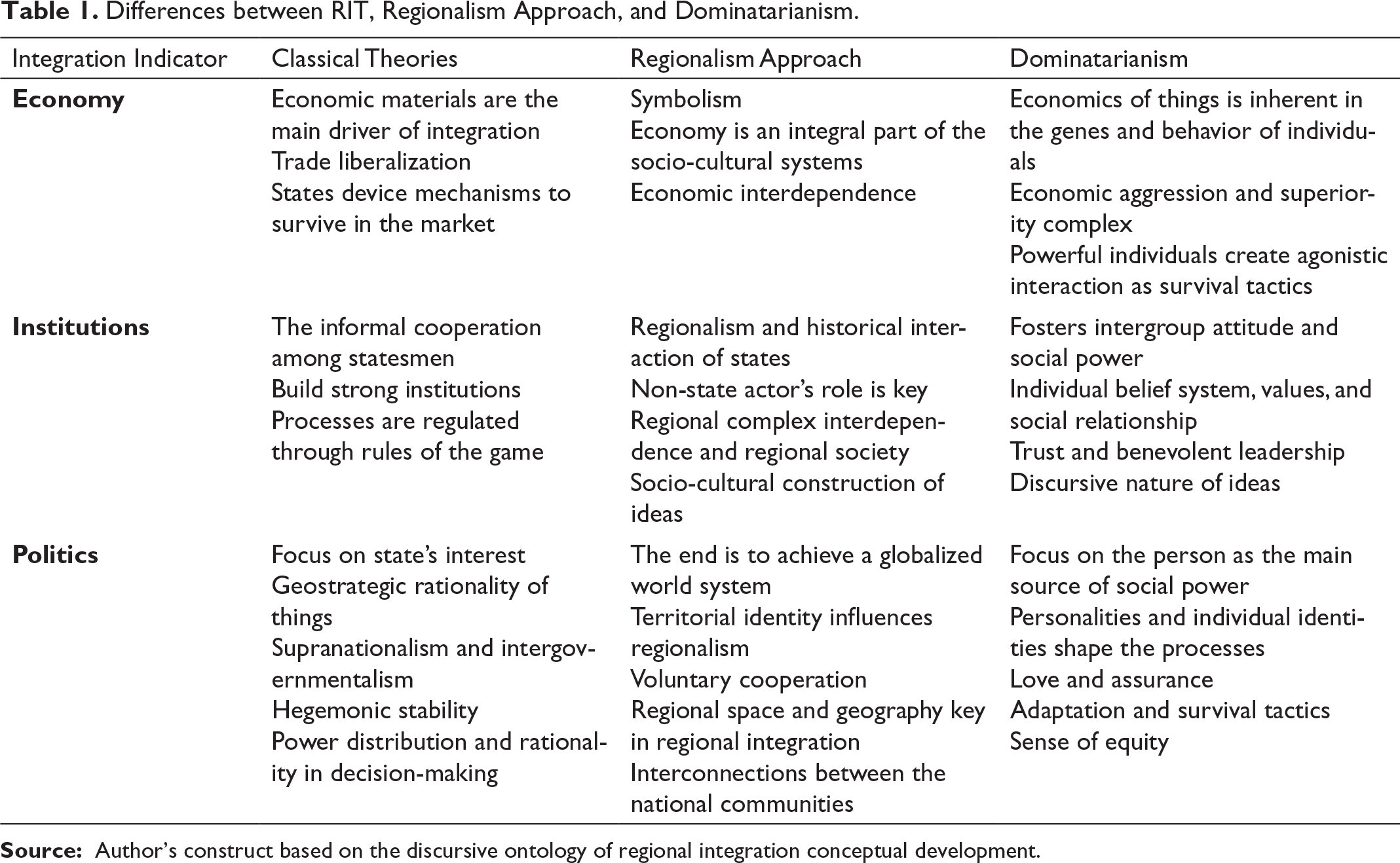
From Table 1, it is clear that the classical regional integration theories and regionalism approaches are insufficient to explain some of the emerging dynamics in African regional organizations. In the case of EAC, there have been unending trade-related frictions between Kenya and Tanzania. Despite the shared history and geography, members of the Community have pursued diverse dimensions of ethnic and ideological policies, which breeds the perception that Kenya dominates over the rest of the Partner States (Miguel 2004).
However, the personality issues arising from the interaction among states in the Community cannot be understood only in the conventional geo-economics frameworks. Worse still, the new regionalism approach to the regional integration has compounded this thinking by drawing in an assortment of pillars—culture, politics, and social. This logic seems “too high,” “too low.” It is like flying an aircraft in the stratosphere (~40,000 ft above the sea level) without provisions for oxygen masks—the pilots are bound to lose consciousness and the plane will crush. But at the same time, flying too low exposes the plane to higher air resistance. Therefore, a middle point is required in order to sustain the journey. Likewise, there seems to be a lacuna between the regional integration theories and regional approaches, as illustrated through the two integration indicators: economy and institutions.
What Does the Data Tell Us About Dominatarian Theory?
The dominatarian theory predicts that while all countries in a trading bloc have a comparative advantage in the integration processes relative to the other trading partners, there will be one with more advantage. Hence, integration processes will tend to favor the most powerful states, more often times degenerating into geopolitical tensions with diverse impacts on the integration process. The dilemma remains, is dominance a sign of comparative advantage or a threat to the regional integration order? We address in turn the aspect of the economic domination and of the relationship mediated by institutional capacity (interest groups).
Economic Domination
On the economic front, there is a reasonable evidence for the contention that the Kenya’s trade performance is higher than the rest in the EAC trading bloc. At the same time, some countries in the bloc have performed well. Still, Kenya enjoys the benefit of well-established institutions such as interest groups. However, the ways in which institutional capacity (interest groups) mediates the economic performance within the EAC Partner States trading regimes appears to be complex. The analysis of the six EAC Partner States suggests the following insights about how economic performance and institutional capacity (interest groups) affect the outcome of the regional integration process.
The implementation of Free Trade Area (FTA) does not necessarily produce the same effect on each partner state. Some countries may be capable of achieving higher performance than average increase from the free trade. Darku (2009) performed “‘gravity model” analysis establishing that during the period 1996–2009, Uganda dominated trade in the sub-region. Further meta-analysis by Buigut (2012) shows that Tanzania’s imports had increased substantially from around US$100 million in 2002 to over US$400 million in 2007. The same case applied to Rwanda, whose imports have increased from around US$60 million to over US$300 million. Buigut attributed this performance to the implementation of the Customs Union. However, during the same trading period, the implementation of the Customs Union did not have the significant concomitant effect on Kenya’s exports. Nevertheless, Kenya experienced an anticipatory increase in her exports to EAC bloc of about 86%. This was in spite of the fact that Kenya’s exports to the EAC Partner States were not granted immediate duty-free status. Overall, during this period, Kenya did not necessarily dominate trade; Tanzania had in fact seen a significant improvement in her intra-regional trading performance.
Fiscal Developments and Prospects (percent of GDP), 2011–2016.

EAC External Trade Indicators, 2012–2016.

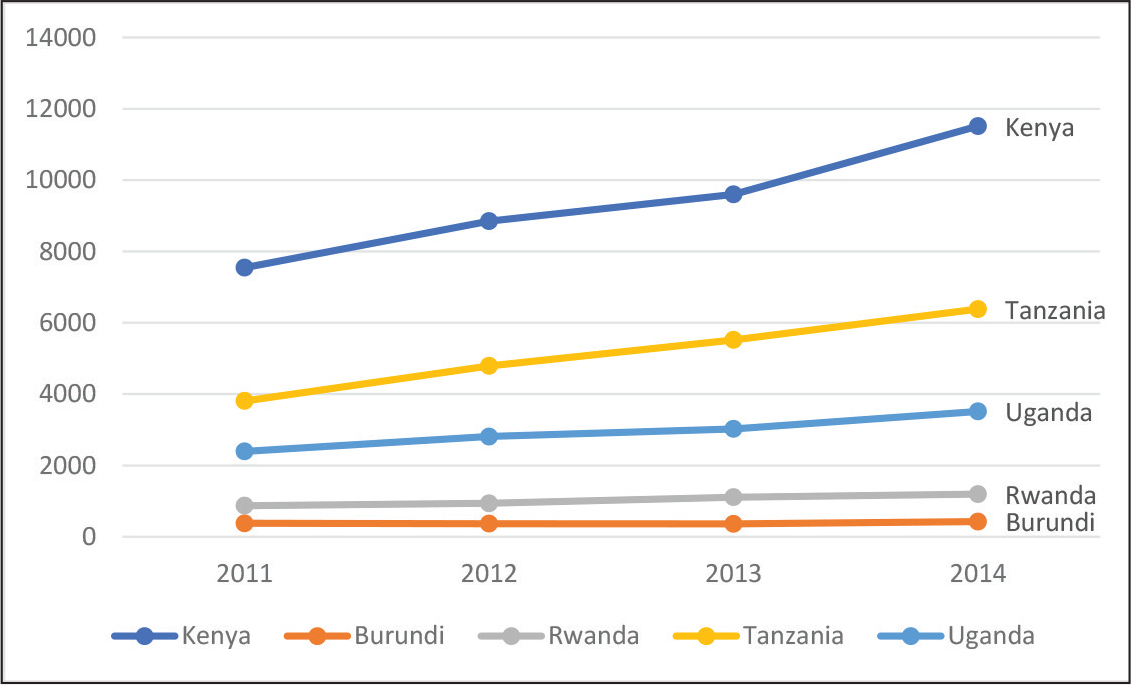
During the same period, Kenya had heavily invested in infrastructure (the Standard Gauge Railway, SGR), while the Republic of South Sudan was experiencing protracted political instability and humanitarian catastrophe. Hence, the two governments experienced the wide gap between revenue and expenditure. Challenges associated with political instability and nation building are not new to the EAC integration process. Nevertheless, these challenges were mild, as Kenya maintained a steady revenue flow reaching the high of US$11,514.7 (see Figure 1).
Number of Air Passengers by EAC Partner States, July 2016 to March 2017.

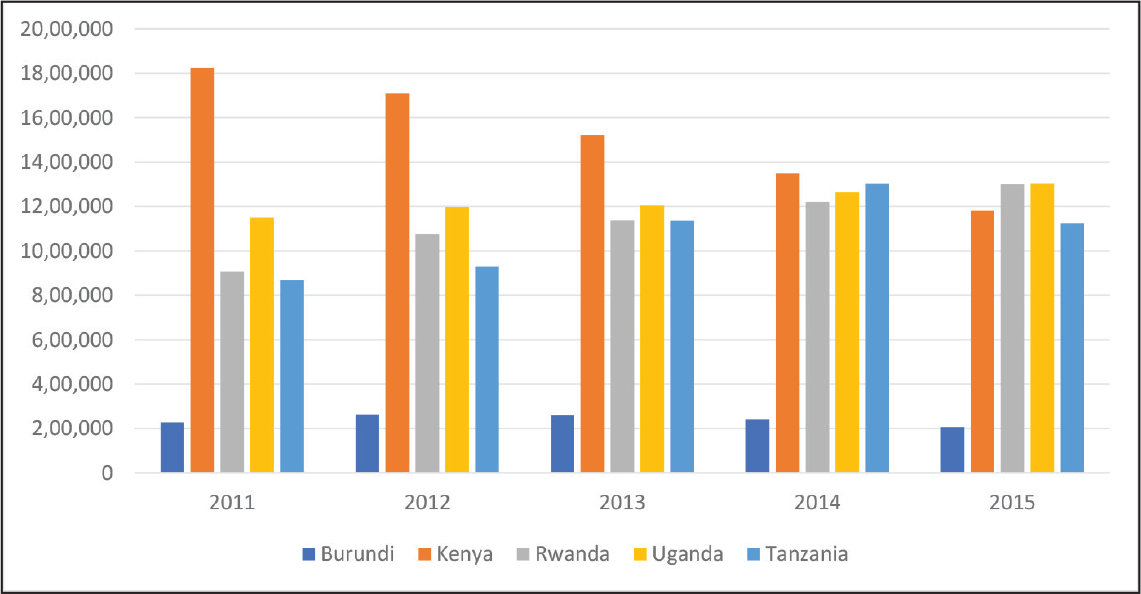
Tourism is also another crucial sector. The sector’s contribution to GDP is the highest in Tanzania (14%) and lowest in Burundi (4.3%). Tourists’ arrival in Kenya declined significantly from 1,823,000 in 2011 to 1,181,000 in 2015. During this period, Rwanda (1,300,000) and Uganda (1,303,000) dominated the tourism market in the region (see Figure 2). Kenya’s retrogression on this indicator was attributed to the changing country’s foreign policy that deployed the Kenya Defence Force (KDF) in Somalia in 2012. Consequently, the country became more vulnerable to the Al Shabaab terror group in retaliation attacks. The tourism sector staggered and the country lost economic dominance grip to Rwanda, Uganda, and Tanzania, who experienced steady growth in tourist arrivals (see Figure 2).
The energy sector is also a key indicator. The energy sector is considered critical to transforming the region’s framework of what is commonly known as “power pool.” The region’s development strategy, 2016/17–2020/21, between 2011 and 2015, shows increased installation of capacity of hydroelectricity and geothermal for Kenya by 2.9% and 9.3%, respectively, while the other Partner States’ remained constant. Installed capacity for thermal electricity decreased by 63.9% in Tanzania while in Kenya it increased by 11%. However, Kenya, Uganda, and Tanzania registered decline in generation of thermal electricity in the margin of 45.4%, 21.1%, and 8.4%, respectively. Kenya, however, still led on geothermal power generation by 55%. The role of energy is essential to the economic performance of a country. On this front, Kenya is considered as the “lead” nation in the region.
The notion of “lead” nation is akin to the concept of RTD. This provides an alternative thinking to the theories that dominate regional integration studies, such as the theory of hegemonic stability (Gilpin, 2000). As right put by Joseph (2001), the theory of hegemonic stability is central in maintaining adherence to liberal international economic regimes, and by extension liberal peace, by underwriting the costs of maintaining the regime rather than coercion. In this article, the proposed RTD framework provides that ‘the most powerful state influences the rest of the Partner States through institutional strength and economic “muscles.” The RTD framework is premised on the understanding that the convergence between the domestic complex interactivities with national interests determines which state influences the others most in the regional integration ecosystem.
Finally, geopolitical dynamics is instrumental in shaping the regional integration processes. A country’s influence in the integration ecosystem is shaped by its capacity to fund such regional organizations. Kenya is one of the principal contributors to the Intergovernmental Authority on Development (IGAD) contributing 27.7% in 2016 alongside Ethiopia and Sudan contributing 29% and 28.5%, respectively (UNECA, 2016a, 2016b). During the same year, Kenya’s contribution to the EAC wealth stood at 39% followed by Uganda’s 21%. Kenya’s relations and performance across the three regional organizations (COMESA, EAC, and IGAD) remains sterling, hence sustaining her dominance traits. Kenya profits most with shares of 95% and 93% of total trade creation and diversion, respectively. This asymmetric regional trade relation poses a real threat to the EAC trading bloc, which would collapse if the issue of trade imbalances between Kenya and the rest of the Partner States was not adequately addressed. On this issue, the International Monetary Fund Directorate of Trade reveals that Kenyan’s exports to Tanzania and Uganda were US$477 million and US$633 million, respectively (IMF 2016). Therefore, in terms of the economic performance, Kenya remains the dominant economy. As illustrated in the next section, the country enjoys powerful negotiation leverages put forward by fairly developed and diverse interest groups (Bizuneh et al., 2018).
Institutional (Interest Groups) Domination
The institutional dimension of the dominatarian theory observes that countries in regional trade relations stand to gain when they allow more multiple-stakeholders on the Regional Trade Agreements (RTAs) beyond the state (Onditi forth-coming). Looking within the EAC trading bloc, we can observe that each country has developed institutional (interest groups) capacity required for trade negotiations. However, the level of influence and strength of each interest group varies across countries.
A country’s influence is driven by both endogenous and exogenous factors. According to Beyers et al. (2008), endogenous groups are state-owned parastatals or have direct contacts with the executive. They work closely with the government and are consulted regularly on a number of issues, whereas exogenous work outside government circles. As seen from the previous discussion in this article, Kenya has benefitted more from unilateral exemptions on the CETs (Bunder 2018). This is mainly attributed to the involvement of the country’s diverse interest groups in the CET negotiations. Indeed, effective trade policies are likely to emerge from competition between the lobbying actions of different interest groups.
Kenya’s interest groups are more actively involved in the CET negotiations. Unlike Tanzania and Uganda, Kenya’s political class has strong linkages with the private sector. This relationship makes it possible to have producers access the regional market and vital information within the trading networks. This clientele type of relationship between Kenyan businessmen and political elites is deeply connected with “‘tribal segmentation,” leading to rent-seeking and patronage activities (Burgess 2010). Moreover, the proximity of the Kenya’s private sector to the government gives them a better access to the negotiation table as compared to Tanzania and Uganda’s. A solitary focus on interactivities of pressure groups is a key in understanding how the different group typologies have evolved the Kenyan regional trade landscape into a dominant Partner State.
Interestingly, other interest groups such as the Tanzania Chamber of Commerce, Industry and Agriculture (TCCIA) and the Tanzanian Private Sector Foundation (TPSF) impede CTI’s organization, yet they should be working in coherence. This has led the private sector to use personal connections with politicians to negotiate on CET. Some well-connected importers from Tanzania are able to push for their interests using informal networks. Capacity constraints within the UMA has made Uganda’s producers to engage directly with the President on trade policies. In fact, the Kampala City Trader’s Association (KACITA) is more influential in tariff negotiations as compared to UMA, which is the representative of Uganda’s manufacturers.
On the contrary, KAM is the only representative of the manufacturing sector in Kenya and almost all producers lobby through the Association. In addition, KAM is well connected to politicians and boasts of high technical capacity. The Association has employed various activist designs throughout its evolution, sometimes acting as policy-making organ or regulatory body, mainly driven by the domestic politics. This is found to be a major source of Kenya’s domination, consequently, intimidating weaker States in the region.
Another exogenous factor is the “intergovernmentality” of African regional integration processes. In the EAC trading bloc, although the Ministries in charge of EAC affairs are involved in CET negotiation platforms, the ultimate decisions lie with the EAC Council of Ministers (EAC 2005). This affects inwardly looking trading Partner States negatively. On this front, Kenya gains as its companies have subsidiaries in Tanzania, Rwanda, and Uganda. This is very evident in the finance, telecommunications, and retail sectors. Kenyan-based firms such as Safaricom, Kenya Commercial Bank, Equity Bank, and Kenya Airways are increasingly expanding across the regional market and pushing for their interests on the regional trade policies. Indeed, market players who are organized in lobbying for favorable policies across a larger geographical space tend to dominate the market.
Undoubtedly, Kenya’s institutional (interest groups) capacity to negotiate business deals in her favor are stronger than any of the other five Partner States are. Based on this finding, it is plausible to argue that Kenya continues to dominate the market, not only because of the high value primary and secondary goods exports, but also because of the robustness of her interest groups.
Finally, Kenya’s progressiveness in both economic performance and institutional capacity (interest groups) continues to create tensions and cynicism to the extent that the other Partner States generate excuses for not complying with rules and policies of regional integration. This behavior tends to actively impede on the regional integration. The intra-regional relations discordance emanating from Kenya’s dominance presents not only a policy lacuna, but also a theoretical dilemma, as to whether “dominance” should be constructed as an aspect of comparative advantage or should be treated in the literature as a negative externality resulting from states’ interactivities. The paper concludes by providing some conceptual insights on how to frame future discourses on the basis of the “‘regional trade dominance” analytical framework.
Conclusion
In the proposed alternative thinking on how future discourses on regional integration ought to be framed, the definition of dominance needs to capture the systemic aspects of regional integration and behavior of states and influential individuals. Based on the findings and analysis in this paper, here are two possible ways of thinking about dominance as relates to the regional integration.
First, framing the administrative and policy interventions for resolving the regional trade imbalances and political tensions. The administrative mechanisms of dominance would include financing, infrastructure and policies, regulatory frameworks and policies. Second, dominance refers to state behavior, ideology, values, and regional networking assets. Focusing on the noun, dominance, rather than the verb, domination helps us to view processes and outcomes better. This alternative way of framing discourses on the regional integration would be better placed to identify both the administrative and behavioral measures to caution the less competitive Partner States without necessarily victimizing the dominant states as a hegemon. The current thinking, which equates dominant economies to hegemon, does not provide for sustainable mechanisms for weaker states. This thinking, instead, entrenches cynicism and mistrust among the Community.
In conclusion, intellectuals and bureaucrats working on Africa’s regional integration, must also employ the human factor when framing the regional integration debate and policy. Dominance as opposed to domination should be regarded as a positive externality emerging from state interaction. Within the RTD thinking framework, the economic and political balance of power in a regional ecosystem ought to be schemed without necessarily creating the notion of “hegemons” verses “underdogs.”
Footnotes
Acknowledgement
The fieldwork reported on here was conducted in 2018/2019 during the academic tour and the subsequent interviews with officials of the East African Community (EAC) at the Secretariat in Arusha, Tanzania. The field trip was supported by Riara University, to which I am very grateful. This article was first presented at the 2019 annual meeting of the African Unity for Renaissance Conference (AURC), organized by the Human Sciences Research Council (HSRC) and African Institute of South Africa (AISA), in collaboration with the University of Johannesburg, Metropolitan area of the City of Johannesburg, South Africa.
Declaration of Conflicting Interests
Funding
The author received no financial support for the research, authorship and/or publication of this article.