



Abstract
This article evaluates the impact of technical and vocational education and training (TVET), a state-sponsored skills training programme, on the scope and quality of employment, income and women’s empowerment among rural youths in Cachar district of Assam. Using a Heckman two-step approach, we find that training does enhance labour market outcomes of rural youths and has a particularly potent effect in securing women’s empowerment. However, the study reveals that employment generation under the programme is heavily biased in favour of wage employment. It is therefore suggested that due attention should be given to promote self-employment ventures by ensuring credit availability and logistical support by tying up with financial institutions and other agencies. Besides, peripheral issues such as level of trainee satisfaction, workplace-related problems and skill mismatch in training and job requirements also need to be addressed for increasing programme efficacy.
Introduction
The idea that human capital constitutes both the means and the end of human development is well entrenched in the literature. The discourse on how human capital impacts on development outcomes has evolved since the pronouncements made by endogenous growth theory wherein human capital, innovation and knowledge were seen as the prime factors which motivated faster growth in developed countries (leading to a negation of the catch-up hypothesis). Indeed, much of the miraculous growth experienced by the so-called “tiger economies”—Singapore, Malaysia, Thailand, South Korea and China—have been attributed to state policies that facilitated high public investment in human capital including both education and health. However, since the advent of the concept of human development in the late 1980s and. more precisely, during the 1990s, the treatment that human capital received at the hands of development. economists underwent a distinctive change. While earlier on, human beings were perceived as mere agents of production whose inherent and acquired faculties determined the rates of economic growth that the nation could achieve (Becker, 1964; Mincer, 1984; Schultz, 1961), post the revolution fostered by the Human Development Index (HDI), human capital came to be looked upon not merely as instruments of growth but primarily as an end in itself The Sustainable Development Goals (SDG) adopted by the United Nations in 2015 seeks to substantially increase the number of youth and adults who have relevant skills, including technical and vocational skills, for employment, decent jobs and entrepreneurship by 2030 (UNGA, 2015). This can be construed from the fact that indices relating to educational attainments and life expectancy are used as outcome indicators to rank countries in the development space using the HDI. In other words, education and good health are also perceived as the basic “freedoms” that individuals strive to achieve (Nussbaum, 2000; Sen, 1999). Besides, endowing the population with skills and knowledge enables them to partake the fruits of development and is considered as the most potent tool for achieving distributive justice (Psacharopoulos, 1977).
India, however, has been a latecomer in so far as the integration of human capital into development policy is concerned. Emphasis on heavy industry-led growth strategy resulted in the near neglect of the social sector with historically low rates of spending on health and education. As pointed out by Sen (1999, p. 42), “The social backwardness of India, with its elitist concentration on higher education and massive negligence of school education, and its substantial neglect of basic health care, left that country poorly prepared for a widely shared economic expansion.” To this day, India’s social sector spending continues to be “woefully below peers” with the country spending a mere 7.5 per cent of its GDP on the social sector in 2016 as compared to 29 per cent for countries such as Belgium and Italy (Reserve Bank of India, 2018). It is not surprising therefore that the country ranks an abysmal 115 out of 157 in the Human Capital Index compiled by the World Bank for the year 2018. However, in recent times, an animated discussion has erupted on the country’s “demographic dividend” and how best it can be harnessed. It is being stressed in academic as well as policy circles that the vast army of India’s young population can be the most significant driver of India’s growth story in the next two decades. This realisation has also seen the increasing emphasis being laid on skill development under the National Skill Development Mission—a flagship programme of the Government of India. While the Ministry of Skill Development and Entrepreneurship and respective state ministries have been overseeing the design and implementation of skill development programmes in the country; the professed objective of the National Skill Development Mission (NSDM) is to achieve convergence across sectors and states in skill training activities. Against this backdrop of newfound enthusiasm about and renewed emphasis on skill development, this study captures the impact of a technical and vocational education and training (TVET) programme implemented under the aegis of the Employment Generation Mission (EGM) of Assam on the labour market outcomes among the rural youths in Cachar district of South Assam, India. More specifically, it aims to study the impact of TVET programme on (a) the work participation and employment among rural youths, (b) income and quality of employment (QOE) and (c) women’s empowerment. The article is organised in four sections including the current introductory one. Data and methodology are outlined in the second section. The third section reports the descriptive statistics and also presents the econometric analysis along with major findings. The last section summarises and concludes.
Data and Methodology
This article is based on primary data collected to study the impact TVET, 1 wherein information was gathered on the status of training, employment, income, household background characteristics and also on indicators related to women’s empowerment. The sample consists of 117 respondents from two groups, namely: (a) treatment group (those who received training) and (b) control group (those who did not receive training). The data on the treatment group was obtained from the rural youths who received training in various trades from the Program Implementation Agency (PIA) 2 under Barak Valley and N.C. Hills Skills and Employment Promotion Project sponsored by the EGM of Assam. 3 Here, it may be noted that the PIA has been offering placement-linked skill development programmes to school and college dropouts from the rural areas of the region in the age group 18–30 years since 2000. So far, the PIA has conducted 120 such courses and has offered in-house training to trainees, both males and females, in various trades such as Electrical, BPO, Industrial Sewing Machine Operations (ISMO) Hospitality and Retail Sales. As the survey for the present study was conducted in 2017, a gap of two years between the time of completion of the course and the time of impact assessment was deemed desirable as it allows the labour market impact of the programme to work out fully. Hence, the list of the 724 trainees who successfully completed the various courses in the year 2014–2015 was obtained from the PIA and a sample of 54 trainees comprising of 25 males and 29 females were randomly selected to get the treatment group. For selection of the control group, two villages in Salchapra Block (adjoining the PIA) were randomly selected and surveyed. The sampling unit for the control group were rural youths in the age group of 15–30 years who had discontinued their studies and also had not undergone any kind of skill development programme. A total of 20 per cent of the households in the selected villages were purposively surveyed to get the control group. The households were asked whether there are any respondents within the age group of 15–30 years who were either school or college dropouts and have undergone any vocational training. Subject to the fulfilment of the first condition, if the response to the second question was negative, the respondents were retained in the sample. Thus, the control group comprising of 63 respondents (37 males and 26 females) was formed.
Any exercise directed towards evaluating the impact of TVET on employment and income throws up specific econometric challenges owing to the self-selection problem that is inherent in such studies. For instance, in evaluating the impact of training on employment, we observe the employment status of only those individuals who are in the labour force or are available for work while those who are not in the labour force automatically tend to be unemployed. However, individuals who choose to be in the labour force may have certain attributes that are quite different from that of non-participants. In other words, the former group of people “self select” themselves in the labour force by virtue of their education, motivation level and background characteristics, thereby resulting in a non-random sample (Heckman, 1979). Ordinary least square (OLS) method in such circumstances yields biased estimates. In order to test and correct for self-selection bias for evaluating the impact of TVET on employment, we use a Heckman probit model (HPM) which essentially involves estimating a sample selection equation for labour force participation (LFP) followed by the estimation of the outcome equation for employment. As the dependent variable in both the selection and outcome equations are binary, they are estimated using a probit model. The selection equation may be defined using a latent variable approach as follows:

Where, LFP and LFP* are, respectively, the observed and latent variables corresponding to the labour force participation (LFP) decision of the respondent, x is the vector of covariates including the treatment and m is the stochastic error term.
The outcome equation for evaluating the impact of training on the employment status of the respondent is:

where EMP and EMP* are again the observed and latent variables corresponding to the individual’s employment status, x is the matrix of covariates including treatment status and ξ is the stochastic error term. As the employment status of individuals is observed only if xβ + μi > 0, the HPM simultaneously estimates Equations (1) and (2) and then tests for independence of the two equations.
However, HPM cannot be used to assess the impact of TVET on income as the outcome variable in this case is not binary. Hence, we use the Heckman two-step selection model (HSM). Again, since income is observed for only those who are in the labour force, the procedure involves the estimation of the LFP equation in Equation (1) using probit model which is used to obtain the inverse Mills ratio (IMR). The IMR is then used as a regressor to estimate OLS estimates of the outcome equation of income for only those sampling units who are in the labour force. Thus,

where Y = monthly income of the respondent, x is the vector of covariates (including treatment status) and η is the stochastic error term. Consistent estimation of the parameters in both the HPM and HSM requires the fulfilment of the exclusion criterion which states that the selection equation should contain at least one regressor which is not there in the outcome equation(s). Due care was taken to ensure that the exclusion criterion was met both from theoretical and practical standpoints.
Further, to assess the impact of treatment on employment quality, a probit equation was fitted to the truncated sample consisting of respondents who are currently employed. Employment quality was adjudged by dividing the respondents into two groups, namely those who were employed in the formal sector and those, who were employed in the informal sector.
4
The specification of the probit model is as follows:

where QOE and QOE* are again the observed and latent variables, respectively, for the quality of employment, x is a vector of covariates and ν is stochastic error term.
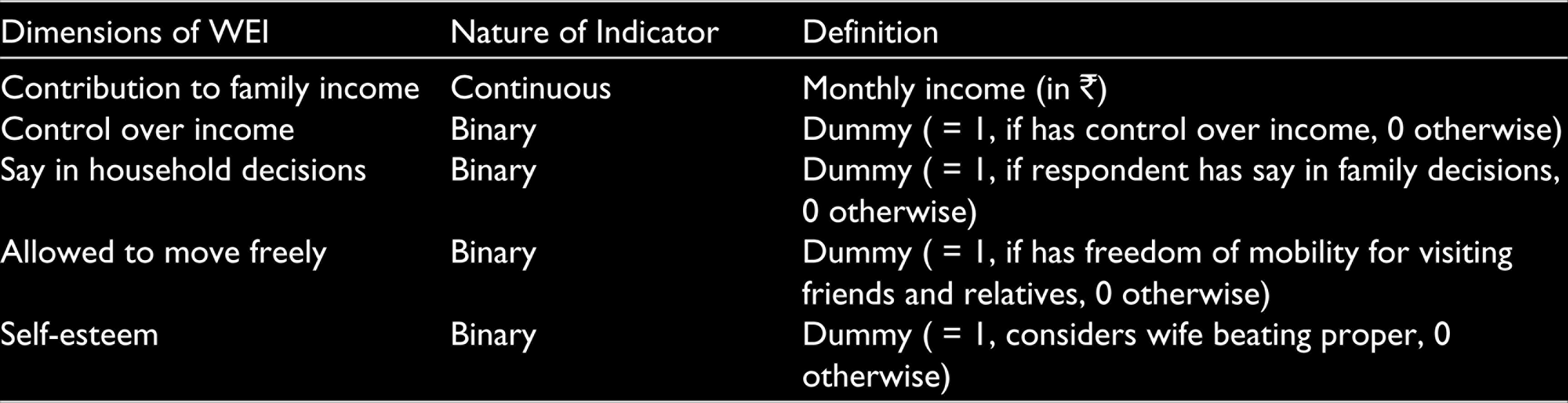
Finally, a Women’s Empowerment Index (WEI) was constructed for each female respondent by employing principal component analysis (PCA) using indicators such as control over income, decision-making, freedom of mobility and self-esteem as shown in Table 1. PCA was preferred to multiple correspondence analysis (MCA) as one of the indicators, namely income is continuous. The first component was used to compile the index.
Components of the Women’s Empowerment Index (WEI)
Analysis and Findings
Descriptive statistics relating to trainee (treatment) and non-trainee (control) groups are shown in Table 2. The mean age of respondents in the trainee group is less than that of the non-trainee group by 1.57 years, while the average years of education (in completed years) is greater by 1.57 years in case of the former as compared with the latter. A significantly higher proportion (50%) of respondents in the treatment group has studied after school, while in the case of the control group, the corresponding percentage is around 30 per cent. On the contrary, a higher proportion of respondents in the control group are married as compared to the treatment group. While labour force participation rates are somewhat lesser in case of males for the treatment group, the situation is reversed in case of females for whom the LFP is significantly higher for the treatment group than for the control group. Likewise, the difference between employment rates between the treatment and control groups are higher for females than for males. On an average, employed persons in the treatment group earn ₹11,988 per month which is about ₹3,468 more than the average monthly earnings of employed individuals in the control group. Around 85 per cent of the employed respondents in the treatment group are into wage/salaried employment, while the proportion of self-employed respondents is found to be higher in case of the control group. Other statistics relating to household characteristics such as caste, household size, age and education of household head are self explanatory and do not warrant further discussion.
Descriptive Statistics of Trainee (Treatment) and Non-trainee (Control) Groups
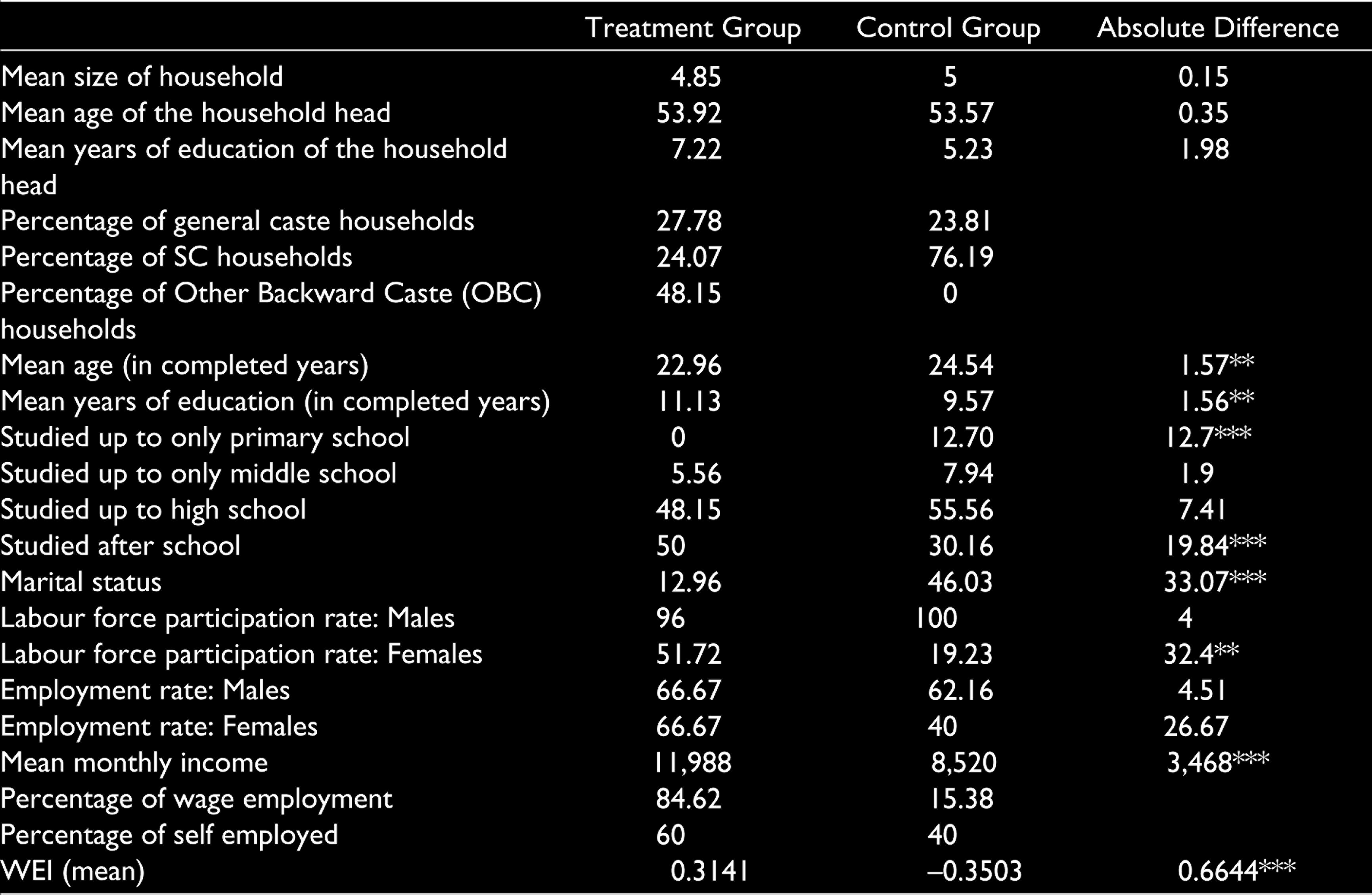
Table 3 presents some additional statistics that are relevant in evaluating the employment status of the trainees. The programme being placement linked, it is observed that 100 per cent of the respondents who received training, both males and females, were given placement after the successful completion of the course. However, it is imperative to take stock of the employment situation of the group after a certain time lag (two years in our study) in order to allow the labour market impact of the programme to fully work itself out which would facilitate a better understanding of the actual impact of the programme on job status. It is evident from the table that the proportion of respondents who were employed two years after the completion of training fell to around 67 per cent for both male and female respondents. Thus, 33 per cent of the respondents who are currently in the labour force are unable to get employment after having left their initial placement jobs for personal or other reasons. However, it may be recalled from Table 2 that in comparison to the control group (non-trainees), the employment rate among trainees is somewhat higher for males and significantly higher for females indicating that despite receding employment rates, labour market prospects may still be relatively better for trainees as opposed to non-trainees. Further, it is also found that only 19 per cent of the male trainees who are currently employed are still continuing with the job offered by PIA, while in case of females, the proportion is 100 per cent. This implies that while male trainees display a higher propensity to change jobs in search of better opportunities, women trainees prefer to stick to the placements made available through the PIA. Further, the employment structure of the trainees is heavily biased towards the wage employment with 75 per cent of the male trainees and 100 per cent of the female trainees being engaged in wage/salary based activities.
Job Status of Trainees: Post-training Placement and Current Scenario

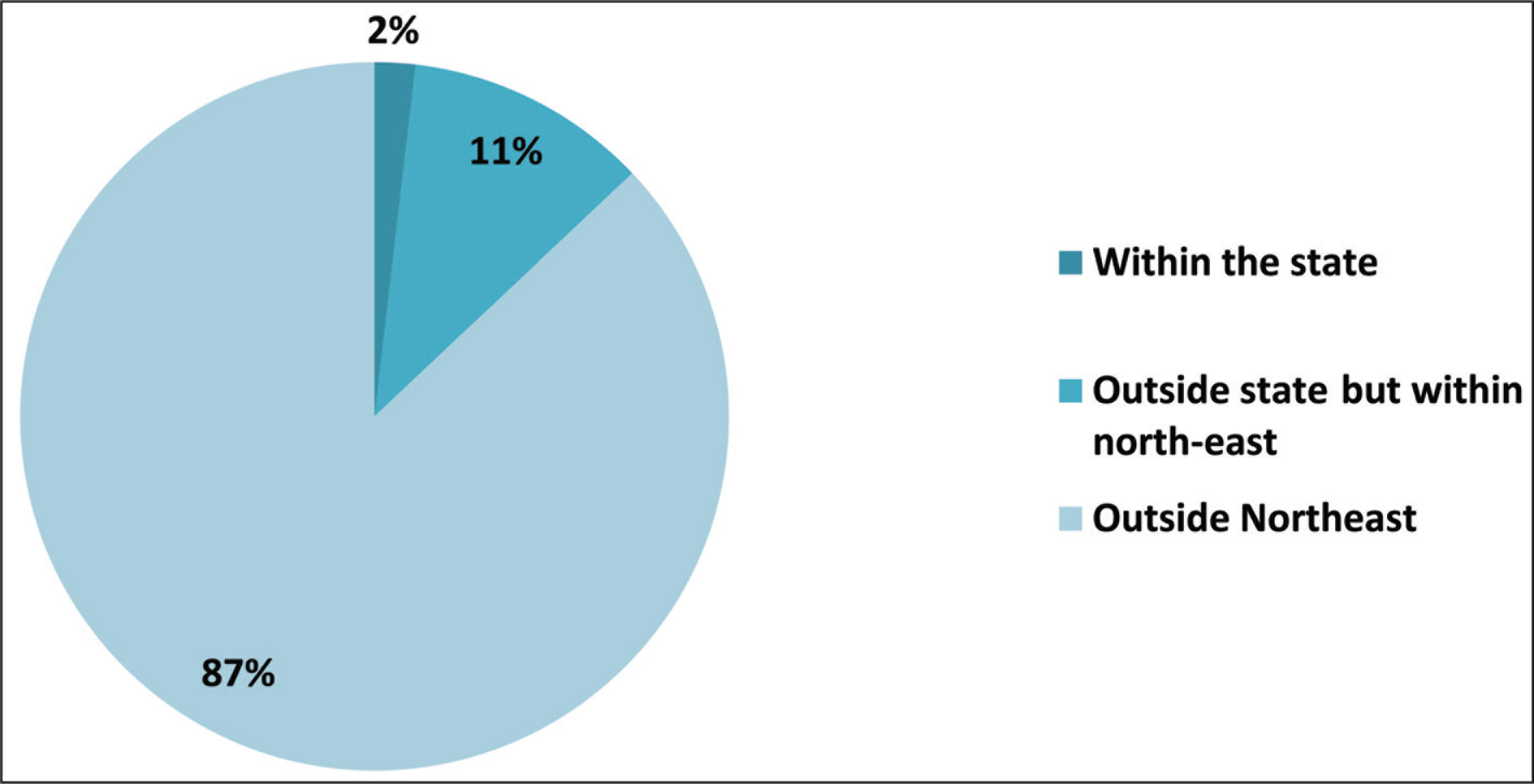
Post-training placement location is shown in Figure 1. It is found that only 2 per cent of the respondents reported having a replacement within the state while an additional 11 per cent said the placement was provided outside the state but within the Northeast region. The bulk of the placements (87%) were given outside Northeast. As we shall see later, these far off placements not accompanied by commensurate salary often make it difficult for people to continue in these jobs, resulting in a falling rate of employment in subsequent time periods.
The results of the econometric analysis of the impact of the training programme on employment are shown in Table 4. As already mentioned, although the programme itself is placement linked, it is judicious to review the employment situations after a certain time lag (two years in our case) to decide whether the programme produces a substantive impact on the employment prospects of trainees as compared with non-trainees. It was observed from Table 1 that there were some differences between the treatment (trainee) and non-treatment (non-trainee) groups with the mean age being somewhat lower and average years of education being relatively higher for the treatment group compared to the control group. However, in both the selection equation and the outcome equations in Tables 4 and 5, suitable controls have been used to account for the impact of age and education, among other factors, on LFP, employment status and incomes of individuals. It is observed from results of the first-stage probit regression (selection equation) in Table 4 that probability of an individual participating in the labour force is not significantly higher for the treatment group as compared with the control group. In other words, it cannot be asserted that a person who has attended and completed the training programme is more likely to seek employment in the labour market as compared with non-trainees. This follows from the fact that the coefficient of the treatment dummy in the selection equation of Table 4, although positive, is not statistically significant. Although training has no discernible impact on LFP, other individual and household characteristics influence the chances of a respondent being in the labour force. Thus, the likelihood of an individual being in the labour force increases with an increase in age and also if the respondent belongs to the Scheduled Caste category (as compared to General category households which constitute the base category). The coefficient of the dummy variable relating to Other Backward Caste (OBC) has not been found to be statistically significant. The selection equation also included a set of interaction dummies relating to sex and marital status to see how these two factors interact amongst themselves to impact the labour market choices of individuals. Since there are two categories each for sex (male and female) and marital status (married and unmarried), four possible combinations are conceivable, namely male and married, male and unmarried, female and unmarried, and female and married. Taking the last group as the base category, it is found that the probability of all the other three groups to be in the labour market is significantly higher. In other words, as expected, if the respondent is female and married (base category), the chance of participation in the labour force is reduced. Surprisingly, the coefficient of education in the selection equation was not found to be significant. Likewise, the coefficients of other household variables such as household size and education of the household head were also not found to be statistically significant indicating that they do not remarkably impact on the labour market decisions of individuals.
Impact of Training on Employment Status of Trainees: Results of Heckman Probit Regression
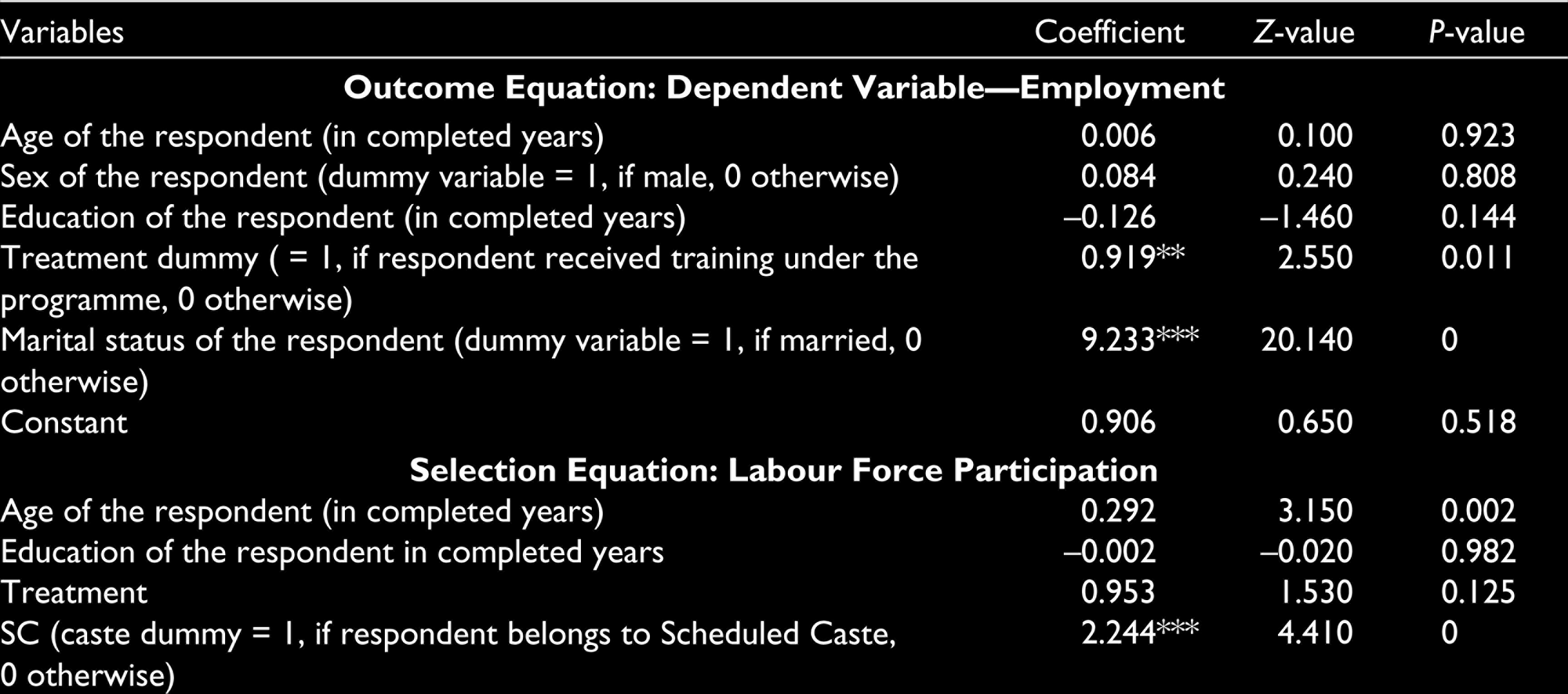
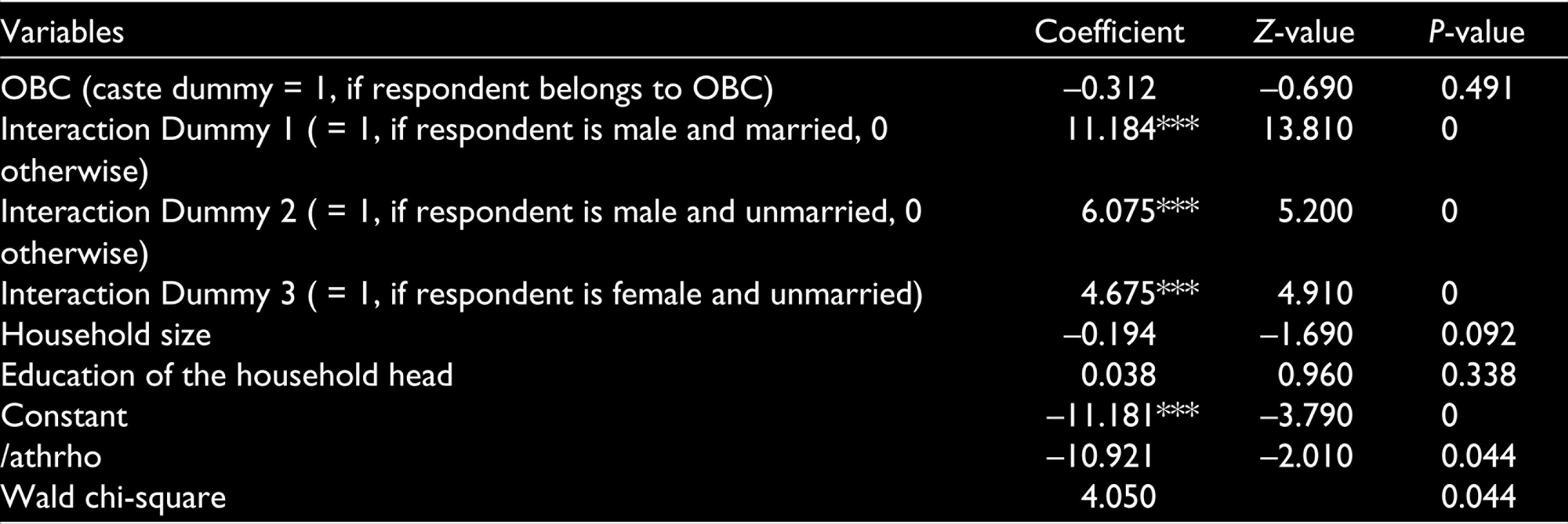
We now turn our attention to the impact of treatment on the employment status of the respondents while at the same time accounting for the other covariates which are also likely to influence the outcome, namely age, sex, education and marital status of the respondent. It is found that the coefficient of the treatment dummy is positive and highly significant which shows that for those who are in the labour force, the probability of an individual finding employment is significantly higher for trainees as compared to non-trainees. In other words, although training may not significantly increase the LFP of individuals, it certainly improves the prospects of finding employment by those who are looking for work. Again, the coefficient of education has not been found to be significant. This can probably be explained by the fact that an educated person may be more selective in terms of taking up certain types of employment as compared to those with relatively fewer years of education. In other words, more educated people have higher reservation wages and may choose not to work if the current wage is less than the reservation wage. Age and sex also were not found to be significant in influencing the employment status of individuals. However, marital status of the individual has a significant impact on employment status indicating that if a person is in the labour force and married, he/she is more likely to be employed than his/her married counterpart, owing probably to the simple reason that he/she may choose to work at the prevailing wages as compared to the unmarried individual, given family obligations or responsibilities. The estimation process of both the outcome and selection equations used robust standard errors. The value of the Wald chi-square given in the last row is statistically significant revealing that the selection and outcomes equations cannot be estimated independently, and the use of the HPM for jointly estimating the LFP equation and the employment equation is indeed necessary.
Table 5 presents the results of the HSM which captures the impact of training on the income of respondents. The coefficient of the treatment variable is positive and highly significant. The outcome equation in this case being linear, the interpretation of the coefficients is quite straightforward, unlike in the case of the HPM shown in the preceding table. Thus, an individual who received training through the PIA, on an average, is expected to earn ₹4,489 more than the respondent who has not undergone such training programme. Similarly, if the respondent is married, the monthly income is significantly higher than his/her unmarried counterpart. The coefficients relating to other individual characteristics such as age, sex and notably education have not been found to be statistically significant. The selection equation for LFP is the same as that of the HPM shown above. The interpretation of the coefficients of the equation is similar to that of the HPM and does not warrant a repetition here. However, it is important to note that the Mills’ lambda has been found to be statistically significant which indicates that the income equation and selection equation are not independent of each other and that the use of Heckman two-step model is indeed warranted. Another indication that the income equation and the LFP equation are not independent is that the value of rho which shows the correlation between the error terms of the two equations is very high at –0.91.
Impact of Training on Income: Results of Heckman Two-step Model

Participation in the training programme is not only found to be having a beneficial impact on employment opportunities and income but also on the QOE, adjudged in terms of formal sector employment. In other words, a respondent who has undergone the training programme is more likely to be employed in the formal sector as compared to the non-trainees. This can be concluded from the results of the probit regression presented in Table 6 which reports the marginal effects of selected covariates, namely age, education and treatment on the likelihood of a respondent being employed in the formal sector. It may be noted here that the dummy for gender was not included as an explanatory variable in this equation as it was found to predict the outcome perfectly. This result can be attributed to the fact that all females in the treatment group who are employed have held on to the jobs provided to them by the PIA, which were in the formal sector. It is observed from Table 6 that taking primary school and middle school education together as the base category, the probability that an individual will be engaged in the formal sector is 45 per cent higher if the individual has studied in senior secondary and above. The coefficient for high school education although positive is not significant. However, our chief interest is in the treatment variable, the coefficient of which is both positive insignificant. It thus follows that an individual belonging to the treatment group has nearly 35 per cent higher probability of finding employment in the formal sector as compared to the control group. This is further corroborated by the fact that while 100 per cent of the jobs provided by the PIA immediately after the completion of the training programme were in the formal sector, nearly 85 per cent of the respondents who changed their jobs thereafter said that they were engaged in the formal sector. Hence, it may be concluded that treatment facilitates formal sector employment. The coefficient of the age variable is negative implying that the likelihood of formal sector employment declines with the increase in age. The coefficient for this covariate has been found to be significant at 10 per cent.
Impact of Training on Quality of Employment

Finally, we turn our attention to the impact of the training programme on women empowerment. As shown in Table 1, the WEI calculated through PCA by considering five distinct indicators, has a mean value of 0.3141 and –0.3504 for women belonging to the treatment group and control group, respectively. In other words, it appears at the first hand that the WEI is higher for trainees as compared to non-trainees. This is further corroborated by the findings of the OLS regression which models the WEI as a function of certain explanatory variables which are likely to influence the value of the outcome. It can be argued from the results presented in Table 7 that three variables, namely senior secondary education, treatment and caste exert a significant and positive influence on the value of the WEI. More specifically, the value of the WEI is on an average higher by 0.82 (approx.) points if the respondent has studied up to the senior secondary level and beyond. The coefficient for the dummy relating to High school education although positive is not significant. Likewise, the value of the WEI increases by 0.84 if the woman belongs to a Scheduled Caste household as compared to a General category household. Although this result appears paradoxical to start with, it can be explained by the fact that the general category households also include households belonging to the Muslim community among whom the average value of the WEI (–0.51) is lower as compared to that of respondents belong to the Hindu community (0.21). The coefficient of the OBC dummy, on the other hand, was not found to be significant. However, the largest impact on the WEI was exerted by the treatment variable. Thus, the value of the WEI, on an average is 1.03 points higher for the treatment category as compared to the control group. The coefficient has been found to be highly significant. No visible impact of age on WEI was discernible from the results.
Effect of Training on WEI

It thus follows from the preceding econometric analysis that training produces a beneficial impact on labour market outcomes measured in terms of employment status, QOE and earned income. By opening up avenues of employment for women, it also serves to enhance women’s capabilities as measured by the WEI. However, this is not to assert that there is no scope for improvement so far as the overall satisfaction level, expectation of trainees and quality of training are concerned. In addition to collecting data on job market outcomes, the survey also collected information on other ancillary issues relating to the training programme imparted by the PIA, namely level of satisfaction with training, satisfaction from current job and causes of dissatisfaction. Column 3 of Table 8 depicts the level of satisfaction derived from the training programme by the 54 respondents who successfully completed the programme. It is observed that only 22 per cent of the respondents ranked the level of satisfaction from the programme as good while 57 per cent of the respondents said that they derived average satisfaction from training. About 11 per cent of the respondents said that they derived low satisfaction, while 9 per cent deemed it excellent. However, the satisfaction levels from the programme differ between male and female trainees. Nearly two-thirds of the female respondents said that they derived average satisfaction while in the case of male respondents, the corresponding figure was much lower at 40 per cent. About 16 per cent of the male respondents ranked their satisfaction level as excellent, while in the case of females, the corresponding figure was only 3.45 per cent. Despite the gender differentials in training satisfaction levels, the generic observation is that a higher proportion of both male and female respondents rank their satisfaction levels as average.
Satisfaction from Training by Gender

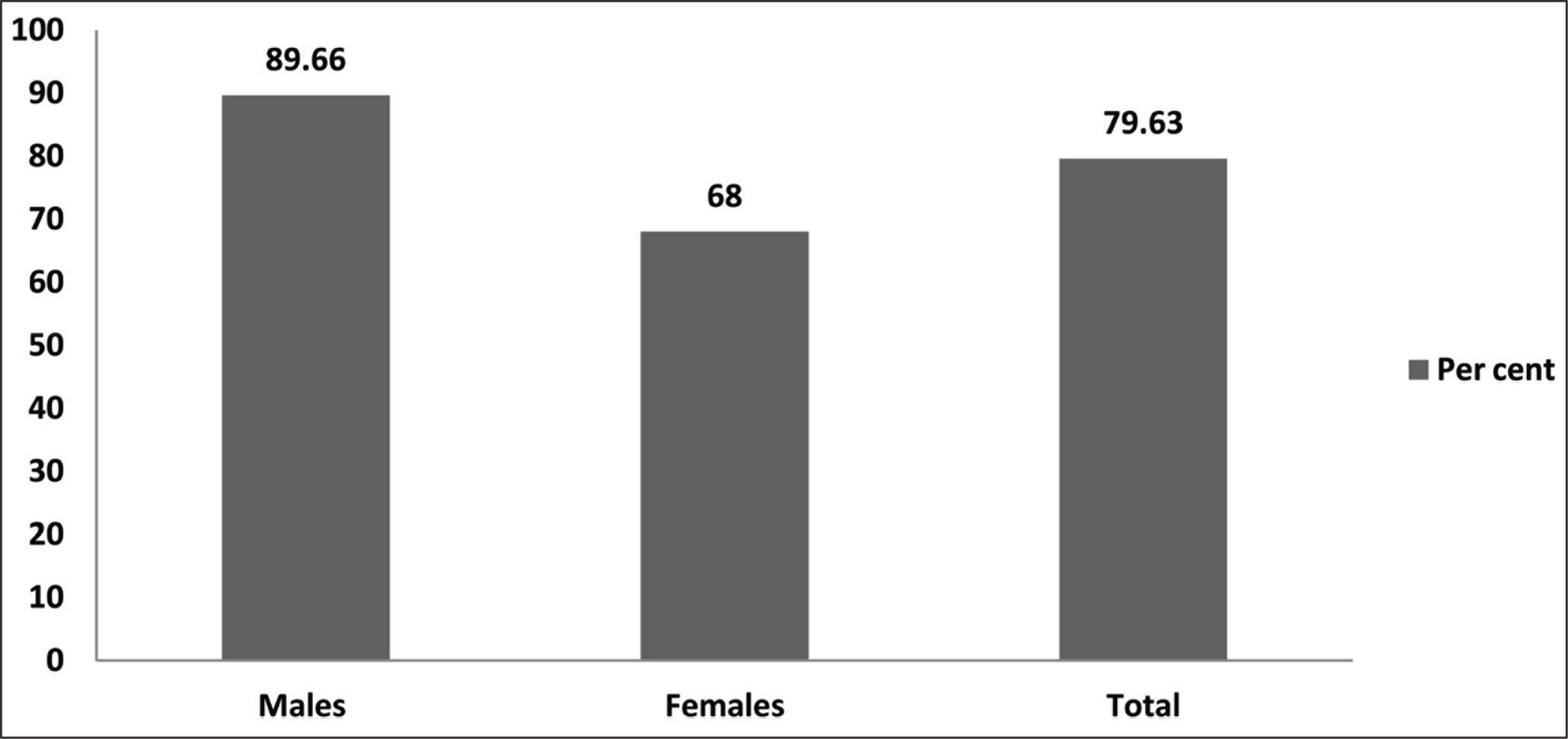
Probing further to gauge trainee satisfaction, the survey revealed that only 53 per cent of the respondents thought that the training helped them in finding a job (Figure 2). Again, gender differentials were observed in the manner in which the preceding question was perceived by male and female trainees. While 68 per cent of the males reported that the training they underwent was useful in terms of facilitating employment, in the case of females, the corresponding percentage was only 40 per cent. Around 80 per cent of the respondents who participated in the training reported that the programme helped in improving their skill base and boosting their self-confidence (Figure 3).

The survey also investigated the reasons behind the declining rate of employment over a period of two years after the high placement rates recorded immediately after programme completion. In particular, respondents who had left their initial placement jobs and were currently unemployed were asked the reasons as to why they had chosen to discontinue in the jobs that were provided through the PIA. The following causes were cited:
Salary: Several respondents were not satisfied with the salary that was being offered in their initial placement jobs, therefore finding it worthwhile to quit. Placement venue: As shown in Figure 1, nearly 9 out of every 10 jobs provided through the PIA were given outside the Northeast. These far off placements act as a deterrent to some individuals in continuing with their placement jobs. Lack of interest: The job which was provided through the PIA was outside their area of interest. Personal reasons: Personal factors such as family responsibilities and health issues also led some respondents to leave the distant placement jobs and return home. Skill mismatch: In some trades such as Electrical and ISMO, individuals reported a problem of skill mismatch in the workplace. In other words, the skills in which they were trained were not specifically suited to the requirements of the job; finding it problematic to continue, some resigned from their jobs.
Summary and Conclusion
In the backdrop of the theoretical importance attached by development practitioners to education and skill upgradation for achieving the goals of economic and human development and the current policy emphasis on skilling for enhancing the employability of India’s youthful population, this article has undertaken a case study to unveil the actual labour market outcomes of such TVET programmes for rural youths in the study area. Besides, the study has tried to ascertain the consequences of the programme for women’s empowerment and also to identify the loopholes that need to be addressed in order to make such ventures more effective. From the descriptive statistics relating to employment rates and a monthly income as well as the subsequent econometric analysis, it emerges that training produces a beneficial effect in terms of enlarging the scope of employment of rural youths while at the same time giving rise to a positive income differential in favour of the trained youths. Specifically, descriptive statistics presented in the beginning of the preceding section reveals that training has been particularly potent in securing improved labour market outcomes for the females in the rural areas by ensuring greater LFP and enlarging the opportunities for employment. This, in turn, has meant that a proportion of women respondents who underwent training were found to be making a positive contribution to family incomes, besides allowing them greater say in decision making within the household and enhancing mobility. All this is reflected in the higher average value of WEI for trainees as compared with non-trainees. Achievements notwithstanding, there are certain grey areas which need to be plugged for enhancing programme efficacy. In particular, it is observed that the employment rate declined significantly over time although initially, placement was provided to everyone. Several reasons were cited by the respondents as to why they had chosen to leave their placement jobs which included dissatisfaction with salary, far away placement venue and also skill mismatch in terms of training imparted and work requirements. It was further observed that opportunities of self-employment generated through the programme were remarkably low. Given the fact that several respondents in the trainee group, especially females, expressed their inability to continue in their placement jobs as the workplace was very distant from their place of origin; to increase the effectiveness of the programme it is desirable that the PIA should also aim to generate employment within the local economy. This can be done by encouraging self-employment ventures by arranging institutional credit through MUDRA loans and other schemes. Also, efforts need to be made to align the content of training with the job requirements of industry for avoiding post-placement skill mismatch and for optimising the realised gains of TVET.
Footnotes
Declaration of Conflicting Interests
The authors declared no potential conflicts of interest with respect to the research, authorship and/or publication of this article.
Funding
The authors disclosed receipt of the following financial support for the research, authorship and/or publication of this article: No funding was received from any agency for this work.