




Abstract
The interrelationship between human development, financial development and economic growth exhibited a very interesting yet peculiar fact that human development is the prime determinant of the development process bestowing significantly to economic growth as well as the development of the financial sector in the Indian economy. To explore short-run as well as long-run interactions between financial development, human development and economic growth of the Indian economy, the autoregressive distributed lag (ARDL) bound test has been employed. It is vital to state that financial development is detected as negatively impacting the growth of the Indian economy; alternatively, growth could have been additionally enhanced through auxiliary human development instead of emphasising financial development at large. Therefore, the need of the hour is to formulate concrete plans and policies to spearhead the development of human resources through the promotion of education and health facilities as an integral part of our policy frame which may axiomatically reinforce the potency of the financial system as well as economic growth in India.
Introduction
Economic growth has constantly been an area of interest and prime significance for policymakers. Since the dawn of human civilisation, every region strives for economic growth. The level of growth in any economy can be associated with a large number of variables including social infrastructure encompassing literacy aids, health facilities, etc. as well as financial infrastructure constituting varied indicators such as number of bank branches, credit facilities, market capitalisation, turnover ratio. No doubt, on the one hand, higher growth levels can be attributed to the better social and financial infrastructure standing, on the other hand, the latter is also impacted by the level of economic growth. Financial development may spur economic growth through the promotion of capital accumulation, augmentation of saving and investment rates etc., whereas demand for financial services increases as a result of economic growth leading to further financial development. Besides augmenting growth, a developed financial system may act as an essential stimulant of human development through the provision of easy credit facilities for better human capital formation. However, financial development may also adversely impact human development as it may exacerbate income inequalities as poor people have limited access to credit owing to a lack of collateral and guarantee for loans, whereas human development is viewed as favourably impacting financial development via rational decision-making.
Economic growth too keeps the potential of a positive impact on human development if it enhances the standard of living, literacy and health standard in the country. Human capital do contributes to economic growth through innovations and technological improvements. In a nutshell, all three variables-economic growth, financial development and human development, are interrelated. Now, a crucial question arises that which out of these three can be picked as a lead/key variable, so that along with human and financial development, economic growth may also be catalysed. The answer lies in the explanation of sediments of this complex relationship only. Though economists have long debated the interrelationship between financial development, economic growth and human development, yet no concrete and definite upshot arises. Hence, some questions haunt our mind: Whether the expansion of bank credit, financial markets, bank branches, profits of the banking sector, turnover ratio, etc. have promoted the cause of economic growth in our country? Whether better education and health facilities upholding human development are impacting our economic growth? Here one more associative query comes across that whether the economic growth in India has impacted the level of human development and financial development or not?
Keeping all this in mind, the present study intends to explore the interrelation among economic growth, financial development and human development to develop some logical reasoning to resolve above-mentioned queries.
To clinch the issue, existing literature on the subject has been recapitalised to extract various research gaps. Florilegium of earlier attempts has been sectioned into three categories: ‘Relationship between financial development and economic growth’, ‘Relationship between financial development and human development’ and ‘Relationship between human development and economic growth’.
Relationship Between Financial Development and Economic Growth
As far as the relationship between financial development and economic growth is concerned, there is continuing discussion regarding interlinkages between the both since the last quarter of the twentieth century. Famous American economist and noble prize laureate Lucas (1988) declares finance as an insignificant determinant of economic growth with no causal relationship between the two. He asserted that economists have overstressed the relationship between finance and economic growth. Conversely, King and Levine (1993) are of the view that financial development and economic growth are positively associated. This ideology can be supported by many other empirical research works, such as Levine and Zervos (1998), Beck and Levine (2004), Dritsakis and Adamopoulos (2004), Minija (2012) and Hailemarian and Guotai (2014).
On the other hand, Robinson (1952) (cited in King & Levine, 1993) contends that financial development simply follows economic growth. He puts forward the idea of growth-driven finance; explicitly financial development follows economic growth as economies expand. It positively impacts financial development on account of augmented demand for financial services. This idea can be termed as ‘Demand following hypotheses’ as well. Chakraborty (2007) and Paramati and Gupta (2011) have also presented similar findings.
When further literature on the theme is explored, we observed that some economists are in support of the idea of finance-led growth, that is, ‘Supply-leading hypothesis’. They believe that financial development promotes economic growth by easing the exchange of goods and services through the provision of payment services (Estrada et al., 2010), bridging the gap between savers and investors (Gomez, 2008, p. 7), enhancing the accumulation of capital (Goldsmith, 1969), mobilising savings to most efficient and productive uses (Bhole, 2004, pp. 15–16; Schumpeter, 1969), reducing information and transaction cost (Demirguc-Kunt & Levine, 2008; Levine, 1997). Numerous empirical studies, such as Outreville (1999), Beck and Levine (2004), Kenourgous and Samitas (2007), Caporale et al. (2009), Nowbutsing and Odit (2009), Tupe (2011), Isabel (2013), Ray (2013), Hailemarian and Guotai (2014), Kumar (2014), Omri et al. (2015), and Nyasha and Odhiambo (2016), have supported the idea of the supply-leading hypothesis in their respective work.
Another group of researchers feel that finance–growth relationship holds the bidirectional causal relationship too as they have emphasised upon the fact that the financial system develops as a result of economic growth and the strengthening of the financial system, in turn, accelerates economic growth. Dritsakis and Adamopoulos (2004), Odeniran and Udeaja (2010), Pradhan (2010) and Qin and Ndiege (2013) have already empirically verified this kind of bidirectional causal relationship.
Moreover, a novel and unique angle to view the issue of finance–growth relation is of ‘Too much finance’ (Loayza et al., 2018), which accentuates that excessive financial development can drag economic growth on account of allocation of resources to inefficient uses (Musta, 2016; Zhao, 2016), real negative returns of financial capital at its very high levels (Sahay et al., 2015) and shift of composition of credit to financial business (Bezemer et al., 2014). Moreover, at times of boom, skilled labour moves towards the financial sector which leads to growth of the financial sector at the cost of the real sector. Thus, the blossomed positive empirical relationship between financial development and economic growth could not continue during recent years (Alajekwu & Achugbu, 2012; Ayadi et al., 2013; Bezemer et al., 2014; Chakraborty, 2008; Iheanacho, 2016; Musta, 2016; Puatwoe & Piabuo, 2017; Saci et al., 2009; Zhao, 2016).
Relationship Between Financial Development and Human Development
Marching ahead in the arena of reviewing previous research endeavours, the relationship between financial development and human development has also been explored. Financial development can contribute towards human development through eradicating capital market imperfections, reducing poverty and income inequalities, through widening the availability of credit, savings, insurance services and thus enhancing the scope for individuals to invest in their education, skills and health (Levine, 2008). Education and health facilities, in turn, expand the opportunities and open the doors for improved skills leading to human capital formation.
Financial development indirectly too promotes human development by achieving high growth rates and consequent poverty reduction (Dhrifi, 2013). Much empirical evidence can be quoted here to support this idea; Jalilian and Kirkpatrick (2001), Ang (2008), Shahbaz and Islam (2011), Baligh and Piraee (2012), Monacelli et al. (2012), Sehrawat and Giri (2014) are to name a few of them.
On the other hand, human development also promotes financial development on account of improved skills for technological advancements and better decision-making, allocation of resources to efficient alternatives. Outreville (1999) proved that human resource development and socio-political stability are vital parameters determining financial development. Filippidis and Katrakilidis (2015) and Kuloglu and Ecevit (2017) can be seen as empirically supporting this viewpoint.
Relationship Between Economic Growth and Human Development
An extensive review of the literature regarding the relationship between economic growth and human development revealed that economic growth directly affects human development through its strong positive impact on literacy rate and health status on account of increase in private expenditures as well as government initiatives. In this regard, Kaur (2013) detected that economic growth inclined towards the welfare of poor keeps a larger influence on human resource development. Alternatively, Deb (2014) has raised the issue that economic growth has been reluctant to promote the level of health and educational development in India.
Whereas, human development, in turn, affects economic growth indicating the bidirectional relationship between economic growth and human development (Mukherjee & Chakraborty, 2007). Development of human capital enhances innovations and hence technological progress, the key determinant of economic growth (Shahbaz & Islam, 2011). Ramirez et al. (1998) affirm that human development facilitates countries to move into virtuous groups. Many empirical studies specifically Ranis (2004), Kaur (2013), Saha (2013), Chakraborty and Krishnankutty (2012) and Menon (2017) investigating the relationship between human development and economic growth have confirmed that human development leads to economic growth.
Although many studies are available regarding the relationship between all possible pairs of the above-discussed three variables, that is, financial development, economic growth and human development, yet the literature exploring simultaneous interaction among these three key variables is very limited, and only a few researchers have tried to explore such interrelationship. Evans et al. (2000) evaluated the role of human and financial development in the economic growth of 82 economies covering the span of two decades from 1972 to 1992 employing panel data and revealed that both human and financial development have played significant role in promoting rate of economic growth; however, their impact was influenced by quantity as well as the quality of inputs employed. Pradhan et al. (2013) have also explored the causal nexus among financial development, economic growth and social development on the basis of 15 Asian countries’ experiences from 1961 to 2011 and observed interrelationship varied from country to country. In the case of India and South Asia, economic growth and social development impacted one another; however, social development and financial development impacted each other only in case of Indian economy. Ahmed et al. (2020) have examined the relationship among financial development, economic growth and human development for Bangladesh for the study period 1985 to 2019 and detected a positive as well as significant impact of human development on economic growth; however, financial development has found to be negatively impacting economic growth.
It is pertinent to mention here that proxies adopted to represent human development and economic growth, in most of the earlier conducted research works are generally uniform, that is, human development index and gross domestic product at factor cost, respectively. But the proxies used to represent financial development have great variations across various existing studies mainly due to use of either different or only a few dimensions, restricting previous researchers to capture a composite, representative and reliable assessment of financial development and hence, further that of interrelation among financial development, human development and economic growth too. Our present research endeavour contributes to the existing literature as we have tried to reckon financial development in India in broader terms so that representation and accuracy level/inferences drawn out of results may be more reliable. We have constructed a composite financial development index for India involving both financial institutions as well as financial markets considering four dimensions—depth, access, efficiency and stability planked upon their respective representative indicators (see Note 2 and Figure 6 for detail of indicators and resultant indices’ formulation) and then established the interrelationship among human development, economic growth and financial development.
However, we cannot deny the fact that scant attention has already been given to this issue with evidence of a few works (Lenka, 2015; Minija, 2012; Razack, 2015; Sehrawat, 2015) devoted to composition of financial development index for India, but all of these studies are found as restricted to single or a few dimensions of financial development refraining to capture a comprehensive picture of financial development in India.
Further, it is also vital to quote here that financial development is not being measured by any authorised agency/institution in a comprehensive manner till date in case of India. Exceptionally, the World Economic Forum (2012) has tried to develop financial development index for different countries including India, but the indices developed at cross country level may not be suitable for in-depth analysis of any particular economy (including India) as the nature of financial development is quite heterogeneous across countries. Moreover, the financial development index developed by the World Economic Forum is not available on yearly basis regularly, limiting its usage in time-series analysis.
Undoubtedly, it is imperative to know the interrelation among financial development, economic growth and human development so that policymakers may decide whether to concentrate primarily on either economic growth or human development or financial development individually or possible subsets of these to design/restructure appropriate growth inducing strategy for our country. Keeping this perspective in mind, a null hypothesis has been formulated that—there is an insignificant interrelationship between economic growth, financial development and human development in India.
Database and Research Methodology
We have tried to investigate the interrelationship among financial development (FD), human development (HD) and economic growth (EG) in India based on secondary data covering the time span from 1991–1992 to 2016–2017. Economic growth in India has been measured in terms of the rate of growth of gross domestic product at factor cost spliced to the base year 2011–2012, and UNDP human development index 1 has been used as an indicator of human development in India. Since any comprehensive representative measure of financial development is not readily available; therefore, financial development of India has been reckoned by constructing a composite financial development index 2 on the basis of various indicators related to four dimensions, viz. depth, access, efficiency and stability of financial institutions, as well as financial markets. The secondary data have been collected from the Handbook of Statistics on Indian Economy (RBI, 2017a), Reports on Trend and Progress of Banking in India (RBI, 2017b), Statistical Tables Relating to Banks in India (RBI, 2017c), World Bank Open Database (World Bank, 2017), Website of Bombay Stock Exchange (BSE, 2017) and UNDP Human Development Data (1990–2017) (UNDP, 2018b).
To check the stationarity of data, augmented Dickey–Fuller (ADF) and Phillips–Perron (PP) tests have been employed. Autoregressive distributed lag (ARDL) bound test methodology has been used to examine the short-run and long-run relation between financial development, human development and economic growth.
ARDL model specification for analysing the relation between financial development, human development and economic growth is as follows:
Economic growth is a dependent variable, financial development and human development are explanatory variables:
Financial development is a dependent variable, economic growth and human development are explanatory variables:
Human development is a dependent variable, financial development and economic growth are explanatory variables:



where D represents the difference operator.
e1t, e2t and e3t are white noise residual terms of the model specified in equations (1), (2) and (3), respectively.
s, t and u are lag lengths of EG, FD and HD, respectively for model specified in equation (1).
p, q and r are lag lengths of FD, EG and HD, respectively for model specified in equation (2).
v, w and x are lag lengths of HD, FD and EG, respectively for model specified in equation (3).
t is a time trend.
The ARDL model evaluates l*(m+1) n regressions for obtaining an optimum number of lags, where l is equal to a maximum number of lags specified for the dependent variable, m is the maximum lag length for each of n explanatory variables. The model with the smallest AIC statistic performs better (Ahad & Muzammil, 2015; Tursoy, 2017) and, therefore, has been taken for model estimation and analysis.
The ARDL bound test examines the null hypothesis of no cointegration among variables and is based on Wald test F statistics that examines the joint significance of coefficients of lagged variables (Frimpong & Oteng-Abayie, 2006; Sehrawat & Giri, 2014).
The set of null and alternative hypotheses is presented below:
Economic growth is a dependent variable, that is FEG (EG/FD, HD)
H0: bFD2 = bEG2 = bHD2 = 0 H1: bFD2 ≠ bEG2 ≠ bHD2 ≠ 0 Financial development is a dependent variable, that is FFD (FD/EG, HD)
H0: bFD1 = bEG1 = bHD1 = 0 H1: bFD1 ≠ bEG1 ≠ bHD1 ≠ 0 Human development is a dependent variable, that is FHD (HD/FD, EG)
H0: bFD3 = bEG3 = bHD3 = 0 H1: bFD3 ≠ bEG3 ≠ bHD3 ≠ 0
The calculated value of F-statistic has been compared with two critical bound values; null hypothesis has been rejected if the calculated F-statistic is above the critical upper bound value, which means long-run relationship between the variables exists. If the calculated F-statistic is less than critical lower bound then long-run relationship between the variables does not exist (Pesaran et al., 1999, 2001). If the calculated F-statistic lies in between two critical bounds, then the result is inconclusive (Alimi, 2014; Katrakilidis et al., 2015) and the decision regarding the existence of long-run relation has been taken on the basis of lagged error correction term; if it is negative and significant then long-run relationship exists (Ahad & Muzammil, 2015).
The Breusch Godfrey serial correlation LM test, Breusch Pagan Godfrey heteroskedasticity test, Jarque Bera normality test and Ramsey’s regression specification error test have been performed to examine autocorrelation, homoscedasticity, normality of residuals and specification error, respectively. The cumulative sum of recursive residuals and cumulative sum of square of recursive residuals test has been used for assessing the stability of parameters.
Analytical Output
Stationarity Test
Table 1, depicting the outcomes of the ADF and PP tests, clearly shows that financial development in India is integrated of order one. Economic growth in India is also found to be non-stationary at levels; however, stationary at first difference in cases when neither trend nor intercept has been included, indicating that economic growth is integrated of order one. However, when only intercept has been included or intercept and trend have been incorporated, then economic growth becomes stationary at levels. This confirms that economic growth is also not integrated of order two. Besides, human development in India, when neither intercept nor trend has been included in analysis, is non-stationary at both levels and first difference. However, in the cases when only intercept or both intercept and trend have been included, human development is stationary at first difference. Since human development assumes an increasing trend during the study period, results of the test including the trend have been considered for further analysis, thus order of integration comes out to be one. Hence, the results of the unit root test have verified that all variables are integrated of the order less than two. Therefore, the ARDL bound test method can be applied for examining the relationship between financial development, economic growth and human development in India.
Results of ADF and PP Unit Root Test (Financial Development, Economic Growth and Human Development in India).
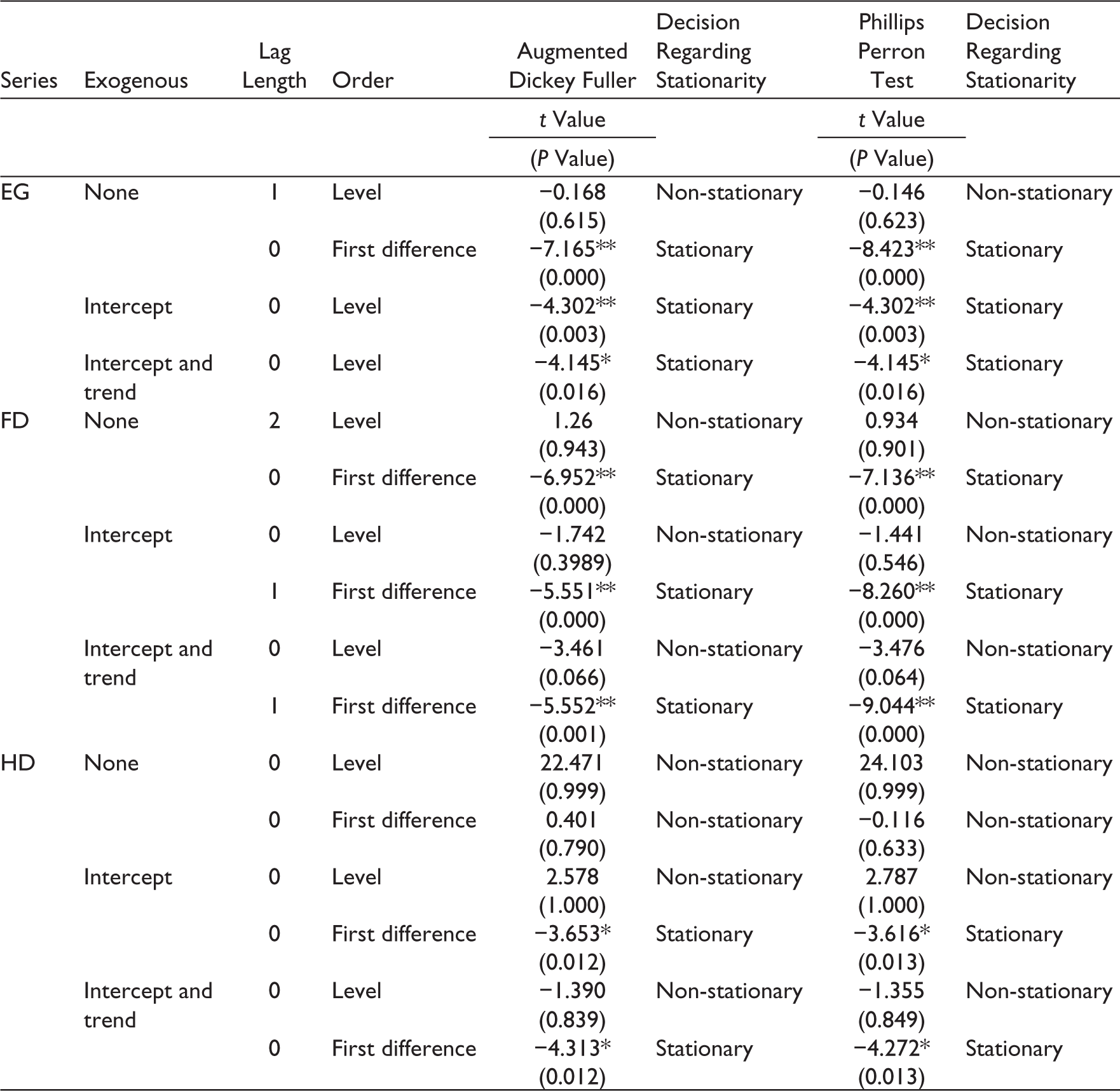
** indicates significance at the 1% level of significance.
ARDL Bound Test Model
Table 2 clearly reveals the presence of long-run relation between economic growth, financial development and human development when economic growth is considered as the dependent variable as well as when financial development is taken as the dependent variable.
Further, the results also imply that being economic growth as a dependent variable, disequilibrium on account of shock in the previous year has been corrected in the present year at a fairly high speed of adjustment of 85.10% and 66.20% of disequilibrium on account of shock in the previous year has been corrected in the current year when financial development is a dependent variable. Table 2 also reveals that when human development is a dependent variable, the results of the bound test are inconclusive. Conclusions can be drawn with the help of additional information that is with the help of error correction terms. The error correction model uncovers that the value of the lagged error correction term, 0.011 (0.302), is insignificant even indicating the absence of stable long-run equilibrium between human development, financial development and economic growth whilst human development has been considered as a dependent variable.
Results of ARDL Bound Test.

All the outcomes of diagnostic tests presented in Table 3 confirmed that the fitted model has appropriate econometric properties and correct functional form. Moreover, residuals of the estimated ARDL model satisfy the assumption of homoscedasticity, normality and non-autocorrelation.
Results of Diagnostic Tests.
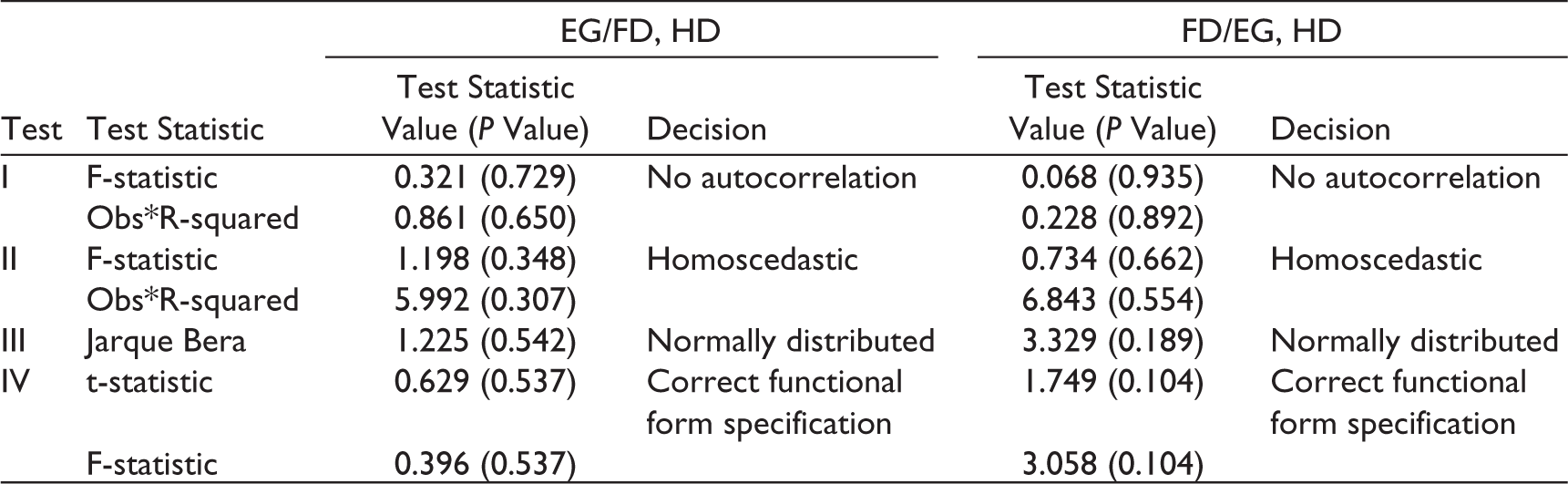
I indicates Breusch Godfrey Serial Correlation LM test.
II indicates Breusch Pagan Godfrey Heteroscedasticity test.
III indicates Jarque Bera Normality test.
IV indicates Ramsey RESET test.
Long-run and Short-run Dynamics
Table 4 discloses that when economic growth is a normalised variable, and long-run coefficient of financial development is negative (−5.920) and significant (P value = 0.063); however, the long-run coefficient of human development is positive (9.417) and highly significant (P value = 0.014). This manifests that the development of the financial system has negatively impacted economic growth in India. However, human development is significantly adding to economic growth.
Economic growth has a positive impact on financial development in the Indian economy in long-run as long-run coefficient of economic growth on financial development is 0.015 with P = 0.711. However, this impact is insignificant. Thus, economic growth in India has insignificantly impacted financial development. The coefficient of human development comes out to be 1.074 with P = 0.022, which indicates that human development has significantly and positively impacted financial development.
Short-run dynamics embodied in Table 4 unveil the fact that when economic growth is a normalising variable, the coefficient of financial development is insignificant; however, coefficient of human development is highly significant. This highlights that human development has positively impacted economic growth even during short run and a 0.01 unit increase in the human development index has led to a 4.726 percent increase in economic growth. However, financial development has insignificantly impacted economic growth in the short run. Further, considering financial development as a normalising variable, coefficients of economic growth and human development are insignificant during short period. All this expressed that neither economic growth nor human development has significantly contributed to the financial development of the Indian economy in the short run.
Stability Test
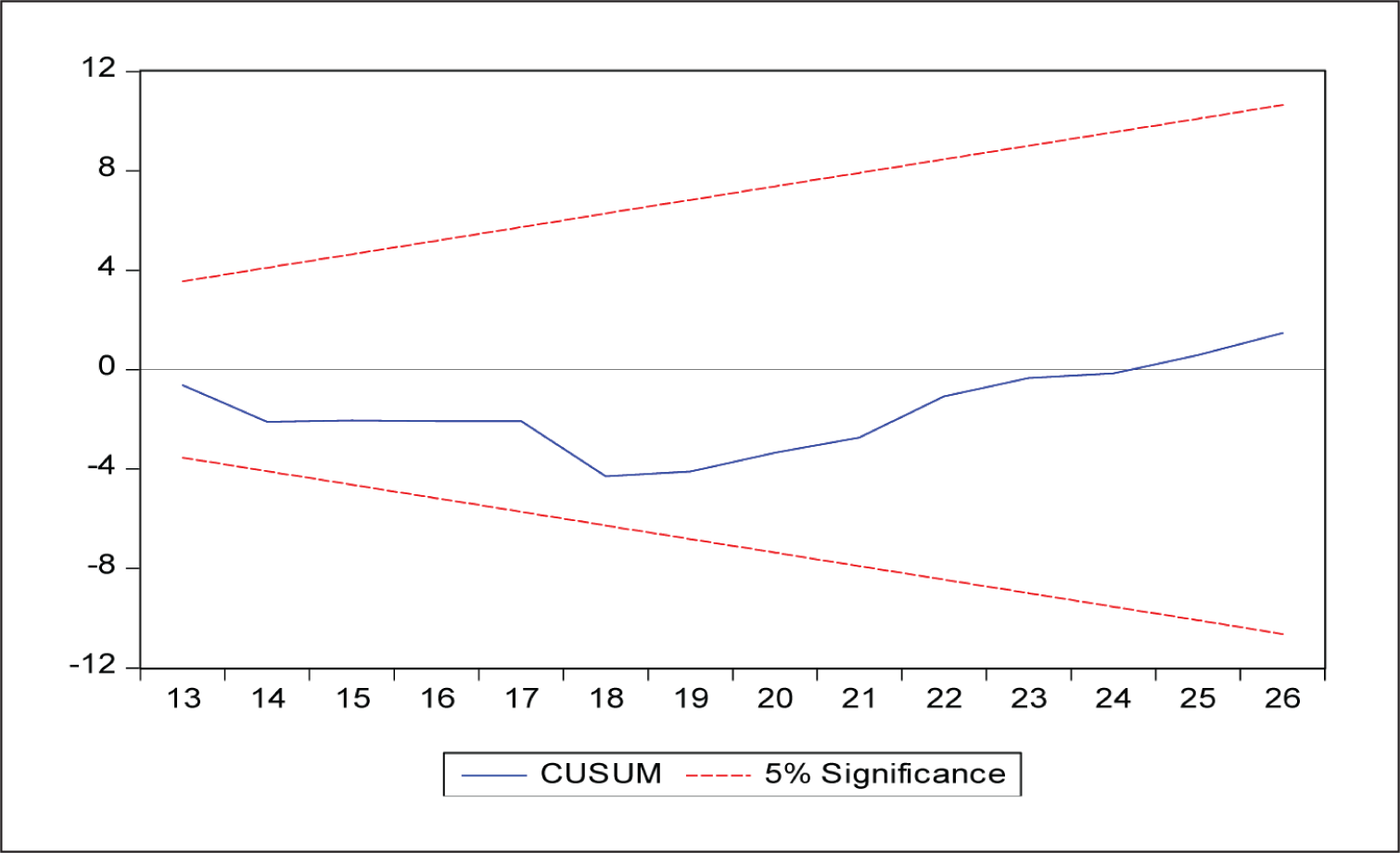
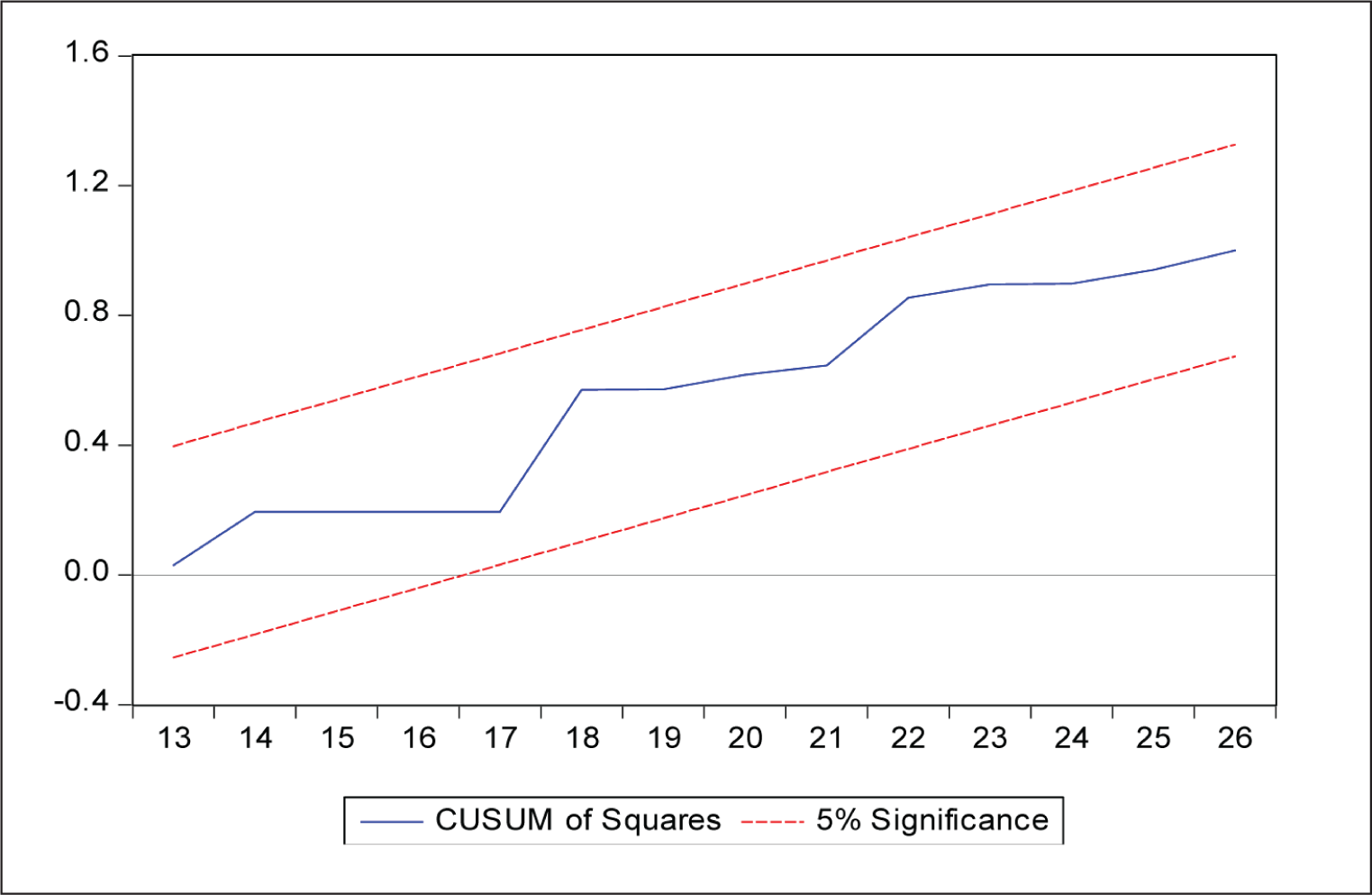
The plots of cumulative sum presented in Figures 1 and 3, and cumulative sum of squares presented in Figures 2 and 4, lie within parallel lines representing critical bound levels at the 5% level of significance, confirming the long-run stable relationship among variables.
Results and Discussions
The empirical explorations for the study period (1991–1992 to 2016–2017) have revealed a very interesting fact that human development has positively as well as significantly impacted both economic growth and financial development in India; however, financial development has negatively affected economic growth (Figure 5).
Estimated Long-run and Short-run Coefficients in ARDL Model.


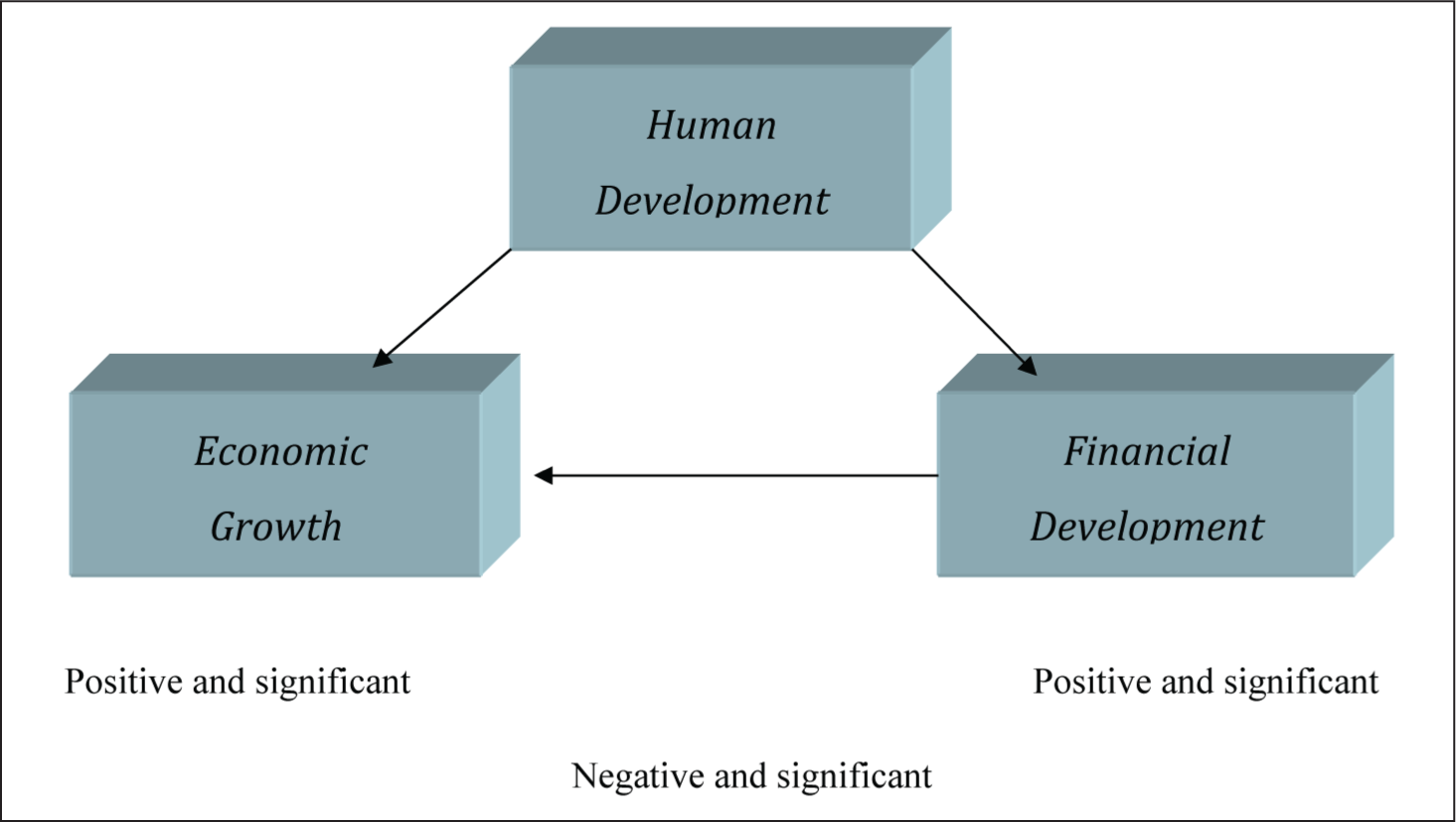
Human development, being constituted of three components, viz. income, literacy and health, has positively affected economic growth probably on account of the impact of its constituents on economic growth. An idea can be built that rising income levels might have directly contributed to higher levels of growth on the one hand and indirectly through raising the level of education and health on the other hand. Besides, improved levels of education might have positively impacted labour productivity effectively through innovations, technological improvement and concomitantly through improvement in income and health of people. Moreover, better health facilities probably have improvised labour productivity and efficiency of workers through enhanced physical, emotional and mental learning efficiency.
We have also detected on the basis of empirical findings that human development has positively impacted economic growth in India. This can be put forward strongly for ensuing policy recommendations. Our findings can be supported by Foster and Rosenzweig (1995) cited in Ranis (2004). They have also confirmed that higher education levels are associated with technological advancements. Moreover, Chakraborty and Krishnankutty (2012) demonstrated that expenditure on education has positively influenced economic growth in India. Examining the data from 1966 to 1996 for India, Self and Grabowski (2004) observed that primary education and female education strongly impacted economic growth. Kotaskova et al. (2018) also highlighted positive association between education level and growth of the Indian economy. Examining the impact of health on productivity growth in India, Saha (2013) discovered that improvement of health conditions positively and significantly affected total factor productivity. Menon (2017) has also detected that improved nutrition has increased the labour productivity in India. All these works too express consonance to our significant research finding that human development significantly impacts economic growth.
Further, the positive impact of human development on financial development in India may be opted as our attention-seeking finding by the policymakers. This kind of impact may have been observed due to influence of components of human development, viz. levels of income, literacy rate and health on financial development. An increase in income levels of individuals may lead to spur in savings, deposits and investments and hence the enhancement of financial depth. Better literacy levels might have led to proper decision-making regarding quality, quantity of investments as well as better allocation of resources, technological progress and innovations which in turn, might have led to increased access and efficient utilisation of available banking and insurance facilities.
Our finding, that human development has significant influence on financial development, is akin to outcomes of many earlier international studies. Filippidis and Katrakilidis (2015) proved that human development has a significant impact on the development of the banking sector in developing economies. Kuloglu and Ecevit (2017) have empirically confirmed that health variables keep significant and positive impact on financial development during long run in high-income countries. Pradhan et al. (2013) also verified that social development led to financial development for Thailand, Malaysia, Hongkong, East Asia and South Asia.
One more significant finding of our study is that financial development leads to a significant but unfavourable impact on economic growth in India, which is in consonance with recent findings of researchers in the field regarding relationship between financial development and economic growth that talks of ‘too much finance’ (Loayza et al.2018) accentuating that excessive financial depth forwards detrimental influence on economic growth owing to misallocation of resources and crowding out of other productive activities.
But this kind of finding (including that of our study too), that is, financial development negatively impacts economic growth is found in contrast with the findings of Chakraborty (2008), Pradhan (2010), Minija (2012), Ray (2013), Kumar (2014), Ghildiyal et al. (2015) and Sehrawat (2015), as all of them have empirically proved the idea of ‘finance-led growth’. The main reason for this repelling finding may be that all of these studies have adopted financial development in terms of a few indicators only, that too related to one dimension, that is, depth. However, Razack (2015), who broadened the concept of financial development using indicators related to two dimensions, that is, depth and efficiency, established that financial development in India had taken place at faster rate than economic growth. In the present study, we have considered four dimensions of financial development, that is, depth, access, efficiency as well as stability; therefore, our finding of negative impact may be treated as comprehensive and reliable.
Our statistical findings reveal that human development plays a pivotal role in promotion of economic growth as well as financial development. But the irony is that the development policies in India are spearheading investment relatively in financial deepening than promoting the cause of human development. However, the reality is that financial development has not significantly contributed to the economic growth in India. We opine that resources invested in the financial sector in India have not been optimally utilised, leading to a negative impact on economic growth. Although various efforts have been made to expand health, nutrition and education facilities, yet India is lagging in terms of human development with the human development index ranking as 131 out of 189 countries as per the UNDP Human Development Index report 2019. Moreover, the employment rate in the Indian economy is also low particularly during the last quinquennial period. Resultant, there is an increase in the level of insecurity among people especially youth, leading to some migration to other developed countries. Therefore, the need of the hour is to modify our development policies, and sincere efforts are to be made for strengthening the cause of human development in India.
The results and findings of the present study reject our null hypotheses and confirm that a significant long-run relationship exists among economic growth, financial development and human development in India, when economic growth or financial development has been considered as a dependent variable. However, there is an insignificant long-run relation among economic growth, financial development and human development in India, when human development has been considered as a dependent variable. Further, human development has significantly impacted economic growth as well as financial development in India, financial development has negatively impacted economic growth in India.
Conclusion
Human development is the prime determinant of economic growth as well as financial development in India. However, financial development has been detected as negatively and significantly affecting the growth of Indian economy, and economic growth has been found as influencing financial development and human development in an insignificant manner. The findings of the present study draw attention to the fact that human development is the key factor in the growth augmentation of the Indian economy; significantly impacting financial development too. Hence, human development is a crucial agent in promoting the cause of the growth of our economy as well as the financial sector. All this implies that spearheading the development of human resources may axiomatically reinforce the potency of the financial system and economic growth. Since human development has been found as a kingpin, therefore concreted efforts should be made for its upgradation to promote financial as well as economic growth of the country.
All this emphasises a due need of a precise role on the part of policymakers to devise conducive plans and policies to strengthen the base of human development via promotion of education and health facilities. Moreover, public sector attention and private sector inducement to invest in education and health sector can further improvise the level of human development, which in turn promotes financial development and economic growth as well. These days, the private sector has already emerged as a significant contributor in providing health and education services, yet a proper regulatory framework is required to supervise and monitor the cost and quality of services being provided by it. Moreover, regional disparities in the provision of health and education services need to be curbed through the provision of requisite funding to backward regions. As far as the health sector in India is concerned, though physical infrastructure is being spread, technical upgradation and availability of human capital are deficient to suffice the optimal level of health services. The education sector also needs further reforms in curriculum designing etcetera to bridge the industry–academia gap and meet international standards. Thus, policymakers can concentrate on the inclusive expansion of education and health facilities and ensuring quality in these sectors to promote human development and consequential economic growth.
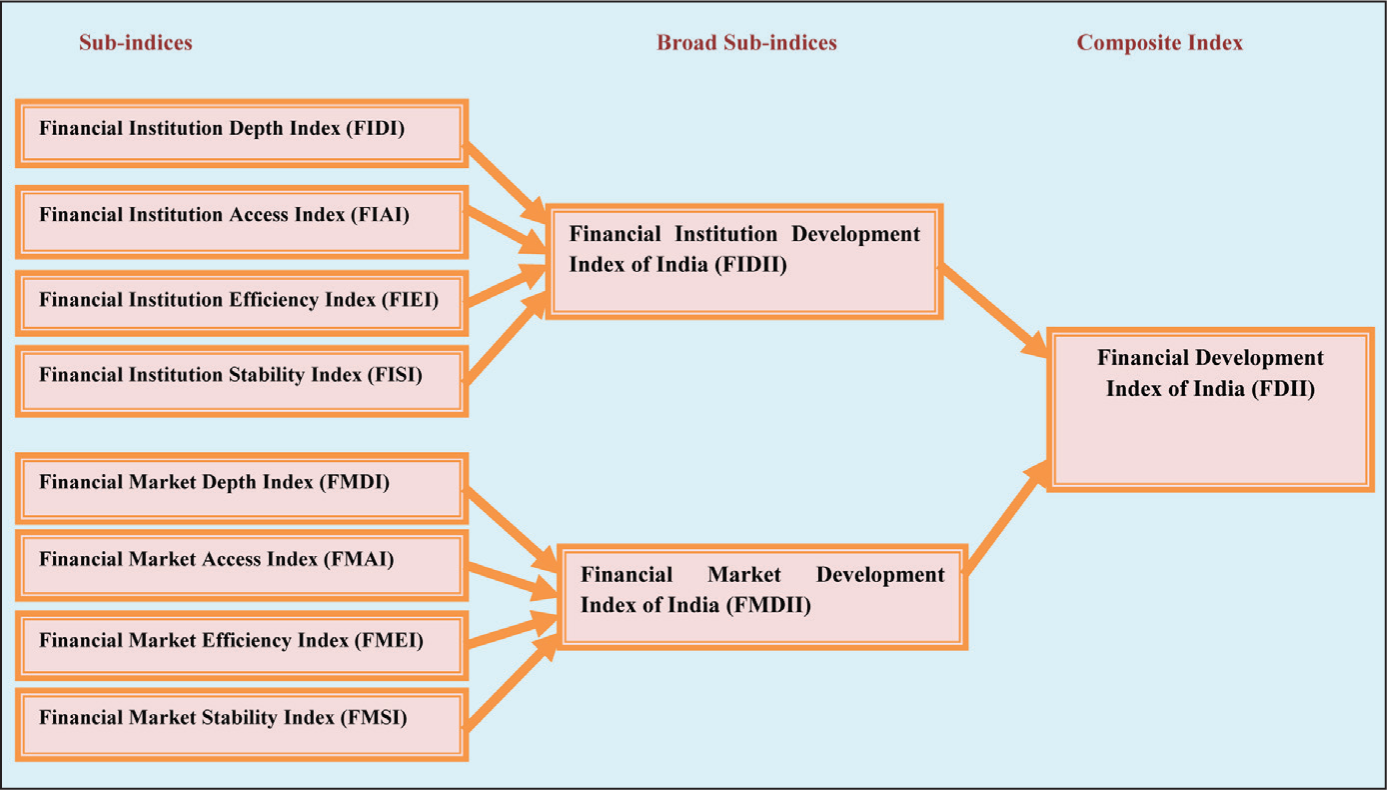
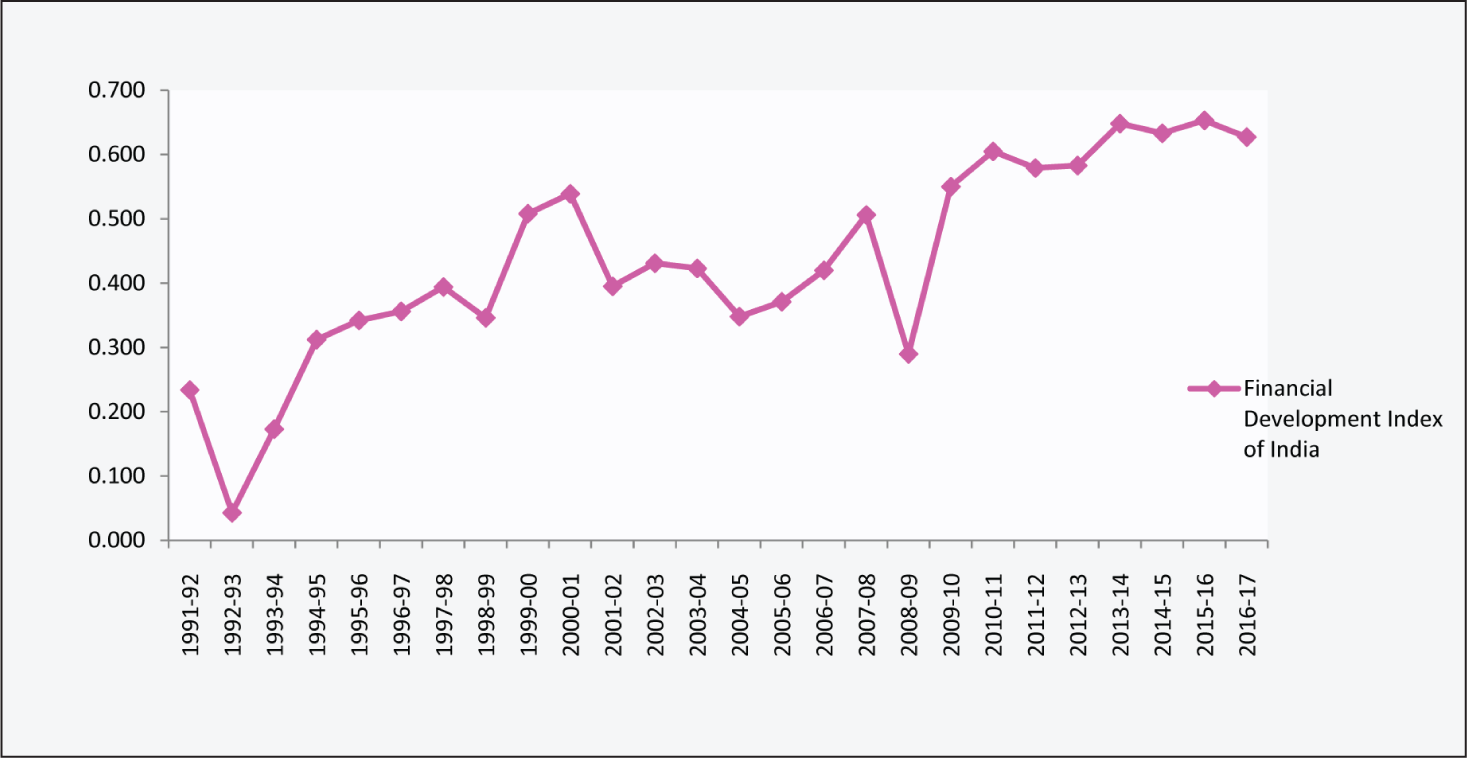
Financial Development Index of India.

As far as future research path is concerned, it is suggested that economic growth can be associated with the happiness index 3 as it is a relatively apt measure to proxy human welfare as compared with the human development index.
Footnotes
Declaration of Conflicting Interests
The authors declared no potential conflicts of interest with respect to the research, authorship and/or publication of this article.
Funding
The authors received no financial support for the research, authorship and/or publication of this article.