




Abstract
The paper explores the available housing options for migrant students based on a field survey in the National Capital Region. The study finds that most migrant students depend on private rental housing, particularly in the form of paying guests and independent flats at relatively higher charges. Students from affluent families prefer independent private accommodation in a better location, whereas those from lower-income groups prefer to stay in distant places from educational institutions. Further, the paper also finds that female students often incur higher accommodation costs as compared to their male counterparts. Besides being expensive, rental housing poses serious challenges to living experiences ranging from sustaining accommodation to managing higher education.
Introduction
Education and migration constitute important components of human capital. Education plays a transformative role in the lives of people in terms of their skills, autonomy, freedom and confidence, with a resultant positive impact on the overall development of a country. Schultz (1961) has pointed out its enormous contribution towards the growth of the economy. On the other hand, migration can help one to access education, and it leads to social and economic mobility among the individual. Educational migration, which depends on the demand and supply of human capital, has increased considerably in the knowledge-driven society across globe (Varghese, 2008). Young adults are believed to have higher aspirations to migrate to a place that will offer multiple benefits from a career perspective. These young people first leave their native area for different cities and towns within the state, and subsequently, they move to another state for quality education. Student accommodation has been an important area of concern with an increasing student population in any location. The higher educational institutions are incapable to provide adequate accommodation to the rising number of students enrolled in the institutions. However, the increased student population caused a shift in on-campus housing policy, combined with the spontaneous rise in commercial off-campus students’ housing development across the globe.
Higher education in India has expanded dramatically over the last two decades. The enrolment number has increased to 38.53 million in 2019–2020 from 8.8 million in 2001–2002. The capacity of hostels has grown slowly because universities have been slow to add to their hostel intake compared to the growth in student enrolment. For example, total enrolment in higher education was close to 39 million, while total hostel intake was only 7 million in 2019–2020 (MoE, 2019–2020). At the same time, educational migrants have increased significantly from one location to another for quality of education from 3 million in 2001 to 8 million in 2011 (Census, 2011). This suggests that an increase in the number of migrant students to various ‘education hubs’ significantly impacts the demand for student housing in the country (Padhan, 2018). Although there has been a significant amount of research pertaining to housing in India (Kumar, 2015; Naik, 2015), there is a dearth of research on migrant students’ and their accommodation (Padhan, 2017).
Against this background, this study explores different forms of accommodations and related challenges facing migrant students in the National Capital Region (NCR), 1 India. According to the Population Census of India 2011, Delhi reported the number of educational migrants increased to 1.32 lakh in 2011 from 81,000 in 2001. Further, in 2007–2008 Delhi had 84,000 educational migrants accounted for 15% of the total inter-state educational migration in the country (NSO, 2007–2008). Further, 1.18 lakh students stayed at a hostel in Delhi from other states in 2014 (NSO, 2015). In recent decades, several private educational institutions, for instance, Ashoka University, Global Jindal University, Sharda University and many more, have come up in the Noida, Gurgaon and Sonipat areas of the NCR.
This paper contributes to the emerging body of literature on student accommodation in four aspects. First, the paper explores different forms of accommodation for migrant students in the NCR. Second, the paper discusses the perspective of accommodations to migrant students having distinct characteristics regarding their gender and class. Third, the paper also discusses some of the pressing challenges that emerge in the life cycle of the students during their stay in the destination. Fourth, this paper sheds light on the policy implication of student accommodation in the context of contemporary higher education in India. The next section deals with existing literature on student accommodation. The third section discusses the collection of data and methods. The fourth section presents a detailed analysis of the student’s accommodations and different challenges. Finally, the paper concludes with some possible policy implications against the backdrop of contemporary higher education and urban housing policy.
Research on Student Accommodation
The profound impact student accommodation on their life has already been documented in the urban research studies (Garg et al., 2014; Ghani et al., 2016; Nimako & Bondinuba, 2013; Turley & Wodtke, 2010). Students have been divided on the basis of mode of lodging, i.e., on-campus or off-campus (Najib et al., 2015). Many students are compelled to stay off-campus because of the lack of hostel infrastructure (Pillay & Ngcobo, 2010). Developed countries could provide better housing amenities to students either in a hostel or private rental housing in the USA (Mtani & Nuhu, 2019). There is also a popular form of alternative housing, best known as ‘purpose-built student accommodation’, managed and regulated by private players mostly available in the Western world (Kenna & Murphy, 2021; Reynolds, 2020; Sage et al., 2013). In the absence of hostel infrastructure, accommodation outside of the campus is very costly, and it affect students on the academic and economic fronts. In many developed countries, including the United Kingdom, it has been reported that rising accommodation costs are a major contributing factor to students’ economic hardship (Accommodation Costs Survey, 2018). Evidence suggests that students have difficulty securing accommodation close to their institutions, particularly in large urban areas in the United Kingdom (Higher Education Authority, 2015). High cost accommodation forces students to work as part-time employees. The precarious living experiences of PhD students in Australia could be due to excessive rent in the private rental market (Ruming & Dowling, 2017). While leaving the parental home and venturing into a new phase of life, searching for accommodation becomes a distinctive challenge. Finding suitable accommodation for a relatively longer period is a challenging task for migrant students (Amole, 2009; Christie et al., 2002; Holdsworth, 2006; Munro & Livingstone, 2012).
Other studies have focused mainly on the established link between residential facilities and the students’ academic performance (Mathew, 2014; Read et al., 2020; Turley & Wodtke, 2010). Institutional hostel accommodation provides an educational input that enhances skills and knowledge through the availability of a library, saving time and money for the hostellers. Therefore, students living in the hostel perform better in the class, and their participation in various learning and extracurricular activities has also improves (Li et al., 2005; Pat-Mbano et al., 2012; Rinn, 2004). For instance, Kwame (2001) found that residential accommodation is the prerequisite factor for good academic performance among final-year students in Nigeria. Several studies suggested that the size of the house, rent, safety and security affect student satisfaction to a great extent; scarcity of time to allocate academic work such as participating in debates and discussions and use of library and internet facilities of the campus (Mathew, 2014; Modebelu & Agommuoh, 2014; Nimako & Bondinuba, 2013). Further, the challenges of transport costs and the inability to participate in the institutions’ social activities have received attention as well (Sen & Antara, 2018). Unhygienic environment is unsuitable for students to attend classes regularly in Tanzania (Mtani & Nuhu, 2019). Some pressing challenges also emerge from private rental housing like safety and security, neighbour disputes, landlord relationships, noise problems, hygiene, frequent shortage of water, disputes over payment, overpayment of monthly electricity bills, etc. (Addai, 2013). On the contrary, emerging literature from urban studies and geographies claims that higher education expansion has implications for the private rented sector in studentification (Smith, 2005; Smith & Holt, 2007). The numerous challenges that emerge out of the broad literature on student accommodation in different geographies reveal varied experiences for a migrant student. In this context, this paper repositions undergraduate students’ accommodation options and experiences as policy challenges for both state and central government (housing availability and affordability, as well as provisions of support for accommodation on ensuring safety and security), and also local government urban policy and governance initiatives.
Methodology and Survey Details of the Study
This paper is aimed at exploring the nature of housing adopted by migrant students in the NCR. The field survey was undertaken during October 2016 to March 2017. The relevant information was collected using a semi-structured interview schedule through the snowball technique from three representative universities., i.e., University of Delhi (DU), Jamia Milia Islamia (JMI) and Sharda University (SU), based on different types and nature of courses they offer. In the next stage, institutions were chosen based on two criteria. First, institutions must have a coeducational campus. Second, colleges that have the highest percentage of students enrolled from other states in chosen streams were collected through the Right to Information and National Assessment and Accreditation Council Self Study Report (NAAC SSR) for the academic years 2014–2015. 2 However, educational institutions of national importance and state universities were excluded from the study. Migrant students were defined as ‘those bona-fide final year students admitted in different institutes who had passed their last higher secondary examination in a state other than NCT-Delhi’. The final-year students were selected because they have adequate experience as a migrant in the educational environment of the region. The study has also used focused group discussion (FGD) among 10 landlords and student activists from different political groups as a part exploring tenant-landlord relations and understanding the varied nature of student accommodation.
Sample Profile
The total number of 296 respondents was analysed for the study on a careful consideration of the inclusion criterion. Out of the total respondents, 53% were from the general course and 47% from professional education. The sample contained 182 (61.5%) males and 114 (38.5%) females. For general courses, 64 students studying Arts in Hindu College (21.6%), 50 students studying Science in Kirori Mal College (16.9%) and 44 students studying Commerce in SRCC (14.9%) were surveyed. Similarly, 50 students (16.9%) from SU, followed by 48 students (13.5%) from JMI, were surveyed for professional courses. The remaining 40 students (13.5%) of management courses from CVS were surveyed. Out of the 296 students, an overwhelmingly majority of the students, 183 (61.8%), were staying as paying guests (PGs), followed by 64 students (21.6%) staying in a private rental apartment, 31 (10.5%) students staying in an institutional hostel and the rest 18 (6.1%) staying in the form of shared accommodation.
Typologies of Accommodation for Migrant Students in the NCR
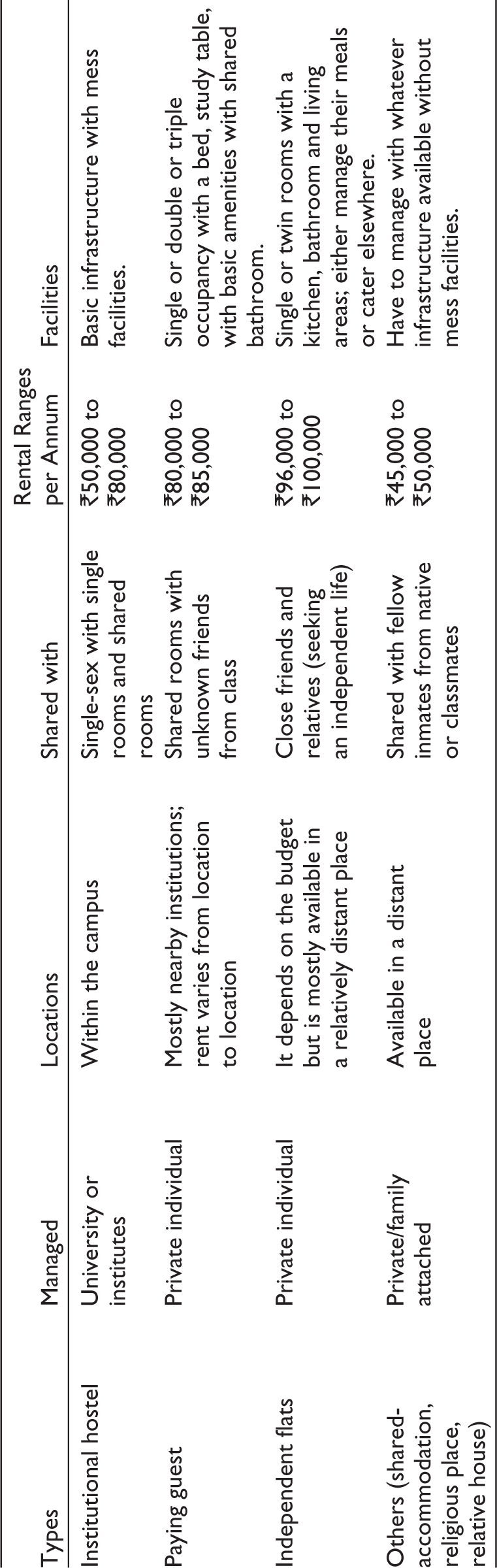
Basic infrastructure such as a sleeping bed, study table, clean water supply, bathroom, sanitary facilities, kitchen, drainage and electricity is essential for students. For accessing better learning convenient transportation and internet Wi-Fi are also necessary. Table 1 presents the different types of housing and their managerial ownership, location and the rental system and the facilities available to migrant students. There are four major types of accommodation available in the NCR for migrant students, which vary from area to area. The first category is institutional hostels provided by the institutions are mostly at an affordable price. Out of six institutions covered in the study, five institutions have hostel facilities, except in the College of Vocational Studies. The hostel’s facilities, range from beds to open space for sports and safety and security, as well as entertainment facilities such as a common hall. Further, students use the hostel facilities at a subsidised rate for food, water, Wi-Fi and other amenities based on their academic requirements. Second, paying guests (PG), facilities include a shared room, lunch and dinner on separate payment, beds, study tables, a chairs and shared bathrooms and a drinking water. The third type of accommodation relates private rental apartment or independent flat which provides freedom and liberty. Landlords who own several PG and rental flats are usually extracted motivated by higher rents from these young out-station students, who are desperately seeking better housing. The fourth type of accommodation is shared accommodations which comprise students in rental flats mostly attached to family properties. Students are taking it up in the group and dividing the rental charges equally. The accommodation charges range between ₹2,700 and ₹3,500 per month per head. This form of accommodation is preferred by relatively economically underprivileged students due to fewer rental charges. The shared accommodations are located in distant places in the cities. The studies have documented shared accommodation associated with students from low-income families (Verhetsel et al., 2017).
Type of Student Housing for Migrant Students in the NCR.
Accommodation Costs for Migrant Students in the NCR by Gender
There is an acute shortage of institutional hostels, and significantly far fewer seats are available as compared to the number of students enrolled in the region. It is quite challenging on the part of institutions to provide institutional hostels to the massive influx of students to the region. With a large number of migrant students, Delhi has very limited hostel accommodation. For instance, only 12% of students stayed in the hostel (DU, Annual Report, 2014–2015). As a result, a vast majority of the migrant students in the NCR are forced to depend on private rental accommodation. An overwhelming majority of the students stay in PG, comprising more than 73.7% of total female students and 54.4% of total male students. A sizeable proportion of the total budget is spent on housing accommodation in England, 30% (Christie et al., 2002) and 21% (Callender & Kemp, 2000). However, this study reveals that expenditure on accommodation that comprises room rent and energy consumption accounts for 47% of the total spending per annum in the NCR. Given this, students end up paying more for accommodation than academic costs. Students staying in rental accommodation need to commute from their residence to the college daily, which involves expenses on transportation. However, students can avail of the student pass 3 for commuting from their residence to institutions through Delhi Transport Corporation.
Further, students can avail of the hostel facilities subject to fulfilling the criteria. 4 The annual charge paid by students during an academic year is vary from college to colleges, and it depends upon the quality of facilities and the nature of the infrastructure. On average, female students have to pay ₹6,432 and ₹5,460 for male students for 10 months. That means female students have to pay an average of ₹972 every month, more than a male hosteller. One can also note that male students spend a small amount initially as annual charges or admission charges. The rest of the fees are paid in monthly instalments. In stark contrast, women’s hostels require students to pay a substantial amount at admission out of the annual charges. This happens in the same month when students have to pay their college tuition fees besides incurring the travel cost to the city. The rest of the fees are paid in fixed amounts within a fixed period; any delay leading to certain amount of fine. Rules like these act as deterrents against women, and parents remain hesitant about investing so much in their daughters’ education. Given this background, the institutional hostels provided by the university differentiate in charging prices based on gender.
It is reported that the price differentials for the accommodation charges for women’s hostels vary from one college to another. For instance, in 2015–2016, the highest amount of hostel accommodation charges were in Daulat Ram College (₹120,000), followed by Indraprastha College (₹112,700), and newly constructed college at Gandhi Vihar at ₹65,000. SRCC charges the lowest amount of ₹40,000 for 10 months (prospectus from various colleges). In contrast, private rental accommodation is costlier which students may sometime find very difficult to afford. Figure 1 presents the average monthly expenditure per student by nature of accommodation for both male and female students. Female students staying in PG have to pay ₹8,215 against ₹6,870 per month. Similarly, for male students staying in an independent flat, the average monthly expenditure is ₹8,930 compared to female students, which costs ₹9,842. The fees for women’s hotels has a gender dimension that is unfavourable for female students and tantamount to gender-based discrimination against female students. This price differential for female students creates barriers to accessing quality higher education.

In view of strict rules and regulations set by the owner of PG, sometimes students hire rental flats along with friends or classmates to stay independently and comfortably. Finding an independent rental flat from a private owner is again a challenging task for migrant students. The students also reported that landlords have been taking advantage of providing accommodation with exorbitant high rent. However, it is a double challenge to get a rental apartment for young girls’ due to the lack of safety and security. This is the reason very few girls’ (13% girls against 26% of boys) preferred to be in the independent flats in the region. Depending on the informal bargaining skills of the students, the brokerage charges (a middleman involves in settling all the agreements for providing accommodation) for 15–30 days (in the range of ₹5,000–10,000). Landlords initially provide very good infrastructure, but later fail to maintain even water quality. Irregular maintenance of water purifiers, lack of cleanliness and sanitation, and poor usage of sanitary goods are only a few examples. In the presence of the guardians, the landlords promised to offer everything without hesitations. Most of the freshers are cheated by the landlord in fixing the price and service delivery. Landlords demand a security deposit from students (the amount to be returned by the landlord once the contract expires) in any form of private rental accommodation. This security deposit typically ranges from ₹14,000 to ₹20,000 for two months of rental charges, depending on the type of accommodation and the rate of rent. This security deposit is a major financial concern for students from low-income families. Discussion among the landlords regarding security deposits reveals that the amount is to safeguard against rental defaults and to maintain the depreciation cost of the housing and different facilities.
Accommodation Costs of Migrant Students by Economic Status
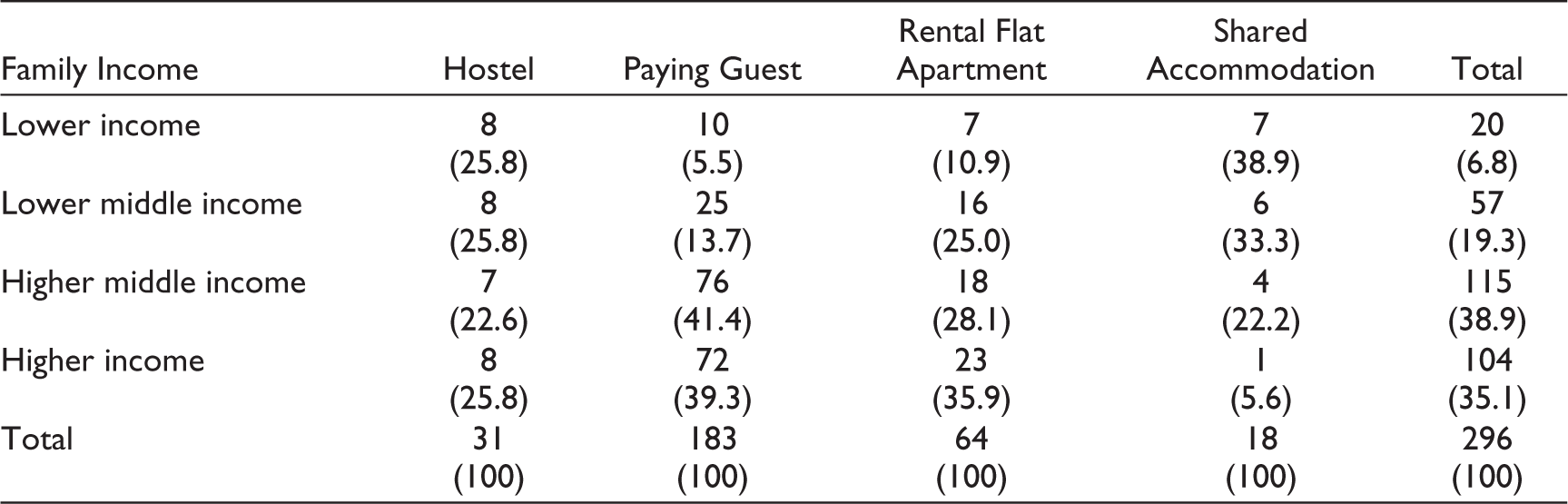
Economic status, as measured by family income, reflects the inter-group household difference of students from different economic classes 5. Students belonging to high parental income groups have higher possibilities to get more support for their education, including better accommodation. Table 2 shows that approximately 36%of students from higher-income families stayed in private independent flats, leaving fewer than 11% of students from low-income groups. The patterns are very similar for PG accommodations, where the majority of them (approximately 80%) are from the higher-middle and upper-income brackets. On the contrary, students (6.1%) from a low-income family stay with friends in private rental accommodations on a shared basis. These accommodations also include students staying with their relatives and sheltering in the religious and cultural centres they have chosen primarily because of financial constraints. This is a kind of coping mechanism to avoid high accommodation costs. As these students come from low-income families to India’s metropolitan cities to get quality education.
Annual Family Income of the Respondents by Type of Accommodations in the NCR.
In view of its proximity to DU and other private coaching institutes, students prefer to stay around in North Campus, in nearest (Kamla Nagar, Vijay Nagar, Maurice Nagar and G.T.B. Nagar, Hudson Lane) and near to South Campus (Satya Niketan and Anand Niketan) which is the hub of PG facilities for students. Private rental accommodation, such as PGs or independent flats, is in short supply in these areas. The price charged depends upon the distance from the location to the college and the facilities provided. On average, in Kamla Nagar, PG for girls is of a very high rate compared to other places. Students from higher-income groups choose quite expensive accommodations, which are also associated with furnished rooms near these areas as these areas. Those who were financially less privileged opted for cheap and poorly maintained accommodations like Gandhi Nagar, a relatively distant location. Students’ experiences have great potential to shape careers and help them lead a better life in the future. The challenges lie in the location and cost of accommodation and adjustment in Prayag Raj, Uttar Pradesh (Tiwari, 2022). Migration to a new city and an unknown environment posed serious challenges for students belonging to far-flung rural areas and low-income families. It has been documented that asymmetric information prevails in the rental student housing market as well. Students are in a difficult situation because they are unaware of the specifics of a new city’s accommodations. Further, issues such as eating habits, isolation, and homesickness were faced by Japanese students (Toyokawa & Toyokawa, 2002).
Lived Experiences of Migrant Students
The field survey reveals that searching for accommodation in the initial days is extremely stressful and difficult task. There is a huge rush observed when thousands of students arrive at DU at the beginning of the academic session. There are numerous barriers for a migrant student, such as negotiating with the real estate agents and landlords who ask for documents and sometimes validate their parents’ occupations and salaries based on which they provide accommodation. Many students recounted stories about real estate agents engaging in inappropriate behaviour. As a result, students are particularly vulnerable to exploitative behaviour when looking for an accommodation to live in and as tenants. Most students who live in private rental arrangements lack a formal tenancy agreement, leaving them without tenancy rights or legal protection. It is also observed that real estate agents (brokers) have their network or are affiliated with various online platforms such as
Learning requires a quiet environment, and accommodation plays a key part in ensuring a conducive atmosphere. The availability of a quiet environment was another challenge, especially for those living in private rental accommodations. For other students, especially females, the issue is related to the restrictions by the owner of the PG. An environment of an unsafe and uncomfortable place to live profoundly impacts students’ physical and mental well-being.
The living accommodations impacted students’ learning and experiences of higher education. PG rules unnecessarily restrict women’s access to learn skills from university and private entities like coaching centres. Because these students are here for a short period, they further limit women’s ability to access various opportunities like part-time employment to support themselves, participate in various sociocultural–educational activities, participate in competitions, or even take extra classes and coaching, which puts them in a disadvantaged position. Students need comfortable accommodation near the place of educational institutions and also should be entitled to get subsidised food, a conducive study environment and safety and security of life. The stories articulated the pain and anguish of the students on limiting the freedom to learn from public places.
There are challenges associated with the girls’ students in particular on safety and security aspects. The sense of fear-ness to those parents as well. Even after charging a heavy amount for accommodation, there is no uniformity in provisions of services from PG. There must be some consistency in how the PG rent is calculated.
During the COVID-19 pandemic, as virus is extremely contagious there was a lack of access to better sanitation and a separate room and toilet. The experiences of students reflected the type of accommodations available to students in the NCR, which is multi-sharing and often unsanitary. Poor sanitation, as well as a lack of separate toilets for students, could pose a serious health risk. Students’ experiences reflect difficulties not only in finding a place to live but also in carrying out day-to-day living activities and learning.
Conclusion and Policy Implications
This paper offers new insight into the urban student housing research in India. Higher education has been expanding significantly in terms of enrolment. Simultaneously, the number of student migrants has also increased, but not in proportion to the number of seats in institutional hostels. Private rental accommodations, which are often informal in nature, have largely dominant in the region. The lack of institutions’ assistance in locating accommodation, particularly for migrant students, impedes their learning and experiences. Female students have been spending higher rental amounts in both institutional and private accommodations, which has the serious implication for opportunities for quality higher education and limits the scope for elite and high-income class families. The majority of students from high-income families have a better chance of receiving additional educational support, including better accommodation. Students from low-income families confined to the far-flung areas of mainland cities as rental cost is comparable low and accommodation is on a shared basis. The brokerage fees and securities deposits required to obtain accommodation have had an impact on students from low-income families (Ruming & Dowling, 2017; Tiwari, 2022). These findings also stand corroborated with recent studies find that students preferred the high-cost independent flats, leading to a superior lifestyle and generating new forms of exclusion among student communities in cities (Kenna & Murphy, 2021). Furthermore, prevailing asymmetric information on various types of private rental housing impacts migrant students in an unfamiliar environment during the negotiation process, which is often disadvantageous for the students (Christie et al., 2002).
The selection of samples may have limited opportunities for generalisation of the aforementioned findings. We have considered only bona fide students for the study. However, thousands of migrant individuals are not enrolled in higher educational institutes and yet are undertaking private coaching for preparation to get into higher educational institutions and competitive examinations, which has immense significance in the life-course approach for youth. Their life experiences with regard to accommodation could be more precarious as they do not have any institutional affiliation, which is some time difficult to get accommodations since the segment of migrant students is growing at an enormous rate in every educational city.
The finding from the paper offers an opportunity to understand urban housing for migrant students in the ongoing policy discussion regarding the implementation of New Education Policy (NEP), 2020. The fact of growing internal student migration and their precarity with respect to accommodation in major metropolitan cities like Delhi.
Firstly, students from low-income families migrating to the cities in search of quality education are forced to spend more on accommodation. These exclusionary practices of a premier place of public universities posed many challenges when it comes to ensuring equity in accessing higher education in the country. Secondly, policymakers should pay attention to the cause of migrant students in the urban housing policy. The National Urban Rental Housing Plan Draft Report 2015 has proposed providing need-based rental housing for migrant labour, including students. Hence, the Ministry of Housing should urgently consider student accommodation needs. It is of the utmost importance to protect migrant students from private rental agents (brokerage fees) and to provide safety and security at an affordable rate. To reduce the economic burden on students, different alternative low-cost accommodations through government agencies such as the Housing for Urban Development Corporation (HUDCO) must be encouraged by involving local municipal corporations.
Thirdly, in the wake of the COVID-19 pandemic, students deserve a well-maintained hygiene accommodation as a part of a conducive academic environment and their overall well-being. The need of the hour is to ensure that every migrant students is able to avail of basic accommodation in cities. At the institutional level initiative it is necessary to take a more proactive approach towards reaching an agreement with landlords on proper lodging facilities in order to restore resilience among the migrant students. The policy response should aim accommodation support for migrant students, especially from low-income families.
Footnotes
Acknowledgements
This article is a part of my doctoral thesis on ‘Student Migration and Human Capital: A Case Study in the National Capital Region’ submitted at the Centre for the Study of Regional Development, Jawaharlal Nehru University. I am thankful to my research supervisor Professor Ravi S. Srivastava for his guidance and interest in this work. I would like to thank my respondents, the students’ friends interviewed for providing ample time and information for this field survey.
Declaration of Conflicting Interests
The author declared no potential conflicts of interest with respect to the research, authorship and/or publication of this article.
Funding
The author received no financial support for the research, authorship and/or publication of this article.