




Abstract
This article aims to analyse the causes and effects of the proliferation of renewable energy megaprojects in Mexico and India, delving more specifically into wind and solar power projects. Particular emphasis is placed on the fact that their presence is part of a planetary phenomenon, one that caters to global environmental and economic interests but is simultaneously guided by national contexts and policies. In this context, this article uses Andreas Malm’s (2020) concept of fossil capital, drawing a close connection between the inception of capitalism, which he locates at the start of the Industrial Revolution, and the proliferation of fossil fuel use. However, in recent years, clean energies have gathered momentum and attained a certain preponderance, yet the question of what actually is the role that these energies have come to play remains. This article frames the generation of energy as a structural matter to engage with this question. It is based on qualitative methodology, drawing on information from the author’s fieldwork experiences in Mexico as well as bibliographic and hemerographic review.
Keywords
Introduction
During the last several years, global energy consumption has risen considerably. In 2019, there was a 3.90% increase with regard to 2018, and in 2020 there was an atypical episode derived from the Covid-19 pandemic, in which there was a 2.70% decrease in energy consumption, which was followed by a bounce back in 2021, with a 5.56% increase in energy consumption, reaching the highest levels in a decade (López, 2021). It appears that this trend will continue along a similar path in the upcoming years, as it is expected that by 2050, global energy consumption will increase approximately by 50% and that renewable energies will follow the same pattern (Roca, 2021). Nevertheless, fossil fuels continue to play a dominant role, and although it is now common to speak of their scarcity, the dependence on them is far from disappearing. As a whole, fossil fuel consumption and production make up an intricate network in which both sides sustain and nurture one another. For this reason, the general idea of this text begins by analysing the role that fossil fuels have played, and continue to play, in the development of the international market and power generation. This article also analyses the irruption of renewables on the global scene as part of the so-called ‘energy transition’ 1 and aims to delve into the social costs of these energies, which, in spite of being considered clean, have multiple impacts on the communities where they are installed, causing their rejection by certain sectors.
This work is the product of reflections derived from previously conducted research in Mexico from 2014 to 2016. It is also the result of an extensive bibliographical and documentary review developed to understand the effects caused by the implementation of megaprojects, particularly on the ways of life of local communities. Thus, the objective of this article is to contrast the energy transition processes in Mexico and India from a general view of the political aspects that have allowed the proliferation of wind and solar energy megaprojects and some of their effects on local populations.
By doing this, this article will seek to shed light upon the striking general similarities between energy policy decisions and their effects in both countries, despite dealing with different continents and conditions.
In this way, this text puts forward an integral view of the energetic sector, which takes into consideration the influence of economic, political, environmental and social factors. At the same time, it establishes a comparison between Mexico and India by looking at various dimensions. For example, both countries saw an increase in renewable energy projects as of 2014 in spite of being extremely different. Likewise, the presence of these projects in rural territories has caused an upsurge of socio-environmental conflicts in both nations.
Indeed, the intrusion of renewable energy projects in both countries has had the same impacts on the same actors: farmers and rural and indigenous populations. The dispossession of land, unequal access to electricity or to a quality service, the elimination of natural areas of ecological importance and of those necessary for agricultural and livestock economic activities, as well as the non-existent creation of jobs have been documented and verified by several authors. 2 Therefore, it is precisely this double game that makes us contrast India and Mexico, because despite being dissimilar, they are going through a similar process, a fact that is a sign of the structural model imposed by these technologies.
Specifically in the Mexican case, renewable energy projects were favoured during the term of Enrique Peña Nieto. Under his presidency, the private sector was supported through various institutional means, and it openly received beneficial political and administrative facilities for the installation of projects of this kind. Unlike its predecessor, the current government, headed by Andres Manuel López Obrador, seeks to reclaim the role of the state as the largest energy producer and regulator, while incentivising the construction and modernisation of refineries to make Mexico less dependent on crude oil imports. Similarly, in 2021, India announced a plan for energetic ‘self-sufficiency’, whose goal is to be completely independent of fuel imports by 2047. However, it is moving towards the privatisation of this and other sectors, and although it has promised to radically reduce its CO2 emissions and produce 40% of its electricity from clean energies by 2030, the adverse effects of this plan are beginning to be seen. Furthermore, India is the world’s leading energy consumer and generator.
This article is made up of three sections: the first offers an energetic diagnosis and describes the emergence of renewable energies as an international priority; at the same time, it describes the particular cases of India and Mexico, where the increase in the number of wind and solar farms is clearly visible. The second section focuses on the social actors and the socio-environmental conflicts associated with these projects, while the third section places an emphasis on some categories and common points between both contexts. Lastly, the conclusions are presented.
Methodology and Conceptual Framework
This article is based on a qualitative methodology since it focuses on social case studies that constitute changing and developing facts. Its flexibility and inductive character are beneficial because it does not start with unquestionable facts or because its purpose is not to verify a phenomenon, but to understand it. At the same time, its inductive characteristic, which is based on dispensing with preconceived ideas and being holistic, humanistic and focused on understanding (Taylor & Bogdan 1986), allows for a broad vision of the problems studied. ‘Qualitative methodology is, therefore, a multidisciplinary way of approaching knowledge of social reality’ (Pérez, 2002), knowledge that can be apprehended by means of data collection without numerical measurement. Among the different data collection techniques is the documentary review, a fundamental part of this work. Books, scientific articles and journalistic notes recording social aspects associated with wind or solar megaprojects in Mexico and India were consulted, establishing an analysis based on the observation of common elements, contexts and differences that would allow contrasting both case studies. Official information provided by governmental institutions of both countries on energy development was also reviewed, as well as figures published by international agencies such as the International Renewable Energy Agency (IRENA, 2021a) and the International Energy Agency (IEA), which provide a general and global overview of the subject.
Although no fieldwork was carried out for the preparation of this article, the reflections expressed in it are the result of extensive research conducted in Mexico by the author, who has worked with people affected by energy megaprojects in the Isthmus of Tehuantepec, Oaxaca (the area with the greatest wind potential in Mexico and which currently has 30 wind farms in operation), Baja California and Yucatan. However, the study presented in the case of India is based on the aforementioned documentary review. Hence, with the intention of achieving an analytical balance, it was decided not to focus on the interviews that could be available as a result of these previous studies.
On the other hand, due to the fact that the energy landscape in which renewables are inserted is dominated by fossil fuels, which have even dictated political and economic guidelines, we will refer to the concept of fossil economy or fossil capitalism by Andreas Malm, who defines it as
an economy characterized by self-sustaining growth predicated on growing consumption of fossil fuels, and therefore generating a sustained growth in emissions of carbon dioxide. Thus defined, the concept refers to an expansion in the scale of material production realised through expansion in the combustion of coal, oil and/or natural gas. (Malm, 2013, p. 17)
In fact, renewable energies are a consequence of fossil fuels themselves, evolving as a response to their harmful effects.
In this sense, two questions arise: How relevant is it then to continue talking about fossil capitalism? And what role have renewables come to occupy in the current landscape?
Renewable Energies, Their Rise and Consolidation: India and Mexico
Today, energy is an indispensable resource for any nation, as it represents a better quality of life for the population and guarantees productive activities in the primary sector. Over the last few years, there have been discussions surrounding the potential recognition of access to energy as a human right. However, the considerations around this resource have largely remained linked to economic growth and to a greater opening towards international trade. For this reason, exploring the role of energy, and especially of fossil fuels, becomes a key step in order to understand the processes of industrialisation and the development of the trade system. Hence, it becomes pertinent to recover the proposal of Andreas Malm, who does not hesitate in naming this association as fossil capital.
According to Malm’s outlook, it is precisely in this relationship that one can find the origins of global warming, which emerges from the intensive exploitation of fossil fuels that has sustained financial growth. What he also refers to as a fossil economy can be defined as an economy based on the ever-increasing consumption of fossil fuels, which constitutes the main driver behind global warming (Malm, 2020). Nevertheless, in spite of their importance in sustaining economic growth, very soon the disadvantages of fossil fuels began to become clear: (a) their finite condition and (b) the environmental damage caused by their extraction and processing. However, a series of political and economic factors, as well as the potential threat of the imminent extinction of fossil fuels, have led to a situation where the possession of hydrocarbons has become a symbol of power.
Still, as a consequence of the scarcity and environmental impact of fossil fuels, during the last decades, the global trend has been to seek to limit the consumption of hydrocarbons and to give attention to the development of alternative energy sources considered ‘clean’ or ‘renewable’. Although by 2018, wind and solar power production represented eight times what it was in 1990, this did not stop the production of fossil fuels from also increasing at a similar pace; during those 28 years, the extraction of gas increased by 50%, and this is not surprising, as the consumption of electricity saw a similar tendency (International Energy Agency, 2021). In 2021, 63.1% of the total electric energy consumption in the world still originated from hydrocarbons.
Now, what is important to realise while looking at this data is the fact that, even though the world is giving an ever-increasing importance to renewable energies, and these have grown considerably during the last few years, such energy shifts are still far from representing a substantial change, as it has been demonstrated that electricity demand increases every year and with it also increases the extraction of traditional fuels such as gas, coal and oil. Because of this, the long-desired energy transition is far from being consummated and the fossil capitalism propounded by Malm remains not only a useful concept to describe the origins of capitalism in its close relationship with fossil fuels but also a useful conceptual tool to describe the consummation, replicability and ongoing adaptive capacity of this system.
In conclusion, we live today under a fossil capitalism, not only because we continue to greatly depend on these fuels but also because capitalism purports to anchor itself to renewable energies in order to guarantee its survival, by adopting a discourse that promotes sustainability but turns the territory, the wind, the sun and the water into merchandise for electricity production. That said, as it is visible in many places where renewable energy projects have been installed, this model has not only failed at solving inequalities in the economic sphere and in the field of access to energy but has rather contributed to aggravate them. Yet, how does this issue originate and play out in Mexico and India?
Of all the energy produced in India, 0.3% comes from oil, 4.5% from gas, 72% from coal, 2.9% from nuclear power, 10% from hydroelectric sources and 9.7% from renewables (solar, wind, biofuel and thermoelectric together) (BP, 2021). India’s case is of particular importance because at a global level the country is the second largest coal extractor, only behind China, even when internationally there is a downward trend in the exploitation of this resource due to its high carbon dioxide (CO2) emissions, which are superior to those of gas and oil (International Energy Agency, 2021). India also occupies the third spot in energy consumption, preceded by China and the United States of America. On this basis, India is also the third nation with the highest CO2 emissions, contributing to about 6.8% of global emissions (Solís, 2021).
It is also important to highlight that India is the most populated country on the planet, with a population of 1,428.6 million inhabitants. Thus, the country has a great need for energy production and industrial activity. Because of this, it is not strange that, even though the country maintains a strong dependence on coal, at the same time it occupies the fourth spot in the global rankings of renewable energy production.
During the last few years, India has invested a large amount of resources in the development of clean energies; in 2019, this investment rose to 8,400 million dollars. In 2020 and 2021, there was a setback in these numbers caused by the Covid-19 pandemic, with 6,400 million and 6,600 million dollars of investment, respectively (Velatia Networks, 2021). These resources are mainly funnelled towards wind and solar farms.
The majority of projects executed in India are developed by large independent power producers (IPP). The most important ones are local companies that have agreements with foreign financial firms … the buyer (government or industry) expresses the specificities of what he wants to purchase, and the sellers offer their products, in this case, the development of a power plant. (Oficina Económica y Comercial de la Embajada de España en Nueva Delhi, 2019, p. 5)
Currently, the country has 54 projects of this kind in operation, which amount to an installed capacity of only 44 GW, although a capacity of up to 695.50 GW has been estimated through 800 monitoring points installed across the country (Ministry of New Renewable Energy, 2022). On the other hand, India has a great potential for offshore wind power, that is, to install wind turbines over the sea. However, even though multiple studies have been conducted, and up to 17 wind farms of this kind have been considered for the country, with an inaugural proposal in Gujarat, none of these projects have materialised as of yet.
In the case of photovoltaic power, the largest electric potentials are concentrated in Rajasthan, Gujarat and Karnataka, even though power plants of this kind are installed throughout practically the whole country. The first Indian solar farm began operating in 2009 in Awan, Punjab, under the direction of the American company Azure Power.
Today, there are more than 46 photovoltaic farms in operation with a total capacity of 71 GW (Ministry of Power, 2023), although it is considered that the country could produce 748 GW at some point. Overall, wind and solar power have grown at an accelerated pace in India. From March 2014 to May 2022, the installed capacity of wind power increased by 93% as compared to a 2064% increase in solar power (PRS, 2023), but even so, the country failed to meet the target imposed by Prime Minister Narendra Modi: to reach 175 GW from renewables by the end of 2022, remaining at 119 GW. ‘Out of this, 62% of the solar power target (62 GW of proposed 100 GW), 70% of the wind power target (42 GW of 60 GW), 107% of the bio-power target (10.7 of 10 GW) and 98% of the small hydro power sector target (4.9 of 5 GW), had been achieved by November 30, 2022’ (Dubey, 2022).
Nevertheless, India still carries great limitations; approximately 64 million people, belonging to 13% of the households in the country, still do not have access to electricity (Nair, 2021). Moreover, ‘energetic policy is highly fragmented and decentralized. There is no institutional organ with complete authority over national energetic policy, but there are rather various ministries that share the power over the different aspects of energetic policy’ (Oficina Económica y Comercial de la Embajada de España en Nueva Delhi, 2019, p. 8). The country also does not have the necessary infrastructure to adequately transport and store the amount of energy produced from renewable energy sources.
Apart from that, CO2 emissions and coal extraction bounced back in 2021, reaching levels superior to those of 2019 (International Energy Agency, 2021), and just like in other countries, the negative effects and limitations of the renewable energy projects are beginning to manifest through socio-environmental conflicts and the opposition of certain sectors of the population. In short, the Indian case clearly shows that despite major investments and technological efforts, fossil capitalism is still in force.
On its part, Mexico is a nation with lower, but still important, energetic necessities. During 2021, the country produced a total of 2,44,600 GW (Comisión Federal de Electricidad, 2021) compared to the 3,95,075 GW generated by India (Government of India Ministry Empower, 2022), and even though the country continues to chiefly depend on fossil fuels, it was responsible for only 1.28% of global CO2 emissions during 2021 (Solís, 2021). According to the latest official report, its energy matrix is made up of 69% hydrocarbons (Secretaría de Energía, 2023).
Also, Mexico joined the market of renewables a little later than India. It was in 1980 that some Mexican researchers began to propose the possibility of generating wind energy in the country, and it was not until 1984 that the first wind measurement tests began to be carried out, which showed that a region of Oaxaca, known as the Isthmus of Tehuantepec, was ideal to implement this technology with a wind speed higher than international standards (Borja et al., 2005). However, the tests continued for years without making considerable progress in the materialisation of a project because, ‘unfortunately, in Mexico there was still no awareness of the importance of evaluating renewable energy resources. The vision regarding the need to continue a line of research for these purposes was not clear’ (Borja et al., 2005, p. 43).
In 1992, amendments to the federal laws established the need to increase private investment in the energy sector in order to reduce the financial burdens of the state and to increase production. Hence, the doors were opened for the private sector to generate its own energy. This explains why, after the inauguration of the first wind farm in 1994 under the direction of the public company Federal Electricity Commission (CFE), almost all the following projects have been in the hands of private companies. The success achieved by it led to significant commercial interest in producing wind energy on the Isthmus, which today hosts 31 projects of this type. However, it also highlights the potential of other areas of the country, such as Tamaulipas, Baja California, Yucatán and Nuevo León.
In total, today 71 wind farms are operating in the country, which generate 7,317 MW (AMDEE, 2023), although estimates for the total power generation potential are around 70,000 MW, an extremely low statistic compared with India (Energy & Commerce, 2021). Regarding photovoltaic energy, it was not until 2014 that the first large-scale plant, located in Baja California Sur and called Aura Solar I, would be inaugurated. Currently, 102 solar farms operate, and 7,544 MW is generated, but it is estimated that 1,800 GW could be produced (ASOLMEX, 2023).
That said, despite the fundamental role of oil within the Mexican economy, the country has begun to see an increase in its number of renewable energy projects as a result of political shifts, especially after 2014. The Energy Transition Law (2014) established a goal to generate 35% of the country’s energy from clean sources by 2024 and 50% by 2050. This goal would also not be met due to the slowdown in the development of new projects as a result of President Andrés Manuel López Obrador’s new energy policy, which limits the private sector.
In sum, it is important to highlight three aspects: (a) Both India and Mexico have experienced accelerated growth in wind and solar power production in their respective contexts, especially after the signature of the Paris Agreement, ratified by Mexico on 14 September 2016, and by India on 2 October of that same year; (b) in both countries the private sector has played a key role in that growth, being in charge of 51.1% of the total installed power capacity in India (Government of India Ministry of Power, 2023) and 50% of energy production in Mexico (Alegría, 2022). These factors are relevant, as they have led to conditions of social discontent derived from socio-environmental damages in both countries; and (c) despite all this, neither nation has managed to reverse the trend in fossil fuel consumption, which continues. In addition, they have not achieved their clean energy generation targets either.
In both countries, private companies and the government work in close cooperation to consummate clean energy projects. This has been possible and encouraged by legal mechanisms that originated in Mexico in 1992, when the Public Electricity Service Act was amended, establishing the legal figure of ‘self-supply’, which consisted precisely of private firms that could generate their own energy.
In India, in a similar fashion, the Electricity Act was passed in 2003, which also emphasised private participation in the generation of energy and promoted competition, as up until then electricity was in charge of the state, as was established by the Electricity Regulatory Commission Act of 1998. In this way, both in Mexico and in India, renewable energy projects cluster under institutional schemes that are clearly marked by power relationships (see Figure 1).
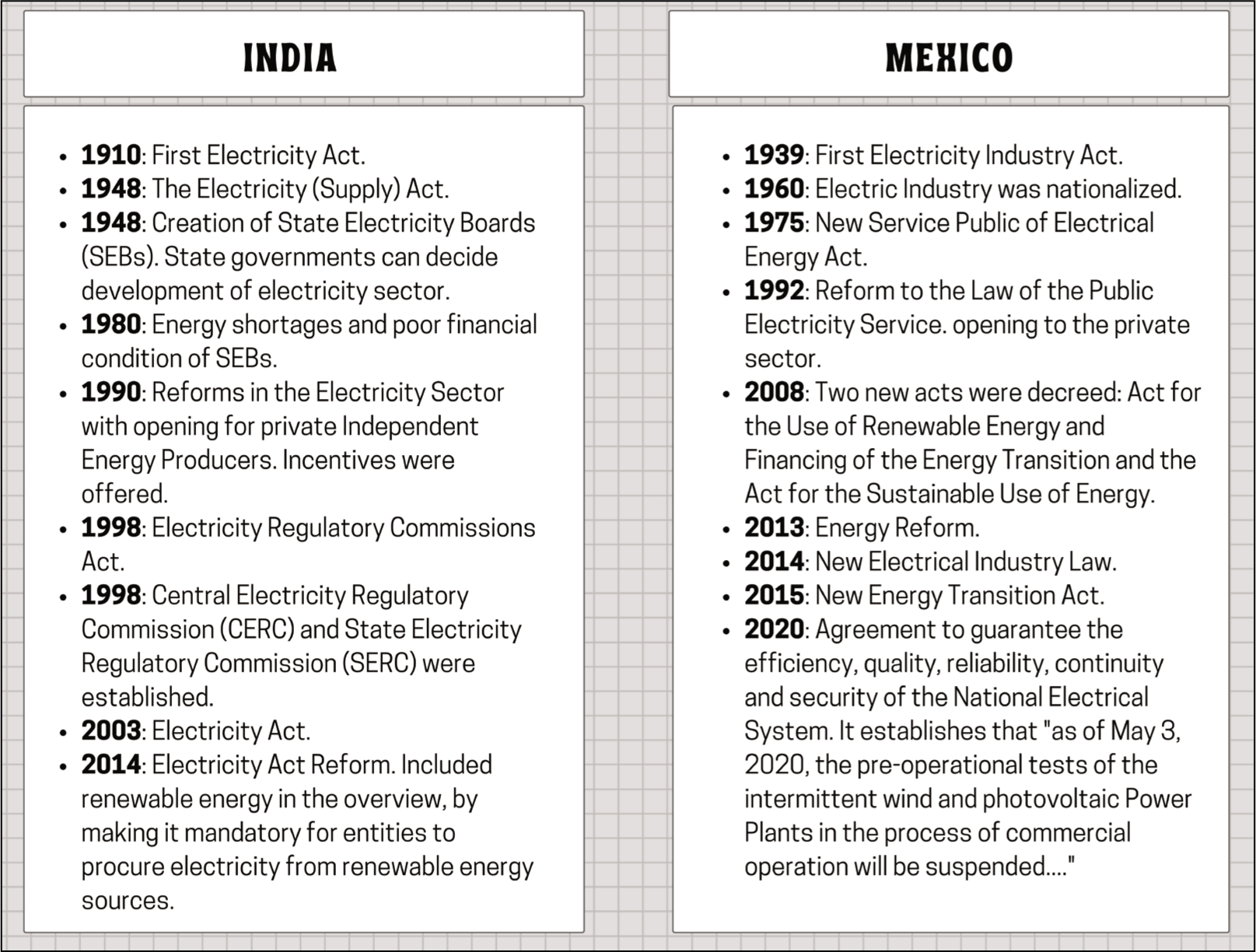
Socio-environmental Problems Associated With the Generation of Wind and Solar Power in India and Mexico
As one can observe, India and Mexico are part of a larger process that is unfolding at a global level, where the reduction of greenhouse gases through incentives for renewable energies has become key. However, what is really behind the drive for these technologies is the fact that they make up one of the largest markets in the world today. It is estimated that by 2050 they will leave profits of between 50 and 142 billion dollars (IRENA, 2021b). Yet, one of the main problems is that, although these energy sources allow for large revenues for private firms, this rarely trickles down to the communities where these projects are installed. On the other hand, these megaprojects do contribute to increasing environmental injustice (Martínez-Alier, 2001), while it is true that some of these wind and solar farms are financed by international organisations such as the World Bank, with the aim of contributing to the reduction in CO2 emissions and providing electricity access to vulnerable populations, this is not always the case.
The main direct profiters of these clean energy projects are, on the one hand, the large corporations that design, build, install and operate them. On the other hand, the other beneficiaries of these projects, besides the state, are the companies that receive the generated energy, which they use to satisfy their own private needs. In both Mexico and India, private manufacturing firms can also execute their own renewable energy projects, which is why Coca-Cola, for example, is a wind power producer in both countries. In India, Hindustan Coca-Cola Beverages has installed seven clean energy projects, with which it currently covers 50% of its energy needs (Thomas, 2021). In Mexico, Grupo Femsa, the owner of Coca-Cola beverages, receives wind power from the ‘Eólica del Sur’ wind farm located in Oaxaca and the ‘Parque eólico San Matías’ wind farm in Baja California.
Describing the economic landscape of the energy sector is important, as it speaks not only of an unequal distribution of wealth but also of selective access to environmental benefits: those with the capacity to pay are, by far, those that receive the greatest advantages from clean energy projects, never mind that such projects are established in mainly rural, peasant and indigenous territories, where levels of poverty run high and where they deepen a marginalisation that is not only economic but also ecological in nature (Goebel, 2010). This exposes the forms in which
a higher power (that of the State, institutions, companies, transnational corporations, oligarchies) is exercised against popular sectors, and how these sectors assimilate and/or resist the exercise of such power. At first glance, the relationship between the exclusion of diverse social groups from the distribution of natural resources, and the social control of the population exercised by the dominant class, might not be an obvious one. … Yet, we cannot put aside one of the basic precepts of the social control and marginality theories: the existence of formal and informal mechanisms of domination. In this sense, and from our perspective, ecological marginalization would act as a formal instrument of social control, in so far as it seeks to impose a specific relationship between society and nature that ‘tailor fits’ the economic interests of power groups and at the same time control, through the means of socio-spatial segmentation, the population as a whole, but especially popular sectors. (Goebel, 2010, p. 133)
In this manner, renewable energy projects alter the relationship of local peoples with the territory, a fact that is reflected in various forms: an extensive territorial occupation that deprives population from performing other economic activities; environmental damages derived from this occupation (deforestation for the installation of solar panels, bird mortality or damages to groundwater systems in the case of wind turbines, for example); loss of sacred sites and insufficient payments for land leases (both in India and in Mexico, amounts vary: generally, 1% to 4% of the annual profits of a project are destined for the corresponding payment of land rent). Besides, renewable energy projects create few local jobs, so their impact in that respect is minimal. While people speak of up to 3.4 million new job vacancies in India associated with renewable energies by 2030 (Kwatra & Steiner, 2022), the majority of such jobs are casual and temporary as they are only maintained during the period of construction of the power plants. Once in operation, the plants function in a mostly independent manner. Because of this, clean energies in Mexico today generate only 16,000 direct jobs in spite of their considerable size (Parral, 2022).
Thus, as is well summarised by the Deutsche Welle news outlet, ‘it is the frenzied growth of the Indian economy and its requirement for ever increasing electric power that lies behind the interest in photovoltaic energy, whereas achieving environmental protection is more of a pleasant secondary effect’ (DW, 2015). Or, paraphrasing Sebastian Engelmeier from the consulting firm Bridge to India: ‘India is a country that is as dynamic as it is unpredictable, where the goal is not to fight against global warming but rather to acquire cheap energy as soon as possible’ (DW, 2015). Indeed, the same patterns of consumption and commerce linked to renewable energies repeat themselves across the whole world, as is demonstrated by the opposition of indigenous peoples in countries such as Norway, Chile and Canada. Similarly, in Mexico today, the areas with greater wind power potential coincide with those inhabited by native populations living in poverty conditions: the Zapotecs and the Huaves in the Isthmus of Tehuantepec, the Yumanos in Baja California and the Mayans in Yucatan. Photovoltaic power has also encountered peasant opposition in Yucatan and, in a more nascent fashion, in the bordering area between the states of Puebla, Tlaxcala and Hidalgo.
Currently, there exist various exercises to keep an account of socio-environmental conflicts linked to energy projects, but numbers are extremely volatile; the Environmental Justice Atlas (2022) estimates that the number of this kind of conflict amounts to only 29, while FLACSO and the NGO Heinrich Boell documented 109 conflicts only in association with wind power (Heinrich Boell, 2020). Lastly, the National Autonomous University of Mexico placed the number at 61 (UNAM, 2021).
In this way, the documentation of socio-environmental conflicts caused by solar or wind power in Mexico is somewhat subjective, as often such accounts do not consider those cases in which there have been reports of tensions derived from the establishment of wind and solar farms without detonating into full-blown conflicts. For example, Paipai and Kiliwa indigenous populations in Baja California are going through surly negotiations with wind power companies (García, 2021); the same happens with the rejection that these companies have faced in other rural areas. For that reason, presenting a full list or recount of such cases is a rather complex and imprecise task.
One of the most well-known cases of opposition against a renewable energy project in the country was the one led by indigenous fishermen from San Dionisio del Mar, San Mateo del Mar and Álvaro Obregón. These fishermen rallied against the ‘Parque Mareña Renovables’ wind farm in 2012, after the consortium formed by Macquarie Capital and Mitsubishi sought to install 132 wind turbines in an area that was essential for their fishing activities. The company paid 10 million pesos to the authorities of San Dionisio so that they could approve the project without getting the consent of the population. Thus, local organisations solidified under a feeling of anger, resulting in the creation of local networks that clustered in the Asamblea de Pueblos Indígenas del Istmo en Defensa de la Tierra y el Territorio (Assembly of Indigenous Peoples from the Isthmus in Defense of Land and Territory [APIIDTT]).
The conflict reached its peak in February 2013, when the opponents of the project confronted the state police as they sought to clear the way for the company to begin the installation of wind turbines. Invoking their right to a free, prior and informed consultation, as is established by the ILO’s Convention No. 169, and waging a struggle on different fronts, the fishermen finally succeeded in having Mareña cancelled, although in 2019 the project ended up being installed at another location of the Isthmus of Tehuantepec as ‘Eólica del Sur’. In fact, the consultation around this project was the first one carried out in Mexico in an exercise that has been considered a failure because it did not fulfil its objective: to protect the rights of indigenous communities. In addition, this consultation (and many others in the country) occurred in a context of social pressure, functioning as a mechanism used by the company and the state to mitigate the socio-political crisis (Zárate & Fraga, 2019).
In India, Land Conflict Watch estimated that in 2021 there were only seven conflicts linked to wind and solar projects, a figure that increased to 83 by 2023. In Mexico and India, as we mentioned, resistance has been led by ethnic minorities and farmers.
However, just like in Mexico, in India there are tensions linked to some projects that are not yet considered environmental conflicts as such. For example, the solar power plant Kamuthi, installed in 2016 in Tamil Nadu, illegally extracts 2,00,000 L of water every day from the wells of nearby communities for the clean-up of photovoltaic cells and has therefore threatened the subsistence of the families that live within a 50 km radius of its installations (France 24, 2017). Lakshmanan, a local farmer interviewed by France 24, expressed his pain with regard to this situation and explained how the power plant has made their work as farmers impossible. Lakshmanan also voiced his disappointment at the prime minister’s unkept promise that with the power plant there would be electricity for everyone, when this is not the case and now the community experiences recurrent water cuts (France 24, 2017).
However, probably the case that has received the most media coverage is that of Assam Solar Park 1, a 90 MW project installed in the Nagaon locality and rolled out in four different stages by the Azure Power company. The project occupied a land plot of 38.4 ha, which the American company assures that it bought only after the Revenue Department 3 reclassified it from agricultural to industrial land, under the justification that the area was sterile land that had not been cultivated in 10 years. Nevertheless, 36 farmer families reclaimed the land as theirs, an act that led to a legal, physical and symbolic struggle for the appropriation of the territory. Since then, those who oppose the solar farm have been beaten, threatened and jailed for not accepting money in exchange for their lands. In December 2020, there was a violent clash between the police and protesters in which women and children who sought to stop the construction work were injured. Following that same trend of violence, armed groups visited the village on several occasions to spread panic amongst the population (Jairath, 2021). Even though the court determined the suspension of the acquisition of lands in March 2021, the construction of the park continued, and its first phase was finally inaugurated on 19 July 2022, under the name of ‘Boko Solar Park’.
In sum, many other similar examples could be cited, and it is very possible that the record of conflicts and, more critically, of socio-environmental problems is considerably underestimated both in Mexico and in India. However, the cases of Assam and Mareña Renovables exhibit that these big energy projects have the backing of the state, even if they operate with illegal practices.
In Mexico, these conflicts are a consequence of poor government planning, which was concerned with seeking the acceptability of the projects but not with integrating the different stakeholders. In fact, emphasis was placed on technical issues by granting developers all the facilities for the transmission and distribution of the energy produced. Thus, despite the fact that developers must comply with environmental and social requirements, these do not seem to work as they lack ‘instruments that allow building legitimate and stable agreements between the different actors’ (Zárate & Fraga, 2016, p. 70).
As we have argued, fossil capitalism continues to be a reference to understand how the bases of the system that associates market and energy are structured, and the global panorama shows that the world still depends on fossil fuels. Consequently, so does the international economy. However, Malm’s conception implies something much deeper than thinking about trade relations per se; obtaining raw materials and the labour that transforms them are part of the equation.
fossil fuels should, by their very definition, be understood as a social relation: no piece of coal or drop of oil has yet turned itself into fuel. No humans have yet engaged in systematic large-scale extraction of either to satisfy subsistence needs. Rather, fossil fuels necessitate commodity production and waged or forced labour as components of their very existence. (Malm, 2013, p. 17)
Certainly, energy from fossil fuels implies territorial, social and human relations that are exploited by capital, a situation that in recent years has been replicated with renewables. Even if it has been a concern to replace fossil fuels due to their scarcity and harmful effects, the model remains the same.
Through energy, inequitable conditions are manifested that are aggravated or created by the occupation of key spaces containing natural assets or the potential to generate them, which translates into the dispossession of the original inhabitants of those territories. Although for Malm ‘capital is a specific process that unfolds through a universal appropriation of biophysical resources, because capital itself possesses a unique, insatiable appetite for surplus-value extracted from human labour by means of material substrata’ (2013, p. 61), and despite the fact that it is the same system that sustains renewables, these new technologies do not focus their interest on labour exploitation; on the contrary, they discard the peoples, but their attention is based on territorial occupation and natural resources. Cano (2019) describes this framework well:
The concept of fossil capitalism names the social, economic and political formation whose objective is the expanded accumulation of capital, as an unequal relation of wealth and power, through the exploitation of labor and the biophysical world, and whose economic structure is linked to the growing consumption of fossil fuels. The deployment of the instrumental rationality of profit, the transformation of matter and energy into capital, the international division of labour, the construction of a market society where utilitarian relations prevail, the concentration of privileges and security in a few social classes, exploitation and domination, the continuous, growing and accelerated growth of the economy and the expansion of political institutions, all these capitalist mechanisms have been deployed thanks to the fact that fossil fuels fit almost perfectly with the need for expanded accumulation of capitalism. (Cano, 2019, p. 77)
The management of fossil fuels and renewable energies is reserved for the same actors: the state and the private sector. For this reason, Altvater (2007) highlights the existence of fossil imperialism, that is, policies aimed at guaranteeing access to this energy and generating a surplus from its production, using legal and illegal resources through four mechanisms: (a) control over the territories where fossil resources are found, (b) control of the necessary infrastructure and logistics, (c) definition of prices and regulation of supply and demand, and (d) establishment of the currency with which fuels are traded. As can be seen, all this is very similar to the way in which renewables have imposed themselves in places that are strategic for them. According to Malm,
It has recently been demonstrated that all energy consumed in the world could be provided from wind, water and solar power, without any noticeable share of coal, oil or natural gas, within a few decades, at little or no extra total cost – if relevant actors only decided to harvest the abundance of energy surrounding us. But there are hurdles in the way. In a major survey in 2010, Science noted that ‘building solar or wind farms is a land-hungry process, and the energy they deliver is often intermittent and hard to store’. Quoting an ecological economist specialising in the field, it drew attention to the fact that “many of the windiest and sunniest regions in the world are virtually uninhabited”. Now these inherent properties of wind and sun – absolute space, concrete time – would perhaps not constitute such serious handicaps if it were not for the particular form of spatio-temporality that governs the world. (Malm, 2013, p. 60)
In Mexico, wind and solar projects have been established under the justification that they are ‘idle lands’ or ‘unproductive’ (Ramírez, 2021) that need to be given a new value, mainly financial. In India, this argument has also been used, even calling them ‘wasteland’ (Baka, 2019) or ‘marginal lands’. This invisibilises local populations in order to legitimise the dispossession of their territories because, although they receive lease fees, these are low in many cases and, in others, are not even met despite the existence of contracts. In addition to land leasing, in both countries the illegal purchase of land has been documented, aggravating the discontent and helplessness of rural communities, as in the case of the Ticul Photovoltaic Park in Yucatan (Llanes, 2019) and in Charanka, Gujarat (Yenneti et al., 2016).
According to Stock (2023), in India the dispossession caused by renewables is highly racialised and corresponds to a neocolonial process based on extractivism and privatisation. This multiplication of wind and photovoltaic farms occurs in the midst of the process of construction of Hindutva, or Hindu nationalism, which has entered into dispute with ethnic minorities in a culturally diverse country where Dalits and Adivasis, highly marginalised groups that are more vulnerable to the consequences of the energy transition, are mainly affected (Bedi, 2022). In Latin America, the term ‘energy colonialism’ has been coined to refer precisely to the foreign dominance, primarily European, in the electricity sector that drives these types of projects and subjugates indigenous populations. As in India,
central aspects of this problem relate to the enclosure of communal territories, the private appropriation of benefits and a lack of direct democratic procedures embedded within the implementation of projects. The claims of indigenous communities reflect a reaction against these uneven outcomes, which reveal historical struggles in the defence of territory, identity and autonomy. (Ávila, 2017, p. 1007)
Energy planning and its implementation have not been in any case accompanied by the real participation of the inhabitants or landowners. On the contrary, their exclusion has been deliberate. The fact of who makes the decisions and who has the right to decide refers to what Sareen and Haarstad (2021) call scalar biases: ‘legal-regulatory and political-economic structural conditions favour utility scale roll-out over roll-out at local and community scale’ (p. 25). In both countries, the design of national agendas follows specific interests without considering local effects, clearly prioritising some sectors.
Global Assessment
The experiences show that the resistances against wind and solar farms are articulated around certain problems, mainly related to access to land, unjust relations in the negotiations between landowners and developers; entrepreneurial malpractices in discordance with human and indigenous rights; an unfair distribution of benefits; little participation in the planning, development, installation and operation of these projects; the abandonment of the state (not only in the face of the arrival of energy companies, but going way back); and environmental damages.
Territory and natural goods are not only means of subsistence; they are also means of social and cultural reproduction. The violent form in which the installation of these projects is conducted, the bad conditions of negotiation, the lack of consultations and the unequal conditions present in the leasing contracts are all expressions of a wider and more complex problem, as energy companies pretend to occupy the territory without really considering the populations that inhabit it and who are mostly under conditions of vulnerability.
In Mexico and in India, the areas with the greatest energy potential coincide with those inhabited by vulnerable sectors, something that contrasts with the discourse of energy transition, which is inserted in a modernization and development plan where such sectors do not seem to have a place. Indeed, energy megaprojects are part of a new process of domination and subjugation, which is why they can be classified as new forms of colonisation, insofar as they answer to particular interests that also seek to benefit specific sectors through the appropriation or indirect privatisation of natural goods and territorial dispossession. Entrepreneurial discourse emphasises the bounties of private investments, which are fundamentally of a monetary kind, although, in practice, people derive little economic and environmental benefits out of them. In both countries, wind and solar farms imply the modification of elements that are fundamental for the livelihood and identitarian reproduction of the peoples by occupying the space through often underhanded practices.
Thus, the resistance against energy projects can be explained through concepts such as ‘grievance’, ‘environmental injustice’ and ‘sacrifice zones’, which can help us to accurately understand how these socio-environmental problems are the product of a capitalist logic that reproduces itself in the world under the precept of caring for the environment and pushing for sustainable projects which, nevertheless, present their own deficiencies. It is more than obvious that the peoples who inhabit the best-suited areas for solar and wind energy production have been ravished both physically and symbolically by the companies that are interested in installing these projects. This reality manifests in the territory through illegitimate occupation and the subjugation of its owners or, even, by the non-acknowledgement of owners as such, which implies also disregarding their identities and their worth as human beings.
In that way, energy projects incentivise grievances, given that, as is pinpointed by Adolfo Gilly (1999), grievances ‘result when someone breaks the established rules of relationship, negotiation and resolution of disputes inside a community in order to de facto impose his way in the detriment of another’. At the same time, this feeling of grievance often acts as the catalyser for social mobilisation and collective action.
On the other hand, megaprojects do not establish an adequate distribution of either environmental or economic benefits; on the contrary, from the get-go, they answer to specific interests that end up creating or aggravating inequities.
Environmental justice can be defined as ‘the fair treatment and involvement of all people regardless of race, colour, national origin, or income when it comes to the development and implementation of environmental laws, regulations, and policies’ (Gallagher, 2021). Therefore, wind and solar farms play out as generators of injustice, given the form in which they are imposed. The resistances that emerge in the face of this type of extractive activities can be classified as movements for environmental justice (Martínez-Alier, 2001). Through these movements, the most vulnerable sectors struggle with their own spaces and possibilities to revert to the dominant logic.
In this sense, when people speak of environmental injustice, commonly the emphasis is laid on the unequal distribution of the costs of environmental damage from the perspectives of class and gender. This has led some authors to identify zones that concentrate these costs and which are visible, for example, because of the high concentrations of pollutants (Lerner, 2012). Thus, the concept of ‘sacrifice zones’ invokes the general idea that some populations are less important than others and can, therefore, receive the negative impacts of the activities that benefit those populations that are considered more valuable. For Lerner, ‘sacrifice zones’ are often communities of low-income people and people of colour who live in ‘hot spots’ of chemical pollution, in the proximity of highly polluting and polluted industries or military bases.
As we can observe, the pattern with which renewable energy projects are propelled in Mexico, India and other parts of the world corresponds to racialised and class power relations with an environmental content. Consequently, areas with high wind and solar power potential that face the onslaught of this kind of ventures could be considered new expressions of these ‘sacrifice zones’, insofar as these types of zones evolve and become more complex following the patterns of the activities of capital.
Lastly, it is important to point out that, while these renewable energy projects interweave global dynamics (such as emissions of greenhouse gases, the global energy transition, the presence of transnational companies, the signature of international agreements, etc.), these dynamics end up exerting an influence at the local level, as is manifested through multiple impacts. Moreover, rural communities are forced to displace themselves and implement far-reaching strategies to obtain answers or solutions.
Conclusions
During the last decade, India and Mexico pushed for an intense generation of renewable energies, especially after the celebration of the Paris Summit in 2015, where both countries committed themselves to reducing their CO2 emissions and promoting clean technologies. For this purpose, India established the initial agreement to generate 175 GW from clean energies by 2022. On its part, Mexico promised that by 2024, 35% of all of its energy production would come from renewable sources. Thereby, international policies that operate as guidelines to be followed, and the local laws that replicate them, have stimulated an exponential growth of mainly wind and solar power projects in both countries.
However, despite the fact that the government and private initiatives have prioritised clean energy megaprojects in Mexico and India, neither country was able to meet these goals. To this date, it is clear that the dependence on fossil fuels permeates and is not something that will change in the short term. Both countries even continue to simultaneously finance or facilitate the presence of hydrocarbons.
Narendra Modi announced in 2020 that he would allow private companies to commercially exploit 41 state-owned coal mines for the first time as part of his strategy to achieve energy self-sufficiency by 2047. The Mexican government has been highly criticised for the energy policy coined by President Andrés Manuel López Obrador that privileges state-owned plants, mainly fossils and hydroelectrics. India and Mexico have traversed similar paths in many aspects, despite their several differences and the specificities of the energy policies implemented by each country.
However, energy consumption in the world will not stop growing, and with it, neither will the extraction of hydrocarbons. Because of this, in this work we took up Andreas Malm’s concept of fossil capitalism, exhibiting its ongoing validity through three angles: (a) the current dependency on fossil fuels that prevails across the whole world; (b) the close relationship of these fuels with the capitalist economic system, which was not only crucial for capitalism’s consummation as a system in the past, but continues to be determinant in its reproduction and development until this very day; and (c) the need to substitute these fossil energy sources with renewable ones, but without altering the industrial and mercantile bases.
The accelerated and disorganised growth of these clean energy projects has had environmental and social impacts that have led to their rejection in some cases, mainly because of the fact that they are submerged in well-defined economic interests that exclude the peoples but yet promote the occupation of their territory and the exploitation of their natural goods. Socio-environmental conflict is an expression of the distribution of uncertain environmental risks for some and benefits for others. These dynamics expose clean energy megaprojects as mechanisms of injustice that lead towards increasing financial and ecological marginalisation.
In this way, more than providing an exhaustive comparative analysis, this work has sought to present a reflection that sheds light on India and Mexico as two manifestations of wider global processes. Hence, it is not strange to find that both countries share close environmental objectives as well as projected plans to meet these objectives; in the end, both countries are operating as part of a single global trend that affects the same segment of the population, the most vulnerable ones.
Footnotes
Declaration of Conflicting Interests
The author declared no potential conflicts of interest with respect to the research, authorship and/or publication of this article.
Funding
The author received no financial support for the research, authorship and/or publication of this article.