




Abstract
Using the 75th round National Sample Survey (NSS) unit-level data on social consumption on education this article identifies the various household and school-related factors which influence the household choice of private schooling for their children at the time of enrolment in primary school in rural India. Parents often choose private schools over government ones due to perceived shortcomings in education quality and infrastructure. This article will also attempt to identify the possible reasons for the gender gap during enrolment in private primary schools in rural India. The contribution of each factor explaining the gender gap in school enrolment is quantified with the help of Fairlie’s Decomposition technique. Economic attributes such as household income, computer ownership in the household, and stable employment decrease gender disparities during the time of enrolment in private primary school in rural India, while social attributes like household religious practices, household size, social group and school-related factors like English medium school, the distance between the household and primary school exacerbate these disparities.
Keywords
Introduction
Education plays an important role in designing the socio-economic development of an economy. Parents always want to ensure the best possible educational environment for their children. Primary education is the base of higher education and achieving better quality basic education would strengthen the pillar of higher education and further enable skill development and better job market options and outcomes. Based on the school management system, three different types of primary schools are available in India: (a) Government schools (referred to as public schools), (b) Private-aided schools (quasi-government in nature) and (c) Private-unaided schools (also referred to as private schools). The government schools are owned, funded and managed by Central, State or Local governments. The private-aided schools are quasi-government in nature as these school follows the rules and regulations laid down by the government and are owned and managed by private institutions but are partially or fully funded by the government. The private-unaided schools on the other hand are owned and managed by private organisations but receive no grants or aid from the government. These are self-financed and generate revenue through student fees, donations, etc. but may sometimes receive government subsidies in the form of tax concession or reduced tariffs. Besides these three broad types of institutions, there are also a few ‘unrecognized’ primary schools which do not follow basic government regulations. In this study, the primary schools are classified as public schools 1 and private-unaided schools
Parental choice of sending their children to public or private school is a growing concern worldwide. In developing countries, prior research portrays that parents prefer to enrol their children in private schools due to various perceptions like the medium of instruction, a better quality of education, infrastructural development, etc. (Alderman et al., 2001; Kingdon, 1996; Tooley & Dixon, 2003). In India particularly after the post-1990s, there has been a massive expansion of private schools even in rural areas (Biswas & Kundu, 2022). The share of private primary schools has increased from 19.49% to 25.24% and enrolment in private primary schools has raised from 19.30% to 45% during 2007–2008 to 2016–2017 (DISE, 2008; U-DISE, 2018). Enrolment in private schools at the elementary level has increased at a higher pace since 2013–2014 and the rate of total private school enrolment and percentage share of private schools among all schools have been consistently increasing since 2013–2014. This is witnessed in all the states of India (ASER Report, 2020). From the sector-wise comparison drawn from Table A1, 2 it is seen that in urban areas children studying in private-unaided schools are higher in comparison to children living in rural areas. On the other hand, in rural areas, children studying in public schools are higher in comparison to children living in urban areas. It also portrays a gap in private primary school enrolment based on gender in India. It is found that enrolment of girl child is higher in public schools compared to a boy. On the other hand, enrolment of the son is higher than daughter in private primary school. This gap in enrolment is even wider in rural areas compared to urban areas. Rural Private Schools (private-aided and un-aided schools) 3 enrolment has increased from 4% in 1993 to 26.6 in 2017 though enrolment in private-unaided primary schools has increased from 9.2% in 1993 to 34.8% in 2017 and enrolment in private-aided schools was reduced from 22% in 1993 to 11.5% in 2017 (U-DISE, 2018). The expansion of private-unaided schools is mainly demand-driven 4 and if the private organisation finds it profitable then only, they will invest in this sector. Thus, with time the expansion of private-unaided schools indicates that household has a fascination with private primary schools over public schools. 80% of primary schools in India are located in rural areas and 71% of enrolment in the country is concentrated in rural locations (Central Square Foundation, 2021). Prior studies suggest that with time parents have the fascination to enrol their children in private primary schools even in rural areas of India (Biswas & Kundu, 2022; Maitra et al., 2011; Muralidharan, 2013). Several kinds of literature have also shown that parent prefers to send their son to private schools but their daughter to public schools (Kingdon, 2007; Muralidharan, 2013). Indeed, the gender gap during the time of enrolment in primary education has decreased over time (Kingdon, 2007). This article will try to identify the possible reasons for the gender gap during enrolment in private primary schools in rural India.
This article is subdivided into eight sections. Apart from the Introduction in the first section, the second section is a survey of the literature, the third section highlights the research objective, the fourth section presents the data and methods used in this study, and the fifth section describes the factors influencing parental choice of schooling. The sixth section explains the Application of Fairlie’s Decomposition Analysis to quantify the contribution of the explanatory factors influencing the decision of gender discrimination among rural parents during the time enrolling their children on private primary school, the seventh section explains the overall conclusion of the article based on the study’s result and empirical findings obtained and finally, the eight section presents the policy recommendations based on the findings.
Literature Review
Most of the existing literature on a consensus supports that private schools or private-unaided fee-charging schools provide better academic achievement compared to public schools (Bedi & Garg, 2000; Goyal & Pandey, 2009; Kingdon, 2007; Muralidharan & Kremer, 2007; Tooley et al., 2010; Wadhwa, 2009). On the other hand, few works of literature portray the picture of discrimination in the choice of school based on gender (Maitra et al., 2011, 2014; Muralidharan, 2013). It is widely discussed in various pieces of literature regarding the existence of gender bias toward sons in the intra-household allocation of resources in Indian society (Dreze & Kingdon, 2001; Muralidharan, 2013; Pal, 2004; Tilak, 2002). Household resources play a significant role in reducing the gender gap in private school enrolment (Kumar & Choudhury, forthcoming). Studies focus on gender differences in educational spending in Indian households. Private school type is the primary factor driving spending variation, while household head education reduces the higher education gender gap (Rashmi et al., 2022). Kingdon (2005) pointed out two main ways by which gender discrimination against girls in education expenditure is happening: (a) through zero spending on education for daughters and positive spending on sons and (b) positive education expenditure for both genders but lower expenditure on girls compared to their boy’s counterpart. It is noticeable that sons are prioritised over daughters, in rural regions in comparison to urban locales (Muralidharan & Sheth, 2013). The parent prefers to enrol their son on private schools even at the primary level to get a better education and their daughter in public primary schools (Kingdon & Pal, 2014; Muralidharan, 2013). Among the age group of six to eight years, 47.9% of boys were admitted to private schools against 39% of girls (ASER Report, 2019). Studies delve into private school selection factors, focusing on school traits and gender disparities highlighting preferences for high teacher attendance, local staff, parental engagement and quality English education showing Female enrolment rises with improved economic status and maternal education (Kumar & Choudhury, 2020). Private school students in India outperform government school students academically however studies show this gap in choice of schooling diminishes with increased school attendance and time spent on homework, suggesting potential improvements in government school students’ cognitive abilities through reduced absenteeism and increased study time (Kumar & Choudhury, 2021). Literature identifying the household and school-related factors responsible for this gender gap in enrolment is not properly available in the Indian rural context. This present study aims to identify the major household and school-related factors which influence parents’ decision on the choice of schooling during the time of enrolment of their children in primary school in rural India. The contribution of each factor responsible for the gender gap at the time of enrolment in private primary schools will also be calculated and a few policies are suggested that can check this gender discrimination during the time of enrolment in private primary schools.
Research Objectives
Factors responsible for the gender disparity which shapes parental aspiration and choice of schooling in the Indian rural context remain poorly explored and not properly analysed in the empirical literature. This study will try to identify the household and school-related factors which influence parental decisions when contemplating the enrolment of their children in a private primary school in rural India. Rural India is considered in this study as a large section of the Indian population resides in rural areas and the majority of the people in rural areas are engaged in informal employment (Roy & Kundu, 2024). This article will also identify those factors responsible for the discriminatory treatment by parents based on gender and quantify the contribution of those factors in explaining gender discrimination during the time of enrolment in private primary schools in rural Indian scenarios.
Initially, this study will try to identify the household and school-related factors that influence a parent when deciding to enrol their child in a private primary school in rural India.
Next, this article will try to identify the possible reasons for the gender gap during the time of enrolment in private primary schools in rural India. The study will also try to quantify the contribution of each factor in explaining gender discrimination during the time of enrolment in private primary schools in rural India. Fairlie Decomposition technique will be used to understand the relative contribution of different covariates to the gender gap during the time of enrolment in private primary school.
Data and Methods
Data Source
The NSSO 75th round dataset of Household Social Consumption on Education is used to address the above-mentioned research problems. NSSO 75th round unit level dataset covers a total of 14,285 FSU (8,097 villages in rural areas and 6,188 Urban Frame Survey Blocks in urban areas) consisting of 1,13,757 households (64,519 rural households and 49,238 urban households) and enumerating 5,13,366 persons (3,05,904 rural person and 2,07,462 urban person). In this survey, the total number of people surveyed was 2,67,887 males (1,59,411 males in rural areas & 1,08,476 males in urban areas) and 24,5479 females (1,46,493 females in rural areas & 98,986 females in urban areas). From this dataset, a sample is considered which comprises children enrolled in primary school. From that extracted sample, children enrolled in rural primary schools are extracted for this study. Here, the total sample comprises 36,821 children out of which 20,331 children are boys (nearly 55%) and 16,490 are girls (nearly 45%). 5 This survey covered both quantitative (expenditure incurred on the education of the household members by its household itself and other household or by any institution/organisation other than the government) and qualitative aspects (educational level attained, type and nature of the institution, current attendance or enrolment rate, etc.) related to the educational attainment of the household members. As private-aided schools are mostly or fully funded by the government or charities, it is considered private-aided schools as public schools for this study. 6
Methodology
First, the household and school-related factors will be identified which play important roles when parents decide whether to enrol their children in a private primary school in rural India. To do that logit model will be applied. Next, this article will try to identify the possible reasons for the gender gap during the time of enrolment in private primary schools in rural India. Later, it is required to quantify the contribution of each factor identified in explaining the gender discrimination which is observed during the time of enrolment in private primary schools in rural India. Identification of the factors becomes very important because the Government of India has implemented various new policies which provide various financial support, concessions, etc. to bridge the gender gap in education. The Blinder–Oaxaca decomposition technique is the most widely used method to identify and quantify the contributions of differences in measurable characteristics to group differences in the outcome variable. However, this technique provides misleading inconsistent estimates when the dependent variable of interest is binary and the group differences cannot be explained by an influential explanatory variable. The solution to this problem is a simulation algorithm to address non-linear decomposition 7 which was first developed by economist Robert W. Fairlie. The decomposition method developed by Fairlie is considered here because in this study the dependent variable ‘enrolment in private primary schools in rural India’ is binary.
Factors Influencing Enrolment Decisions in Private Primary Schools in Rural India
Initially, it is required to identify the factors which influence a parent during the time of deciding the type of school for their child during the time of enrolment in primary school. To do that logit regression technique will be here applied as the outcome variable is binary. It takes the value ‘1’ if the child is enrolled on a private primary school and ‘0’ if the child is enrolled on a public primary school. The possible influencing factors will be narrated below with strong theoretical justifications.
Log income (lnincij): Here monthly consumer expenditure (₹) is considered a proxy for the household’s total monthly income. In a patriarchal society, the income of a household possibly plays an important role during the time of deciding on the type of primary school at the time of their children’s enrolment. The income of the household is an important determinant of the prevalence of gender disparity in rural India (Alcott & Rose, 2017). So, this variable is here considered to address the research problems.
Gender (Genderij): Through this variable, it is required to investigate whether there exists any gender preference among parents during the type of enrolment in private primary school. This dummy variable is assigned a value ‘1’ if the ith child surveyed from the jth household is a girl child and ‘0’ otherwise.
Ownership of computer (Comij): There is a positive association between household computer ownership and the educational outcome of children (Djinovic & Giannakpoulos, 2022; Schmitt & Wadsworth, 2006) and various literature supports that the educational level of parents has a positive association with the academic achievement of the children (Li & Qiu, 2018; Parsasirat et al., 2013). Thus, indirectly there is a positive association between household ownership of computers and the educational level of the parents (Cheah & Mei, 2013). It is expected that better education among the household members and better income level of the household are the two main determinants of the ownership of a computer. So here, owning a computer is considered a proxy for the parental education level. 8 It is also obvious that educated parents usually earn more compared to less educated ones. So, indirectly ownership of computers also acts as a parameter of the economic solvency of the household to which he/she belongs. The value of it is assigned ‘1’ if the ith child surveyed from the jth household has ownership of a computer and ‘0’ otherwise
Occupation (Occuij): Occupation of the household plays a major role in making decisions regarding their children enrolling in private school. The occupations of the sample rural households are divided into three categories: (a) regular salaried workers in the agricultural and non-agricultural sectors and (b) self-employed in the agricultural and non-agricultural sectors. (c) Casual workers in the agricultural and non-agricultural sectors. Here casual workers in the agricultural and non-agricultural sectors are considered the reference category.
Social/caste groups (Casteij): The caste/social group of the household is an important decision-making factor in this analysis. In the NSSO data set, the caste of an individual is classified as scheduled castes (SC), scheduled tribes (ST), other backward class (OBC) and general castes. For this study, social groups have been classified into two groups: (a) households belonging to SC and ST castes are clubbed under one group called ‘backward caste’ (BC) and households belonging to OBC and general castes are clubbed under another group called ‘forward caste’ (FC). During the time of application of the Fairlie Decomposition method, Here the value of ‘Social Group’ will be considered as ‘1’ if the sample household belongs to the BC and ‘0’ if the household belongs to the FC.
Household size (hhsizeij): Distribution among the household members in terms of age is not given. So, it is not possible to calculate the household size on the adult equivalence scale. Hence, the total number of household members of a particular rural household represents the household size. According to Muralidharan (2013), if household size rises, parents prefer to send their girl child to public school, and their son to private primary school (Kingdon, 2007; Muralidharan, 2013). So, this variable is considered here to check this proposition.
Religion (Religionij): The majority of Indian households belong to the Hindu community (79.8%) followed by the Muslim community (14.23%), Christian Community (2.30%) and other communities (3.67%). Households belonging to minority groups prefer to send their children to school where their children get access to their religious practices and strengthen their religious base along with education (Zada, 2006). Among Muslim children aged 7–19 years, the proportion of Muslim children mainly boys studying in madrasas is higher in rural areas (NCAER, 2018). But on average only 2.3% of Muslims in the primary school age group are enrolled in madrassas (National Council for Educational Research and Training [NCERT], 2016). However, most Christian people in rural India belong to the lower strata of society (NCPCR Report, 2016). Christian missionary schools are mainly funded by Christian missionaries 9 and the medium of instruction is mainly English in these schools. In missionary schools, there are also special reservations for children belonging to the Christian community so rural households belonging to the Christian community mainly enrolled their children in aided Christian schools (National Sample Survey [NSS], 75th round). It is expected that the religion of the household may play an important role in the choice of schooling for their children. For the logit analysis, religion is classified into four groups: (a) households belonging to the Hindu religion, that is, the dominant religious practice of the majority of the population, (b) households belonging to the Muslim community, (c) households belonging to the Christian community and (d) households belonging to other religious community except Hindu, Muslim and Christian religion. Households belonging to other religious communities except Hindu, Muslim and Christian religions are considered as the reference category. For the decomposition analysis, ‘Religion’ is defined as a binary variable, that is, the value of ‘Religion’ will be considered as ‘1’ if the sample household belongs to the Hindu community and ‘0’ if the household belongs to the Muslim, Christian or other community.
The school-specific factors influencing the choice of schooling are narrated below:
Distance of nearby primary school (both government and private) (distij): Distance was assigned a value of ‘1’ if the distance to the nearest primary school (any type 10 ) is less than three km and ‘0’ if the distance to the nearest primary school is more than or equal to three km. Distance to school may play a major role in the choice of schooling in rural India as still now many places of rural India lack transport connectivity and road availability to school. Considering societal problems, this distance to school from a house may strongly influence parents when choosing a school for their child.
Medium of instruction in school (Mediumij): The medium of instruction in school can play a deciding factor in the choice of schooling for the child (Kumar & Choudhury, 2020). The medium of instruction was assigned a value of ‘1’ if the medium of instruction in the school in which the child enrolled is English and ‘0’ if the medium of instruction in school is Hindi or another local regional language.
Factors Influencing Parental Choice of Schooling
Initially, it is required to identify the household-related factors which can influence the household during the time of enrolling their children in private primary schools in rural India. To do that logistic regression is applied. The following logit regression equation is considered to address the first research problem.

Here Yij = 1 if the ith child from the jth household is enrolled on a private primary school = 0 if the ith child from the jth household is enrolled on a public primary school.
All the independent covariates were tested for possible multicollinearity through the VIF test before putting them in the regression model. 11 The results of the logit model mentioned in Equation 1 are presented in Table 1.
Logit Regressions for Probability of Child Enrolled in Private School.
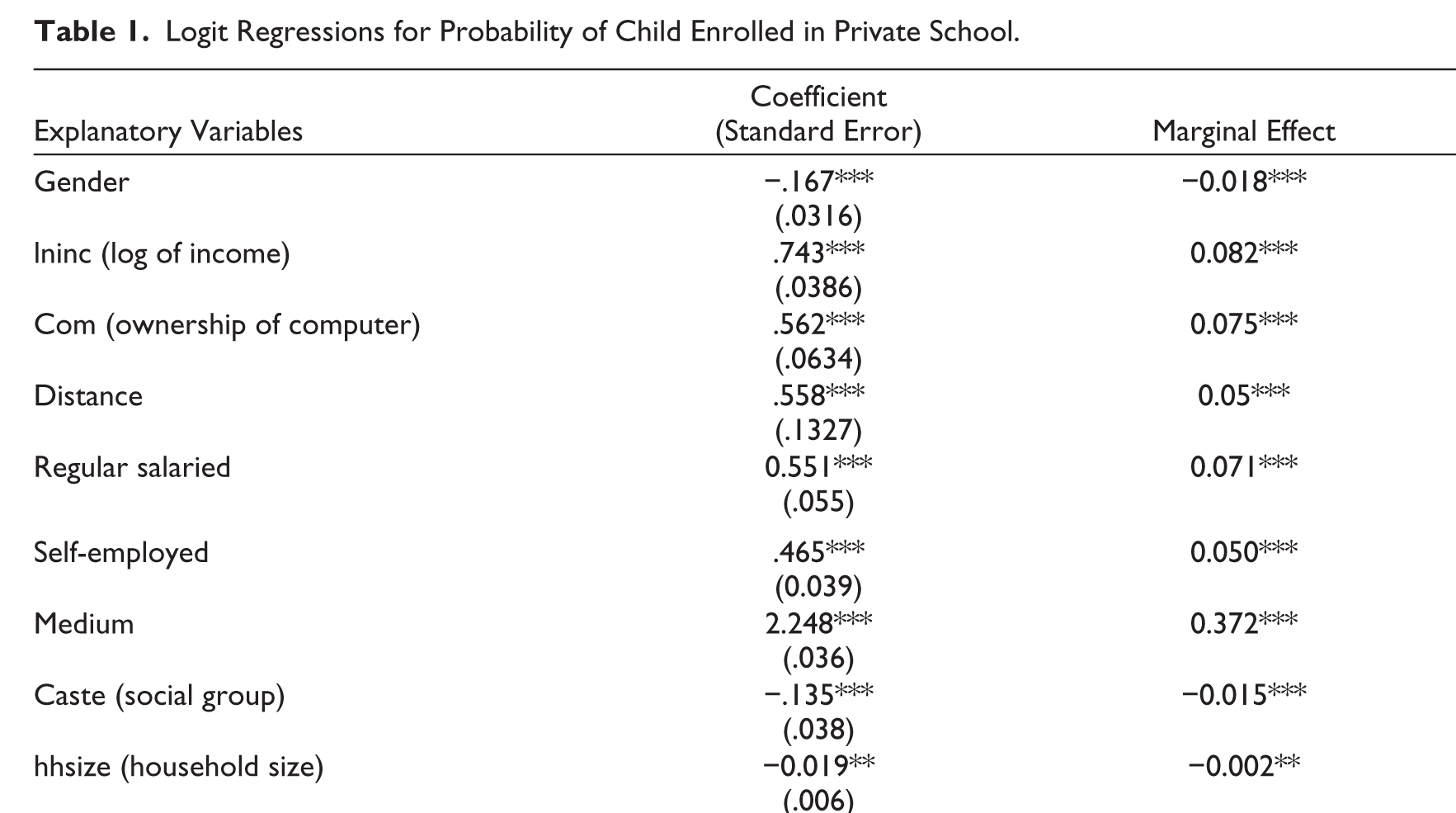
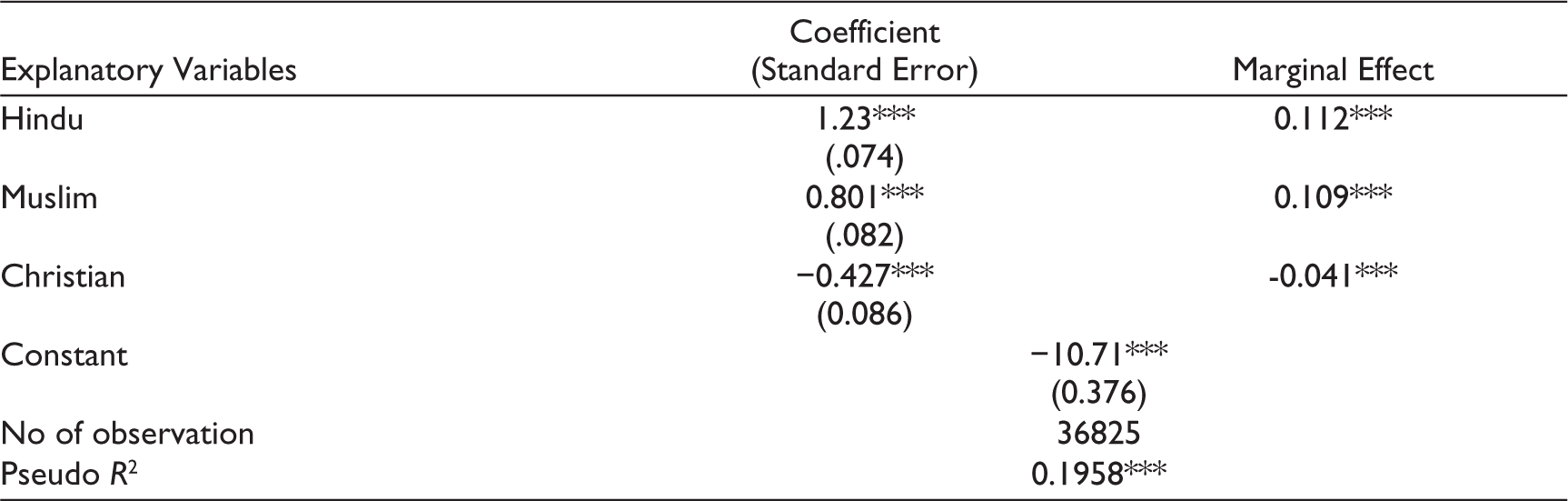
Table 1 indicates that comparatively economically affluent rural households prefer to send their child to private schools. The increased economic well-being of a family tends to increase their livelihood and choose a private primary school for their children’s education. The ownership of a computer in a household (acts as a proxy of household wealth and a certain education level of the parents) induces parents to enrol their children in private schools. The medium of instruction in school is an important determinant for the household to enrol their child in private school and the result depicts the same picture. Parents prefer to send their children to private schools because the medium of instruction in private schools is English. This finding is similar to many other scholars who also claim that the use of English as the medium of instruction is the main reason for a rural household to enrol its child in private schools (Baird, 2009; Muralidharan & Kremer, 2007; Tooley & Dixon, 2003). Households belonging to a BC, 12 prefer to enrol their children in rural public primary schools. It is found that household belonging to the Christian community has a negative association with enrolling their children on private schools. From the NSSO 75th round unit level data set it is found that among the total 2,977 (8%) households belonging to the Christian community, most of the children are enrolled in the private-aided school, followed by public school and private school. Here, as private-aided schools are considered public schools, a negative value of the coefficient is observed. According to the NCPCR Report (2016) among the total minority group, the Christian community comprises 11.54% of the total minority population but there is 71.96% of Christian missionary schools among the total minority schools. On the other hand, as per our result, households belonging to Hindu and Muslim communities have a fascination towards enrolment in private schools over public schools in rural India. Households with regular salaries engaged in agricultural and non-agricultural activities prefer to send their child to private schools but household members engaged in casual labour in agricultural and non-agricultural activities have to send their children to public schools primarily due to financial constraints. Our result also portrays that ‘English’ as the medium of instruction in primary school is the largest possible decision-making factor influencing parents to enrol their children in private primary school as reflected in the marginal coefficient. The sons receive preferential feeding compared to girls during the time of enrolment. According to Dixon and Humble (2017) probably as parents, preference for girls is a safe environment and they likely want to admit their daughter to public primary school. But this is not the only cause behind gender discrimination during the time of admission in private primary schools in rural India which is patriarchal. The other reasons will be discussed next.
The household belonging to the ‘Hindu’ or ‘Muslim’ religion is the second and third most important factor influencing parents towards private school enrolment for their children. Similarly, the income of the household and ownership of the computer which denotes the economic solvency of the household is the fourth important factor guiding parents to enrol their children on private schools.
According to NSSO, 75th round unit level data apart from these factors considered in our logit model, there are some other factors mentioned in Table 2 which are responsible for the fascination of parents towards private school enrolment. This study failed to incorporate these factors in our logit model (in Equation 1) as these reasons for attending private school were reported in the dataset by surveying only those children who are already enrolled in private primary school. 13
Preference (Qualitative) Reasons for Enrolment in Private Primary School.
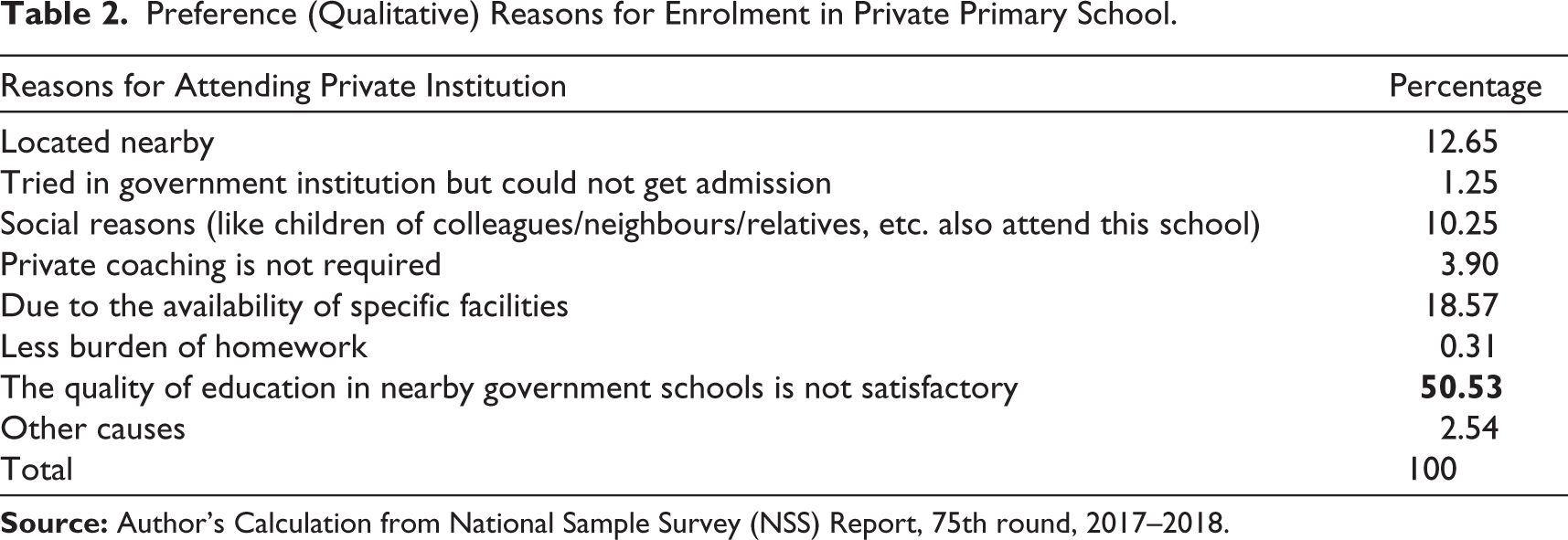
There is no overlapping case among the reasons. The cited reasons behind the fascination of parents in enrolment of their children in private primary schools in rural India are ‘quality of education in nearby government school is not satisfactory’ and ‘availability of specific facilities in private primary schools’ which indicates better infrastructure of the schools. Biswas and Kundu (2022) through framing the School Grant Coverage Index (supply-related grants provided to the public schools by the government under one head or index) had shown that all types of government grants have percolated down to most of the public primary schools in all parts of rural India. Still, that fails to gain confidence among rural parents and an inclination is observed among themselves to private primary schools during their children’s admission.
According to the Annual Status of Education Report (ASER-Rural, 2014) among the age group of 6–14 years nearly 29% of enrolment are now in private schools. Rural primary private school enrolment shows a discriminatory trend. Girls’ enrolment is higher than boys’ enrolment in public school but this pattern gets reversed in private un-aided school enrolment (NSS, 75th round). Research suggests that gender discrimination in private school enrolment is increasing over time in rural areas in elementary education attainment (Härmä & Rose, 2012; Mehrotra & Panchamukhi, 2006; Woodhead et al., 2013). Now, Fairlie Decomposition analysis will be used to quantify the contribution of the explanatory factors to gender discrimination in rural India during the time of admitting children to private primary schools.
Application of Fairlie’s Decomposition Analysis to Quantify the Contribution of the Explanatory Factors Influencing the Decision of Gender Discrimination Among Rural Parents During the Time Enrolling their Children in Private Primary School
According to the standard Blinder–Oaxaca decomposition, the gender gap in the average value of the dependent variable, Y, (here enrolment in a private school) can be expressed as:

Where X̅j is a row vector of the average value of the independent covariates and b̂j is a vector of coefficient estimates for gender j (j = M, F).
Following Fairlie (2006) the decomposition for a non-linear equation, Y = (Xb̂) can be written as

Here ‘F’ stands for girl ‘M’ stands for boys and ‘N’ stands for sample size. In this case, the coefficient estimates b̂M for boys are used as weights for the first term in the decomposition and the girls’ distribution of the independent covariates X̅F are used as weights for the second term. The alternative expression for the decomposition is used because:
Y̅ does not necessarily equal F (Xb̂). An equally valid expression for the decomposition is:

In this case, the girl’s coefficient estimates b̂F are used as weights for the first term in the decomposition and the boys’ distribution of the independent covariates X̅ M are used as weights for the second term.
Y̅ j is defined as the average probability of the binary outcome of interest for gender j and F as the cumulative distribution function from the logistic distribution.
The first term of Equations 3 and 4 provides an estimate of the contribution of gender differences in the entire set of independent covariates to the gender gap in the dependent variable (due to group differences in the distribution of X). Estimation of the total contribution is relatively simple and to calculate two sets of predicted probability by gender gap is required and take the difference between the average values of the two. The second term represents the part due to the differences in the group processes determining the level of Y. It also captures the portion of the gender gap due to group differences in unmeasurable or unobserved endowments.
Identifying the contribution of group differences in specific covariates to the gender gap is not as straightforward (Fairlie, 2006). For simplicity, there exists a natural one-to-one matching of boys’ and girls’ observations is assumed. Using coefficient estimates from a logit regression for a pooled sample b̂*, the independent contribution of Xi to the gender gap can be expressed as:

Similarly, the contribution of X2 can be explained as:

The contribution of each variable to the gap is thus equal to the change in the average predicted probability from replacing the girl’s distribution with the boy’s distribution of that variable while holding the distributions of other variables constant. The result of the decomposition analysis is given in Tables 3 and 4, respectively.
Aggregate Fairlie Decomposition Result.

Fairlie’s Decomposition of the gender discrimination Probability of a Child Enrolled in Private Primary School.

Here, Fairlie’s decomposition analysis is used to elucidate the various factors contributing to the gender disparity in enrolment observed within a private primary school situated in rural India. While Fairlie’s decomposition analysis effectively identifies how differences in the distribution of observable variables contribute to the explained portion of the gender enrolment gap, discerning the unexplained portion remains challenging through this method. The explained part is regarded as an ‘endowment’ (Fairlie, 2006). If the discriminatory groups (girls) have the same endowment as the favoured group(boys) then this explained part or in other words, the ‘endowment effect’ will be zero. The unexplained part of the gap may be ascribed to factors contributed by unobservable variables such as prevalent socio-cultural norms, perception of parents and patriarchal forces. It can be labelled as ‘discrimination’ accounting for gender differences in enrolment in private primary schools in rural India. Table 3 demonstrates the aggregate Fairlie’s Decomposition results where the total gender disparity in enrolment in a private primary school in rural India is divided into two parts: explained and unexplained. The model can elucidate 29% of the gender gap using independent variables, specifically endowment factors. The decomposition analysis fails to explain the unexplained part (71%) which contributed to other unobservable factors which cannot be incorporated into this model due to data unavailability.
Table 4 demonstrates Fairlie’s Decomposition analysis result of gender discrimination in the Probability of a Child enrolled in a private primary school. The probability of enrolling a son to a private primary school is 0.181 and that for the daughter is 0.157. Thus, there is a difference in the probability of enrolling children on private primary schools based on gender 14 and this result portrays the presence of son pro-bias in enrolment in private schools in Indian rural society. The gender gap in enrolment is less among the economically affluent rural households. Similarly, when any one member of the household has ownership of a computer it will also reduce the gap in enrolment based on gender. 15 It reflects that discrimination based on gender is usually less in educated households compared to uneducated households which supports the finding of Muralidharan (2013). Again, among the households with regular stable salary holders, gender discrimination in enrolment to private schools as households is less. English as a medium of instruction in school is an important covariate in widening gender discrimination in enrolment in private schools. The medium of instruction in school is an important parameter when enrolling on a private school as it is normally believed that a child with a better English vocabulary has a better future in the job market in adulthood. In most of the rural private schools, the medium of instruction is English compared to rural public schools and considering a better future for the son, parents enrol their boy child on private school and girl child on public schools. Religious practices in the household also act as an important driving force in increasing the gender gap in private primary school enrolment. Similarly, in a rural patriarchal society in India as, household size increases, there is a cut-down in education expenses for girl children whereas that is not the case for boys. Thus, as household size increases the gender gap in enrolment in primary schools also expands. Distance to the primary school from the household also widens the gender gap in enrolment as still in the twenty-first century girls are mainly enrolled on nearby schools due to safety and other social issues but these social issues are less important when making decisions on boys’ enrolment. Here, social attributes like caste, religion and school-related factors like English medium school, the distance between the household and primary school and household size widen the gender gap and economic attributes like better income, occupation of the head of the household and ownership of computers can reduce the gender gap in enrolment in private primary schools in rural India.
Household income level contributes to (−)25.63% in explaining the gender gap in enrolment in private primary schools in rural India (Table 4). It is the major factor responsible for gender discrimination during the time of enrolment in private primary schools. It is also proved that gender discrimination is less common among economically affluent rural households. It is followed that ownership of computer [(−)1.26%] whose sign of contribution is also negative. Medium of instruction in the primary school contributes 23.53% in explaining the gender gap and religion of the household explains 16.80% of the gap in enrolment. Here all the contributions are positively signed which implies those two factors are responsible for the widening gender gap during the time of enrolment. Household with the main working members with regular salaries (agricultural and non-agricultural sector) explains (−)2.10% of the gender gap on the other hand, households with the main working members engaged as self-employed (agricultural and non-agricultural sector) contribute to 3.36% in explaining the gender gap in the outcome variable. Household size exhibits a minor contribution of 1.68% in explaining the gap in enrolment. The distance between the household and primary school contributes 4.2% of the gender gap in enrolment, similarly, the social groups (caste) to which the household belongs also explain 8.4% of the gender gap in the outcome variable.
Conclusion
It is observed that parents residing in rural areas, opt for private primary schools primarily due to their perception of the inadequate quality of education provided by government schools. This underscores a widespread concern among parents regarding the educational standards in public institutions, leading them to seek alternatives in the private sector. This emphasises the urgent need for improvements in the public education system to address parental apprehensions and ensure equitable access to quality education for all children, regardless of their socio-economic background or geographical location. The second significant factor compelling rural parents to enrol their children in private schools are the availability of specific facilities that these institutions offer, which are often lacking in government schools. This highlights the disparity in resources and infrastructure between public and private primary schools, with the latter often providing amenities and services that cater to parental preferences and expectations. This underscores the importance of addressing infrastructure gaps in government schools to ensure that all children have access to essential facilities necessary for their educational development, regardless of the type of institution they attend. Parents in rural areas are often inclined to enrol their children in nearby private primary schools due to factors such as convenience and social considerations. These include the presence of colleagues, neighbours, or relatives whose children also attend the same school. This indicates the significance of social networks and community ties in influencing parental decisions regarding their children’s education. The results of logit regression highlight that English as the medium of instruction in private schools influences parents to send their children to private schools. Financially secure rural households reflect improved economic status and education levels, and households with computer ownership prioritise private schools. The decomposition results highlight the presence of gender discrimination in the probability of enrolling children on private primary schools and this result portrays the presence of son pro-bias in enrolling on private schools in Indian rural society. Social attributes like caste and religion widen the gender gap but economic attributes like income, occupation, and ownership of computers can reduce the gender gap in enrolment in private primary schools in rural India. On the other hand, school-related factors like the medium of instruction in primary school or the distance between the household and primary school widen the gender gap in enrolment in the outcome variable. Better income of the household, computer ownership, and households with regular income reduce gender discrimination during the time of enrolment of their children in private primary school. On the other hand, religious practices by the household, household size, social group to which the household belongs, medium of instruction in school and the distance to the primary school widens the gender gap in enrolment in private primary school.
Policy Recommendations
Based on the above results we can suggest a few policy prescriptions which can reduce gender discrimination by parents in rural India, during the time of enrolment in private primary schools.
The government should initiate English as the medium of instruction in public primary schools. As the direct cost of education in public primary schools is very low, this may reduce the fascination of the parents to send their children to private primary schools during the time of enrolment. This may also reduce gender discrimination during the time of enrolment.
The income of the households could be enhanced through different income support and income-generating programmes which can also reduce gender discrimination.
Setting up new primary schools in the different gram panchayat is necessary to reduce the distance from the household to the nearest school and the gender gap in enrolment in primary school.
The patriarchal mindset which plays a decisive role in the enrolment of girls in private primary schools vis-a-vis male children can be reshaped through various campaigns by the government which will provide moral and ethical views to change the parental prejudice and aspiration towards their daughters.
Research Limitations
The article is based on NSSO Unit Level data (75th round) on Social Consumption of Education. Here our research objective is to identify the possible household-related factors and school-related factors which can influence the possibility of private primary school enrolment in rural India. Some factors are identified. The lack of availability of data like parental education level, perception of parents, etc. which can also influence the enrolment cannot be considered in this investigation though it has strong theoretical justifications.
Footnotes
Declaration of Conflicting Interests
The authors declared no potential conflicts of interest with respect to the research, authorship and/or publication of this article.
Funding
The authors received no financial support for the research, authorship and/or publication of this article.
Appendix
Percentage of Students in Primary School by Type of Institution in which they are Currently Attending.

| Type of Institution | Rural | Urban | Total (Rural & Urban) | ||||||
| Male | Female | Person | Male | Female | Person | Male | Female | Person | |
| Government School | 72 | 75.7 | 73.7 | 30.4 | 31.5 | 30.9 | 61.5 | 64.9 | 63 |
| Private-Aided School | 5.6 | 5 | 5.3 | 18 | 18.6 | 18.2 | 8.7 | 8.3 | 8.6 |
| Private-Unaided School | 22.3 | 19.2 | 20.9 | 51.2 | 49.7 | 50.5 | 29.6 | 26.6 | 28.3 |