




Abstract
The purpose of this article is to deepen the understanding of informality, and related efforts governments must take to cope with large and persistent informal sectors. Is the informal sector a source of growth and employment or a drain on the fiscus that undermines social safety nets? This article questions the ‘formal sector bias’ present in much of the policy discussions surrounding informality. A theoretically grounded distinction between ‘functional’ and ‘juridical’ informality is drawn and applied to subcontracting as an illustrative case. The broad conclusion of the paper is not supportive of public intervention to formalise the informal sector but rather suggests that tolerating the informal sector might well improve economic performance as measured by output and employment.
Keywords
1. Introduction
There is little agreement on precisely what constitutes informality, which averages more than half of non-agricultural employment in the developing world. Definitions range from the purely juridical ‘informal sector participants pay no taxes’ to the more theoretical ‘the informal sector operates processes of production that do not return the average rate of profit when factors are paid their marginal products’ (Gibson & Kelly, 1994). In between, there are definitions that range from the nature of the product and its global supply chain, the conditions of work, to the more political, namely, that the ‘reserve army of unemployed’ allows capital to more ruthlessly exploit labour.
This article decomposes the informal sector into two parts: one in which informality is defined by the legal structure of the economy, juridical informality, and a second in which informal activity is related to the dynamics of capital accumulation and the demand for labour. The latter is referred to as functional informality. This approach follows the lead of Ray (1998), who carefully distinguishes functional from moral problems associated with poverty and income inequality. Functional informality is, in this article, due to the shortage of physical and human capital. Juridical informality, on the other hand, refers to de jure informality, that is, firms that break or infringe the rule of law by failing to comply with legal regulations governing their trade. 1 The key to understanding this difference is that the latter is largely a matter of choice, while the former is not.
No matter how it is defined, the share of gross domestic product (GDP) produced by the informal sector is correlated with poverty, a distorted distribution of income and precarious forms of work. In the past, the informal sector was seen as arising from the failure of government to act as an employer of last resort. As recently as 2007, the World Bank proclaimed that informality is itself ‘a blunt societal indictment of the quality of the state’s service provision and its enforcement capability’ (Perry et al., 2007, p. 2). One can, however, sense a turning of the tide towards a more benign stance against informality, abandoning what has been called ‘formal sector bias’ in policymaking circles. Biau (2011) notes that many
…international organizations [stress] the urgency of formalizing economies. At a January 2011 panel event hosted by the Organization of American States (OAS), for example, participants discussed the ‘problem of the informal sector’ and presented various ‘roadmaps to formalization’ as proposed policy responses.
An alternative view focusses on a more bottom-up rather than top-down solution, calling for more inclusive institutions, both political and economic, as the foundation for sustained growth and prosperity (Acemoglu & Robinson, 2012).
The article is organised as follows. The following section introduces the distinction between juridical and functional inequality in more detail. The third section discusses changing nature of informality in the Indian economy and the fourth section introduces subcontracting as an illustration of the concepts developed in the article. The final section concludes the article, highlighting the principal policy recommendations that emerge from the study.
2. Theory: Juridical and Functional Informality
In many developing economies, the informal sector is a ‘second economy’, accounting for as many as 80 per cent of non-agricultural jobs in sub-Saharan Africa and South Asia (Jütting & de Laiglesia, 2009). The definition of informality used in this beacon study is
…jobs or activities in the production and commercialization of legal goods and services that are not registered or protected by the state. Informal workers are excluded from social security benefits and the protection afforded by formal labour contracts. The majority of them cannot opt for scarce better jobs in the formal sector. Others voluntarily opt out of the formal system. For them, the savings from being completely or partly informal–no social security contributions, no tax payments, no binding labour regulations, and more freedom for business activities–outweigh the benefits accrued through registration and compliance.
This is an expansive definition and it is argued here that it conflates juridical and functional elements. 2 Moreover, the International Labour Office (ILO) distinguishes informal jobs from informal enterprises. Figure 1 is a Venn diagram of the forms that informal employment, shown by the dotted ring, can take, following the typology developed in ILO (2012). 3 All workers, by definition, have jobs, depicted in the figure as the solid black outer ring. The set of all enterprises is shown as the mixed dotted and dashed ring with informal enterprises, shown by the dashed ring, as a proper subset. The distinction is based purely on their legal status, whether they are registered by the state (both enterprises and employees), their bookkeeping practices and the like (ILO, 2012).
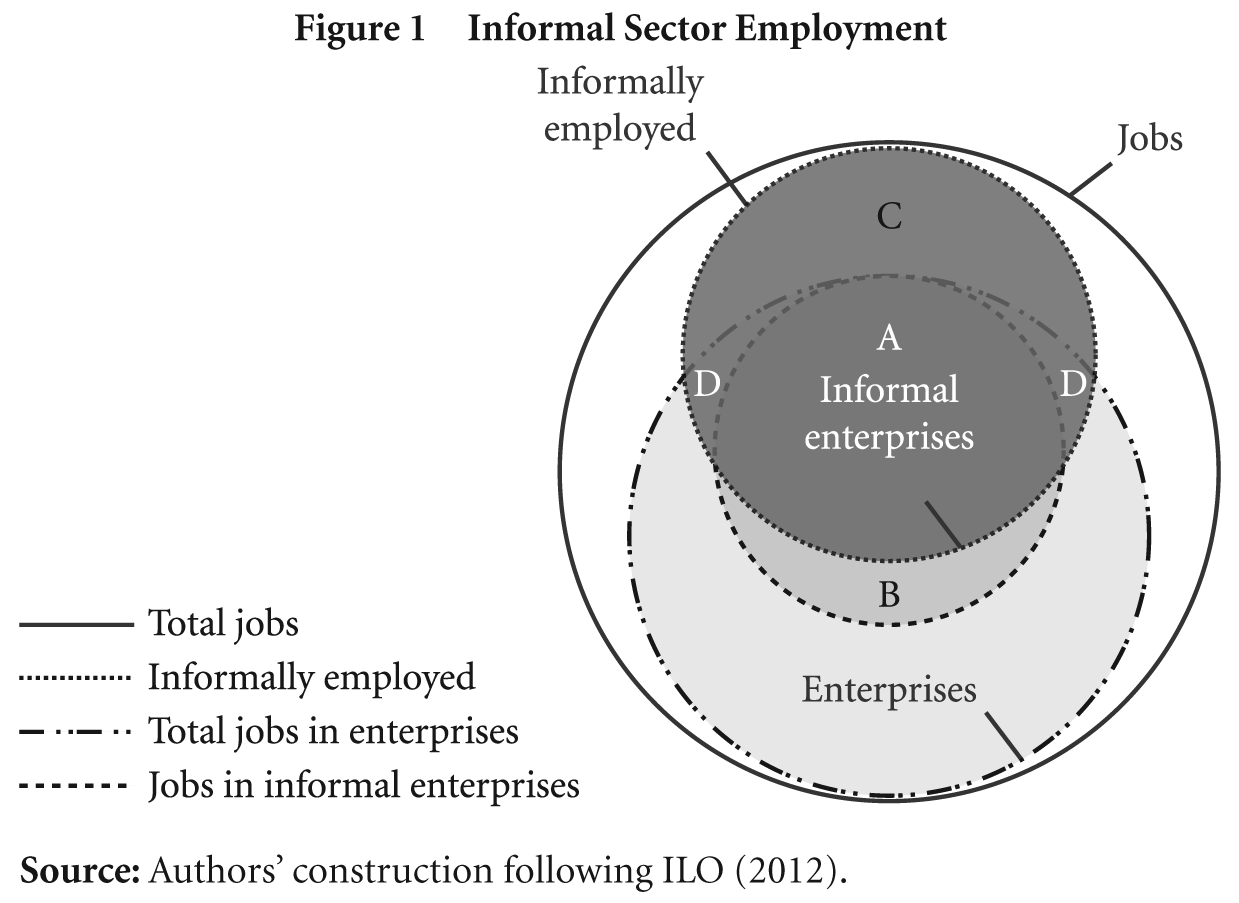
Not all those with a job are employed by a firm: some are self-employed, shown by the jobs complement to the enterprise set labelled in the figure as C. The ILO data count informal self-proprietors as informal workers who are not employed by informal sector enterprises. 4
In region A, the intersection of the informally employed and the informal enterprise sets, informal workers hold jobs with informal firms. The intersection of the informal enterprise set and the jobs set, outside the informally employed set, is vanishingly small. Labelled B in the figure, it includes workers who hold formal jobs with informal sector firms. An example of this, based on the juridical definition of informality, starts with an unregistered firm not paying taxes and or legally mandated wages and benefits to all workers. However, some informal firms do pay these obligations to select categories of workers, despite that the firm itself is informal. These workers then occupy region B. The opposite holds for region D, in which a formal sector firm employs informal workers. A clothing factory operating some permanent sewing lines with formal employees but also temporary lines employing temporary workers, who do not receive legal wages and benefits, illustrates this case of informal employment.
Region C comprises those who are self-employed in an informal activity. Examples are informal street traders, independent construction workers, homeworkers and those who run small businesses, such as garment sewing, food preparation or metalworking.
Regions A, B and C are uncontroversial and fit most definitions of the informal sector. Region D, however, is another matter. Consider a developing country with a legal structure that specifically provides a loophole enabling employers to pay exploitative wages and no benefits to some category, possibly even racial, of workers. 5 This example highlights the weakness of tying informality to some legal structure, which is ultimately arbitrary. These workers are juridically formal, but the ILO and other observers bend over backwards to count them as informal, given lack of coverage by the standard suite of labour legislation. ‘A job is informal’ they write, ‘when it lacks basic social or legal protections or employment benefits and may be found in the formal sector, informal sector or households’ (ILO, 2012). Uncovered temporary workers, whether by time or location, are all informal by this definition.
These workers may well be employed in the formal sector and specifically excluded from benefits by labour legislation. If there is no labour legislation covering temporary workers, they cannot be juridically informal. Workers who accept these jobs are nonetheless defined by the ILO as informal, possibly motivated by the kind of moral analysis usefully set aside by Ray (1998), in favour of a functional account.
2.1 Functional Informality Defined
How can functionality be defined? One way would be to say that if the production processes would fall into disuse if the employer had to pay proper wages and benefits, then the informality is functional (Gibson & Kelley, 1994). The strength of this distinction between juridical and functional informality, then, is that the latter is tied explicitly to underlying economic processes.
The functionally informal lack either human or physical capital in quantities sufficient for employment either in a formal establishment or on their own accord. 6
Juridical informality, on the other hand, obtains by the stroke of a politician’s or policymaker’s pen. Juridical informality is not grounded in economic analysis but results from piecewise, arbitrary and conflicting legal requirements. Indeed, firms may be juridically formal at one governmental level (e.g., city vs state) but informal at another.
Just as economic theory would appropriately reject a legal definition of monopoly or price gouging, so must it seek to isolate the functional or economic concept of informality from its juridical representation. Part of the reason is governmental authorities do not and indeed cannot usually determine whether a firm is permanently unprofitable or only temporarily so as it begins its metamorphosis to formality. Recall that Facebook, Amazon and Google were highly successful in equity markets long before they earned any profit. None of these firms was in business because the owners were incapable of earning a living any other way, yet, each could at some point in their history be classified as juridically informal. The legal establishment has only blunt instruments and does not even try to separate out infant industries from their survivalist counterparts.
In treating them all the same, however, government policy can block the transition of juridically informal firms to formal status. Policymakers may harbour a bias towards formality owing to its contribution to public sector revenues and the like. These concerns aside, the economy would be better off if all informal workers were transformed into formal mainly because productivity would be higher. This, of course, cannot be done by legislative fiat or other top-down policies other than those prescribed by standard economic theory. Therein, government’s role is not to usurp the expression of preferences through market activity but rather to repair, when possible, market failure, provide public goods, such as infrastructure, restrict monopolies and other forms of non-price taking behaviour and generally support rather than inhibit competitive market processes.
2.2 Trade, Growth and Functional Informality
Sinha (2011) notes that since the 1960s it was generally accepted that economic growth would eventually lead to the disappearance of the informal sector. She has in mind functional rather than juridical informality, however, since the latter would not necessarily dissolve with higher income per worker. Functional informality would disappear since with sufficient capital, there would be no reason to employ any but the most efficient techniques. The price system would then adjust to ensure that those methods would be profitable to operate. Since trade is associated with more rapid growth, it follows that trade should accelerate the decline in informality, as in the celebrated model of Lewis (1954). Yet,
… despite strong global growth that coincided with a massive increase in international trade, many jobs in developing countries remain in the informal economy. The share of employment in the informal economy has been persistent in many developing countries over recent decades and even increased in some regions. On average, 60 per cent of employment in developing countries is in the informal sector…In contrast to developed countries’ experiences, the formal sector in developing countries has not been able to absorb informal workers and production processes as expected. In fact, many studies suggest that globalization and trade reforms lead to competition in the formal sector, which may result in a reduction in formal employment, at least in the short run. (Sinha, 2011, p. 125)
The persistence of juridical informality, as noted above, is not in itself something that economic growth would necessarily end. Functionally formal firms can choose juridically informal strategies and the Internet has spawned a number of celebrated cases, such as Uber, Air B&B and others, that operate outside the legal structure and sometimes even cause the legal structure to change in order to accommodate the forms of creative destruction. These activities undermine rent-seeking behaviour that arose precisely in response to an effort to suppress juridical informality in the past.
Functional informality, however, is quite another matter. It stems from the notation that without a functioning social safety net, there must be close to full employment in developing economies. While not all workers work formally, most of the capable workers, even children in many instances, work. The production processes they operate may be defective in the sense that they would not be operated by profit maximising firms in competitive equilibrium, but they nonetheless persist because of a capital—either physical or human—shortage. It is this variety of informality for which economic growth is traditionally assumed to be the antidote and to which Sinha (2011) refers. If functional informality persists, it is only because growth is insufficient. It would be incorrect to conclude, however, that growth and trade might be powerless to end informal activity, if one did not first separate out juridical from functional informality.
Tokman (2007) points out that in Latin America and Africa, structural adjustment and reform actually increased the size of the informal sector. Sinha (2011), as noted above, points out that globalisation has increased or at least not significantly decreased the size of the informal sector. The informal sector has exploded with globalisation and economic openness (Verick, 2006). Harris–Todaro effects caused the urban informal sector to grow as a result of structural reforms. In Kenya, Ikiara and Ndung’u (1999) suggest that the structural adjustment programmes (SAPs) caused the employment rate in the urban informal sector to increase from about 4 per cent in the 1970s, when most of the labour force was in agriculture, to some 50 per cent by 1994. Smaller governments, responding to directives of the Bretton Woods institutions calling for more market-oriented economies, can also contribute to urban informality since discharged workers are unlikely to return to the countryside. This includes military demobilisation, as happened in Ethiopia when it released over 540,000 soldiers between 1991 and 1995 (Haltiwanger & Singh, 1999).
On the other hand, it might well be correct that the pace of growth is inadequate to end or even diminish functional inequality. It is simple to conceive of a model with rapid conversion of informal to formal workers as the economy expands, but with fertility remaining stubbornly high for institutional or cultural reasons. In that case, the rate of growth of the labour force could easily at times, and even over a significant interval, exceed the rate at which formal jobs are created. The persistence of the informal sector in no way challenges the role of trade and growth in removing functional informality. Persistent functional informality persists when these forces are weak or when they are opposed by frictions, political or otherwise, that arise in the process. Suffice it to say that there is some rate of growth for the economy as whole that would be consistent with the eventual disappearance of functionally informal labour.
Nor is functional informality the outcome of a well-defined choice of theoretic framework that economics normally employs to analyse problems. There is no margin at which the benefits of formal and informal activities are equalised. Most informal participants are not there because they feel that the formal sector is too restrictive. The outcome of informality is more closely aligned with more fundamental constraints. The opportunity cost of informal activity is not the formal sector, but rather leisure, which would itself compromise biological sustainability. Contrary to the claim, advanced by deSoto (1989) and others, functionally informal workers have, by and large, not ‘chosen to operate outside such bad laws, which entail high costs and…complex regulations.’ Functionally informal sector participants are informal only because their next best option fails to satisfy some minimum survival constraint.
The claim here must be understood carefully because it relates to the basic distinction of the article: informality that retains any economic content cannot depend on whether workers choose to avoid regulation labour or environmental laws or taxation, and are thus informal, when they could just as well abide and pay taxes and join the formal sector. Tax avoidance, strictly speaking, is an illegal activity. In a well-functioning political system, illegal activities are irrational since the incentives to obey the law must be built into the system in order for it to qualify as well functioning. Without an effective legal system, it may well be that laws are broken, but this would not apply only to informal sector operatives. 7
Not surprisingly, the data confirm this view. Taxation does not cause informality. Aruoba (2004) estimates cross-country differences in informal activity, government policies and institutions using data for 118 countries. The study finds that ‘better’ institutions are associated with higher income tax rates and less informal activity and higher levels of informal activity are associated with lower income tax rates. Deficit financed fiscal expenditure leads to more inflation in the latter set of countries and less in the former.
Nothing in the theory elaborated in this paper suggests that the informal sector cannot disappear entirely. 8 Growth may well eradicate functional informality over time, but juridical informality is likely to survive indefinitely, if government regulation and the taxation to support it fail to confer palpable benefits. The same is true if there is significant free-ridership. The data for Southeast Asia seem to support the view that functional informality will disappear. In countries such as South Korea, Taiwan and Singapore, informal workers have been absorbed into large-scale formal enterprises. The same is true in China, although the backlog of rural functional informality is larger and more problematic.
2.3 Public Policy and the Origins of Functional Informality
Functional informality aside, the debate on what constitutes juridical informality is lively and revolves around the appropriate role of the government. For some, the informal sector is viewed as a renegade, illegal and undocumented sector, often underground. This attitude is promoted by governments which see the informal sector as ‘tax cheats’, flying under the fiscal radar, thereby depriving governments of their rightful share of resources. Some economists challenge the idea that the government is entitled to any specific level of tax revenues and that they have become overly insistent on formality at the expense of a more vital economy. An early articulation of this view is by deSoto (1989), who, among others, argued that in repressing the informal economy, states also effectively repressed entrepreneurship. Here, it is clear that juridical informality can indeed be a choice: Biau (2011) notes that the ‘legalist’ school presents informality as a response to the presence of government-induced distortions. She notes that ‘a vast group of theorists now ascribes to the view that in an overly controlled environment, workers voluntarily opt out from the formal labour market to escape the burden of government regulations, cumbersome bureaucracy, and high transaction costs’ (Kaufmann, Johnson & Schleifer, 1997; Loayza, Oviedo & Servén, 2005; Pratap & Quintin, 2006; Schneider & Enste, 2000). Blocking the activity of small, flexible and dynamic producers through criminal or civil prosecution could quickly become counterproductive.
Formal sector employment opportunities are quantity constrained, usually by the amount of physical or human capital required for their operation. On the other hand, when formal sector employment shrinks, as it did after the financial crisis of 2007–08, released formal sectors workers do indeed compete with the informal sector, driving down incomes and presumably increasing poverty rates. This latter observation follows from price-taking behaviour in the informal sector. Informal producers have no market power and therefore must take relative prices as given. 9 Output is constrained by the scarce factor, usually capital per worker. When a wave of newly unemployed workers turns to informality, existing informal workers have no way of blocking their new colleagues from absorbing some part of the effective demand in the economy. Since the latter is now reduced, the reason the uptick in formal unemployment occurred in the first place, the effective demand is not only smaller but will also be shared across a larger number of informal sector participants.
When the wage falls to a level at which the means of subsistence can be obtained informally, then the wage will adjust no further. The productivity of the informal processes provides a lower bound below which the formal wage cannot fall. Transaction costs economics provides various explanations for why the wage may not fall this far, but it is certain that it cannot fall further (Basu, Chau & Kanbur, 2010).
Consider, for example, fluctuations in formal sector activity brought on by some real shock, such as a change in the mean temperature that occurred in the Younger Dryas. When formal output fell, there was nothing to stop workers who could not find formal employment from producing the means of production on their own, ‘crofting’ or retreating to subsistence farming. When population pressure relents, as it did after the ‘clearance’ of the potato famine and forced emigration to Australia, a tradable surplus arises. Trade generalised the reliance on potato calories and the functional informal sector, at least in Ireland, was born. It is key to see that no amount of market power in the formal sector can block the production of surplus potatoes—or indeed any other good produced by the informal sector. So long as there is demand, domestic or foreign, and sufficient land to allow for the surplus to exist, then informal activity will take place. Large-scale formal producers cannot eliminate the informal competition by any economic means. If formal producers lower their prices, informal producers will match the new lower price. Formal producers can only rely on the state to declare the competition ‘unfair’ and employ legal means to suppress the informal sector, primarily through government capture and subsequent politico-legal pressure (Biau, 2011). Historically, the other ‘solution’ to informality has always been the Malthusian one, but it is necessarily incomplete. As informal workers die from starvation, the real per capita income in the informal sector rises until a minimum subsistence is achieved. At that point, the formal sector is powerless to reduce the ranks of the informal, except by hiring them as the output expands.
It follows that trade is not essential to the notion of functional informality. Certainly, subsistence subeconomies that do not trade with the formal economy, such as the Yanomami in Brazil, are not functionally informal. The reason, however, is that their real subsistence incomes have no effect on the formal wage in Brazil since formal workers have no ability to join the tribe. When informal trade does arise, it may be taxed or not depending on the legal system and the degree to which laws and regulations are enforced. Note that if explicit laws do regulate trade and informal producers choose to ignore them, returns in the informal sector rise and so too does the lower bound on the formal wage.
Schneider and Enste (2000) provide a taxonomy of modern ‘crofting’ methods, including trade in stolen goods, drug manufacturing and dealing, prostitution, gambling, smuggling and fraud. All these put upward pressure on the formal wage. The point is that there is nothing special about law breaking since the formal wage itself may be enhanced in similar ways. Consider untaxed employee fringe benefits and employee discounts, including tuition remission, and even employer provided health care that originally came about as a form of tax evasion. When otherwise formal firms engage in tax evasion or other illegal activities, they do not become functionally informal. They are juridically informal.
The idea that the informal sector arises from some inadequacies on the part of the public sector, such as their inability to ‘formalise’ this sector or that, is therefore meaningless. Even if there were no government failure, and property rights completely secured, the informal sector would persist. The key point in the examples above is that the formal market participants, no matter how much or little market power they possess, cannot block informal producers. On the contrary, the presence of the informal sector undermines any market power formal producers might have by providing substitutes for consumers paying monopoly prices.
Juridical informality has no causal relationship to any necessarily undesirable outcome in economics. It might be said that if an informal sector were not paying taxes, then the public sector would be deprived of revenues and could not pursue its objectives of providing public goods, such as the provision of infrastructure, protection of private property or the maintenance of the monopoly on the use of force. This argument critically depends, however, on the absence of government failure. It rests on the assumption that the government would use the foregone revenues precisely to advance its efforts in the classical arenas of responsibility. If this is not the case, then the loss of revenue has no particular welfare implications to speak of, other than avoiding dead-weight loss.
2.4 Interdependence of Juridical and Functional Informality
Juridical informality, on the other hand, can be extinguished by way of public policies, simply by raising the benefits and lowering the costs of informality. Consider the cat-and-mouse game that has the informal producers taking steps to avoid detection since in their view, the benefits of formality do not outweigh the burden of taxation and the cost of regulations. The former include income, value-added or other taxes, as well as the payment of social security contributions. The costs of compliance include meeting legal labour market standards, such as minimum wages, limits on working hours, trade and immigration barriers, safety and workplace hazardous materials as well as environmental regulations and licensing, registration and intrusive data gathering. Formalising these juridically informal firms may involve welfare losses due to those who cannot be hired once full compliance is achieved. A reduction in juridical informality thereby increases functional informality.
Equilibrium in labour markets is brought about by adjustment in the real rate of remuneration. A formal sector firm that hires a willing but unregistered worker at a below market wage rate only facilitates adjustment to market equilibrium. In many countries, labour market subsidies have been considered as a means of reducing open unemployment. If policymakers permit an unregistered worker to be hired informally by a formal employer who then avoids payroll taxes, does not pay benefits or shoulder the expense of occupational health and safety measures, then they are effectively providing a labour market subsidy. From the perspective of the employer, the cost of labour is the same in the case of the direct subsidy or the indirect subsidy arising from the ability to employ workers under informal conditions of wages and benefits. From the point of view of the state, moreover, the fiscal drain of a subsidy is eliminated by the shift of the incidence of the subsidy to the juridically informal workers. These workers now bear the cost of the subsidy in the form of the gap between their wages, benefits and protections relative to those of formal sector workers. Market efficiency is nonetheless enhanced and the economy-wide real wage rises since the average productivity of functionally informal workers, both in and out of the formal sector, has increased.
2.5 The Benefits of Functional Informality: A Trade Model
Informals specialise in branches of the economy along the lines of classical comparative advantage, thereby increasing the efficiency with which resources are allocated. By doing what the informal sector does best, formal sector firms are free to concentrate on the production of goods and services that require higher levels of capital, both human and as embodied technological advance. Less of scarce capital has to be allocated to branches that more easily adapt to very high levels of labour intensity. In this way, a larger fraction of the capital stock can be retained where it is needed the most, precisely in the sectors in which the formal sector overwhelmingly dominates. This trade model approach to the informal sector suggests that informality gives informal sector participants ‘something to do’ with their time. Simple Ricardian theory can be applied to show that informality allows everyone, both formal and informal workers, to have more. As the argument goes, of course, this is only relative to the autarkic state in which there is little or no trade between the sectors as in the subsistence Yanomami subeconomy mentioned above.
Some may find this construction artificial despite its pedigree in economic theory. 10 There are well-known downsides to specialisation according to comparative advantage that mostly rely on the static nature of the problem addressed. Trade improves static allocation but may block growth if there is no opportunity for skill acquisition and climbing the ladder of comparative advantage (Gibson, 2005b). There is little hope for change if informal sector participants are locked into low productivity jobs in which there is limited skill acquisition through learning by doing. Moreover, as essentially a non-traded sector, informals are not subject to productivity-enhancing foreign competition to nearly the same extent as the formal sector. The dynamism of the economy as a whole predominantly relies on the dynamism of the formal sector. The question then is about the growth of demand for labour in the relevant skill categories that results from formal sector expansion. As noted above, if productivity rises faster than output, then formal employment opportunities shrink rather than expand. This does not happen in the long run, but long periods of rather stagnant growth in formal employment are consistent with the trade model approach.
If growth is largely dependent on the combination of ultra-low wages with ultra-high capital intensity, comparative statics of the standard models of international trade suggest a rather perverse response to a rise in foreign demand. Rather than increase the demand for labour-intensive goods as is usually the case in the Stolper–Samuelson world, foreign demand is likely to fall on the more capital-intensive sectors. As these expand, they can, to some extent, draw capital away from the other sectors, shifting the balance of domestic factor demand away from labour. The factor–price ratio will logically reflect the change in the demand, driving down the wage relative to the return on capital. In principle, foreign demand for the output of the informal sector could, and perhaps should, increase. In practice, that is almost never the case for a variety of real-world reasons, including quality standards, marketing and supply chain dynamics that characterise modern international trade. It is far more likely that a burst of foreign demand will cause a decrease rather than an increase in the wage–rental ratio, as suggested by the trade theorems.
What if the informal sector is not a perfect substitute for formal labour inasmuch as it lacks education, experience and labour market attachment, measured by job tenure, in short all the characteristics leading to successful labour market outcomes? If informal sector workers are inherently less productive than their formal counterparts, most of the time there is an inverse relationship between employment and productivity. The lack of substitution makes formal labour effectively more scarce. This enables textile manufacturers in South Africa, for example, to argue that labour is hard to find, despite an official 40 per cent rate of unemployment. In an economy with more low-wage informal labour, whose qualifications prevent their earning the commodious salaries of their formal brethren, aggregate demand is more likely to lag behind.
In this case, it is best to think of the formal/informal structure as essentially a trade model (Davies & Thurlow, 2010). If informal workers are unsuited to formal jobs, they can still contribute to GDP growth in the same way as countries with relatively low productivity contribute to the growth of world output. They do so through specialisation and trade. So long as the informal sector produces what it does best, the formal sector specialises in the rest. This is the standard trade model operating within one country. Workers in the informal sector might better tolerate long, variable or non-traditional working hours or be willing to risk dangerous or unpleasant jobs while at the same time they are unwilling or unable to acquire the human capital necessary to work in the formal sector. If these individuals self-select into the informal sector and work at jobs that no formal worker would accept, then total output will, of course, rise.
When total output rises, so too does total income and so the informal sector may well make a significant contribution to the level of aggregate demand. If this is the case, then when the formal labour force is near exhaustion, labour-saving technological change must still be introduced, causing a rise in productivity. If aggregate demand does not increase in step, then some formal workers will be ejected to the informal sector. In time, their human capital might well depreciate to the point at which they become permanent members of the informal sector. Over a shorter time horizon, this is less likely of course, and so they will probably be re-absorbed into the growing formal sector.
Something like this must occur as a country globalises. With entry into the world economy, a country will tend to specialise along the lines of comparative advantage. The transition is likely to be accompanied by a rapid inflow of foreign capital, which in turn raises productivity in the traded goods sector but does little or nothing for the productivity of the non-traded sector. McMillan and Rodrik (2011) note that productivity in the non-traded sector can decline and this is precisely in line with the analysis developed so far. As the traded sector expands, the economy experiences the productivity burst. Employment growth will slow down and the political establishment will decry the empty promise of globalisation as a jobs generator. It is possible, though unlikely, that globalisation could be accompanied by a strong increase in productivity and decline in the unemployment rate among formally qualified workers. This would be unusual, however, and would result only when the cost advantage of the combination of advanced technology and low wages is so strong that demand for exports grows at an extraordinary rate. The advantages of current account liberalisation are not conditional on this rate of expansion of demand, but the advantages are much more salient to the policy establishment if they are.
2.6 Informality, Productivity and Income Distribution
Finally, enumerating the functional characteristics of the informal sector must also include the effect on income distribution. Rapid productivity increases in some sectors of the economy will undermine the egalitarianism of subsistence economies and can be seen as a problem deserving some policy response. To some degree, however, the safety net protecting the poorest elements of developing economies is provided by informal activity itself. The ILO was one of the first to advance informality as an ameliorative to poverty and surplus labour in developing countries (Bangasser, 2000).
If functional informality derives from the capital-limited nature of the economy, then informality must be synonymous with low productivity. A sector with low productivity is identifiable in the data and has a clear policy implication. Informality defined in this way also has a clear causal relationship to important economic variables. Human welfare is never served by reducing productivity, and improvements in productivity are broadly correlated with virtually all measures of human well-being. 11 Functional informality is thereby associated with an unequal distribution of income and higher poverty indices.
If informal processes are just low-productivity processes, then it would seem that there would be a clear policy mandate to simply raise productivity. Unfortunately, policymakers do not always have a clear understanding of the effects of productivity-enhancing technical change. The reason is that low- productivity processes create the most jobs and the political establishment is often beguiled by job creation. As noted, there is nothing in the canons of economic theory that suggests that job creation per se could be a valid or coherent policy goal. For the same level of output, more job creation simply means less leisure and this is an unambiguous decrease in human welfare. The existence of the informal sector, functional informality, clearly illustrates the point. If the formal sector could replace informal output in, say, one-tenth of the time required by the informal sector, total leisure in the system would rise and most economists would say that the economy is better off. Without some form of redistribution, it could be argued, the informals would be left without the means of subsistence. In the competitive model, the redistribution comes in the form of lower wages and higher formal employment through real-wage adjustment.
3 Data: Indian Manufacturing Informality
One of the key conclusions of the theoretical framework developed above is that while a worker or firm may well choose to become juridically informal in preference to formality, the functionally informal are never observed to make that choice. Functionally informal workers always choose formal work over informal. If this conclusion is correct, it should follow that the number of functionally informal firms should shrink as growth and development proceeds. This section considers the data for manufacturing informality in India as a check on the validity of this broad conclusion.
Central questions concerning informal activity remain difficult to answer with any confidence, including even such basics as trends in the number of informal enterprises and workers. Moreover, very sparse information exists on what type of informal activities may be becoming more prevalent, those that generate better jobs and tend to be juridically informal or those that are closer to survivalist strategies, the functionally informal.
The most consistent detailed data on informal sector manufacturing available at the country level are for India. From these data, one can get a clear picture for country trends in the informal sector over time, as well as cautionary lessons concerning how specific and sensitive informal employment is to location and sector.
At the national level, Table 1 data show that the number of informal manufacturing enterprises grew between 1994 and 2010. However, the number of informally employed in manufacturing fell between 2000 and 2010. As a result, the average size of informal enterprises also fell, from a national average in 1994 of 2.29 workers per informal enterprise to 2.03 in 2010. At the same time, one can see that the percentage of full-time workers declined, from 89 to 80 per cent from 1994 to 2010, and the gender composition shifted towards women, albeit with a decline in the female share of informal employment between 2005 and 2010.
Informal Manufacturing Enterprises and Employment in India, 1994–2010
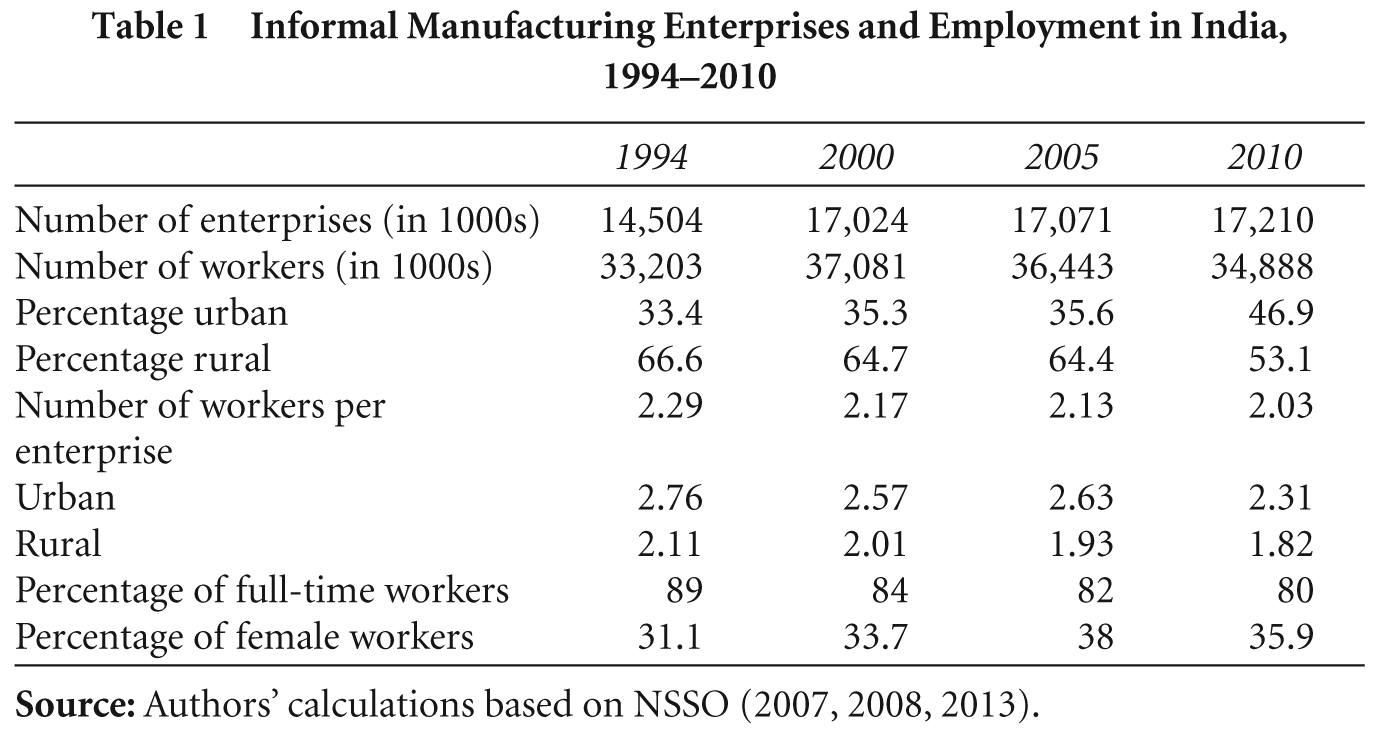
The table suggests that Indian informal manufacturing activity is broadly consistent with the hypothesis advanced above: Globalisation combines capital-intensive production processes with low-wage labour to gain a foothold in world markets. As argued by McMillan and Rodrik (2011), among many others, this raises productivity of one segment of the labour force and decreases the productivity of the rest. The latter are the functionally informal whose juridical counterparts are those workers who subcontract to the formal firms outside the existing reach of labour law and its enforcement mechanisms. Globalisation thus increases both juridical informality (mostly a good thing from a purely economic perspective) and functional informality (mostly a bad thing from an economic perspective).
The table shows that firm size is declining and fewer permanent workers are employed. Both trends support—or at least are not inconsistent with— the elaborated hypothesis. Disaggregating by sector and type of enterprise, Table 2 paints a generally supportive picture, although with some caveats. The own-account enterprises (OAEs), those which do not employ hired workers on a fairly regular basis, are the smallest and least productive and least remunerative, most likely functionally informal, and the worst jobs in terms of earnings and stability (Sahu, 2010; Sundaram, Ahsan & Mitra, 2012). From the table, the three largest sectors of informal manufacturing employment are heavily concentrated in OAEs, which accounted in 2010 for 69.7, 64.2 and 58.8 per cent, respectively, of total informal employment in the sector. Wearing apparel, the sector that grew the most in share of total informal manufacturing employment, has the highest share of OAEs. Thus, the shift towards wearing apparel seen in Table 2 is also a shift to the sector in which OAEs are most prevalent.
Informal Employment by Sector and Enterprise Type, 2005 and 20101

Considering variations in informality by region, the Indian experience also reveals that aggregate national data on manufacturing informality obscure significant differences by location. In Table 1, there is a clear shift from rural to urban informality. In 1994, 66.6 per cent of informal manufacturing workers were in rural areas, but in 2010 the rural share had fallen to 53.1 per cent. This too is consistent with the overall trends in a globalisation-driven development process of which India is often taken as an example.
Table 3 presents differences across the largest three regions of informal manufacturing employment between 2005 and 2010 and finds a similar shift. In all three, the share of urban employment in total regional informal employment rose over the period, with a large shift in Tamil Nadu, where the share of urban informal employment rose from 47.1 to 63.7 per cent, but only a slight change in West Bengal, which remained in 2010 at a 73.5 per cent share of rural informal manufacturing employment. At the same time, the share of OAEs in urban informal manufacturing employment rose as well. Again, the largest shift was in Tamil Nadu, where OAEs accounted for 46.5 per cent of urban informal employment in 2005 but 73.2 per cent in 2010. In rural parts of these regions, however, the table indicates that the share of OAEs fell.
Share of Informal Employment by Location and Enterprise Type, 2005 and 20101

Missing even from the Indian surveys, however, are indicators such as the relationship of informal manufacturers to the formal sector and global value chains, the availability of credit and the state of infrastructure. These are all important additional determinants of the potential to generate better jobs of the juridically rather than the functionally informal enterprise. One must then rely on case studies, with all their attendant problems of comparability across enterprise types, locations and time periods (Bacchetta, Ernst & Bustamante, 2009; Sen & Raj, 2013).
3.1 Informal Scaling and Subcontracting
One would assume that the informal economy scales with the economically active population rather than the formal economy. Many of the characteristics of informality prevent informal processes from scaling in any meaningful way. Yet, informal subcontracting provides a powerful example of informal processes that do scale to the formal economy. They can remain juridically informal, but like other start-ups they are not economically tied to the small scale with which they begin. They have access to labour and capital to flexibly expand production when formal producers subcontract out excess demand. At any given moment, the firms may well operate informally, ignoring labour and environmental laws even while earning large profits. The role these firms play is one of backstopping demand that their formal counterparts cannot satisfy, however, and so while profitability might be high in one period it can quickly go to zero or negative when demand is slack. These firms are in no position to be taxed as formal entities even though from time to time they might appear quite profitable. Whether they eventually transition to full formality depends on the overall macroeconomic and trade environment in which the country operates. This section explains in detail how scaling of the informal sector can work.
Informal firms sell intermediate goods to the formal firms, especially in manufacturing. These goods may be partially or fully elaborated with the latter requiring little more than packaging and shipping. In this case, there is a strong positive correlation between the output of the formal firm and that of its informal subcontractors, rather than a negative correlation suggested by the general theory of functional informality.
Militating against this positive correlation is the possibility that the subcontractors might be hired by the formal firm. Here, the distinction between juridical and functional informality is highly relevant: While functional informals would accept a formal sector job if offered, no such assumption is warranted in the case of the juridically informal. A common example is formerly skilled workers or managers in a formal firm who start their own informal firms and now cooperate with former employers as subcontractors.
Indeed, subcontracting is a salient form of direct interaction between formal and informal firms. The United Nations Industrial Development Organization (UNIDO) defines subcontracting as
…an economic relationship where one entity the main contractor, requests another independent entity, the subcontractor or supplier, to undertake the production or carry out the processing of a material, component part subassembly or the provision of an industrial service in accordance with the main contractor’s specifications. (Morcos, 2003)
The mosaic of relationships can become quite complex. Subcontracting chains, for example, can go from large retailers to large formal sector firms to smaller formal and then even on to functional informal producers. 12 The most studied case of subcontracting relationships is the garment industry, which in the past 30 years has experienced dramatic structural change away from in-house production to subcontracting manufacturing while retaining only specialised functions such as design. Morcos (2003) finds that more than 30 per cent of large US enterprises in 2001 were subcontracting more than 50 per cent of production. A survey in 2003 in Bangladesh found that only 32 per cent of clothing producers got their orders directly from the buyer; the rest were subcontractors (Hale, 2004).
The informal part of the subcontracting chain, by its subliminal nature, is hard to detect and evidence is limited to case studies. A common finding is that the size of the informal activity is large relative to the formal. The Commission of the European Community in 1996 reported that of the 650,000 workers engaged in subcontracting, 200,000 were home based and an additional 150,000 were undeclared (Commission of the European Communities, 1996). In examples from country or local case studies in the ready-made garment sector in Bangladesh, informal employment from subcontracting was estimated to be 75 per cent of the level of formal employment (Rashid, 2006). One study of the city of Ahmedabad in India found that 56 per cent of value added in large garment factories came from subcontracting (Unni, Bali & Vyas, 1999).
The main forms of subcontracting are full-capacity subcontracting, in which firms regularly subcontract work because of insufficient capacity, and specialised subcontracting, in which the contracting firm lacks specific skills or equipment for some operations (Lemma, 2001). 13 In these cases, the subcontracting firms provide flexibility, specialised products and services and logistical support to the firms from which they get orders, causing the positive correlation between formal and informal output and employment mentioned above. The benefit to the subcontractor is demand.
These interindustry flows increase direct and indirect demand. To the extent that the subcontracting firm finds the relationship profitable, more savings and investment can potentially result. A common complaint is that if low costs are the singular motivating factor in subcontracting, growth is likely to stagnate. This outcome, however, is not predicted by economic theory. The latter strongly suggests that all non-coerced transactions are mutually beneficial ‘modernising linkages’, irrespective of motive (Moreno-Monroy, Pieters & Erumban, 2012). Whether prices are high or low, it is the demand, not the ability to retain earnings, that counts. That UNIDO has estimated that a full one-third of subcontracting is motivated by cost rather than these mutually beneficial modersizing linkages is, strictly speaking, irrelevant (Morcos, 2003). 14
The more capital intensive is the firm doing the subcontracting work, the more likely it is in turn to encounter its own capital constraint and then to subcontract out part of its work (Morcos, 2003). The positive relationship between formal and informal activity is smaller for labour-intensive formal activity (Kongmanila & Takahashi, 2009; Moreno-Monroy et al., 2012; Sundaram, Ahsan & Mitra, 2012). The reason is self-evident in the framework of this article. In capital-constrained developing countries, the expansion of labour-intensive processes is less likely to encounter a constraint, and thereby need to rely on subcontracting, than its capital intensive counterpart. A countercurrent is when there are credence goods in the system that require formal monitoring of labour conditions (Gibson, 2005a; Gunther & Launov, 2012; Kucera & Roncolato, 2008). Here, an additional constraint comes into play, such that there are now two kinds of labour, one that complies with the international labour standards and one that does not. The first behaves like a new capital constraint, causing the firm to reduce output and thus subcontracting.
Firms that have only an indirect connection to credence goods may also be affected by changes in global subcontracting chains. The interconnectedness of the economy implies that few firms, even chemicals and manufacturing, are free of this effect. The net impact is to reduce demand for scalable, juridically informal subcontracting. With monitoring, however, the demand for credence goods could reasonably rise, thereby increasing the demand for labour within the monitored firms. The correlation between the output of the formal and functional, non-scalable, informal sector is now reversed. Consumer preferences in developed countries can be reasonably associated with a rise of formality, increasing with the firm’s human rights profile and a decline in the kind of informality most closely associated with poverty and badly distributed income (Perry et al. 2007, p. 25).
Labour monitoring thus results in shorter subcontracting chains, putting indirect pressure on informal subcontractors to obey the very labour laws that juridically informal firms typically escape. Market forces thus provide an incentive for these producers to turn quasi-formal with no government involvement (Gereffi & Fredeick, 2010). Since local consumers presumably do not care about or cannot afford to purchase goods embodying high labour standards, an opportunity for specialisation along the lines of comparative advantage arises, with local functional informals supplying local markets with unprotected goods, while the vertically integrated formal sector concentrates on foreign markets. 15
Despite the trends in the post-dotcom period, it is hard to imagine a more functionally informal environment than home work in a developing economy. One worker, one machine or tool, with output limited largely by the inherent productivity of the machine the worker employs. Were the worker to pay herself the market wage, there would be scant surplus to cover the rental cost of capital, most likely nothing at all. Home work can be either specialised work that falls into the category of regular subcontracting or work that is sporadic and depends solely on spikes in demand or bottlenecks in the formal sector firm. The former typically is skilled work like tailoring of high-end garments, while the latter includes simple stitching or work that is considered too dangerous to be performed in factories, such as stuffing down garments or stripping paint for metalworking. Here, the idea is that concentration of hazardous materials in a firm is a cost that is not borne in the decentralised environment of home work.
It has been argued that home work could be and sometimes is operated on a formal basis, paying taxes, obeying labour laws and achieving compliance with environmental regulations on point-source emissions by the decentralised planform of production. This contributes to the overall efficiency of resource allocation and is fully compatible with an entirely formalised economy. A second equally rarified example is highly skilled garment or specialty woodworkers whose production process is entirely non-scalable. They cannot benefit from formal organisation and comprise an artisan class of workers who are content to work in the isolation of their homes for family or other reasons. Needless to say, learning by interacting with colleagues cannot be a part of this kind of production. The reality, however, is that home work is rarely efficient and largely populated by functional informals who would likely accept an offer of formal work (Hale, 2004).
As noted, functional informals who abandon home work, piecework, their own kiosk, a storefront in their own homes and now are hired by formal firms can assist the efficient allocation of resources if they accept a lower than going wage. This will encourage the firm to hire more of the formerly functionally informal workers as now juridically informal, since they are technically in violation of existing labour laws. The ILO refers to these as ‘disguised wage workers’ (Bennett, 2003; ILO, 2002). 16
Informal labour within formal establishments is juridical but not functional. To see this, note that workers who apply for, accept and work at a wage offered by a formal establishment in violation of labour laws are actually pushing the market wage closer to the shadow value of labour. Hence, it could be argued that they are working at a market wage, even though it is not a legally sanctioned wage. The formal process will pay the average rate of profit; otherwise, it will not be operated by the formal firm. The worker is then juridical, but not functional.
It is therefore incorrect to say, as many observers do, that workers who are not registered or paid legal wages with mandated benefits must be considered informal. The fact that they are not paid a full formal-sector wage is not economically relevant, since the latter is determined by way of a political rather than an economic criterion. A single factory, for example, may have production lines using more highly skilled workers and automated machines and at the same time simple machines operated by low-skill workers. A common mechanism for circumventing labour legislation is to deny workers formal contracts or the equivalent legal document to demonstrate employment, despite regular and continuing employment in the firm (Mather, 2004; Unni et al., 1999). Surveys conducted by Women Working Worldwide found that in Pakistan and Bangladesh, 95 per cent of workers interviewed had no appointment letter and so could not establish their rights under their labour laws of the country (Hale, 2004). It should be cold comfort to these workers that they have improved allocative efficiency of their economies.
Conditions of work in many dimensions, wages, hours, health and safety, generally deteriorate with functional informality. It is less clear with juridical informality but since home production is rarely juridical, it is safe to conclude that homeworkers are at the bottom of most distributions of any desirable quality of work. This is not to say that juridical informality cannot be a choice. For example, it is true that home work can be preferred for its flexibility or for personal safety and convenience compared to a factory environment. Self-employment also may be preferred for many reasons including increased independence and ownership of future returns if the enterprise succeeds. It is sometimes observed that self-employment in the informal economy can yield higher returns than wages to low-skilled or unskilled workers in the formal sector, but unless corrected for the difference in skills, experience, tenure and labour market attachment, the comment is mostly irrelevant (ILO, 2002).
Wage and benefit differentials between formal and informal work can be substantial due to the capital constraint. Research from Women Working Worldwide has found that the line-leaders, workers in formal sector firms who subcontract work to homeworkers, pay 20–30 per cent of the rate they receive to the home workers. In the UK, homeworkers at the top of the earnings range in 2003 earned only 73 per cent of the minimum wage, while those at the bottom end earned only 25 per cent of national legal minimum (Hale, 2004). 17
Are these large wage differentials evidence of the presence of functional or simply juridical informality? If the wage differences just compensated the additional flexibility and absence of monitoring in home work, then workers would be presumably indifferent at the margin to employment at home or on the factory floor. Since it is implausible that the benefits of home work would offset the large observed difference in wages, one would predict that if offered, the overwhelming majority of homeworkers would immediately accept a formal sector job. Apart and quite distinct from any offense to a sense of fairness incorporated into political slogans, such as ‘equal pay for equal work’, the large wage differentials strongly support the view that these workers are functionally rather than juridically informal. It follows that efforts to change their legal status without addressing the root cause of their functional informality, the shortage of human and physical capital, might be meaningless in terms of human welfare.
It is sometimes argued that subcontracting itself explains the persistence and growth of informal sector activities. Since subcontracting is nothing more than a market transaction, it is unclear how it could cause informality. Certainly there is significant inequality in pay and conditions of work across both the categories of informality. It is less clear that these differences reflect anything but differences in the underlying skill set across informal sector participants. A consistent result in empirical studies of the nature and impact of formal–informal transactions is that these linkages are highly concentrated in the juridical part of the informal sector (Maiti, 2010; Moreno-Monroy et al., 2012; Mukherjee, 2003; Sahu, 2010). Subcontracting chains can often lead to functionally informal firms at the chain’s end, and home work, the lowest link in the chain, appears to have expanded in several countries. Nonetheless, formal sector demand for informal goods and services is strongest for juridically informal firms with more capital, higher productivity, scalable and a more highly educated workforce. The reasons are straightforward. Informal firms with less capital and skill are seldom able to satisfy the quality, reliability and delivery time demands of formal enterprises. In specific tasks and circumstances, such as simple stitching of garments and basic metalworking of household objects, the chain may extend to the bottom, home work.
Note that the nature of the subcontracting agreement is effectively outside the command and control of the state inasmuch as the Coasian theory of the firm largely determines whether there will be subcontracting in the first place or the inputs will be produced in-house. Following Coase, significant transaction costs will encourage in-firm production even if excess capacity exists and the arrangement lacks the imprimatur of efficient resource allocation. This suggests that governments would be well advised to take a transaction costs approach to formal–informal regulation and not stand in the way. 18
What does Coasian theory have to offer to assist an understanding of the scalable technology adoption problem? Subcontracting effectively transfers market risk to subcontractors, who because of their informal status cannot afford to refuse the offer. Backward induction suggests that all the formal firms must do is announce a contract and informal firms will accept the risk. The variance in the demand for full-capacity subcontracting enters into the decision at both ends of the transaction. Formal firms are more profitable because of it and informal firms suffer higher volatility in their returns. There is nothing the state can do however, short of aggressive exchange rate policy, since it is only the extent of the market that allows the backward induction to solve the bargaining game.
The roles are somewhat reversed in full-capacity subcontracting. In this arrangement, market risk is shared by the formal and informal firms. A dip in demand that causes output to fall below full capacity in the formal firm does not mean the demand for subcontracting falls to zero in that period. Given the complexities of the product lines, which include design and material substitution, change orders and long-tail runs, formal producers cannot easily find substitute subcontractors and quickly realise that it is in their interest to maintain a stable order flow so that the informal firm does not stray.
In developed economies, there is a significant principal–agent problem in subcontracting. The informal subcontractor, the agent, can pursue its own objective if it knows it can find other principals. In economies with a formal/informal structure, that is, developing economies, the structure itself solves the formal sector’s agency problem. When the relationship between the two is irregular and uncertain, the subcontracting firm, the agent, has less of an incentive to perform as expected by the principal. Long-term relationships increase the performance risk of the subcontractor, thus reducing the burden on the contracting firm to monitor the agent. Here arises the main difference from fully formal economies: Informal firms lack the breadth of market to support their bargaining position and so backward induction causes the principal–agent problem to be resolved in favour of contracting principal or formal firm. There are fewer performance breaches. Is this something public officials should try to ‘fix’ by requiring that subcontractors register and behave as formal firms? The analysis provides its own answer. The problem is that the subcontractors actually lack options, while formal firms can always go offshore, if need be. It is a dilemma that is probably best resolved by the status quo, recognising that further burdens imposed on the informal sector to comply with social regulation might well make the problem worse.
3.2 Labour Market Dynamics: Evidence from Latin America
Much of the theoretical elaboration of this article rests on the proposition that workers never choose structural informality. Is there evidence that this is true? A fairly vibrant literature does exist on the question of whether agents can ever choose juridical informality. ‘To first approximation’, write Bosch and Maloney (2007), ‘entry into the sector should be seen as a vocational choice in line with the worker’s comparative advantage, to work in a more entrepreneurial sector, albeit one with irregular relations with the state’. It follows that the state of play of the macroeconomy may well condition this choice. Maloney (1999), for example, argues against the traditional segmented labour model that is often applied to the informal sector. In this account, government or union intervention pushes wages in the formal sector above their market-clearing level. There are more qualified applicants than vacancies, so workers queue up for good jobs and, in the meantime, join the informal sector.
As noted above, some workers may in fact prefer the informal sector, given that there are a number of infelicitous barriers, such as drug testing, immigration or cultural or racial discrimination or simply personal preferences. These and other factors may push a worker out of the formal into the informal sector, but there are also pull factors at work. Some may prefer the flexibility, hours and absence of surveillance and intrusion that the informal sector offers. Using Mexican data, Maloney (1999) shows that often informal work is more remunerative than formal. The segmented labour market approach suggests a one-way pattern of mobility from informal to formal sector employment. The data for Mexico show that this is not necessarily true.
Gunther and Launov (2012) argue the heterogeneity of the informal sector, in that some workers are clearly rationed out of the formal sector, while for others participation in the informal sector is a competitive strategy. Using data from Côte d’Ivoire, they show that the informal sector is composed of two segments, of approximately equal size, with a distinct wage equation in each segment. One segment of the informal sector is ‘superior’ and the authors base this finding on the ‘comparative advantage’ of these individuals.
In clear contradiction with the theoretical approach in this article, however, they claim that this group has ‘higher average earnings as well as higher returns to education and experience’ (Gunther and Launov, 2012, p. 8). This is the notion of ‘upper-tier’ informality, which, according to the analysis presented here, has no clear theoretical foundation. Indeed, higher remuneration for more skills, education and experience is due to nothing more than market forces and cannot delineate informality in any important way (except perhaps ex post). Perhaps the upper tier is simply juridical informality; the authors do not say. What they do offer is a test of the unlimited sector mobility and find a considerable number of informal workers who would be better off in another segment of the labour market. Then, to make matters worse for the functional/juridical distinction, they parenthetically note ‘(most, but not all, of them are found in the lower- paid informal segment)’. They then conclude that the ‘higher-paid informal segment seem to have a comparative advantage in the informal sector’ (emphasis added). This conclusion is ipso facto erroneous since comparative advantage can only be claimed in the case in which labour mobility is incomplete. 19 Comparative advantage, as in the trade model approach discussed above, applies here mostly to the lower, immobile, tier and therefore cannot explain the bifurcation the authors so expertly uncover in their data. The study then does not fully support or contradict the framework offered here.
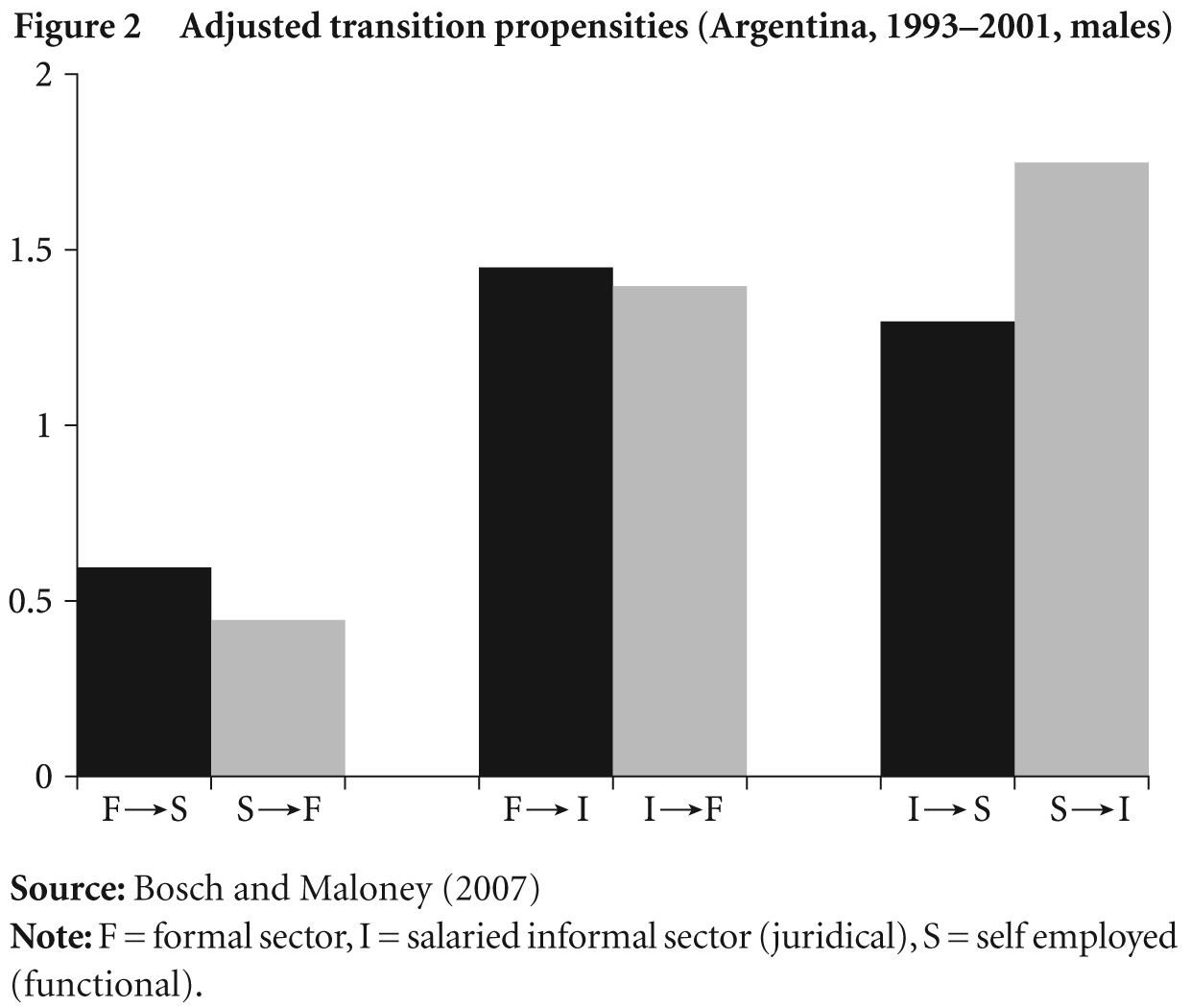
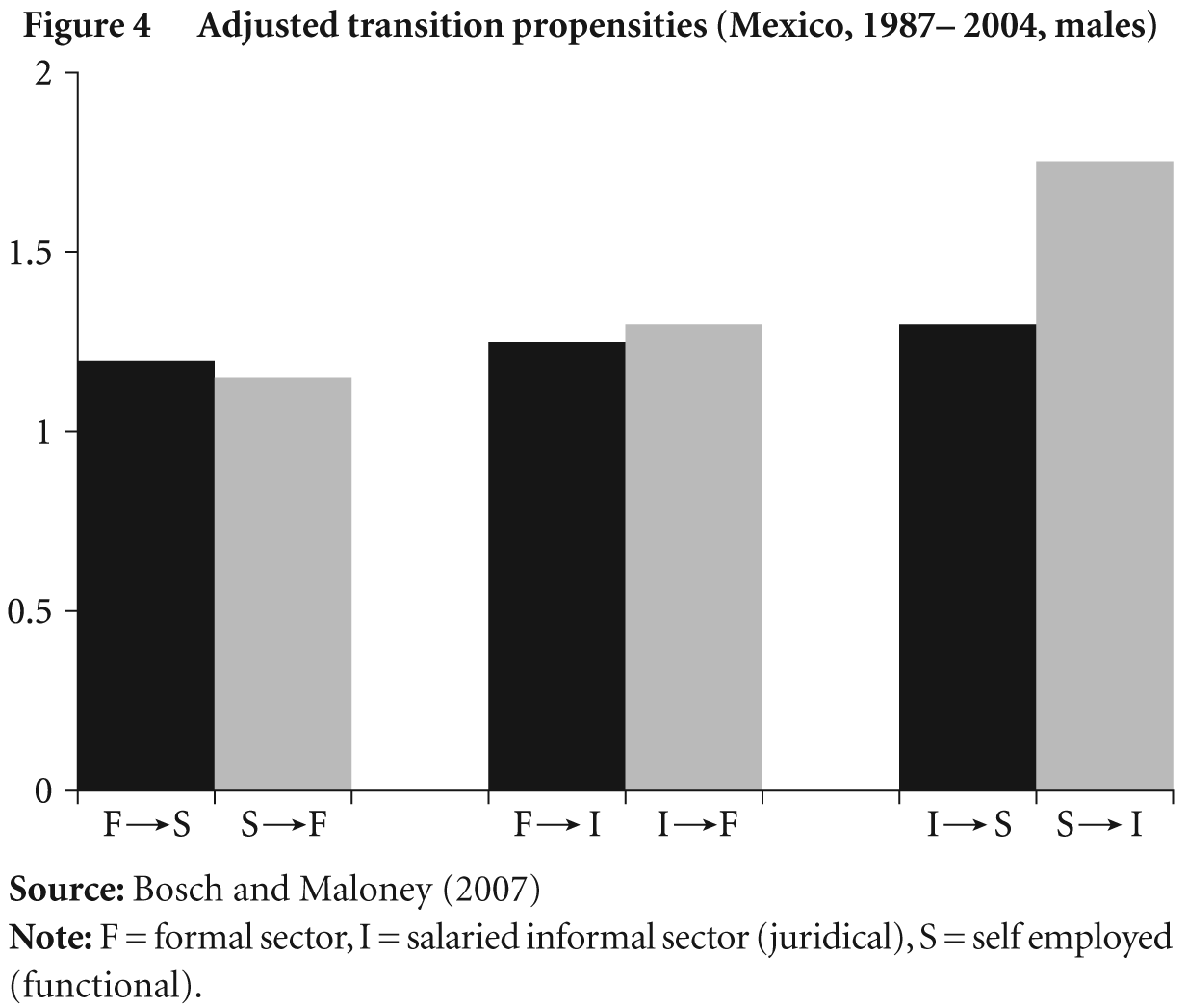
Bosch and Maloney (2007) develop continuous-time Markov transition processes and employ them to study and compare labour market dynamics in three developing countries, Argentina, Brazil and Mexico, all of which are very similar in terms of the structure of the labour markets. The authors distinguish formal sector salaried jobs (F), informal sector salaried jobs (I), self-employment (S), out of labour force and unemployed. Workers in informal sector salaried jobs are more likely to be juridical than functional and vice versa for the self-employed. Figures 2–4 show indices of labour flows in and out of the three sectors. Flows to formality from subcontracting sectors seem to be greater than from the functionally informal sector. In these three countries, the juridical informal sector seems to be a stepping stone between the functional and formal sectors. The figures show that the path to formality is more likely to pass through subcontracting, I, than to go directly to the formal sector, F. These data are consistent with the idea that productivity in the formal sector, at least in Argentina and Brazil, rises faster than output. In Mexico, productivity and output grow at approximately the same rate. A larger flow of workers seems to go from the self-employed or functionally informal to juridically informal, who are likely to have subcontracting work from formal firms, than the reverse. These juridically informal then queue for jobs in the formal sector. Labour migration into the juridical informal sector may well be pro-cyclical but for functional informality, it is undoubtedly countercyclical. Juridically informal workers may take up self-employment knowing that if their fledgling business fails, they can always retreat, more easily when the economy is robust. Indeed, these individuals might well wait for an upturn in the economy before venturing out on their own, abandoning the security of a juridically informal sector post. Evidence from Mexico suggests that juridical informality is pro-cyclical and the same seems to be true for Argentina. Bosch and Maloney (2007) find that the share of self-employed in Argentina increases as economic conditions improve, while Fiess, Maloney and Fugazza (2000) show similar results for Colombia, Brazil and Chile during periods of expansion.

4. Policy Conclusions
First, while structural change from largely informal to more formal manufacturing industry is in principle desirable, it must be done through processes that ensure the development of inclusive (non-extractive) economic and political institutions.
Fundamental to the idea of the informal sector is that the state cannot block participation. No reasonable government would try to do this, so the question is how best to assist the evolution of informality so that informals contribute as much as they can to the growth process.
Were government under some political pressure to ‘do something about the informal sector’ and perceived that it had a choice of whether to repress either functional or juridical informality, it should choose the former. This is supported by the results shown above. Any effort to discourage functional informality should be accompanied by more relaxed proscription of juridical informality. Displaced informals would then be freer to bid down the average wage rate (without necessarily reducing individual wage) thereby enhancing competitiveness in export markets.
Outward orientation has a positive but weak association with economic development. The reason is clear: Export-oriented manufacturing sectors often require flexible, cheap sources of inputs that can be provided by subcontracting, which can involve the manufacturing informal sector. Any attempt to formalise these linkages runs the risk of the loss of competitiveness for the country. Tolerating informality is equivalent to an export subsidy that protects both formal and informal sector profits and jobs.
A country with a dense input–output matrix will have a larger manufacturing informal sector than a country that specialises in one crop, one product or a particular natural resource. This does not imply a regular relationship between industrial structure and the informal sector, since the latter can be either a complement to a range of domestic sectors or a substitute for the imports that a more specialised economy earns with its exports. No general policy recommendations are forthcoming from this analysis.
Were the Lewis model correct, the flow from informality would always be unidirectional. Since benefits of formality are usually significant from the employee’s perspective, there would never be a reason to return to informality. This provides another economic way of distinguishing the informal sector as a reserve army of unemployed, operating processes that are defective and likely to remain that way, from production processes that may promise to scale into highly profitable, capital-intensive (physical or human) drivers of economic growth (Gibson & Kelley, 1994; Williams & Tumusiime-Mutebile, 1978).
There is no binding resource constraint in the juridical case that enforces informality. It is an economic choice made by rational agents seeking to start new concerns. These individuals are more likely to strike off and become independent proprietors when the economy is strong and unemployment is low and can provide a backstop in case the new venture fails. Government has no role in this process other than that justified by standard economic theory, attention to public goods and externalities.
The implication for public policy of informality of this sort is virtually nil since there is nothing the government can or should do about individuals who having identified a market for some good or service then try, often at great personal risk and sacrifice, to satisfy the demand. If anything, policies that are designed to repress functional informality, arising out of static or dynamic market failure, should be tempered so that the policy establishment runs no risk of collateral damage to entrepreneurs who are undertaking the essential tasks of the economic system.
The central difficultly in carrying out this advice is simply that the most dynamic, entrepreneurial firms and those mired in the self-exploitation of functional informality have always evolved from a common ancestor. If the political structure lacks confidence in its ability to pick winners, or indeed if it chooses to support the loser through tax breaks, subsidies and the rest, while in effect suppressing the winner, there is little point in the exercise. This unfavourable outcome should give pause to overly zealous policymakers.
One of the biggest problems facing the informal sector is lack of access to capital markets, either because of the absence of collateral or if present, its lack of clear title. Most of the recommendations of this article suggest that government should take a hands-off policy towards the informal sector. The approach does not, however, imply anarchy or anything of the sort. A parallel or shadow set of informal rules, regulations and other uncodified social norms and group dynamics arise to provide order within the existing informal economy. The World Bank sometimes makes the point that informal norms might be adapted to the formal sector regulations to enhance the flexibility of the latter (Perry et al., 2007).
The juridical distinction between the formal and informal economies may itself pose a barrier to the implementation of the appropriate technology, if it can be identified. Consider a subcontractor whose cost advantage derives from his skirting labour laws and paying less than the minimum wage. In this case, the cost of moving to the scaled technology involved a transformation of not only the capital stock but also the institutional context in which the firm operates. Some will be willing to make the transition; others not. If the transition to formality could be made less expensive with grandfathered tax and labour laws, more appropriate technological choices could be made.
It is important to remember that public policy is subject to capture by the formal sector. In Russia, for example, the formal sector was successful in blocking informal competition through the political process. This is nothing more than formal sector rent seeking. China provides a counterexample by encouraging formal–informal sector linkages far more than most countries.
Footnotes
Acknowledgements
Extensive comments from Ascha Pedersen of UNIDO are gratefully acknowledged. Thanks also to Michael Ferris and Reginald Minott of the University of Vermont for research assistance.