



Abstract

This publication is a refreshing attempt to discuss the role of boards in the current context wherein organisations are facing multiple challenges. More than ever, boards occupy the centre stage in working of organisations, their growth and competitiveness and their connect with the society. The Sustainable Development Goals have created a new context for the management and governance of organisations, and the COVID-19 has upstaged their vision, mission, objectives, programmes and activities. The changing paradigms of corporate governance are keeping them on their toes. Governed by the corporate governance codes impelling high degree of disclosure and transparency, the onus of compliance rests with the boards. The adage ‘digitisation or die’ has made the role of boards more crucial. The problems of cyber security have further added to their woes. As if this is not sufficient, the boards encounter complicated issues of competitiveness, productivity, innovation and leadership. Efficacy of internal controls and volatility pervading the ecosystem are the juggernaut problems. Board functioning and outcomes, trusteeship principles propounded by Mahatma Gandhi, Saga of Corporate Misgovernance and tsunami of frauds need deeper analysis and attention.
The publication has been authored by three renowned experts holding top positions in academia, industry boards and public policy making. With his deep experience Dr Preetam Singh has brought many key leanings and insights for members of the boards. He along with the co-authors Dr Asha Bhandarker and Dr Subir Verma provides valuable insights and analysis of board room functioning from the lens of organisational performance.
Besides a comprehensive introduction, the book is divided into six chapters. The book incorporates valuable information in seven appendices. As a part of the introduction, the socio-economic and political environment of the country has been narrated and the role of corporate sector has been highlighted. The need for the corporate sector to undergo transformational changes is emphasised as an essential precondition for creating a secure and prosperous India. In this context, it is argued that survival of organisations is more important than its growth. It is the sustainable development that holds the key to a turnaround of India, and the role of the corporate sector is very critical in making India Athmanirbhar (self-reliant). There is no reason why it cannot happen since both India and China had the same volume of the gross domestic product in 1975 and China’s gross domestic product is now 8 times higher than what it was in 1975. The corporate sector played a dominant role in the surge in gross domestic product in China and has assiduously built a sustainable competitive edge with the leadership of their effective boards. The State-owned Assets Supervision and Administration Commission has steered this process of establishing functioning corporates board to gain their prime global position. India has been left way behind and the authors observe that the corporate sector should play a similar role in putting the country on the top echelons.
The key question that has been discussed is whether the corporate boards could be architecting sustainable competitive edge? The authors suggest a three-stage approach to enable this task successfully. Firstly, the boards have to be in sync with the business context, secondly the boards have to become enablers of sustainable competitive edge and finally the boards have to act as levers of sustainable competitive edge. The authors note that Indian firms are not able to cope up with the global competition as they are ill-equipped to seize the opportunities available to them in the ever-changing business landscape. The authors also observe that innovation is the key to sustainable competitive advantage regardless of the nature of the firm. What actually matters is business innovation. The authors moot the idea of recognising continuous innovation as the centrepiece of strategy for bringing in sustainable advantage for the organisations.
The other major aspect of focus is that the boards need to get engaged in creating harmonious organisational culture and people power. The authors express their belief that for any strategic change, cultural change becomes a crucial variable and an agenda for leadership. According to them, the only thing real important contribution of a leader is to create and manage organisational culture, which in turn manages the organisations, and the boards may not even be aware of the extent to which this is happening. It is here that the authors very appropriately bring in the need for the boards to institute ethical governance. Good governance is not only about rules and compliances but also about ethics and values.
The book deals at length with the discussion on levers of sustainable competitive edge and the role of boards therein. Sustainable competitive advantage could be built by developing strategic focus, transforming organisational DNA and promoting shared vision for mobilising organisational energies. In the third chapter, the authors discuss in-depth the contours of board room functioning and sustainable advantage. Their study reveals that sustainable leadership should be topping the list in this regard followed by ethical governance, continued innovation, speedy response to market, and people with winning spirit, cost focus and stress on quality. But the literature tells us a different story with regards to the priority given in the board room discussions which most of the time revolves around costs. There is much less focus on issues such as quality, customer centricity, responsiveness, innovation, ethical governance, strategic leadership and people with winning spirit.
The key finding of the study regarding the board room functioning is alarming especially in the case of Indian boards which are focused on the present rather than the future (p. 126). The authors present the survey results of the thrust of board room discussions which disclose that interaction on the audit committee report and the statutory auditor’s report take away a major chunk of time during the board meetings. The discussion on risk management and human resource issues follow suit. An important feature of a competent organisation is when the boards are focusing on the strategic challenges facing their business in the coming years and its future implications. Based on these assessments the boards need to build strategy, prepare people and organisations and identify innovative approaches and solutions to build competitiveness. Building organisational reputation and giving attention to various stakeholders, both of which are important contributors to organisational sustainability, do not get much attention.
Dissecting the nature of Indian boards, the authors point out that of the sample of 115 boards chosen for the study, 70% Indian boards are ornamental, 25% behave as country club and only 4% are committed boards. The authors point out that board agenda is very heavy and is not sent out to the members on time. It is also felt that preparing a heavy board agenda is deliberate and intentional. In their study on board behaviours and organisational collapse, it is noted that the questionable integrity of the board members is the major reason of the organisational collapse.
The institution of board of directors finds an ample room in this book. Based on this sample survey, the authors note that independent directors are responsible to a high extent for unethical board-level practices as well as the poor performance and collapse of companies. It is pointed out that the problem starts when family members are made board members. In most of the company boards where something goes wrong, it is found that directly or indirectly, the founder members are involved. When the family members are being nominated on the boards, they are inviting from disaster sooner or later. The tendency to bypass serious discussion and agree on issues brought to the board by the top management is not a positive sign for the organisation. Independent directors are also silent on most issues during board discussions and that becomes the root cause of the problems.
For a board to successfully discharge its responsibilities, the members need to have a modicum of certain competencies. Each board member needs to possess domain expertise and business understanding, should be ethical and have openness to ideas and willingness to explore and endowed with strategic mindset and belief in teamwork. The other suggestions on board competencies relate to diversity and high-quality leadership. One of the reasons responsible for the collapse of companies and frictions in the boards relate to appointment of an incompetent individual as chairman of the board. A competent chairman is endowed with high level of knowledge and has the capability to manage board dynamics, engage stakeholders regularly and have clarity on the return on equity from them and manage dissentions. The ability of the board to step back and evaluate its own performance is a critical reflection on the board’s confidence in the value it is providing to the organisation. In the case of India, though the 2013 Act emphases the need to establish a mechanism for performance evaluation of the boards, most organisations do not have a structured process for board performance evaluation.
Chapter 4 of the book is devoted to recommendations towards value adding boards. The recommendations are built around the answer to the question: Are Indian boards value adding or value destroying? Findings of authors’ research are that Indian boards are adding value to a limited extent. The focus is more on compliance and there is none on the business side, which is very weak. They are characterised by strong inward and bureaucratic orientation hampering organisational effectiveness and growth. This could be overcome by going back to the basics, introducing a dynamic new business model and bringing in enablers of the dynamic business model. Back to the basics required shift in the mindset from wealth extraction to wealth creation, enfold future into the present and build a winning vision and creative destructions. The key weapons to go back to the basics are customer centricity, cost and quality leadership and time to market. Growth through innovation, from organising for exploitation to organising for exploration, organisational agility, people power and culture would be the enablers of the dynamic business model. The authors finally suggest the model of winning the corporate war (see Figure 1).

The authors concluded that the use of the model depends upon the dynamic capability of the organisations which is different from the ordinary capabilities and are focused on exploration oriented. Such organisations are ambidextrous with empowered multi-disciplinary teams, use venture capital type planning and funding, hire and retain the best talent, heighten people power and institute a culture of innovations with its roots in wealth creation. The success of the model rests on the board. The authors quote Sun Tzu, ‘if the sovereign heeds these stratagems of mine and acts upon them, he will surely win the war … If the sovereign neither heeds nor acts upon them, he will certainly suffer defeat ….’ The boards could be winners if they differentiate among the hibachi of practices governing their business.
Research studies show that diverse skill sets represented on the boards lead to success in organisations. In the Indian context it has been observed that most organisations prefer individuals who are accounting professionals, lawyers and retired government officials and the boards are lacking in humanistic skills. Having highlighted in-depth the role of boards, the authors could have further extended the discussion on other emerging issues. Their research falls short of appreciations in unpacking diversity contributions on corporate boards. The issues that need attention include contribution of gender diversity on the boards and the inclusion of minorities and expert foreign nationals which have not been covered in detail.
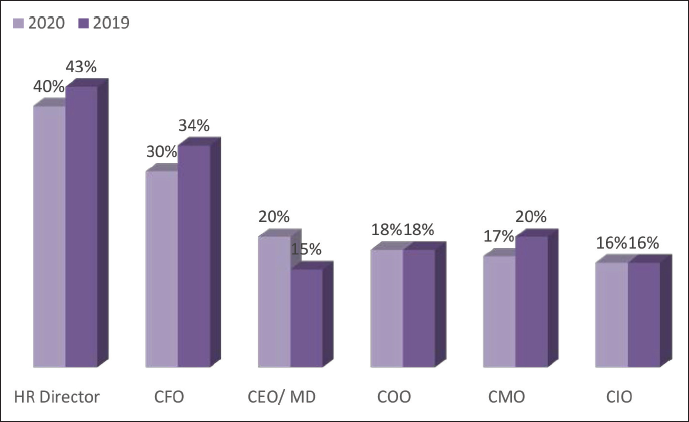
It is instructive to explore the factors that have limited the recognition of female board members contributions. One major factor is that women leaders are seen as more risk averse. Figure 2 depicts the proportion of women in specific roles. It is evident that at chief executive officer level there is an increase in the women during 2020 while there is a decline in chief financial officer position. It is observed that senior women occupy Human Resource Director’s role. It is noted that there is a shift in the movement within the roles where women are winning promotions and moving to next level.
In India before the mandate from the Companies Act 2013, the share of women directors was as low as 5% at the end of fiscal 2013. But then a gender quota, introduced in the new Companies Act 2013, forced listed and large companies to appoint more women on boards. Since then, the share of women directors has tripled. Among the Nifty-500 firms, 31% had two women on their boards. Only 5% had three women. And only 11 companies or 2.2% had more than three women on board. Figure 3 details the women and men representation on boards in Nifty-500 firms.

Research in the area of organisational demography suggests that heterogeneous groups may be more effective than homogeneous groups, suggesting that such groups contribute to higher organisational performance via the diversity of their members. The homogeneous teams are more effective at making quick decisions due to similarity in perspectives, the research suggest that heterogeneity is favoured in situations where novelty is desired. The boards with new members are more likely to pursue innovative strategies due in part to their willingness to experiment with strategies outside of industry norms. While highlighting the import of behavioural aspects in the role of boards the authors could have discussed the role of anchors of power and legitimacy either through their tenure in the board or through their voting control. Some burning questions such as the skill set required by the board members and their socio-psycho-economic background could have provided the relevant. The international comparisons and relevant case studies could have been included as a part of the book. These could have been useful to the reader of the book to understand the problem with comprehensive. Importantly, the research could have dealt with the ecosystem that is needed for the boards to perform effectively in terms of time required, back up support, research assistance and remuneration commensurate to their work.
Although the study has dealt with the role of independent directors, it has not highlighted their role that the nominated members should play. Various studies have shown that the successful organisations put a lot of emphasis on the role of independent directors and have a clearly defined role for them on the boards. Their reflections and unbiased opinions on various critical issues are considered very valuable by the organisations. There is ample scope provided to the independent director(s) to discuss matters of importance with all stakeholders. Studies have shown that many progressive boards have a clearly articulated focus on the rotation of the board members. This facilitates to infuse fresh thinking in the board room discussion and also to a great extent upholds the independence of these individuals. The recent report submitted by Securities and Exchange Board of India in August 2021 highlights the fact that the independent directors are unable to freely express their views on various critical issues as they fear their continuation on the boards. A very clear sign of a performing board is where the board members have the capability and the willingness to contribute to the business, the feedback from the board is welcomed by the management/promoters and where the independent members of the board have an enabling environment to actively contribute to the growth of the organisation. This alone could avert the criticism on the functioning of the boards that they are not merely coffee and cashew nut clubs.
In this VUCA (volatility, uncertainty, complexity and ambiguity) world, board members have to seize upon new knowledge and practices. Board development programmes can remedy this problem. The study could have researched on this issue.
Today’s business leaders are in a difficult place, they are being criticised for their lack of diversity and for abusive compensation policies. They rank close to the bottom of the opinion polls when it comes to operations of trust and reputation. The book is one of the most outstanding works and a commendably successful attempt in exploring and providing deep insights into the functioning of corporate boards in the Indian context. Boards have a key role to play in steering organisations towards sustainable future by adopting sound ethical governance and financial management policies. Their role assumes significance when organisation all around the world are faced with mission deficit, governance deficit, humanistic deficit, relevance deficit, financial deficit and cross-functional deficit. The book is an instant classic that will be read and consulted by chief executive officers, corporate board members and regulators, and those who seek to become one. The book has brought to the fore the insider view on the issues and challenges of board room functioning and performance.
While many studies have focused on the board’s compliance with the financial rules and regulations, and confirming to the law of the land, this study breaks new grounds by highlighting the behavioural aspects impacting board room functioning have been adequately highlighted in the book. The authors have done a great value addition to their presentation by giving a detailed bibliography at the end of the various chapters and supporting their conclusions with anecdotal references.