



Abstract
This paper aims at identifying the probable impact of board gender diversity on the key business operational areas explored by the existing published research. Moreover, the study also emphasises exploring the role of board gender diversity in the Indian banking sector. The data from existing literature from 2000 to 2022 have been extracted from the Scopus database. By devising VOSviewer software, citation analysis and bibliographic coupling analysis were conducted to identify the influential documents, authors and journals that made significant contributions to this segment of research. According to the findings of the study, no significant research has been conducted to determine the impact of board gender diversity on various key operational aspects of the banking sector. It also discovers that the majority of the studies were carried out in European countries. The Indian context is still underexplored. The study suggests key research questions, the answers to which can be investigated by future researchers.
Introduction
Recent dynamic and complex business scenarios have set the debate regarding women’s low presence on corporate boards, and thus piqued the attention of scholars and policymakers (Bøhren & Staubo, 2016). This grave concern rattles all the corporate boardrooms across the globe. This has resulted in many developed countries enacting gender quota legislation, which mandates the nomination of female board members. For example, Norway, Germany, Belgium, Iceland and France, mandate a minimum of 40% female representation on public company boards (Ahern & Dittmar, 2012). Discourses, conventions, programmes, procedures and firm’s spectrum of day-to-day behaviours are assessed and challenged by gender diversity policies, which also cause a change in organisational culture and attitudes. A lot of research has been done about board gender diversity because there has been a big rise in the number of women on boards.
Moreover, public debate has, further, centred on whether gender diversity on corporate boards affects company performance (Adams & Funk, 2009; Terjesen et al., 2016). Numerous research studies have focused on exploring the probable impact of board gender diversity on various company operations, such as risk-taking (Chatjuthamard et al., 2021; Poletti-Hughes, & Briano-Turrent, 2019; Mohsni et al., 2021; Nadeem et al., 2019), firm performance (Munira, 2020; Solal & Snellman, 2019), decision-making (Arora & Kumar, 2016; García-Izquierdo et al., 2018; Sila et al., 2016), innovation (Attah-Boakye et al., 2020; Ritter-Hayashi et al., 2019) and corporate social responsibility (Fadli et al., 2019; Ghaleb et al., 2021; Giannarakis et al., 2020). Previous research studies have produced conflicting findings on the relationship between female representation on boards and firm performance: some studies have shown that increasing the proportion of women on corporate boards improves financial performance, while others have found negative or no benefits. The vast majority of research on board gender diversity is empirical in nature and draws on management literature for its theoretical foundations. In earlier research on board gender diversity, three management theories have been highlighted: (a) resource dependence theory (b) behavioural agency theory and (c) social identity theory.
We, therefore, have the opportunity to propose an in-depth analysis of how board gender diversity affects the various aspects of bank performance. In this context, we performed a systematic literature review of the board gender diversity and performance of banks. To achieve this goal, we propose to answer two questions:
Three research questions are formulated in this study to review the literature on board gender diversity and business operational aspects. In this study, we identify the key business operational areas in which the impact of board gender diversity has been explored by the researchers based on a systematic literature review. Further, we also aim to identify the extent to which board gender diversity plays a role in the Indian banking sector.
We conducted a systematic literature review with research in the academic databases Scopus from 2000 to 2022. VOSviewer software was used to perform citation analysis and bibliographic coupling analysis to explore the influential documents, authors and journals that contributed significantly to this segment of research. The study finds that no substantial research has been conducted to find the impact of board gender diversity on various key operational aspects of the banking sector. It also, further, finds that most of the studies were conducted in European countries. The Indian context is still untapped as very few studies have explored the impact of increasing female board members in a bank on key banking operations. The study also suggests key research questions whose answers can be explored by future researchers.
The rest of this study is organised as follows: The second section presents the methodology of this study and the results of bibliometric citation analysis. The comprehensive bibliometric review and discussions are developed and presented in the third section. The fourth section offers the future research agendas, and the fifth section concludes the study with the conclusion and limitations of the review study.
Resource Dependence Theory
One of the most important organisational and strategic theories is resource dependence. The theory observes the corporation as an open system that relies on the external environment for its survival. The resource dependence hypothesis, which has been extensively studied in the past, has been suggested as a useful paradigm for studying boards of directors. To put it another way, Pfeffer and Salancik (2003) argue that directors contribute four benefits to organisations: advice and counsel, information in the form of advice or counsel, access to channels of communication between the firm and environmental contingencies. The benefits provided by directors are classified by Hillman et al. (2000) as business experts, insiders, community influencers and support specialists. Hillman et al. (2000) extend the applications of resource dependence theory and observe that a gender-diversified board of directors provides effective and efficient financial and operational outcomes for companies. The resource dependence theory paradigm provides various considerations for promoting board diversity. To illustrate this point, a diverse board of directors serves as a conduit between the company’s internal and external constituents. The postulates of resource dependence theory give a number of arguments in support of increasing board diversity. Gender-based diversified directors also bring different perspectives to the table, which can potentially improve board advisory services to managers and aid in better decision-making. In addition, board diversity sends a crucial message to the product and workforce markets. Because they are not business insiders or specialists, directors from a wide range of backgrounds can bring a variety of viewpoints and unconventional ideas to bear on the company’s challenges. Gender and ethnicity have been treated separately in prior studies on board diversity under the resource dependence paradigm. Although the impact of gender diversity on economic outcomes has been studied in the context of resource dependence theory, recent studies have focused more specifically on gender and the impact of gender on economic outcomes (García-Sánchez et al., 2017). A diverse set of skills, knowledge and perspectives distinguishes male and female directors from one another, all of which lead to a higher level of creativity and innovation in the workplace (Taylor & Greve, 2006). By including female directors on the board, the needs of female clients, staff and customers can be catered to effectively (Hillman et al., 2009).
Behavioural Agency Theory
Agency theory, an influential management theoretical paradigm (Boučková, 2015) developed by Jensen and Meckling (1976), is based on the relationship between a principal and an agent (s). The theory emphasises the operation of a business based on competing interests in principal–agent relationships. In addition, knowledge asymmetries and misaligned motivations on either side of the interaction may be a source of friction in the relationship. The linkage between corporate board gender diversity and firm performance in the context of the monitoring function of a firm is explained by agency theory. The advocates of the agency theory (Fama & Jensen, 1983; Jensen, 1986; Jensen & Meckling, 1976) argue that decision-making should be kept separate from control. Further, Eisenhardt (1989) highlighted that agency theory is concerned with resolving two difficulties that arise when the principal and agent’s interests or aims conflict and/or when the principal cannot verify what the agent is actually doing. Roberts et al. (2005) employ agency theory as a foundation for corporate governance. When the board has representation from varied groups, like different genders, it is less likely that a single individual or a small number of individuals will exert too much influence over the board’s decisions (Hampel, 1998). The responsibility of the board of directors is to provide authentic information to the shareholders, resulting in the effective supervision of corporate management and executives (Fama & Jensen, 1983). Several previous research studies have used the agency theory framework to investigate the impact of board gender diversity on business actions and outcomes (Ararat et al., 2015; Nguyen et al., 2015; Ntim, 2015).
Social Identity Theory
Tajfel (1978) describes the tendency of an individual to categorise himself and others into socially homogeneous groups based on demographic characteristics, such as education, gender and age. Homogeneous and heterogeneous groups are created to differentiate one another and to maintain self-identity. The authors observed, along the same lines as social identity theory, that gender diversity in corporate boards leads to the development of an ‘Us vs. Them’ perception among board members.
This paper reviews the research on the presence of gender diversity on corporate boards of directors in the banking sector. The rationality behind the selection of banking sectors is their different operating and risk management mechanisms. The regulations and government policies differ from those of other industrial sectors across the globe (Elamer et al., 2019; Elamer et al., 2020). The banking sector is thought to be the heart of any economy because it keeps an eye on and controls the amount of money that businesses have. This means that the banking industry’s compliance standards are very strict (Arnaboldi et al., 2020). The lending practices of banks make it one of the most financially exposed sectors in the economy. Thus, the role of the board of directors of banks has become substantially more important in formulating policies regarding bank performance and other critical business aspects that influence board gender diversity, and the impact that board gender diversity has on firm-specific challenges. Furthermore, future research directions are suggested. Undoubtedly, the profile of board members will have a significant influence on the performance, lending practices, decision-making and risk management strategies of banks (Figure 1).
Literature Review
An increase in the number of academics examining female participation on corporate boards of directors, as well as their multidimensional implications on companies, has resulted in a proliferation of research.
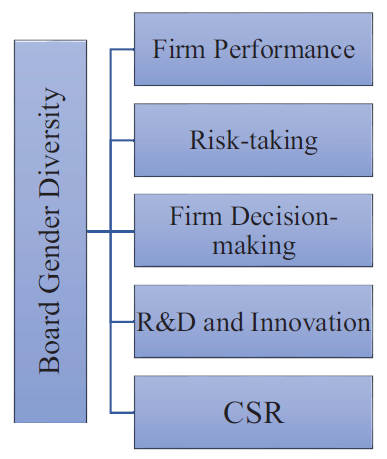
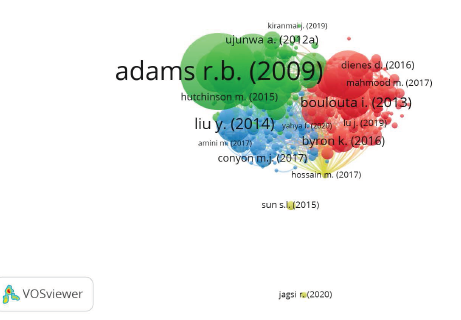
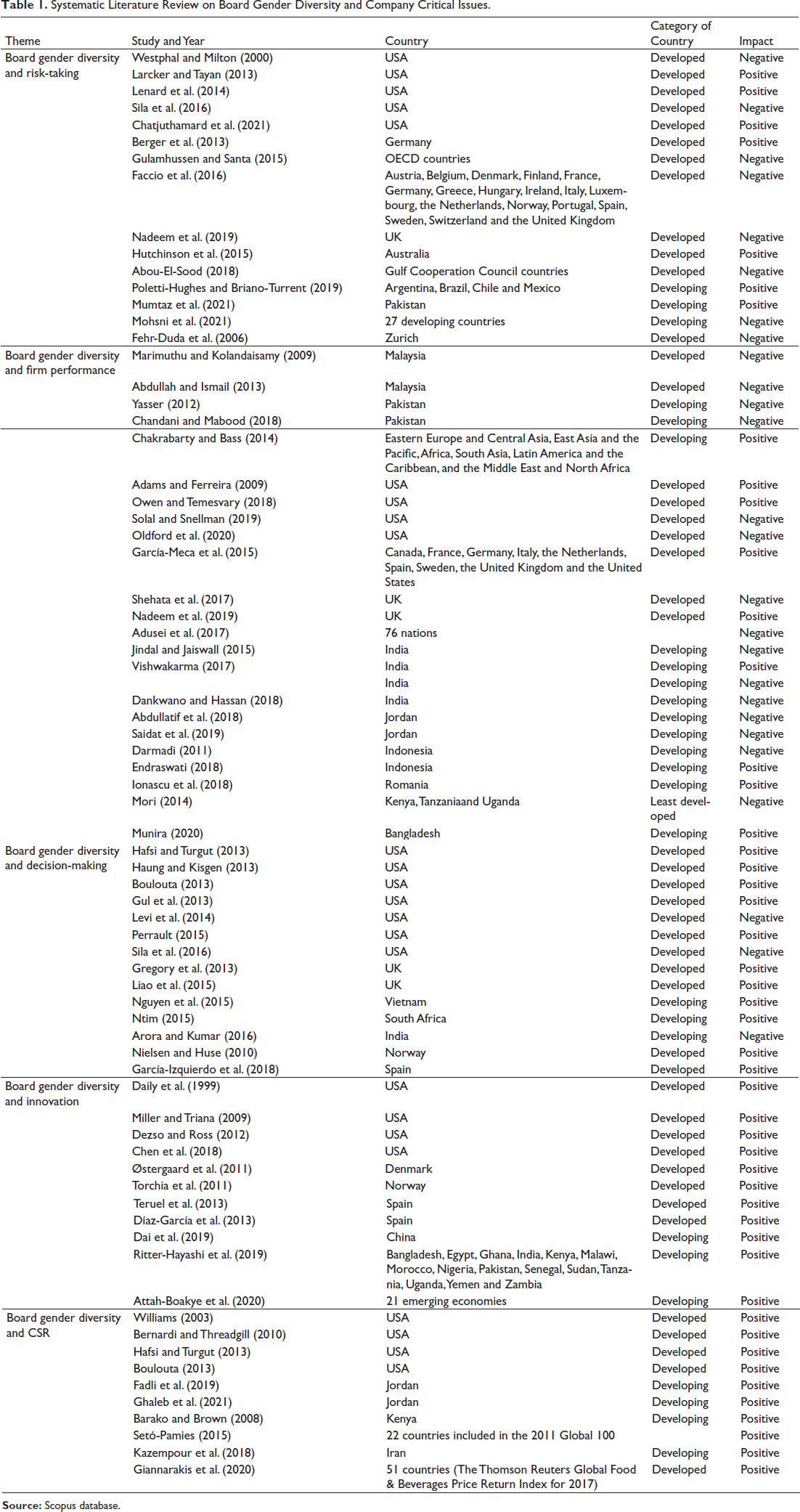
Table 1 summarises the findings of the existing literature related to board gender diversity and critical decision-making activities. The first section of the table depicts the summary of findings in the context of board gender diversity and risk-taking in firm operation. The results give mixed results. Eight of the 15 studies described in the section support the positive relationship between board gender diversity and risk-taking, while seven other studies describe the negative impact of increasing women directors on corporate boards on companies’ risk-taking capacity. The next section depicts the findings of the previous studies conducted to explain the impact of board gender diversity and firm performance. The results reveal that 66% of studies show the negative impact of adding women to boards on firm performance, whereas only 33% of existing studies observed the positive relationship between board gender diversity and the performance of a company. It shows that with an increase in women’s presence on board, the companies’ performance improves. The third section documents the summary of studies highlighting the relationship between board gender diversity and decision-making. The findings of the section show that out of 14 studies, 11 studies show that with adding more women to the board, there is more transparency in the decision-making, whereas 3 studies oppose this fact and give negative findings. In the context of board gender diversity and innovation, all the studies under investigation show similar findings of an increase in innovation in companies by involving more women on the board. On the same note, a similar trend has been noticed in the findings of the studies conducted to examine the role of corporate social responsibility and board gender diversity in the studies. It implies that, with giving more space to women as board members, the company intends to do more corporate social responsibility activities. They become more socially responsible.
Systematic Literature Review on Board Gender Diversity and Company Critical Issues.
Recent Research Trends in Board Gender Diversity (Bibliometric Analysis)
Bibliometric analysis has been performed to dig deeper into investigating the trend in the existing literature on board gender diversity and various critical aspects of company operations. To conduct this study, the relevant papers were drawn from the Scopus database. To extract the relevant papers, the keywords such as board gender diversity, women on board, female directors, boardroom gender diversity, firm performance, decision-making, risk-taking, innovation, corporate social responsibility, CSR and firm performance were used. In the beginning, 654 articles were drawn from the Scopus database. Then we further applied some filters like time duration (from 2000 to 2022), subject areas (Business Management and Accounting, Social Sciences, Economics, Econometrics, Finance and Decision Sciences) and source type. For our studies, we only consider journal articles. Finally, 406 articles were shortlisted that fulfilled the selection criteria. Out of 406 journal articles, 393 were research articles and 13 were literature review papers. Out of the 406 journal articles, 359 of them were published, and 47 of them were still in the process of being published.
Citation Analysis
A publication’s relevance is determined by the number of citations it receives. The citation analysis measures the ‘popularity’ of a publication by looking at how many times it has been referenced in other works of literature (Ding & Cronin, 2011; Grover & Bhullar, 2021; Tahamtan et al., 2016).
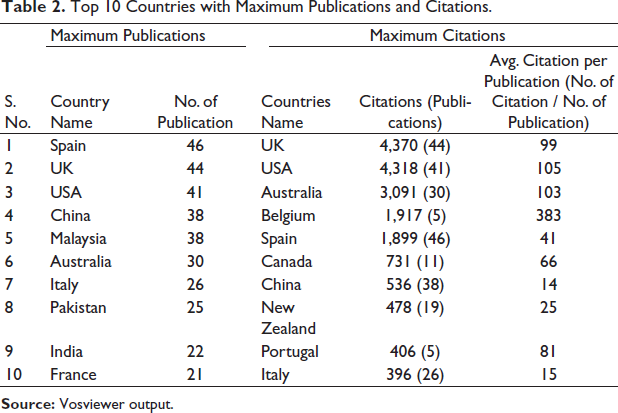
Table 2 acknowledges the impactful countries that contribute the most to publishing quality research on board gender diversity. The left portion of the table demonstrates that Spain contributes the most by publishing 46 research articles, followed by the UK (44) and the USA (41). Out of 10 countries, 40% of companies are Asian countries, whereas 60% of the countries with the highest number of publications are from the Western side of the world. The right side of the table shows the impactful countries with the highest number of citations on their research articles on the theme of board gender diversity, and it demonstrates a very surprising and contradictory view as compared to the left side of the table. It shows that in terms of citations, the UK (4,370), the USA (4,318) and Australia (3,091) are among the top three countries with the maximum number of citations. But on the contrary, to find the countries with the most impactful publications, when we calculated the average number of citations per document, the results were surprising. The findings show that Belgium is the country that publishes only 5 research studies on board gender diversity but receives 383 citations per document. It is higher than any other country, which publishes more articles but receives fewer citations. It can be inferred that Belgium conducts the most impactful studies that are generally referred to by many global researchers. In the case of the USA (41), the UK (44) and Spain (46), which publish the most articles, the average number of citations per article is lower in the USA (105), the UK (99) and Spain (41) than in Belgium. The results further infer that no Asian country produces impactful studies with considerable citations per article. This is confirmed by the table, as no Asian country stands among the top 10 countries with the maximum citations.
Top 10 Countries with Maximum Publications and Citations.
The above Table 3 shows the impactful organisations that do the most research and publish the most research articles on the theme of board gender diversity. University of Utara Malaysia affiliation authors write the most articles (13), followed by Universidad de Salamanca (11) and COMSATS University Islamabad (10). A lot of articles are written by people who study at these universities. A higher percentage of the universities are from Europe, and only three universities are from the Asian continent. The other side of the table shows the impactful organisations with the highest number of citations on their research articles on the theme of board gender diversity, and it demonstrates a very surprising and contradictory view as compared to the left side of the table. It shows that in terms of citations, the Centre for Economic Policy Research, UK, the European Corporate Governance Institute, Belgium, the London School of Economics and Political Science, London and UQ Business School, Australia, all published only one article but received 1.827 citations for that one article. It shows the impact of the research conducted by these organisations. These studies produced significant results and were used by many other research scholars for citations in their own studies based on the number of female directors on corporate boards. No Asian organisation got any position in the top 10 organisations. Even out of the 10, 4 Asian universities produced the most publications on this research issue.
Top 10 Universities with Publications and Citations.
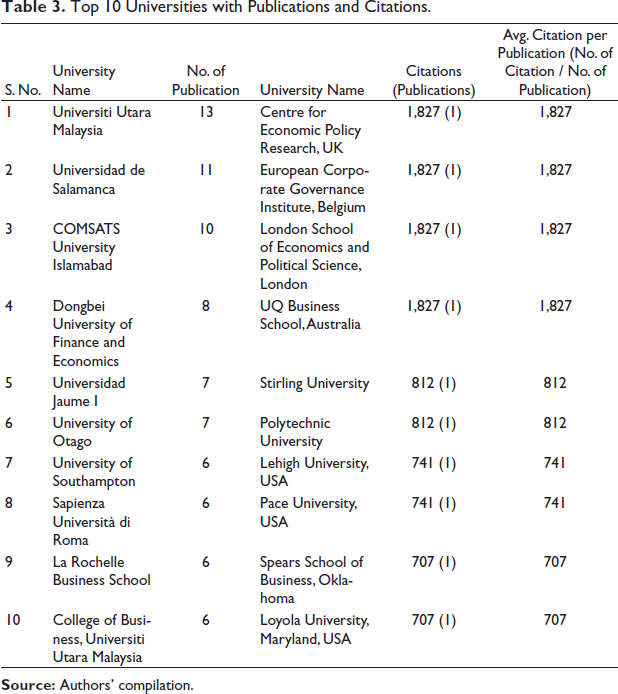
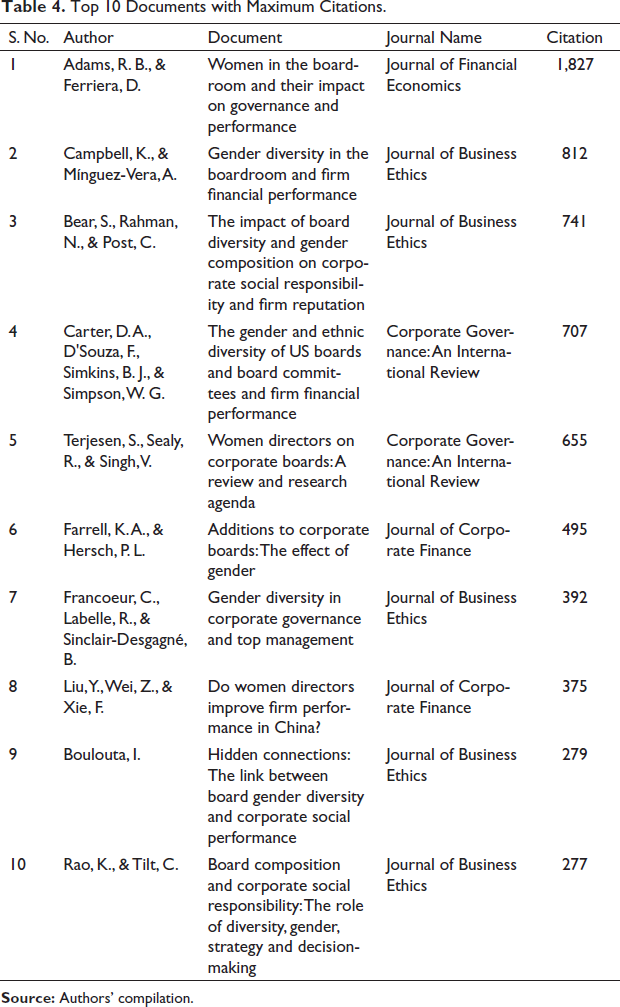
Table 4 summarises the most influential papers (in terms of citations) on the theme of board gender diversity. The results reveal that the paper entitled ‘Women in the boardroom and their impact on governance and performance’ authored by Adams and Ferreira (2009) has emerged as the most influential paper, as this paper was cited by 1,827 studies. The paper studied directors’ level data of S&P midcaps and S&P small caps companies for seven years from 1996–2003. They studied 8,253 firm-years of data on 1,939 companies. The study found that board gender composition has a positive impact on the effectiveness of board performance. The greater the number of female directors on corporate boards, the greater the likelihood of increased corporate monitoring. The next most influential study (812 citations) was done by Campbell and Mínguez-Vera in the segment of board gender diversity. The authors investigated the influence of the number of female board members on the performance of a firm in the context of Spain. They calculated the board’s gender diversity by applying the Blau index and the Shannon index, and firm performance was measured by Tobin’s Q. The study reveals that an increase in female presence in corporate boards does not have any negative impact on the shareholder’s value. Moreover, investors gave more value to those companies whose boards had a significant percentage of female directors. The study further emphasised the balanced proportion of male and female directors on the corporate board structure. The top five influential studies on board gender diversity have attracted more than 500 citations due to their seminal work. The rest of the 5 studies in the top 10 were also used in more than 250 studies about the relationship between board gender diversity and other business operations. It is important to note that, out of the 10 most important papers, only 2 from each journal made the top 10. Five from the Journal of Business Ethics and two from the Journal of Corporate Finance and Corporate Governance: An International Review made the top 10. The researchers can use these findings to determine the most important article and the most relevant and reputable journal in the field that published the top 10 cited articles on board gender diversity (Figure 2).
Top 10 Documents with Maximum Citations.
The above network diagram of bibliometric coupling of documents provides four clusters: Cluster 1 (green colour), Cluster 2 (red colour), Cluster 3 (blue colour) and Cluster 4 (yellow colour). Cluster 1 comprises all the documents that conduct the research on board gender diversity and corporate social responsibility. It contains 118 documents. These studies explore whether the presence of women directors on boards transforms companies into more socially responsible ones as compared to having no women directors on the management board (Atif et al., 2019; Bear et al., 2010; Boulouta, 2013). Cluster 2 represents the group of publications that explore the impact of female board directors on firm performance. It comprises a group of 109 research articles. These articles highlight the implications of having female board members on the various aspects of firm performance. We explore whether increasing female board members has a positive or negative impact on the financial performance of the companies (Adams & Ferreira, 2009; Bin Khidmat et al., 2020; Ionascu et al., 2018). The blue colour cluster includes research studies on women on boards and business-related critical activities such as risk-taking and company stock price. The studies elaborate on the scenario of how women board members affect the risk-taking tendency of the firms in their various board decisions (Biswas et al., 2021; Bouteska & Milli, 2021; Mukarram et al., 2018). It also comprises a group of studies explaining the impact of board gender diversity on the equity risk and stock market risk of companies (Loy & Rupertus, 2022). Only three studies fall under the Yellow Colour Cluster 4. All these studies highlight the impact of women’s board presence on various aspects, such as climate change–related disclosure (Hussain et al., 2017), women in medical societies (Jagsi et al., 2007) and economic crisis (Sun et al., 2011).
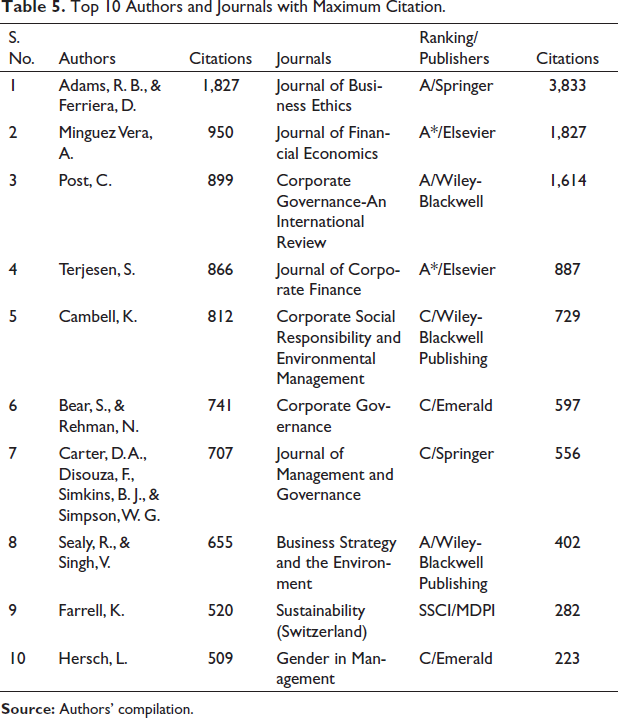
As you can see in Table 5, the most important journals have published research on board gender diversity in businesses. The results show that the journals from globally renowned publishing houses (Springer, Elsevier, Wiley-Blackwell and Emerald/MDPI) gave preference to publishing the research work on this theme. In the case of the Australian Business Dean Council ranking, out of 10 top influential journals, 5 fall under the category of A/A* ranking, 4 come under the C category and 1 has an SSCI (Web of Science) ranking. This ranking demonstrates the study’s importance from both an academic and a business perspective. Governments, corporations and academics are all paying attention to the growing trend of gender diversity on corporate boards. Gender diversity in corporate boards has become a buzzword and has attracted the attention of governments, corporate houses and scholarly research. All of the big publishing companies with their best-known journals show that they prefer to publish articles on this important subject. The above table also depicts the top 10 most influential researchers who have published their research work on various aspects of board gender diversity. Citations were used as a measure of the writers’ impact. According to the table, there were 1,827 studies on board gender diversity that referenced Adams and Ferreira’s research. They came out on top of the list of the most influential authors in the world. Minguez Vera comes in second, followed by Post in third. They each received 950 and 899 citations for their groundbreaking contributions in this field. The remaining authors who are included in the list of the most influential authors each receive more than 500 citations as a result of their work.
Top 10 Authors and Journals with Maximum Citation.
Bibliographic Coupling
In the bibliographic coupling technique, two articles citing the same study are coupled because a high degree of mutual reference suggests a similar intellectual capital between both studies (Khanra et al., 2021).
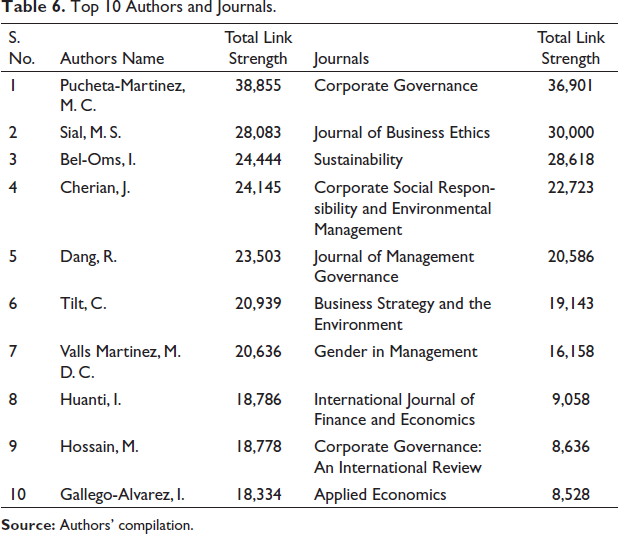
Table 6 acknowledges the findings of the authors’ bibliographic coupling analysis. This analysis technique is used for mapping active authors in a research field for a more realistic picture of the current state of its research activities (Zhao & Strotmann, 2008). Influential authors who contributed significantly to this field and recognised their publication source with the significance of their work. The highest link strength indicates the most research similarities with other authors. The data cited in the above table show that Pucheta-Martinez is the most influential author, followed by Sial and Bel-Oms. The link strength of these authors is higher than that of other authors. In the context of journals, the Corporate Governance journal has the most linkage strength and can be termed the most influential journal in terms of bibliographic coupling.
Top 10 Authors and Journals.
Discussion
In this study, we present a thorough account of how research on board gender diversity affected the various critical firms’ progress through time, as well as a description of the most significant and fruitful authors, institutions, countries and sources throughout history. This review study will serve as a firm foundation for future meta-analyses on this topic, which will be developed on the basis of the findings of this paper. Four hundred and six articles have been studied in this paper that were downloaded from the Scopus database published during the tenure from 2000 to 2022. The results show that major prime journals showed an interest in publishing studies on board gender diversity. Belgium has emerged as the country that produces the most impactful research on board gender diversity. Most of the studies explore the impact of female board members on firm performance, risk-taking, decision-making, innovation and CSR activities. Major studies consider companies in general industries for their research. Very limited studies have explored their research on the banking sector, and in the banking sector, Indian content is still untapped. No significant studies have been conducted to measure the effect of board gender diversity on the Indian banking sector. Being an emerging global economic power, it is imperative to study the Indian banking sector in this aspect.
Future Directions
Although significant studies have been conducted in developed nations to ascertain the impact of gender diversity on various business domains, those studies in developing nations remain scanty. The Indian economy, being a developing one, also finds itself in the category of very limited research. A detailed classification based on the industry sector may also reveal better insights.
Finally, the present study contributes as a directory for future academics, guiding them through the identification of key documents, institutions, countries and journals, as well as the conclusions of recent articles and review studies, among other things. It provides an opportunity for less experienced scholars to concentrate their efforts in this area. It also provides a beneficial service by providing interested readers with more comprehensive access to the bibliographic analysis as well as potential research scopes.
Footnotes
Declaration of Conf licting Interests
The authors declared no potential conflicts of interest with respect to the research, authorship and/or publication of this article.
Funding
The authors received no financial support for the research, authorship and/or publication of this article.
