



Abstract
This paper investigates the effect of governance practice on firm value. The extent of corporate governance practice being influenced by the firm value of the company is assessed. Adopting a descriptive research design, primary data were collected from 650 governance professionals. To identify the factors of corporate governance, the exploratory factor analysis technique is used, and to assess the effect of governance practice on firm value, structural equation modelling is applied. The results of the study conclude that there exist significant effects of governance attributes on firm value.
Keywords
Introduction
The concept of governance is not new to India, because the essence of governance was preached even in the times of ancient India. The famous Indian epics of ancient times such as Thirukural, the Ramayana, the Arthashastra, the Mahabharata and the Bhagavad Gita have incorporated the essence of governance in legal, trade, commerce and tax systems. However, they remained confined to the ancient epics only. Of late, the corporate governance waves was re-emphasised due to continuous corporate scandals which shook the globe. Corporate failures by the giant firms cautioned governments over the globe to enact laws on corporate governance, so as to protect the interest of the various stakeholders and to bring moral fear among the corporate entities to adopt ethical principles in business, by way of following transparency and disclosure (T&D) practices. In order to address the issues of clandestine activities of corporate taking the other stakeholders for a ride, the Government of India constituted various committees and sub-committees such as the Kumar Mangalam Birla Committee (The ‘Birla Committee’, 1999), the Taskforce on Corporate Excellence (2000), the Naresh Chandra Committee (2003), the N. R. Narayana Murthy Committee (2003), the J. J. Irani Committee (2005), the CII Taskforce (2009), the Corporate Governance and Ethics Committee (2010), the Adi Godrej Committee (2012), The SEBI (LODR) Regulations (2015) and the Uday Kodak Committee (2017), with the intension to bring in necessary amendments in the existing law, as well as to bring new law with regard to corporate governance among the listed companies and other specified companies. In the initial phase of the implementation period, the committees suggested to the government to adopt voluntary corporate governance practices. But over a period, the influence of the recommendations of corporate governance committees elsewhere, specifically in Western countries as well as the unethical practices of giant corporate entities, mandated the regulatory authorities to change the provisions of voluntary corporate governance into the mandatory clause accompanied with punitive provisions for non-compliance. Corporate governance basically is intended to surge the liability of a firm and evade enormous catastrophes before they arise many a time because of proxy advisers and shareholders who discursively disturb the governance practice. On the contrary, board is considered to be an essential part of governance as they lead the firm towards building investors’ trust, protecting the shareholders’ rights and maximising firm’s wealth. Though the directors are chosen by the owners, i.e., shareholders, the role of the board is not only restricted to financial value optimisation but also to integrate various stakeholders of the firm and to achieve the organisational goal through ethical business practice. Better governance practice can help the firm to win over the confidence of the investor, through which a firm can enhance its reputation not only in the domestic market but also in the global market. A firm with business ethos of transparency can combat corruption and also can attract buyers and in turn can improve its performance.
Role of Governance Professionals
The major role of any board lies starting from the establishment of a predetermined goal, implementation of the same with an effective leadership and overseeing the business activities and intimating the status to the concerned stakeholders. Hence, the board is primarily responsible for the implementation of effective governance and integrates various stakeholders. On the other hand, the shareholders’ role in governance ends with the appointment of key managerial personnel and active participation in the meetings of the company etc. Company secretary being governance professionals’ has a high responsibility for the efficient administration of any organisation, especially ensuing legal and regulatory compliances and informing the board about their legal responsibilities, to ensure proper implementation of the board decisions. A governance professional having a fiduciary position, connect the board, shareholders, society and other stakeholders by assisting and adding value, through advice such as establishing corporate and strategic planning, framing the statements and principles relating to governance, ethics and legal advice on conflicts of interest, etc. Since the implementation of the Companies Act 2013, the boardroom dynamics have shifted from voluntary compliance to mandatory compliance. Hence, the board is realising the need of specialist knowledge and skills from the governance professionals, i.e., company secretaries, who are entrusted with organisational governance, supporting the mechanism, board and committee processes, board development, communication with stakeholders, disclosures and reporting, etc.
Review of Literature
The term ‘corporate governance’ (CG) has been defined by different authors in different connotations. According to Becht et al. (2003), corporate governance is a mechanism by which a company achieves its goal. Board structure, board process, T&D and shareholder value enhancement are the key components of corporate governance (Institute of Company Secretaries of India (ICSI), 2018). Board structure has a close association with firm financial performance (Al-Matari et al., 2014; Dibia & Onwuchekwa, 2014; Galbreath, 2018; Gordini and Rancati, 2017). Kyaw et al. (2017), Tamimi and Sebastianelli (2017) and Cabeza-García et al. (2018) found that gender diversity on the corporate board enhances corporate social performance. Whereas Nieto (2018) found that board diversity when combined with performance (earning management), results are not conclusive and give a mixed result. Mishra and Kapil (2018), Forbes and Milliken (1999) and Jehn and Mannix (2001) explored interrelationship between board characteristics and a firm’s financial performance of the company. According to Darko et al. (2016), Di Berardino (2016), Mcphail (2014) and Adams et al. (2010), the board process does not significantly influence financial performance of the company. Theory of disclosures was supported by Li et al. (2018) and, Bushman and Smith (2003). Fatemi et al. (2018), Cucari et al. (2018), Manita et al. (2018), Malik and Makhdoom (2016) and Hermawan and Mulyawan (2014) stated that in higher disclosure practice and the timeline reporting, board gender diversity reduces the value of the firm. Theory of shareholders was endorsed by Ararat et al. (2017), Ammann et al. (2011), Gillan and Panasian (2010) and D’Souza et al. (2001), who proved that there is a direct relationship between governance practices and firm performance. Some authors also opined that companies with higher shareholder rights and shareholder activism found to have no association with financial performance (Black, 1998; Gompers et al., 2003).
Research Methodology
The nature of the data on which the study has been conceptualised is primary in nature. The questionnaire was constructed by considering the existing studies along with the Corporate Governance Award Questionnaire of ICSI (2017, 2018). Expert opinion was obtained from the experts like Dean of Centre for Corporate Governance Research and Training, practising company secretaries and company secretaries in employment on the questionnaire. The responses were solicited on a five-point Likert scale ranging from 1 to 5, which indicates strongly disagree to strongly agree. The finalised questionnaire was tested with the help of a pilot study which was conducted at the Southern India Regional Council of the ICSI. The data relating to pilot study were analysed with the help of descriptive and reliability analysis. The research work adopted standardised sampling design for choosing a sample from the population. Following snowball sampling as well as convenient sampling, the minimum sample size as per the prescription of Krejcie and Morgan (1970) for the known population arrived at 382 for the total population of 52,182 members. The researchers collected 650 responses including Google Forms (111). After rejecting the incomplete questionnaire, the study considered 544 as the final sample size. Table 1 contains Socio Economic Profile of the CG professionals. For data analysis, statistical techniques like frequency analysis, descriptive analysis, exploratory factor analysis (EFA) using SPSS 23 and structural equation modelling using AMOS 23 software along with MS Excel statistical tool pack were employed.
Data, Analysis and Discussion
Exploratory Factor Analysis
EFA was employed on the corporate governance variables. All the inputs were measured in a five-point Likert scale. The corporate governance variables were grouped under four categories, namely, board structure (BS), board process (BP), T&D and shareholder’s value enhancement (SHG). The EFA basically measures reliability, eigenvalue, percentage of variance explained, KMO and Bartlett’s test values, etc. The results of the EFA are presented in Table 2.
Socio-economic Profile of the Corporate Governance Professionals.

Results of the Corporate Governance Factor Classifications.

As data in Table 2 indicate, the eigenvalue is 3.121, the mean value of all the items of the measurement ranges from 2.897 to 4.132, KMO with a value of 0.868 indicating that the data adequacy is meritorious, i.e., 0.80–0.90, as per Meyer et al. (1977) at the 99% confidence level, the values of Bartlett’s test showed χ2 value as 4,463.420 with a degree of freedom of 190. As the accepted value is greater than 0.70 (Awang et al., 2015) and arrived value of Cronbach’s alpha 0.858 it is considered to be good, and it indicates that for all the construct in the measurement model, the reliability is achieved.
Corporate Governance Variables
The respondents were given 20 statements (Appendix) relating to CG variables namely role of company secretary, lead independent director, appointment of alternate director, independent director tenure, action taken report, intimation of compliance schedule to the board, intimation of independent director resignation, audit committee meeting, nomination and remuneration committee, intimation of material events, limited review report, disclosure of accounting standard, medium of disclosure, whistleblower policy, disclosure of fines and penalties, risk management policy, shareholder activism and impact of corporate governance on company image.
Data Adequacy
Data adequacy was tested using correlation analysis (Bartlett’s test of sphericity and results of the same were found to be highly correlated at the 99% confidence level. Along with the correlation analysis, the following information was also obtained: KMO, Bartlett’s test and reliability (Cronbach’s alpha) value. The results relating to data adequacy are presented in Table 2. As Cronbach’s alpha was more than 0.70, it passes the reliability test.
Factor Extraction
Factor extraction was done using factor analysis, with the help of PCA with varimax rotation and also considering eigenvalue greater than one. All the 20 statements relating to corporate governance variables were grouped under four factors. Based on the factor loading, these factors included BS, BP, T&D and shareholder value enhancement (SHVE). The results of the factor analysis along with factor loading and communalities are presented in Table 2.
Firm Value Variables
Firm value has been measured through five statements, namely, turnover, paid-up capital, net worth, EPS and ROA, to study the impact of corporate governance on the above-mentioned firm value measures in the context of the last five years’ performance. These statements were based on a perception scale ranging from 1 to 5: 1 refers to strongly disagree and 5 refers to strongly agree.
Data Adequacy
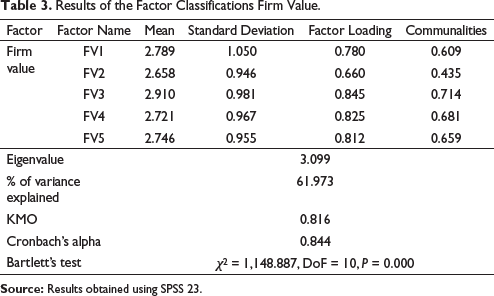
Considering an adequate number of samples for the analysis is an important step in factor analysis. As far as data adequacy is concerned, the items of the firm value construct must be correlated so that it does not fall into the other construct. Correlation among the items of firm value construct was ensured through Bartlett’s test and KMO value above 0.80 was considered as data adequacy is meritorious. A reliability (Cronbach’s alpha) value above 0.60 is considered for fitting the model. Table 3 presents the results of data adequacy.
Results of the Factor Classifications Firm Value.
Factor Extraction
Factor extraction ensures the grouping of similar items of a construct into one factor. Using PCA with varimax rotation, the eigenvalue greater than one was considered. An essential function of factor extraction is to group similar items of a construct. Based on the factor extraction method, all the questions related to the financial performance of the companies were grouped into one and the same is named as ‘firm value’. The results of the factor analysis including mean, standard deviation, factor loading and communalities are presented in Table 3.
Table 3 presents the result of factor analysis for the firm value factor clarified. As per Meyer et al. (1977), the eigenvalue above 1, i.e., 3.099, and KMO value above 0.816 imply that data adequacy is meritorious, i.e., 0.80–0.90; the values of Bartlett’s test showed χ2 value as 1,448.887 with a degree of freedom of 10, which indicates that there is no widespread correlation at the 99% confidence level. Cronbach’s alpha above 0.70 ensures internal reliability and conveyed that the measurement model for firm value achieved its reliability (Awang et al., 2015).
After identifying the factors of corporate governance and firm value, an attempt was made to study the association between socio-economic profiles of corporate governance professionals and the sum of governance attributes, the following hypothesis has been framed:
The Mediation Effect of SHVE and T&D on Firm Value
The direct and indirect effects of the components of governance attributes, i.e., BS, BP, T&D and SHVE and firm value, are tested and confirmed through the following figures. Hence, the following model (Figure 1) is constructed to test whether T&D and SHVE mediate the effect of BS and BP on firm value. For this purpose, BS and BP were considered as independent variables, and firm value was considered as the dependent variable along with the T&D and SHVE variable as mediating variables with a 95% confidence interval. The total, direct and indirect effects were computed using bootstrap techniques. Figure 1 portrays the direct and indirect effect between components of governance attributes and the firm value. This effort is undertaken to test the second hypothesis set for this research work.
H2: T&D and SHVE mediate the effect of BS, BP on firm value.
The Mediating Effect of SHVE and Transparency and Disclosure on Firm Value.

Figure 1 presents the direct and indirect effect of BS and BP on firm value through T&D and SHVE as mediating variables. The standardised regression weights for the direct effect obtained were BS to firm values (−0.06), BP to firm value (−0.10) as against the indirect effect BS to firm value through SHVE (0.15 × 0.13 = 0.02) and BS to firm value through T&D (0.17 × 0.18 = 0.031). The indirect effect with respect to BP to firm value through SHVE and T&D were 0.31 × 0.13 = 0.04 and 0.52 × 0.18 = 0.05, respectively. The positive coefficient values confirm the direct relationship among the variables.
Table 4 presents the result of path regression analysis. Values of Critical Ratio (CR) are arrived by dividing the estimates with the standard error (SE) and P-Value indicates that the path values are significant at 5% level. The results indicated that the standardised coefficient values for every path were positive except for the path of BS and BP indicating, except BS and BP, all the paths positively affect the firm value and BS and BP indirectly affect the firm value, that is, through T&D and SHVE.
The Path Regression Weights and Its Significance Value for Respective Path.
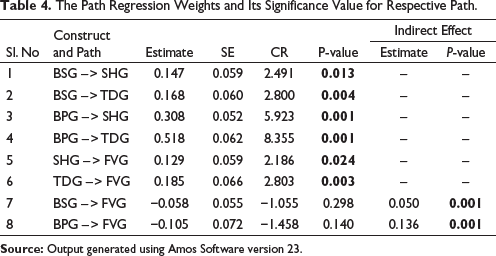
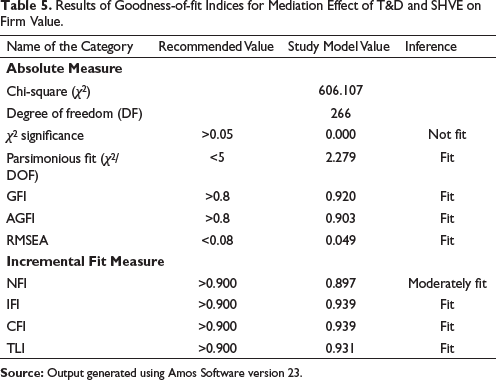
Table 5 presents the summary of fitness indices along with significant values for the model mediation effect between BS, BP and firm value through T&D and SHVE. There are two parts of fit indices, namely, absolute fit measures and incremental fit measures. The absolute measure includes parsimonious fit (2.279), GFI (0.920), AGFI (0.903) and RMSEA (0.049), and the incremental fit includes NFI (0.897), IFI (0.939), CFI (0.939) and TLI (0.931). Looking at the fitness indices of the study model as against the values recommended by Hair et al. (2014), the model is considered to be fit. Hence, the hypothesis is supported, that is the conceptual model is confirmed by saying that the governance attributes significantly contribute to the firm value.
Results of Goodness-of-fit Indices for Mediation Effect of T&D and SHVE on Firm Value.
Conclusion
One of the unique features of the Companies Act 2013 is enhanced compliance, protecting the interest of the stakeholders as well as firm’s wealth through efficient governance practices and corporate social responsibility. From the overall study result it was found that the firm performance is significantly influenced by corporate governance practice adopted by the governance professionals in their respective organisations. It was also evidenced from the study that the socio-economic profiles of the governance professionals have direct association with governance practices. This observation indicates that there is a significant difference between age and experience of the governance professionals with respect to governance practices, whereas gender, types of company, educational qualification and the type of profession do not having any association with the governance practice. It was also discovered that the socio-economic profiles of the governance professionals influences effective governance practices, that is, governance professionals in the age group up to 50 years with experience of 4–8 years have been found practising good governance in their respective organisation. This study affirms that in the event after the implementation of the Companies Act 2013, the practices of corporate governance in Indian companies have improved significantly and such governance practices contribute to the firm value. The opinion of corporate governance professional reveals that the companies comply with the provision of corporate governance, especially more importance is given to the aspects of transparency and disclosures and SHVE over the other aspects like BS and BP. The study also reveals that the socio-economic profiles of the corporate governance professionals influence the effective practices of corporate governance execution in their respective companies.
Appendix: Variable Definition and Measures.

Footnotes
Acknowledgement
The earlier version of this paper was presented at The First Virtual International Conference of Sustainable Finance, Economics & Accounting in The Pre- and Post-Pandemic Era (30th-31st July, 2021) organised by Indian Institute of Management Jammu, India with University of Bradford, UK. The author (s) of this paper gratefully acknowledge the valuable suggestions received from the chair, co-chair and participants.
Declaration of Conflicting Interests
The authors declared no potential conflicts of interest with respect to the research, authorship and/or publication of this article.
Funding
The authors received no financial support for the research, authorship and/or publication of this article.
