



Abstract
The purpose of the study is to develop a theoretical model to ascertain if the IT investment in the banking sector is capable of generating a new equilibrium with increased efficiency. The empirical strategy is to seek an indirect test for Jordanian banking sector by looking at the time profile of banking profits as a temporal function of IT investment. The study enquires if the banking sector, as an iterative process of credit allocation and information acquisition through IT investment, lead to a stable equilibrium? Does IT investment ensure stable market shares for Jordanian banks in the long run? The study finds that investment in IT has led the banking system in Jordan away from an efficient equilibrium. We also find that the banks in Jordan directly interact with each other, although they may have collusive arrangements with some of their rivals, this means the banking market is not fragmented.
Introduction
We develop the dynamics of acquiring information by investing in information technology (IT) in a model that closely represents the modern banking industry. At the outset, it is imperative to note that modeling of IT investment by banks as a process of information acquisition and their consequences have not been examined in a consistent framework. Our main contribution will be to develop a new framework and then test the tenability of the framework by examining the banking sector in Jordan. Typically, banks invest significant amounts of resources to collect information about all relevant borrower characteristics and rivals’ strategies (Office of the Comptroller of the Currency [OCC], 2001). Information acquisition helps identify and rate creditworthiness, thus, it is an important feature of the banking industry (Berger & Mester, 2003). In the pursuit of information acquisition, the role of IT for commercial banks cannot be overemphasized; it also plays an important role for central banks, which in this era of modern banking have an important supervisory role ensuring the quality of credits advanced by individual banks (Estrella, 2000).
The main problem with information acquisition in the banking industry is that information is mostly obtained through the process of lending and interacting with customers and rivals; obtaining inside information also gives rise to market power (Bhattacharya & Thakor, 1993). In this study, we design the banking industry as an allocation mechanism to capture market power, information asymmetry and externalities that characterize banking and economic activities at false prices. We then develop an iterative mechanism to characterize banking activities to collect information by jointly investing in IT and their customers. The iterative mechanism is shown to generate a Pareto improvement in the joint welfare of banks and their customers. The implication is straightforward. The Nash product of the utilities/profits of banks and their customers can form the basis of Lyapunov function in order to establish the convergence properties of long-run equilibrium of a banking system. One may therefore argue that an iterative investment process in IT to acquire more information about customers and rivals acts as an equilibrating device for the modern banking industry. The issue assumes paramount importance for a developing economy such as Jordan, where the banking sector has its investments in Information Technology increased to third compared with the total investment in the business between 1993–2010 (Central Bank of Jourdan (CBJ)). The problem of information acquisition in the banking industry is a central issue in developing nations. This is because in developing nations, the availability and sectoral distribution of credits play a decisive role in determining the overall economic activities. For example, rural economic and trading activities are seriously influenced by the availability of credits (Gangopadhyay & Sengupta, 1986, 1987). Even in developed nations, central banks play a significant role in the allocation of credits (Gangopadhyay, 1996, 1997b, 1999; Gangopadhyay & Varoufakis, 2001).
There are three sets of problems that characterize the allocation of credits in the banking sector in a developing economy, Jordan being among them. First, an economy does not instantaneously reach equilibrium because there are informational asymmetries and missing markets. As a result, some kind of disequilibrium phenomenon underpins the gradual adjustment towards a long-run equilibrium. Second, in this gradual adjustment central banks guide the allocation of credits in order to achieve some sort of efficiency. Finally, the decision to borrow/credit is usually undertaken by decentralized decision makers, and commercial banks create debt instruments with these decentralized decision makers.
These three elements give rise to a complex decision-making problem that motivates the current study. It is important to realize that there is little research that evaluates the resulting equilibrium of the banking sector in the context of information acquisition dynamics, though much desired from the standpoint of society. The critical question is whether the equilibrium propelled by investment in IT enhances competition and rivalry among banking firms. The answer is not straightforward, and this study will address the question of the desirability of a banking equilibrium. The basic questions of the study are: does the banking system as an iterative process of credit allocation and information acquisition through IT investment, lead to a stable equilibrium? Is the equilibrium “socially” desirable? If the answer to the second question is not in affirmative, can we reverse engineer and alter initial conditions so that the resultant equilibrium becomes desirable? The current article models the problem of credit allocation as an iterative allocation mechanism and demonstrates the possibility of achieving a maximization of the joint welfare of participating agents.
Basic Model: Malinvaud, Dreze, and Poussin (MDP) Procedure and Credit Rationing
The hallmark of decentralized decision-making is the dispersion of knowledge (Arrow, 1984). An allocation mechanism in this context entails an iterative communication process that generates information necessary for optimal allocation of resources. In a seminal paper for which he won the Nobel Prize in Economics Science, Hurwicz (1960) modeled the process of information extraction in a specific structure; each decentralized agent has a set of characteristics which form his private information. Given this set of private information and the state of mechanism, each agent transmits a “message” to an external coordinator who collates, collects and disseminates all the messages received from the decentralized agents. In the modern era, IT investment plays an important role in the collation, collection and dissemination of relevant information, which typically drives banks to heavily invest in IT. Note that, at each iteration, based on the available messages, an adjustment process in terms of choice variables of economic agents is initiated.
A great deal of research has firmly established that reasonable restrictions on the design of mechanisms engender an adjustment that converges to a Pareto optimal allocation of resources (Gangopadhyay, 1997a; Hurwicz et al., 1975). Optimality calls forth efficiency as an absence of slack in an economic system; however, efficiency has nothing to do with social desirability as our study will establish. The theory also sheds light on the measurement of minimum amount of information needed to implement a particular allocation (Jordan, 1987; Reiter, 1977). Such an iterative procedure has two broad divisions. First, the Arrow-Hurwicz type of iteration rests on the assumption that the coordinator/center sends price messages while the decentralized agents send quantity feedbacks. A coordinator sometime acts as a quasi-auctioneer. Malinvaud (1970, 1971, 1979), Dreze and Poussin (1977), and Green and Laffont (1979; hereafter MDP) developed the quantity-guided procedure. The MDP bears a remarkable resemblance to the IT investment by the banking sector.
In the MDP framework the bank is a coordinator and proposes or implements the allocation of credit while the customer, as an agent, respond with their marginal valuations. The role of IT is to smooth and facilitate this interaction. Once the IT sends and returns communications, the coordinator (bank) revises the allocations on the basis of marginal valuations. We develop the MDP procedure in the context of banking to examine the problem of credit rationing as an allocation mechanism in an economy in which economic activities take place at “false prices”.
The main findings indicate how credit allocation in such an iterative framework result in a Pareto improvement of joint welfare of all parties. The argument subsumes the following: in the long-run Walrasian equilibrium the competitive process generates an interest rate, r*, which drives the supernormal profit to zero for each industry. Such a supernormal profit function is bilinear in prices and quantities while the long-run equilibrium is a saddle point. In the long-run equilibrium all markets clear and, hence, no question on credit rationing arises. But in the short run, if the actual interest rate strays from the notional rate r*, the economy is beset with disequilibrium phenomena (Benassy, 1975, 1977, 1988; Gangopadhyay, 1997a, 1999, 2004; Hahn, 1985).
This study argues that under reasonable restrictions, each agent in the banking industry faces a quantity constraint emerging from credit rationing, an excess demand for credit due to an initial state of disequilibrium. The actions and reactions of agents in the banking industry gradually take the system out of disequilibrium into equilibrium. Against the backdrop of disequilibrium the equilibrium looks good, and economists are keen to discern if the equilibrium is a Pareto improvement from the initial disequilibrium. What we argue is that such considerations of Pareto improvement may not shed important insights into the desirability of equilibrium. We will need to consider whether equilibrium raises or lowers the degree of rivalry among banks. These details will be discussed later.
Economics of Information Dynamics: Our Model of the Banking Sector
The following idea is latent in Von Neumann (1945) that was expanded by Arrow (1989) and Dore et al. (1989). Consider a long-run equilibrium which is expressed as follows:

the competitive process engenders the rate of interest r*, which sets a saddle point for the function K(X,P) = [XBP]/[XAP] where A is the input matrix of the economy, B is the corresponding output matrix, X is the output vector and P is the price vector. The left-hand side of equation (1) labels the supernormal profit, which is zero at the long-run equilibrium. The supernormal profit function is bilinear: that is, the supernormal profit is a linear function of X when P is fixed and a linear function of P when X is fixed. Such a function assumes importance only when price and quantity adjustments are independent during a period of adjustment. A good example is the much-celebrated Walrasian tatonnement.
The concern of the model is to explore the short-run implications when the system deviates from the long-run equilibrium. The immediate corollary is that the economy suffers from a set of quantity restrictions as some or all agents fail to fulfill their ex-ante optimal trades (Gangopadhyay, 1997a, 1999). We devise a quantity guided allocation mechanism to demonstrate how decentralized decision-making, mediated through a coordinator, could achieve an improvement in joint welfare.
Consider an extremely simple economy with a two-good, two-agent national system, such as the Jordanian economy, which is coordinated by a mediator (say, the central bank) that plays the role of a manager-cum-arbiter (hereafter MA). It is important to realize that the IT takes the role of a coordinator, and simply collects, aggregates, and transmits information. We keep the role of MA mainly to simplify our story—ideally, it should be a servomechanism or big computer screen that does the work of the coordinator as decentralized agents are hooked to the main frame.
The agents have private information about the techniques of production, which they transmit to the MA at each iteration. The out-of-equilibrium transactions impose quantity constraints on the agents. It is noted that both agents face credit constraints, which brings the banking sector on the scene to determine the equilibrium outcome. The backdrop of decision-making is such that agents do not know the precise magnitude of the credit constraints. Each agent has a demand price for credit that is private information. Each agent has a supply price of the good that he produces and a demand price of the good that he uses as an intermediate input.
The Network of Information Sharing: A New IT Model for the Banking Sector
Agents send the following messages, first, optimal linear techniques a, a, second, demand prices L1, L, third, supply prices S1, S, and fourth, demand prices for credit λ1, λ2.
The MA sends the following messages: (a) The input–output matrix A = [a1, a2]; (b) The gross outputs X1, X2; (c) The credit rationing coefficients θ1, θ2.
Theorem 1: The uncoordinated economy in the short run is beset with an excess demand for credit and hence both the agents are credit-constrained.
Proof: Let µ1, µ2 be the uncoordinated quantity decisions of the agents without the MA. Then the excess demands for these two goods are E1 and E2, which are as follows:


Assuming S and S to be the relevant supply prices, the value (V) of excess demands for these goods

Substitution of the values of excess demands in equation (4) yields the following:

Note that for positive profit

where D and S are respectively the demand for credit and supply of credit. From equation (5) and identity (6), we know that (D̶S) > 0. Hence agents confront a regime of credit rationing if the system fails to reach the long-run equilibrium Q.E.D.
Assumption 1: The utility function of agent i is postulated to be:

where R is the profit rate from producing one unit of X. The following restrictions in terms of partial derivatives, are imposed on U:

An example: Let the utility function be of the following type in profit ύ
i
and X be of the Cobb-Douglas form,
Proposition 1: The rate of profit R bears a positive relation with the gross output X if
Proof: By definition R is the following:

Differentiating (8) with respect to X yields the following:

Under the restrictions δR/δX > 0. Q.E.D.
The intuition is that if the demand price for the credit of agent i is bounded within (1 – a1)/ a1 and if the agent is ready to pay a constant/higher price for credit as his output goes up, then R and X would definitely bear a positive relationship.
Postulate 1: We postulate that as X goes up R goes up for all i and j.
This postulate assumes that higher (lower) output of a good has a positive (negative) externality on the profit rate in the production of the other good. Because of this public good nature of production, we apply the MDP procedure for the efficient allocation of resources. Now, we specify the adjustment rules by the agents and the MA to demonstrate that the quantity guided MDP procedure will yield a Pareto improvement in the joint welfare of the participating agents.
Adjustment Rules and Pareto Improvement
Rule 1: The MA adopts the following output adjustment rule:

Where ϕ is the speed of adjustment, δRj/δXi; is the marginal contribution of X to the rate of profit of the jth agent which is positive from Proposition 1. The term (L δRj/δXi) measures the marginal valuation, in terms of utility, of the increase of profit of the jth agent as X; changes by a small unit. From Postulate 1 we know that δRj/δXi is positive. Since S is the supply price of good i, hence
Rule 2: If the demand price of credit of agent i is λ, then the credit allocation rule is given by the following:

where h is the speed of adjustment and λj labels the credit allocation coefficient. If the demand price of credit of agent i exceeds the demand price of credit of agent j, then the share of credit of agent i is increased.
Rule 3: Agent i responds in the following fashion:
Agent i sets the supply price S as the marginal valuation of X given as the following:
Agent i sets the demand price as the marginal valuation:
Agent i sets the demand price of credit as the marginal valuation:



Where U is some threshold level of utility, which agent i may achieve without entering into an economic contract with the other agents.
Definition 1: We define the Nash product in the logarithmic form, W(t), and express it as the following:

Theorem 2: If the MA follows the adjustment rules (10) and (11), and the agents follow the rules (12), (13), and (14), then
Proof: Differentiating

Substituting

As a result,

Now, we know from equation (13) and equation (14) that:


Combining (19), (20), (14), and (11), we arrive at the following:

Similarly,

Hence,

Similarly,

Substituting (23) and (24) into (18) yields the following:

Theoretical Model of Fund Allocation: The Edgeworth Process
Optimal allocation of investment fund is predicated upon an appropriate evaluation of the credit risk. The evaluation of credit risk critically hinges on efficient information acquisition. The problem of information acquisition in the credit market is enormous since there are significant impediments to information production. The main problem in the banking industry is that information is mostly obtained through the process of lending. Therefore, IT investment plays a critical role in the dissemination of relevant information, which has indeterminate effects on the degree of competition among banks.
The presence of inside information with the incumbent lender renders the nature of information in credit markets a “soft” good upon which property rights are difficult to enforce. In such a scenario, an instantaneous and equilibrium allocation of investment funds is patently unlikely. How does the current system allocate the scanty investment funds? This is the main query of this theoretical construct.
We posit that economic activities take place outside the long-run equilibrium, or at so-called false prices. The implication is three-fold. First, agents confront quantity signals (Barro & Grossman, 1971; Benassy, 1977, 1988; Solow & Stiglitz, 1968). Second, agents acquire market power due to informational asymmetry (Benassy, 1975, 1988; Bhattacharya & Thakor, 1993; Negishi, 1974, 1978). Third, quantity decisions have external effects (Benassy, 1977; Gangopadhyay, 1997a; Nikaido, 1978). As a result, the competitive framework does not fit the out-of-equilibrium state. In the non-competitive framework the Arrow–Debreu firms turn into Negishi firms (Hahn, 1985) while quantity decisions of these firms are interlocked to generate large doses of externalities.
The basic idea is to present a model to capture these imperfections by considering the allocation of credit in a simple economy, supervised by a coordinating device like an IT mechanism that collects and transmits information very quickly. Firms now have price-making power and their quantity decisions have significant externalities, so does the banks. The mutually inconsistent decisions of these firms and banks, as a reflection of non-equilibrium result in a mismatch in the credit market. A central agency (possibly a central bank) attempts to allocate credit in order to increase national welfare. The model designs a simple allocation mechanism to demonstrate how firms in such an out-of-equilibrium state can interact with banks to steadily improve the welfare of participating economic agents.
The notion is analogous to the Edgeworth process, which postulates that exchange takes place out of volition and, hence, the convergence to equilibrium is tantamount to the steadily improving welfare of participating agents. The model shows that even if an economy initially wavers from the long-run equilibrium, the scheme of iterative communications engenders an equilibration process that takes the economy towards the core of exchange. The immediate spin-off is that one may set up the relevant Lyapunov function from the steadily increasing Nash-product to establish the quasi-stability of the long-run equilibrium (Fisher, 1983). One may, therefore, argue that an iterative planning of the allocation of credit can act as an equilibrating force in a mixed economy in which banks heavily invest in IT so that the communication mechanism improves.
In the next section we seek empirical confirmation of our theoretical model to ascertain if investment in IT has steadily improved the profits of the banks in Jordan during the era of investment banking. If this is so, we have a necessary condition satisfied for IT investment to trigger an efficient equilibrium. However, this is not a sufficient condition. The violation of steadily improving or declining real profits in the banking sector will signify the inaccessibility of the equilibrium. This is a purely empirical question. The next issue is whether IT investment has social desirability.
Convergence Towards the Nash Equilibrium: Empirical Evidence
We assume that the profit of bank i at date t is given by ύ and ύ is the aggregate profit of the banking industry at date t:

We first use the inverse of ύ as the Lyapunov function. For many classes of ordinary differential equations (ODEs), it is important to note the existence of Lyapunov functions as a necessary and sufficient condition for stability. While there is no general technique for constructing Lyapunov functions for ODEs, in many specific cases in modern economics the construction of Lyapunov functions is linked to the sum of payoffs of agents—such as their utilities from incomes or profits. In this section, we take the sum of profits as the first index of a Lyapunov function. In physical systems, conservation laws can often be used to construct Lyapunov functions. Informally, a Lyapunov function takes positive values everywhere except at the equilibrium in question, and decreases (or is non-increasing) along every trajectory of the ODE. The principal advantage of Lyapunov function-based stability analysis of ODEs is that the actual solution (whether analytical or numerical) of the ODE is not required. We write the empirical equation as:

This equation investigates how the industry profit evolves over time (t). The data set is the bank profit which is collected for 22 banks that were operational in Jordan between 1993 and 2010. The data were obtained from the Database of the Central Bank of Jordan. We note the following from the simple linear estimation of (27):

with Adjusted R2 = 0.754, ** Significant at 5% and *** Significant at 1%. From a simplistic point of view, ύ
t
can be used as a Lyapunov that can possibly ensure that the banks will converge on the Nash equilibrium. However, a problem arises when we look at the non-linear and non-monotonic relationship between ύ and t, as described below:

The empirical estimate of (28) is given by:

with Adjusted R2 = 0.90,

Coefficients Estimation with Fixed Effect Model.
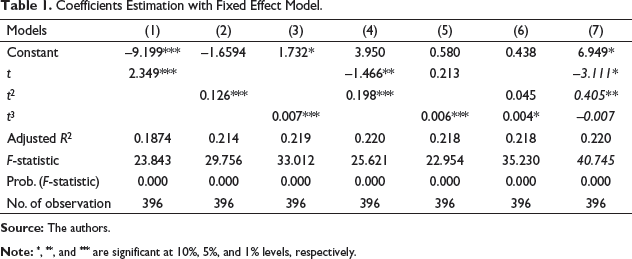
In Table 2, we provide the estimate of the natural log product of the profit function of 22 banks, the equation for estimation is given as:


Coefficient Estimation of the Logarithmic Profit Functions from Base Profits.
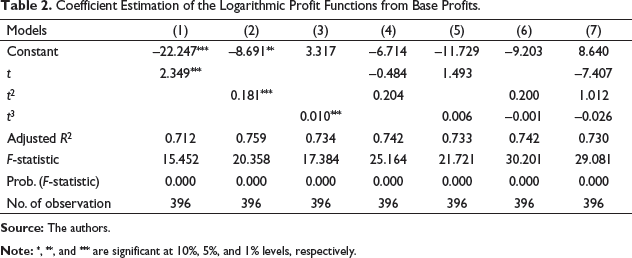
The last column of Table 2 establishes that there is no confirmation that one can be sure that profit functions will ensure the convergence property of the Nash equilibrium. The dynamic path of the bank profit gives us an indication that the iterative mechanism fails to lead the banking system to a Nash equilibrium outcome. There is nothing sacrosanct about the existence and stability of the Nash equilibrium in pure strategies in the postulated game in which banks use their technologies to grab markets from each other by connecting with potential customers. As we will explain later, the non-existence of a “reachable” Nash equilibrium will create opportunities for banks to engage in collusive arrangements. For the concept of reachability of n equilibrium, see Hahn (1985); it is equivalent to the concept of a (Lyapunov) stable equilibrium. Alternatively, banks will be driven by copy-cat strategies, or what we call herd instincts, in choosing their investment projects in IT. We empirically ascertain that investment in IT has led the banking system in Jordan away from an efficient Nash equilibrium, underscoring the possibility of non-existence of a set of mutually-consistent investment activities for the banking sector. We therefore stress that there is no critical point or point of attraction, towards which the banking system of Jordan has been gravitating. In what follows, we investigate if the dynamics of IT investments in the banking sector have “desirable” characteristics.
Social Desirability of Information Technology Investment (ITI) in the Jordanian Banking Sector: Dynamics of Collusion and New Insights
The primary intuition of this work is that globalization along with market segmentation creates an opportunity of entry by a business firm like a bank into new regional or national markets. This can have serious impacts on the equilibrium configuration through the effects of potential entry on the incentives of and constraints on incumbent banks/firms. The banking sector, and the financial sector at large, has traditionally been insulated from overseas competition in most nations. The Jordanian banking sector is no exception. However, in the new millennium they started experiencing pressure from overseas competition as well as identifying business opportunities overseas, especially in the Middle East. Three questions shed light on the profit dynamics of commercial banks in Jordan: Does IT investment act as a coordinating device that allows banks to segment their markets? In other words, has IT investment prompted cooperation and collusion in the Jordanian banking industry? Does IT investment increase rivalry and competition among banks? Has IT investment acted as a strategic investment to ensure stable market shares for Jordanian banks in the long run?
The analyses using the Lyapunov function above gives no evidence that the Jordanian banking sector has gravitated towards a (pure-strategy) Nash equilibrium configuration. In this context, the Nash equilibrium implies that banks choose mutual best responses and that there is no incentive for an individual bank to stay away from the Nash equilibrium, which is their chosen path of IT investment. However, if banks fail to home in on the Nash equilibrium, they have incentives to collude, as collusion which is a departure from the Nash equilibrium will then be rational. Such collusion can create competitive pressure among the 22 banks. In other words, competition will arise from rivalry among groups of banks. Although the models of fragmented oligopoly are similar in letters to our case, the existing theory of rivalry does not shed much light on the possibility or dynamics of collusion in the banking industry. It hence becomes largely an empirical question. In the following subsection, we will investigate the issue of collusion by applying simple tools of empirical microeconomics. In a fragmented oligopoly, a subset of firms compete directly with each other in specific regional markets while others have no direct influence on the subset. In fact, the banks in Jordan directly interact with each other, although they may have collusive arrangements with some of their rivals; the banking market is not fragmented.
Empirical Evidence on Collusion in the Jordanian Banking Industry: Traditional Measures of Collusion
Once we establish that the profit dynamics of the 22 banking firms in Jordan failed to reach the Nash equilibrium, which is a set of mutual best responses, we can raise the question of the fairness of profit distribution; we ask whether there is evidence that the profits of Jordanian banks are caused by their investment strategies. To answer this, we framed our research to determine whether increased profits reaped by Jordanian banks have been driven by any collusive arrangements. In order to investigate the role of collusion in banking profit we seek answers to the following question: Is there evidence of increased collusion in the Jordanian banking industry due to IT investment?
Traditionally, collusion is an integral component of competitor analysis, and rudimentary competitor analysis entails some measures of industrial concentration. The two most prominent methods of concentration measurement are the Herfindahl–Hirschman index (HHI) and the concentration ratio. Upon the collection of data, we will measure the HHI and concentration ratios for the Jordanian banking industry to start our analysis on collusion. As a precursor to the study, we will apply the standard tools to derive the above measures of competition for the Australian banking sector. We will also undertake a comparative study of the Jordanian and Australian banking sector.
As an example, Figure 1 plots the concentration of Jordanian banking assets as measured by HHI. This index is defined as:

Where S is the share of each bank in the market in terms of assets. If we multiply HHI by 1000, then the value of HHI can be interpreted as follows: if the value of HHI is below 1000, the market is considered “unconcentrated”; between 1,000 and 1,800 as “moderately concentrated”; and above 1,800 as “highly concentrated”. Figure 1 shows that HHI has generally fluctuated over time in terms of bank assets in Jordan, though the general trend has been downward. It is also important to note that the value of the HHI never rose above the threshold (1.8) which signifies a high level of collusion. In terms of assets, the HHI shows a moderate scale of collusion only in 1994 (HHI almost = 1.2), except this, it seems to reveal a healthy and competitive banking sector. There is also evidence of an improving rivalry among banks, characterized by a decline in HHI.
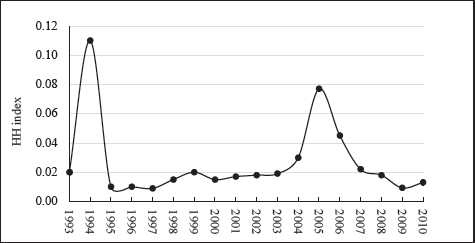
It is also noted that the decline in HHI has not been smooth but has been low, showing banks are competitive in terms of the distribution of assets. Although it fell over time, but has remained under the threshold of 1.800 throughout. Hence, while sharp improvements in concentration have been made, the Jordanian banking sector continues to be highly competitive in regard to asset holdings.
An alternative to HHI is the use of concentration ratios. Figure 2 plots the concentration of Jordanian banking assets as measured by concentration ratios. Concentration ratios are defined as the market shares S of the top n firms in an industry. The most widely used is the four-firm concentration ratio (CR4) :

The findings in Figure 2 are in line with those found under HHI. There has been a decrease over time especially, after the year 2000. This low level of concentration indicates a high degree of rivalry. The decline, and the low levels, of the concentration ratio demonstrate that there has been healthy competition in the Jordanian banking sector.
Technological innovation has allowed banks to operate in markets they never before had access to. Small regional banks can now offer their services in major cities throughout Jordan without the need to operate bank branches in these areas, coming into direct competition with larger banks. The results from both HHI and concentration ratios indicate that the Jordanian banking sector remained highly competitive except between 1998 and 2002.

Although HHI and concentration ratios allow us to measure competitiveness through concentration, these methods are somewhat flawed as they fail to take into account the behavior of firms under consideration. This point is well known among economists working in the field of industrial economics, yet it does not seem to have been recognized in other literature on the Jordanian banking sector.
An Advanced Measure of Collusion: The Degree of Competition Index (λi)
In contrast to the HHI and the concentration ratio, the conjectural variation approach takes into account the behavior of firms in estimating the degree of competition within an industry. The earliest models of oligopolistic behavior—such as the Cournot, Bertrand, and Stackelberg models—can be interpreted as special cases of the conjectural variation model rather than as game-theoretic models. In each game-theoretic model, firms control either quantity or price. In the Cournot and Stackelberg models, the strategic variable is output; firms choose their output levels and the demand curve determines price. In the Bertrand model, the strategic variable is price; firms choose prices and let demand determine output.
The conjectural variations approach proposed by Bowley (1924) takes into account the behavior of firms in estimating the degree of competition (or competitiveness) within an industry. To understand Bowley’s idea, consider two firms that produce a homogeneous product with output levels q1 and q2, and an aggregate output of Q = q1 + q1. Provided the invertibility conditions are met, the market price associated with this output may be expressed in terms of the inverse demand function p(Q) = p(q1 + q2). Each firm i is supposed to have a cost function c (q), i = 1,2. Assuming that the strategic variable for both firms is the output level, firm 1’s maximization problem is:

This demonstrates that firm 1’s profit depends on the output choice of firm 2. In order to make an informed decision, firm 1 must therefore forecast firm 2’s choice. A similar problem can be formulated for firm 2. According to the standard version of the Cournot assumption, each firm expects the other not to modify its behavior as one’s output changes and the market price changes with it. The first order condition of the firms’ maximization problems are:

Given that each first order condition determines the optimal choice as a function of the rival’s output, firm 1’s reaction function f1 (q2) is implicitly defined by the first order condition:

A similar equation holds for firm 2’s reaction function f1 (q1). The conjectural variation 
The same reasoning can be repeated for firm 2, whose conjectural parameter is v12. Several cases can be derived:
If v12 = v21 = 0, we obtain the first order conditions of the Cournot model, where each firm believes that its rival will not react to the other firm’s choice: that is, one firm conjectures that a change in its output level will not incite the other firm to change its output response. If v12 = v21 – 0, we have the competitive model or Bertrand competitive conjecture (Telser, 1972), where the first order condition is nothing but the standard marginal cost-pricing rule. This is where a firm believes that any increase in its output is exactly offset by a decrease of its rivals’ output, so that the market price remains unchanged. If there are n identical firms, the Bertrand conjecture is v = –1/(n – 1). Substituting v = –1 into equation (35) gives the equilibrium condition p = C’ (price equals marginal cost), which is the Bertrand or competitive equilibrium. If v = q/q, where i, j =1,2, we get the joint monopoly outcome. The firm conjectures that there will be collusive equilibrium as the firms behave symmetrically (q1 = q2). In such a case, v = 1 as the firm believes that if it changes its output, its rival will also change its output by the same amount. Thus, the firm can affect total industry output, but not its market share, by varying its output. The firm cannot increase its profits at the expense of the other firm, so it produces the cartel output.
Let us consider the output of a bank i and call it q. In the following we calculate the conjectural variations (λ) from the year 1993 to 2010. That is:

Note that ∂ q is the change in output of a bank, for all i, q is output of bank i, λ is conjectural variations in output of the rest of the firms as firm i changes its output:

The Jordanian Banking Sector and the Index of Collusion
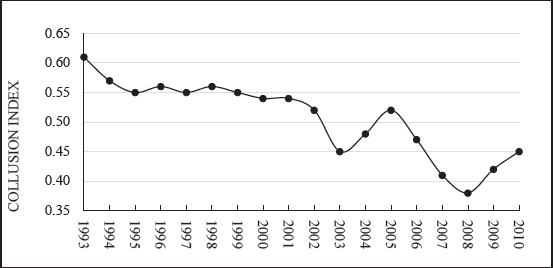
We apply 22 Jordanian banks data to calculate conjectural variations which is an index of collusion for the sector. Figure 3 shows the measures of conjectural variations, equation (37), of Jordanian banks from 1993 to 2010. Let us call the index of collusion CONJECT. It shows a general trend of improving rivalry in the Jordanian banking sector except during the financial crisis, the index of collusion has a steady increase since the crisis, which implies significant collusive arrangements in the banking industry.
Conclusions
The purpose of the study is to develop a theoretical model to ascertain if the IT investment in the banking sector is capable of generating a new equilibrium with increased efficiency. The empirical strategy is to seek an indirect test by studying the time profile of banking profits in Jordan as a temporal function of IT investment by the banking sector. Once we tested whether the IT investment has created an efficient equilibrium outcome in the context of multi markets, we move to a partial equilibrium analysis. We studied the banking sector in isolation from the rest of the economy and examined whether IT investment in the banking sector is socially desirable. We performed the analysis by developing and applying new measures of collusion for the banking sector of Jordan. This study aimed to answer some questions: does the banking system as an iterative process of credit allocation and information acquisition through IT investment, lead to a stable equilibrium? Has IT investment acted as a strategic investment to ensure stable market shares for Jordanian banks in the long run or socially desirable? The study finds that the investment in IT has led the banking system in Jordan away from an efficient equilibrium, underscoring the possibility of the non-existence of a set of mutually-consistent investment activities for the banking sector. We therefore stress that there is no critical point, or point of attraction, towards which the banking system of Jordan has been gravitating. For socially desirable issue, the banks in Jordan directly interact with each other, although they may have collusive arrangements with some of their rivals: the banking market is not fragmented.
Footnotes
Acknowledgments
We would like to thank the Central Bank of Jordan for providing the data for this work.
Declaration of Conflicting Interests
The authors declare no potential conflict of interest with respect to the research, authorship, and/or publication of this article.
Funding
The authors received no financial support for the research, authorship, and/or publication of this article.
