




Abstract
Since the physiocrats, agriculture has been seen as a panacea for economic development. However, studies suggest that manufacturing and, recently, advanced service industries are the engine of economic growth. This study analyzes how employment structure contributes to economic complexity (EC) in African countries. To achieve this objective, it uses data spanning 1996–2017 on 27 African countries and applies the ordinary least squares, fixed effects, and system generalized method of moments estimators. Results suggest that due to its inability to admit many divisions or develop production linkages, agriculture’s employment growth is negatively associated with EC. Thus, there are better fits for enhancing complex output in Africa than a more significant share of agricultural employment. On the contrary, employment growth in industry and services enhances the production of sophisticated goods. These findings are robust after several sensitivity checks. Among policy implications from these findings, agriculture should shift from subsistence to mechanized farming, allowing excess workers to reallocate to more productive sectors of industry and advanced services.
C26, J21, O1, O55
Keywords
Introduction
Over the past decade, economic growth returned to the developing world and many African countries. Yet, economic sophistication and diversification in services and products with higher value-added remained a big challenge. Though the increase in income per head has to a certain extent, created larger domestic markets for local enterprises, most of these economies are still too small for internal demand to guarantee the main engine of growth (Nchofoung et al., 2022). Success in exporting remains vital to the private sector’s growth and creating more jobs (Addison et al., 2017; Hidalgo, 2021).
Though some signs of structural transformation are perceptible in Africa, the manufacturing sector remains weak. Indeed, there has been a slow but constant shift of labor from the lowest-productivity agricultural sector. The fastest employment growth is in the service sector, where most activities are informal (Jones et al., 2015). Statistics indicate that employment levels in Africa between 2000 and 2019 grew at 2.5–3% annually, led mainly by Central and Eastern Africa. The employment-to-population ratio is lowest in North Africa and highest in East Africa. Agriculture remains the primary source of employment throughout the continent, accounting for 53.5% in 2011 to 50.7% of total jobs in 2019. The service sector employment increased from 34% in 2011 to 36.1% in 2019, while industrial employment was almost constant, from 12.5% in 2011 to 13.1% in 2019 (O’Higgins et al., 2020).
Sectoral employment shares, which respond to how employment by activity is allocated and measured, have always been a critical concern in economic dynamics. 1 Labor productivity often measured as a value-added per worker, empirically reflects high productivity characteristics acute to the sophisticated services and manufacturing industries. These sectors employ many workers with higher productivity levels than the average. Emerging or prosperous economies stand out as having relatively large shares of their labor force employed in these sophisticated services and manufacturing industries (Gala et al., 2018; Reinert, 2008).
In recent decades, economic complexity (EC) has gained the attention of scholars as it is widely considered a robust proxy of economic development (Felipe et al., 2012; Hausmann & Hidalgo, 2011; Hidalgo, 2021; Hidalgo & Hausmann, 2009; Vu, 2020). For instance, countries that are capable of producing highly sophisticated products such as electronics, chemicals, and automobiles are more likely to experience sustained growth (Felipe et al., 2012; Hidalgo, 2021), better health outcomes (Vu, 2020) and less income inequality (Hartmann et al., 2017). Conversely, those producing less complex products such as wood, textile, and raw materials suffer persistent underdevelopment. This shows that the predisposition to produce and export complex goods is embedded in countries’ mastery of production techniques materialized by the amount of knowledge within the economy (Felipe et al., 2012; Hidalgo, 2021; Hidalgo & Hausmann, 2009). Therefore, understanding the determinants of EC is paramount in designing policies that can help alleviate poverty and underdevelopment, especially in African countries. So far, empirical studies have documented some drivers of EC, including but not limited to human capital (Yalta & Yalta, 2021), patents (Nguyen et al., 2020), foreign direct investment (Zhu & Fu, 2013), internet (Lapatinas, 2019), tax burden (Lapatinas et al., 2019), and institutional quality (Vu, 2021). Surprisingly, employment structure as a determinant of EC is sparsely explored.
The sophistication of the economy involves high-tech or knowledge-intensive industries, which require substantial upstream investments in promoting and extending innovation. With increasing returns, technological change and innovations, and high synergies and linkages arising from labor division, the manufacturing and sophisticated service sectors strongly induce development (Reinert, 2008). These activities induce high research and development (R&D), high industrial concentration, fast technical progress, economies of scale, and product differentiation. This group of high-value-added sectors is usually opposed to low value-added-agriculture sectors, common to poor and middle-income countries (Reinert, 2008). Indeed, according to Adam Smith, economic activities’ potential for generating specialization and division of labor is not neutral; while some activities are more conducive to it, others are less. Agriculture, for example, does not admit many divisions and, consequently, develops no production linkages virtually, neither within itself nor with other sectors.
Therefore, the study’s main hypothesis is that a country’s potential to produce complex and sophisticated products depends on the size and location of its labor force across the broad sectors of agriculture, industry, and services. This hypothesis stems from the following assertion, which reemphasizes the interdependency between employment structure and output diversification;
Economic development is a process of capital accumulation with the incorporation of technical progress that increases productivity and wages and living standards in the long term; increased productivity involves industrialization or, more precisely, productive sophistication, because it happens less due to the production of the same goods and services, and more due to the transfer of labor from low sectors to sectors of high added value per capita. (Bresser-Pereira, 2016, p. 246)
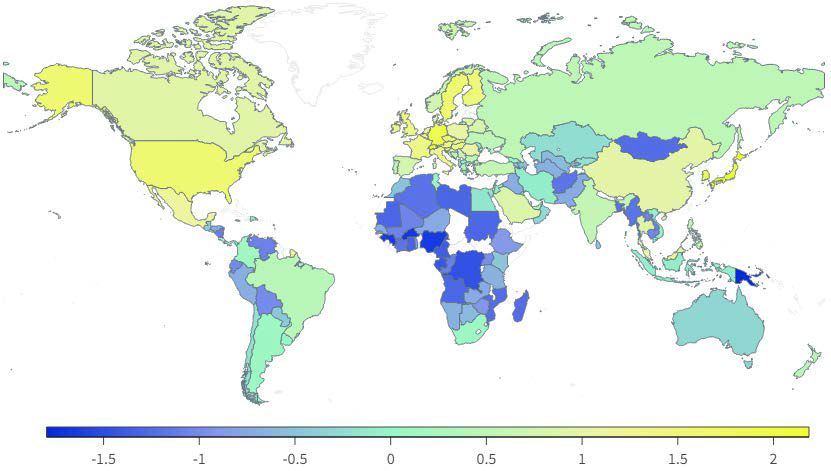
Thus, this study brings together two strands of the literature; the determinants of EC, which are underexplored (Hidalgo, 2021; Pereima, 2020), and the potential developmental effects of employment shares. By so doing, it contributes to the existing literature in several ways. First, to the best of our knowledge, this is the first study to empirically analyze the effects of employment structure on EC in African countries. Of the few studies that considered this relationship (Adam et al., 2023; Gala et al., 2018; Nepomuceno Lima et al., 2022), none focused on African countries. The choice of African countries for empirical investigation is pertinent for several reasons: (a) African countries are ranked by the observatory of economic complexity (OEC) in 2018 as the least complex region (Figure 1); (b) The employment structure of most African countries during the last two decades has presented interesting features for structural transformation. This is seen in the steadily decreasing shares of agricultural employment and a simultaneous increase in industrial and service employment. This indicates that structural transformation in Africa might be slow but is taking place (Busse et al., 2019). (3) The COVID-19 pandemic is more likely to severely affect employment structure and EC in regions with high informal sectors, like Africa, since informal workers operate on a day-to-day basis with no savings or unemployment benefits to cover their living expenses (O’Higgins et al., 2020).
Second, most empirical studies on the determinants of EC suffer from heteroskedasticity, which appears omnipresent (Baum et al., 2003), and endogeneity which generates biased estimates as they mainly use ordinary least squares (OLS). This study, thus, stands out from previous ones as we use the Lewbel two-stage least squares (2SLS) approach and system generalized method of moments (GMM) estimator, which allows us to correct the feedback causality of the assumed endogenous variables. Third, seeking beyond-average effects, this study is the first to employ quantile regressions (QR) in analyzing the relationship between EC and employment structure. Furthermore, this study uses two proxies of EC (ECI and ECI+). The use of ECI+ is essential to address measurement errors common to African countries that face difficulties exporting certain products, corrected by this index. Our results suggest that employment growth in agriculture is negatively associated with the production of complex products. Due to its inability to admit many divisions or develop production linkages, employment in agriculture does not make a good fit for enhancing EC in Africa, unlike labor reallocation to industry and services, which portrays positive effects on economic sophistication.
The rest of the article is organized as follows: The next section discusses theoretical foundations and a brief literature review. This is followed by the data description, model, and estimation strategy. Next, we present the results, discussions, and robustness checks. Lastly, the conclusions and policy implications are discussed.
Theoretical Foundations and Brief Literature
The theoretical foundation linking output sophistication and employment structure stems from the early development theory by Lewis (1954), Kuznets (1955), and Chenery (1960). They proposed a dual-sector model of development where structural transformation arises through the transfer of surplus labor from the traditional agricultural sector to the modern industrial sector, which is proportional to the rate of capital accumulation in this modern sector. According to Dabla-Norris et al. (2013), demand factors with income and relative price effects or supply factors generated by differential rates of productivity growth drive structural transformation. Indeed, spatial and sectoral reallocation of labor can occur only if there are differences in productivity across sectors and a sufficiently low cost of mobility.
Back in time, agriculture was seen as a panacea for economic growth (Higgs, 1897). In the early development process of nations, agriculture improvements were important because they provided basics for survival (e.g., reducing extreme famine and paving the way to food security) (Higgs, 1897; Rostow, 1959). However, beyond providing some basic needs, it would be extremely difficult to build a strong and resilient economy based on this sector. Unstable prices and low dispositions for technological growth are the main reasons why most countries with large agricultural shares face difficulties taking off in today’s globalized world. According to Adam Smith, the division of labor can be considered a pillar of productive progress and productivity gains. Regarding the potential for generating a division of labor, economic activities are not neutral. While some sectors, like industry, are more conducive to the division of labor, others, such as agriculture and natural resources, respond less.
Even today, the manufacturing sector is considered the engine of economic growth and global competitiveness. Rodrik (2013) presents a three-sector model consisting of the natural resources, services, and manufacturing sectors. Among these, only the manufacturing sector manifests characteristics consistent with the so-called unconditional convergence. The sector produces tradable goods, which can be quickly integrated into the global production network, and, thus, facilitate the transfer and absorption of technology. According to the author, the quickest way to spur the catching-up process is through implementing policies that facilitate the development of modern manufacturing industries, which can employ an increasing share of the economy’s workforce (Rodrik, 2013, 2016).
As countries deindustrialize, the service sector gains interest and develops similar features to industry (Gala et al., 2018; Rodrik, 2016). As Rocha (2015) points out, many studies have investigated the interdependence between manufacturing and services. According to these studies, services and manufacturing sectors have become increasingly integrated through a symbiotic and synergistic relationship. Pisano and Shih (2009) also believed that manufacturing and services share a collective pool of resources that sustains innovative processes. Only the services sector is doing well in most African countries.
The literature is nascent on the specific relationship between employment structure and the production of sophisticated output. Gala et al. (2018) used EC analysis and input–output matrices to assess the importance of employment creation in advanced sectors. In accordance with the data from 35 countries using the GMM estimator, results show that in the long run, economic development depends on countries’ efforts and ability to generate employment in advanced manufacturing and service sectors. They also assert that sophisticated service jobs are more critical for EC than manufacturing jobs.
In a similar study, Nepomuceno Lima et al. (2022) used a panel of 28 countries, including 20 developed countries and eight emerging economies. Their analysis was based on a parametrical method using panel dynamic OLS and the non-parametric one, applying data envelopment analysis. Their econometric results suggest that allocating workers in high R&D manufacturing positively impacted the ECI level of all the countries in the sample analyzed. However, there was a discrepancy between emerging and advanced countries. In contrast, Adam et al. (2023) examined the effect of EC on the labor market using annual data of Organization for Economic Co-operation and Development (OECD) countries from 1985 to 2008 and averaged data from 1990 to 2010 for 70 developed and developing countries. They showed that moving to higher economic sophistication of exported goods leads to less unemployment and more employment, revealing that EC does not induce job loss. In addition, they built an index to illustrate how the development of sophisticated products is associated with changes in the labor market and that the economic sophistication of exported goods captures information about the economy’s job creation and destruction.
Materials and Methods
Data Description
We used a panel of 27 African countries 2 from 1996 to 2017. Data on EC were obtained from the OEC, while other variables were extracted from the World Bank (2022), world development indicators database. 3 The availability of reliable data on key variables such as ECI and ECI+ mainly determined the choice of the sample and time period.
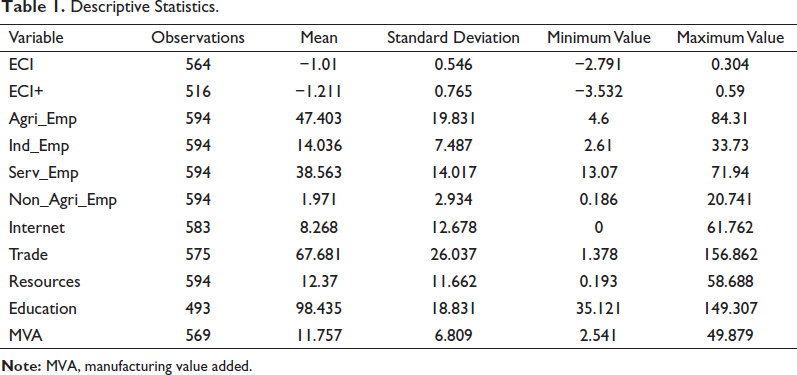
Table 1 presents the summary statistics of the variables included in the model. The variation in observations among some variables indicates that our panel is unbalanced. The mean of the variables lies within a reasonable interval. Therefore, their scale is appropriate for comparability. Agriculture remains the dominant sector in Africa regarding employment, with an average of 47.4% of total employment.
Descriptive Statistics.
Description of Variables
Dependent Variable
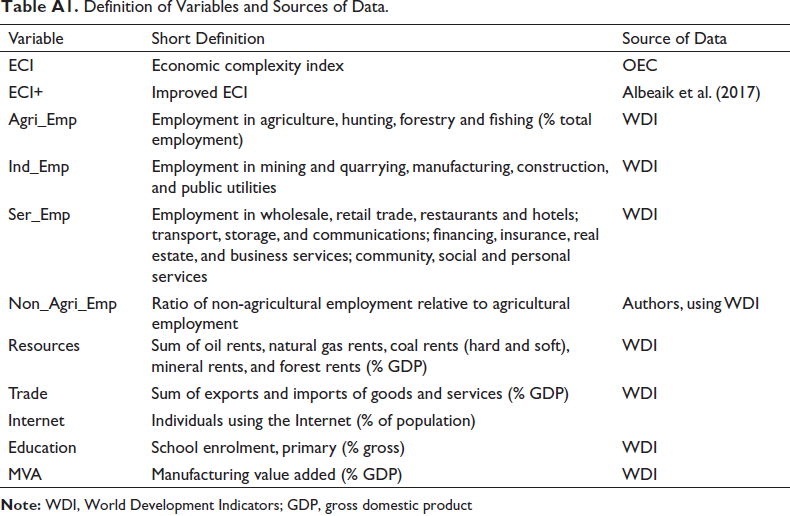
EC is the main dependent variable in this study proxied by ECI. It captures the ability and connectedness of an economy’s existing knowledge to drive diversification into related complex production, using the product space as elaborated by Hausmann (2009) and Hidalgo (2021). However, given some measurement errors common with data collection and processing attributed to the low statistical power of some African countries, we checked the sensitivity of our results with an improved 4 proxy of EC, the ECI+, by Albeaik et al. (2017). It is adjusted to account for the goods and services that a country produces but faces difficulties exporting them. This index has also been applied in other studies to seek the drivers of EC (Lapatinas, 2019; Nguyen et al., 2020; Nguyen & Su, 2021, Vu, 2020).
Independent Variable
The independent variable of interest is employment. It is defined as working-age persons engaged in any activity to produce goods or provide services for pay or profit. Data on this variable represent estimates following the International Labor Organization (ILO) (for better comparability across countries) by sector as a percentage of total employment. The agricultural sector, for instance, consists of activities in agriculture, hunting, forestry, and fishing, in accordance with division 1 (ISIC 2) or categories A–B (ISIC 3) or category A (ISIC 4) of the ILO’s classification. The industry comprises mining, quarrying, manufacturing, construction, and public utilities (electricity, gas, and water). Finally, the service sector consists of wholesale, retail trade, restaurants, and hotels; transport, storage, and communications; financing, insurance, real estate, and business services; community, social and personal services, by divisions 6–9 (ISIC 2) of International Labor Organisation Statistics (ILOSTAT) database. We also computed a ratio of relative employment mobility from the agriculture sector given as the sum of industry and service shares divided by agricultural employment. This ratio has been used by Busse et al. (2019) to approximate the state of structural transformation.
Control Variables
According to the extant literature on the determinants of EC (Bhorat et al., 2017; Lapatinas, 2019; Nguyen & Su, 2021; Sepehrdoust et al., 2019; Zhu & Li, 2017) and also to circumvent possible omission variable bias, we included several control variables; openness to trade, natural resource rents, education, internet, industrialization.
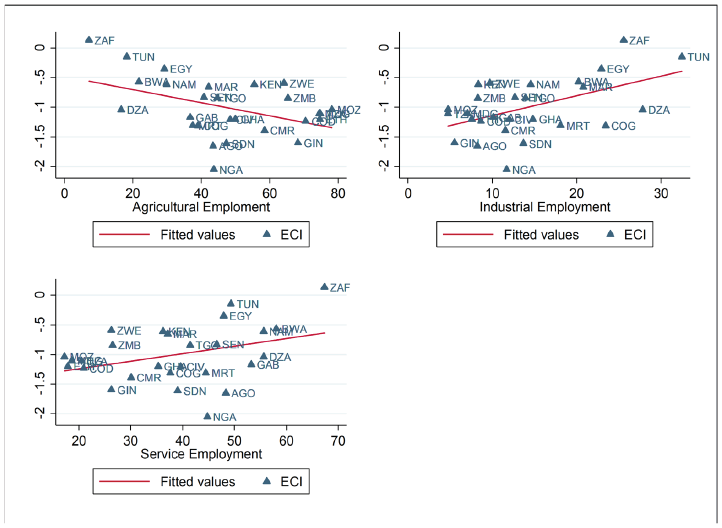
Figure 2 reveals that agricultural employment share is negatively associated with EC for the sample of 27 African countries, while industry and service employment are positively associated with ECI. This provides a preview of the relationship between employment structure and EC, but since correlation does not necessarily imply causation, we proceed with econometric regressions. Pairwise correlations are presented in Table 2. We can observe a strong correlation between the two EC indexes (0.783). This high correlation indicates the similarity between the two variables. Apart from agricultural employment share and the total natural resources rents negatively associated with ECI and ECI+, the correlation with EC and all other variables are positive. Also, the coefficients associated with the correlation between agricultural employment share and industry, then, with service employment, are −0.882 and −0.963, respectively, which largely exceeds the threshold of 0.7, suggesting separate specifications for these variables.
Correlation Matrix.
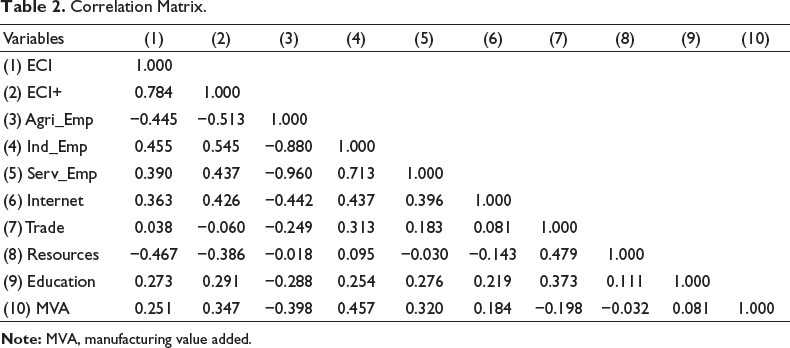
In fact, following the rule of thumb, we do no joint variables with correlation coefficients of more than 0.7 in the same specification as documented by Kennedy (2008). This is a way to circumvent possible multi-collinearity, which could lead to bias in our estimates.
Model Specification
The model specified below is inferred from the works of Gala et al. (2018) and Lapatinas (2019).

where EC
it
represents EC distributed across time and measured by ECI and an improved EC index (ECI+). Emp
it
is employment captured by each sectors’ share.
Estimation Strategy
We start with the standard OLS technique to estimate the model. However, the OLS fails to account for individual effects. The literature suggests using the fixed effect (FE) estimator that allows for controlling for country-FEs, which are country-specific factors such as a country’s history or climate. However, the presence of the lagged dependent variable among the regressors makes the FE and OLS estimators inappropriate (Nickell, 1981). Also, results obtained from the FE model may be subject to heteroskedasticity (according to Baum et al. (2003), a problem that appears omnipresent in most empirical studies) and endogeneity bias. Theoretically, endogeneity may arise for three reasons: the first could be simultaneity bias or reverse causality, where some variables are strongly interdependent. Indeed, while we posit that employment shares may affect EC, we cannot refute that EC can also affect employment. The second gathers the occurrence of errors from measurement with the explanatory variables, which is common to the developing world, including in Africa, where their statistical capacity is questionable. And the third reason could be that sometimes relevant explanatory variables’ omission can create correlations between explanatory variables and the error term.
To circumvent endogeneity issues, the extant literature recommends the use of instrumental variables (IV) 2SLS technique or the GMM (Farhadi et al., 2015). However, the difficulty with the former approach is finding purely external instruments that vary across groups and over time (Baum et al., 2012; Stock et al., 2002). Also, the IV does not account for the endogeneity of other regressors. Therefore, the GMM is preferred over the IV approach in this study. That notwithstanding, we further employed Lewbel’s 2SLS approach to check the sensitivity of our findings. Lewbel’s two-stage least square is a variant of the IV-2SLS which does not require external instruments. This technique is applied when sources of identification, such as having appropriate external instruments, are weak or unavailable. This approach is essential for identifying structural parameters in regression models with an endogenous or poorly measured regressor without traditional identification information. This method includes in-house constructed heteroskedasticity-based instruments. The internal instruments are generated from the residuals of the auxiliary equation, which are multiplied by each of the included exogenous variables in mean-centered form. An advantage of the Lewbel 2SLS approach is that it does not rely on the satisfaction of standard exclusion restrictions.
The system-GMM technique, elaborated by Blundell and Bond (1998), which, has been proven to perform better than the difference GMM initiated from the works of Arellano and Bond (1991) and Arellano and Bover (1995), has the advantage of controlling endogeneity of all the explanatory variables by using their lagged values as IV, both in level and/or in first difference. The two-step GMM estimators often have lower bias and standard errors than one-step estimators, which thus leads to higher significance levels. Some studies have remained skeptical of the two-step estimator due to its downward bias nature and instead preferred one-step. However, applying the standard error correction put forth by Windmeijer (2005) rescues the two-step estimators from the downward bias. Though the system GMM is robust in addressing the above issues of endogeneity, the pitfall is that it can generate too many instruments leading to over-fitting of variables treated as endogenous, which weakens Hansen’s statistics of validity of instruments, producing biased estimates (Roodman, 2009). To appropriately address this problem, the rule of thumb suggests that the instruments used should be less than the number of panels, and a limit should be placed on the number of lags. Accordingly, this estimator’s validity relies essentially on (a) Hansen test statistics which is a criterion for the appropriateness of the choice of instruments set, and (b) Arellano and Bond second-order serial correlation [AR(2)] should not auto-correlate.
Results and Discussion
Baseline Results
Table 3 presents baseline estimates of the effects of employment by sector on EC in African countries using the OLS and FE estimators. Both estimators present similar results globally. Agricultural employment is observed to negatively affect EC in Africa at 1% significance level. This result can be comparable to that of Nguyen and Su (2021), who found that an increase in the size of the agricultural sector in terms of value added to total GDP negatively affects EC. The rationale behind this result is that the African agricultural system is mostly subsistence agriculture, which uses ancestral tools such as hoe and cutlass, low-yielding species, and has less productivity, even though employing a more significant share of the workforce. Also, workers in this sector are primarily unskilled and unlikely to innovate, making it challenging to produce sophisticated goods since their conception requires competitive knowledge (Hildago, 2021).
Effect of Employment by Sector on Economic Complexity.
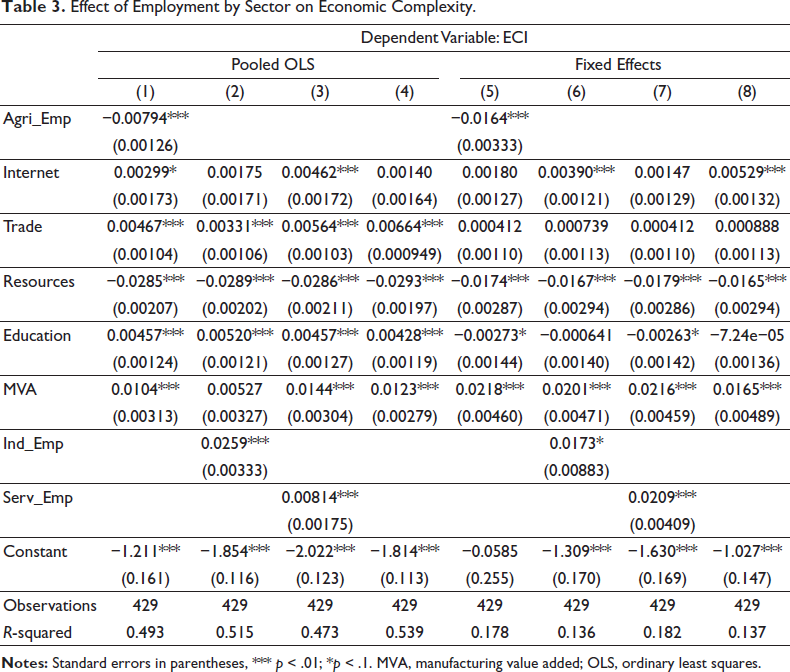
Contrary to agricultural employment, employment in industry and services spurs EC. A 10% increase in industrial employment will lead to a 0.26 percentage point increase in EC. This result is typical since, through learning by doing and specialization, both skilled and unskilled labor of this sector experience growth in productivity and acquire the know-how needed to produce sophisticated goods. This result corroborates those of Nepomuceno Lima et al. (2022), who showed that employment in high R&D sectors of manufacturing is positively associated with EC in both developed and developing countries. Indeed, according to Rodrik (2013), manufacturing is the only sector with characteristics consistent with unconditional convergence. The sector produces tradable goods that can quickly integrate the global production network, facilitating the absorption and transfer of technology. This can ease the production of complex goods and further increase the workforce share in the industry.
The positive and significant effect of service employment at a 1% level aligns with the mainstream literature. Gala et al. (2017) argued that a nation’s EC level is driven by its capacity to generate employment in advanced sectors of industry and sophisticated services. This is because, more recently, the services sector has started to experience a high incidence of technological change and innovations similar to the manufacturing sector, resulting in increased returns and inducing development (Reinert, 2008).
Regarding control variables, an increase in the share of individuals using the internet is positively associated with EC. This indicates that the internet can facilitate the transfer of information and knowledge, lower transaction costs, save time, and facilitate the acquisition of knowledge, which leads to the production of sophisticated goods. This is consistent with Lapatinas (2019), who concluded that implementing policies that increase Internet access will accelerate a country’s level of sophistication and productive capacity. The positive and significant impact of openness to trade on EC highlights the spillover effects of trade activities on the production systems in most developing regions. This result corroborates the mainstream globalization theories. The result also conforms with previous empirical studies indicating that trade liberalization can benefit economies with more significant market outlets, specialization, and productivity growth (Nguyen & Su, 2021; Sepehrdoust et al., 2019). A positive and robust relationship is reported between industrialization as proxied by MVA and EC. According to Nepomuceno Lima et al. (2022), industrialization is an essential driver of EC due to its ability to perform research and development, implement new technologies, and spur the production of complex products. Natural resource rents have a negative and significant effect on EC. This result is in accordance with the resource curse hypothesis extensively documented in the literature. Indeed, the abundance of natural resources in Africa could undermine the development of highly productive sectors by reducing their competitiveness through the Dutch disease or lead to the deterioration of institutions, particularly by generating conflicts and corruption. Our results present some similarities with those of Yalta and Yalta (2021) and Malah Kuete and Asongou (2022).
Robustness Check
To check the robustness of our results, we performed several sensitivity tests, including (a) endogeneity concerns, (b) the use of an alternative dependent variable, (c) nonparametric estimations, and (d) excluding outlays.
Endogeneity Concerns
Though the OLS and FE estimators are relatively easy to implement and the latter rich in accounting for country-specific factors, the results could be biased and inconsistent due to endogeneity (measurement errors, reverse causality, and omitted variables). Thus, system GMM and Lewbel’s (2012) approach are used for sensitivity analysis to ensure our results are robust to endogeneity. Also, system GMM helps account for the dynamic nature of our model in addition to treating endogeneity issues.
The results of this exercise are presented in Table 4. The standard practice would be to start by showing the diagnostic results. The Arellano and Bond serial correlation test confirms the presence of first-order serial correlation. Since the p value is less than 10% thus, we reject the null hypothesis of no first-order serial correlation (this result is expected as defined when building the system GMM) but validate the hypothesis that there is no second-order autocorrelation of residuals. Also, Hansen’s test does not reject the null hypothesis of the instruments’ validity. The maximum number of instruments generated by the system GMM is 22, less than the number of sample countries, indicating the absence of instrument proliferation. Finally, the Fisher statistics of overall stability suggest that our model is globally significant.
Sectoral Employment and Economic Complexity (Lewbel 2SLS and System GMM).
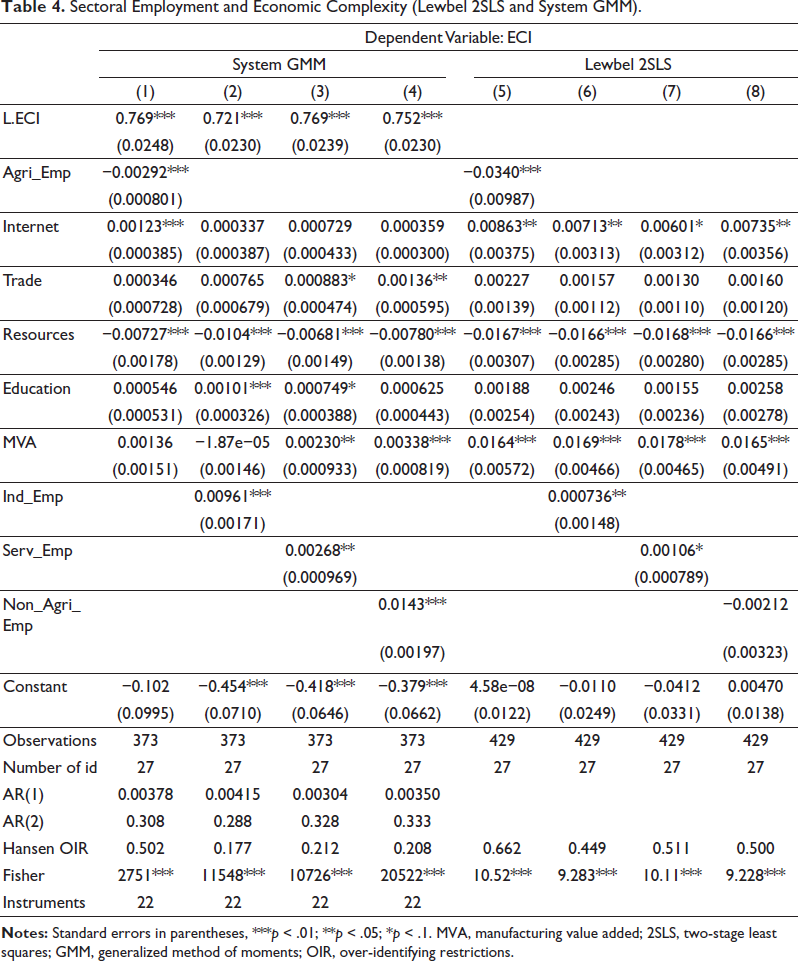
The lagged ECI variable is positive and significant, confirming EC’s dynamic nature. This means that previously attained levels of EC remain important for present and further sophistication. The coefficients of employment shares dispose of the same signs as those presented in the baseline estimates. Everything else is globally similar to the previous findings regarding the control variables. Therefore, our results are robust after endogeneity checks irrespective of the estimator used (system GMM or Lewbel 2SLS approach).
To capture the state of structural transformation in the region through labor reallocation and its effect on EC, we computed a ratio of relative employment mobility from the agriculture sector given as the sum of industry and service shares divided by the share of agricultural employment. This ratio has been used by Busse et al. (2019) to approximate the state of structural transformation. Results presented in Table 4 reveal that labor reallocation from agriculture fosters EC at a 1% significance level. This result is an aggregation and a further confirmation of the previous results on the positive effects of industry and service employment shares on EC.
Using Alternative Proxy of Economic Complexity
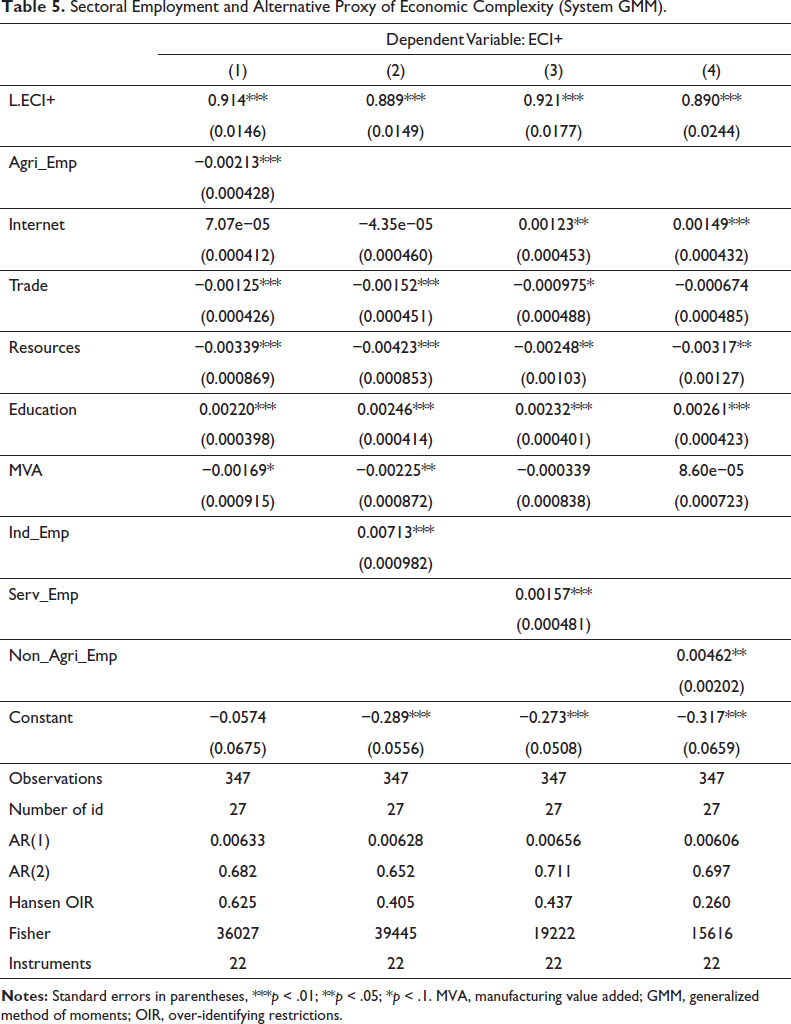
To further check the robustness of our baseline results, we used an alternative measure of the dependent variable, the ECI+ 5 developed by Albeaik et al. (2017), known to be an improved version of ECI. The motivation for using this index lies in trying to circumvent some measurement errors common with data collection and processing attributed to the low statistical power of some African countries. Many studies investigating the drivers of EC have also applied this index (Nguyen et al., 2020; Nguyen & Su, 2021). The results displayed in Table 5 are globally consistent with those documented previously. Thus, our baseline estimates are robust to using an alternative measure of EC.
Sectoral Employment and Alternative Proxy of Economic Complexity (System GMM).
Using Nonparametric Estimation (Quantile Regression)
Seeking beyond average effects unlike the OLS, FE, and GMM results so far, this article further employs QR, a nonparametric technique proposed by Koenker and Bassett (1978), which uses conditional means to account for extreme values of the dependent variable in percentiles.
This method has advantages over the OLS, as the QR is more robust to outliers and non-normal errors. Also, it accounts better for heterogeneity in the distribution of the dependent variable. Results displayed in Table 6 show that the magnitude of the previously documented negative effect of agricultural employment share is higher in countries belonging to the median quantile but reduces with upper quantiles of EC.
Sectoral Employment and Economic Complexity (Quantile Analysis).
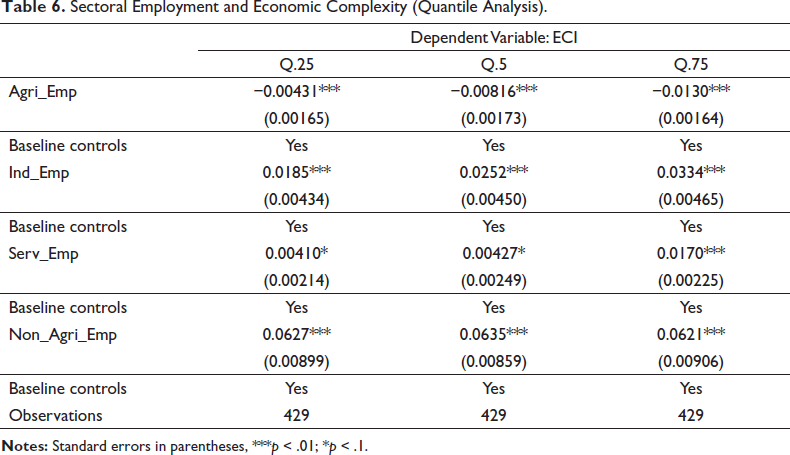
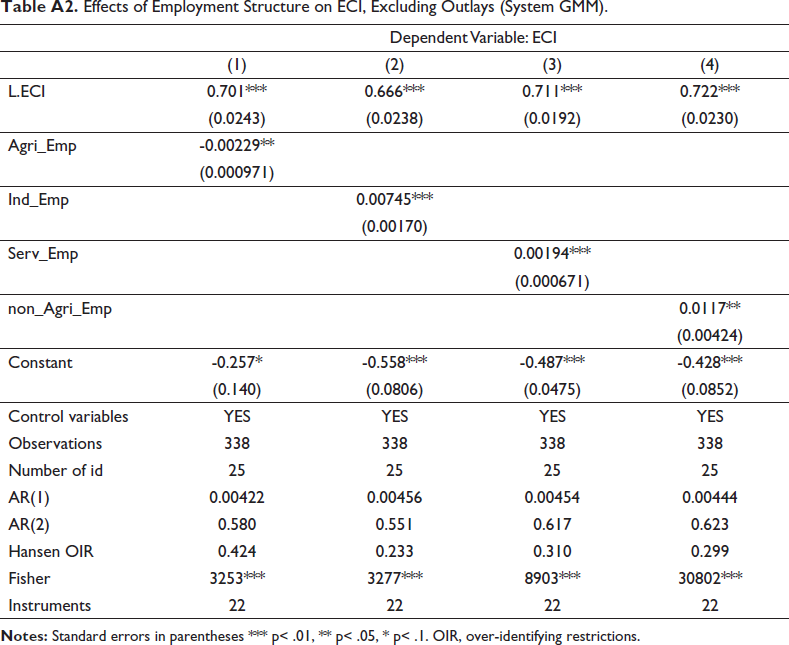
The previously established positive effect of industrial employment on EC increases in magnitude with quantiles of EC while keeping its statistical power at a 1% significance level. This confirms that employment growth in the industry remains a crucial driver of output diversification. Regarding other control variables, all have expected signs corroborating previous estimates not reported here to save space. Finally, Table A2 of the Appendix presents the sensitivity test results. Here, we excluded outlays from the sample and re-estimated the model. No irregularities were reported.
Conclusion
This study aimed to provide an empirical contribution to the literation on the relationship between employment structure and economic sophistication in an African context. African countries are characterized by a weak but progressive reallocation of workers and resources from agriculture, an ailing manufacturing sector, and a booming service sector. These specific features fueled our interest in choosing this region for an empirical investigation. After a brief theoretical discussion, this study used panel data on 27 African countries and applied the OLS and FE estimators for baseline estimates. Because of the possible endogeneity and distributional heterogeneity, Lewbel’s 2SLS, system GMM, and QR were further applied for robustness checks.
Results show, on the one hand, that an increase in the share of employment in agriculture relative to total employment negatively affects EC and, thus, structural transformation in the region. Given that agriculture alone is home to roughly half of the total employment in Africa and is mostly subsistence, this becomes a strong argument for the poor ranking of African countries in terms of the production and export of sophisticated products. On the other hand, our findings consistently establish that employment outside of agriculture is positively associated with output sophistication in African countries. This is the case for industry and service employment shares and the ratio of labor relocation outside of agriculture. Our estimates remained consistent after using ECI+ as the alternative dependent variable and controlling potential variable omission with additional control variables.
From these findings, some policy recommendations emerge, following the desire to create “the Africa we want” as stated in aspiration 1 of Agenda 2063 of the African Union. African policymakers and governments must not neglect the important role of agriculture. Rather, they could create appropriate conditions to foster structural change reflecting through the EC process, by shifting from subsistence to mechanized agriculture. This could boost labor productivity and, thus, push the excess workers to relocate out of agriculture progressively. Also, easing access to credit facilities, channeling aid funds towards agricultural development, and providing quality infrastructures could be good incentives for encouraging long-term employment outside the agricultural sector for better diversification and economic resilience.
This study has some limitations. It did not consider the informal versus the formal and precarious structure of employment, which could be important for African countries. Also, given that employment structure differs across countries, it would be interesting for future research to perform a similar study at the country level, to provide country-specific policies.
Appendix
Definition of Variables and Sources of Data.
Effects of Employment Structure on ECI, Excluding Outlays (System GMM).
Footnotes
Acknowledgments
We acknowledge the contribution made by Jules-Eric Tchapchet Tchouto and Arsene Mouongue Kelly to an earlier version of this article.
Declaration of Conflicting Interests
The authors declared no potential conflicts of interest concerning the research, authorship, and/or publication of this article.
Funding
This research received no funding for the research, authorship, and/or publication of this article.
