




Abstract
This study estimates the energy costs and greenhouse gas emissions for the production and the processing for thermal use of Giant reed (Arundo donax L.), a second-generation perennial energy crop. The agronomic study took place in Buenos Aires (Argentina) under humid to subhumid climatic conditions. Rhizomes and in vitro micropropagated plantlets were employed and cultivated under both fertilization and rainfed conditions during 2018–2022. The yield demonstrated a substantial increase from 3.8 t/ha to 23.1 t/ha from implantation to crop setting. Throughout this period, the energy input escalated from 23 to 70 GJ/ha, with the planting phase exhibiting the highest energy intensity. This surge can be attributed to the use of herbicides, accounting for 44.1%–61.3% of the energy consumed. Energy outputs were 17 (±0.19) MJ/kg as the low heating value obtained from the biomass elemental composition. The net energy yield for the 10-year lifecycle resulted in 2851.3 (±20.2) GJ/ha, and the output/input ratio varied from 41 (for pellets) to 126 (for chips). Carbon emissions ranged from 343.9 (for plantlets) to 371.9 (for rhizomes) kg CO2e/ha during the implantation stage, resulting in 208.3, 397.6, and 859.6 kg CO2e/ha for chips, bales, and pellets, respectively. This study reinforced the knowledge about the farming of this energy crop and displayed a promising scenario for the sustainable development of the Arundo donax L. based value chain.
Introduction
From the oil crisis of the seventies to the current scenario where Europe finds itself at the epicenter of the unsafe energy market (IEA, 2022), environmental emergencies have triggered the need to search for new renewable energy sources. None of the more significant Latin America and the Caribbean (LAC) countries has escaped this reality since Colombia, México, Brazil, and Argentina have not significantly reduced CO2 emissions, as evidenced recently by the increased dependence on fossil fuels in their energy mix (Sheinbaum et al., 2011). In addressing these challenges, biomass presents a viable solution. It offers farmers a compelling alternative to nonfood crops to open up new avenues for business, fostering diversification and ensuring a more stable income. The development of a value chain of energy crops could contribute to alleviating the impact of the intensive use of fossil fuels and natural resources (soil and water) and additionally promote the use of marginal and/or devalued areas that are not suitable for food production (Pilu et al., 2013). Among energy crops, Giant Reed or Arundo donax L. (AD) has been recognized as one of the best prospective energy crops that could be grown under low input conditions (Angelini et al., 2009; Lewandowski et al., 2000, 2003). It is a perennial cool-season grass, C3 pathway, with high photosynthetic efficiency and a cropping life of about 12–15 years (Pilu et al., 2013; Rossa et al., 1998). Moreover, this perennial grass is not highly demanding of nutrients due to the recycling capacity through their rhizome systems. In temperate climate regions, AD could be a less expensive energy resource compared with annual crops such as maize or sorghum (Pilu et al., 2013). Once the crop reaches its full growth, generally after the first two or three years, the production of dry aerial biomass ranges between 20 and 40 t/year (Angelini et al., 2005; Faix et al., 1989). Angelini et al. (2009) reported that over 10 years, the performance of the aerial dry matter achieved 37.7 t/ha/year, 31.3% higher than other lignocellulosic crops such as Miscanthus.
AD is a naturalized species in the Southern Pampas region. The first research on this perennial herbaceous in Argentina indicates a vast region suitable for its cultivation in terms of soil, water, and climate conditions (Falasca et al., 2011). Nevertheless, establishing a crop with adequate agronomic management remains incipient (Nogar et al., 2021; Rodríguez et al., 2021). The capacity to grow in poor soils and marginal regions could improve land use, avoiding or minimizing the competition between land use to produce food or biomass. Some studies suggest AD could be considered an invasive and dangerous weed plant (Lowe et al., 2000). However, these characteristics were observed mainly in riparian zones and roadsides in California and Southern Europe (Dudley, 2000). Besides, unlike other species, the sterility of its seeds contributes to the slow invasion of AD (Pilu et al., 2013; Zegada-Lizarazu et al., 2013). Regarding crop management, the scarcity of propagules and the high planting costs are the main obstacles to the rapid scaling up of plantations. For accurate crop utilization, the development of agronomic procedures and mechanization operations are still necessary (Pilu et al., 2013).
The potential of AD as an energy crop is primarily based on the high production of biomass and its chemical composition, typical of lignocellulosic resources such as soft and hardwood (Córdoba et al., 2023; Faix et al., 1989). As for any energy crop, the energy balance must be positive (i.e., the energy yielded by the crop should be significantly higher than those required to grow and produce the final biomass). In the past five decades, a growing focus has been on addressing environmental and sustainability concerns. Consequently, there is a heightened interest in evaluating energy balances as part of assessing crop production, ensuring a holistic approach to energy efficiency and environmental impact (Boehmel et al., 2008; CEPAL, 2014; Hülsbergen et al., 2001).
Energy balance is based on a comparison of the inputs (energy consumed) and the output (energy produced) of the process, in energy units (Manzanares, 1997). The methods to determine the energy balance vary widely throughout the literature (Hülsbergen et al., 2001). However, these authors emphasize that since there is no standard for computing the energy balance, it must be accomplished at least with a clear definition of the system boundaries, the energy equivalents of the inputs, and all the energy requirements for the operations involved. An energy balance can be expressed as (i) the net energy yield (energy output minus energy input), which refers to a total balance of the energy produced to the energy used in the process, or as (ii) the energy production efficiency, that is the energy output/energy input ratio. This last represents the efficiency in producing “renewable” energy to the fossil energy used in its production. This is usually referred to as the energy return on investment (EROI) or as the energy return ratio (ERR) and represents the total usable energy that generates a unit of fuel/biofuel divided by the energy required to make that fuel/biofuel, or the primary energy input in the lifecycle. Values of ERR greater than 1 are favorable for renewable energy resources, and higher ratios represent improved energy efficiency processes (Hamedani et al., 2019). Holmatov et al. (2019) highlighted the usefulness of EROI when energy inputs are similar, that is, when producing similar energy types, and obtained values for bioethanol and biodiesel from different feedstock. The inputs of the energy balance of biomass production are, therefore, the energy equivalent of those agricultural operations related to the crop and the materials involved. The inputs can vary widely between different regions depending on climatic conditions, economic development of the area, and, particularly, the type of crop, among others. The input calculation must consider the complete fuel cycles, including the primary energy consumed in producing the energy vector (Manzanares, 1997). Mantineo et al. (2009) and Cosentino et al. (2016), among others, indicated that perennial lignocellulosic crops generally have positive net energy balances better than annual crops.
In previous studies conducted mainly in the Europe (Angelini et al., 2005), AD demonstrated a favorable energy balance, giving a total input decrease from the AD crop implantation stage to the following years of growth. Mantineo et al. (2009) compared three lignocellulosic energy crops (including AD) over a five-year crop cycle, revealing a high yield of available energy from AD under different agronomic conditions with very low energy inputs. In the Mediterranean environment, AD gave the best performance compared to Miscanthus x giganteus and Cynara cardunculus in terms of yield, net energy yield, and energy ratio, reflecting a promising crop. Similarly, Angelini et al. (2009) reported net energy yields of 637 and 467 GJ/ha for AD and Miscanthus x giganteus, respectively, cultivated in Central Italy after 10 years of experiments.
In Argentina, there are no references to AD production for energy purposes. However, the first research on the agronomic behavior of this perennial herbaceous described the actual and potential growths under rainfed or fertilized and irrigated conditions, demonstrating the influence of the solar intercepted radiation on yield (Rodríguez et al., 2021). More recent studies focused on the technological behavior of AD, revealing an interesting energy content and satisfactory performance of the biomass under controlled combustion in terms of its gaseous emissions profile (Córdoba et al., 2023). Another study described the behavior of the harvested canes under field and laboratory drying processes, demonstrating that conditioned canes speed up moisture loss during the drying process (Córdoba et al., 2022). As an energy cane, AD could be made into pellets and chips as forms of biomass fuel, similar to wood pellets and chips. Wood pellets are mainly used for residential and small commercial heating, while wood chips are used for commercial and institutional heating (Unnasch & Buchan, 2021).
This study aims to evaluate the energy analysis of AD aerial biomass obtained from rhizomes and plantlets plantations to determine the energy production efficiency and the net energy yield of chips, bales and pellets for thermal use. AD yield in Southern Pampas, Argentina, under conventional agronomic practices, rainfed and least fertilization was also evaluated. Holmatov et al. (2019) pointed out the importance of individual crops making substantial contributions at the country level to achieve greenhouse gas (GHG) emission savings through bioenergy utilization. Therefore, this study also included the assessment of the GHG generated along the lifecycle of the production and processing of AD biofuel.
The rest of the study is laid out as follows. The next section describes the materials and the methods used in the study. This is followed by the results and the discussion of the agronomic, energy, and GHG assessments. Finally, the conclusions are presented.
Materials and Methods
Agronomic Experimental Characteristics
The study of the field production of AD was developed in two experimental sites located in the central region of Buenos Aires (Southern Pampas), in the districts of Azul (AZ, 36°49’47.5” S, 59°53’13.9” W at 137 m.a.s.l.) and Olavarría (OL, 37°02’05.47” S, 60°19’08.58” W at 166 m.a.s.l.). The experimental field studies were conducted during 2018–2021 in OL. It started in AZ in 2019 and still continues. The climate of the region is temperate-humid to subhumid. The mean annual temperature is 14.3 °C, while 21 °C is the mean temperature for the warmest and 7.6 °C for the coldest months (Vilatte et al., 2017). The frost-free period (0 °C) is about 189 days, with an average date of first frost 20–30th April and the last frost date of 5–12th October, with values corresponding to a 50% probability (Fernández-Long et al., 2016). Rainfall has a regular pattern with a historical annual mean of 858 mm (minimum of 488 mm and a maximum of 1470 mm) (Vilatte et al., 2017). The soil was illitic, thermic, petrocalcic Argiudoll (Natural Resources Conservation Service and Agriculture Department, 2010) in both sites. The depth to the petrocalcic horizon was 0.9–1.5 m in AZ and 0.3–0.7 m in OL. Chemical properties in the top 0.20 m soil were 4.5 (AZ) and 5.0 (OL) g organic matter/100 g soil, 16.4 (AZ) and 6.1 (OL) mg P/kg available P (Bray I) and 43 kg/ha N-NO3.
Agronomic Experimental Design and Crop Management
The field experiments were carried out in randomized complete blocks, with two treatments: T0 (soil without mineral fertilization, as control) and T1 (diammonium phosphate (DAP) addition); each treatment had four repetitions with plots sizes of 16 m2 (AZ) and 64 m2 (OL). The fertilization for T1 (50 kg/ha) was applied at the planting time in the implantation year and after each harvest (approximately during September) in subsequent years.
Perennial weeds were controlled in the fall before planting using 48% glyphosate (4 L/ha). During winter, the fields were plowed and disk-harrowed before planting. The planting density was 10,000 pl/ha with a spatial arrangement of 1 × 1 m. Two types of propagules were used for the plantation: rhizomes and plantlets. Rhizomes were obtained from a reed bed of a naturalized clone from an area close to the experimental site and then unearthed using a moldboard plow. It was manually collected, cleaned, and chopped to select planting pieces of 339 ± 50 g. Rhizomes were manually placed in furrows 25 cm deep and then covered using a disk-harrow. The dates of rhizome planting were October 2018 (OL) and September 2019 (AZ). In vitro, micropropagated plantlets provided by a local company were planted in two blocks in the AZ experiment in holes 5 cm deep when the sprouting of the rhizomes began (early November 2019). All experiments were conducted under rainfed conditions.
Weight Biomass and Crop Growth
After the first autumn frosts, the aerial biomass produced was determined by cutting 5 cm canes above ground level in 4 m per plot. Biomass was weighed wet, and subsamples were oven-dried (at 60 °C) until constant weight was obtained to get the dry matter content. Yield data were reported as weight of dry matter per hectare. Assuming the year of implantation as “year 1”, the study provided data on AD yield during years 4 and 5 for AZ and OL, respectively, as the region’s first crops of this perennial species. Data for the fifth year of the AZ experiment were estimated based on the average of the relative growth crop rate (RGR) between successive years (between the fourth and fifth year of the OL experiment) (Hoffmann & Poorter, 2002), resulting in 0.26 ± 0.044 y.−1 Moreover, based on several references (Antal, 2018; Jámbor & Török, 2019; Visconti et al., 2020), it was assumed that the crop would reach its maximum yield in the fifth year and remain relatively constant in the following years.
Energy Balance
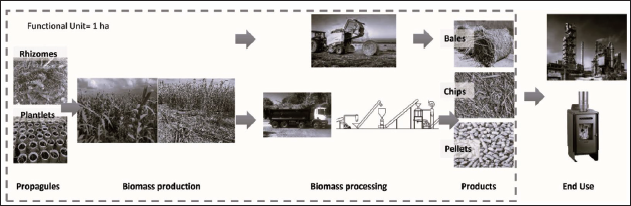
To measure the energy balance of AD production, the process analysis method by Hülsbergen et al. (2001) was used. It was based on the physical materials fluxes for a functional unit of one hectare. The energy inputs were estimated according to the technology and materials used, the agronomic practices applied, and the unit operations required to produce bales, chips, and pellets from the biomass obtained from rhizomes and plantlets. The boundary of the study (Figure 1) included two propagules (rhizomes and plantlets), the biomass production (conventional agronomic practices existing in Argentina for commodities such as corn, wheat, sugar cane, etc.) and the conversion of biomass in bales, chips, and pellets. A distance of 25 km was assumed to transport the bulk canes to the processing plant for shredding (chips) or pelletizing, while fossil fuel consumption was not considered in transporting bales, since they were ready from the farm to the final user.
Boundary of the Study.
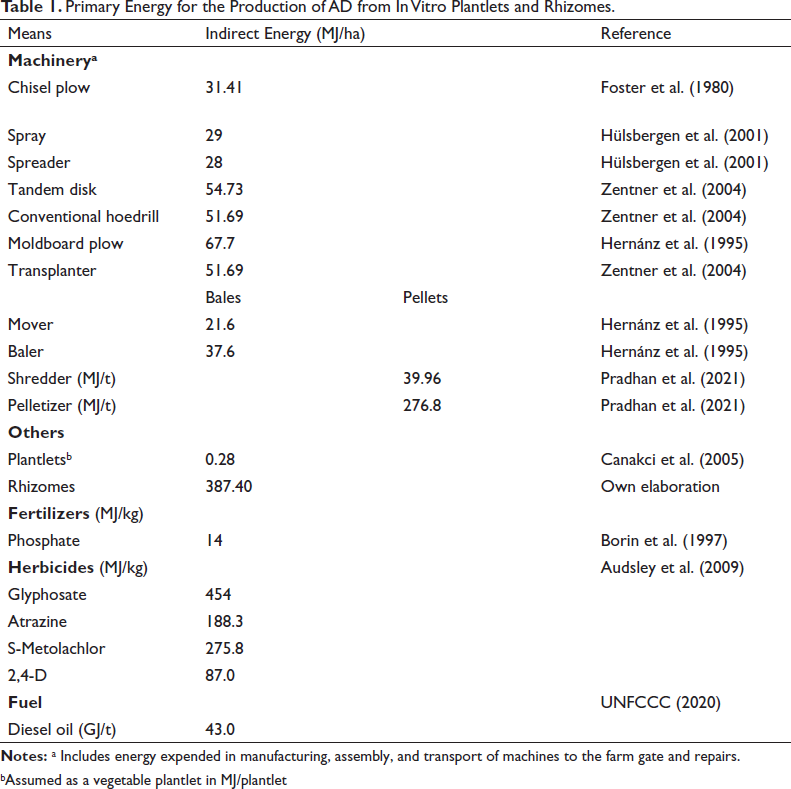
The energy costs were estimated for machinery fabrication and repairs, herbicides, fertilizers, and fuel and electricity consumption for each operation along the production cycle, from the implantation stage and during 10 years of crop production. The machinery employed was typically used for conventional tillage and baling in Argentina. Energy inputs for mechanization included direct costs of fuel and lubricant consumption of the tractors and other machinery, and the indirect energy included materials, assembly, fabrication, maintenance, and repair (Pimentel, 1992). The energy from the propagation materials (processing, transport, and planting), fertilizer, herbicides, and associated machines was also considered as indirect input. The coefficients summarized in Table 1 were used to convert the physical quantities of the inputs into energy values.
Primary Energy for the Production of AD from In Vitro Plantlets and Rhizomes.
Regarding human labor, there were different perspectives for its inclusion in the energy balance. Borin et al. (1997) assume a value of human energy of 2 MJ/h based on data from Pimentel (1980). However, Zentner et al. (1998, 2004) did not include energy from human labor since it accounted for less than 0.2% of the total energy input for most cropping systems. Dazhong and Pimentel (1984) only considered human labor when assessing the corn energy inputs in China, based on the labor-intensive workforce requirements. Hülsbergen et al. (2001) indicated that energy equivalents associated with labor vary considerably and should be adapted to the current living conditions in the target region. In the present study, the value suggested by Borin et al. (1997) was applied based on Pimentel and Pimentel (2007) of 1.95 MJ/h and an average of 10 h/ha suggested for corn by Pimentel (1992).
For rhizomes, the energy cost was obtained from the author’s calculations based on the required machinery and labor, resulting in a value of 387.4 MJ/ha, while for plantlets, the value of 0.28 MJ/plantlet proposed by Canakci et al. (2005) as vegetable plantlets were used for 10,000 plantlets per hectare.
Outputs of AD production were calculated as the gross energy content of the harvested crop assessed by multiplying the dry matter yield and the lower heating value (LHV, MJ/kg) obtained from Eq. 1 (National Council for Air and Stream Improvement Inc. (NCASI), 2005):

where H is the fraction of hydrogen in biomass,𝞴 is the vaporization heat of water, and HHV is the higher heating value (MJ/kg) obtained from Eq. 2 as proposed by Demirbaş and Demirbaş (2004).

where C and H represent the carbon and hydrogen percentages. The elemental composition of AD was carried out in a Leco® CHN628 equipment, with sulfur, microoxygen, and elemental modules.
The energy balance was calculated as the difference between the energy yield (from LHV) and the energy consumption (from the methodological approach and the dataset for energy and fuels), while the energy production efficiency was obtained from the output/input ratio of net energy yield and the consumed energy.
GHG Emissions
The GHG emissions for the production of bales, chips, and pellets from AD were calculated from the application of herbicides, diesel oil used for the tillage operations and transport, and the electricity required for biomass conversion in the mentioned shapes. The emission factors used for diesel oil were 74.1 t CO2/TJ, 4 kg CH4/TJ, and 0.6 kg N2O/TJ (UNFCCC, 2020) corresponding to carbon dioxide, methane, and nitrous emissions, respectively. The applied emission factor of the national electricity grid of Argentina was 0.386 t CO2e/MWh, as the latest official published value (Ministerio de Economía, 2019). The value of 0.069 kg CO2e per MJ of herbicide applied, as reported by Audsley et al. (2009) was used to estimate the GHG emissions from the use of pesticides during the first two years of the implantation of the crop, while for the application of DAP phosphate, the value of 1.117 kg CO2/kg nutrient was used as proposed by Bullard (2001). Regarding nitrous oxide emissions, despite Audsley et al. (2009) pointing out that about 50% of the global warming potential from arable crops is due to the field emissions, in the present study, they were considered negligible based on the fact that nitrogen fertilizer (such as urea or ammonium nitrate) was not applied, the DAP dose was very low, and arable work was not implemented after the first year.
Results
Biomass Yield
The biomass yield of AD increased from the implantation to the fifth year, as shown in Table 2 for the two sites and treatments applied. The yield for the AZ experiment for the fifth year was obtained as previously described based on the RGR. Despite the higher productivity soil such as those of AZ, which produced 42.2% higher biomass yield (average of all years), the analysis of the entire result showed that the above-ground biomass yield was not influenced by fertilization (DAP) at the doses applied, at 0.05 significance level. Previous studies that revealed nitrogen (N) accumulation in AD associated with beneficial microorganisms with N-fixing and phosphate solubilizing abilities (Ping et al., 2014) could explain the lack of response observed in AD to fertilization. No significant influence of the type of propagule used on AD yield was noted either.
Biomass Yield of AD According to Treatments and Sites.
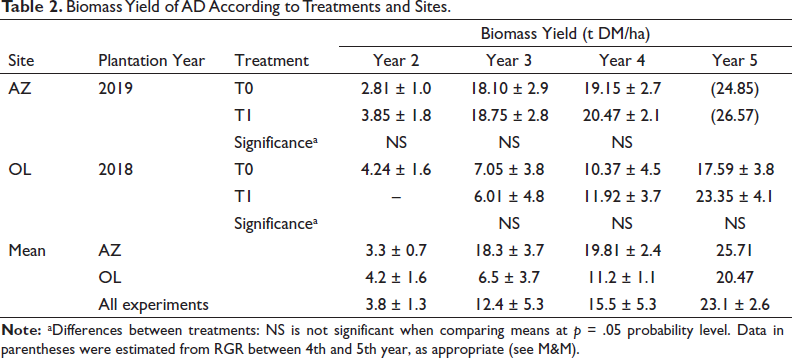
Thus, for this work, the average of all experiments and sites was considered for the energy output calculation, taking into account the increase in yield from 3.8 to 23.1 t/ha from the year of implantation to the fifth year of cultivation and assuming a constant yield of 23.1 t/ha for the four remaining years (6th–10th) according to a 10-year lifecycle assumed for the assessment of the energy costs.
The AD yield obtained in this study was lower than the experiments carried out in Italy under irrigation and fertilization conditions (Angelini et al., 2005, 2009; Corno et al., 2014; Mantineo et al., 2009; Scordia et al., 2014). Angelini et al. (2009) reported AD dry yields ranging from 39 to 49 t/ha (3rd to 8th year) with an average of 43.5 t/ha and a decreasing trend to a mean value of 25.5 t/ha at the final stage (9–12 years). The differences could be explained by the fact that the experiments were irrigated, fertilized in high doses, and implanted in a warmer Mediterranean climate. The results obtained here were comparable to those reported by Antal (2018) for crops growing in Hungary, under continental climate and annual precipitations of 650–800 mm, without irrigation or fertilization, who reported an average yield of 20 t/ha.
Energy Inputs
The energy balance assessment assumed a period of 10 years of production, with a mean yield from all experiments as described in Table 2 and a constant value of 23.1 t/ha from the 5th year onwards. The energy inputs for machinery, herbicides, fertilizers, transport, and postharvest operation consumptions for producing bales, chips, and pellets from AD biomass are detailed in Table 3. The operations and equipment used during the stage of crop implantation included sprayers for herbicides, spreaders for fertilizer, chisel and moldboard plows for the extraction and plantation of rhizomes, and transplanting of plantlets. The energy costs of rhizomes obtained from our calculations (387.4 MJ/ha) were higher than those reported by Mantineo et al. (2009) of 69.0 MJ/ha. However, other authors believe that this input was insignificant (Angelini et al., 2005, 2009). From the first harvest to the end of the project, the machinery used was for cutting, baling, chipping, and pelletizing the canes.
Direct Energy Inputs for AD Produced in Argentina (Pampean Region).
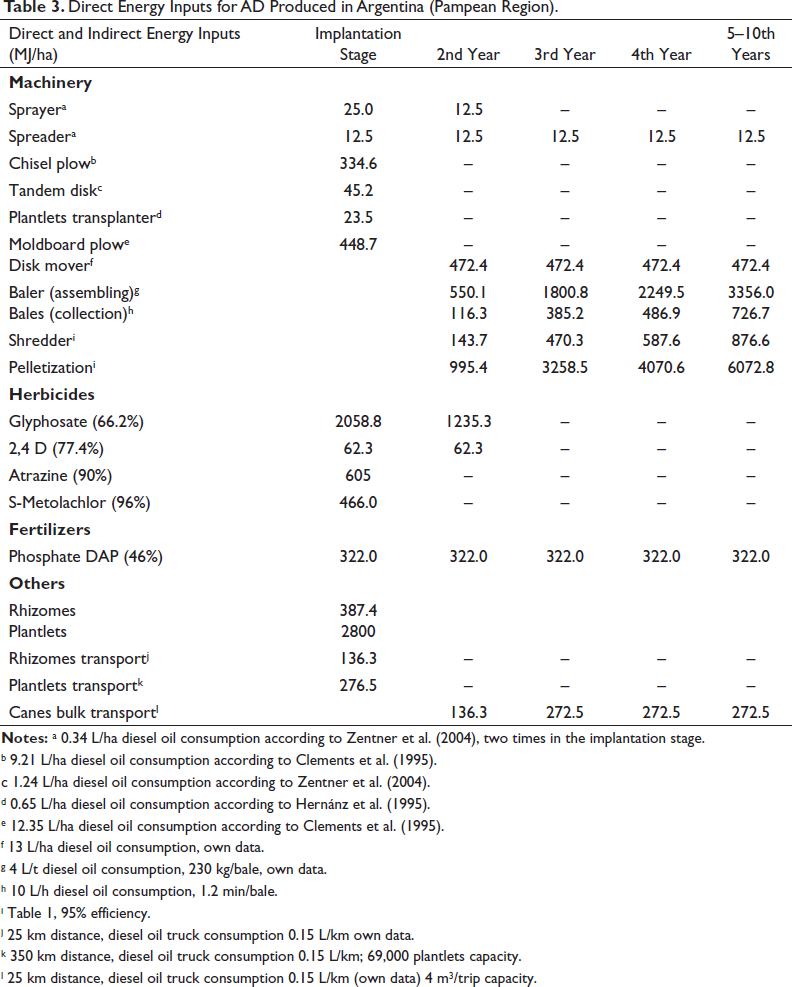
b 9.21 L/ha diesel oil consumption according to Clements et al. (1995).
c 1.24 L/ha diesel oil consumption according to Zentner et al. (2004).
d 0.65 L/ha diesel oil consumption according to Hernánz et al. (1995).
e 12.35 L/ha diesel oil consumption according to Clements et al. (1995).
f 13 L/ha diesel oil consumption, own data.
g 4 L/t diesel oil consumption, 230 kg/bale, own data.
h 10 L/h diesel oil consumption, 1.2 min/bale.
i Table 1, 95% efficiency.
j 25 km distance, diesel oil truck consumption 0.15 L/km own data.
k 350 km distance, diesel oil truck consumption 0.15 L/km; 69,000 plantlets capacity.
l 25 km distance, diesel oil truck consumption 0.15 L/km (own data) 4 m3/trip capacity.
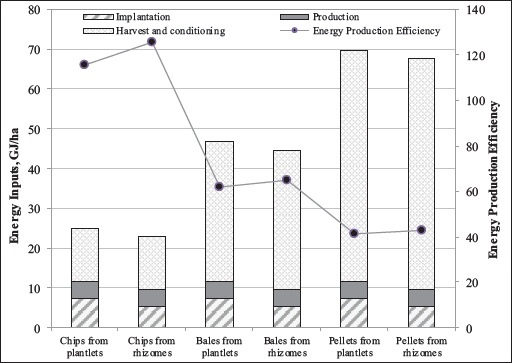
The total energy input for the AD implantation year resulted in 5.2 and 7.2 GJ/ha from rhizomes and plantlets, respectively (Figure 2). The productive period (between two successive harvests), which includes the application of herbicides (only half of the first application in the second year) and minimal fertilization, achieved 4.2 GJ/ha, while the energy costs of the harvest and conditioning varied according to the energy vector to be produced, being 13.6, 35.2, and 58.3 GJ/ha for chips, bales and pellets, respectively. The low energy input required for chips can be explained by the fact that, once canes were harvested, they remained at field conditions until the moisture content decreased enough to be collected for simple crushing. This technique is based on a previous study about the drying kinetics of AD canes carried out at field conditions in the region of the study (Córdoba et al., 2022). The energy inputs for AD bales are mainly explained by the use of fuel and minimal materials for biomass baling. Bales are widely used in Argentina to preserve animal feed during winter time, while chips or pellets, usually of straw, wood, or forest residues, are used as fuel for kilns, furnaces, or household heaters. The energy inputs for the project’s lifecycle varied between 23 (rhizomes) and 25 (plantlets) GJ/ha for chips, between 44.7 and 46.7 GJ/ha for bales, and between 67.8 and 69.8 GJ/ha for pellets. As with perennial grasses (Angelini et al., 2009), higher energy inputs were also observed in this study during the establishment year, as demonstrated in Figure 2. The energy inputs decreased from the implantation stage to the crop establishment (5th year) from 62% (rhizomes) and 72% (plantlets) for chips production, and from 4% to 31% for bales. However, it increased from 11% and 55% for pellets due to the high electricity consumption of machinery required for the trituration and compaction of biomass. Regarding the type of propagules used for the production of AD biomass, 39.1% higher energy input was required for the implantation of AD from plantlets than rhizomes without significant effect on yield (p = .05). Angelini et al. (2005) reported energy inputs for the crop establishment of 7.7 and 21.7 GJ/ha for unfertilized and fertilized, respectively, with 20,000 pl/ha density, while Angelini et al. (2009) showed an average of 12.5 GJ/ha for 12-year crop growth. Mantineo et al. (2009) obtained a value of 34 GJ/ha (21–40 GJ/ha), although the authors highlighted that the energy costs decreased to 2.8 GJ/ha when inputs used were decreased. Hülsbergen et al. (2001) report on the total energy input under various fertilizer treatments for cereals, sugar beets, and potatoes, highlighting that the input energy increased due to nitrogen application. However, they indicated that the energy inputs could be minimized by growing crops capable of biological N fixation as companion crops or intercrops combined with lingo-cellulosic crops.
Total Energy Inputs for the Production of AD-Based Products for a 10-year Lifecycle.
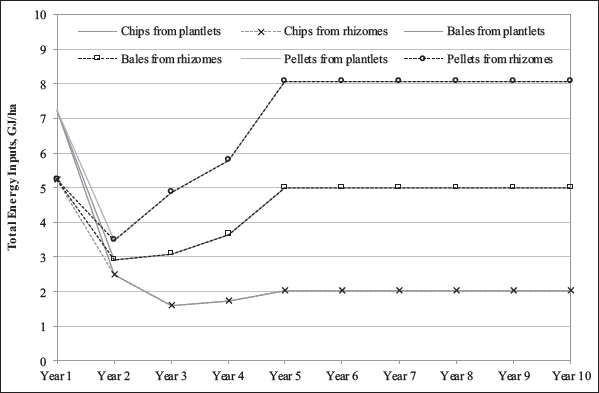
The energy inputs involved in the use of herbicides for AD production resulted in 3.2 GJ/ha being the higher contribution to the total energy inputs during the implantation stage, representing 44.1% and 61.3% for plantlets and rhizomes, respectively, followed by fuel consumption (9.9%–19.7%), fertilizers (4.4%–6.2%), and tillage operations (2.9%–5.0%). In the second year also the energy inputs prevailed due to the application of herbicides (37%–52%) in comparison to fertilizers and machinery; the energy costs from the use of fuels (for transport and electricity) increased from 31%–51% to 82%–96%, representing the highest source of energy costs once the crop was set. The high values of energy inputs from herbicides during the implantation stage were close to the data reported by Audsley et al. (2009) for sugar beet, while for perennial ryegrass seed crops, Chastain and Garbacik (2011) reported an energy input of 21 GJ/ha with a 9.3% allocated to pesticides and 68.1% to fertilizers applications.
The unit for estimating the energy costs, that is MJ per hectare, allows the results of different scenarios to be compared, just as when analyzing the AD yield obtained in the present study, which was lower compared to those obtained in Italy (Angelini et al., 2009; Faix et al., 1989; Manzanares, 1997). The energy inputs obtained for AD cultivated in Argentina were significantly lower than those reported in the literature by Angelini et al., (2009), which refers only to the crop production without further processing. The low use of fertilizers and the absence of irrigation in our experiments could explain the observed differences. The progressive increase in energy inputs after the implantation stage until the fifth year, assumed as the stage of crop establishment, was explained by the rise of the yields that require more labor and resource consumption. After the implantation period, no significant differences were found in the total energy inputs when products were obtained from rhizomes or plantlets, as can be observed in Figures 2 and 3. The contribution to the energy inputs of each stage of crop development and products are shown in Figure 3. Chips production required the lowest energy since the fuel and electricity required for transport and chipping were lower than the fuel consumption for baling and the electricity required for pelletizing. In all cases, the higher contributions to the energy inputs after the implantation stage were due to postharvest operations, pelletizing being the more intensive energy process. Further analysis regarding the market price of each product and the relationship with logistic costs could be worked out to determine the optimal type of AD-based product. The values of the energy production efficiency shown in Figure 3 indicate that pellets require almost three times more energy than chips. The differences in the net energy yield when the biomass was obtained from rhizomes or plantlets were negligible, being 0.16% for all products.
Energy Inputs and Energy Production Efficiency for AD-Based-Product Stages for a 10-year Lifecycle Process.
Energy Outputs
The elemental composition of AD obtained from four samples of each essay and treatment revealed a carbon content variable between 45.54% and 46.13% and hydrogen between 5.85% and 6.02% (dry weight) without significant difference between environments (p < .05) as detailed in Table 4. The HHV obtained from Equation 2 was 18.27 MJ/kg (±0.18), and the LHV calculated from Equation 1 was 17.03 MJ/kg (±0.19). The value of HHV obtained by direct measurement through the calorimetric method was 18.75 MJ/kg. The values of HHV and LHV obtained were similar to those reported in the literature, as 17.5 (Krička et al., 2017), 17.6 MJ/kg (Angelini et al., 2009), 16.4 MJ/kg (Mantineo et al., 2009), and the ranges between 17.3 and 18.8 MJ/kg (Lewandowski et al., 2003).
Elemental Composition of AD (%).

Different letters for the same parameter indicate significant differences at 95% confidence (p value < .05).
Since nitrogen and sulfur contents in biomass are inauspicious components as they increase GHG emissions, lower values of these elements may be expected when the conversion of biomass into energy is evaluated. The Handbook of Biomass Combustion and Co-firing (Koppejan & Van Loo, 2002) recommended N content lower than 0.6% to limit NOx emissions. Krička et al. (2017), studied the properties of three agricultural energy crops and reported higher sulphur (0.29%) and similar nitrogen (0.74%) contents than those obtained for the AD cultured in Southern Pampas (Table 4). Based on the fact that genetics and environmental conditions influence the elemental composition of the biomass, Szyszlak-Bargłowicz (2014) reported percentages of nitrogen variable between 0.1% for coniferous wood, 0.5% for willow, 0.7% for Miscanthus and 1.4% for grass in general, while Bullard (2001) described ranges between 0.4%–0.7% for nitrogen and 0.1%–0.4% for sulfur, for the elemental composition of Miscanthus, Switchgrass, and Reed Canary The elemental composition obtained from AD revealed energy properties that make feasible the potential use of this biomass for thermal energy purposes in replacement or supplementing other woody biomasses such as pine, spruce, or poplar pellets. A previous study on the behavior of AD bundles of low density during a partially controlled combustion in a domestic stove (Córdoba et al., 2023) revealed an adequate performance of the thermal process despite a gas profile with higher NOx and CO emissions than those reported for wood pellets and poplar chips burnt in a boiler of a district heating system (Lyubov et al., 2020).
The outputs of the year of implantation were −0.39 (rhizomes) and 2.8 (plantlets) GJ/ha growing rapidly to 64.5 (2nd year), 211.0 (3rd year), 263.6 (4th year), and 393.3 GJ/ha (5–10th year) without any differentiation between the type of propagules used once the crop was established. The differences observed in the year of implantation were explained by the higher energy demanded by the development of plantlets compared to the rhizomes. The total outputs for the 10-year lifecycle resulted in 2.9 TJ/ha. The energy output obtained for AD was similar to the gross and net outputs reported by Holmatov et al. (2019) for sugarcane used for heat in cogeneration or combined heat and power (CHP) of 382.7 and 366.8 GJ/ha, respectively.
Energy Balance
The net energy yield, estimated as the difference between output and input energy per hectare, on average, was 2851.3 (±20.2) GJ/ha for all products. The average for the total lifecycle was 2873.4, 2851.8, and 2828.7 GJ/ha for chips, bales, and pellets, respectively. In the year of implantation, the difference between the energy outputs and inputs varied between −5.6 (rhizomes) to −10.0 (plantlets) GJ/ha. Still at the low yields obtained in the first years, the balance fast grew up to 62.0 (2nd), 209.5 (3rd), 261.9 (4th), and 391.3 (5th and following years) GJ/ha for chips, 61.6, 208.0, 260.0, and 388.3 GJ/ha for bales and 61.0, 206.2, 257.9, and 385.2 GJ/ha for pellets, without significant differences between the type of propagules used. Angelini et al. (2009) reported a value of 637 GJ/ha for the energy balance in the year of implantation, while Mantineo et al. (2009) obtained an average of 419.1 GJ/ha; both studies were carried out in Italy under N fertilization and irrigation with yields higher than 20 t/ha.
The output/input ratio, also called energy production efficiency, was 116 (plantlets) and 126 (rhizomes) for chips, 62 and 65 for bales and 41 and 43 for pellets, as shown in Figure 3. Angelini et al. (2009), found that crop yields up to 49 t/ha gave a mean output/input ratio of 53 (±20), while Mantineo et al. (2009) reported averages between 141.0 and 154.1 under conditions of fertilization and two levels of irrigation. These values reflect the gross energy and, therefore, are comparable but do not include a route of energy conversion. Manzanares (1997) reported the energy balance of different energy crops showing energy yields (in terms of output/input ratios) variable between 4.6 for rapeseed and 35.5 for thistle. The ratios for maize, conventional winter cereals and soybean reported by Borin et al. (1997) under different tillage systems varied between 2.44 and 9.41. Holmatov et al. (2019) stated that the EROI factor, as the ratio between the energy output per unit of energy input, applies when energy inputs are similar. However, comparisons could lead to misinterpretation when different fuels or production routes are involved. Hamedani et al. (2019) reported ERR values of 1.7, 5.22, and 3.25 for vine pruning, olive pruning, and poplar wood pellets, respectively. Prananta and Kubiszewski (2021) reported a list of EROIs for a broad type of biofuels, giving values of 0.64 and 0.69 for biofuel energy from wood cellulose and switchgrass, respectively; these values come from the works of Pimentel and Patzek (2005) which describes the conversion of both raw materials into ethanol. The ERR values obtained for the production of bales, chips, and pellets from AD reflect the gross energy contained in the biomass and are comparable with the results reported by Angelini et al. (2009) and Mantineo et al. (2009) for the same biomass. Further considerations on specific equipment and efficiency in the energy conversion should be carried out to compare the net energy produced to avoid misunderstanding when comparing EROIs since it is subject to several factors such as the technologies applied, the availability of resources, the type of bioenergy produced and the associated processes, among others.
From the economic point of view, the preliminary costs of implantation and the production of bales from AD in the study region differed depending on the propagule used. Menici et al. (2022) reported values of 750.8 and 2841.7 dollars/ha for the implantation of AD from rhizomes and in vitro plantlets, respectively, while the production of bales resulted in 849.4 (rhizomes) and 953.9 (in vitro plantlets) dollars/ha. From the second year onwards, the harvest represents 70% of the agricultural costs and transportation to the final destination (40 km). Based on the yield of AD obtained in the Southern Pampas region, the production costs varied between 41.44 and 47.65 dollars/t. Bonfante et al. (2017) reported crop planting costs of 3300 €/ha in Italy, while Jámbor and Török (2019) reported costs of harvesting, handling, in-field storage, and delivery (less than 20 km) to the conversion plant of 46 €/t for round bales giant reed in South of Europe.
GHG Emissions Assessment
The environmental analysis was carried out from the perspective of the potential GHG emissions generated due to the growth and processing of AD as a tool to further environmental balances when biomass will be used as a substitute for fossil fuels. Previous studies, such as Bullard (2001) demonstrated the CO2 reduction benefit obtained from cultivating Miscanthus, Reed Canary, and Switchgrass instead of herbaceous crops. This was based on the increase of the root/rhizome mass, giving CO2 abatements between 182 and 211 t CO2/ha (for an average of 7 years). Other positive impacts of AD cultivation are the minimal sulfur content in the biomass compared to fossil fuels and the minimal erosion regarding arable crops due to the fast ground coverage rate after the implantation of the crop (Bullard, 2001). Moreover, this study focused on the production of this crop on the premise that it does not jeopardize the water resources (experiments were conducted under rainfed conditions) or the use of land for food production since AD could give satisfactory yields in less demanding environmental conditions, as was demonstrated.
According to Börjesson (1999), the nitrous emissions (N2O) due to loss of N varies from almost zero to 2% depending on soil, fertilizers, and land management. As urea was not applied and DAP dose was low (9 kg N/ha and 10.1 kg P/ha), the amount of N2O emitted was assumed negligible in the present study. The calculation of GHG emissions generated during the production of bales, chips, and pellets and the associated transport was carried out based on the described emission factors (Table 1). Figure 4 summarizes the total equivalent CO2 emissions generated from the production and AD processing to obtain products.
GHG Emissions Generated During AD Production for a 10-year Lifecycle.
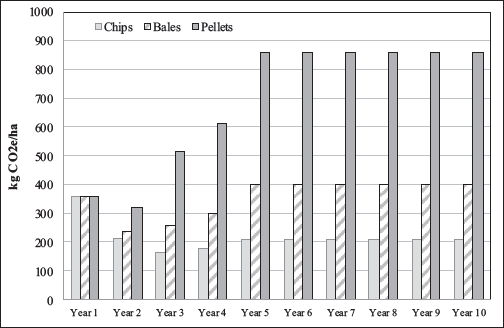
The impact of the implantation of the crop resulted in 343.9 and 371.9 kg CO2e/ha for plantlets and rhizomes, respectively (average 357.9 ± 19.8). The use of herbicides and fertilizers was responsible for 74%–80% of these emissions. GHG emissions from the production of chips decreased by 41.8% from implantation to the established production (year 5) due to the absence of herbicides after the second year and the minimal energy demand for processing the biomass. The slight increase of 11% observed for bales between year 1 and year 5 was caused by using fossil fuel for baling. The highest increase of 140.2% obtained for pellets was explained by the electricity and fuel consumption for transport and processing the biomass, which overcame the emissions of the first years due to the use of herbicides and fertilizer. The impact of the pelletizing process on GHG emissions was significantly higher than the use of fossil fuel required to produce bales during the post-harvest stage.
The analysis of the response of AD yield to fertilization at the level applied did not reveal a significant effect. Therefore, using DAP only during the first two years of the crop could be considered. This practice is justified by the fact that more mature crops can regulate and mobilize nutrients upward (from below ground to above ground) during the growth season and downward (from aboveground to belowground) after the onset of senescence before harvest (Christou et al., 2018). In this case, the net energy yield will only decrease by 0.11%, but GHG emissions could be reduced by 7%, 15%, and 28% for pellets, bales, and chips, respectively.
Assuming the energy content of petroleum (41.8 GJ/t) and carbon (30.1 GJ/t) and the mean value of AD energy yield from a 10 year lifecycle (290 GJ/ha), the use of AD could replace 6.9 and 9.6 t/ha of these fossil fuels, respectively. These values are approximately half of those reported by Angelini et al. (2009) for AD cultivated in Italy with yields between 25 and 49 t/ha. Regarding GHG emissions, producing one hectare of AD gives 208.3, 397.6, and 859.6 kg CO2e for chips, bales, and pellets, respectively. The carbon intensity of each product, calculated as the ratio between the GHG emissions and the mean (10-year lifecycle) energy output, resulted in 0.72, 1.37, and 2.97 kg CO2/GJ (t CO2/TJ) for chips, bales, and pellets, respectively. These values represent the emission factors of each of the three energy vectors obtained from AD based on current technologies available in Argentina. According to the definition of the renewable fuel standard RFS2, the current set of regulations enacted in 2007 in the U.S. considers AD as a cellulosic biofuel based on the life cycle GHG emissions being at least 60% less than the petroleum full baseline (Unnasch & Buchan, 2021). The huge difference in the carbon intensities found between AD energy vectors and fossil fuels (as an example, the emission factor of diesel oil, the most used fuel in agricultural activities, is 74.1 t CO2/TJ) warrant further research that contributes to strengthening the development of this perennial biomass to add new sustainable biofuels to replace fossil fuels in thermal energy uses.
Discussion
This study complements the previous one that demonstrated the technical viability of AD for thermal use, based on the higher thermal efficiency under combustion, the low ash content, and adequate LHV besides the combustion gas profile in terms of CO and NOx emissions (Córdoba et al., 2023). The same study demonstrated good thermal efficiency based on the processing time to reach the boiler temperature with lower biofuel consumption, as Solarte-Toro et al. (2021) called the highest challenge of domestic combustion systems. However, more research should be developed regarding assessing the operational efficiency of AD in specific devices such as boilers, kilns, or heaters in terms of the effectiveness in its energy use, taking into account the influence of the equipment design on the burning efficiency of woody pellets or chips (Lyubov et al., 2020). Based on the results obtained, AD could also be considered alternative biomass for thermal use to replace or compensate for wood biomass restoration periods or to provide alternative bioenergy in dispersed populations with poor access to energy sources, as in rural Argentina.
This study proposed AD bales production as a low-cost and widely used technology in the agricultural sector given the availability of facilities adapted for feeding this biofuel. A recent study (Córdoba et al., 2021) demonstrated the good performance of AD bales in a cement industry that combined this biofuel with RDF (residue-derive fuel). Considering that this option could be limited, the pelletizing of AD canes has the advantage of raising the heating value due to increased bulk density and volatile matter (Solarte-Toro et al., 2021). Further research regarding improving the quality of pellets in terms of ash content and optimizing the milling and densification processes incorporating biomass energy sources could contribute to improving the carbon footprint of AD-based products.
On the other hand, the proposal to produce AD chips was based on the fact that the process is more straightforward than pelletizing. However, some disadvantages should be evaluated regarding storage, transportation, and feeding systems in thermochemical processing to produce heat in domestic and industrial sectors.
This preliminary knowledge of AD as a biofuel could contribute to advancement in the development of derived products from thermochemical and catalytic upgrading technologies for cost-effective and efficient ways to harness energy conversion, as was suggested for woody biomasses in several works (Ambaye et al., 2021; Holmatov et al., 2019; Solarte-Toro et al., 2021). Moreover, AD could also be considered as a source of carbon for biochemical conversion which was demonstrated in a recent study on the AD silage for biogas production (Córdoba et al., 2023).
Conclusions
The results of the cultivation of AD under rainfed and minimal fertilization conditions, demonstrated that the energy outputs increased six times in the fifth year from the implantation, giving an energy input of 290 GJ/ha (average 10 years). The absence of annual applications of herbicides significantly decreased the energy inputs and GHG emissions. Implementing tillage practices adapted to AD will increase crop energy efficiency.
Despite the relatively lower yield obtained in this preliminary study carried out in the Southern Pampas region of Argentina, compared with results obtained in Italy, the energy indicators showed an adequate performance, exhibiting this herbaceous plant as a promissory energy crop in a sustainable scenario for fossil fuel replacement for thermal energy production at small and medium scale for residential and industrial heating purposes.
Transitioning from fossil fuels to renewable energy demands a deep understanding of how bioenergy affects land and water resources. The development of AD value chains can potentially alleviate the strain on land and water compared to other feedstocks like soybean, corn, or rapeseed. It can also sidestep challenges associated with cultivation and harvesting, as seen in algae production (Ambaye et al., 2021). It is also crucial to carefully select lands that will not compete with agriculture for food production. Simultaneously, optimizing the logistics of biomass sourcing, plant processing, and market distribution can minimize travel distances and reduce the overall impact of fossil fuel consumption on the life cycle of AD value chain. As Holmatov et al. (2019) highlighted, large-scale first-generation bioenergy production should be avoided when water and land requirements are too extensive. The AD value chain has several advantages since the crop can grow in marginal areas with minimal water and soil requirements preventing soil erosion and increasing the carbon stock through their rhizomal nature. The results obtained here suggest that the development of a value chain AD based on conventional and available technologies to produce and convert AD biomass in thermal vectors to replace or complement wood biomass or RDF used in the residential or industrial heating process of small- or medium-scale, appears more reasonable rather than for large scale use in electricity production. As highlighted by Ambaye et al. (2021) in their discussion of the social and economic significance of biofuel development, the advancement of AD value chain holds the potential to expand the bioenergy matrix. This expansion can specifically cater to small or medium scale industrial needs, offering a viable substitute for traditional fossil fuels.
Availability of Data and Materials
The datasets generated during and/or analyzed during the current study are available from the corresponding author upon reasonable request.
Footnotes
Acknowledgments
We would like to extend our gratitude to Cementos Avellaneda S. A. for providing the field for the experimental trials at Olavarría.
Declaration of Conflicting Interests
The authors declared no known competing financial interests or personal relationships that could have influenced the work reported in this article.
Funding
This work was supported by the Universidad Nacional del Centro de la Provincia de Buenos Aires (UNCPBA), Secretary of Science, Arts and Technology (SECAT) through the framework Strengthening Science and Technology in National Universities (2019/2020 Announcement), project 03-PEIDyT-02E Arundo donax L. as a source of bioenergy for the substitution of fossil fuels.
