




Abstract
The category of the region, in its use as an adjective to cinema, presumes a convergence of language, culture, and geography as its ground. This article attempts to understand the dynamics of unification and difference, aggregation and disaggregation that is central to the production of the linguistic region. Focusing on cinematic practices of the early 1950s in Malayalam, it examines the conditions under which a Thiruvithamkoor (Travancore)-based film industry transforms into an industry for “unified Kerala.” Sidestepping the teleological narrative of unification, the article attends to this period as one characterized by many possible futures. The article is organized around two sets of texts. The first set comprises Chalachitra Kala (The Art of Moving Pictures) by Nagavally R.S. Kurup and Cinima (Cinema) by Moorkoth Kunhappa. Published in 1951, these were the first books on cinema to be written in the Malayalam language. I read these books to understand the differential relationship to cinema that seemed to exist within the Malayalam-speaking territories—a difference founded on the ways in which the industry was organized, publics constituted, and markets formed. The second set comprises three films—Jeevitha Nauka (1951), Neelakkuyil (1954), and Thiramala (1953). These films demonstrate how the discourse of stardom during this crucial period, between the end of the colonial regime and linguistic reorganization of states in independent India, engendered industrial and narrative assemblages that (re)constituted the imaginaries of the region.
This article focuses on a short period from the formative years of one of the most active film industries in the south of India—Malayalam cinema—produced in a geographic/cultural/linguistic/administrative region called Kerala. By describing this cinema in this slightly awkward manner, I intend to place emphasis on the attempt at disaggregation of the “region” in “regional cinema” that this article embarks upon. The premise of such a disaggregation is historical, while its implications might not be. Balan (S. Nottani), made in 1938 in Salem (present-day Tamil Nadu), was the first film to speak Malayalam language; the establishment in 1926 of “The Travancore National Pictures” and the production, in 1928, of Vigathakumaran (The Lost Child; silent) by J.C. Daniel marked the beginning of a film industry in the geographical region that we presently call Kerala; and “Kerala” as a geographical and administrative unit was formed in 1956. While these historical facts are commonplace and well known, the article investigates its implications for the apprehension of an object called “Malayalam cinema.” The still-continuing debate around the “first” Malayalam film—was it the first film which had spoken Malayalam language, or was it the one that was first made in the region presently known as Kerala—is the only instance of the public recognition/acknowledgment of the issues involved, if in the form of originary narratives. 1 Sidestepping the trappings of such endeavors, the article describes the mechanics by which an industry that had its beginnings in a princely state attempted a transformation into one that represented a new regional configuration called Kerala through the dynamics of aggregation and disaggregation, its pulls and pressures.
While the reigning complaint of the film historian has been the paucity of material, 2 the speculative nature of some of the arguments I propose here are occasioned by the difficulties presented by existing frameworks around the category “region” and the research that proceeds from it. The history of Malayalam cinema has been narrated with the assumption of an overlap between language, culture, and geography, and the consequent emergence of the administrative unit. In other words, all histories have attempted to tell the “truth” of this emergence. This truth is produced through the discourse of unified Kerala, which includes contemporary scholarly engagements with the region. 3 The assumption of the overlap prevents the historian from taking the implications of a disaggregated conception of the region seriously—be it Kerala or other linguistic and/or administrative regions formed in the period following national independence. In this scholarship, “region” appears either as a formation that is well within the structuring of the nation-state or as one that, while emerging from the same impulse, challenges it. It is not a coincidence that “regional cinema” as a category gets consolidated in the discussions of non-Hindi cinema only around the integration of local aesthetics into the project of the nation, in the context of the “New Indian Cinema” of the 1970s. To understand the specific ways in which cinematic practices emerged in different parts of the country, especially outside the centers of colonial government, we will have to suspend the category “region” temporarily, resurrecting it only when it emerges out of specific instances under consideration. How do we begin by disaggregating “Kerala” and the structures of thought that inhibit such a disaggregation before we embark on such an investigation?
In the existing scholarship on Kerala, it is routinely mentioned that Kerala was formed by the unification of two princely states, Thiruvithamkoor and Kochi, and Malabar, which was part of the Madras Presidency. One of the many glaring problems with this description is that it telescopes a period of almost a decade, from 1946–1947 to 1956, in a teleological imagination where the unification of region is predestined. This was the time when the two princely states, Thiruvithamkoor and Kochi, had been unified to form “The United State of Travancore and Cochin” (renamed later as “State of Travancore–Cochin,” popularly known as “Thiru-Kochi” state) 4 after much reluctance from Thiruvithamkoor, and when Malabar was a district of the newly formed Madras state. The demand for unification of Kerala—most visible in the “Aikya Keralam” (united Kerala) movement—dates back to a few decades before its materialization in 1956, and the period after independence saw an acceleration of the discourse. However, there is little evidence to conclude that the social history of the region and the tenors of the social lives of its subjects could be explained or understood within this singular teleological imagination.
In an influential paper on the dynamics of the Aikya Keralam movement, J. Devika, examining debates in the public sphere, works with the premise that “[social development] has been powerfully projected in public discourse and internalized by late twentieth century Malayalees, and still serves to define the very sense of being Malayalee” (Devika, 2007a, p. 5; emphasis added). One will have to devise methodologies that will provide us with evidence to suggest that such a “sense of being Malayalee” is discernible. She notes “the non-availability of a harmonious and united ‘Malayalee People’” that could be mobilized for the cause of aikya Keralam, for reasons that included the fact that “Malabar in the north and the southern States differed in many important aspects of culture, social institutions, and economic and social infrastructure” (ibid., p. 15). 5 While focusing on the centrality of “development” as the glue that, in the final instance, binds the people of the region as “Malayalis,” Devika imagines the role of language to be instrumental, marking a distinction from the neighboring states like Tamil Nadu (ibid, p. 17). It might be the case, as I suspect it is, that “development” was fetishized as that symbolic register that could unite the region in the discourse of unified Kerala, including of the Left. However, this leaves us with no indication of how lives were lived and transformed within this regimen, or whether the discourse of “development” had the power that Devika attributes to it, even after conceding the hegemony of the Left. Devika’s useful and thick historical investigation provides evidence for a shift in rhetoric of the time, about how one could imagine oneself as a “Malayali.” 6 Echoing a similar framework, I have discussed elsewhere the rhetoric of development and progress within the Left imaginary as the normative domain within which Malayalam cinema emerged (Radhakrishnan, 2010). Ultimately, the argument for a radically reformed subject, the “Malayali,” with a new sense of self, is one which presumes the always already modernity of the region that we have come to know as Kerala, where associational and communal tendencies are not the cornerstone of this transformation, as would seem to be the case with its neighbors.
The premise of this article is that there is no evidence to suggest an overhaul of subjectivity undergirding the formation of the linguistic state and that any attempt to research the period prior to unification (and even after) needs to take this lack of evidence seriously. The article also presumes that there could not have been a magical transformation in the mid-1950s, where the “Malayali”—a hegemonic category which imagines the linguistic, the cultural, and the geographic to coincide—emerged fully stitched in. 7 This latter presumption requires us to map the contours of the limits and possibilities that political transformation offers to its subjects. Making this a starting point is not to argue for the falsehood of Kerala in any sense. On the contrary, it investigates the conditions under which this “truth” emerges.
The article is organized around two sets of texts. The first set comprises Chalachitra Kala (The Art of Moving Pictures) by Nagavally R.S. Kurup and Cinima (Cinema) by Moorkoth Kunhappa. Published in 1951 within a span of a few months, these were the first books on cinema to be written in the Malayalam language. I read these texts to understand how radically different imaginations of what constitutes cinema existed in Thiruvithamkoor and Malabar, especially regarding the role of the public vis-à-vis the industry. The different imaginations at play had an impact on the way cinema made in Malayalam imagined its public; a public potentially unified in language, but not yet constituted culturally or geographically. After marking these differences, I move on to discuss three films—Jeevitha Nauka (“The Boat of Life”; K. Vembu, 1951), touted as the first hit in Malayalam; Neelakkuyil (“The Blue Cuckoo”; P. Bhaskaran & Ramu Kariat, 1954), described as the film that inaugurated a distinctly “Malayali” cinema; and Thiramala (“Waves”; P.R.S. Pillai & Vimal Kumar, 1953). Attending to the discourses of stardom, I describe Malayalam cinema’s attempt to simultaneously engage with the pulls and pressures of unification and difference, aggregation and disaggregation. I read films not as ideological constructs, nor as metaphorical objects whose truth is revealed in the world of real politics. The books and the films formed practices within a nascent film industry, where they attempted complex assemblages in relation to industrial and cultural norms, in which “unified Kerala” was but a component. Films are products that engage with the drawing and redrawing of markets, the imagination of publics, and are in conversation with existing theatrical and cinematic traditions.
Two Books: Film Viewers and a Cinematic Public
Nagavally R.S. Kurup’s Chalachitra Kala was published by the National Book Stall (Kottayam) and Moorkoth Kunhappa’s Cinima was published by the Mangalodayam Press (Thrissur). 8 In 1951, Nagavally R.S. Kurup was already known in literary and cultural circles in Thiruvithamkoor as a writer and broadcaster. He had entered the world of cinema as a script-dialogue writer for Chandrika (V.S. Raghavan, 1950), and as an actor in Chandrika and Sasidharan (T. Janaki Raman, 1950), and joined the All India Radio in 1951. Moorkoth Kunhappa, hailing from Thalassery in Malabar, was a highly placed official in the railways who had served in various cities in India and, in 1966, became a full-time journalist with Malayala Manorama. In 1951, Kurup and Kunhappa were placed in radically different locations vis-à-vis the emergent cinema in Malayalam. The former was entrenched and writing from within the nascent industry and the latter was located outside, in the domain of the viewer/critic. The titles of the books are also telling. While Kurup titled his book “The Art of Moving Pictures,” pointing to the process of production, Kunhappa’s title, “Cinema,” refers to the product, or an institution, whose nature has to be grasped.
Kurup writes:
This is the first book on the art of moving pictures in Malayalam. If cinema-loving people of Kerala (keraleeyar) accept this book with love, it will have many successors. When common people [samanya janam] gain right knowledge about it, the art of moving pictures will make progress in our land. (Kurup, 1951, p. 5; emphasis added) The art of moving pictures will progress only if the common people distinguish between films and encourage films that are artistically and technically superior. The following chapters of the book attempt to provide knowledge towards this end. (ibid., p. 34)
Throughout the book, Kurup is unambiguous about the pedagogic value of his endeavor. By the end of the book, he elevates the status of the “common people” to that of a corrective to the industry.
While Kurup insists on the role of viewers as being significant, his figuration of the viewer is as one who is uninitiated to the art of moving pictures. The book presumes a reader, who while present in the cinema halls, is unfamiliar with the elements that go into its making. Here is the book’s solitary description of the film viewer (apart from its constant refrain of the “responsible viewer”), which appears in the beginning:
Let us go into a cinema exhibition hall, like the one that has become common even in our villages. It is full with viewers who are waiting impatiently for the screening to start. The kind of viewers who have gained the title of the “Lords of the Floor” are sitting closer to the screen eating peanuts, sipping soda lemonade, and making impatient noises like clapping and whistling. Gentlefolk sitting with all seriousness in the higher classes are reading notices that provide the film’s story. (Kurup, 1951, p. 9)
He describes the darkening of the cinema hall before explaining why there are “credits” before the film starts. The darkness within which the viewer is located is an apt starting point for the book, as Kurup attempts to “enlighten” the viewer, literally. With minimal reference to film texts, the book introduces the reader to the components that go into the making of moving pictures. Except the last chapter (chapter IX), titled “Oru thirinju nottam” (A look backwards), all the chapters focus on different aspects of filmmaking: “I—Beginning, II—Shooting, III—Tools for producing moving pictures, IV—The art of cinematography, V—The use of sound, VI—Editing—The backbone of the art of moving pictures, VII—Movie music, VIII—Acting in moving pictures” (Kurup, 1951, p. 6).
The book, an attempt to impress upon the reader that movie making is a collaborative art, lists the many skills that filmmaking needs to mobilize and explains the work done by different personnel involved. As the book progresses, it becomes clear that the main motive behind writing the book is to persuade the reader, addressed as the common folk who patronize cinema, to become a participant, like the artists and technicians, in the flourishing of the movie-making industry in Malayalam. At the end of the chapter titled “Shooting,” Kurup writes:
Rather than becoming a forgotten art form—lifeless, unconnected to social life and patronized by a few intellectuals, the art of moving pictures will continue to be owned by the common folk, by virtue of its dependence on them. Because of this, the common people, the guardians of the art of moving pictures should recognize their responsibilities and help its progress. (Kurup, 1951, pp. 33–34; emphasis added)
The book’s primary objective is to expand the sphere of responsibility for the success of the moving picture industry by inducting the “common people” into a position of power. Kurup’s constitution of the viewer is not as a public, autonomous from the industry, but as a part of the industry. In the last chapter titled “A look backwards,” Kurup offers his assessment of Malayalam cinema until then. This chapter attempts to distinguish Malayalam cinema from its Tamil counterpart, a familiar discourse of the period (Muraleedharan, 2005). Claiming that a generational shift was taking place in the industry, he argues that there ought to be local initiatives involving local technicians. Keeping with the argument of the book, he urges that only the “people of Kerala,” imagined here in terms of the non-Tamil, could make sure that cinema in Malayalam would remain an indigenous or a properly “regional” product (Kurup, 1951, p. 87).
Moorkoth Kunhappa begins his book by describing a “cinematic public” defined by language, not region. He describes the public’s interest in cinema as a bramam—an irrational affinity.
The public [pothu janam] in Malayalam today appears to show an irrational affinity to film literature. One could see film magazines in every bookshop. In every nook and corner, they are reading, talking and singing film literature. In Malayalam, there are film magazines with all the possible titles that you can imagine…What about regular newspapers? The space given to film literature in the form of full page, columns and images are increasing. (Kunhappa, 1951, p. 1)
The book is not presented as an attempt to educate the viewer. Kunhappa locates himself squarely within the cinematic public. He writes in the preface of the book, titled “Trailer:”
The attempt is not to fill the lack in Malayalam of a book that discusses cinema in its historical, scientific, social and artistic aspects. I do not have the knowledge or the familiarity that such an endeavor demands…The desire to talk to each other about the films that one has seen is also a commonplace affliction. It is an attack of this affliction that makes me write this book. (Kunhappa, 1951, n.p.)
As this quote testifies, Kunhappa presents his book as an instance of the already existing conversation on cinema. The logic of cinephilia is central to the discussion. As the title of the book signifies, the public it refers to is interested in cinema as an institution which includes films, magazines, gossip, and so on. Kunhappa makes a sharp distinction between his exercise and other writings, which he sees as emerging within the institution of cinema. In the first chapter titled “Cinima Sahithyam” (Film literature), he introduces the reader to a Penguin publication titled Cinema 1950, to distinguish between different kinds of writing on cinema.
“Cinema 1950” does not praise nor criticize films, nor does it participate in the advertising of films by pretending that one’s thoughts constitute opinions. It increases the pleasure in watching films. The knowledge resource in the book is like depositing money in a bank. Each time you see a film, the sheen of your pleasure will increase because of what the book illuminates. This should be the aim of film literature. (Kunhappa, 1951, pp. 11–12)
Cinima has seven chapters, which when put together presents an argument for the public nature of cinema: “Cinema Sahithyam” (Film literature); “Cinema Studio,” “Cinema Janakeeya Kalayano?” (Is cinema people’s art?); “Kanan Balakku Kittunna Kathukal” (The letters that Kanan Bala gets); “Cinimanadanaavaane!” (To become a film actor!); “Charlie Chaplin”; and “Cinimakkarude Kirukku” (The eccentricities of film people).
Attesting to the modernity of the institution of cinema, Kunhappa retells the story of his visit to a studio in “Tollywood”—as Tollygunje (Calcutta), the capital of film production in Eastern India, was known. He talks about encountering the shooting of a mythological film and about having tea with Hanuman, Ravana, and Mandodari in the studio cafeteria (Kunhappa, 1951, pp. 15–16). He renders the world of cinema as a modern space where older mythic boundaries unfold. This segment could be read as a prelude to his next chapter where he attempts to answer the question: “Is cinema a people’s art?” The chapter begins with him berating the elites for their criticism of the enthusiasm shown by the lower classes for cinema and argues that their attempt to educate the masses about cinema is a non-starter (ibid., pp. 20, 22).
In villages, older forms of entertainment have disappeared and new ones are yet to take their place. Humans sustain themselves not just with food. They need music, dance, images, stories and drama for survival. How can they access these? Where do they find it? The answer to these silent but important questions is the cinema hall…If you pay 8 annas, you get stories, drama, images, songs. In two or three hours, you could hear the biggest singers in India. Do you want to see the acting of the world famous Charlie Chaplin? You just need to have a cinema hall in your town. What else do you get for 8 annas? Not even a good meal. (ibid., p. 21)
Unequivocal about the popular nature of cinema, he describes the role of the viewer in terms radically different from Kurup. While the latter insists on the “responsibility” of the viewer in making an industry possible, Kunhappa asserts the logic of desire that makes possible a cinematic public. As in the case of the discussion of the Penguin book quoted earlier, he locates the public, in which he includes commentators like himself, outside the domain of the industry. He argues that it is the desire of the public that enables different kinds of films. However, unlike Kurup, he does not want to change the grounds of their engagement or demand responsibility. He even steps away from the familiar reformist rhetoric of the time, which unfavorably compared Indian cinema with Western films, by suggesting that the latter follows the logic of storytelling that the Western public is entrenched in, by making a distinction between “our” investment in repetition and “their” investment in suspense (Kunhappa, 1951, p. 26). He examines fan cultures using the example of the Bengali actress and singer Kanan Bala. He details the role that fans play in making a star and how the former could shape the image of the latter and encourages the reader to write to stars: “It’s possible that our opinions may be acceptable, and films become more attractive because of this. If you feel like writing something, write immediately, and send it” (ibid., p. 81).
The most significant difference between the texts by Kurup and Kunhappa is the imagination of the cinematic public. While Kurup imagines the viewer, or in his words “samanya janam,” as constitutive of the film industry, Kunhappa imagines a public (pothu janam) autonomous from the industry. 9 I argue that the fact that the books emerge from two distinct geographies—Thiru-Kochi in the case of Kurup; and Malabar in the case of Kunhappa—with contrasting experiences of cinema, is constitutive of this difference. Attending to the absence of film industry (except the exhibition sector) in Malabar could be one way that we could prize open the difference in emphasis in the two books. During this period, the film industry was centered in Thiruvithamkoor, both industrially and culturally, and formed within policy frameworks initiated by the princely state and linked to the interests and patronage of the royal family (Menon, 2009, 2014). Malayala Cinema Directory, published in 1970, suggests that the first production house was set up in Malabar only in 1957. Even as late as 1970, we find only three production houses in the region—two in Thalassery and one in Calicut. This was in comparison to the 151 production houses making Malayalam films that had emerged out of towns in Thiru-Kochi and in present-day Tamil Nadu (Malayala Cinema Directory, 1970, pp. 37–51). Of the 55 distribution companies listed, only one—Manorama Pictures, established in 1946 in Calicut, distributing only Tamil and Hindi films—was in Malabar. All the rest were set up in Thiru-Kochi, with some of them having branches in Calicut and Palghat (ibid., pp. 54–64). All the 18 magazines devoted to cinema listed in the directory were Thiru-Kochi based (ibid., pp. 65–66). As a first step in argument, we need to recognize that the film industry was essentially a Thiruvithamkoor-based industry, with markets extending not only to Malabar but also to regions outside the linguistic territory. Prasanna (S.M. Sreeramulu Naidu, 1950) was released in Tamil and Telugu-speaking regions and in Singapore, Malaysia, and Ceylon as a “Malayalam pesum Tamil padam” (A Tamil film that speaks in Malayalam) (John, 2012, pp. 19–20). 10 Recent scholarship on cinema in Malayalam has recognized the fact that the film industry of the time was Thiruvithamkoor based, in terms of its industrial infrastructure, capital, and patronage (Menon, 2009). 11 The insistence of the centrality of aikya Keralam as teleology forecloses the discussion of both the cultural implication of this industrial location and the status of Malabar. 12
Appan Thampuran’s unsuccessful attempt to film his novel, Bhootarayar (1923), in 1939–1940 (see Menon, 2011; Parayil, 2009) and P. Ramdas’s Newspaper Boy (1955) were the only two initiatives in filmmaking that happened closer to Malabar, in Thrissur town, which was once part of the princely state of Kochi and later the Thiru-Kochi state, bordering Malabar district. Bhootarayar was to be produced by the Calicut (Malabar)-based “Kerala Cinetone” and shot in Thrissur, Thampuran’s hometown. The film was to feature actors from all over the Malayalam-speaking region, including the then princely state of Thiruvithamkoor, suggesting that most of the personnel had to be imported. Newspaper Boy, popularly referred to as the “first neo-realist film” in Malayalam, was shot in Merryland Studios in Trivandrum with a crew and cast entirely from Thrissur and neighboring areas. Unlike films of the time, which featured exterior shots of either Madras or Trivandrum, those in Newspaper Boy were mostly shot in Thrissur. I argue that the absence of a Thiruvithamkoor ethos was one of the grounds on which the film’s “difference” was asserted both in reviews of the time and retellings later. In his memoirs, Ramdas remembers how the acting style that he was trying to elicit from his actors and the realist imagination of set design and lighting baffled the staff of the studio (in Thiruvithamkoor). One could speculate that the differences also arose from the fact that, unlike the Thiruvithamkoor-based productions, Newspaper Boy did not have its genesis in the musical theater (sangeetha natakam) of the time. In a telling anecdote, Ramdas and his team approached Nagavally R.S. Kurup, the author of Chalachitra Kala, to write the dialogues for the film:
Kurup Sir finished writing the dialogues and gave it to us before Christmas vacation [in 1953]. However, we faced one difficulty. We could not use the dialogues he had written. The characters in Newspaper Boy were those living around Thrissivapperur [Thrissur]. The language and the intonation of these people were absent in the dialogues that Kurup Sir had written. The Malayalam used by the common folk in Thiruvithamkoor and Kochi areas was very different in terms of both language and style…Kurup Sir’s writing was in the “Thiruvithamkoor model”. There was no option but to inform him and take permission to rewrite it. Thus, I ended up rewriting the dialogues once again. (Paul, 2008, pp. 56–57)
I would argue that there is enough evidence to suggest that the differences within the Malayalam-speaking areas posed significant challenges to the emergent film industry. The industry in time had to find ways of negotiating these differences, not only at the level of production but also by producing narratives that put together a life-world that could travel across regions, as I will demonstrate in the next section of the article. An investigation into how this affected industrial/narrative practices of Malayalam cinema, in general, is outside the scope of this article. 13
I have tried until now to establish the differences in the imagination of what engagement with cinema meant for the two regions. The foundations of these differences were not the inherent cultural qualities of an already formed Thiruvithamkoor and Malabar. These were not inert, fully formed entities but were subject to change in the political and cultural reorganization that was underway. The emergent forms of publicity and the differential prospects of recognizing one’s own life-worlds in a cinema that spoke a shared language structures the specific nature of the difference between “regions.” The relative level of distance and proximity to production was one constituent element of this difference. What we are talking about is essentially a Thiruvithamkoor-based industry finding its markets. Rather than an ideological investment, it was the necessity of reorganization of its market into a linguistically organized one that pushed the industry into negotiating these differences. 14 In the context of the differences between the way the cinematic public was imagined in Thiruvithamkoor and Malabar and the continued attempts by the industry to negotiate these, I would like to propose the following argument.
As far as the Thiruvithamkoor film industry was concerned, I propose that Malabar appeared to operate as a space of transcendence, a neutral space marked by the modern logic of consumption and the response of the public sphere, and was necessary for the industry to establish itself outside its own cultural particularities. Nagavally R.S. Kurup sets out to educate the viewer to make him/her an agent for transformations within the industry. The imagination is not of a “public” in the modern sense of the term, but of consumers who are partners in the industry. On the other hand, Moorkoth Kunhappa presumes the existence of a public, engaging in the classic instruments of a public sphere such as magazines, letters to film stars, and so on, as an autonomous entity. My argument is not that Malabar was always already modern. Malabar functioned on a dual, if contrary, logic as far as cinema from Thiruvithamkoor was concerned; it was contiguous by language and hence a market, and at the same time, it had a social and cultural topography that was distinct. I argue that such an imagination of Malabar was a necessary condition for the transformation of the Thiruvithamkoor industry into an industry for post-reorganization Kerala. I hope that the argument will become clearer in the next section where I discuss stardom as one of the sites through which such transcendence was achieved.
Three Films, Four Endings
This section of the article returns to a much-discussed aspect of the cinemas of south India—the link between the emergence of male stars and the formation of the linguistic region. Madhava Prasad has paid attention to the emergence of male stars in Indian cinema and calls the shift from a female-oriented star discourse to one that is male centered, “a momentous transformation in the history of Indian cinema” (Prasad, 2014, p. 144). The shift from female stars to male stars constituted the production of a figure of symbolic authority that could hold a fragile formation—the linguistic, the cultural, and the geographic—in place. Prasad locates the emergence of the male star as contiguous with the emergence of “socials” where a new social order predicated on star protagonists as figures of authority had to be invented (ibid., p. 17). If we follow the traces of what is available of the films from the 1940s, the structure of Prasad’s argument would hold for the cinema in Malayalam as well. The transition, though, was not necessarily internal to the emergent industry in the Malayalam-speaking region. That is to say, considering only seven films (including two silent) were made in the region till 1950, the understanding of what constituted cinema in the region would have to be reformulated to include non-Malayalam films. The social in Malayalam emerged in a film culture saturated with cinemas in many languages. The high point of female stardom was short or even effectively bypassed in the case of cinema made in Malayalam language (but not in the film culture, defined by consumption, in these regions). Any semblance of an industry took place only in the period after the end of the colonial regime. It was at this time that the question of what constituted a “region” and its culture emerged, and with it the elevation of (star) figures with whom publics could identify. In what follows, I look at three films of the early 1950s to understand the negotiations with stardom that led up to the formation of a “properly” Malayalam cinema, one in which language, culture, and geography could be symbolically integrated. As I have shown, the link between these three features has been central to the discussion on what constitutes “Kerala” or the “Malayali.” On the other hand, cinematic practices, rather than being ideologically invested in region formation, engaged such processes by way of seeking new markets. The emergence of male stars was central to the reformulation of the market in this period.
Historians of cinema in Malayalam, in their origin narratives, agree on the fact that Jeevitha Nauka was the first hit in Malayalam and that Thikkurissi Sukumaran Nair (popularly known as “Thikkurissi”) was its first bona fide star. It is clear from the details of films released after Jeevitha Nauka that Thikkurissi was the first male actor to have had a fan base in Malayalam cinema. Before Jeevitha Nauka, Thikkurissi had acted in two films, including the screen adaptation of his successful play, Sthree (“Woman”; R. Velappan Nair), in 1950. Thikkurissi came from a background in commercial theater that had been undergoing significant shifts in the decade preceding his entry into films. Unlike actors such as Sebastian Kunhu Kunhu Bhagavathar, who had earlier made a transition from musical theater to films, Thikkurissi was associated with the reformist side of theater in Thiruvithamkoor. Theater historian, K. Sreekumar, makes the following observation:
If [kicking out’ the bhagavathars and the orchestra from the stage] is an important moment in theatre history, its credit should go to Thikkurissi Sukumaran Nair. At a time when only the handsome and the melodious could get a chance to be on stage, those who couldn’t sing were recognized as actors only after the staging of Thikkurissi’s Sthree in 1945. (Sreekumar, 2014, p. 289)
I argue that Thikkurissi’s stardom in cinema was dependent on an already existing discourse in Thiruvithamkoor, which figured him as a reformer in theater.
In Jeevitha Nauka, Thikkurissi’s character, Soman, exhibits modern dispositions, and not just in his attire and looks. He is made to mouth statements such as “there are only two castes—men and women,” a social reform trope which was a component of the discourse of individuation in the early decades of the twentieth century (Devika, 2007b). Soman, while unmarked by caste, is recognizably upper caste and a part of the emergent middle class. His brother, Raju, played by Sebastian Kunhu Kunhu Bhagavathar, one of the most popular stars that musical theater in Thiruvithamkoor had produced, works as an accountant for the local landlord. This is an occupation that ties him to an order that is seen as crumbling, while Soman goes to college in the city. Soman’s romance with Lakshmi (B.S. Saroja), who is from a lower caste, is presented in the register of melodrama, displacing the social dimensions of inter-caste romance into the domain of the familial and the personal. Soman’s credulous brother, manipulated through the film by his evil wife Janu (Pankajavalli), agrees to the marriage between the lovers on two grounds: first, that Lakshmi could be a maid for his wife; and second, for the social prestige he will gain by demonstrating his modernity as someone who agrees to an inter-caste marriage. Raju’s understanding of the social meaning of inter-caste marriage and its facilitation is an index of how the modern is also presented in the film as embedded in and visibilized through a set of practices, in contrast to Soman’s modernity, which, as mentioned earlier, is anchored on the question of individuation. While the former addresses the social world within the diegesis of the film (which Raju believes will recognize his act as constituting his modernity), and by extension is a comment upon the public outside it, the latter is embedded in the register of romance in the film and is addressed to the non-diegetic public. Thus, the film sets itself outside a tradition/modernity binary and, as we will see, presents a chasm between multiple modes of inhabiting the modern. 15 It is because of the scheming Raju and his wife that Soman is forced to go to the city leaving Lakshmi behind.
Jenson Joseph argues that the film deploys modern notions of cause and effect in propelling the narrative forward. He makes the pertinent observation that there is no logical reason for the guiltless Soman, later in the film, to faint after watching a play where John the Baptist (performed on stage by Lakshmi) is shown to admonish the king for his failure to attend to his duties toward his family, apart from the narrative insistence on cause and effect as principles of modern narrative (Joseph, 2013a, p. 44). While this is true, I will further his argument to suggest that the inexplicable moment of self-introspection by the protagonist—a moment for the production of interiority, where the tragic is now located—establishes Thikkurissi’s potential as a star. Following this moment, a chain of events is unleashed resulting in the reunion of the couple and the reform of the brother and the sister-in-law, who represent the unfinished project of the modern. The characters of the brother and sister-in-law follow, with minor differences, the prototypes of the evil minister and his scheming partner recurrent in fantasy films of the time. The heroine suffering at the hands of the villains is also a character type from fantasies and the dominant forms of the social in that period. Unlike earlier films where the vanquishing of the villains would have ensured the resolution of the narrative, in the case of Jeevitha Nauka, the antagonists are agents that push the protagonists into a modern quandary that can only be resolved at the level of subjectivity.
As mentioned earlier, the potential for Thikkurissi’s stardom lay in his image as a modern figure. This figuration was anchored in the fact that cinematic practice and its public were contiguous with the practices within commercial theater in Thiruvithamkoor and in the specificity of Thikkurissi’s trajectory as a reformer within it. Thiruvithamkoor’s cultural history was the necessary condition for Thikkurissi, the film star. This configuration of stardom could be seen to displace two others: that of Sebastian Kunhu Kunhu Bhagavathar, whose potential for stardom emerged from his status in musical theater; and more importantly, B.S. Saroja who, by then, was already a popular star in Tamil cinema. 16 The narrative of subjective transformation and the negotiations between agents and subjects in Jeevitha Nauka inaugurated the necessary condition for the production of a new form of stardom in Malayalam cinema. Nevertheless, the subjective transformations engendered by the already intra- and extra-diegetic modern figure, Thikkurissi/Soman, would turn out to be an inadequate ground for stardom as the Thiruvithamkoor industry transformed into a “Kerala” industry. It was the re-imagination of the subject of transformation, that is, who needs to be transformed, in what way, and to what end, that would make possible Malayalam cinema’s attempt to aggregate language, culture, and geography, both in terms of the market and, finally, in terms of narrative.
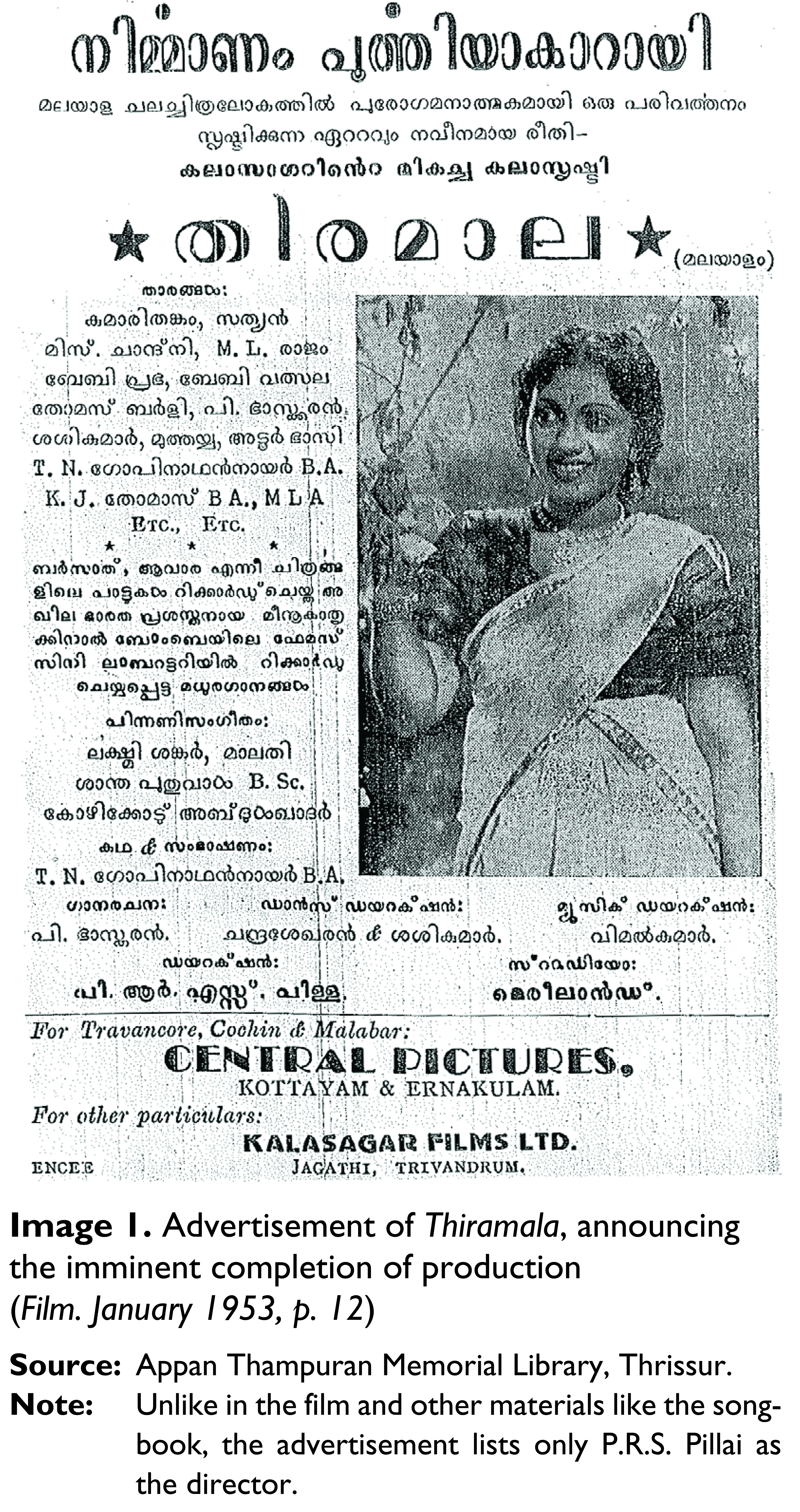
The 1953 film, Thiramala (see Images 1 and 2), is rarely invoked in the history of Malayalam cinema, except when some of the illustrious individuals who made their debut with this film are mentioned. This more or less forgotten film is exceptional in that two versions of the film, with different endings for Thiruvithamkoor and Malabar, were released.
17
T.N. Gopinathan Nair, who wrote the script and acted in the film, remembers:
[Thiramala] initially had a tragic ending. Once they realized that the audience was not responding well to the tragedy, they changed the ending into a comedy [sic]. Newspapers in the south praised the film sky high. The papers in the north tore it to pieces. (Nair, 1980, p. 186)
Of the many prominent names associated with the film, which includes P. Bhaskaran (lyricist, actor) and Ramu Kariat (assistant director, actor), who would together go on to direct Neelakkuyil the following year, was Sathyan, the star, who, along with Prem Nazir, would define Malayalam cinema for years to come. 18 I will discuss Thiramala, and the curious case of the two endings, as a significant event in the emergence of Sathyan’s stardom and the transformation of the industry.
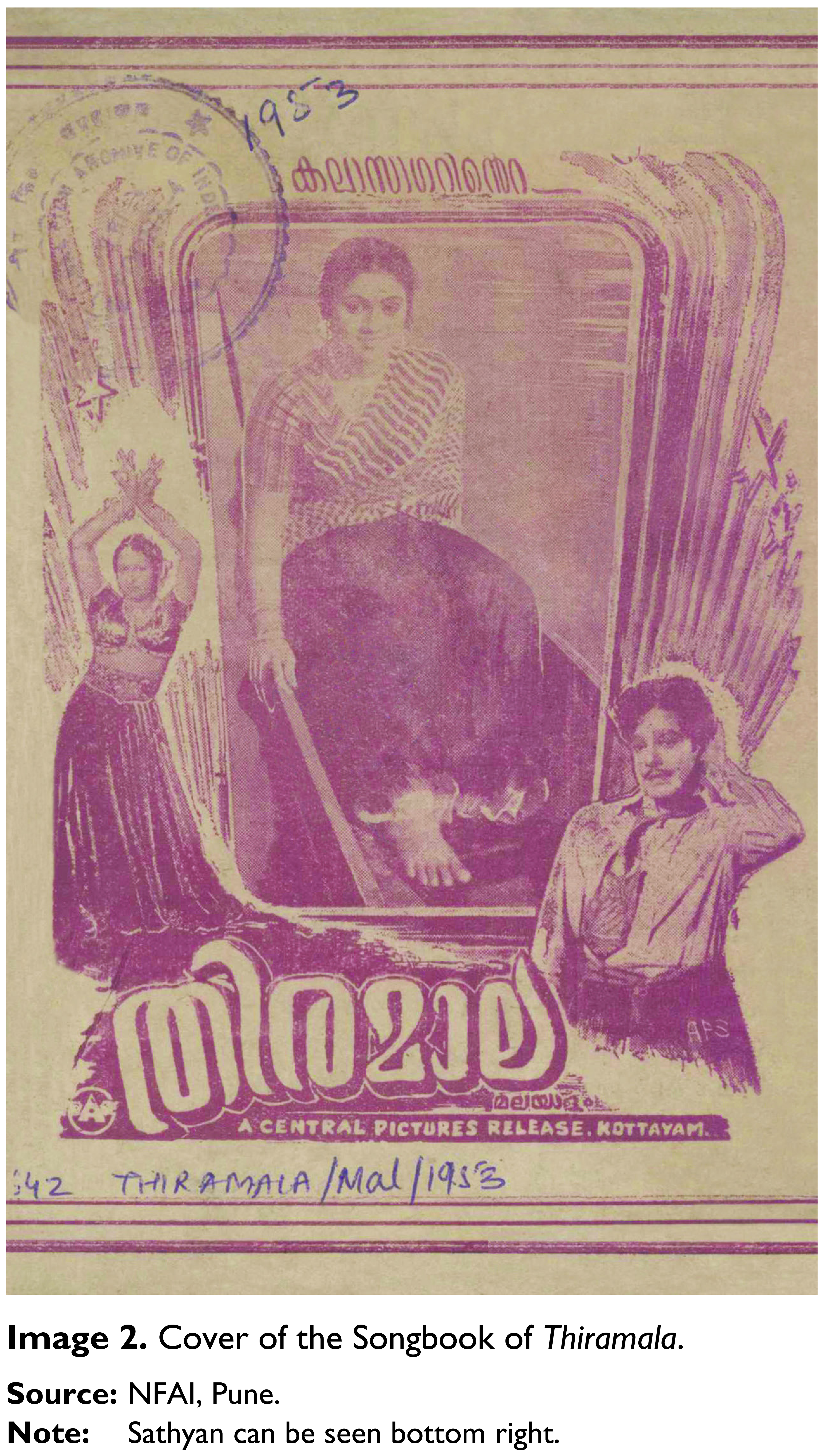
In Thiramala, Sathyan plays Vijayan, rich and city bred, who is introduced around the middle of the film to marry the heroine, Lakshmi (Kumari Thankam), and thus separate her from her lover, the hero Venu (Thomas Burleigh). As Vijayan is unaware of this romance, he is not a villain as such. It is his city ways—an affair with a hotel dancer, Swarnalatha, and his gambling habit—that destroy his relationship with Lakshmi and makes him into an anti-hero whose transformation forms the crux of the film. Meanwhile, Venu reaches the city and finds employment in the very hotel where Swarnalatha performs. While Venu is a more or less silent observer of Vijayan’s downfall with his limited attempts to intervene rebuffed, at the climax of Vijayan’s fall, he comes to his rescue. On her way back to the village after leaving Vijayan, Lakshmi encounters Venu who has by now returned to the village. A boatman by tradition, he offers to get Lakshmi across the river. In a re-enactment of a similar moment from their childhood that appears in the beginning of the film, the boat is caught in a storm. They manage to get across, only to hear the voice of a repentant Vijayan calling Lakshmi from the other bank. Despite the storm, Venu offers to go back and fetch Vijayan. In the “Thiruvithamkoor ending,” the storm hits the boat and we see Venu’s dead body thrown back onto the shore. We must presume that Vijayan and Lakshmi are eternally separated on either side of the river. In the “Malabar ending,” Venu succeeds in going across and getting Vijayan back to Lakshmi. According to the available script, we see a close up of a smiling Venu and a shot of Lakshmi and Vijayan walking toward the sunset on the beach. 19
The change in ending was a decision taken after the film received negative reviews in Malabar, especially in the review column by film critic “Cynic” (pseudonym of M. Vasudevan Nair) in Mathrubhumi Weekly, where film criticism as a discernable genre of writing in Malayalam was taking shape. This instance helps us understand the conditions of possibility of practices within the industry and its flexibility, rather than identify a consciousness of clearly differentiated markets, cultural entities, and strategies for their engagement. While the “Thiruvithamkoor ending” prioritized the fate of Venu who is the hero of the film, the “Malabar ending” manages to elevate Vijayan into the position of a hero alongside, or even above, Venu. In the latter, while Venu’s sacrifice is befitting a hero, Vijayan is rewarded for his transformation. While Venu and Lakshmi are throwbacks from earlier character types—lovers separated by external forces—Vijayan is the locus of interiority of the modern subject. There are two occasions in the film where we are shown close-ups of Vijayan’s photograph. In both instances, his smiling face transforms into a demonic face as Lakshmi holds it in her hand. Unlike Soman from Jeevitha Nauka, Vijayan here is the locus of both the production of interiority and of positive transformation—a self-reflexive subject. Considering that the film focuses on Vijayan’s transformation and that Sathyan (and not Thomas Burleigh) was its top billed actor, as the credits and publicity material of the film attest, it is surprising that the “Thiruvithamkoor ending” marginalized his character completely. I argue that the reason for this marginalization and the reinstatement of Vijayan’s character in the “Malabar ending” can only be explained by examining Sathyan, the actor and the future star.
Sathyan, whose real name was Manuel Sathyaneshan Nadar, was born in a Nadar family that had converted to Christianity. 20 Forty years old when he debuted as hero in 1952, Sathyan had worked as a schoolteacher, a government clerk, served in the army and was a sub-inspector of police, and was briefly active in theater in Trivandrum before he entered films. Sathyan was from the socially mobile yet lower Nadar caste—a fact that could not go unnoticed in the highly caste-regimented Thiruvithamkoor during the early 1950s. 21 The late 1940s and early 1950s were times when there were consistent attacks on Nadars in Thiruvithamkoor by upper-caste Nairs, occasioned by the unsure future of the predominantly Tamil-speaking people (as Nadars historically were) and of the southern part of the region in the unfolding geopolitics of the time. As is well known from the discussions of the evidence provided to the Indian Cinematograph Committee of 1927, the problem of the possible mismatch between the performer’s caste/community and his/her character’s identity had been a cause of concern with the advent of cinema in the colony (Prasad, 2004). The violence meted out by upper castes against P.K. Rosy, the heroine of Vigathakumaran who was from the lower Pulaya caste, is a well-known instance. The upper castes were reacting against what they perceived to be Rosy’s audacity in acting as a Nair woman on screen, and such sentiments appeared to have wide currency in Thiruvithamkoor (Menon, 2014; Rowena, 2013). In this context, how did Sathyan, belonging to the Nadar caste, manage to inhabit the world of the upper castes that Thiramala represents, and later transform into a star? The narrative negotiations that we encounter in the film provide us with some clues.
The first version of Thiramala follows social conventions to the letter. The crisis that separates the hero and heroine, Venu and Lakshmi, is of class, and possibly of caste (left a bit ambiguous as Venu’s caste name, Panikker, could make him a Nair or an Ezhava, most probably the latter, while Lakshmi is clearly marked Nair). Vijayan’s caste status is never explicitly revealed. His palatial house in the city has a nameplate that says, “S. Vijayan, MA.” It could be assumed that he is Nair, considering the eagerness of Lakshmi’s father to get his daughter to marry him. Venu’s death in the storm, in the “Thiruvithamkoor ending,” leaves the possibility of the reconciliation between Vijayan and Lakshmi unrealized. Even with very little evidence to go by, I suggest that caste miscegenation was being prevented by Venu’s death. Would it have been possible in Thiruvithamkoor to show a Christian Nadar man “ending up” with a Nair woman? This reading, albeit based on circumstantial evidence, will help us explain the revision of the ending for Malabar. In this case, one witnesses the triumph of Sathyan, the future star. The recognition and rewarding of Vijayan’s transformation provides the potential for extraction of star value for the future. Sathyan’s caste status would not have made any difference to the viewers in Malabar. The argument, of course, is not that caste did not matter in Malabar. Rather, the specific caste configuration within which Sathyan is placed in Thiruvithamkoor would have not been legible in Malabar as Nadars were not part of the immediate social imaginary of its people.
This explanation of the curious case of two endings throws more light on the status of Malabar that I had raised earlier. Here, I reiterate my argument that Malabar’s simultaneous closeness and distance was central in the future of the Thiruvithamkoor film industry. Malabar allowed for the particularities that structure the habitus of film texts produced in Thiruvithamkoor to be transcended and made invisible. Language was a necessary condition for this transaction, as it was only on the ground of a common market that Malabar gained this particular status vis-à-vis the Thiruvithamkoor industry. The argument is not about the inherent modernity of Malabar, but that, for the specific needs of the Thiruvithamkoor film industry and its transformation into an industry for Kerala, Malabar lent itself as the space for its sublimation into the modern, that is, into “Kerala.” The erasure of Sathyan’s particularity as a Nadar man in Malabar, allowing for the change of ending in Thiramala, was a necessary node in the story of his ascendance as a star for a unified Kerala. Neelakkuyil attempted to imagine a new geography for Kerala that was not the sum total of Thiruvithamkoor and Malabar, and was symbolically held together by Sathyan’s stardom, even though earlier formations continue to haunt it.
Neelakkuyil made a radical break in prevalent filmmaking practices and assembled a set of individuals for its crew who were not from the cultural space of Thiruvithamkoor. Writer Uroob, musician K. Raghavan, cameraman A. Vincent, and actor Balakrishna Menon, who played the important role of Moidu, all came from Malabar and were, at one time or the other, active in its cultural scene. The producer, T.K. Pareekutty, was from Fort Kochi, which was part of Malabar district. While the hero and the heroine were from Thiruvithamkoor, directors P. Bhaskaran and Ramu Kariat were from Thrissur. More importantly, the film incorporated Malabar into its narrative universe, thus becoming the first film to imagine a narrative of integration. 22 However, the assemblage of territories, personnel, populations, and cultural products is not an easy task. The film attests to such an attempt and to its limits. The integrationist imagination is clear from the title card that appears immediately after the credit sequence. It reads: “Above, the unbound skies of Central Kerala (madhya Keralam); below, the expansive spread of virgin fields; in between them, the lives of human beings flow. ‘Neelakkuyil’ is a story woven out of their diverse and conflict-ridden lives.” The film effectively invents a new geography in the invocation of “Central Kerala,” avoiding references to Thiruvithamkoor, Kochi, or Malabar. The protagonist of the film is a Nair, as in the earlier films. However, the protagonist Sreedharan Nair, unlike Soman and Vijayan, carries a surname “Nair,” and not its analogues such as Pillai, Kurup, or Nambiar, which would tie it to particularities of Thiruvithamkoor or Malabar. The use of the generic term “Nair” has been central to the integration of disparate jatis through community reform among shudra castes in the region. This led to the formation of institutions such as the Nair Service Society (NSS) in the early decades of the twentieth century. The usage of “Central Kerala” and “Nair” are modes that propose an integrated universe with new normative registers for what constituted the social world of the region. It is the experiments, like the one we see with Thiramala, that present the conditions of possibility for Sathyan to be endowed with the representative status in the imaginary of “unified Kerala.” If the location of the dominant, that is, Nair, was kept in play or suspended in the earlier film, in Neelakkuyil, it is affirmed unequivocally. With the imaginary of unified Kerala and its subject in place, the film’s burden is to demonstrate the existence of a landscape where language, culture, and geography coincide. I argue that what Neelakkuyil succeeds in producing is an assemblage under the sign of unified Kerala and not a narrative elaboration of this newly constituted region and the regional subject; such a narrative of integration, as I have been arguing, might not exist.
In what follows, I draw on Jenson Joseph’s work on Neelakkuyil (Joseph, 2013b), raising questions regarding the status of Malabar which his framework does not allow for. Most writings on this much-discussed film focus on the protagonists, Sreedharan Nair (Sathyan) and Neeli (Ms Kumari), and rightly attend to the imagining of a modern subject for the region, “Kerala,” and its limits (Rowena, 2002; Venkiteshwaran, 2011, pp. 121–133). Departing sharply from this focus, Joseph (2013b, pp. 126–129) urges attention to postman Sankaran Nair (P. Bhaskaran), the voice of reason in the film, and Moidu, a comparatively minor character. Moidu is a Muslim character whose comportment is akin to that of the Mappilas of Malabar. He gets to sing one of the most popular songs in the film, set to tune like a mappila pattu, popular in Malabar, especially among Muslims. According to Joseph, Moidu’s significance lies in the fact that he seems to be privy to narrative events that only the audience knows about, including private matters. Joseph reads him as standing in for the viewer, figured as subaltern and mobilized by the film as distinct from the upper-caste population it “represents” (ibid., p. 128). He argues that between the postman, Sankaran Nair, who he reads as the voice of the emergent Left rhetoric of rationality and modernity, and Moidu, as respectively sender and receiver of the message of rationality, the film manages to appeal to multiple constituencies. While Joseph is interested in the ideological underpinnings of the narrative of Neelakkuyil, I draw on his analysis to ask a different question. While Joseph’s argument that Moidu’s subaltern character and capacity to mobilize a constituency is suggestive, why is a Mappila Muslim the representation of the subaltern in the emerging regional imagination? We need to calibrate the status of the discourse of the rational, undoubtedly the central thematic of the film, much as we need to with the notion of “development” in Devika’s argument. Unsurprisingly, Joseph bases his discussion on Devika’s thesis (ibid., pp. 130–131).
The deployment of Moidu, a Mappila Muslim from Malabar, as the “subaltern” in Neelakkuyil needs explaining. If Thiramala belatedly, after its release and initial failure, encountered the potential of Malabar as a space where experiments with narrative could be carried out, I argue that Neelakkuyil anticipates Malabar in its narrative by including Moidu in its social universe. Moidu functions not just as the subaltern figure but also the element in the assemblage that makes Malabar visible in the body of the text. With most of the main actors familiar from earlier films made in the Thiruvithamkoor industry, Moidu becomes the only signifier of Malabar in the film text; the site for its narrative elaboration. This is, of course, not an easy maneuver for a text of the 1950s. It was through the figure of the “fanatic” Mappila Muslim that Malabar was thematized for the reading public in Malayalam in colonial and nationalist writings (Ansari, 2005). One could argue that in the new regional imagination of Neelakkuyil, it is this figure that would have to be re-mobilized in attempts to integrate and produce the modern space called “Kerala.” Neelakkuyil transforms the “fanatic” into the lovable Mappila, who flirts and sings, and is invested with the potential of representing the rational subject of modernity, thus refiguring Malabar as a site of the modern. While Moidu is indeed the comic element in the film, his rationality marks him as radically different from the comic characters that were common in Malayalam cinema of the time—of the kind actors such as S.P. Pillai were known for. One could argue that the socials continued to deploy the latter form of the comic through the sidekick characters played by actors Adoor Bhasi and Bahadur, and that Moidu’s rationality was displaced on to the language of social realism of the Muslim social. Moidu remains a singular character in Malayalam cinema and Balakrishna Menon, who played Moidu, never acted again.
In counterpoint to Moidu’s characterization is the continuing trope of transformation of the protagonist as the condition for star production. Neelakkuyil finds its resolution in Sreedharan Nair’s transformation into a modern individual. The story of the film is about his relationship with Neeli, who hails from the lower Pulaya caste. When Neeli becomes pregnant, Nair refuses to accept her and marries a Nair woman. Neeli commits suicide after giving birth to a boy. Postman Sankaran Nair takes charge of the child and raises him. By the end of the film, a repentant Sreedharan Nair accepts the child as his own. Sankaran Nair advises Sreedharan Nair to raise his son “as a good man, a big man,” and not to raise him as “a Nair, a Mappila or a pulaya.” Neelakkuyil takes upon itself to propose, elaborate, and establish the contours of the modern. This is in contrast to Jeevitha Nauka where the modernity of the hero is presumed and Thiramala where the hero’s modernity, founded on a city–country dyad, is no guarantee of his virtue or even desirability. As Joseph notes correctly, the character who is already modern in Neelakkuyil is postman Sankaran Nair. I argue that the transformation of the hero from his caste-based existence to a modern figure (the reformed Nair) needs to be staged in the film. Unlike the Thiruvithamkoor films where the logic of the modern was being accessed from the world outside cinema from sites such as the discourse of social reform and the transformations in commercial theater, for a geography that was being newly fashioned, a pre-given regional imaginary was not available as a resource. Sreedharan Nair, as portrayed by Sathyan, remained the hero of the film precisely because of his potential for transformation and because he provided the ground for the elaboration of interiority. The displacement of the normative rational discourse onto Sankaran Nair, a secondary character, is what made possible the emergence of Sathyan as a star for post-reorganization Kerala, replacing Thikkurissi, whose star potential was limited to Thiruvithamkoor and its caste/reform habitus. The continuing trope of the transformation of the Nair man as the locus of the modern, the “humanizing” of the Mappila (and by association, Malabar) as the locus of the subaltern, and the norming of the “rational–modern,” combine to produce the assemblage that we call Kerala, where no singular register of the “Malayali”—an aggregate of language, culture, and geography—obtained. While Neelakkuyil presented itself as a text of the modern, I argue that it is a text that reanimates the question of the modern on the unsure and slippery ground of “unified Kerala.”
“Regional” Cinema
Studies on non-Hindi cinema have had to be content with the burden of inhabiting regions as though the linguistic–cultural–geographic bind is a given. This governmental imagination provides for one of the most powerful and enduring normative planes within which cinematic and other cultural practices function. If one were to think of cultural production not just as instances of representations that are ideologically structured, and refigure them as practices negotiating the normative limits that are imposed upon them, they will tell us the story of regions that are fragmented and constantly under revision. What I have attempted here is to deny primacy to the discourse of unified Kerala and the attendant discourse of development, and consequently the primacy of the Left imagination, to think through other possible narrative emplotments. The re-imagination of the film industry of the time as a Thiruvithamkoor film industry opens up the possibility of telling the story of the subject of the region, from a vantage point not determined by the Kerala as its necessary teleology. As for the film industry, such an intervention makes new objects appear with new significance, reorganizing the story it tells of itself and that which has been told of it.
Footnotes
Acknowledgements
I thank Jenson Joseph for his comments on an earlier draft that has helped me fashion some of the crucial arguments in the article. I also thank Ravi Vasudevan, Paulomi Chakraborty, Veena Hariharan, and the editor of the special issue, S.V. Srinivas, for their patient engagement and comments. Thanks to Abhilash A.J. who helped me with collecting some of the archival material and to Anitha Ramesh who helped me retrieve an important source.