




Abstract
In this article, I trace the growth of the action film genre in Bangladesh in the 1970s and 1980s, at a time when new technologies such as video cassette recorder (VCR) were emerging in the market and national politics was wrestling with the competing notions of masculinity, leadership and heroism. I look at the emergence of the Bangladeshi action star Joshim within the context of South Asian trans-regional cinema and its changing tropes of masculinity. I argue that anxiety over new technologies, changes within Bangladesh’s political regime and its leadership, including state censorship, and shifts in the representation of heroic masculinity within national imagery—from a socialist model associated with Sheikh Mujibur Rahman to the modern, energetic and globally inflected masculinity of Ziaur Rahman—were intertwined. These changes, I contend, are reflected in the transition in Joshim’s roles from the primarily villainous characters of his early films to an action hero from the 1980s onwards. The article examines Joshim’s role in the film Muhammad Ali (Motaleb Hossain, 1986b), as an example of a glocalised action film. Its sources include articles and letters printed in Purbani and Chitrali, the most widely read Bangladeshi film magazines of the 1970s and 1980s.
I am not a hero, not a singer, nor a villain. I am just an actor like any other.
Introduction
The 1980s saw the refashioning of the action genre in cinema industries around the world. New technologies of home entertainment such as the video cassette recorder (VCR) and videocassettes not only increased the popularity of the genre, but also affected the way transnational filmmaking was rapidly evolving (Morris, 2004). In Hollywood, when the action genre was revived in the 1980s, it soon began to ‘colonise’ other genres (Donovan, 2010; Weaver & Carter, 2003) and this was true for Asian cinema as well (Higbee & Lim, 2010; Nasreen & Haq, 2008; Raju, 2014; Srinivas, 2013; Vitali, 2008; Wong, 2002). This was perhaps a predictable outcome of a decade marked by multiple transactions between global cinemas, which constantly remoulded the action genre in manifold ways.
In this article, I trace the growth of the action film genre in Bangladesh at a time when new technologies like VCR emerged in the market, and national politics was wrestling with competing notions of masculinity, leadership and heroism. A closer examination reveals that the change in the range of genres coincided with a political scenario in which Ziaur Rahman’s political ideologies and state censorship, as well as the introduction of new visual technologies, led to direct aesthetic outcomes in the production of new visual forms of heroic masculinity in popular cinema. I explore the emergence of the Bangladeshi action star Joshim 1 within the context of South Asian trans-regional cinema and its changing tropes of masculinity to argue that anxiety over new technologies, changes within the political regime and its leadership, and shifts in the representation of masculinity within national imagery—from a socialist model to the modern, energetic and globally inflected masculinity of Ziaur Rahman—were intertwined in Bangladesh. These changes, I contend, are reflected in the growth of the action genre in Bangladesh and the transition in Joshim’s roles from the primarily villainous characters of his early films to an action hero from the 1980s onwards.
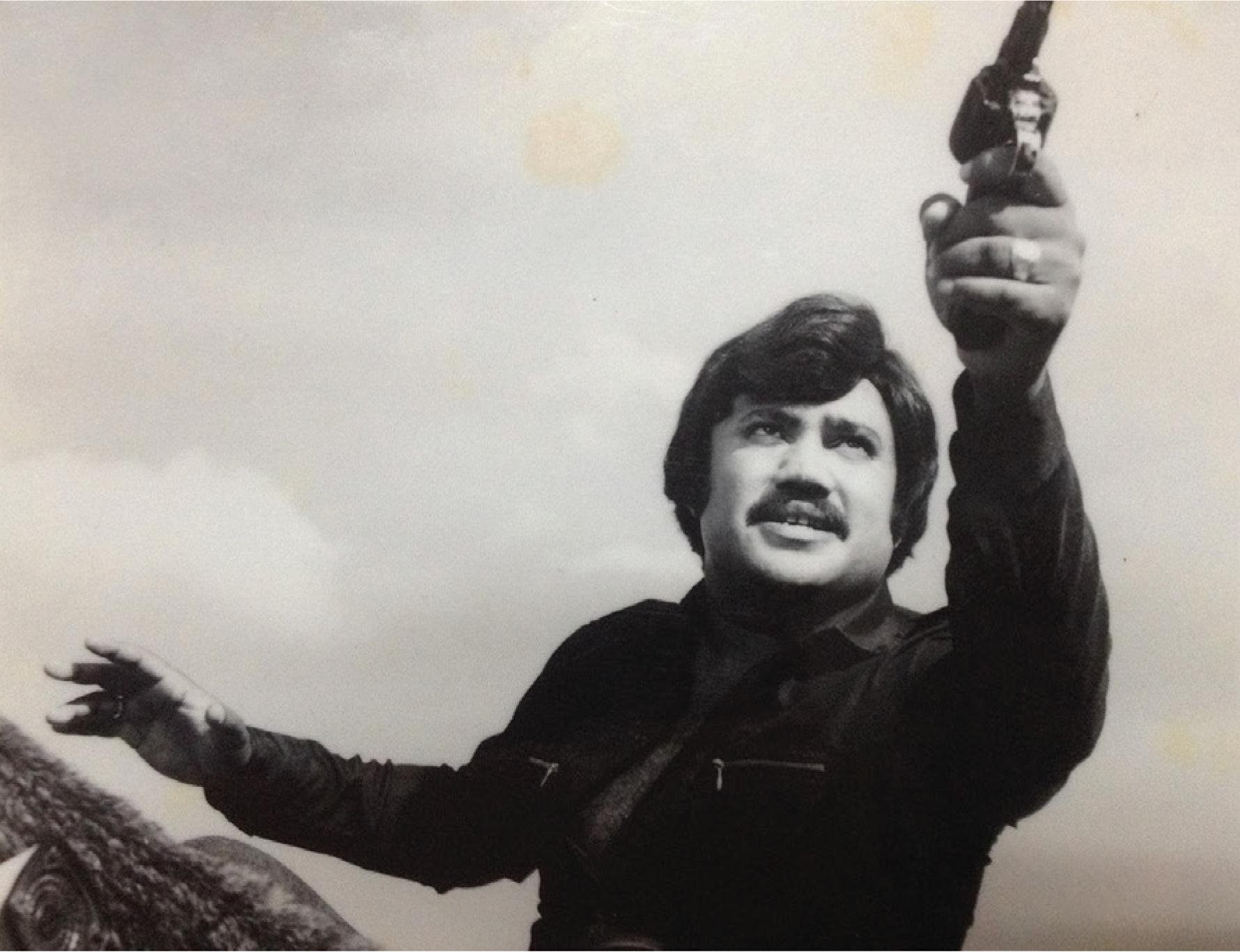
This article takes the curious case of Joshim to understand the socio-economic and political conditions that coincided with his transition from the popular image of a villain/anti-hero to the image of a hero. Abul Khair Joshim Uddin, popularly known by his screen name Joshim, was born on August 14, 1950 in Keraniganj village in Bangladesh. He served under the leadership of Sector Commander Major Abu Taher Mohammed Haider of Sector 2 in Bangladesh’s War of Liberation or Muktijuddho (in Bangla the literal translation of mukti is liberation and juddho is war). A sound stage known as Floor 2 of the Bangladesh Film Development Corporation (BFDC) in Dhaka was named Muktijuddha Joshim Floor after the demise of the actor in 1998. The naming not only honours the late actor but also highlights his contribution as a muktijoddha (freedom fighter). The tall, dark, stout actor with a trademark moustache began his career in films as a stuntman and action choreographer (more commonly referred to ‘fighter’ in the Bangladeshi film industry). Thus, from his national hero status as a freedom fighter to his career as a ‘fighter’ in films—originally as a villain and later as a hero—Joshim’s personal and professional life revolved around the metaphorical opposition between hero and villain. Joshim entered the film screen with Rongbaj (Zahirul Haque, 1973), Bangladesh’s first film in the action genre, with a brief appearance as a peripheral character playing the role of a local extortionist with just two lines. Nonetheless, he also played an important role behind the camera as an action choreographer. And soon his behind-the-camera role began to translate into increasing on-screen time as an anti-hero.
Joshim’s image as a principal antagonist was clinched by his role as the dacoit Gaffar in Dost Dushmon (Dewan Nazrul, 1977), modelled on the very famous Bombay film character Gabbar Singh from Sholay (Ramesh Sippy, 1975). The Gaffar character’s resemblance to Gabbar Singh is unmistakable. 2 For the Bangladeshi audience, who at that time had access to Sholay through the various VCR projection houses around the country, Gaffar offered a Bangladeshi rendition of the successful Gabbar. The film magazines of the era discussed this openly. A fan of Joshim, Md. Habibur Rahman from Dhaka, looks back at Joshim’s roles as an antagonist and comments, ‘He (Joshim) truly was a villain, a very famous villain in Bangladesh’ (Purbani, May 9, 1991, p. 15). While his reputation as a villain grew, just as Amjad Khan’s success did with his iconic role as the popular villain Gabbar, it did not limit Joshim’s popularity among his viewers, as we can see from the film magazines of the 1980s such as Chitrali and Purbani. Less than a decade after his first film, Joshim made his debut as the central protagonist in Shobuj Shathi (Shubhash Dutt, 1982). A family social film, Shobuj Shathi centres on the relationship between two siblings. Joshim’s role here as a protective brother to his sister (played by Shabana), and its overwhelming acceptance despite the fact that the pair had played in very different roles in Dost Dushmon (where Joshim was Shabana’s abductor), clearly marks a major leap for Joshim from a negative role to a positive one; from an abductor to a protector. 3 Though his transition from negative roles to positive ones is significant, what is common to both is action. The action image of Joshim became more versatile with his gradual embodiment of a working-class rebellious hero as the 1990s wore on, with films like Protihingsha (A. J. Mintu, 1983), Rokter Bodla (Johirul Hoque, 1991), Hingsha (Motaleb Hossain, 1993) and Goriber Shongshar (Delwar Jahan Jhontu, 1996). His engagement with films continued up to the last year of his life. His final film Jore (Motaleb Hossain, 1999) was released the year after his death.
Joshim’s gradual embodiment of the masculinity of an action hero in Bangladeshi cinema can be analysed from two vantage points. First, it can be understood in the context of changes brought about by visual entertainment apparatuses in Bangladesh and the growth of the action genre in Bangladesh; and second, it must be analysed from within an understanding of the political reconfiguration of the image of historical heroes and villains in Bangladesh after Muktijuddho or the Liberation War of 1971 and in the context of regime change. I argue that Joshim’s rise and sustained popularity as an action hero is located at the nodal point where these two axes intersect. The widespread distribution within Bangladesh of images of Hollywood and Asian action stars from abroad coexisted with the mainstream, politically motivated rewriting of Bangladesh’s national history during Ziaur Rahman’s regime (1976–1981). Being a controversial historical persona and becoming the most significant national figure of his time, Zia’s 4 political life refashioned, sometimes overlapped with, and often blurred the binary understanding of the concepts of hero and villain in Bangladeshi politics. I trace a parallel in Joshim’s transitioning image on screen. In order to disentangle these intertwining concerns, the article is divided into three sections. In the first section, I concentrate on the ways in which regime change in Bangladesh opened the country up to transnational film distribution, which became instrumental in the generic development of Bangladeshi action cinema and Joshim’s place in it. The second section attempts to understand how the political aesthetics of Bangladesh created a watershed moment for Joshim to emerge as an on-screen hero. Using the example of the film Muhammad Ali (Motaleb Hossain, 1986), which combines global and local cinematic influences, the final section weaves the aforementioned concerns together. 5
Aside from scholarly articles, in order to understand the pulse of the then film industry this article draws on a host of previously little explored empirical material found in the Bangladeshi film magazines Purbani and Chitrali, which were widely read in the 1970s, 1980s and 1990s. The manner in which items about Joshim and his films was covered by the magazines, together with the readers’ responses to the news and the industry through letters published in these magazines, provide a detailed archive that can help to throw a fresh light on the film industry, uncovering perspectives on Bangladeshi cinema which have otherwise been absent in scholarly works on Bangladeshi cinema. The magazines are originally in Bangla and all translations from Bangla to English in this article are by the author unless otherwise mentioned.
Change of Political Hands and the Emergence of Action Genre
A politically significant point in the history of Bangladesh coincides with the arrival of VCR in the country, which resulted in remarkable shifts in the economy of film viewing. The year 1975 marked a watershed in Bangladesh’s political scenario with the assassination of Sheikh Mujibur Rahman, the first prime minister, followed by a brutal political transition scarred with coups and counter-coups that eventually led to the new leadership of Ziaur Rahman in 1976. To date, Ziaur Rahman remains a controversial player in relation to Sheikh Mujibur Rahman. For those who hail Mujib as a national hero, Zia is in opposition to their ideology and a political villain. Zia’s regime, which significantly altered national politics, especially in some cases in direct conflict with Mujib’s political stance, not only made major governmental and religious reforms to the national constitution but also changed the cultural industry. His government (1976–1981) added significant clauses to the Wage Earners Scheme, which increased the influx of new technologies of entertainment such as VCR players and VHS cassettes of foreign language films (exempting films from the Indian subcontinent) (Islam, 2008, p. 92). The later regime of Lieutenant General Husain Muhammad Ershad (1983–1990) continued the path established by Zia. Like his political predecessors, Ershad attempted to strengthen his grip on the media. However, despite this being an era of strict regulation, the scenario of illegal VHS and VSR film screenings, which were becoming a major concern for the Film Development Corporation, did not stop. A 1984 survey shows that while there were 425 cinema halls throughout the country, in Dhaka alone there were 50 illegal VHS film exhibition spaces (Islam, 2008, p. 94). This illustrates how the changes brought about by Zia had a longer term effect on film viewing spaces and modes of viewership in later decades. This context of political and cultural change is crucial to an understanding of how different governments shaped the ways in which the Bangladeshi cinema became punctuated with multiple visual languages and narratives from around the globe.
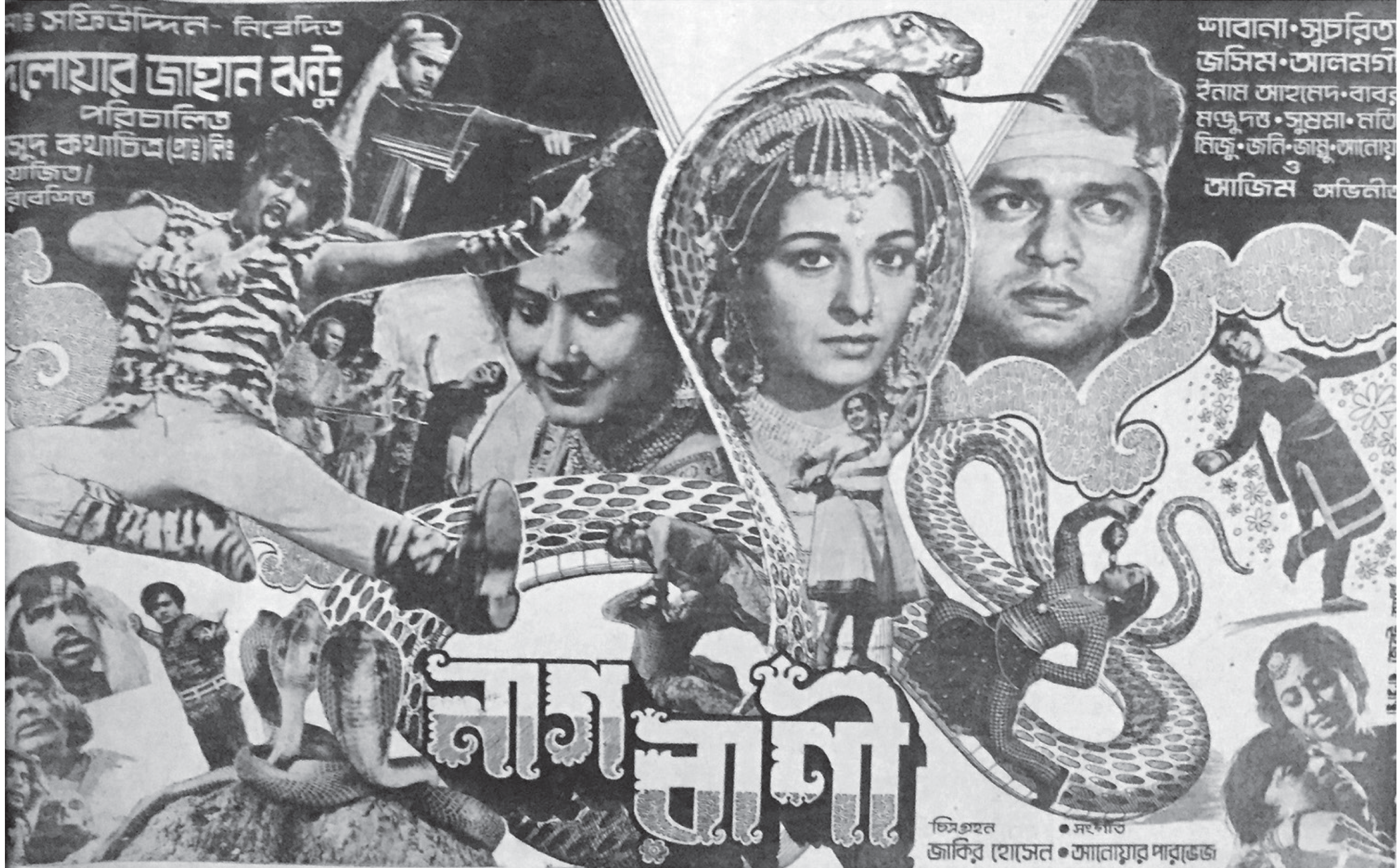
Film critics within Bangladesh considered the global cinema effect as a ‘threat’ to the indigenous film industry. Although there were concerns about the impact of these ‘threats’ on the film industry and its turn towards glocalisation (discussed below), in a discussion on the exchange and borrowing of visual elements in the Bangla film Dost Dushmon, Zakir Hussain Raju comments: ‘Bangladesh cinema—like other Asian cinemas—is a transnational film culture connected with a host of other cultures’ (2014, p. 294). Some of the earliest experiences of transnational filmmaking are evident in the initial years of the East Pakistan Film Development Corporation or EPFDC (now BFDC), when there was a dearth of trained personnel. In the 1950s, groups of workers ranging from film directors to errand boys, who had earned their stripes in the pre-partition Calcutta-based film industry, were being hired, an example of how Calcutta-based techniques and resources were employed in the newly founded Dhaka film industry (Kabir, 1979, p. 25). Moreover, the cross-cultural exchange of modes of production is also visible in Bangla film production, given that it was so reliant on the studios of Calcutta and Bombay. The Bangladeshi film industry and its products were therefore already situated at the intersection of the many global flows of action cinema. Looking at popular film titles, script, dialogues, song lyrics and music of the 1980s—film tropes resonant with borrowings from different cinema industries—we see evidence of the increasingly glocalised manner of filmmaking. For instance, the opening scene in the film Akrosh (Motaleb Hossain, 1986a) shows Joshim playing a flute in front of an audience of young children. The tune is intriguingly and unmistakably similar to a famous flute tune played by Jackie Shroff in the Bollywood film Hero (Ghai, Subhash 1983). For the spectator, the opening of the film with the ‘borrowed’ tune would be understood less as plagiarism and more as an inter-textual reference to the famous action hero Jackie Shroff. Thus, while critics were anxious about the effect of global films on the indigenous industry, one can clearly see that the cinema has always celebrated this kind of exchange.
In Bangladesh, while short action sequences or gunshot exchanges were not uncommon in war films such as Ora Egaro Jon (Chashi Nazrul Islam, 1972) and Roktakto Bangla (Momotaz Ali, 1972), it was only after 1973, with the release of Joshim’s debut film Rongbaj, that action cinema began to slowly make its presence felt as a separate genre. Later films in the genre increasingly displayed narrative nuances borrowed from foreign action films. However, as in any other film industry, the rise of the production of action films was not without opposition. In Barna William Donovan’s words, action films around the world have tended to be critically disparaged as being full of ‘[g]ritty, bone-fracturing, cartilage-crushing, lip-splitting fights, car chases, gunplay, trash-talking put-down humour from foul-mouthed tough guys brimming with anti-authoritarian “attitude” and, most of all, city-scale, searing, pyrotechnic destruction’ (2010, p. ix). For similar reasons, in Bangladesh there was repulsion among critics towards action cinema in its early phase. Yet action scenes began to take up increasingly more screen space across the range of genres.
The hybrid or ‘glocalised’ manner in which the action genre was evolving in Bangladesh has been a core anxiety of many film critics. While the word ‘glocalisation’ can commonly be understood as the simple convergence of the global and the local, Victor Roudometof argues that ‘glocalization is globalization refracted through the local. The local is not annihilated, absorbed, or destroyed by globalization, but rather it affects the final outcome; it operates symbiotically with globalization and affects the end state or result’ (2016, p. 65). In the context of cinema, Shakuntala Rao’s ethnographic exploration of the anxieties and desires of the Indian film audience views glocalisation as a process that brings together influences of Western and Indian cinematic metaphors on screen, in which the ‘Western adapts to India’ (2010, p. 1). In this article, I rely on Roudometof’s contention and Rao’s framework of glocalisation to explore Joshim’s position in Bangladeshi action cinema.
The gradual glocalisation and colonisation of earlier genres by action is evident in how action scenes became an important element across the range of genres, making way for increasingly mardanga and action films (Qader, 1993, p. 149). Thus, the social/family dramas made a transition towards the shamajik (social) action or social action genre (action films with social concerns), while poshaki (fantasy/costume) films moved towards dhumdharakka poshaki or costume films with action (‘Crisis of films’, Purbani, October 2, 1983, p. 1). In discussing a similar trend in Hollywood cinema, Donovan notes, ‘In this sense, the “action” film often colonizes a lot of other genres, borrowing archetypes and transforming them into an entirely new breed of entertainment’ (2010, p. 40).
In film magazines of the 1980s, the increasing use of words like mardanga and ‘modern action’ bear witness to the dominant message that action was now overwhelmingly present in Bangladeshi cinema. Whereas in Urdu mardangi means virility and in Hindi manliness, in Bangladeshi cinema mardanga came to be understood as ‘heavy-duty action’, identified with hyper-masculinity. The use of mardanga was mostly restricted to jatra-styled 6 folk, fantasy and costume films. The gradual decline in use of the word mardanga in the later decades and increase in the English word ‘action’ is symptomatic of the shift of plots to modern settings, where the urban was replacing the rural, the modern state was replacing princely kingdoms, and guns were replacing swords. One film director’s comment, ‘There is no need of costume films, this is the time of modern action films’ 7 (Purbani, November 24, 1983, p. 3), sheds light on the general trend within the industry and how action was becoming an integral part of all genres. It also meant that such changes were driven by a financial incentive and logic for the industry. Also, BFDC was desperate to catch up with the hype of international action cinema, which meant that more money was pumped into the genre, resulting in a drop in the number of straight family social films during this period (Nasreen & Haq, 2008). While Raju confirms that the mid-1980s saw a decline in family social films (2013, p. 84), Lotte Hoek notes that this shift towards action films was simultaneously taking place in India and Pakistan (2010, p. 38). It is no accident that the cinemascape from then on became packed with unrealistic, violent and obscene imagery catering to the local audiences’ 8 new interests. According to a report titled ‘Contemporary state of Dhaka films’, some popular filmmakers claimed, ‘Rationales are useless on this point. Dance, song and action sequences are central to any film’ (Purbani, October 20, 1983). The 1980s’ film magazines Chitrali and Purbani were full of features and discussion on ‘modern action’: on action films themselves, debates defining the action film genre and images of film actors in action poses on film posters. These clearly trace the generic shift from costume drama and family social films to action films. Director Dewan Nazrul, in a Purbani interview about his then upcoming action film Jony (Dewan Nazrul, 1983), uses the term ‘modern action’ to define the growing genre which he says was based on the notions of modernity and action. Nazrul explains that action films are more than just a few action sequences; rather, in these films, the story revolves around fight sequences instead of having fight sequences as part of the larger narrative. In other words, the action spectacles are the driving force of the diegetic world. From Nazrul’s discussion one gathers that he sees modernity in Bangladesh’s action cinema not as an art movement but in terms of the modern capitalist experiences of city dwellers and migrants, which necessitates that the plot be based in an urban setting (Purbani, October 27, 1983, p. 6). While Nazrul’s comment highlights the new trend of urbanising action cinema, the escalation in depictions of action scenes in Bangladeshi films across all genres also knits together the familiar (in the folk) and the new (in the modern action films), alongside wider tropes of action scenes drawn from across global cinema.
While keeping in mind that such changes in Bangladesh’s cinemascape coincided with Ziaur Rahman’s regime, I contend that the challenges posed by the new visual entertainment media introduced by Zia have played a complex role in forming a market for different genres of film. Given the anxiety that accompanied these new challenges, Bangladeshi cinema significantly altered its visual style and modes of storytelling. The influx of new apparatuses of entertainment positioned Bangladeshi cinema within the grid of trans-border international cinema production, distribution and exhibition, including illegal circulation and piracy, and this makes it relevant to ‘read national cinema against the local/global interface’ (Marsha Kinder as cited in Higbee & Lim, 2010, p. 8).
Joshim, a Product of Bangladesh’s Political History
It is not surprising, given the context of exposure to popular foreign films and the nature of their mass circulation through VHS and VCR around Asia, that there was a market for the masculine action figure in Bangladesh that began to be reproduced in BFDC films in the 1980s. Joshim’s significance lies in the manner in which he became a product of both this complex trans-border circuit of entertainment and the changing political context of Bangladesh. I argue here that Joshim’s popularity as an action figure was a result of the cross-cultural productions and forging of new political affiliations that marked changes in the political culture of the newly liberated Bangladesh. Further, the growing need for an indigenous form of the action figure contributed to the establishment of action as an independent genre. As melodrama in films was being replaced by action after Independence, the cinemascape was changing rapidly: ‘extortionists, goons and anti-heroes were replacing the moral heroic characters. Swords would lighten, guns would thunder and gunpowder would be in flames… . Within such a changing scenario Joshim becomes an important factor’ (Chitrali, January 29, 1982, p. 6).
Joshim’s significance within the action genre in Bangladeshi cinema derived as much from his off-screen activities as his on-screen roles. As mentioned earlier, in Rongbaj Joshim worked both as an action choreographer and as a fighter. With friends he formed the Jambs Group, a company that provided all kinds of services, from action choreography to arranging stuntmen for Bangladeshi films. It was the first company of its kind (Chitrali, January 29, 1982, p. 6). Mohammad Ali (Motaleb Hossain, 1986b), Haalchal (Saiful Ajom Kashem, 1986) and Nay Onnay (A. J. Mintu, 1991) are just a few names in the long list of films choreographed by the group. Later on, the group became the film production house Jambs Production Private Limited. With films like Hero (Raihan Mujib, 1988), Rokter Bodla (Johirul Hoque, 1991), Shanti Oshanti (Delwar Jahan Jhontu, 1992) and Tiger (Jillur Rahman, 1997), action films soon began to mean Joshim and Joshim began to mean indigenous martial arts in Bangladeshi cinema. This made him a key intermediary between the local and global action cinema.
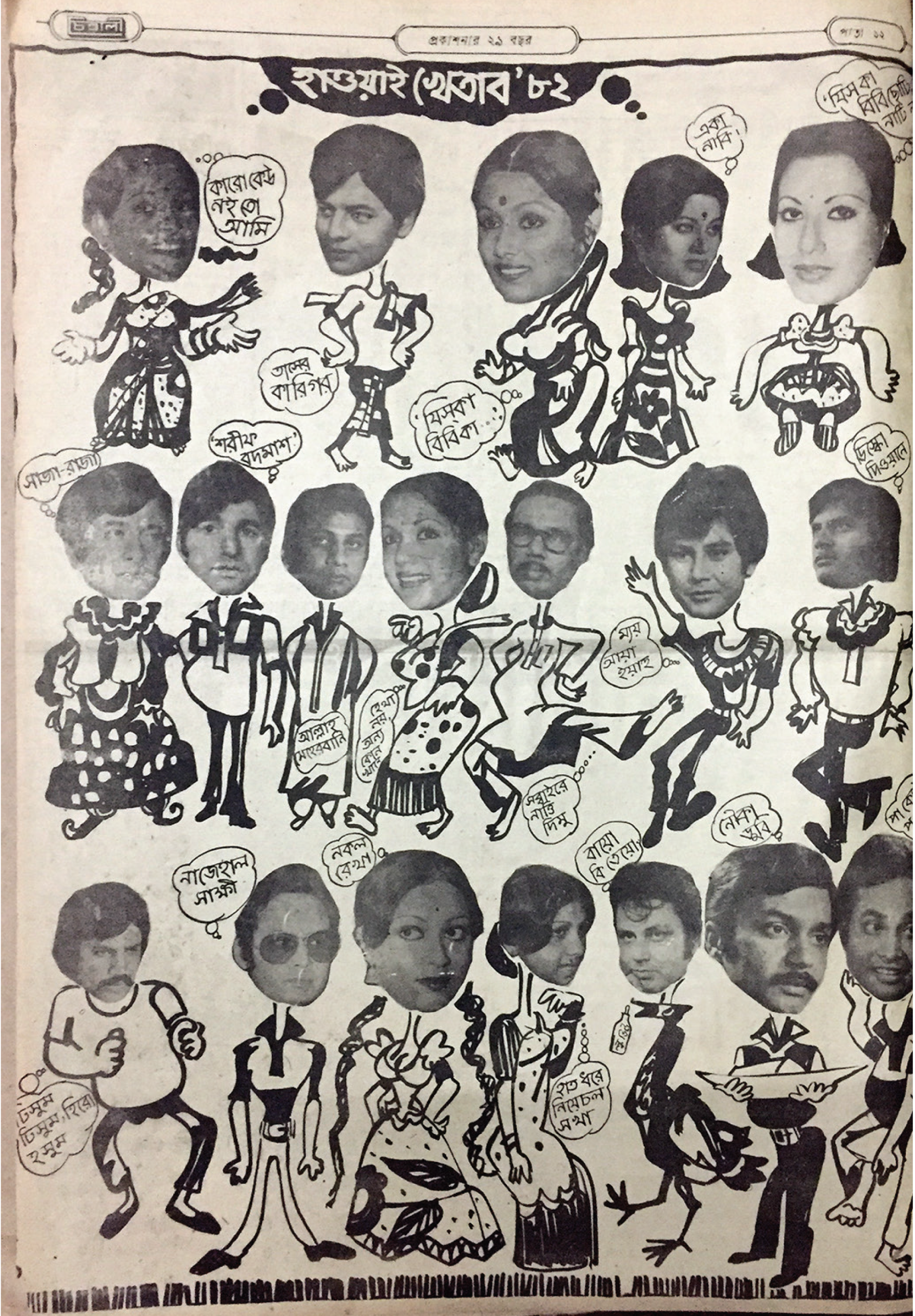
In parallel, one could see new kinds of occupations were being inspired by the action film genre. Sports pages of film magazines in the 1980s began to report on martial arts competitions and wrestling, which gives a sense of how far the action genre was mediating between the inside and outside worlds of cinema. Following the success of the Jambs Group, new companies like Mini Jambs Group sprouted up to meet the industry’s growing need for more production support in action filmmaking. The behind screen economy of this genre reveals increasing investment in new sound effects specialists, music producers, stuntmen and action choreographers (Chitrali, January 22, 1982, p. 6). The rise in the number of film poster images depicting action suggests a change in public taste and a growing appetite for new kinds of visuals portraying action scenes, blood and violence. This mediascape, shaped by the prevalence of ‘action’, called for different audio–visual forms of masculine presence. Within such an economy, Joshim’s significance on screen and behind the scenes was indisputable.
I looked at many issues of the film magazines Purbani and Chitrali in order to understand the kind of image that was in circulation around the action figure of Joshim. It is striking that, unlike other popular actors who would occasionally be the centre of controversy, rumour or criticism, news items on Joshim invariably centred on his image as an action star. To give a few examples from the 1980s: while one article titled ‘A tiger cub in Joshim and Shuchorita’s home’ features Joshim buying a tiger cub from Cox’s Bazar (Chitrali, January 22, 1982, p. 3), another one follows up on the death of the cub (Chitrali, January 29, 1982, p. 8) and next quotes Joshim, ‘I will buy another tiger cub’ (Chitrali, February 12, 1982, p. 2). The news item titled ‘Bruce Lee flies from Australia for Joshim’ reports that his wife, actress Shuchorita, once commented ‘He even dreams of martial arts’. This comment and Joshim’s love for martial arts were so well reported that friends returning from abroad would bring him souvenirs and gifts such as books, movies or posters related to martial arts and Bruce Lee (Chitrali, March 20, 1981, p. 2). One staff reporter notes, ‘He has been very meticulous about creating his image as a sacrificing hero. One cannot overlook his effort in improving his performance. This is reflected in the film Koshai’ (Chitrali, January 1, 1982, p. 10). From these news items one also gets to know of Joshim’s commitment to the industry, as articles would inform their readers that unlike other actors he was never late on set and was hard-working (Purbani, September 15, 1983, p. 2; Chitrali, January 15, 1982, p. 2). His general disapproval of delays in shootings caused by actresses taking too much time in the make-up room (Chitrali, January 15, 1982, p. 2) conveyed to the readers a sense of his professional attitude. Further, articles on Joshim mentoring upcoming stuntmen and action directors helped to sustain his popular action image both on and off screen. A feature in Purbani about a new action director Muslim mentions that, ‘Joshim would take the trouble of mentoring Muslim and others like him in his breaks while on film shoots’. It continued, ‘Muslim commends Joshim whose single-handed dedication and commitment has popularised action in Bangladesh’. (October 28, 1982, p. 5). Another news item, which described him being pen friends with Danny Denzongpa, a contemporary of Joshim who was well known for his negative roles in the Bombay film industry (Chitrali, March 4, 1983, p. 8), connected Joshim to a larger global cinema and its villains.
These regular news updates bear testament to the popular press’ fascination with Joshim’s hyper-masculine action image. Moreover, a number of articles dealt with his concern about his looks and whether they fitted the image of a hero. His wife, the actress Shuchorita, mentions that Joshim started to change his diet (Chitrali, June 17, 1983, p. 8) and he himself expressed anxiety about his appearance when he was looking forward to a role as a hero in Shobuj Shathi (Chitrali, September 18, 1981, p. 2). One item, titled ‘To be a hero Joshim is forgetting his meals’, emphasised his controlled diet despite his love for food. It joked, ‘Joshim is well known as a food lover in the film industry. He can’t stand hunger. And when presented with good food he forgets everything including his wife’ (Chitrali, September 3, 1982, p. 6). This widely circulating positive knowledge of his off-screen engagement with action, of the labour he undertook to fit into the image of a hero and of comments from his wife such as ‘in real life he is very romantic’ (Chitrali, June 17, 1983, p. 8), contributed to the widespread acceptance among audiences of Joshim’s transition from a villain into an extremely popular hero.
But to say that this transition was without angst would be misleading. Joshim was ‘aware that he does not fit the image of a regular hero’ (Chitrali, January 1, 1982, p. 10). For Joshim, the transition from a negative image to a positive one was not without concern. One feature quotes him as saying, ‘Just because Shobuj Shathi has done good business does not guarantee that the audience will accept me in similar roles from now on’ (Chitrali, February 4, 1983, p. 8), demonstrating his apprehension about audience reception. Probably this was why he did not immediately decide to stick to playing positive roles:
I have performed well in the role of a caring brother [in Shobuj Shathi], but this does not mean I will not act in negative roles. I don’t hold any such conditions. … If the roles are substantial I am willing to play both negative and positive characters (Chitrali, August 27, 1982, p. 9).
The anxiety seems to have subsided as he gained recognition in positive images. By 1990, he was one of the actors most frequently cast as a hero. He was quoted as saying,
I do not have the appearance of a romantic hero. Yet I am grateful that audiences have accepted me in such roles. As an actor my screen tears have brought tears to the eyes of the audience. I would say this is my achievement (Purbani, January 3, 1991, p. 5).
I argue that we can best understand the emergence of, anxiety around and embracing of Joshim as an action hero (and the growing industry of martial arts around him) within the changing visual cultures that accompanied the post-1975 military dictatorships in Bangladesh. With the death in 1975 of a public hero, Sheikh Mujibur Rahman, the mediascape went through rigorous censorship in the first few years of Ziaur Rahman’s rule. During this period, there was a silence regarding certain features of—and individuals who had been involved in—Muktijuddho, which significantly altered the way public memory around heroes of the Bangladeshi national movement and liberation war circulated. For Ziaur Rahman to establish his new image as a public hero, this recent history needed to be edited. In a cultural exploration of Ziaur Rahman’s regime, Manas Kumar Chowdhury (2006) makes a schematic reading of Ziaur Rahman’s public life and finds that ‘the uprising of the lower ranked army against Mujib should be seen as a more complicated event than it appears to be in the regular history books’ (p. 49). In drawing his framework from Stuart Hall’s reading of the way in which Thatcherism became a populist trend during the 1980s, Chowdhury argues that Ziaur Rahman’s regime too was a populist manifesto that was constantly engineered. ‘Thatcherite manifestation’, a term coined by Hall, scrutinised specific projects that were to comply with the values and desires of working class people. Chowdhury’s study shows how similar strategies were employed to iconise Ziaur Rahman as a popular political face.
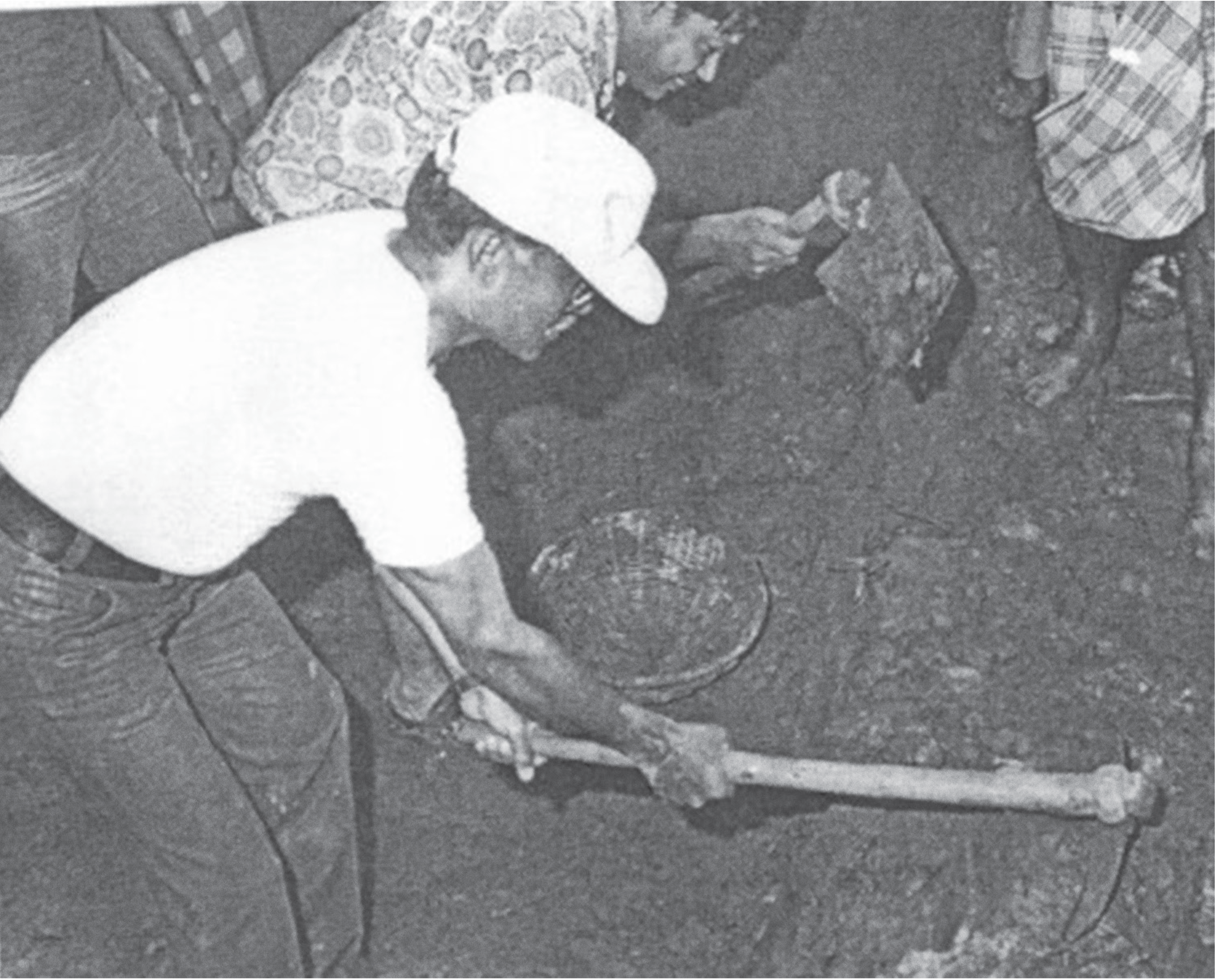
The iconisation of political leaders has been a crucial practice in the process of modern state building. Rounaq Jahan (2005) notes that most military regimes begin with a promise to return power to the political elites, but this rarely happens. Instead, the regime begins to civilianise itself to legitimise its position of power. This civilianising happens on two levels: first, by holding elections and second, by forming a political party to gain political support. Ziaur Rahman gradually civilianised his regime and legitimised his image, as both a military and a political persona (2005, pp. 227–233). Two sets of images of Zia circulate most frequently: one depicts him in military uniform, with stern, resolute expression; the other promotes the impression of a public man in jeans, golf cap, a white T-shirt and a pair of aviator sunglasses. These images are in startling contrast to images of Sheikh Mujibur Rahman, who was always traditionally attired, wearing thick, black-framed spectacles and the famous Mujib-coat. If Sheikh Mujibur Rahman’s image appealed to the older, educated middle classes, Ziaur Rahman’s image, which was constructed around modernity and energy, appealed to the country’s youth. His jeans and T-shirt marked the country’s entrance into and participation in the global marketplace, while his aviator sunglasses symbolised active military masculinity. What he was doing in this attire was even more significant: digging canals. However, there is some controversy around this image, as images found online suggest.
The aforementioned images (Figures 5 and 6) have been collected from a blogosphere Daily Alochona that appears to be politically aligned with Sheikh Mujibur Rahman’s political party, the Bangladesh Awami League. The images are being used to make the point that it was Sheikh Mujibur Rahman who initiated the canal development project in 1972, even though it is popularly believed it was Ziaur Rahman. 9 It has not been possible to authenticate the context of the 1972 image, but if the claim were true then what the images reveal is the power and success of Ziaur Rahman’s popularising project. Zia was primarily viewed as an agent of development, who built canals, successfully overriding and replacing Sheikh Mujibur Rahman’s public image. Canal-digging symbolically portrays the ability to alter a natural route, and what Ziaur Rahman’s well-known and much-reproduced image brings to the fore is the active masculinity that is engaged in public service, and which covertly hints at his role in changing the political face of Bangladesh. The masculinity of the manual labourer that this image embodies is one that the working classes and field labourers can easily relate to. The image also engages the masses in a vision of progress through development projects made possible by funds that were flowing into the new Bangladeshi state. The masculinity that Ziaur Rahman portrayed was a very different one from that of Sheikh Mujibur Rahman. It is a transition from the socialist style of imagery within which the public representations of Mujib’s masculinity were produced to a militarised-cum-democratic modern vision that Zia’s masculinity encompassed. Ziaur Rahman did not have the power of oratory that Sheikh Mujibur Rahman was famous for, but he compensated for that by manufacturing visions of his politics through texts and visuals in the form of posters, campaign imagery and messages addressed to the masses in daily newspapers.

Returning to the expurgated nature of the political timeline Ziaur Rahman constructed after he took power, it is hard not to notice the resultant long pause in the production of war genre films in Bangladeshi cinema.
10
This was being openly discussed in the film magazines in 1981. In 1981, Chitrali published an interview featuring three significant directors Shubhash Dutt, Mumtaz Ali and Alamgir Kabir to explore the absence in the production of war films post-1975. Filmmaker Khan Ataur Rahman responds,
We have come to forget the memories of the liberation war. Our freedom fighters are divided into different political camps. Each political party claims to be that of authentic freedom fighters. These so-called freedom fighters have stolen the pride of the liberation, … so much so that we have become indifferent to the plight of the real freedom fighters (Chitrali, March 27, 1981, p. 5).
His response reflects on the political silencing and how it had affected the public memory of the war, creating political indifference and a sense of betrayal. A number of significant directors of the day put their views. Shubhash Dutt adds, ‘[i]n war films you have to portray political reality which is not possible at present’. Mumtaz Ali comments, ‘The enthusiasm over the glory of Muktijuddho faded away in the 1980s. The social and political pressures are such that we will face trouble if we make war films’ (Chitrali, March 27, 1981, p. 5). Alamgir Kabir says that his inability to make another war film after Dhire Bohe Meghna (1973) was a result of his failure to grasp the difference between what happened historically and how it was narrated. ‘I can clearly say that it was because I could not understand the War of Liberation. Because I knew something to be true but in reality it was not’ (Chitrali, March 27, 1981, p. 5). These responses shed light on the government’s strict control over the Bangladesh Film Censor Board (BFCB) that made it impossible to project political aspects of the war. These comments are telling of the ways in which state mechanisms control public memory and the forgetting of history.
This was not the first time Bangladesh’s history was being edited. With the sovereignty of Bangladesh in 1971, the nation went through a complex process of decolonisation, 11 which included deleting historical documents and deciding on a grand narrative of Bangladesh’s nationalism (Mohaiemen, 2012). Lotte Hoek observes that although there is insufficient proof available to support the claim, public memory and rumour has it that the film industry too was deleting traces of its colonial past on celluloid (2014). I suggest here that this could be read as a possible clue to the absence of overt references to pre-1947 undivided colonial Bengal or post-partitioned East Pakistan in Bangladeshi cinema. This modality of decolonisation in the film industry may be viewed as an attempt to fashion a new language of filmmaking that would complement the new project of nation building. Silencing certain elements and forging new ones in the on-going process of recreating public memory has meant that Bangladesh’s historical discourse is centred on the process of censorship. Political actors from different camps have claimed different histories of 1971 to strengthen their legitimacy over state power. In 1991, a staff reporter for the film magazine Purbani criticised the Bangladesh National Party for the selective conception of their political history. Their account begins from 1957 and omits important political leaders like Fazlul Huq, Moulana Abdul Hamid Khan Bhashani, Huseyn Shaheed Suhrawardy and Sheikh Mujibur Rahman, as well as the students’ contribution. The manifesto was telling of the way history was presented during Ziaur Rahman’s government and the way he replaced Sheikh Mujibur Rahman as a major political leader in that historical account (Purbani, February 7, 1991, p. 1). Naeem Mohaiemen aptly comments that ‘political parties pose the greatest threat to historians’, as each new government wipes out a whole set of ‘established’ histories (2012, p. 41). Given the often contradictory versions of history—the production and deletion of ‘facts’ and narratives—it is important to note that new heroes were replacing older ones in the new historical discourse that Ziaur Rahman’s ideological state apparatus produced.
‘I failed to understand who was a villain during the war and who was a hero. I could not understand who a Pakistani collaborator was and who wished for real freedom’ commented Alamgir Kabir in 1981 (Chitrali, March 27, 1981, p. 5), and his observation is striking for this discussion. Experiencing times of censorship like this, where state heroes and villains become merged in a historical matrix, creates pockets in the public imagination that allow for a fluidity around notions of heroes and anti-heroes. This, I argue, paves the way for the transition of Joshim from the image of a villain to that of a hero. The absence of war films meant the absence of visual representation of the most common heroic figure that the post-Independence industry had up to then reproduced, the image of the freedom fighter. Reading the films of the post-liberation era as archives provides interesting points of historical conjecture about the type of masculinity presented on screen. The film Alor Michil (Narayan Ghosh Mita, 1974) is based on post-war disillusionment with the spirit of Muktijuddho and the social and economic rejection that the freedom fighters encountered. A scene from Dhire Bohe Meghna (Alamgir Kabir, 1973), in which two freedom fighters turn into vigilantes after 1971 due to poverty, makes apposite comments on what seems to be the state’s selective recognition of freedom fighters. The sequence shows two freedom fighters hijacking a car. Immediately after the event, one of them begins to regret his actions and they reflect on their disillusionment with the new nation. This points to the mass disillusionment with the grand narrative of Muktijuddho, coupled with the famine of 1974, economic instability, corruption and the lack of jobs in post-liberated Bangladesh. The sequence ends with an exchange of gunshots between the two characters, leading to their deaths. I read the presence of the guns of the two vigilantes as residues of the occasion when Sheikh Mujibur Rahman had called all freedom fighters to surrender their arms in January 1972. This residual reference hints at the lack of assurance and faith in the newly formed government, and hence the non-submission of arms. These are also important points of allusion that blur the line between normative ideas of good and bad, heroism and villainy. The absence of the figure of the freedom fighter in the subsequent years on the screen, and the kind of active masculinity that Ziaur Rahman was propagating, created a space for a new kind of masculinity that Joshim came to occupy. Joshim’s image as an action star, action director and his increasing presence as a working class hero, compensates for the lost heroic figure of the freedom fighter on celluloid.
The kind of role the magazines played in creating a powerful image of Joshim, as discussed earlier, as a dedicated actor and director, loving husband and a helpful mentor, combined with the extra-textual knowledge that Joshim was in fact a real freedom fighter in Muktijuddho, lent additional value to his on-screen persona as a villain or anti-hero in the first decade of his career in the 1970s. This surplus value distinguished Joshim from any other actor playing negative roles and we can see an increasing demand from viewers for the visual transference of this surplus into the role of a hero from one of an antagonist. To give a few examples, a cinephile Duronto Pothik from Dewan Bazar, Chittagong writes a letter addressed to Joshim requesting that he appear in films as a hero. Pothik writes, ‘Not in the role of a fighter or a villain, please appear in a hero’s role from now on’ (Chitrali, April 3, 1981, p. 11). After the release of Shobuj Shathi in 1982, the demand to see him further in positive roles increased. Imran Bin Yunus from A. K. M. Bari Raujan in Chittagong writes, ‘Joshim has been starring in almost all contemporary fighting and costume films. But his recent film Shobuj Shathi shows the versatility of his acting calibre. We believe he can gain new acceptance in social films also’ (Chitrali, October 26, 1983, p. 3). Joshim’s image as an active, masculine figure on-screen becomes relevant in the context in which his transition from an antagonist to a protagonist was compensating for the empty space once occupied by freedom fighters.
Glocal Cinema, National Politics and Joshim
Emphasising the visuality of the action figure, Mark Gallagher suggests that the spectacle of the posturing male ‘calls attention not only to the exhibition of male power, but also to the “to-be-looked-at-ness” of the male body’ (2006, p. 173). With his stout features and moustache, Joshim did not fit into the normative body type of American or East Asian cinema action heroes. His popularity was not that of a body-centric hero, nor did he propagate muscle fetishism. Let me give an anecdote to illustrate the circulation of different male body-types among the viewing public. I viewed the film Muhammad Ali (Motaleb Hossain, 1986b), discussed below, with two Indian friends, one a Punjabi speaker and the other a Hindi speaker. They were both struck by how closely Joshim resembled South Indian male actors, illustrating the easily recognisable typecasting of South Indian actors’ bodily features, especially of the 1980s and 1990s. In a private conversation with Madhava Prasad, Ashish Rajadhyaksha suggests, ‘the first rank of [South Indian] heroes is distinguished from the second by the fact that the former cannot afford to appear on screen without a moustache’ (Prasad, 1999, p. 51). Therefore, the South Asian-ness of Joshim’s body, that was so easily recognised by my friends, can be seen as mediating between familiar and foreign body typologies through the performance of an equally familiar indigenised martial art form. As such, Joshim’s body is commoditised on multiple levels, as I highlight in the discussion of the film Muhammed Ali, which should also be seen in relation to the earlier deliberations of this article.
In Muhammed Ali, Joshim plays the role of the title character, Mohammad Ali, prince of Modhupur and son of the generous King Badsha Sekander. Chingula, a Mongol dacoit, overthrows King Sekander. During the coup, the queen escapes with the child Muhammad Ali to a nearby village. Driven by this violent childhood memory, Ali grows up as a cowardly young man. Meanwhile Akbar, the weapon wielder in Sekander’s kingdom, is trying to form an army by recruiting young men from the village to overthrow the oppressive Chingula. Feeling defeated by the fear that is cowering the villagers, Akbar comes upon Muhammad Ali, whom he trains and transforms into a warrior. Ali returns to rescue his kingdom and reunite his family.
The film relies on a plethora of referents to address the audience. To begin with, it would be no surprise if the name of the film brought the image of the famous boxing champion Muhammad Ali to mind, a very popular celebrity in Bangladesh, especially after his visit in 1978 at the invitation of Ziaur Rahman. It will be useful to mention here that Ziaur Rahman was propagating Islam as an entry point to address Bengali nationalism. Around the same time, in the late 1970s, Muhammad Ali was travelling the globe with his vision of solidarity between Black Americans and the Muslim Third World as his way of fighting American racism. While one might think it ironic that he would respond to Ziaur Rahman’s invitation, given that Zia’s was a pro-America government, Zia’s regime had also bridged strong alliances with the Middle Eastern nations. Both men were consolidating a larger national, gender and racial identity through Islam, and also working particular tropes of masculinity into that. 12
The second set of referents is the film’s music that seems to have been freely and indiscreetly borrowed from both West and East. One example would be the use of the famous track of Swedish rock band Europe’s ‘The final countdown’ (Joey Tempest, 1986). Further, in action sequences one can hear the clattering of swords, sounds-effects of boxing punches, kicks, shouts of pain and most interestingly the sound of kaia. 13 There are sword fights, martial arts, wrestling and boxing all in one visual and aural narrative. As such the film interacts with its audience through the shared inter-textual repository that the transnational film network allows.
Similar to the film’s sound track, the sartorial design stitches together elements from numerous sources into the narrative. The men in the film wear various kinds of costume, from suit-and-boot to flashy outfits and imaginary indigenous costumes that do not seem to have any real referent. Similarly, women in the film are dressed in a wide variety of clothes that range from lehenga, ghagra–choli, salwar–kameez and saree to elaborate shiny Mughal costumes, sometimes with paranda (commonly worn by Punjabi women) braided in their hair. In the latter half of the film, Akbar wears a Roman costume, a knee-length white toga with gladiator sandals strapped up to the knee. When Ali returns as a warrior, he is seen alternately wearing black and brown gladiator leather tops, blue jeans and leather boots. Very crucially, I contend, such a mixed wardrobe covertly addresses the heterogeneous Bengali identity and its suppressed memory of pre-partition, pre-liberation days and the country’s relation to the contemporary globalising world. While Bangladeshi politics has been preoccupied with defining Bengali as a homogenous identity, whilst deleting references to its colonial past, the film’s visual tropes—especially the absurd collection of costumes—ironically question the rationality of such a homogenising project.
The landscape in the film also draws from diverse visual tropes. It changes from a studio setting of a palace to mountain ranges and elaborate hideouts in caves. The close resemblance between Modhupur and the village visualised in Sholay (a glocalised Bombay film inspired by Japanese, Italian and American action films) is astonishing. One of my friends remarked, ‘This is Ramgarh!’, the setting for Sholay’s fictional village. It is interesting that we both acknowledged the landscapes of the film through our past viewing of Sholay, though none of us has any visual knowledge of a ‘real’ Ramgarh—which was set in the Ramnagar hills district, where some of the film was shot—outside the Hindi film. The remake of Sholay in Bangladesh as Dost Dushman, which was a breakthrough film for Joshim, works as an extra visual citation for Bangladeshi audiences while watching Muhammad Ali. These examples reveal how the aural, visual and cultural tap into multiple sources of global action narratives.
On a symbolic plane, the film’s narrative negotiates between the past and the censored present of Bangladesh. Chingula, as a Mongol character, acts as an outsider to Modhupur village, and his usurpation of the king and his family works as a reminder of the bloody coup in which Mujib and most of his family members lost their lives. This reminder works in a complicated manner within a regime of strict censorship and silence instituted by Ziaur Rahman and intensified by the subsequent military dictatorship of Lieutenant General Mohammed Hussain Ershad, at the time of the film’s release.
Unlike the way in which political issues were treated in most other genres, including straight action films, in folk and costume films violence and obscenity were not censored by the BFCB. These films, because of their fantastical narratives, were thought to have less impact on the viewers, who were aware of the impossibility of what they were viewing, as discussions of the day indicate. The sarcastic tone of one director expresses the filmmakers’ discontent with the double standards of the film censorship process: ‘the censor argues that since these films have very little to do with reality, they will not have any adverse effect on the audience […] Thanks to the censor board we now will have a new definition of obscenity’ (Purbani, November 17, 1983, p. 6). Muhammad Ali belongs to a composite genre of costume, fantasy, folk and action, which allowed the film to pass through the Censor Board, even despite Ershad’s rigorous control, without much scrutiny. In an encrypted manner, the film questions the coups of Bangladesh’s political leaders, the absence of a justice system to try the murderers and the complete silencing of any democratic voice during Ershad’s dictatorship. The illegitimate and oppressive rule of Chingula metaphorically represents the state of the then Bangladesh. The return of Muhammed Ali to claim his rightful place and free the kingdom from the oppressor Chingula creates its (visual) impact for the audience through the fantasy wish fulfilment of a democratic nation. When the villagers join Mohammed Ali to fight against Chingula, an elaborate preparatory sequence shows the village men and women being trained in sword combat. The presence of this long sequence symbolically engages the audience in mass participation against an autocratic ruler. This is significant given the manner in which the role of a single hero was, from the mid-1970s onwards, taking over the role of collective participation of villagers in Bangladeshi cinema. This sequence also taps into the memory of the mass revolution of 1971 that made it possible for Bangladesh to gain its sovereignty. Beside its subtle political parallels, the film is an excellent example of the glocalised manner in which Bangladeshi cinema was operating within the transnational network of foreign film circulation and projection.
Conclusion
In this article, I have traced a complex network that connects events such as changes in Bangladesh’s politics with new forms of visual entertainment, the glocalisation of Bangladeshi cinema and the emergence of action films, with their subsequent influence on the pre-existing film genres. Using empirical material from popular film magazines, I have shown how these changes knit together the familiar and foreign entertainment with Bangladeshi politics, where I contend Joshim became an important marker of the action figure who could negotiate between local and global demands. Further, in this article, I argue that Joshim’s emergence as a hero coincided with a new political framework that allowed for a reconfiguration of the very idea and form of the hero and villain of Bangladesh’s history: this changed from the celebration of the freedom fighter and the socialist orator and benefactor as male hero, to the production of a new masculinity on screen comparable to the one Ziaur Rahman was producing in the political realm. Therefore, I suggest that a space for Joshim’s transformation from villain to hero was made possible within the political discourse, where a new form of action figure was the need of the time.
Reading Indian popular films as social history, Jyotika Virdi, echoing the work of earlier scholars, suggests ‘[t]he pleasures the commercial film offers, and the desires it creates, make it a vital part of popular culture and a critical site of cultural interpretation’ (2003, p. 2), with the power to produce an ‘imagined community, the nation’ (p. 7). Bangladeshi action cinema, punctuated as it is with foreign film and cultural referents, not only offers pleasures and creates desires but also mediates between regional and global pleasures and desires. From playing an extortionist in Rongbaj to a protector in films like Shobuj Shathi, and in later films becoming increasingly associated with an active masculinity working against social injustices, Joshim’s versatile persona makes him central to such pleasures and desires, particularly in a confined political setting.
Footnotes
Acknowledgements
I am grateful to the editors of BioScope, Dr Rosie Thomas and Dr Lotte Hoek, for their continuous support through insightful suggestions and edits. This article has also benefitted from the comments of an anonymous reviewer for BioScope. I wish to thank Dr Mallarika Sinha Roy and Dr Elora Chowdhury for their suggestions at various stages of writing of the article.